




Abstract
Native bees are important pollinators of cultivated and wild plants. Although much importance has been accorded them in many countries of the world, India has largely ignored the role of these important ecosystem service providers for too long. The consequence is public apathy toward these beneficial insects. This study has attempted to find out the general “bee awareness” of people living in agrarian societies in a socioeconomically underdeveloped Indian district through picture-based questionnaire surveys and has also attempted to determine the effectiveness of information divulgation in changing people’s perception toward native bees. Opinion of the people on honeybee health in this district has also been explored. It has been found that traditional knowledge of bees is largely restricted to the honey-producing species of the genus Apis, and even though other native species are frequently encountered by the people, there is a substantial lack of awareness about their true nature and importance. However, the study suggests that through right training, this situation may favorably be altered. Multiple regression analysis of socioeconomic factors determining bee knowledge of respondents revealed that women were > 4 times better at identifying native bees than men, both with or without given information, and the higher the level of education the better people were at identifying native bees. People considered pesticides and their irregular application to be the major killers of honeybees. This study generates hope for involvement of local people in native as well as honeybee conservation and management through proper awareness campaigns and right education.
Keywords
Introduction
There are more than 20,000 species of bees in the world, majority of which are solitary or parasocial insects (Michener, 2007) that do neither live in elaborately constructed hives nor produce honey, but which are important ecosystem service providers as pollinators of wild and cultivated crops (Luck et al., 2009). Studies conducted across diverse ecosystems around the world indicate an equal or possibly even a higher efficiency of these alternate bees over the conventional honeybees in pollinating crops (Breeze, Bailey, Balcombe, & Potts, 2011; Hogendoorn & Keller, 2012; Kremen et al., 2002; Mayes, 2011; Winfree, William, Dushoff, & Kremen, 2007) with one study estimating the value of pollination services provided by non-Apis native bees (non-honeybees) in North America alone to be approximately US$3 billion, as of the year 2000 (Vaughan, Shepherd, Kremen, & Black, 2007).
With growing reports of honeybee mass mortality from across the world (Winfree et al., 2007), at present, a shift in reliance on only a few species of bees, chiefly on honeybees of the genus Apis, to the diverse array of native bees for pollinating many of the world’s cultivated crops, is being strongly encouraged (Brittain, Williams, Kremen, & Klein, 2013; Garibaldi et al., 2013; Goulson, 2003). Simultaneous emphasis is also being given on adopting management and conservation policies that benefit the locally occurring native non-Apis bees (Food and Agriculture Organisation of the United Nations [FAO], 2012). The first step toward the formulation of such management and conservation policies is awareness among the people, who, by being associated with agriculture, or even by maintaining a small garden, are the major beneficiaries of the ecosystem services provided by the bees. As such, it is essential that knowledge of the identity and importance of non-Apis native bees be disseminated as much as possible (Hatfield, Jepsen, Mader, Black, & Shepherd, 2012) and not be restricted within the narrow confines of academic interest.
Well-structured public outreach and extension programs are addressing this modern agricultural concern successfully in many countries of the developed world (Hodges & Baxendale, 2007; Isaacs & Tuell, 2007; Moisset & Buchmann, 2012), often aided by the already existing traditional knowledge among the indigenous and local communities of a place (Athayde, Stepp, & Ballester, 2016; Cortopassi-Laurino et al., 2006; Maginnity, 2015). In fact, the Intergovernmental Science-Policy Platform on Biodiversity and Ecosystem Services (IPBES, 2016), in the summary of its assessment report on pollinators, pollination and food production, has acknowledged the importance of incorporating the expertise of existing indigenous and local knowledge systems in conserving and managing diverse pollinators, including bees.
Can traditional bee knowledge be utilized similarly for managing and conserving India’s bee fauna? While there is no dearth of information on honeybees and honey-producing bees in India, right from the very beginning of written history (Srivastava & Singh, 1997), information on other native bee species is scant and ambiguous. For instance, mention of a big, black buzzing bee is frequently found in classical Sanskrit texts such as the Bhagavad Purana, Kalidasa’s Raghuvaṁśa, Bāna’s Kādambarí and so forth, variously referred to as the bhrāmara or bhāṛ ṅga (Karttunen, 2009; Ray, 1986), which oriental melittologists identify as the large carpenter bee of the genus Xylocopa (Batra, 1977). However, in other classical texts like the Suśruta Samhitā, bhrāmara honey forms one of the eight types of honey prized as medicine in classical times (Karttunen, 2009), a direct contradiction to the solitary, non–honey-producing nature of the Xylocopa bees. This propensity of classical era Indians to associate bees with honey clearly seems to have influenced the naming, hence identification, of bees, since, other than the bhrāmara, the only other types of bees mentioned, and very often eulogized, in the ancient and medieval Sanskrit texts are the various species of honey-making bees collectively referred to as the madhukara/madhumāksika/madhupa and so on, words which begin with the Sanskrit word for honey, that is, madhu (Karttunen, 2009), a practice still in use by modern Indian languages derived from classical Sanskrit. These contemporary languages seem to have further confounded the problem of misidentification of native bees, by adopting names of non–honey-producing bees from classical texts to refer to both bees and other six-legged, winged insects, such as beetles, wasps, and so on (Karttunen, 2009; Turner, 2008). Thus, modern colloquial Bengali frequently confuses bhrāmara (Xylocopa sp.) with giant hornets (genus Vespa), calling both by the derivative bhömra (vide Bankim Chandra Chattopadhyay’s essay Basanta O Biraha in his collection of essays Lokrahasya, 1874), and in Hindi, the derivative bhauṁrā is often used to denote both black bees and beetles (Satyaprakash & Mishra, 1971).
Such restrictive and ambiguous terminology has resulted in a very rudimentary and incomplete knowledge of bees among Indians, who currently identify as bees mostly the various species of Apis, a few species of stingless bees (Kumar, 2012), and some species of bumble bees (Bombus sp.) used for pollination across a few north Indian states (Thakur & Soni, 2012), even though Bingham (1897) and Batra (1977) have contributed significantly to documenting close to one hundred different species of bees from the country. The consequence is the prevalence of well-developed management practices for conservation of only the aforementioned bee species (Kumar, 2012; Thakur & Soni, 2012), with a complete disregard for other native species found across India, a situation which may act contrary to the interests of agriculture in the country.
Basu, Bhattacharya, and Ianetta (2011) reported a steady decline in the yield of pollinator-dependent crops in India since 1993. Recent studies from the country report several agricultural and horticultural plants to host different native bee species (Abrol, Shankar, Chatterjee, & Ramamurthy, 2012). These findings coupled with the reports of successful pollination of several agriculturally important crops using native solitary bees (Cane, 2008; Klein, Steffan-Dewenter, & Tscharntke, 2003; Kremen et al., 2002) in different countries of the world makes it imperative that the indifference toward native bees is reconsidered, and research, management, and conservation efforts aimed at alternate pollinators, chiefly native solitary bees, be undertaken with alacrity in India. Adoption of conservation and management policies, however, are not enough unless the major stakeholders of said policies, namely, crop growers, farmland owners, and people in general, are educated on the issue and trained to uphold the policies and effectively implement them (Freitas et al., 2009; Mayes, 2011), the first step toward which is assessment of the extent of their knowledge concerning locally occurring bee fauna.
The present study was undertaken with similar objectives, that is, to explore the level of bee knowledge in the rural community associated with agriculture in an underdeveloped agrarian district of the state of West Bengal, India, through questionnaire surveys and interviews with local villagers. Paucity of extensive research on the state’s native bees and the near absence of information divulgation among its citizens by the scientific community is suspected to have resulted in a knowledge void when it comes to identifying and managing native bees. The level of bee knowledge of the respondents before and after divulgation of information on non-Apis pollinators was assessed to evaluate if public awareness programs can be effective in changing people’s perception of bees. The results have been interpreted to indicate feasibility and possibility of instituting management and conservation strategies for alternate bee pollinators through people’s participation in this rural agrarian district.
Methods
Study Area
The study was conducted in three villages in the western part of West Midnapore (Paschim Medinipur) district that is situated between 21°47′ N and 23° N latitudes and 86°40′ E and 87°52′ E longitudes, in the state of West Bengal, in eastern India. The district has 88.1% of its population living in the villages, a rural literacy rate of about 69%, and approximately 65% of its population associated with agriculture, as cultivators or agricultural laborer (Development and Planning Department, Government of West Bengal [DPDGWB], 2011). The western part of this district, located in the fringe plains of the Chotonagpur plateau, is characterized by rugged lateritic badlands developed by active rill and gullying by running water (Aown & Kar, 2016). Agriculture is the mainstay in this region, although it is plagued by frequent droughts. Lack of suitable infrastructure hinders development of large scale industries here. As such, among the 637 villages identified as “backward,” that is, underdeveloped, in the district by the Government of West Bengal, the highest concentration occurs here (DPDGWB, 2011).
As part of a separate study, bee faunal diversity of one forested habitat (near Depara village in Chandra gram panchayat [gram panchayat = basic, first formal democratic elected institution at the village level in India] in Medinipur block; location: 22°28′01.2″ N 87°09′28.0″ E) and one semiforested habitat (near Gurguripal village in Kanakabati [Tantigeria] gram panchayat in Medinipur block; location 22°25′58.9″ N 87°13′00.5″ E) located in this region was documented from 2013 to 2015. Sixteen bee species were identified from the two sites during the study (Bhattacharyya, 2016). For the present study, these two villages, that is, Depara and Gurguripal and another, Chuashol in Dherua gram panchayat in Medinipur block (location 22°29′41.2″ N 87°05′43.8″ E), were selected (Figure 1). The three villages were located within a 10-km radius of the first study site in the forested habitat at Depara.
Map of study area showing survey sites. Above, West Midnapore district with survey sites marked in Medinipur block (shaded). Below, Medinipur block showing names of survey sites. Inset, map of India showing the state of West Bengal (shaded).
Questionnaire Survey
A picture-based questionnaire survey was conducted to assess the villagers’ knowledge of locally available bee fauna in the months of June and July 2016. A total of 58 randomly identified and willing respondents were interviewed. Verbal consent was secured from all respondents before conducting the interviews and taking necessary photographs.
The survey was conducted by three enumerators trained beforehand, all postgraduate degree holders in life sciences and well versed in the local vernacular to facilitate conversation with the respondents. The questionnaire survey had two parts. The first part consists of (a) questions aimed at finding out background information on socioeconomic status of the respondent (namely, gender, age, and level of education of the respondents as enumerated in completed school years) to explore the effect of these variables on the bee knowledge of respondents (Kasina, 2007) and (b) questions that attempted to find out the perception of respondents with respect to the commonly occurring honeybees, their health, and possible causes of population decline. Considering the age profiles of the respondents, 20 respondents of age 35 years and above were identified as the “Principle Informants” and were asked to rank the commonly identified problems of honeybee decline. Rank Based Quotient of each problem was calculated following the formula of Sabarathnam (1988) as cited by Roy and Hassan (2013).

The second part of the survey involved showing the respondents a picture guide containing pictures of the locally sampled bees and a few other bee species known to be found in south Bengal (following Bingham, 1897) interspersed with pictures of other locally occurring insects (Kasina, 2007). The respondents were asked to identify from among the pictures the insects they considered as bees, that is, moumacchi/mӧu/mӧupӧkā/bhrӧmar/bhӧmra (all possible colloquial Bengali names for bees were used during interview) and which they had encountered in their surroundings. The responses were recorded as the respondents’ individual “pretest score” (McKenney & Terry, 1995), indicative of their knowledge of locally available bee fauna. Unsurprisingly, mostly honeybees were identified by the respondents, initially.
Next, the enumerators discussed with the respondents, individually, about the presence of other species of bees which (a) share several features with conventional honeybees, namely, (i) general body plan—bee-like body, four wings, constricted abdomen, hairs on body, two large eyes, two antennae and so on, and, (ii) behavior—bee-like flight, pollen gathering on legs, abdomen or face, nectar sucking using bee-like tongue, similar foraging times, pollinating flowers, and so on, and which (b) differ from conventional honeybees in (i) nesting habits—living solitarily in soil burrows or tree/wood cavities instead of in elaborate hives, and, (ii) not building combs, or making honey and wax. This constituted an “on-field seminar” of limited scope. The respondents were then asked if they knew such insects and were again shown the picture guide and asked to point out all the insects they would now consider bees in the light of the newly received information. Their responses were recorded as their “posttest score” (McKenney & Terry, 1995).
All responses were recorded with the respondents’ verbal consent using a handy-cam wherever possible and simultaneously noted down.
Statistical Analyses
The information obtained from the survey was analyzed using SPSS version 16, 2007, software. Respondents’ individual pretest and posttest scores were converted into percentages indicating correct bee identification from among all bee pictures shown. Age, level of education, and response means between groups of male and female respondents were compared using Independent Sample’s t test (Nishishiba, Jones, & Kraner, 2013; Ruxton, 2006). Results were reported for equal variances assumed as well as not assumed; the test statistic comparing two means when equal variances are not assumed is also called the Welch’s t test and is used for samples of unequal sizes and unequal variances (Kohr & Games, 1974). Changes in the response scores of total, male and female respondents, individually, before and after information divulgation were compared using Paired Sample’s t test (Nishishiba et al., 2013).
To determine the influence of socioeconomic predictor variables, namely, respondents’ gender, age, and level of education in completed school years, on the informed bee knowledge (posttest scores) of respondents, multiple regression analysis was performed, following Kasina, Kraemer, Martius, and Wittmann (2009), but with modifications to suit data requirement. Multiple regression analysis is a predictive statistics used to explain the relationship between a continuous dependent variable and multiple independent variables, which may be categorical or continuous, and has been widely used in determining the effects of socioeconomic and demographic variables on test performances (Guerrero-Berroa et al., 2014; Tomul & Polat, 2013). Absence of outliers was ascertained, and assumptions of collinearity of data and independence of errors were verified and validated using Variable Inflation Factor and Durbin–Watson tests, respectively. All results were considered significant at 0.05 level of alpha in the analyses.
In this article, all bees other than honeybees of the genus Apis are referred to by the generic term native bees or non-Apis native bees.
Results
Demographics of Sample
A total of 31 women and 27 men were interviewed representing respondents of every possible age-group (see Appendix I). The average age of the respondents (n = 58) and its standard deviation (SD) was 33.79 ± 18.30 years. The average age of female respondents (24.52 ± 14.53 SD years; n = 31) was significantly lower than the average age of male respondents (44.44 ± 16.43 SD years; n = 27; Levene’s F = 0.372, p = .544; Independent Sample’s t = 4.901, df = 56, p < .001; Welch’s t = 4.86, df = 52.425, p < .001). On average, female respondents interviewed had a higher average level of education, as enumerated in number of completed school years (6.65 ± 4.88 SD; n = 31) than male respondents (average 2.30 ± 3.84 SD; n = 27) and this difference was also found to be statistically significant (Levene’s F = 3.819, p = .056; Independent Sample’s t = 3.73, df = 56, p < .001; Welch’s t = 3.792, df = 55.46, p < .001). The average education level of male and female respondents combined (n = 58) and its SD was 4.62 ± 4.90 completed school years (Figure 2).
Age (in years) and education (in completed school years) profiles of respondents.
People’s Perception of the Importance of and the Threats to Wild Honeybees
Responses to the Questions (a) “Are Honeybees Essential?” and (b) “What Benefits Do You Get From Honeybees?”.

Problems Identified as Threatening Honeybee Health and Survival in the Study Area and Their Ranks Following RBQ Analysis.
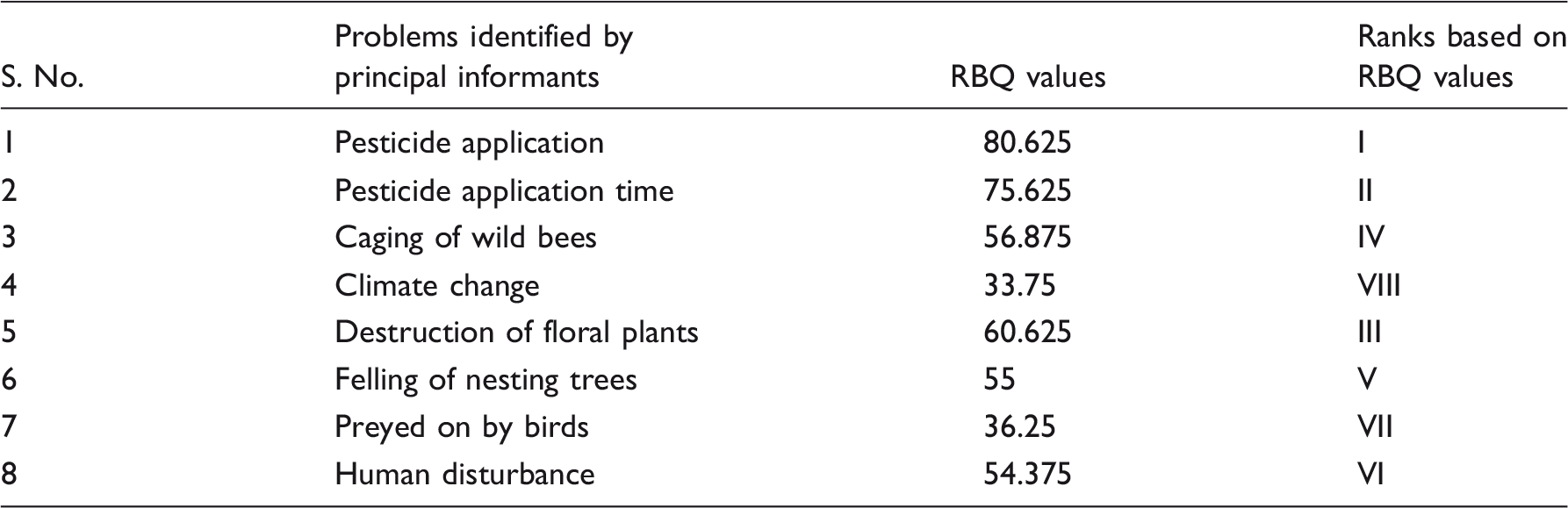
RBQ = Rank Based Quotient.

Proportion of principal informants assigning perceived ranks to each identified problem threatening locally occurring honeybees.
Estimation of Bee Knowledge of Respondents
On average, the pretest score of the respondents was found to be very low (9.96% ± 6.88 SD; n = 58), being primarily limited to honeybees. This pretest score of women (mean 12.72% ± 7.05 SD; n = 31) was found to be significantly higher than that of men (mean 6.79% ± 5.18 SD; n = 27) (Levene’s F = 3.102, p = .084; Independent Sample’s t = 3.603, df = 56, p = .001; Welch’s t = 3.679, df = 54.54, p = .001).
The average posttest score of the respondents (17.15% ± 10.77 SD; n = 58), indicative of their informed bee knowledge, was found to be significantly higher than the average pretest score of respondents (mean difference = 7.18 ± 7.92 SD, SE of mean = 1.04, Paired Sample’s t = 6.903, df = 57, p < .001). Gender-wise also, the posttest scores of respondents varied significantly from their individual pretest scores. The average posttest scores of female respondents was found to be 22.22% ( ± 9.40 SD; n = 31), which was statistically significantly higher than their pretest scores (mean difference = 9.49 ± 7.88 SD, SE of mean = 1.41, Paired Sample’s t = 6.709, df = 30, p < .001). The average posttest scores of male respondents was found to be 11.318% ± 9.30 SD (n = 27), which was statistically significantly higher than their pretest scores (Mean difference = 4.526 ± 7.23 SD, SE of mean = 1.39, Paired Sample’s t = 3.252, df = 26, p = .003). The posttest scores of female respondents was also found to be significantly higher than the posttest scores of male respondents (Levene’s F = 0.184, p = .67; Independent Sample’s t = 4.426, df = 56, p < .001; Welch’s t = 4.429, df = 55.06, p < .001; Figure 4).
Average response scores of respondents increased significantly after information was given about existence and nature of native bees.
Before discussion with respondents and information divulgation about alternate bee pollinators, honeybees were known to 81.03% of total respondents (70.37% of men and 90.32% of women interviewed knew at least one species of honeybee from among Apis dorsata, Apis cerana, and Apis florea); 13.79% of total respondents (7.41% men and 19.35% women) knew stingless bees. Only 20.69% of total respondents (29.03% women and 11.11% men) were familiar with at least a single species of native bee (not honey-producing species). More than one species of non-Apis native bees were known to only 3.45% of total respondents (3.70% of men and 3.23% of women). Apis dorsata was the most commonly identified honeybee (75.86% of respondents identified it) while Xylocopa auripennis was the most commonly identified native solitary bee (17.24% of respondents identified it).
Responses, following discussion with the respondents informing them about native bees, indicated that the proportion of respondents who knew honeybees and could identify them from the pictures had remained unchanged at 81.03% of total respondents interviewed, and gender-wise too this proportion did not change. However, after information on alternate bees was given, 17.24% of total respondents (11.11% men and 22.58% women interviewed) could identify stingless bees from among the picture of insects. And 72.41% of total respondents now confidently identified at least a single species of native bee (not honey-producing bees), and this value was higher considerably among women (90.32%) than among men (51.85%). More than a single species of native bees was identified from pictures shown by 39.66% of total respondents (22.22% men and 54.84% of women) who claimed to have seen them on flowers but did not consider them as bees traditionally. Apis dorsata remained the most commonly identified honeybee (75.86% of respondents identified it) while Xylocopa auripennis was again the most commonly identified native bee (37.93% of respondents identified it). Proportion of respondents (total, male and female) identifying different bee species from the picture guide before and after information divulgation is graphically represented in Figures 5 to 7 (see also Figure 8).
Proportion of total respondents identifying different bee species before and after information divulgation. Proportion of male respondents identifying different bee species before and after information divulgation. Proportion of female respondents identifying different bee species before and after information divulgation. Some bee species identified by respondents interviewed. From top (a) Apis dorsata, (b) Xylocopa aestuans, (c) Trigona iridipennis, (d) Nomia sp.2, (e) Ceratina hieroglyphica, (f) Pseudapis oxybeloides, (g) Ceratina binghami, (h) Apis florea, (i) Megachile hera, (j) Nomia sp.1, (k) Braunsapis mixta, (l) Xylocopa auripennis, (m) to (o) interviews with respondents, (p) Marigold cultivation near Chuashol village, (q) A. florea hive, and (r) A. dorsata hive. Image credit: M. Bhattacharyya.


Effect of Age, Gender, and Level of Education on Informed Bee Knowledge of Respondents
Multiple Regression Values of Gender, Age, and Education Level on Bee-Knowledge Score of Respondents.

Discussion
Questionnaire survey of villagers, all coming from farming families, even if themselves not farmers by profession, encompassing all possible age groups, and basic school education levels, indicated that knowledge of local non-Apis native bee fauna tends to be very limited in the study areas, that is, people tend to “not know” (identify as bees) native bees even if they see them regularly in their surroundings. The age-old tradition of associating bees with honey seems to have strongly influenced their bee knowledge. According to Abrol (2011), this lack of information about alternate bees seems to be the general trend across the country. However, the in-situ workshop/on-field seminar managed to significantly change this trend in people’s perception of insects to be considered as bees. The same respondents, therefore, after receiving information on the existence and nature of alternate bee pollinators from the surveyors, correctly identified more insects as bees from the same picture guide than before. Single-session seminars and workshops have been shown to be successful in altering people’s perception about specific issues (McKenney & Terry, 1995; Singletary et al., 2015). This finding suggests the possibility of conducting more rigorous and elaborate workshops/field seminars and so on, to educate people, especially the agriculturists, on the diversity of alternate pollinators, with emphasis on non-Apis bees.
Results indicated that women tend to have a better acumen at identifying native bees compared with men, when provided with the same information. Also, the higher the level of education of the respondent, the better they were to learn from the information and apply it in identifying bees. Similar findings were reported by Kasina (2007) from surveys conducted in agro-pastoral lands in Kakamega, Kenya. These findings could be interpreted to suggest a greater potential of women to partake in biodiversity conservation activities and the findings could be instrumental while formulating bee/pollinator conservation and management policies involving local people. Women could perhaps be made principle stakeholders in such conservation and management initiatives and education of women be encouraged. It has been shown that women tend to be better custodians of biodiversity, perhaps from their instinctive nurturing nature, and as such management and conservation policies often encourage greater women involvement as stakeholders (Rietbergen-McCracken & Narayan, 1998). This could serve the dual purposes of conservation of local bee fauna and women empowerment by consolidating their position as stewards of nature, paving the way toward gender equality.
Majority of the respondents interviewed affirmed the positive beneficial role of honeybees in the ecosystem. This finding suggests a possibility of educating the villagers/agriculturists on the usefulness, importance, and necessity of conserving non-Apis native bee species as important ecosystem service providers too, once they learn to identify these species as insects similar to their prized honeybees and associate them with crop pollination. With time, it is reasonable to expect sufficient concern about the health and survival of these native pollinator species, among the villagers, quite similar to what they expressed for the locally occurring honeybees, which could, in turn, translate into effective management and conservation policies for these pollinators with active public involvement and people’s participation.
Of the eight major problems, the respondents believed to be plaguing the local honeybees, pesticides and their wanton application was considered by majority of the respondents as the principle cause behind the perceived decline in honeybee populations. This finding resonates with findings from across the world suggesting strong relation between honeybee mortality and population decline with pesticide/insecticide application (Decourtye, Devillers, Cluzeau, Charreton, & Pham-Delègue, 2004; Kluser, Neumann, Chauzat, & Pettis, 2010; Yang, Chuang, Chen, & Chang, 2008). Surprisingly, some respondents had quite scientific view as to the timing of insecticide application, complaining honeybees were dying because insecticides were being sprayed when the honeybees foraged actively, instead of in early morning or late evening, as is recommended. This was their insight developed through direct observation in nature and was not formed under the influence of any information gained from any source, because survey revealed that no government agriculture extension officer ever visited the village (contrary to what Kasina, 2007, reported for Kakamega farmlands). This further ascertains the possibility of successfully implementing well-structured public awareness campaigns to educate people on and engage them in conservation and management of crop pollinators in general, and bees in particular.
As in the rest of the country (Gupta, Sachdeva, & Kushwaha, 2015; Monga & Manocha, 2011), so too in this study area, involvement of the local government in promoting beekeeping among the villagers is, unfortunately, absent. As such, beekeeping was not found to be an occupation with which the villagers actively engaged. This scenario needs addressing, at the government level, so that people find encouragement and support to get involved with this industry in a sustainable way, which would economically benefit them and ensure both reared and wild pollinator conservation thereby reducing the possibility of crop failures in future.
India is the second largest producer of vegetables in the world, after China (Vanitha, Chaurasia, Singh, & Naik, 2013), and many of the vegetables grown in this country are insect pollinated. The 2011 study by Basu et al. indicated a possible decrease in the yield of vegetables in this country, which, apart from affecting the economy, is also suspected to negatively impact the nutritional requirements of its citizens. FAO (2012) reported that despite such findings, no such study was conducted to evaluate the scale of the decline in natural pollinators, adding that although “ideally it would be best to compare the overall pollinator abundance over the years, that data is not yet available.” This absence of information may well make conservation and management efforts for pollinators in general, and bees in particular, difficult (Freitas et al., 2009). As biodiversity documentation is an uphill task, enlisting the help of the local people has become a practice in large scale documentation studies (Theobald et al., 2015; Tulloch, Possingham, Joseph, Szabo, & Martin 2013), which requires divulgation, that is, dissemination of information on the issue among the locals. With growing evidence suggesting that India focus on its alternate pollinators to ensure adequate pollination of its crops (FAO, 2012), making villagers, farmers, and people in general aware of the existence and significance of the local non-Apis bee fauna appears even more important.
Implications for Conservation
The present study has established that people residing in villages and directly or indirectly associated with agriculture are unaware of the existence of alternate bee pollinators even though they see them every day. As such, they do not accord these bees any importance. This study has also established that very little effort is needed to educate people on the identity and nature of these alternate bee pollinators occurring in their vicinity, following which they readily learn to associate these alternate non-Apis native species with the more common and popular honey-producing Apis bees and subsequently identify the former as bees, as opposed to considering them insignificant insects, as tradition dictates. As people have ample concern about the health of honeybee populations, through awareness and training programs, once the perception of the people toward the nature of native bees is changed, it is reasonable to assume that the survival and health of native bee fauna will elicit similar concern among people, which might in turn help in formulation and implementation of effective management and conservation policies for these beneficial ecosystem service providers. Women and the better educated among the people are particularly adept at learning to quickly identify native bees, and may therefore be made principal stakeholders in bee monitoring, conservation and management policies.
Public awareness is essential for implementing pollinator conservation and management campaigns (FAO, 2012; Freitas et al., 2009). Very recently, largely due to the initiative of citizen volunteers in the United States, seven species of the native bee genus Hylaeus in Hawaii have been accorded protection under the U.S. Endangered Species Act (Wang, 2016), generating hope for bee conservation through positive human involvement. Ecosystems, which have at least some angiosperms, cannot do without pollinators, chief among which are the bees, and at present, at a global as well as local scales, bees cannot do without human support. This mutualistic relationship needs nurturing and the findings from the present study stress the necessity and prospects of the same, especially in rural, agrarian India.
Footnotes
Acknowledgments
The authors wish to thank all the participants of this study for their valuable cooperation. They also thank the authorities at Medinipur Sadar Block Development Office and Mr. Subal Mahato, elected member of Dherua Gram Panchayat, for providing necessary permission for conducting the survey work and the authorities of Vidyasagar University, West Bengal, India, for providing necessary infrastructural facilities and miscellaneous support in preparation of this article. The authors also acknowledge with thanks the technical assistance provided during survey work by Mr. S. Midya, Department of Zoology, RNLK Mahila Mahavidyalay, Midnapore, West Bengal; Mr. S. Ghara, Department of Zoology, Vidyasagar University, Midnapore, West Bengal; and Mr. M. K. Bhattacharyya, RuTAG-EI, IIT, Kharagpur, West Bengal.
Declaration of Conflicting Interests
The author(s) declared no potential conflicts of interest with respect to the research, authorship, and/or publication of this article.
Funding
The author(s) disclosed receipt of the following financial support for the research, authorship, and/or publication of this article: Research fellowship provided by the University Grants Commission, Government of India to the first author of this study during the course of this study is also sincerely acknowledged.