






Abstract
Tunisia is a very important World Natural Heritage Site, and no scientific exploitation of its resources regarding insect fauna has taken place. In this study, we present the first work on Carabidae collected fromexpeditions to the Ichkeul and El Feidja national parks between 2012 and 2013. A total of 52 species classified into 33 genera, 14 tribes, and 6 subfamilies were found. Five of the captured species are endemic to North Africa; and two species, Acinopus haroldi Schaum, 1863 and Cryptophonus litigiosus litigiosus (Dejean, 1829) were recorded for the first time in Tunisia.
Introduction
The family Carabidae, or ground beetles, currently inclu des about 40,000 (Thiele 1977) to 50,000 species (Desender 1987) but Gaston 1991 consider it could be about 60,000 spe cies. This family is characterized by a very wide adaptive success on the multiple ecological conditions encountered worldwide. They are able to colonize almost all terrestrial ha bitats and represent an important part of the ground-dwelling invertebrate predators. Furthermore, Carabidae are a relevant indicator group which was used for biodiversity research, ecological surveillance, and research in the domain of envi ronmental change (Latty 2006). Besides that, ecologists em ploy endangered and endemic species to prioritize the crea tion of protected areas (Brooks et al. 2006). Studies on the distribution and survival of many Carabidae species along different habitats serve to consolidate our level of knowledge of the effects of environmental and climate change (Vaibhao et al. 2013; Kerr et al. 2007). Species checklists are effective tools in the domain of natural science. They are directly rela ted to any program of species conservation. Carabidae fauna from Tunisia is rather unknown in comparison to other zoo geographical areas such as Europe. Only a few studies cover the topic of ground beetles in Tunisia so far Bedel (1895), Peyerimhoff (1909) and Normand (1933), or recently leading to the discovery of new species (Guéorguiev 2012; Quéinnec and Ollivier 2012; Ghannem et al. 2014). In general, no Tu nisian or African law, referring to insects' protection exists, and, Tunisia does not have a red list of threatened species adapted to its territory. Only the International Red List of Threatened Species (IUCN) exists as a baseline data. It is, therefore, essential to determine a list of species requiring urgent protection measures. In addition, natural heritage si tes play an important role in the conservation ecological sys tems and biodiversity. This survey aims to update the Cara bidae checklist in order to improve the knowledge on ground beetles in Tunisia, particularly in case of two national parks Ichkeul and El Feidja, and in order to establish a first list of heritage species (endemic and new species to the country).
Material and methods
Site 1. Ichkeul National Park (37'08'51.31″N 9°40′ 03.18 E, altitude: 46 masl).
Situated 25 km to the southeast of Bizerte and 15 km from the cities of Menzel Bourguiba and Mateur, it surrounds a wetland, with lake Ichkeul in the middle, occupying a surface of 150 kmβ being one of the most important bird sanctuaries of North Africa. Vegetation of the park is characterized mainly by Olea europaea L.
Ichkeul has been registered since 1977 as a Biosphere Reserve under the UNESCO MAB program, in 1979 as a World Heritage Site Natural and Cultural and in 1980 as a Wetland of International Importance under the RAMSAR Convention. It is important to mention that Ichkeul station was the first national park in the world that has benefit from this international status. In Tunisia, the value of Ichkeul National Park is linked to its diversity of habitats and taxonomic groups (Hollis et al. 1986).
Site 2. El Feidja (36°46'09.17″N 8°39′00.14"E; altitude: 571 masl).
This national park is located 100 km to the south of Mediterranean Sea, near the frontier with Algeria. The park is the natural environment of the Kroumirie, which is the wettest region of Tunisia. The soil is rich in humus and slightly acid and the most important component of vegetation are Quercus faginea Lam., 1785, Ilex aquifolium L., Celtis australis L., Salix pedicellata Desf., 1799, Ficus carica L., and Populus alba L. (Rossler 1996).
In general, we followed the classification suggested by Bouchard et al. (2011).
Results and discussion
There were found 52 species from 33 genera and 6 subfamilies found in Northern Tunisia parks represented in 274 individuals. All registered species belong to the following subfamilies: Nebriinae (one tribe, two genera, and two species), Omophroninae (one tribe, one genus, and one species), Apotominae (one tribe, one genus, and two species), Trechinae (two tribes, nine genera, and nine species), Brachininae (one tribe, one genus, and six species), and Harpalinae (eight tribes, 21 genera, and 32 species). The registered taxa are listed below.
Nebria (str.) andalusia Rambur, 1837
Nebria (str.) rubicunda Quensel, 1806
Phrator variegatum seurati Alluaud, 1935
Apotomus rufithorax Pecchioli, 1838
Apotomus clypeonitens canadensis Jedlicka, 1961
Asaphidion stierlini (Heyden, 1880)
Nepha genei (Küster, 1847)
Ocyturanes dudichi (Csiki, 1928)
Nejacirtense Netolitzky, 1914
Tachys scutellaris Stephens, 1828
Polyderis algiricus (Lucas, 1848)
Sphaerotachys haemorrhoidalis Ponza, 1805
Species heavily hygrophile (Thérond 1975; Zaballos 1984).
Trechus rufulus Dejean, 1831
Trechus obtusus Erichson, 1837
Brachinus (str.) efflans Dejean & Boisduval, 1829
Brachinus (str.) crepitans Linné, 1758
Brachinus (Brachynolomus) immaculicornis Dejean, 1825
Brachinus (Brachynidius) sclopeta (Fabricius, 1792)
Brachinus (Brachynoaptinus) mauretanicus Bedel, 1914
Brachinus (Cnecostolus) exhalans Rossi, 1792
Chlaenites spoliatus spoliatus (Rossi, 1792)
Chlaenius velutinus auricollis Géné, 1839
Trichochlaenius chrysocephalus (Rossi, 1790)
Trichochlaenius aeratus varvasi Laporte, 1834
Chlaeniellus olivieri (Crotch, 1870)
Carterus (str.) rotundicollis Rambur 1837
Carterus(str.) interceptus Dejean, 1830
Amblystomus mauritanicus Dejean, 1829
Ophonus (str.) opacus Dejean, 1829
Harpalus (str.) distinguendus (Duftschmid, 1812)
Harpalus (str.) neglectus Serville, 1821
Harpalus (str.) serripes (Quensel, 1806)
According to Lindroth (1975), this appropriate species of xerophilic zones with wide-spread herbaceous vegetation, as well as other authors associate it with sandy soils and limestone (Jeannel 1942; Jeanne 1971c; Lindroth 1975; Therond 1975).
Acinopus haroldi Schaum, 1863
Acinopus grassator Coquerel, 1858
Parophonus hispanus Rambur, 1838
Parophonus hespericus Jeanne, 1985
Cryptophonus litigiosus litigiosus (Dejean, 1829)
Bradycellus lusitanicus Dejean, 1829
Stenolophus teutonus (Schrank, 1781)
Apristuss triatipennis Lucas, 1846
Microlestes corticalis (Dufour, 1820)
Microlestes mauritanicus Lucas, 1846
Olisthopus fuscatus Dejean, 1828
Poecilus (Parapedius) decipiens Waltl, 1835
Poecilus (Coelipus) crenulatus Dejean, 1828
Poecilus (Carenostylus) purpurascens (Dejean, 1828)
Poecilus (str.) tyrrhenicus Csiki, 1930
Calathus (Bedelinus) circumseptus Germar, 1824
Calathus (Neocalathus) mollis Marsham, 1802
Platyderus ruficollis Marshamm, 1802
Amara (str.) familiaris Duftschmid, 1812
Zuphium (str.) olens Rossi, 1790
The results of this study indicate that there is a highly diverse fauna of Carabidae in both parks. In this survey, a total of 52 species belonging to 6 subfamilies were collected from two different localities. Of the six subfamilies studied here, Harpalinae was the most abundant with 32 species (61.5 % of total). According to Lorenz (2005) the subfamily Harpalinae is the largest group of ground beetles with 19,000 species. Eight of the species (15.3 % in total) were common to both parks.
Within the other subfamilies, two species, Acinopus haroldi Schaum, 1863 and Cryptophonus litigiosus litigiosus (Dejean, 1829) from Ichkeul national park are new records for the fauna of Tunisia. Endemic species represent a par ticular class of rare species (Gaston 1994). Five species are endemic to the North Africa: Neja cirtense Netolitzky, 1914, Apristus striatipennis Lucas, 1846, Trichochlaenius aeratus varvasi Laporte, 1834 (El Feidja national park), Acinopus ha roldi Schaum, 1863 (Ichkeul National Park) and Brachinus (Brachynoaptinus) mauretanicus Bedel, 1914 (both parks). Hence, one subspecies, Phrator variegatum seurati Alluaud, 1935 (El Feidja National Park) is endemic to Tunisia. The global species richness of ground beetles varied between sampling sites (Fig. 1); the highest value was recorded in El Feidja national park (37 species); in Ichkeul national park were recorded 24 species. Also, the higher abundance of spe cimens was observed in El Feidja with 146 individuals; where the most representative species were: Apotomus clypeonitens canadensis Jedlicka, 1961, Chlaenites spoliatus spoliatus (Rossi, 1792) and Poecilus (str.) tyrrhenicus Csiki, 1930. In Ichkeul the abundance obtained was 126 individuals, where the most abundant species were: Poecilus (str.)tyrrhenicus Csiki, 1930, Trichochlaenius chrysocephalus (Rossi, 1790), Chlaenites spoliatus spoliatus (Rossi, 1792), Brachinus (Brachynolomus) immaculicornis Dejean, 1825 and Poecilus (Carenostylus) purpurascens (Dejean, 1828). In other study sites, Ghannem et al. (2014) recorded five species of Carabi dae, from Bou Hedma National Park southern Tunisia. Dajoz (1982) recorded eight Carabidae species, from southern Tu nisia. In addition, in Algeria, in Mont Babor National Park, Benkhlil and Doumandji (1992) have been captured 28 spe cies of Carabidae. Remini (2007) sampled in Ben Aknoun National Park, five species of Carabidae. Within Fezzan (desertic area of 15,000 kmβ located in Libya), 19 Carabidae were recorded by Peyerimhoff (1948). In comparison with the previous sites, the high species richness refers to the sites seems to be related to altitude, vegetation, soil, availability of trophic resources, structural complexity of the environment and the degree of disturbance. Different abiotic factors can influence the activity of carabid beetles and associated taxa in different climates (Moraes et al. 2013). The difference can attribute to the affinity and adaptation by local species to their habitats (Erwin et al. 2005). According to Loreau (1978) deciduous litter can provide favorable microclimatic condi tions, and creates a complex spatial structure through gene rating stratification that may allow the coexistence of some ground beetle species.
In this study, we noticed that there is no great difference in species richness sorted by abundance specific level, which proliferates despite the study sites are geographically distant from each other. This will demonstrate the importance of the conservation of these sites (national parks since 1980 and 1956) which are relevant for the entire ecosystem and in particular the species of Carabidae.
This study constitutes a guide for future taxonomical and ecological research of Tunisian species. With more long-term and periodic work the checklist of Carabidae from Tunisia can be updated with new findings of different species.
The presence of such ground beetles' biodiversity at the El Feidja and the Ichkeul National Parks can only approve their heritage significance. Managers of this biodiversity hot spot are required to entrust more interest and conservation efforts, reducing the unsustainable practices (overgrazing, fire…) that exist in these "protected" area. Sustainable management of these heritages requires taking into account all functions and uses that the both parks have to offer (ecological, economic, tourism…) and their integration to management reflections undertaken by the different concerned parties.
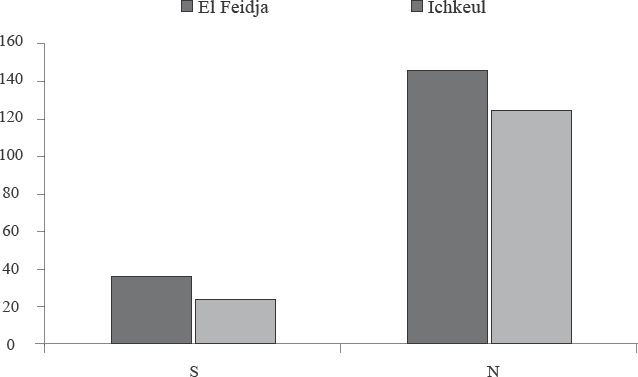
Abundance (N) and species richness (S) variation in sampling sites.
Footnotes
Acknowledgements
We thank to Mr. Olegario Del Junco (Jerez de la Frontera, Spain) and Dr. Ildefonso Ruiz-Tapiador Aparicio (Universidad Politécnica de Madrid), who helped us for the identification of specimens.