






Abstract
Abstract
A survey of Monomachus (Hymenoptera, Monomachidae) was carried out with five Malaise traps/area in five areas of Atlantic Rainforest in São Paulo State, Brazil. The sampling effort in all localities amounted to 9,900 traps-day. Data were obtained from a total of 304 exemplars of Monomachus: 66 females and 238 males. The highest occurrence of Monomachus was observed between June and September with a frequency peak in July, and they were most frequent in Parque Estadual Morro do Diabo (PEMD) (350 m above sea level), where the sampling effort to catch each exemplar was 65.1 traps-day. From the sample of females of Monomachus captured in the Parque Estadual Intervales, Parque Estadual da Serra do Mar/Núcleo Santa Virgínia (PESM/NSV), PEMD and Estação Ecológica Juréia Itatins, between December 2009 and December 2010, two species were recognized: M. fuscator (N = 58 / 87.9%) and M. cubiceps (8 / 12.1%). In additional samplings in 2011 at PESM/NSV two exemplars of M. klugii recorded only from Rio de Janeiro State, Brazil were obtained, showing that its distribution has extended to São Paulo State.
Introduction
Monomachidae (Hymenoptera: Diaprioidea) is a small family of parasitoid wasps with two recognized genera: Monomachus Klug, 1841, which have an Austral disjunct distribution with species recorded from Australia, New Guinea and New World, and Chasca Johnson and Musetti, 2012, known only from South America (Musetti and Johnson 2004; Johnson and Musetti 2012); they are sexually dimorphic, with females possessing a long sickle-shaped metasoma, and very short ovipositor hidden inside the segment VIII; whereas males have a pedunculate metasoma (Masner 2006).
There are 23 species of Monomachus known from New World and five from Australia/New Guinea (Johnson and Musetti 2012). Seventeen species are recorded for Brazil, six of them in the State of São Paulo (Musetti and Johnson 2004; Johnson and Musetti 2012). Most species of Monomachus appear to be rare, with limited geographic distributions; the greatest diversity of species is found in the Atlantic rainforest of southeastern Brazil (Musetti and Johnson 2004).
Little is known about the hosts of Monomachidae: the Australian species M. antipodalis Westwood, 1874 acts as egg-larval or egg-pupal parasitoid of Boreoides spp. (Diptera: Stratiomyidae, Chiromyzinae) (Riek 1970; Naumann 1985, 1991); Lima et al. (2001) reared Monomachus sp. from puparia of Chiromyza vittata Wiedemann, 1820 (Diptera: Stratiomyidae, Chiromyzinae) a pest of coffee root in Brazil. The present study derives from the activities developed during the course "Systematic and bionomics of parasitoid Hymenoptera" presented by N. W. Perioto, R. I. R. Lara and D. R. R. Fernandes in the winter of 2013 to students of the Post Graduate program in Agronomy (Agricultural Entomology), Universidade Estadual Paulista "Julio de Mesquita Filho", Jaboticabal campus, São Paulo State.
Material and methods
Monomachidae from five localities of Atlantic rainforests in São Paulo State (Fig. 1) were sampled, i.e., Estação Ecológica Juréia-Itatins (EEJI) (24°31′14.6"S, 47°12′5.7"W), Iguape County; Parque Estadual Intervales (PEI) (24°16′28.0'S, 48°25'14.8"W), Ribeirão Grande County; Parque Estadual Morro do Diabo (PEMD) (22°36′17.0"S, 52°18′05.8″W), Teodoro Sampaio County; Parque Estadual da Serra do Mar, Núcleo Picinguaba (PESM/NP) (23°19'59.3"S, 44°49′57.8"W), Ubatuba County, and Núcleo Santa Virgínia (PESM/NSV) (23°19′24.8″S, 45°05'40.1"W), São Luiz do Paraitinga County, between December 2009 and December 2010. At PESM/NSV the samplings extended until December 2011, this additional collection period was not considered for the calculation of sampling effort. The surveys were authorized by the Sistema de Autorização e Informação em Biodiversidade (SISBIO), license #10632-1. In each area five Malaise traps (Townes 1972) were operated continuously, placed 50 meters apart using Dietrich solution as a preservative; the samples were removed monthly. The total sampling effort over all localities amounted to 9,900 traps-day.
Identifications were made using the key to genera of Monomachidae proposed by Johnson and Musetti (2012) and, the key to females of species of the New World proposed by Musetti and Johnson (2004) that stated "Males of Monomachus spp. generally have the diagnostic characters of the mandibles and clypeus only weakly expressed. They are, therefore, often difficult or impossible to identify and are not included in [the] key".
The specimens are deposited in the Coleção Entomológica do Laboratório de Sistemática e Bioecologia de Parasitoides e Predadores (LRRP) of the APTA Ribeirão Preto, Ribeirão Preto, São Paulo State, Brazil (N.W. Perioto, curator).
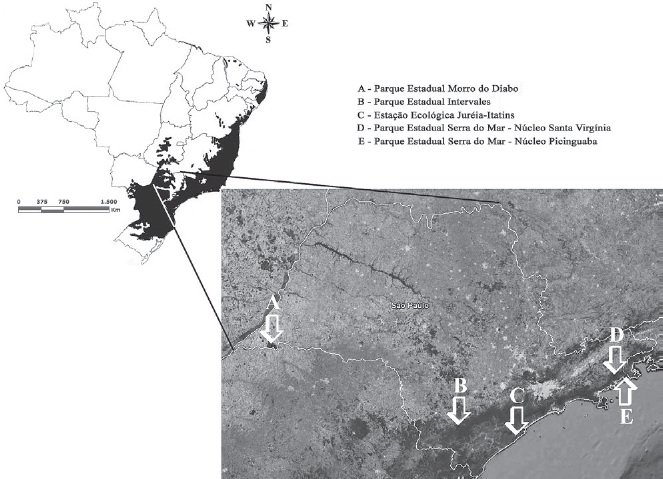
Collect sites in Atlantic Rainforest at São Paulo State, Brazil. Image sources: www.wwf.org.br and Google Earth.
Results and discussion
Data were obtained from a total of 304 exemplars of Monomachus, which 152 exemplars (50.0% of the total collected) at PEMD, 85 (28.0%) at PEI, 56 (18.4%) at PESM-NSV, 9 (3.0 %) at EEJI and, 2 (0.7%) PESM-NP (Table 1).
Females and males of Monomachus Klug, 1841 (Hymenoptera: Diaprioidea) collected with Malaise traps in areas of Atlantic Rainforest of the São Paulo State at Estação Ecológica Juréia-Itatins (EEJI), Parque Estadual Intervales (PEI), Parque Estadual do Morro do Diabo (PEMD), Parque Estadual da Serra do Mar, Núcleo Santa Virgínia (PESM/NSV), and Núcleo Picinguaba (PESM/NP) between December 2009 and December 2010.
In this study a strong deviation towards males was observed: 238 males (78.3% of the total collected) and 66 females (21.7%) were caught, resulting in 3.6 males for each female (Table 1). These data corroborate those of Musetti and Johnson (2004), who reported that only 17.2% of the specimens in collections were females, suggesting that the two sexes occupy different habitats as adults: the males fly in search of females, perhaps even forming swarms while females fly closer to the soil and leaf litter searching their hosts (opus cit.). Azevedo and Santos (2001) collected only males of Monomachus: 100 exemplars of M. eurycephalus Schletterer, 1890 and 22 of M. fuscator (Perty, 1833) in an Atlantic rainforest in the Reserva Biológica de Duas Bocas, Espírito Santo State.
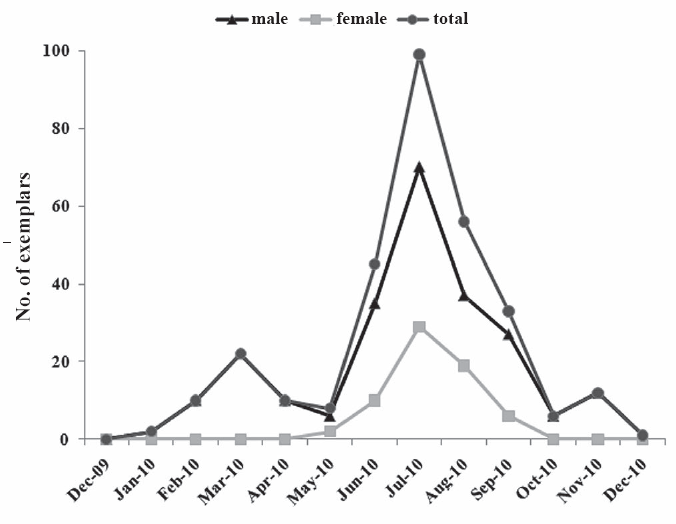
Monomachus Klug, 1841 (Hymenoptera: Diaprioidea) collected with Malaise traps in five areas of Atlantic Rainforest of the São Paulo State, Brazil, between December 2009 and December 2010.
In this study were necessary 32.6 traps-day, in average, to collect one exemplar of Monomachus. Exemplars of this genus are generally rare in collections (Musetti and Johnson 2004). The observed abundance of female of Monomachus spp. was low, but this may be a reflection of the sampling method employed. In contrast, Azevedo and Santos (2001) captured 0.42 specimens per minute employing sweeping nets.
The highest abundance of Monomachus (233 exemplars, 76.6% of the total collected) was observed between June and September with frequency peak in July (99 / 32.6%) (Fig. 2); the increase of the populations of this genus coincides with early winter in the southern hemisphere. As males and females had similar population fluctuations it is plausible to assume that their flight activities are concomitant in the studied areas, which corroborates the observations of Azevedo and Santos (2001), Perioto and Lara (2003) and Perioto et al. (2005) who did not capture Monomachidae in studies carried out at PESM-NP and EEJI in January and May, respectively.
Although the PEMD is located in a region of São Paulo State where temperatures are high throughout the year, they usually decrease between May and September, the period that corresponded to highest abundance of Monomachus in the area; Monomachus was more abundant at PEMD (350 m above sea level - asl) where the sampling effort to catch one exemplar was 65.1 traps-day, followed by PEI (880 m asl) with 116.0 traps-day/exemplar, PESM-NSV (1030 m asl) with 177.0 traps-day/exemplar, EEJI (16 m asl) with 1,100.0 traps-day/exemplar and PESM-NP (215 m asl) with 4,950.0 traps-day/exemplar.
Like Monomachidae, Chiromyzinae, their hosts, also have disjunct distribution in the southern hemisphere. They are also found in the Neotropical and Australasian regions and, in general, the greater abundance of Monomachus in the dry season and in areas of higher altitude seems to be related to the temporal and geographic abundance of their hosts (Woodley 2001; 2011). In a survey in areas of Atlantic rainforest in Minas Gerais State Fontenelle et al. (2009) obtained exemplars of Chiromyzinae only in the dry season. From females of Monomachus were identified M. fuscator (58 / 87.9% of the total of females of Monomachus captured) and M. cubiceps Schrottky, 1911 (8 / 12.1 %) (Table 1).
M. fuscator, with its distinctive green color, is one of the most common species of the genus and, together with M. cubiceps, predominate in samplings in southeastern Brazil (Musetti and Johnson 2004). M. fuscator has a wide distribution in Brazil, with reports of its occurrence in the states of Pernambuco, Bahia, Minas Gerais, Espírito Santo, Rio de Janeiro, São Paulo, Paraná, Santa Catarina and Rio Grande do Sul and, M. cubiceps is limited to southwestern and southern Brazil, Argentina and Paraguay (Musetti and Johnson 2004).
M. fuscator was more abundant at PEMD (49 exemplars/ 84.5% of the total this species), followed by PESM-NSV with 4 (6.9%), PEI with 3 (5.2%), EEJI with 2 (3.4%), and none exemplar was captured in the PESM-NP (Table 1). The highest abundance of M. fuscator (43 exemplars, 74.1 % of the total this species) was observed in July and August with population peak in July (26 / 44.8%) (Table 1, Fig. 3A). Due to the small number of specimens of M. cubiceps captured, the analyzed data were restricted to M. fuscator (Table 1, Fig. 3). M. cubiceps were collected only between June and August in the PEI and PEMD.
It is important to highlight that several authors have reported the inability of Malaise traps in capturing the Hymenoptera fauna in a certain environment when used as a single method of capture (Noyes 1989; García 2003; Campbell and Hanula 2007, Aguiar and Santos 2010). Further, Masner (1995) noted that Monomachidae are only occasionally captured with Malaise traps. The results obtained in this study indicate that Monomachus can be collected in great number with Malaise traps in high-altitude areas, if used for long periods with multiple replications.
In the additional collection period at PESM/NSV, in November and March (late spring and late summer in south hemisphere), were obtained two exemplars of M. klugii Westwood, 1841 that is readily separated from other South American species by its darkened wing tips and by the relatively flat and apically expanded mandibles. M. klugii was known only from Rio de Janeiro State, Brazil (Musetti and Johnson 2004) and now its distribution is extended to São Paulo State.
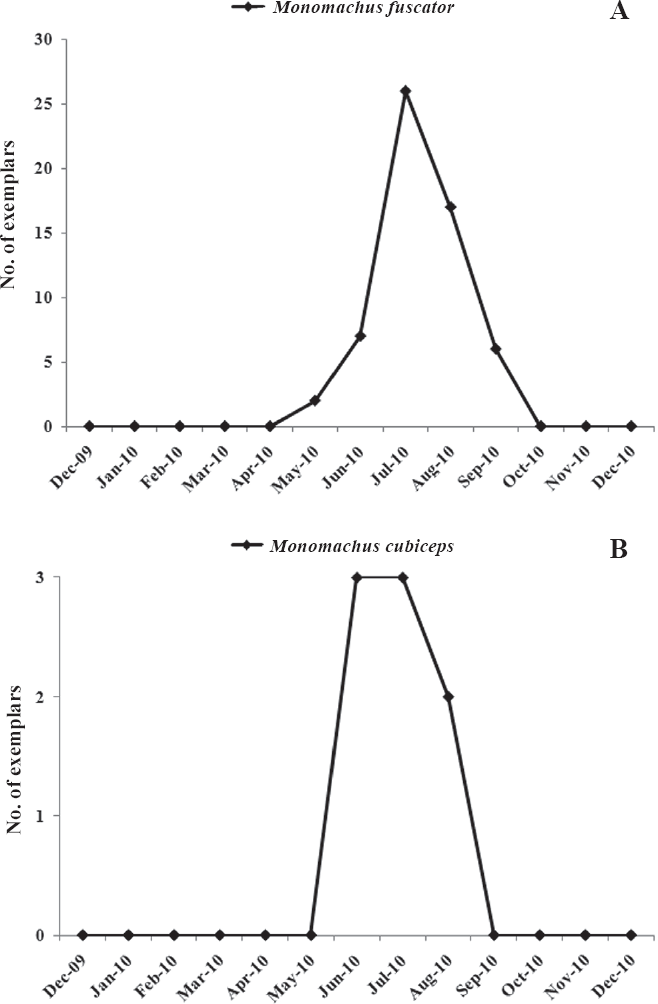
Species of Monomachus Klug, 1841 (Hymenoptera: Diaprioidea) collected with Malaise traps in five areas of Atlantic Rainforest of the São Paulo State, Brazil, between December 2009 and December 2010. A. Monomachus fuscator. B. Monomachus cubiceps.
Acknowledgements
To the Instituto Nacional de Ciência e Tecnologia dos Hymenoptera Parasitoides da Região Sudeste Brasileira (Hympar/Sudeste – CNPq/Fapesp/Capes) for the financial support.