






Abstract
In agricultural landscapes, non-crop habitats, such as forest fragments, may not only play an important role for natural enemies, but may also favor some pests. However, there is a lack of studies in Neotropical regions about these interactions. Thus, the aim of this study was to investigate aphid parasitoidism at two distances (25 m and 525 m) from edges of forest fragments adjacent to wheat crops. This research was carried out in four wheat fields in the north of the Parana state, Brazil, during the planting season of 2009. In total, 8,392 aphids were counted, representing two species. There were 589 total aphid-parasitized ("mummies"), represented by six species. In all four areas, aphid abundance and parasitoidism showed no clear relationship to distance from forest fragments (25 m and 525 m). In addition, inverse density dependence between aphids and parasitoidism was observed. In summary, this study does not support the hypothesis of higher parasitoidism of aphids near edges of forest fragments. However, this is the first study in the Neotropical region and more research must be done to better understand this tritrophic interaction.
Introduction
Biological control services in agricultural landscapes are enhanced by natural and semi-natural habitats adjacent to arable fields (Holland et al. 2008; Thomsom and Hoffman 2013). Shelter, floral resources and alternative preys and hosts for natural enemies are provided by these non-crop habitats (Tscharntke et al. 2005), but several studies showed that crop pests can be benefited by these habitats (Bianchi et al. 2006). Investigations on effects of non-crop habitats on the occurrence of crop pests and their natural enemies have mostly been performed in the northern hemisphere (Bianchi et al. 2006; Thies et al. 2008; Caballero-López et al. 2012), while there is scarce information for Neotropical region. In this context, the aim of this study is to investigate the effects of tropical forest fragments on aphid abundance and parasitoidism rates in adjacent wheat fields in agricultural landscapes of Paraná State, southern Brazil. On the basis of the studies highlighted above we hypothesized that aphid parasitoids benefit from forest fragments and will be higher abundance near the forest fragment than in center of the crops.
Material and methods
It was carried out a study during wheat cropping season 2009 (from April to September) at four commercial wheat fields, all located in northern Paraná State, Brazil. The sites were located in the municipalities of Ibiporã-San Antonio Farm (SAF, 23°14′34″S, 51°27′07″W), Ibiporã-Bonsucesso Farm (BF, 23°12′26″S, 51°03′51″W), Rolândia- Gioconda Farm (GF, 23°23′59″S, 5°19′01″W), and Londrina (23°19′49″S, 51°08′12″W). The study region is characterized by a humid subtropical climate with rainfall concentrated in the summer months and an average annual temperature and precipitation of 21 °C and 1600 mm, respectively (IAPAR 2015). The size of wheat fields varied from 2.3 to 20.9 ha and adjacent forest (Atlantic) fragments varied from 24.5 to 380 ha. In general, the landscape complex around each farm (considering 2 Km radius) was compound majority by wheat crops (39.2 to 47.4%), follow by non-crop area (forest fragment and pasture) (26.2 to 39%), maize (7 to 26.5%) and coffee crops (2.9 to 20.5%).
Population dynamics of the cereal aphids were monitored weekly from wheat emergence to physiological maturity of winter wheat (from April to September, 2009). All aphids were identified to the species level, by means of a visual inspection (Salvadori and Tonet 2001). The number of healthy and parasitized aphids (mummies) in the edge (25 m) and centre (525 m) of the wheat fields were concomitantly estimated. In each field, aphid counts were conducted in two 100m linear transects fixed at two distances apart from the adjacent forest fragments. The linear transects were composed with 10 assessment points with a spacing of 10m between points. Each assessment point comprised 20 wheat shoots/tillers summing to 400 shoots/tillers per field. All parasitized aphids were collected and reared in plastic microtubes until parasitoid emergence. Parasitoids were identified to species level using the identification key (Kavallieratos et al. 2006).
To detect differences in parasitoidism rates between the crop edge (25 m) and centre (525 m) t test was used. Also, aphid abundance was correlated with the number of mummies using Pearson rank correlation test. To check if the data residuals are normally distributed the Shapiro & Wilk (1965) test was used. All analyses were performed using the statistical software SAS (SAS Institute 2001).
Results
In total were recorded 8,392 aphids, compound by two species Sitobion avenae (Fabricius, 1794) (85%) followed by Rhopalosiphum padi (Linnaeus, 1758) (15%) (Hemiptera: Aphididae). It was recorded 4,668 and 317 mummies in Ibiporã-SAF and 3, 257 aphids and 250 mummies Londrina. In Ibiporã-SAF and Rolândia-GF were reported low densities of aphids and mummies (n= 360 aphids and 10 mummies; 107 aphids and 11 mummies, each field, respectively).
Parasitoids were represented by six species: Lysiphlebus testaceipes (Cresson, 1880), Diaeretiella rapae (McIntosh, 1855), Aphidius colemani Viereck, 1912, Aphidius ervi Haliday, 1834, Aphidius uzbekistanicus Luzhetzki, 1960 and Aphidius rhopalosiphi De Stefani Perez 1902. All parasitoids emerged from mummies collected in Ibiporã-SAF and Londrina (Table 1) therefore, the fields Ibiporã-SAF and Rolândia-GF were excluded from parasitoidism analysis.
Pearson rank correlation showed that aphids were negatively correlated with parasitoidism in crop edge (r = - 0.67 in Ibiporã-SAF and r = - 0.50 in Londrina; P < 0.01) and centre (r = - 0.50 in Ibiporã-SAF and r = - 0.18 in Londrina; P < 0.05). Aphid abundance and parasitoidism rates in crop edge and interior were not affected by distance from adjacent forest edge (Fig. 1).
Parasitoids (Braconidae: Aphidiinae) emerged from mummies collected in Ibiporã-SAF and Londrina. Wheat cropping season 2009 (April to September).
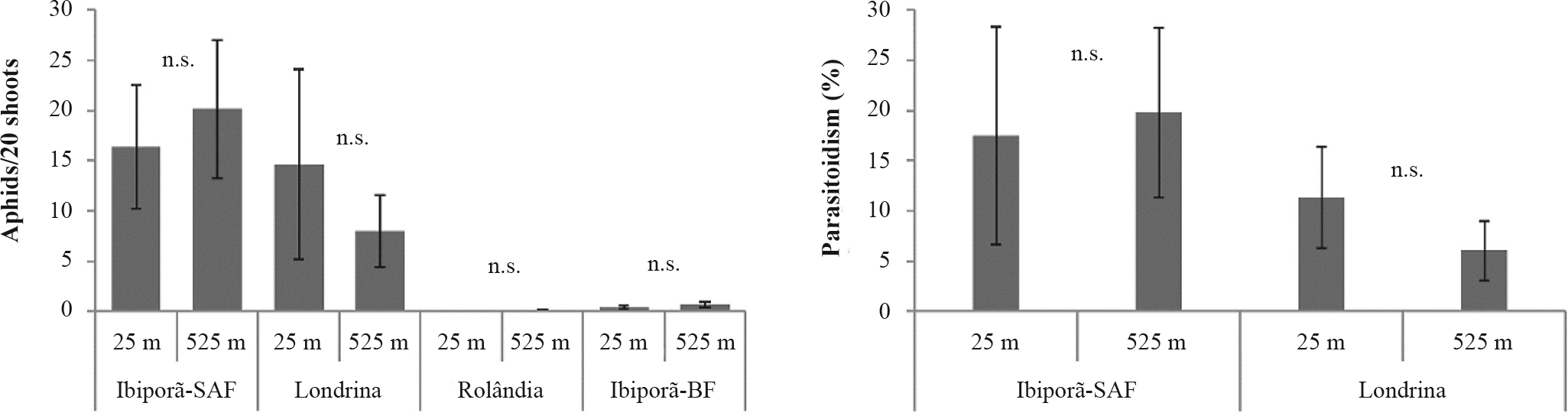
Aphid abundance (A) and parasitoidism (B) in wheat fields, near (25 m) and far from (525 m) the edge of forest fragments. Parana State, 2009 cropping season (April to September). (ns = non-significant). * = (Student t test; * = P≤ 0.05). Ps. Ibiporã-Bonsucesso Farm (BF) and Rolândia-Gioconda Farm (GF) had a low parasitoidism (10 and 11 mummies, respectively) what avoid to compare this parameter near (25 m) and far (525 m) the forest edge.
Discussion
Aphid abundance was negatively correlated with parasitoidism rates in both distances (25 m and 525 m). On the other hand, aphid abundance and parasitoidism rates in crop edge and interior varied considerably among the fields and the hypothesis that crop edge presents higher parasitoidism rates than interior was not supported.
These findings contrast with studies conducted in temperate regions where cereal aphids and their parasitoids presented positive associations with non-crop habitats (Thies et al. 2005; Roschewitz et al. 2005). In temperate regions, aphids reproduce sexually in crop fields and eggs are laid on adjacent trees and herbaceous plants (overwintering sites) (Starý and Havelka 2008). However, under favorable climatic conditions aphids reproduce by thelytokous parthenogenesis (Simon et al. 2002). Thus, under the mild climate conditions in the Neotropics, aphids reproduction are done exclusively by thelytokous parthenogenesis and do not need to hibernate in trees of adjacent forest fragments. In addition, the crop rotation system adopted in the study region comprises soybean and corn in summer and wheat and corn in autumn and winter. Therefore, cereal crops are available throughout the year and crop associated species such as cereal aphids and their parasitoids probably spillover from adjacent cereal crops and not from forest fragments.
Here, first information is provided about aphid-parasitoid interactions in cereal crops and adjacent tropical forest fragments in a Neotropical region. Future studies should investigate how aphids and parasitoids interact with natural and managed ecosystems at multiple spatial and temporal scales. This information is essential to maintain and even enhance aphid biological control in agricultural landscapes.
Conclusion
In the present study, crop edges near forest fragments did not support higher aphid abundance and parasitoidism rates than interior. These results can be attributed to the diversity of host crops that probably allows aphids and their parasitoids spillover from other host plants to winter wheat fields and not from forest fragments. Finally is needed more studies in Neotropical region, for better understand this relationship between environment and aphid parasitoids.
Footnotes
Acknowledgements
We are grateful to CAPES and CNPq that provided research grants to authors.