






Abstract
Lipids represent the main source of energy in entomopathogenic nematodes. In the infective juvenile (IJ) phase, the level of such reserves can be influenced by storage, and this may affect their infectivity. The aim of this study was to evaluate the percentage of lipids and the associated infectivity in IJs of Steinernema carpocapsae, S. riobrave, Heterorhabditis sp. JPM4, Heterorhabditis sp. CCA and Heterorhabditis sp. PI that had been stored under different temperatures (8-28°C) for various times (0 to 180 days). The amounts of lipids present in IJs were evaluated histologically using a colorimetric method, while infectivity was assayed against Galleria mellonella larvae. Lipid levels diminished with increasing storage time for all nematodes, but the rates of decrease varied according to storage temperature and species. Lipid reserves were conserved for longer storage periods at 8, 16 and 20°C, while at 24 and 28°C the percentage of lipids decreased rapidly. The infectivities of IJs of Heterorhabditis spp. were less tolerant than those of Steinernema spp. to temperatures of 8, 24 and 28°C. Thus, while storage at 8°C was optimal for conserving lipid reserves, infectivity was best preserved at temperatures of 16 and 20°C gave rise to the least reduction in infectivities after 180 days of storage. In this way, lipids and infectivity are influenced by different storage temperatures for the species tested. These data are useful for greater success in using entomopathogenic nematodes as biocontrol agents.
Introduction
Entomopathogenic nematodes (EPNs) in the families Steinernematidae and Heterorhabditidae are considered particularly useful in the biological control of insect pests. The ubiquitous distribution of EPNs reflects their ability to adapt and survive under stress conditions, including changes in osmotic tension, temperature or desiccation, and the presence of chemicals and predators (Finnegan et al. 1999; Glazer and Salame 2000). The infective juvenile (IJ) of EPNs are specifically adapted to search for insect hosts, and are able to survive in the absence of a host for weeks, or even months through a reliance on energy reserves (Hatab and Gaugler 1999; Qiu and Bedding 2000; Hass et al. 2002). Additionally, in order to conserve energy, the IJs of some EPN species become inactive when stored in water (Fitters and Griffin 2004).
The success of EPNs depends largely on their physiology and biochemistry that enables them to achieve efficient control of pests. In this context, the amount of lipid within the body of the IJ greatly influences the viability and infectivity of the nematode (Wright and Perry 2002). Saturated lipids are the most important energy reserves of aerobic nematodes, particularly in IJ, and represent between 11% and 67% of the dry weight of the organism (Barrett and Wright 1998). Neutral fats typically account for more than 70% of the total lipid content of nematodes, with triglycerides being the major storage form (Barrett and Wright 1998; Chitwood 1998). IJs rely on lipids as their sole energy source while searching for a host (Lee and Atkinson 1977; Van Gundy 1985), and a high lipid content therefore allows survival for extended periods. There is evidence that an extended period of storage and a reduction in total lipid content can lead to a decrease in the infectivity of IJs (Lewis et al. 1995; Hass et al. 2002; Fitters and Griffin 2004). Since the levels of storage lipids may be affected by alterations in environmental conditions, it is likely that the supply of different lipids can determine the survival and pathogenicity of IJs (Hatab and Gaugler 1999; Menti et al. 2003).
Triglycerides can be analyzed using various chromatographic techniques or by the application of histological methods based on staining with oil red O (Lee 1960; Croll 1972). Chromatographic analysis is time consuming and demands a large number of nematodes, whereas histological assay is straightforward and can be applied to individual specimens. Image analysis has been successfully employed to quantify the degree of oil red O staining, and allows the examination of many samples within a short period (Stamps and Linit 1995). Moreover, results acquired using the staining method has been validated against those obtained by conventional gas chromatography (Patel et al. 1997). The method can thus provide specific and conclusive results regarding the utilization of lipid reserves, and was hence selected for application in the present study.
Many of the market difficulties in introducing EPNs are related to low efficacy under unfavorable conditions, application conditions, refrigeration requirements and limited room temperature shelf life (product quality) (Georgis et al. 2006). Lipid reserves can affect each of these factors and are therefore an important consideration when developing EPN biological controls. The objective of the present paper was to determine the levels of IJ lipid reserves in different isolates of Steinernema and Heterorhabditis after storage and at different temperatures. Additionally, the association between lipid reserves and IJ infectivity towards larvae of Galleria mellonella L., 1758 (Lepidoptera: Pyralidae) was evaluated.
Materials and Methods
Multiplication of EPNs.
Infective juveniles of Steinernema carpocapsae (Weiser, 1955) Wouts, Mrácek, Gerdin & Bedding, 1982 (obtained from North Carolina, USA, soil sample), Steinernema riobrave Cabanillas, Poinar & Raulston, 1994 (obtained from Texas, USA, soil sample), Heterorhabditis sp. JPM4 (from Lavras, MG, Brazil), Heterorhabditis sp. CCA (from Araras, SP, Brazil) and Heterorhabditis sp. PI (from Piauí, Brazil) were maintained in the form of aqueous suspensions (500 IJs/ml) under biochemical oxygen demand at 16°C.
For each treatment repetition, three stained nematodes, taken randomly from the stored suspension, were placed onto a glass slide and observed and photographed using a trinocular microscope Olympus SZ40. The total IJ body area and the areas corresponding to the red-stained lipids were estimated from the digitized images with the aid of Image Tool for Windows version 3.0 (The University of Texas Health Science Center, San Antonio, Texas), from which it was possible to determine the percentage of triglycerides in relation to body area.
The effects of storage on the infectivity of IJs towards larvae of G. mellonella were evaluated by placing five larvae into a Petri dish (5cm diameter) lined with filter paper and adding a 0.5ml aliquot of IJ suspension that had been treated as described above. Dishes were incubated at 24±1°C for 3 days, after which the mortality rates of the larvae were determined. Each treatment was replicated four times. Galleria mellonella larvae were tested as control applying water, without IJ.
The percentage data corresponding to lipid concentration and infectivity of the stored IJs were submitted to variance analysis and to the Tukey test (p>0.01) for comparisons between the means.
Results
Concentration of lipids in IJs after storage at different temperatures.
The concentrations of neutral lipids, expressed as percentages of the total body areas of the IJs, varied between the species tested. Maximum values were detected in newly emerged IJs. The average of neutral lipids for newly emerged IJ just before storage were 97.4% for S. riobrave, 90.3% for S. carpocapsae, 89.2% for Heterorhabditis sp. PI, 88.6% for Heterorhabditis sp. CCA and 90.7% for Heterorhabditis sp. JPM4.
The intensity of the lipid stain was stronger in the area of the intestine and lighter in the anterior portion, with irregular spots distributed throughout the body (Fig. 1). For all of the nematodes studied, the percentage of lipids generally diminished with time, although there were variations in the rate of decrease depending on the temperature of storage on the EPN. At temperatures between 8 and 20°C, the IJs conserved lipid reserves longer, whereas between 24 and 28°C, the percentage of lipids diminished rapidly. After 180 days at 24 and 28°C the reserves of lipids were reduced to < 50% in 90 days, and were almost completely depleted after 120 days (Tables 1-5). Between 8 and 16°C, the IJs were motionless, and for S. carpocapsae it was possible to observe that the typical "J" form. In contrast, between 20 and 28°C, the IJs were in constant motion. Hence, the maintenance of lipid reserves was more efficient when IJs were stored at 8 or 16°C, independent of species or strain, even when the IJs were dead.
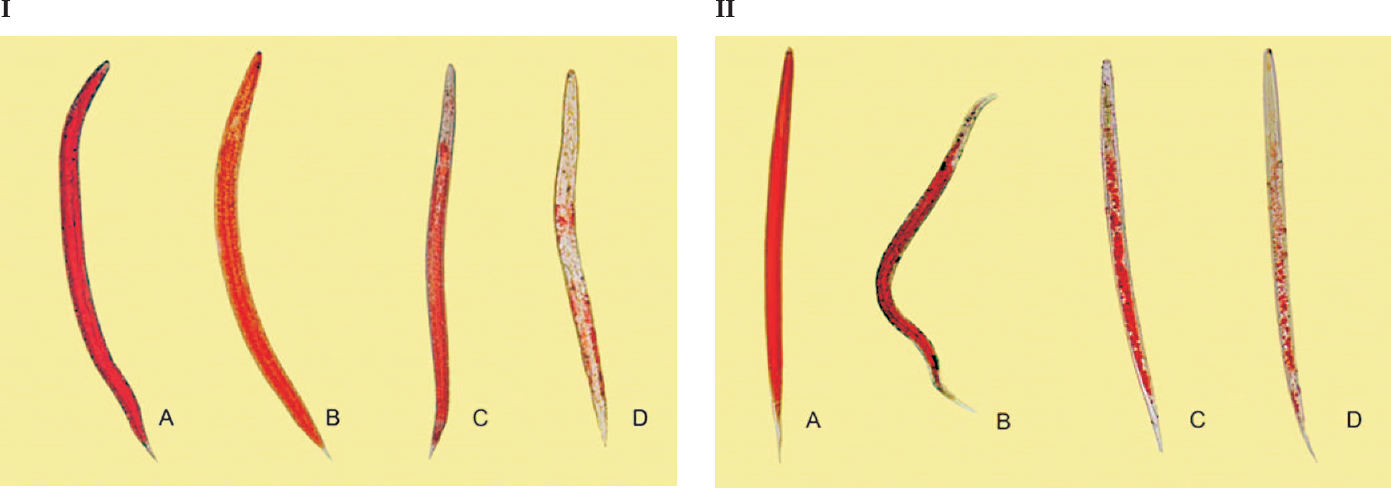
Variations in the concentration of lipids present in infective juveniles of Heterorhabditis sp. JPM4 I and Steinernema riobrave II, as determined by oil red O staining, after storage at A. 15 days at 8°C; B. 180 days at 8°C; C. 15 days at 28°C; and D. 180 days at 28°C.
Percentage of lipids present during storage of IJs from Heterorhabditis sp. CCA for 15 to 180 days at different temperatures.
Means followed by the same small letter within columns and same capital letter within lines are not significantly different by the Tukey test (p>0.01).
Percentage of lipids present during storage of IJs from Steinernema carpocapsae for 15 to 180 days at different temperatures.
Means followed by the same small letter within columns and same capital letter within lines are not significantly different by the Tukey test (p>0.01).
Percentage of lipids present during storage of IJs from Heterorhabditis sp. JPM4 for 15 to 180 days at different temperatures.
Means followed by the same small letter within columns and same capital letter within lines are not significantly different by the Tukey test (p>0.01).
Percentage of lipids present during storage of IJs from Heterorhabditis sp. PI for 15 to 180 days at different temperatures.
Means followed by the same small letter within columns and same capital letter within lines are not significantly different by the Tukey test (p>0.01).
Percentage of lipids present during storage of IJs from Steinernema riobrave for 15 to 180 days at different temperatures.
Means followed by the same small letter within columns and same capital letter within lines are not significantly different by the Tukey test (p>0.01).
Infectivity of IJs after storage at different temperatures.
For all of the nematodes studied, the IJs stored for 0 days showed the highest mortality rates towards larvae of G. mellonella. For Heterorhabditis sp. PI, S. carpocapsae and S. riobrave these mortality rates were 100%, for Heterorhabditis sp. CCA was 95% and for Heterorhabditis sp. JPM4 was 97.5%. The percentage infectivity of IJs diminished upon storage, but the rate of reduction varied according to storage temperature and EPN. At temperatures of 24 and 28°C, the ability of all nematodes to infect insect larvae typically diminished after just 15 days storage. On the other hand, the infectivities of IJs from S. carpocapsae and S. riobrave were unaffected by storage at 8°C for up to 90 days, although those of IJs from the Heterorhabditis species were greatly reduced after 15 days of incubation under such conditions. Indeed, IJs from Heterorhabditis sp. CCA were no longer able to infect G. mellonella larvae after 60 days of storage at 8°C. Thus, the IJs from Heterorhabditis isolates were less tolerant to both the lowest (8°C) and the highest (24 and 28°C) temperatures tested in comparison with those from Steinernema species.
The most favorable temperature for the maintenance of EPN infectivity was estimated to be between 16 and 20°C, since the percentage infectivities after an incubation period of 180 days were 72.5% for S. carpocapsae, 70.0% for S. riobrave and 62.5% for Heterorhabditis sp. CCA with storage at 16°C, and 40% for Heterorhabditis sp. PI, 60.0% for Heterorhabditis sp. CCA and 67.5% for Heterorhabditis sp. JPM4 with storage at 20°C (Tables 6-10).
Percentage infectivity to larvae of Galleria mellonella during storage of IJs from Heterorhabditis sp. CCA for 15 to 180 days at different temperatures.
Means followed by the same small letter within columns and same capital letter within lines are not significantly different by the Tukey test (p>0.01).
Percentage infectivity to larvae of Galleria mellonella during storage of IJs from Steinernema carpocapsae for 15 to 180 days at different temperatures.
Means followed by the same small letter within columns and same capital letter within lines are not significantly different by the Tukey test (p>0.01).
Percentage infectivity to larvae of Galleria mellonella during storage of IJs from Heterorhabditis sp. JPM4 for 15 to 180 days at different temperatures.
Means followed by the same small letter within columns and same capital letter within lines are not significantly different by the Tukey test (p>0.01).
Percentage infectivity to larvae of Galleria mellonella during storage of IJs from Heterorhabditis sp. PI for 15 to 180 days at different temperatures.
Means followed by the same small letter within columns and same capital letter within lines are not significantly different by the Tukey test (p>0.01).
Percentage infectivity to larvae of Galleria mellonella during storage of IJs from Steinernema riobrave for 15 to 180 days at different temperatures.
Means followed by the same small letter within columns and same capital letter within lines are not significantly different by the Tukey test (p>0.01).
Correlation between lipid content and infectivity.
In the case of IJs from the two Steinernema species, a direct correlation could be established at all storage temperatures between lipid content and infectivity, i.e. as the percentage of lipids in the nematode body diminished, the infectivity to G. mellonella larvae tended to decrease. With respect to the Heterorhabditis isolates, however, there was an inverse correlation at 8°C, thus, despite a high lipid content infectivity was lost after 60 days of storage.
After 180 days of incubation at 16°C all IJs, except for those derived from Heterorhabditis sp. PI, induced > 50% mortality in G. mellonella larvae. For S. carpocapsae and S. riobrave, the percentage infectivities were < 50% when the lipid reserves fell below 20% and 32%, respectively. After incubation at 8°C, all Heterorhabditis isolates presented low infectivities even when the lipid content was high. Thus, IJs from Heterorhabditis spp. PI, CCA and JPM4 that had been stored for 180 days at 8°C could not induce mortality in G. mellonella larvae although their lipid contents were 70%, 80% and 77%, respectively. At storage temperatures > 8°C, infectivities of around 50% were attained by IJs from Heterorhabditis spp. PI, CCA and JPM4 that exhibited lipid contents of < 46%, 15% and 15%, respectively. Hence, although the lipid reserves of Heterorhabditis nematodes were adequately preserved at 8°C, the infectivities of the IJs were not.
Discussion
According to Grewal (2000), S. carpocapsae is able to survive longer in water at 5°C than other nematodes because it adopts a "J" form, thus becoming quiescent and conserving energy. The differential thermo-adaptation of some nematodes is associated with the accumulation of trehalose lipid, a non-reducing disaccharide that plays a role in the maintenance of virulence during acclimatization to low (5°C) or high (35°C) temperatures (Jagdale and Grewal 2003). The amount of trehalose accumulated by different nematodes varies with temperature, and this may confer specific advantages to certain species, as revealed in the present study for Steinernema sp. in which lipid reserves were preserved for longer periods at all temperatures tested.
Some IJs become inactive in water in order to conserve energy, and this ability also varies with species. Several studies have shown that the percentage of inactive IJs in water is greater for S. carpocapsae than for S. glaseri or H. bacteriophora (Lewis et al. 1995; Fitters and Griffin 2004). Additionally, a significant increase in infectivity towards G. mellonella larvae was reported for H. megidis IJs in the first two weeks of storage in water, after which infectivity declined (Fitters and Griffin 2004).
Molecular studies of genetic modulation have revealed that IJ stress response is associated with proteins involved in desiccation that are differentially regulated by more than 30 genes, thus determining a differential capacity for adaptation to extreme environments such as excessive salt concentrations, excessive temperature oscillations and low humidity. The response to stress selects for IJ populations that are genetically adapted to survive under severe conditions (Serwe-Rodriguez et al. 2004; Bornstein-Forst et al. 2005), as is the case for some Steinernema species that are well adapted to resist large oscillations of temperature.
The levels lipids in Heterorhabditis isolates varied less than in Steinernema isolates, and some of the lipids found in the latter were typically either not present or present only in small amounts in the former. Additionally, Steinernema nematodes survived longer than Heterorhabditis species from which the lipids were depleted more rapidly. In all species of Steinernema, a reduction in lipid reserves was observed from the fourth week onwards with storage at 23°C, and from the fifth week onwards with storage at 20°C (Lewis et al. 1995; Patel et al. 1997; Fitters et al. 1999). The levels of lipids reserves observed in the newly-emerged IJ populations were similar (i.e. between 80% and 96%) to those reported for S. feltiae and H. megidis in which IJs of the former survived for 16 to 20 weeks whilst those of the latter survived for only 12 weeks and with declining viability (Patel and Wright 1997). The present study thus corroborates these previous reports since the percentage of lipids in Heterorhabditis isolates stored at 24°C diminished from the 30th day onwards at a rate that was much higher than that observed for Steinernema species. It has been reported that S. carpocapsae can regulate the water content of its membranes depending on the temperature (Fodor et al. 1994), whilst S. riobrave accumulates large proportions of unsaturated fatty acids at high temperatures (Hatab and Gaugler 1999), characteristics that contribute to the thermo-tolerance of these species.
According to Patel et al. (1997), the survival of S. carpocapsae and S. riobrave varies between 120 and 135 days, the infectivities of S. riobrave, S. feltiae and S. glaseri, decline as the lipid reserved are depleted. Moreover, the sizes of the IJs and the initial amounts of lipid present in their bodies appear to be related to survival and the manner in which the organisms use energy reserves. Thus smaller nematodes, like those S. carpocapsae and S. riobrave, utilize their lipids more rapidly than larger IJs like those of S. feltiae and S. glaseri (Patel et al. 1997). In the present study, however, the infectivity of S. carpocapsae IJs was maintained even when lipid reserves were low, suggesting that nematode populations are quite heterogeneous and are able to use such reserves for different purposes. Furthermore, the present findings demonstrated the importance of locomotive activity of IJs during storage in water and the significance of the quiescent form for minimizing the use of energy.
Steinernema carpocapsae IJs exhibited a rapid decline in infectivity after 90 days of storage, which is similar to the findings of Wright et al. (1997). These authors emphasized that the use of glycogen as energy reserve ceases earlier on whilst the lipid reserves continue for a much longer period, perhaps explaining the initial rapid decrease in the infectivity of S. carpocapsae. In Heterorhabditis IJs, a direct relationship between infectivity and the percentage of lipids was also observed, as previously reported by Hass et al. (2002).
As stated by Wright and Perry (2002) the efficacy of the selection of EPN isolates that are already adapted for commercial use depends on a comprehensive knowledge of their physiological and biochemical attributes. Clearly the quality and quantity of lipids present in the IJs are of utmost importance, since such energy reserves critically influence the viability and infectivity of EPNs.
Conclusions
Thus, this paper presents the importance of lipid reserves for IJs, showing that temperature directly influences its variation and correlates the decline of the reserve to a decrease in infectivity for all species tested. By using this information it is possible to handle properly the situations for greater success in using EPNs.