






Abstract
Adults and nymphs of Poekilloptera phalaenoides (Auchenorrhyncha: Flatidae) were found on Acacia podalyriaefolia (Leguminosae: Mimosoideae) in Viçosa, Minas Gerais, in October 2007. This is the first record of this insect in the municipality of Viçosa and on plants of A. podalyriaefolia on which it can complete its full life cycle.
Introduction
Poekilloptera phalaenoides (L., 1758) (Auchenorrhyncha: Flatidae) is recorded from Mexico through and Brazil (Maes 2004). In Brazil it has been reported in Bahia, Goiás, Mato Grosso, Minas Gerais, Pará, Paraíba, Rio de Janeiro, Rio Grande do Sul, Roraima, São Paulo and Sergipe states (Araújo et al. 1968; Querino et al. 2007; Silva 2009; Ferreira et al. 2009). Poekilloptera phalaenoides is characterized by having general pale yellowish color with black spots on the tegmina and wings (Figs 1C-D) (Costa Lima 1942). It is phytophagous (Maes 2004) and excretes a sticky substance that causes sooty mold to grow on the plant and cover leaves and branches, obstructing to some level the plant breathing, transpiration and photosynthesis (Querino et al. 2007). Plants considered as potential hosts for P. phalaenoides include species of the genera Cassia, Delonix (Caesalpiniaceae), Cajanus, Dipteryx (Fabaceae), Manguifera (Anacardiaceae), Anona (Anonaceae), Eucalyptus, Psidium (Myrtaceae), Rosa, Prunus (Rosaceae), Coffea (Rubiaceae), Citrus (Rutaceae), Theobroma (Sterculiaceae), Enterolobium, Pithecelobium, Inga, Albizia and Acacia (A. mangium) (Mimosaceae) (Maes 2004; Querino et al. 2007).
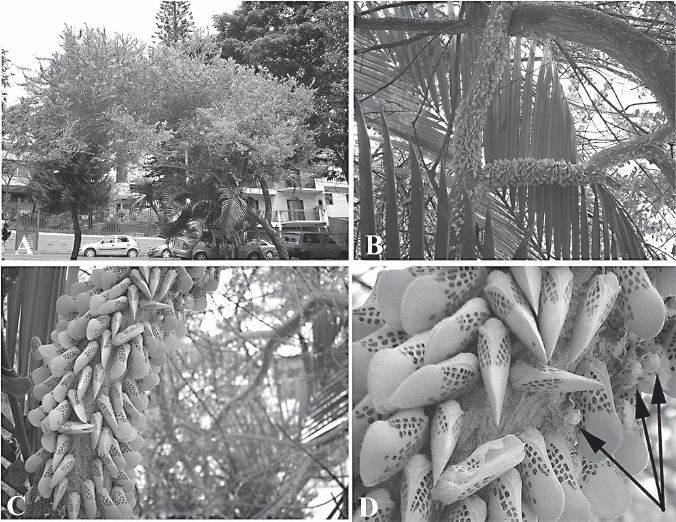
A. Acacia podalyriaefolia (Leguminosae: Mimosoideae) plant in Viçosa, Minas Gerais, Brazil. B. Specimens of Poekilloptera phalaenoides (Auchenorrhyncha: Flatidae) on branches of A. podalyriaefolia. C. Detail of P. phalaenoides and its gregarious habit. D. Nymphs of Poekilloptera phalaenoides (Auchenorrhyncha: Flatidae) on plants of Acacia podalyriaefolia (Leguminosae: Mimosoideae).
Adults and immature stages of P. phalaenoides were found on plants of A. podalyriaefolia (Leguminosae: Mimosoideae) on October 2007, in Viçosa county, state of Minas Gerais (coordinates: 20°45′28.2"S; 42°52′26.6"W at 656 masl altitude). This is an exotic plant in the Brazilian fauna, native to Australia (Fig 1A). Specimens of P. phalaenoides were collected and sent to Dr. Stephen W. Wilson from Department of Agriculture of the University of Central Missouri, USA, for identification. The plant was identified by Dr. Antônio Lelis Pinheiro from the Department Plant Biology of the Federal University of Viçosa (UFV). These insects were observed feeding exclusively on branches of this plant, and the observed symptom was the presence of long, curled filaments of waxy exudate covering the branches. After this observation, it was concluded that A. podalyriaefolia can be a potential host for P. phalaenoides (Figs. 1A-B) because in addition to the adults, there were nymphs on the branches of the plant (Fig 1D, arrows), indicating that the plant can be not only a refuge or shelter but also a place to reproduction.