





Abstract
Histone deacetylase inhibitors (HDACis) are emerging as promising and selective antitumor agents. However, HDACis can lead to tumor stasis rather than shrinkage, in which case, traditional imaging methods are not adequate to monitor response. Consequently, novel approaches are needed. We have shown in cells that 19F magnetic resonance spectroscopy (MRS)-detectable levels of the HDAC substrate Boc-Lys-TFA-OH (BLT) are inversely correlated with HDAC activity. We extended our investigations to a tumor xenograft model. Following intraperitoneal injection of BLT, its accumulation within the tumor was monitored by in vivo 19F MRS. In animals treated with the HDACi suberoylanilide hydroxamic acid (SAHA), tumoral BLT levels were higher by 77% and 132% on days 2 and 7 of treatment compared with pretreatment levels (n = 6; p < .05). In contrast, tumoral BLT levels remained unchanged in control animals and in normal tissue. Thus, 19F MRS of BLT detected the effect of HDACi treatment as early as day 2 of treatment. Importantly, tumor size confirmed that SAHA treatment leads to inhibition of tumor growth. However, difference in tumor size reached significance only on day 6 of treatment. Thus, this work identifies BLT as a potential molecular imaging agent for the early noninvasive MRS detection of HDAC inhibition in vivo.
NOVEL ANTICANCER THERAPIES are increasingly targeted to specific molecular events that are associated with onset and progression of cancer. Histone deacetylase (HDAC) inhibitors (HDACis) are one example of this approach. HDACs and histone acetyltransferases, respectively, catalyze the addition or removal of acetyl groups onto the ε-amino of lysine residues in the histone tail and, as such, can control gene expression by altering deoxyribonucleic acid (DNA) packaging and chromatin structure. Disruptions in HDACs and histone acetyltransferases have been associated with cancer development,1,2 leading to modulation of several genes associated with oncogenesis. 2 In addition, the acetylation, and consequently the activity, of nonhistone proteins that contribute to cancer progression, such as heat shock protein 90 (HSP90), can also be affected by HDACs.2,3 Importantly, HDACis lead to differentiation, growth arrest, and/or apoptosis in treated cells and tumors.1,3–7 Consequently, HDACis are currently in clinical trials and show promising results in different tumor types.1,2,8–13
However, at present, there is no direct noninvasive means to measure drug delivery to the tumor tissue, drug-target interaction, or molecular drug response. Further, in many cases, molecular drug action results in tumor stasis rather than shrinkage. 8 As a result, traditional imaging methods may not be adequate for rapid monitoring of molecular drug action and response. Response to HDACis in clinical trials is therefore currently assessed by monitoring the acetylation of histones in peripheral blood mononuclear cells or tumor biopsy specimens.8,10,11,13 Blood tests are well tolerated by patients but provide only an indirect indicator of drug delivery and activity at the tumor site. In contrast, biopsies reliably assess drug action but are surgically invasive and cannot be used on a regular basis to longitudinally monitor treatment efficacy. Consequently, determining the appropriate, biologically relevant drug dose and assessing drug molecular action at the tumor site present a challenge,14,15 and a noninvasive method that can provide this information is needed.
Magnetic resonance spectroscopy (MRS) presents a noninvasive and nondestructive method that can provide longitudinal pharmacokinetic and pharmacodynamic biomarkers of oncogenesis and response to anticancer therapies at defined anatomic locations in individual cancer patients. Specifically, it is now well recognized that an increase in the endogenous choline-containing metabolites, as detected using either 31P or 1 H MRS, is associated with cell transformation, whereas a drop in those metabolites is typically associated with response to cytotoxic treatments.16–18 We have shown that a drop in choline-containing metabolites is also observed following treatment with novel therapies targeted at specific oncogenic mutations.19–23 More recently, we showed that phosphocholine (PC) levels were inversely correlated with HDAC activity in suberoylanilide hydroxamic acid (SAHA)-treated PC3 cells 24 and that the increase in PC levels following HDAC inhibition was associated with depletion of HSP90 client proteins, consistent with HSP90 inhibition subsequent to inhibition of HDAC6.25,26 A similar finding was also made by others in an LAQ824-treated xenograft model. 27
However, the metabolic changes observed in the 31P or 1 H spectrum represent indirect and sometimes nonspecific downstream events. Consequently, specific direct indicators of drug activity on the intended molecular target are also needed to inform on upstream molecular events occurring in tumor cells following treatment. We have shown that MRS can be used to directly monitor inhibition of HDACs in cells. We showed that the fluorinated lysine derivative Boc-Lys-TFA-OH (BLT) is a cleavable HDAC substrate that can be monitored by 19F MRS. In the presence of active HDACs, BLT is cleaved, and its MRS-detectable cleavage product (trifluoroacetate [TFA]) is removed from the cell, leaving only an unfluorinated, MRS-invisible moiety inside the cell. In contrast, following HDAC inhibition, BLT remains unchanged, and its intracellular levels, as detected by 19F MRS, are therefore significantly higher than in untreated control cells. Consequently, BLT levels are inversely correlated with HDAC activity. 24
In the current study, we extended our investigations to a tumor xenograft model and show here that the findings made in cells translate to the in vivo setting. Specifically, the inhibition of tumor growth following HDAC inhibition is preceded by a clear and significant increase in tumoral levels of BLT, as detected by 19F MRS at the tumor site. This work thus identifies BLT as a useful molecular imaging agent for the detection of HDAC inhibition in vivo.
Materials and Methods
Effect of BLT In Vivo
A small-scale study was performed to monitor the possible side effects of BLT. Sixteen male 1-month-old CD-1 nude mice (Charles River Labs, Wilmington, MA) were distributed into two subgroups of eight mice each. The control group received weekly intraperitoneal injections of 40 μL dimethyl sulfoxide (DMSO), and the treated group received weekly intraperitoneal injections of 100 mg/kg BLT (Advanced Chem-Tech, KY) in 40 μL DMSO—the dose used for MRS studies. During a 3-week period, the animals from both groups were continuously monitored for weight loss, skin lesions, activity and behavioral changes, dehydration and feeding problems, and neurologic deficit as signs of possible toxicity. Also, weekly blood samples were collected for laboratory testing aimed at monitoring liver and kidney functions and general animal physiology. The tests included a complete blood count, total bilirubin, aspartate aminotransferase, alanine aminotransferase, blood urea nitrogen, total protein, and creatinine levels. At the end of the third week, the mice were euthanized by CO2 inhalation, and tissue samples from the liver, heart, spleen, and kidney were collected for histologic studies following hematoxylin and eosin staining.
The results of the laboratory tests were compared between control and treated groups using a Mann-Whitney test. The Fisher exact test was applied to check for any possible difference in the frequency of side effects, and Kaplan-Meier analysis was used to compare survival in the two groups. Histologic sections of corresponding organs were compared qualitatively.
Cell Culture, Tumor Induction, and Treatment
PC3 human prostate cancer cells were routinely cultured in Dulbecco's Modified Eagle's Medium/F-12 (Life Technologies, Grand Island, NY) supplemented with 10% FBS (Hyclone, Logan, UT) and 10,000 U/mL of penicillin, 10,000 μg/mL of streptomycin, and 25 μg/mol of amphotericin B (Life Technologies) at 37°C in 5% CO2. To induce tumors, 5 × 10⁶ cells suspended in Matrigel (BD Biosciences, Franklin Lakes, NJ) were injected subcutaneously in the flank of male CD-1 nude mice (Charles River Labs). Palpable tumors were observed from about 3 weeks. Tumor size was monitored daily by caliper measurement, and tumor volume was calculated using the formula (π/6) × length × width × depth. When an average tumor volume of 0.2 cm3 was reached, mice were separated into two groups. The treated group (n = 6) was treated with 50 mg/kg SAHA (synthesized in-house 24 ) intraperitoneally once a day for 7 days in 40 μL DMSO and the control group (n = 6) was treated with 40 μL carrier DMSO only, for the same period. Animals were treated in accordance with the ethical requirements of the Institutional Research Committee of the The University of Texas M.D. Anderson Cancer Center. The difference between average tumor sizes (± SE) in control and treated groups was assessed using an unpaired two-tailed Student t-test, with differences considered significant for p < .05.
In Vivo Magnetic Resonance Imaging and MRS Studies
The magnetic resonance (MR) studies were performed on a 4.7 T Biospec imaging system (Bruker Biospin, Billerica, MA) prior to treatment (day 0) and on days 2 and 7 of treatment using a 1.5 cm (inner diameter) retunable 1H/19F surface coil, which was placed on the tumor. During the study, the physiologic condition of the mouse was monitored using an MR-compatible monitoring and gating system (Model 1025, SA Instruments Inc., Stony Brook, NY). Following animal positioning and automatic shimming, each MR study was performed as follows. First, an anatomic image of the tumor was obtained using a T2-weighted RARE imaging sequence via the surface coil tuned to 1H. This was followed by further manual shimming over the voxel of interest (typically, the water line width was on the order of 15 Hz) and localized 1H MRS using point-resolved spectroscopy (PRESS – echo time [TE]/repetition time [TR] = 20 ms/3 s) with water suppression (100 averages) and without water suppression (1 average). Before 19F MRS, 1H one pulse sequence was used for global auto and manual shimming (typically, the water line width was on the order of 50 Hz). The surface coil was then retuned to 19F, and a baseline 19F MR spectrum was recorded (TR = 1 s, 45° flip angle, 300 averages); 100 mg/kg BLT in 40 μL DMSO was then injected intraperitoneally, and sequential 19F MR spectra were recorded every 5 minutes over the course of 75 minutes, monitoring BLT uptake into the tumor. It should be noted that, overall, the mouse and tumor locations were not expected to change significantly prior to and following BLT injection for the following reasons. In this study, the mouse was taped securely on a plastic slide with the surface coil also securely positioned so that it was located over the tumor. After placing the tumor at the center of the magnet, the position of the slide was marked and recorded with respect to the edge of the magnet bore. For the BLT injection, the slide was taken out and BLT was injected without disturbing the position of the mouse or coil on the slide. After BLT injection, the slide was repositioned to the same location relative to the edge of the magnet bore. As the mouse/tumor and the surface coil are not disturbed while moving the slide, we assume that the shim values did not change significantly. This was also confirmed when assessing the quality of sequential 19F spectra, the first of which was acquired prior to BLT injection, whereas subsequent spectra were acquired following BLT injection. At the end of the 19F study, the 1 H/19F surface coil was then replaced with a coil tuned to 31P, and a 31P spectrum was recorded (TR = 2 s, 45° flip angle, 900 averages). 19F MRS was also performed on an unaffected region by placing the surface coil on the contralateral flank in tumor-bearing mice.
The MR spectra were analyzed using MestRec software (Mestrelab Research SL, Santiago de Compostela, Spain). 19F MR spectra acquired for 5 minutes were added (giving 10-minute time points) to improve the signal to noise ratio. BLT levels determined by 19F MRS were normalized to the external reference 20 mM ααα-trifluorotoluene (TFT; Sigma-Aldrich Chemical Co., MO; placed in a microcell spherical bulb at a fixed distance from the coil) and relative to tumor volume. BLT levels were then expressed as a percentage of the maximum tumor BLT level observed in each animal prior to treatment. The steady-state level of BLT in the tumor (BLTss) was determined by fitting the temporal evolution of BLT to an uptake curve BLTss(1-exp−kt). This uptake curve provides a phenomenologic semiquantitative representation of the delivery and accumulation of BLT in the tumor tissue. K will depend primarily on tumor vasculature and perfusion, whereas BLTss will depend primarily on BLT diffusion, transport, and metabolism within the tumor. A two-tailed paired Student t-test of BLT evolution over time was performed for days 2 and 7 with respect to day 0. In addition, a two-tailed unpaired Student t-test was performed for average BLT values comparing days 2 and 7 with day 0 and further comparing day 2 with day 7. In addition, at each time point, a two-tailed unpaired Student t-test of BLT levels in treated tumors compared with levels in DMSO-treated controls was performed.
1 H MRS data were analyzed by monitoring the total choline (tCho) signal normalized to the total 1 H signal (tCho/total 1 H). 31P MR spectra were analyzed by monitoring the phosphomonoester (PME) signal normalized to the total 31P signal (PME/total31P). Average tCho/total 1 H and PME/total31P levels were determined, and values observed following treatment were compared with pretreatment values using a paired two-tailed Student t-test. All values were expressed as average ± SE, and differences were considered significant for p < .05. At the end of MRS studies on day 7, the tumors were excised and stored frozen at −80°C for Western blot analysis.
Ex Vivo MRS Studies of Tumor Extracts
Tumors grown for this purpose and treated for 2 days with SAHA or DMSO as above were extracted in perchloric acid (PCA), as described previously. 22 Briefly, tumors were weighed and thoroughly homogenized in a liquid nitrogen–cooled mortar, and 0.3 M PCA (10:1, v/w) was added to the tumor and ground further until the tissue and PCA were mixed well. The homogenate was centrifuged (1,600g, 20 minutes, 0°C), and the supernatant was collected. The precipitate was extracted again with 1 mL of 0.3 M PCA at 0°C, and the homogenate was centrifuged as before. The supernatants were combined, neutralized with 1.5 M KOH, and centrifuged at 0°C to remove precipitated KClO4. The resulting supernatant was passed through an ion exchange resin (Chelex 100, Na form, 50–100 mesh) and lyophilized. The lyophylized sample was reconstituted in 500 μL of D2O and placed in 5 mm nuclear magnetic resonance tubes. For 1 H MRS, trimethylsilylpropionate was used as an internal reference for chemical shift and quantification. For 31P MRS, ethylenediaminetetraacetic acid (EDTA; Sigma-Aldrich Chemical Co.) (65 μL, 100 mM) was added to each sample for chelation of metal ions, and methylene diphosphonic acid (Sigma-Aldrich Chemical Co.) was used as an internal reference. 1 H and proton decoupled 31P MR spectra were acquired on a 500 MHz Bruker spectrometer (Bruker Biospin, Rheinstetten, Germany). 1 H MRS was performed using a 30° flip angle, 4-second relaxation delay, and 160 scans, whereas 31P MR spectra were acquired using a 30° flip angle, 3.6-second relaxation delay, and 4,000 scans. The spectra were analysed using MestRec software. Metabolite concentrations in the control and treated groups, normalized to tumor volume, were compared using a two-tailed unpaired Student t-test.
Western Blot Analysis
Tumor tissues from tumors following imaging (7 days of treatment) or grown for this purpose (2 days of treatment) were lysed in NETN lysis buffer (containing 0.5% Nonidet P-40, 20 mM Tris [pH 8.0], 150 mM NaCl, 1 mM EDTA, 5 mM phenylmethylsulfonyl fluoride, 25 mM NaF, 2 mM sodium orthovanadate, and 1 μL/mL protease inhibitor cocktail set III; Calbiochem, La Jolla, CA). The tissue lysates were centrifuged at 4°C at 1,600g for 30 minutes, and total protein concentrations were determined using Bio-Rad DC protein assay reagents (Bio-Rad, Hercules, CA). Western blots of the proteins were performed as previously described. 22 Briefly, proteins were separated by SDS-PAGE using 10% gels and transferred electrophoretically to 0.45 μm nitrocellulose membranes. Membranes were blocked in blocking buffer containing 5% nonfat dry milk in TBS (pH 7.6) and 0.1% Tween 20 and incubated overnight at 4°C with primary antibodies as follows: c-Raf (1:1,000; Cell Signaling Technology, Danvers, MA), cyclin-dependent kinase 4 (cdk4; 1:2,000; Cell Signaling Technology), and glyceraldehyde-3-phosphate dehydrogenase (1:5,000; Stressgen, Victoria, BC). This was followed by 1-hour incubation with horseradish peroxidase–conjugated secondary antirabbit (Cell Signaling Technology) and antimouse (Cell Signaling Technology) antibodies at dilutions of 1:1,000 and 1:2,000, respectively. Membranes were washed with enhanced chemiluminescence reagents (LumiGLO & Peroxide, Cell Signaling Technology) for 1 minute and exposed to Hyperfilm (Amersham Biosciences, Piscataway, NJ), which was developed on a Konica SRX-101 automatic developer (Konica, Tokyo, Japan). The intensity of individual bands of interest was quantified using Image J software (National Institutes of Health, Bethesda, MD) and normalized to the intensity of glyceraldehyde-3-phosphate dehydrogenase (loading control). A two-tailed unpaired Student t-test was performed to assess the difference in HSP90 client protein expression between the control and SAHA-treated groups.
Results
BLT Does Not Lead to Detectable Toxicity in Mice In Vivo
Prior to performing MRS using BLT as a spectroscopic probe to monitor HDAC inhibition, it was necessary to rule out substantial in vivo toxicity of BLT. A small-scale study was performed wherein mice were exposed to 100 mg/kg BLT (the dose subsequently used for MRS) once a week over the course of 3 weeks. External indicators of toxicity and blood tests were monitored during the 3-week period, and histologic examination of internal organs was performed at the end of the 3 weeks. No significant differences were observed between animals exposed to BLT and animals exposed to carrier DMSO alone in any of the parameters monitored. BLT was thus deemed safe to use for monitoring response to HDACis in mice. The MRS studies performed involved animal exposure to BLT on days 2 and 7 of the same week. However, none of those animals showed any side effects either.
19F MRS of BLT Can Serve as an Early Indicator of HDAC Inhibition
The goal of this study was to determine whether 19F MRS of BLT can be used as an indicator of molecular action and response to HDAC inhibition. Extensive work has been performed on HDAC inhibition in prostate cancer models and in particular on PC3 cells and tumors.5–7 In our previous work, we had investigated PC3 cells, and in this study, we continued our investigations using the same HDACi and the same cancer model. 24 Specifically, we monitored the effect of the clinically relevant HDACi SAHA on PC3 human prostate cancer xenografts. To assess the response to SAHA, we monitored its effect on PC3 tumor growth. To this end, tumor size was monitored by caliper measurement in vehicle-treated control and SAHA-treated tumors over a period of 7 days. Figure 1A illustrates the relative change in tumor volume, demonstrating a significant inhibition in the rate of tumor growth in treated tumors relative to carrier treated controls. On average, tumor volume in the control group increased by 3.8 ± 1.1% (n = 10) per day, whereas SAHA-treated tumors showed a slight drop in size at −1.3 ± 1.4% per day (n = 12, p = .009 for control versus treated tumors; it should be noted that not all of the mice included in tumor volume data were used for in vivo spectroscopy). However, it is important to note that when control and treated tumors were compared on a daily basis, the average tumor size differed significantly only from day 6 onward (p < .05).

A, Relative change in tumor volume following treatment with suberoylanilide hydroxamic acid (SAHA) (•) and dimethyl sulfoxide (DMSO) (▪) in PC3 tumor xenografts. Tumor volume was significantly different between control and SAHA-treated groups from day 6 onward (*p = .003). B, Typical T2-weighted magnetic resonance image of a PC3 tumor. TFT = ααα-trifluorotoluene.
MR was used to monitor HDAC inhibition in the same PC3 xenografts. Figure 1B illustrates the T2-weighted MR image of a tumor. The microsphere observed in the image contained the external reference TFT used for relative quantification of BLT in the tumor. Following imaging, the temporal evolution of BLT was monitored by 19F MRS after animals were injected with 100 mg/kg BLT intraperitoneally. 19F MR spectra were recorded for 75 minutes. Figure 2A shows a representative 19F MR spectrum of a SAHA-treated tumor with a BLT resonance peak around −78 ppm, and Figure 2, B and C, shows the time course of sequential 19F spectra in control and treated tumors. Figure 3 illustrates the average tumoral BLT uptake in the DMSO-treated control (A; n = 6) and SAHA-treated tumors (B; n = 6) prior to treatment and on days 2 and 7 of treatment. The error bars show SE. No significant changes in the chemical shift (< 0.2 ppm) or width of the BLT resonances was observed over time following BLT injection or when comparing control and treated animals, indicating that any changes in the tumor microenvironment were not substantial enough to affect the BLT peak. The initial rate of BLT accumulation (assessed from the dynamic portion of the uptake curve) also did not change significantly on days 2 and 7 when compared with day 0, most likely indicating that BLT delivery to the tumor tissue was not altered by SAHA treatment. In contrast, the steady-state level of tumoral BLT in SAHA-treated animals increased significantly and reached 177% and 232% on days 2 and 7, respectively, relative to day 0 (using the external reference and comparisons with phantoms, the tumor concentration is estimated to be on the order of 100 mM in control tumors). A paired comparison between days 0 and 2 and between days 0 and 7 for each SAHA-treated animal indicated a statistically significant difference in BLT uptake prior to and following treatment (n = 6; p < .05), whereas the comparison between the average BLT levels on days 2 and 7 did not show a statistically significant difference (p = .2). In contrast, in DMSO-treated controls, the steady-state level of tumor BLT on days 2 and 7 remained comparable to day 0. The unpaired comparison at each time point between DMSO-treated controls and SAHA-treated tumors showed that on days 2 and 7 of SAHA treatment, tumor BLT levels were significantly greater from 50 minutes onward following BLT injection.

A, Representative in vivo 19F magnetic resonance (MR) spectrum of a suberoylanilide hydroxamic acid (SAHA)-treated tumor following intraperitoneal administration of Boc-Lys-TFA-OH (BLT). Time course of 19F MR spectra following BLT administration illustrating BLT uptake in (B) a SAHA-treated tumor and (C) a control (DMSO treated) tumor.

Average tumoral Boc-Lys-TFA-OH (BLT) uptake in dimethyl sulfoxide–treated control (A) and suberoylanilide hydroxamic acid (SAHA)-treated (B) tumors (n = 6 in each group) prior to treatment (day 0) and following 2 and 7 days of treatment. Paired comparisons show that average tumoral BLT levels on days 2 and 7 were significantly higher compared with day 0 (*p < .05) (n = 6) in the case of SAHA-treated tumors but not significantly different in controls. The error bars represent standard error.
To assess the specificity of this effect, we also collected spectra from the contralateral flank of control and SAHA-treated animals on days 0 and 2. We found that BLT uptake on day 2 of treatment and its steady-state tumor level were not altered in normal tissue following SAHA treatment (n = 3; p = .2) (data not shown).
In Vivo 1H and 31P MRS of Endogenous Metabolites Are Not Affected by Treatment
Our previous studies in cells 24 indicated that PC levels increased following SAHA treatment. We therefore questioned whether this observation would also translate to the in vivo setting. PC cannot be easily resolved in vivo; consequently, we assessed both the PME peak, which is composed of phosphoethanolamine (PE) and PC using 31P MRS, and the tCho peak, which is composed of choline, PC, and glycerophosphocholine using 1 H MRS. 1 H and 31P spectroscopy were performed on days 0, 2, and 7, and typical in vivo spectra of SAHA-treated tumors are shown in Figure 4. Unexpectedly, no statistically significant differences were observed in either of these metabolites when comparing days 2 and 7 with day 0 in either control or SAHA-treated tumors (n = 6; p > .5).

Representative in vivo (A) 1 H and (B) 31P magnetic resonance spectra of a suberoylanilide hydroxamic acid–treated tumor. Cr = creatinine; NTP = nucleotide triphosphate; PCr = phosphocreatine; PME = phosphomonoester; tCho = total choline.
To confirm that no change in PC levels occurred in vivo, high-resolution 1 H and 31P MRS was performed on a separate group of control (n = 5) and SAHA-treated (n = 5) tumors excised at the end of 2 days of treatment. Using this method, the PC peak could be clearly resolved. The tumor extract data confirmed the in vivo findings and further indicated that PC levels were not altered following SAHA treatment of PC3 tumors.
Western Blots
In cells, the increase in PC was associated with inhibition of HSP90. 24 To understand why the in vivo 1 H and 31P spectra were not altered in vivo, we wanted to determine whether the HSP90 client proteins are depleted in vivo following SAHA treatment, as observed in the case of our cell studies. 24 To this end, we compared Western blot analyses of selected tumors treated with SAHA for 2 days (n = 4) and 7 days (n = 4) to carrier-treated controls (n = 4). As seen in Figure 5, no depletion of the HSP90 client proteins c-Raf and cdk4 and no statistically significant difference in band intensities were observed following SAHA treatment for either of the time points investigated when compared with untreated controls. We concluded that HSP90 was not inhibited.
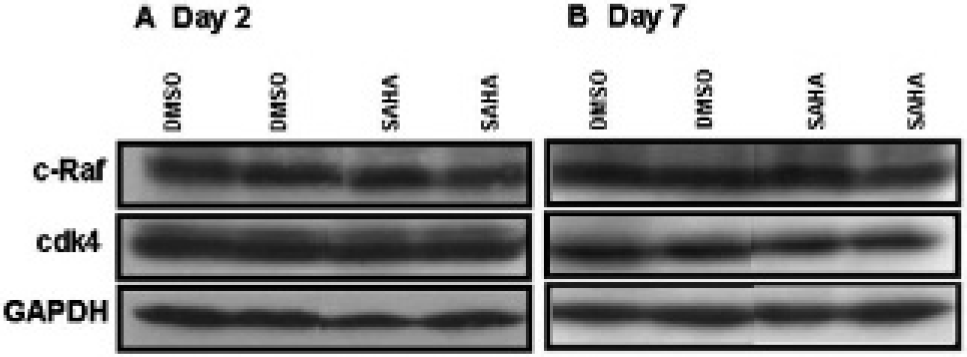
Western blot analysis of tumor lysates from the dimethyl sulfoxide (DMSO)-treated control group and the suberoylanilide hydroxamic acid (SAHA)-treated group showing that levels of the heat shock protein 90 client proteins c-Raf and cdk4 were not affected by 2 (A) and 7 (B) days of SAHA treatment. GAPDH = glyceraldehyde-3-phosphate dehydrogenase.
Discussion
In the work described here, our goal was to assess the value of MRS as a noninvasive method for monitoring the molecular action of HDACis in vivo. In particular, we wanted to confirm that 19F MRS of the exogenous fluorinated HDAC substrate BLT can be used to monitor HDAC activity, as indicated by our earlier cell studies. 24
First, we performed a pilot study to rule out substantial BLT toxicity in vivo when animals are exposed to MRS-detectable levels of the compound. Our study indicated that, as in the case of our previously described cell work, 100 mg/kg of BLT had no detectable toxicity. This is not surprising, considering that BLT is a lysine derivative, and no lysine toxicity has been reported in patients given up to 4 g of lysine per day for the treatment of herpes. 28
SAHA treatment of tumor-bearing animals led to inhibition of tumor growth, indicating treatment efficacy and consistent with previous reports of SAHA treatment in prostate cancer models. 5 Following intraperitoneal injection of BLT, the fluorinated compound was rapidly delivered to the tumor site, and its intratumoral uptake could be monitored by 19F MRS (see Figure 2). In general, tumoral levels rapidly reached steady state within 50 minutes of injection. Importantly, the steady-state level achieved was significantly higher in tumors treated with SAHA than in tumors treated with vehicle DMSO. This observation is entirely consistent with our observations made in PC3 cells in culture. Our previous studies indicated that BLT rapidly enters the cell and is cleaved to the 19F MRS-detectable TFA in the presence of active HDAC. 24 However, TFA is rapidly removed from cells, and only BLT can be detected by 19F MRS of the intracellular compartment. Thus, in cell studies, intracellular BLT levels were shown to inversely correlate with HDAC activity. Here our data indicate that, most likely, a similar process is occurring in vivo. BLT is delivered to the cells within the tumor, and depending on HDAC activity, or HDAC inhibition by the HDACi SAHA, BLT is either cleaved or remains unaffected within the tumor. If it is cleaved, the cleavage product TFA is most likely cleared from the intracellular compartment and then further cleared from the tumor via the circulation. If HDAC is inhibited, BLT remains unchanged within the tumor. Thus, as in the case of SAHA-treated cells, higher BLT levels are indicative of HDAC inhibition.
Importantly higher levels of tumor BLT were observed in SAHA-treated tumors within 2 days following onset of treatment—the first time point investigated. This is substantially earlier than the 6 days required to detect a significant difference in tumor size between control and treated tumors. Thus, BLT levels could be used as an early indicator of the activity of HDACis within the tumor, possibly predicting tumor shrinkage. Further, the fact that BLT uptake in the contralateral unaffected tissue of tumor-bearing mice did not increase significantly following 2 days of SAHA treatment points to the specificity of BLT as an indicator of tumor molecular response.
Our previous cell studies indicated that PC levels were also higher in SAHA-treated cells, and we showed that this was likely due to HSP90 inhibition, consistent with earlier work on the HSP90 inhibitor 17-AAG.22,24 To monitor PC levels in vivo, we monitored either the tCho peak or the PME peak using 1 H or 31P spectroscopy. However, no statistically significant difference was observed, indicating that PC levels remained unchanged by treatment in vivo. This finding was confirmed by monitoring PC directly using high-resolution MRS of tumor extracts. This observation is in contrast to in vivo studies describing an increase in the PME peak following treatment of a colorectal cancer xenograft with the HDACi LAQ824. 27 It should, however, be noted that the treatment with LAQ824 also resulted in depletion of the HSP90 client proteins, whereas our studies indicate that this is not the case in our SAHA-treated PC3 xenografts. Thus, although our in vivo findings with regard to the endogenous metabolite PC are not in line with our results in cells, our in vivo observations are entirely consistent with the lack of HSP90 inhibition in the in vivo treated PC3 tumors. This suggests that some of the molecular effects of HDACis in vivo differ from the molecular effects in cultured cells, at least in this tumor model and at this dose of SAHA. More importantly, the lack of change in the endogenous metabolites also further highlights the need for an exogenous indicator of molecular drug action such as BLT.
In summary, the results of our current studies confirm and validate 19F MRS of BLT as a novel and noninvasive MRS-based molecular imaging method for monitoring HDAC inhibition in vivo. This method could be used to monitor delivery and activity of HDACis specifically at the tumor site. Further, this work suggests that similar approaches could be used for the development of radiotracers and using PET to monitor HDAC inhibition in vivo.29,30