






Abstract
Nanomaterials functionalized with targeting ligands are increasingly recognized as useful materials for molecular imaging and drug delivery. Here we describe the development and validation of azide–alkyne reactions (“click chemistry”) for the rapid, site-specific modification of nanoparticles with small molecules. The facile preparation of stable nanoparticles bearing azido or alkyne groups capable of reaction with their corresponding counterpart functionalized small molecules is demonstrated. The Cu(I)-catalyzed cycloaddition of azides and alkynes is shown to be a highly efficient and selective method for point functionalization of magnetic nanoparticles. Derivatized nanoparticles bearing biotin, fluorochrome, or steroid moieties are stable for several months. Nanoparticle click chemistry will be useful for other nanomaterials, design of novel sensors, and drug delivery vehicles.
Introduction
Nanoparticles with optical and magnetic properties are emerging as useful materials for molecular imaging at the cellular [1], mouse [2], and human level [3]. In order to impart unique biological function (e.g., optimized pharmacokinetics) and targeting it is often necessary to attach affinity ligands to such materials. A number of different covalent conjugation strategies using amine (–NH2), carboxyl (COOH), aldehyde (CHO), and thiol (SH) groups exposed on the surface of nanoparticles have been developed [4]. Many of these strategies are robust, cost-effective, biocompatible, and fast. However, there is a need for alternate, selective immobilization strategies for complex biomolecules. Ideally, such approaches should be founded on chemical reactivity that is selective and orthogonal to other functional groups required for target binding. Furthermore, conjugation should be possible in parallel format for high-throughput synthesis and one-pot reactions for rapid scale-up. A matched pair of selective reacting groups would therefore be highly useful in the preparation of targeted imaging agents.
The use of azido and alkyne chemistries that allow site-specific “click reactions” to occur on biocompatible nanoparticles is detailed. The functionalities are stable over wide pH and temperature ranges and are compatible with a range of solvents. Although the conjugation is slow at room temperature, several strategies accelerate the conjugation, for example, Cu(I) catalysts [5], modified azido and alkyne reagents [6], and microwave chemistry [7]. In fact, this chemistry has been used to cross-link and orthogonally functionalize other polymeric nanoparticles for non-imaging uses [8]. To demonstrate the feasibility of site-specific attachment of small molecules to magnetic and fluorescent nanoparticles (MNPs), six different prototypes were investigated. These test systems demonstrate the facile conjugation chemistry as well as the stability and biocompatibility of the resulting linkers.
Results
The synthesis of “clickable” azido- or alkyne-derivatized MNPs is outlined in Figure 1. A convenient starting material is carboxylated polymer (e.g., bromoacetic-acid-modified cross-linked dextran) coated nanoparticles. Alternatively, amino functionalized nanoparticles can be converted to carboxylate functionalized MNPs by treatment with succinic anhydride [4]. Carboxylated MNPs were first reacted with azido propylamine using 1-ethyl-3-(3-dimethylaminopropyl) carbodiimide hydrochloride (EDC) and N-hydroxysuccinimide (NHS) as conjugation agents in MES buffer at pH 6.0 to afford azido MNP. A second strategy is attachment of alkyne groups to MNPs through the use of propargylamine (Figure 1). Functionalization of the MNP with azide or alkyne moieties was monitored by the loss of residual carboxylic acid groups and typically resulted in 60 reactive molecules per nanoparticle.
In a separate step (Figure 2), a number of biologically relevant molecules were derivatized to add azide or alkyne functionality. These model molecules included biotin, a far red indocyanine dye (VT680-S), an azo dye, taxane, and estradiol. Azido/alkyne biotin was synthesized by the reaction of biotin NHS ester with the appropriate azide- or alkyne-modified alkyl amine (82% and 89% yield, respectively). This methodology was applied to prepare the azide- or alkyne-modified fluorochromes. To functionalize native hydroxyl groups, we chose estradiol and Disperse Red 1 using CDI for activation. All reactions occurred at >85% yield and the products were purified by flash column.
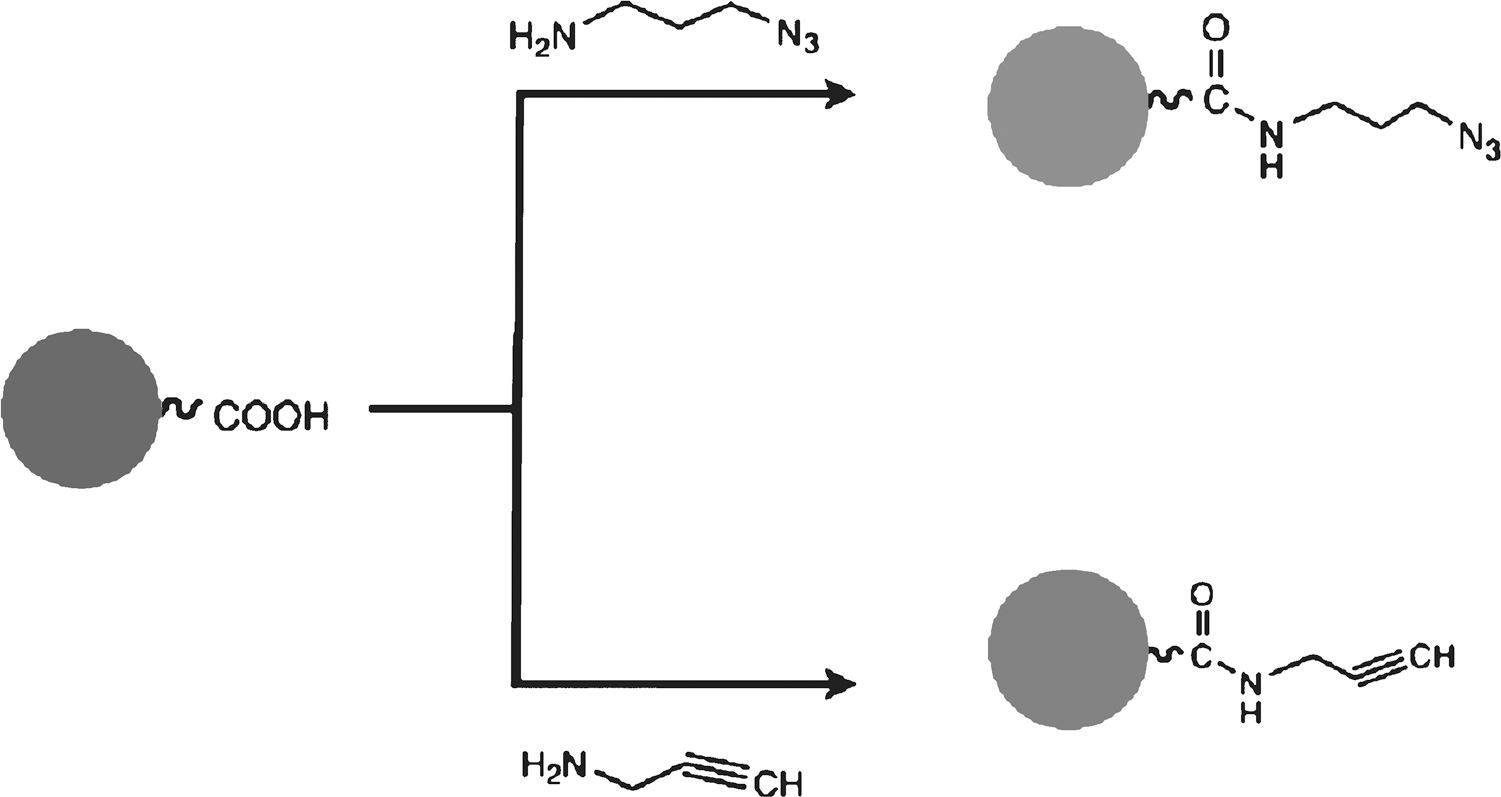
Reaction of MNPs with 3-azido propylamine to yield azido modified compounds and proparglymine to yield alkyne functionalized compounds.
To demonstrate and optimize the click reactions, sets of corresponding nanoparticle/small molecule pairs were chosen (Figure 3). In one set of experiments, alkyne MNPs were reacted with azido-functionalized small molecules in aqueous solution catalyzed by Cu(I). Typical reaction times were 5–8 hr at 37°C. All reactions resulted in >90% conversion of alkyne groups. Several methods were used to characterize the small-molecule functionalized MNP. As shown in Figure 4, fluorescein-modified nanoparticles had a characteristic absorption at 497 nm, whereas VT680-S conjugated MNPs exhibited absorption at 680 nm. Magnetic relaxation assays were also used to characterize the bioactivity of the small-molecule-modified nanoparticles [9]. With biotin-attached nanoparticles, the addition of avidin resulted in nanoparticle oligomerization as monitored by relaxivity changes (dT2 30 msec). In addition, azido MNPs were reacted with the alkyne-derivatized small molecules to give the corresponding small-molecule-conjugated MNP in similar yields. Finally, we tested the fluorochrome-labeled nanoparticle for its uptake into macrophages (Figure 5). As expected, there was considerable uptake into cells as demonstrated by fluorescence microscopy and FACS analysis.
Initial stability tests indicate that the triazol linkage formed between nanoparticle and the small molecule is stable under aqueous conditions. No noticeable decomposition was observed upon storage of the derivatized MNP for 3 months as monitored by fluorescence spectrophotometry.
Discussion
In this report, the utility of “click chemistry” for modification of biocompatible nanoparticles is detailed. The azido–alkyne cycloaddition reactions are specific, generate stable triazole linkers, and are biocompatible. In comparison to other bioconjugation strategies [4], click chemistry has several advantages. First, click chemistry can be carried out in aqueous solution under mild conditions. Second, click reactions are highly specific and form the desired products in nearly quantitative yield. Thus, typically, only a slight excess of one reagent is necessary to entirely react the limiting reagent. Furthermore, this reaction does not produce undesired by-products. Third, both azide and alkyne groups are stable under a variety of conditions and react to form biocompatible triazole linkers. A number of drugs bearing triazol groups have been approved by the FDA, such as Triazolam, a commonly used drug for insomnia.
Click chemistry has been advocated by Kolb et al. [10] and is used increasingly in modular drug development [11], small-molecule radiopharmaceuticals [11], and DNA sequencing [12]. In its most common form, click chemistry relies on the Husigen 1,3-dipolar cycloaddition between an azide and a terminal alkyne to form a 1,2,3-triazole. Because click chemistry has high reaction yields in aqueous solution, the reaction has been used for activity-based protein profiling [13] and targeted enzyme inhibitor discovery [14]. In the general click chemistry reaction, monovalent Cu(I) is used as a catalyst to facilitate the reaction. However, in some cases where Cu(I) is not tolerated, use of cyclic alkyne substrates has been shown to form triazoles in good yield, obviating need for the catalyst [6].

Modification of representative small molecules into matching azido (light gray) or alkyne conjugates (dark gray). Top row (from left to right): biotin, estrogen, indocyanine fluorchrome (VT680-S). Bottom row (from left to right): disperse red 1, fluorescein, paclitaxel.
The described conjugation reactions may find applications with other nanomaterials, such as those used for imaging, sensing [9,15], or drug delivery [16]. For example, quantum dots [1], magnetic [3], bismuth [17], silica nanoparticles [18], gold nanoshells [19], and ultrasound microbubbles [20] could be modified by the described azido–alkyne chemistry to develop targeted imaging agents. Finally, we envision that new classes of targeted nanomaterials could be developed by in vitro click chemistry in cell-based assays. This approach, coupled with high-throughput screening, may prove invaluable for the rapid development of targeted nanomaterials.
The examples described herein illustrate the convenient use of click chemistry for the attachment of chemically diverse sets of functional molecules to nanoparticles. Given the previously described application of click chemistry to a diverse set of building blocks, we believe that there are few limitations to their application in nanomaterial synthesis.
Materials and Methods
The reagents EDC and sulfo-NHS (sulfosuccinimidyl ester) were purchased from Pierce (Rockford, IL). Biotin NHS ester and paclitaxel 2-hemisuccinate were purchased from Molecular Biosciences (Boulder, CO). VT680 was obtained from Visen Medical (Woburn, MA), 1,1-carbonyldiimidazole (CDI) and all other chemicals were purchased from Sigma-Aldrich (St. Louis, MO) and used as received.
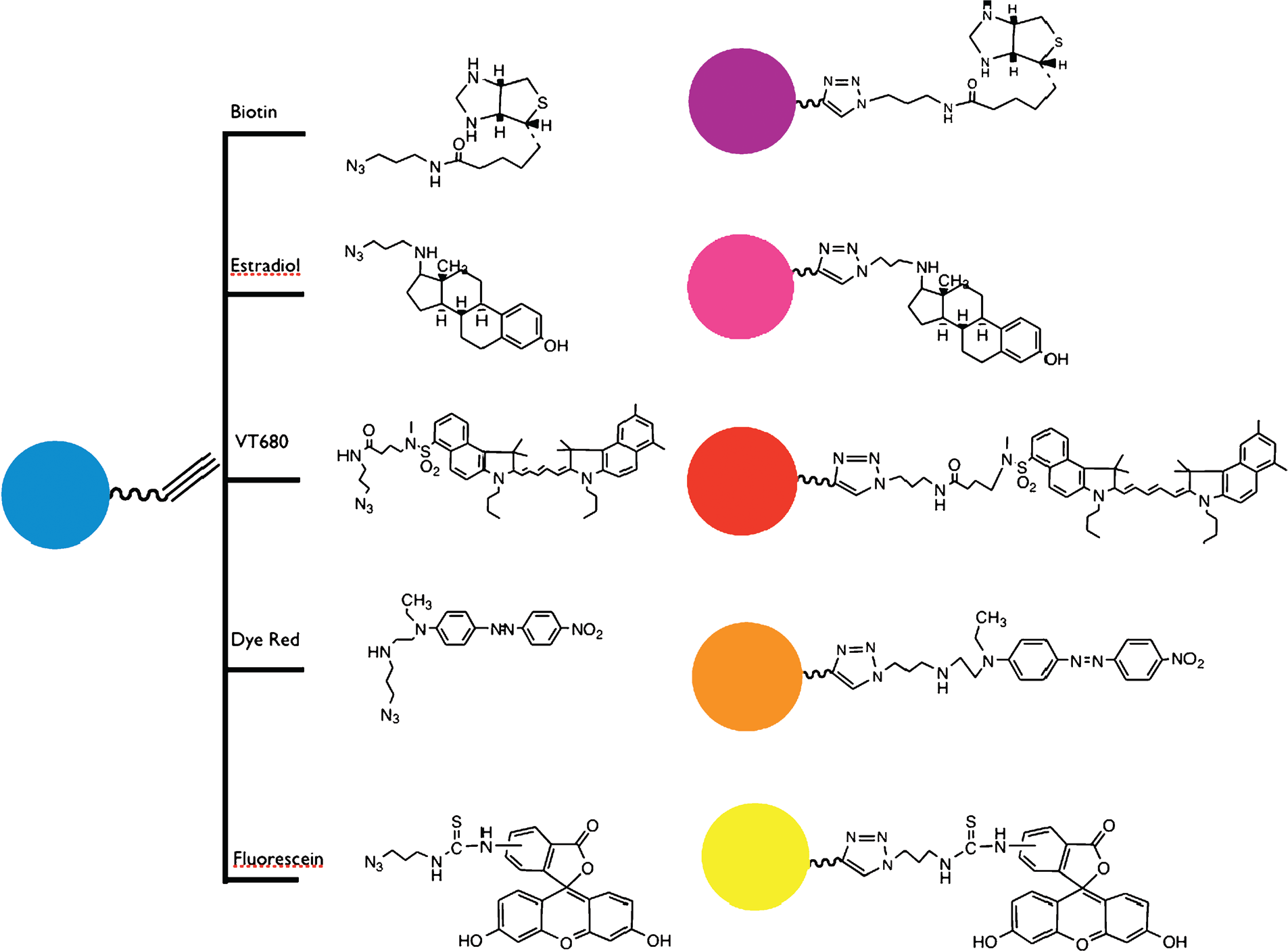
Conjugation of the representative azido compounds from Figure 2 with the alkyne-derivatized MNPs.
Nanoparticle Synthesis
The MNPs used in this study consist of an iron oxide core (5 nm diameter, 8000 Fe/particle) with a thick shell of 10-kDa dextran. Amino-cross-linked iron oxide (CLIO) nanoparticles were synthesized by cross-linking the dextran coating with epichlorohydrin and reacting it with ammonia to provide primary carboxyl groups or with ammonia to provide primary amine groups [21]. The number of amines per nanoparticle was determined using N-succinimidyl 3-(2-pyridyldithio) propionate (SPDP) method described previously [22].
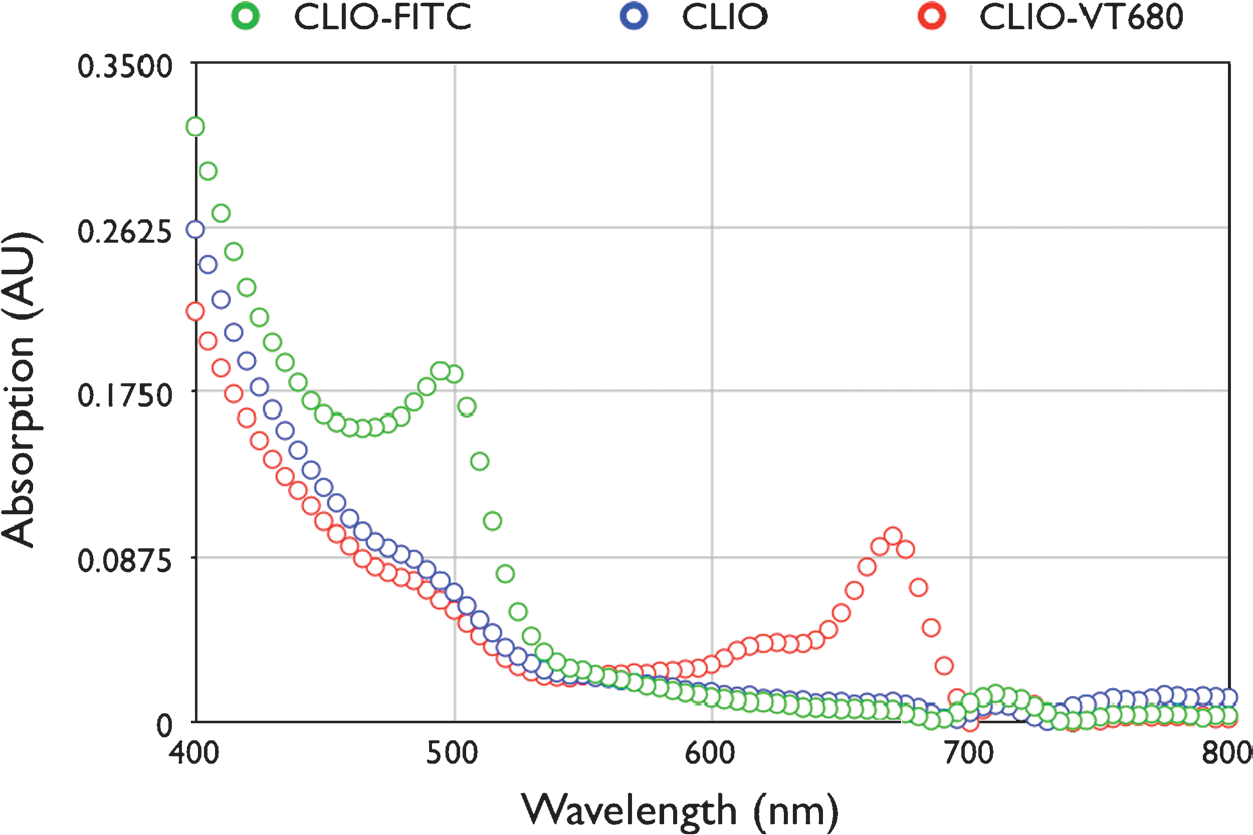
Absorbance spectra of free-alkyne-modified nanoparticles before and after conjugation with azido-derived fluorescence and VT680-S.

Cellular uptake of CLIO-VT680-S into macrophages (RAW cells).
3-Azido Propylamine Synthesis
The compound 1-chloro-3-aminopropane (6.5 g, 50 mmol) and sodium azide (9.75 g, 150 mmol) were dissolved in 50 mL distilled water and the solution was heated at 80°C for 15 hr. After cooling to 10°C, 4 g of KOH was added and the solution was extracted with diethyl ether (2 × 20 mL). After evaporation of the solvent, final product (4.35 g, 64.4%) was obtained.
Alkyne-CLIO and Azido-CLIO Synthesis
Carboxylic acid functionalized CLIO (1 mg) was dissolved in 0.1 M MES buffer, pH 6.0. To this solution was added propargylamine (0.55 mg, 10 μmol) in 200 μL DMSO followed by the addition of EDC (1.92 mg, 10 μmol) and NHS (1.15 mg, 10 μmol) in 200 μL DMSO. The reaction was incubated for 3 hr at room temperature and the product was purified using a PD-10 column eluting with 0.1 M bicarbonate buffer (pH 8.5). For azido-CLIO, a similar procedure was used except 3-azido propylamine was used in place of propargylamine.
Azido/Alkyne VT680-S Synthesis
The fluorochrome VT680-S-NHS (2 mg, 1.76 μmol) in 250 μL methanol was added to 3-azido propylamine (1 mg, 10 μmol) or propargylamine (0.55 mg, 10 μmol). The reaction was incubated overnight at room temperature. The crude reaction mixture was loaded onto a silica gel column, washed with CH2Cl2 to remove unreacted chemicals, and the final product was eluted with methanol.
Azido/Alkyne Biotin Synthesis
To biotin NHS ester (3.41 mg, 10 μmol) in methanol was added 3-azido propylamine (1 mg, 10 μmol) or propargylamine (0.55 mg, 10 μmol). The reaction was stirred under a nitrogen atmosphere at room temperature over night. The crude reaction was applied to a silica column and with the product was eluted with CH2Cl2. Solvent evaporation under reduced pressure gave the final product.
Azido/Alkyne Estradiol Synthesis
To a solution of estradiol (27.2 mg, 0.1 mmol) in 1 mL CH2Cl2, 1,1′-carbonyldiimidazole (CDI, 38.9 mg, 0.24 mmol) was added. The solution was stirred under a nitrogen atmosphere at room temperature and monitored by silica gel thin-layer chromatography. Upon completion, two drops of water were added to decompose unreacted CDI. This was followed by the addition of 10 mg (0.1 mmol) azido propylamine or 5.5 mg (0.1 mmol) propargylamine. Reaction was continued for an additional 4 hr at room temperature. The final product was purified by silica gel chromatography.
Azido/Alkyne Fluorescein Synthesis
To a solution of fluorescence isothiocyanate (20 mg, 0.05 mmol) in 5 mL methanol was added 3-azido propylamine (10 mg, 0.1 mmol) or propargylamine (5.5 mg, 0.1 mmol). The reaction was incubated at room temperature overnight and the solution was purified by silica gel chromatography. The solvent was evaporated to give a yellow product.
Azido/Alkyne Paclitaxel Synthesis
To a solution of paclitaxel 2-hemisuccinate (9.54 mg, 10 μmol) in 1 mL of methanol, 3-azido propylamine (2 mg, 20 μmol), or propargylamine (1.1 mg, 20 μmol) was added, followed by the addition of 200 μL EDC and NHS (100 mM in DMSO). The reaction was incubated at room temperature overnight and the product was purified by silica gel chromatography.
CLIO-VT680-S Synthesis
The CLIO-alkyne nanoparticles (250 μg) in PBS were added to 250 μL azido-VT680-S in 500 μL of bicarbonate buffer (pH 8.5) and CuI (30 μg) was added. The reaction was incubated at room temperature overnight and the final product was purified using PD-10 column eluting with PBS buffer. The final product was stored at 4°C for further characterization.
Conjugation of Other Small Molecules to Clickable Nanoparticles
Typically, clickable CLIO (azido- or alkyne-CLIO) (1 mg Fe in 0.1 M bicarbonate buffer, pH 8.5) was added to azido- or alkyne-functionalized molecules (5 mol in DMSO) with CuI (30 μg) as catalyst. The reaction was allowed to proceed at room temperature overnight and the final product was purified with a PD-10 column eluting with PBS buffer. The final product was stored at 4°C for further characterization.
Measurements
The T2 values were measured on a 0.47 T Brucker minispec and nanoparticle diameters were measured by a laser light scattering instrument. In a typical T2 measurement, small-molecule-derived CLIO was mixed with correspondent binding proteins incubated in PBS buffer, pH 7.4 at 37°C for 30 min before the T2 measurement. UV–Vis absorption spectra were recorded on Cary 50 Bio UV–Vis spectrophotometer. Uptake of CLIOVT680-S was tested in RAW 264 cells (macrophage-like cell line) and determined by fluorescence microscopy (Nikon Eclipse, Tokyo, Japan) and FACS analysis (FACScalibur BD Biosciences, San Jose, CA).
Footnotes
Acknowledgments
The authors would like to acknowledge the help of Nikolay Sergeyev for synthesizing CLIO, Kim Kelly and Rajesh Anbazhagan for cell experiments and others for useful discussions on click chemistry: Timothy Sawger, Tim Lewis, Stan Shaw, Hartmuth Kolb, Scott Hilderbrand and Jason McCarthy.