






Abstract
Environmental risk assessment is an essential step in the development of solutions for pollution problems and new environmental regulations. An assessment system for environmental risks has been developed in China in recent decades. However, many of the Chinese technical guidelines, standards, and regulations were directly adapted from those of developed countries, and were not based on the Chinese environmental and socioeconomic context. Although existing environmental regulations for pollutants are usually obtained by extrapolations from high-dose toxicological data to low-dose scenarios using linear-non-threshold (LNT) models, toxicologists have argued that J-shaped or inverse J-shaped curves may dominate the dose–response relationships for environmental pollutants at low doses because low exposures stimulate biological protective mechanisms that are ineffective at higher doses. The costs of regulations based on LNT and J-shaped models could therefore be dramatically different. Since economic factors strongly affect the decision-making process, particularly for developing countries, it is time to strengthen basic research to provide more scientific support for Chinese environmental regulations. In this paper, we summarize current Chinese environmental policies and standards and the application of environmental risk assessment in China, and recommend a more scientific approach to the development of Chinese regulations.
1. INTRODUCTION
Since the State Environmental Protection Administration (SEPA) issued the
2. ENVIRONMENTAL RISK ASSESSMENT POLICIES AND GUIDELINES
In 1990, SEPA (1990) required an environmental risk assessment to account for the possibility of potential environmental accidents. According to these regulations, both new projects and expansions of old projects with a significant chance of accidents (i.g., chemical, petroleum, nuclear and pharmaceutical industries) should be assessed in terms of their environmental risks as part of the project's overall environmental impact assessment. However, before 2004, environmental risk assessments were conducted according to the guidelines and technical documents developed in other countries. The following guidelines have been widely applied in China:
Based on these guidelines, China's Ministry of Environmental Protection (It replaced the SEPA during the March 2008 National People's Congress sessions in Beijing) issued technical guidelines for environmental risk assessment in projects (SEPA 2004) on 11 December 2004. The guideline, which describes and defines the procedures and technical methods that should be used in environmental risk assessments, is the first Chinese technical document that focuses on environmental risk assessment, and is therefore of great instructional importance. Since this guideline was published, environmental risk assessment has been gradually standardized due to the important role played by this document in the Chinese environmental risk assessment system.
The 20 years of development and improvement that have occurred since 1990 have led to the publication of many policies and guidelines (Table 1), and a basic system of policies for environmental risk assessment and the associated technical framework have been established in China. However, environmental risk assessment is still in its early stages in China. The assessments mainly focus on construction projects and are administered by governmental bureaus. Even though planning for these assessments is becoming an increasing focus of attention, many of the required supporting policies have not yet been issued.
list of the policies and guidelines currently in force in China.

Similarly to the case for Mainland China, the Hong Kong and Macau Special Administrative Regions have no independent environmental risk assessment regulations (FFTI 2008). In these regions, environmental risk assessments are only mentioned in various environmental standards and guidelines for air, noise, waste, water, and environmental assessment and planning. In Hong Kong, the
An overall system of policies for environmental risk assessments to protect public health and the ecological environment has not yet been established in mainland China or either of the two special administrative regions. Further efforts are therefore needed to let project managers and government officials plan environmental risk assessments, establish a policy framework for these assessments, and promote the development of a comprehensive policy system. Another problem is that, as we noted pre-viously, most of the technical systems and methods are based on foreign research; for example, the technical framework for nuclear plants is based on USNRC (1975), and the
In Hong Kong, the
3. STANDARDS AND THRESHOLD VALUES
The development of threshold values for a range of pollutants is a fundamental part of environmental risk assessment. Unfortunately, few standards and threshold values have been issued in China. In the current environmental risk assessment framework, the standards and threshold values for risky materials are important references to identify and judge the acceptability of these materials. According to the
The regulation demonstrated the importance of the LC50 and IDLH parameters as environmental risk threshold values. LC50 can be obtained from various reference books, including the
Currently, standards related to threshold values in China include the
The standards used for environmental risk assessment in China.
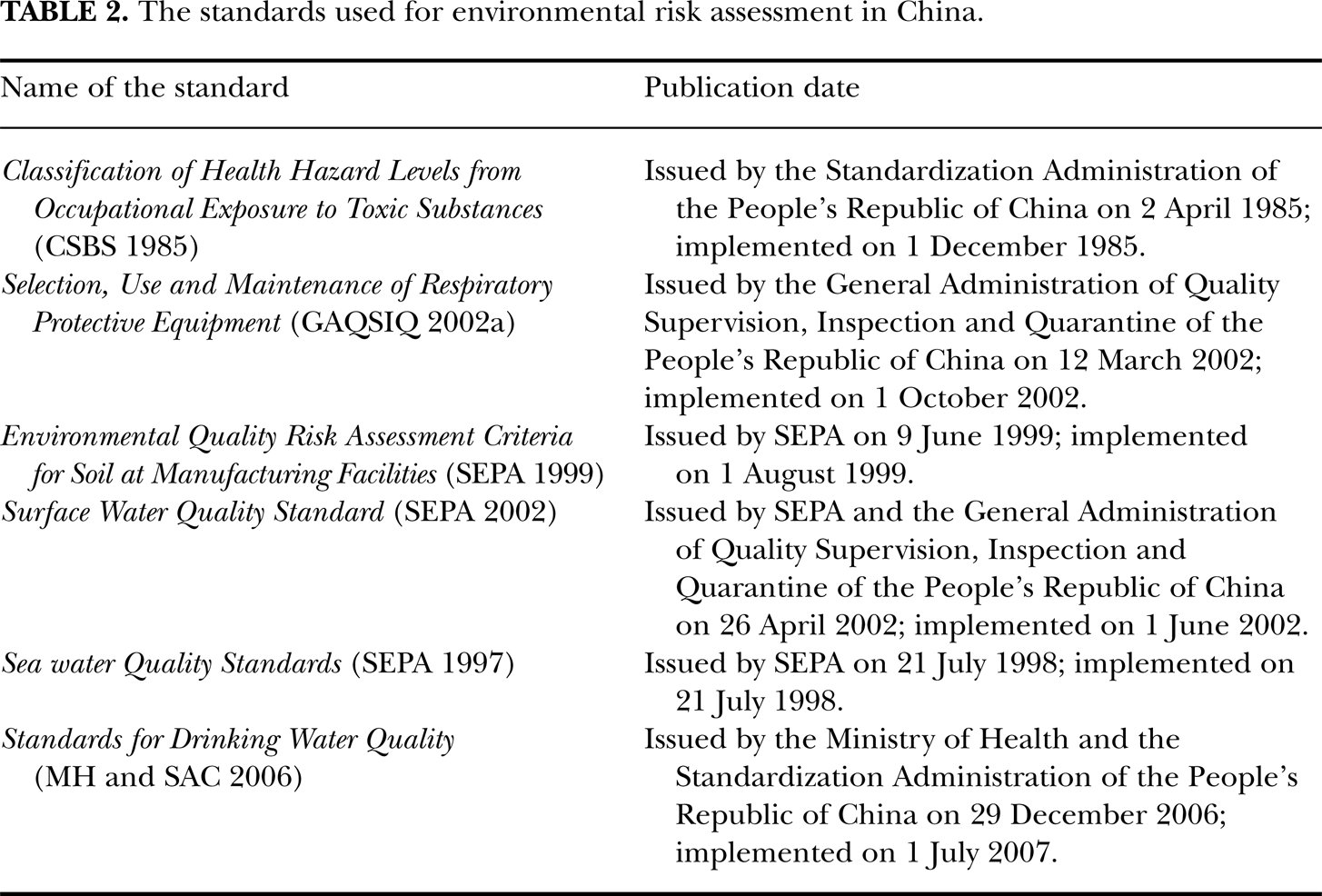
The
The
Comparison of the standard values for some soil pollutants in China and the United States.

the benchmark based on carcinogenic risk
the benchmark based on non-carcinogenic risk
Dilution Attenuation Factor
Due to the lack of threshold values prepared for hazardous and toxic substances emitted into bodies of water, the
Comparison of water quality indexes in various Chinese standards.
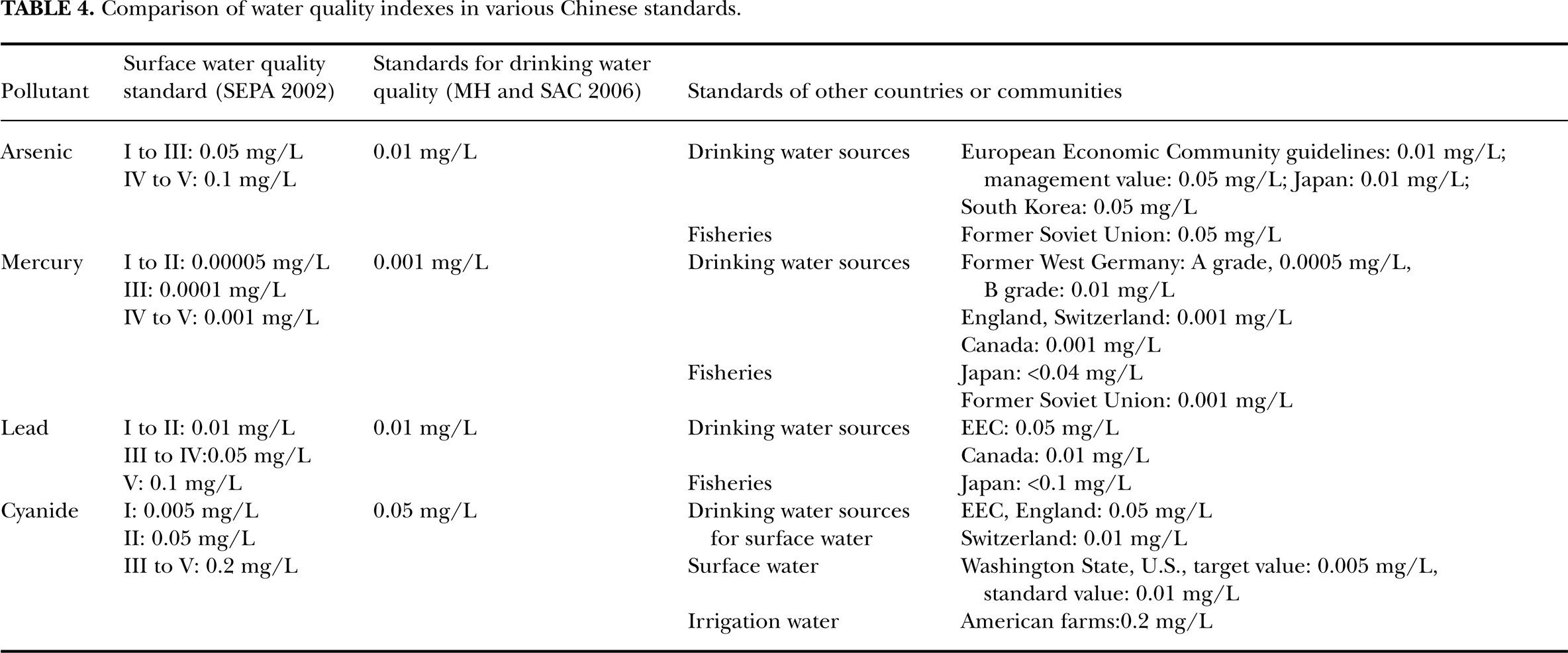
For example, in 1976, USEPA proposed a maximum contaminant level (MCL) of 0.05 mg/L for arsenic in drinking water as part of the
Mercury is another example. In the
Fish (and especially commercially valuable fish) are also highly sensitive to lead. The toxicity of lead in the water is influenced by the water's pH, hardness, and other factors. USEPA (1976) set a standard value of 50 μg/L to provide guidance to water suppliers that would account for non-health effects such as those on fish. In 1980, USEPA recommended a standard value of 56 μg/L for lead in ambient water because they believed that this standard value would protect humans from the health hazards caused by lead intake (USEPA 1980). Based on the U.S standard, China issued a more stringent standard by defining the standard concentration of lead as 10 μg/L (the analytical detection limit) for class I and II water, 50 μg/L for class III and IV water, and 100 μg/L for class V water.
Chinese standard developers also defined values for cyanide based on the toxicology index of this compound to both guarantee human health and protect aquatic organisms. They used free cyanide in the water as an indicator. Aquatic organisms (and especially salmonids) are much more sensitive than terrestrial organisms to cyanide, and in 1976, USEPA (USEPA 1976) proposed a benchmark of 5 μg/L for the protection of aquatic organisms. In 1985, a 4-d mean cyanide contamination level of 5.2 μg/L was proposed (USEPA 1985). Because these two benchmark values were both about 5 μg/L, the developers of the Chinese standard believed that this benchmark could protect aquatic organisms (including sensitive fish), and defined a cyanide level of 5 μg/L for water class I. In 1999, USEPA set a cyanide level of 700 μg/L as the benchmark for protecting human health (USEPA 1999). Because of the centralized drinking water sources used to supply class II water, the standard developers increased security by choosing 50 μg/L as the standard value for cyanide in water class II areas, which is a lower value than the benchmark used for the protection of human health. In addition, studies showed that 200 μg/L of free cyanide is a lethal concentration for most fish (USEPA 1976). Therefore, standard values for water classes III, IV and V areas were set at 200 μg/L based on the acute toxicity benchmark for the protection of human health and most fish.
However hydrologic and geological conditions in china, and the species and ecosystems affected by these conditions may be significantly different from those in the areas of U.S. for which the USEPA standards were developed. It is therefore evident that risk threshold values for water quality should be studied more intensely in China to confirm that the abovementioned values (and values for other key pollutants) are appropriate. Furthermore, fundamental research on aquatic toxicology is needed in order to develop a set of risk threshold values that are suitable for the aquatic environment and organisms in China.
The guidelines for environmental risk assessments for contaminated land are particularly important guidelines because industries producing large amounts of pollution are increasingly being moved out of populated urban areas, after which the land is reused for other purposes. For example, during the planning that occurred during the development of the
The compilation of the national
Comparison between China and the United States of exposure parameters for soil risk assessment.

As a special risk factor, ionizing radiation has received much attention from the Chinese government. Many standards have been developed for common radiation sources and certain sites where radioactive materials are used, except nuclear facilities such as power plants, for which the only standard is
Because of the large number of references used in the standards development process, most of the standard values developed by international authorities such as the International Commission on Radiological Protection (ICRP) and IAEA were adopted in many Chinese standards. For example, the
For historical reasons, Hong Kong and Macau have their own separate systems of environmental standards, in which the values were adopted directly from European standards. For example, the drinking water quality standards used by the Hong Kong Government follow the WHO standard, whereas Macau's government follows the European standard. However, there are few legislative standards and threshold values for environmental risk assessment.
4. CASE STUDIES
Recently, a number of environmental risk assessment studies have been conducted for Chinese construction projects; the fields include the petrochemical industry, fossil fuel–based power generation, and pipeline transportation. The properties of these projects were analyzed while determining the scope of the effects of each project, and specific thresholds were decided accordingly for each project (Fang et al. 2009; Cai 2010; Dong 2010). Fang et al. (2009) evaluated the environmental risk assessment in a project in which coal chemical industry proposed the production of 1.5 Mt methanol as an example. The main steps were project engineering analysis, identification of materials that posed an environmental risk, identification of major hazards, prediction of environmental risks, assessment of the risks that would be created by accidents, precautionary measures to reduce the environmental risk, and the preparation of contingency plans. The lethal concentration of methanol was set at 86 000 mg/m3, and the upper limit for the concentration in the environment was set at 260 mg/m3 (OSHAPEL-TWA). (Zhang 2008).
As another example, X.Q. Zhang et al. (2009) predicted the consequences of the maximum credible accident for a proposed petrochemical project that would produce propylene by means of catalytic pyrolysis of residues. To do so, they used the environmental risk assessment procedure recommended in
Relatively few studies have assessed the environmental risks created by fossil fuel–based power plants. Zhang (2009) analyzed the impact of extensive emissions of SO2 on the surrounding vegetation caused by a malfunction in the plant's dust removal efficiency. He defined an SO2 concentration that would produce 5% visible leaf damage on crops as the threshold value. The environmental risk assessments for other projects used China's national standards to define the concentration thresholds. For example, Yu et al. (2008) studied a delayed coking project with an annual production of 1 Mt. Based on the procedure in the recommended environmental risk assessment guideline (SEPA 2004), fire was selected as the accident with the maximum likelihood of occurrence, and the “Large Outdoor Fire Plume Trajectory Model-Flat Terrain” was used to predict the plume and the distribution of combustion products down-wind. In this study, the carbon monoxide concentration threshold regulated by the
In some other cases, the LC50 values from relevant Chinese standards such as the
Because of the current lack of consistent guidelines, regional environmental risk assessments are still being studied. Chen et al. (2006) selected the LC50 and the 100% lethal concentration of a leaking gas as the threshold for determining the risk rating. Yang et al. (2006) studied a development area along the Yangtze River (the Jiangsu section) and applied a framework with four subsystems (risk sources, elementary control mechanisms, secondary control mechanisms, and receptors) in their case studies. They developed index systems and a formula to compute the “system partial value” for the whole area in which development was occurring:

where
Qu et al. (2010) developed an environmental risk assessment index system with two groups of indexes that represented the hazard posed by the cumulative hazard posed by all potentially dangerous substances and the fragility of the ecosystem to assess the environmental risk status in each Chinese province. The study used time-ordered weighted averaging to determine a time vector that would permit a dynamic integrated assessment for all Chinese provinces; based on the resulting 5-year environmental risk status, the provinces were divided into regions with high, medium, and low risk.
Xu and Liu (2009) proposed an environmental risk assessment method based on the use of gridded information dispersion. This method is based on fuzzy set theory, and their model effectively disperses each individual source of environmental risk. By conducting the information dispersion, they were able to group and analyze the acquired regional environmental risk index under specific regional environmental risk classification standards, and produced a distribution map for the environmental risk. Case studies using this method included studies of Huangge Town and Nansha Town in the Nansha Area of Guangzhou City. Each risk source was grouped into four categories (i.e., lethal zone, heavy injury zone, light injury zone, and inhalation reaction zone), and they obtained the environmental risk distribution for hazardous gases using a simplified calculation according to fuzzy set theory.
Xu et al. (2004) assessed the ecological risk for the Yellow River Delta region by defining and analyzing the target area, analyzing receptors and risk sources, analyzing the hazard exposure, and performing an integrated risk assessment. The risk sources were identified as flooding, drought, storm surges, oil spills, and disruption of the Yellow River's flow. The ecological loss for each ecosystem in the study area was quantified using a species conservation index, biological diversity index, perturbation intensity, degree of the natural state, fragility index, and ecological loss index. Since the risk sources differed in their intensity of effects on the corresponding receptors, Xu et al. (2004) used the analytical hierarchy process to assess the dominant ecological risk sources. Based on the integrated risk probability, the integrated ecological loss, and the integrated ecological risk index, they calculated a risk index for each sub-region within the study area and classified the results into five categories.
The abovementioned studies demonstrate that the use of integrated indexes is still the dominant approach to regional environmental risk assessment in China. However as these examples show, each researcher used a different approach, and there has been no standardization of methods that would provide a consistent framework for these evaluations.
Because there are no shared technical guidelines for health risk assessment in China, this kind of assessment is still being studied. Zheng et al. (2010) evaluated the health risk of Urumqi's drinking water resource using a method recommended by USEPA (1992), in which organochlorine pesticides enter the human body primarily through drinking water. They concluded that the carcinogenic and non-carcinogenic risks acquired from each monitoring section were lower than the maximum acceptable risk recommended by USEPA (2004). The formulas used in the calculation and the selection of parameters, such as the carcinogenic slope factor and non-carcinogenic reference dose, were adapted from USEPA (2004).
Zhang et al. (2010) applied an improved Monte-Carlo method to conduct a health risk assessment based on the quality of the effluent from a wastewater treatment plant in Xi'an. The reference dose and carcinogenic intensity coefficient in the formula were determined using rules proposed by international cancer research institutes, WHO, and USEPA.
A number of other studies applied methods developed in the United States to conduct health risk assessments, such as growing rice in a polluted field and measuring pollutant concentrations in the grains (Lei et al. 2010), and analyzing concentrations in surface water (Ji et al. 2010a; Kai et al. 2010) and groundwater (Ji et al. 2010b). The American methods are still the dominant approach used in China. In many cases, methods have been adapted from American environmental health risk assessment guides and the threshold values were from the United States or other countries. Thus, environmental health risk assessments in China still rely almost exclusively on methods and applications developed in other countries, and China lacks techniques that are focused on the Chinese context and effective support for these guidelines based on fundamental research data in that context.
5. CONCLUSIONS AND RECOMMENDATIONS
Environmental risk assessment in China has entered a critical period. After several decades of development, this field has made great progress in the establishment of policies and standards, as well as in their application. However, the situation remains imperfect because a complete and consistent system has not yet been established. The development of environmental risk assessment methods and standards for accidents, contaminated sites, and human health has just started in China. In particular, basic research to develop standard values and thresholds is weak, with most of the guidelines, standards, and thresholds directly adopted from values in other countries. Most of the applications also follow the methodologies used in developed countries. Unfortunately, during the decision-making process related to assessing environmental risks, neither the suitability of foreign regulations to the Chinese context nor the reliability of the assessment process used to determine the threshold values has been evaluated.
In most developed countries, there are differences of opinion about the risk assessment process that should be used for developing regulations. For example, in the United States, regulatory agencies assume that cancer risk follows a linear increase at low doses, but hormesis phenomena (i.e., beneficial effects at low doses) that result in J-shaped dose–response curves have been widely reported, independent of the biological model, measured endpoint, and chemical class or physical stressor that were studied (Calabrese and Baldwin 2003; Calabrese 2010). This is believed to occur because low exposure levels may stimulate biological protective mechanisms that are ineffective at higher doses. Obviously, predictions of adverse effects based on a J-shaped dose–response model and a linear non-threshold model would produce quite different results in the low-dose region, and this would result in the selection of different threshold numbers. Figure 1 conceptually compares the predictions of adverse effects using these two conceptual models. In an extreme case, if the J-shaped model is true and the acceptable upper bound of the cancer risk for a given dose is below the turning point on the J-shaped curve, it is not necessary to reduce the dose; in contrast, a linear non-threshold model would suggest the need for measures to reduce the dose, leading to higher regulatory costs. Since economic factors are an important consideration when making regulatory decisions in developing countries, where budget constraints can be significant, it is critical to establish a more scientifically based risk assessment system at the current stage of China's development. Therefore, it will be important to strengthen basic research on environmental risk assessment so that China can develop a more suitable and scientific approach to the determination of risk thresholds—one that is optimal for the Chinese context.

Comparisons of the predictions of adverse effects using a J-shaped (hormetic) dose–response model and a linear non-threshold model.
Footnotes
ACKNOWLEDGMENTS
This work was supported by the National Natural Science Foundation of China (No. 40701004), the Program for Changjiang Scholars and Innovative Research Team in University (No. IRT0809), the National High Technology Research and Development Program (No. 2008AA06A404) and the Fundamental Research Funds for the Central Universities.