






Abstract
Objective
To document changes in body composition and body mass in male and female tree planters.
Methods
Height, mass, skin-fold thickness, and limb girths were measured in 17 male and 5 female tree planters before and after 10 weeks of work.
Results
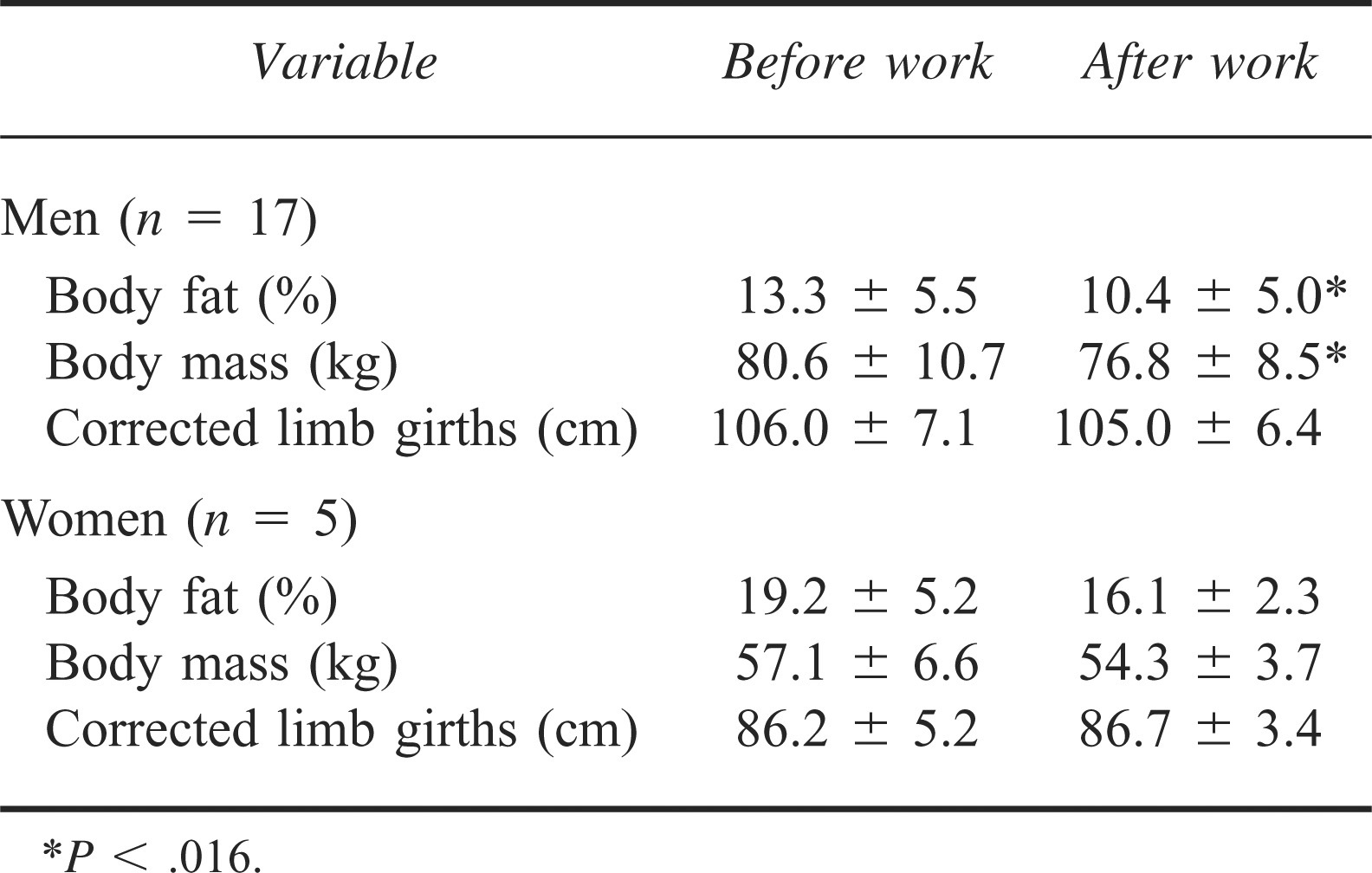
Significant decreases were found in body mass (80.6 ± 10.7 kg vs 76.8 ± 8.5 kg) and body fat (13.3% ± 5.5% vs. 10.4% ± 5.0%) in the men (P < .05). No changes in skin-fold–corrected limb girths were found in the men or women. Initial body mass was significantly (P < .05) correlated with mass loss in men (r2 = .46) and women (r2 = .67). Estimated daily energy consumption was 20680.1 ± 2204.5 kJ for men and 14516.6 ± 2077.3 kJ for women, and estimated daily fat consumption was 194.2 ± 30.1 g for men and 132.3 ± 35.6 g for women.
Conclusions
Ten weeks of tree planting leads to significant decreases in body mass and body fat in men while maintaining skin-fold–corrected limb girths.
Introduction
Reforestation of harvested areas in Canada is achieved by manual labor of tree planters who are typically employed seasonally for 3 to 6 months in an environment that is both physically and psychologically demanding. The majority of tree planters live in remote bush camps often situated several-hours’ drive from any urban center and typically work alone in conditions requiring them to deal with variable weather, insects, and very rudimentary accommodations. Reforestation work consists of physical movements that are repeated thousands of times per day, and workers are paid according to production. For this reason, the physical work pace is often grueling. Tree planters typically move a distance of 16 km while carrying loads of approximately 17 kg during the course of a workday, with heart rates of approximately 120 to 130 beats/min.1,2 Roberts 1 has calculated that the majority of the 7- to 9-hour workday is spent at between 60% and 75% of maximal heart rate. Other physical work typically included in a tree planter's workday, but not previously measured, includes loading and unloading equipment from vehicles and repetitive upper-body exertion during the planting of approximately 1300 to 1500 tree seedlings each day.1,2 The extreme nature of the activity undertaken by tree planters is physically taxing and typically leads to an injury rate of 50% to 90% during a career,2,3 which is likely to last less than 5 seasons. It is likely that physiological and body composition changes occur as a result of this long-duration physical activity; therefore, tree planting is an interesting occupation for study in the fields of body composition and applied physiology. Previous studies examined changes in biochemical markers1,3 and mechanisms and rates of mechanical injuries1,2,4 and found elevated serum enzyme activity (creatine kinase, lactate dehydrogenase, and aspartame transaminase) and greater injury rates than those of average physical laborers.
Abundant data describe the effects of continual exercise on body composition, and it has been clearly demonstrated that long-term aerobic exercise generally leads to fat and mass loss. 5 –10 Only 1 study to date contains data on body composition changes in tree planters during a season. 1 Therefore, the purpose of this study was to characterize body composition changes for a group of male and female subjects working as tree planters during a period of approximately 10 weeks.
Methods
Subjects
A total of 17 male and 5 female subjects volunteered for this study from a pool of 35 workers on a reforestation crew. Of the men, 9 had a mean of 1.6 seasons of previous tree-planting experience and 8 had no previous experience. Of the women, only 1 had previous experience in the industry (for 2 seasons). Written informed consent was obtained from all subjects before participation as approved by The University of British Columbia Committee on Human Experimentation.
Description of Environment
During the season, the pool of 35 workers from which our subjects volunteered planted a mean number of 72 500 seedlings. The workweek typically consisted of six 12-hour days (breakfast at 0600 hours and supper at 1800 hours) including an average daily transportation time of 46 minutes and 1 day off spent in the nearest town. Over the course of the season, workers lived in 4 subsequent bush camps averaging 61.3 km from the nearest town (population >500) and 786 m above sea level.
Experimental Measures
Measurements of height, body mass, skin-fold thickness, and limb girths were taken before and after the approximately 10-week work period on each subject. Pre- and postmeasures were performed 2 to 3 hours after an evening meal. During both the pre- and the posttests, each of the following 9 skin-fold sites were measured twice with skin-fold callipers (Harpenden HSK-BI, John Bull British Indicators Ltd, St Albans, Herts, UK): biceps, triceps, subscapular, midaxillary, chest, iliac, abdomen, thigh, and medial calf. Measurements were repeated if the 2 values had a difference greater than 1 mm. Both pre- and postmeasures were performed by the same person, certified by the Canadian Society for Exercise Physiology. To avoid any bias, the premeasures were not reviewed until all the postmeasures were complete. The 2 measures at each skin-fold site were averaged and used to calculate body fat with the generalized equations for body density by Jackson and Pollock11,12 and the equation for body fat by Siri. 13
Upper-arm, thigh, and calf girths were measured twice at each site with a flexible tape measure and repeated if the values had a difference greater than 5 mm. The 2 values at each site were averaged and used to estimate skin-fold–corrected girths. Skin-fold thickness was assumed to be twice the adipose tissue thickness, and skin-fold–corrected limb girths, Cm, were calculated according to the formula Cm = Climb – πS, where Climb is limb girth and S is skin-fold thickness. This formula has been used previously as an estimate of limb-muscle circumference. 14 –18
Five male subjects recorded food consumption for 1 day each, and 2 female subjects recorded food consumption for 3 days each. Records of food consumption were analyzed with Diet Analysis Plus 5.0 software (Wadsworth/West Publishing, Belmont, Calif) for energy content, fat, protein, carbohydrate, and other nutrients.
Statistics
Descriptive statistics (mean ± SD) were calculated for age, height, mass, days of work, and nutritional measures. Paired t tests were used to analyze the mass, body fat, and girth data with α = .05 by using a computer statistical package (SPSS 11.5 for Windows, Chicago, IL). A Bonferroni adjustment was used to reduce the possibility of type I error (α = .05/3 = .016). Pearson moment correlations were used to examine the relationships between mass and mass loss and between body fat and fat loss.
Results
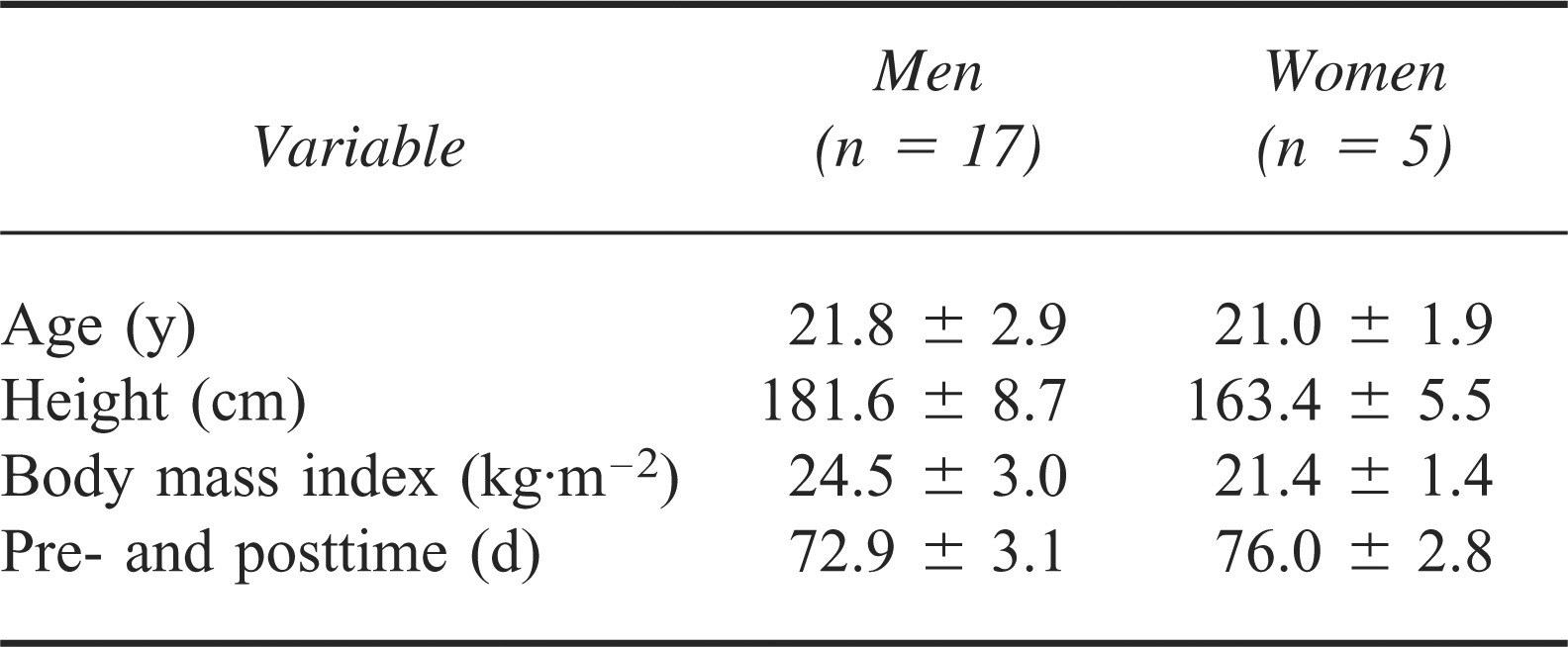
Subject characteristics are presented in Table 1. Over the course of the 10 weeks, subjects worked 49.8 ± 3.0 days. Men experienced significant decreases in body fat (P = .0007) and body mass (P = .001). The women experienced no significant changes in body fat (P = .20) or body mass (P = .20). Range of mass loss and body fat loss were −1.2 to 14.1 kg and −1.9% to 9.7% for men and −0.9 to 8.7 kg and −2.7% to 8.8% for women (a negative score denotes an increase). The distributions of skin-fold thickness are presented in Figure 1 for the men and Figure 2 for the women. No significant changes were found in skin-fold–corrected limb girths (Table 2) in the men (P = .20) or women (P = .80). A significant positive correlation was found between premeasured body mass and mass loss in the men (r2 = .46, P = .003) and women (r2 = .80, P = .04) and between premeasured body fat and fat loss in the women (r2 = .82, P = .03). The patterns of skin-fold–site thickness are presented in Figure 1 for the men and Figure 2 for the women. For the days on which nutritional data were collected, mean energy consumption was 20680.1 ± 2204.5 kJ for the men and 14516.6 ± 2077.3 kJ for the women, and daily fat consumption was 194.2 ± 30.1 g for the men and 132.3 ± 35.6 g for the women.
Subject characteristics (mean ± SD)
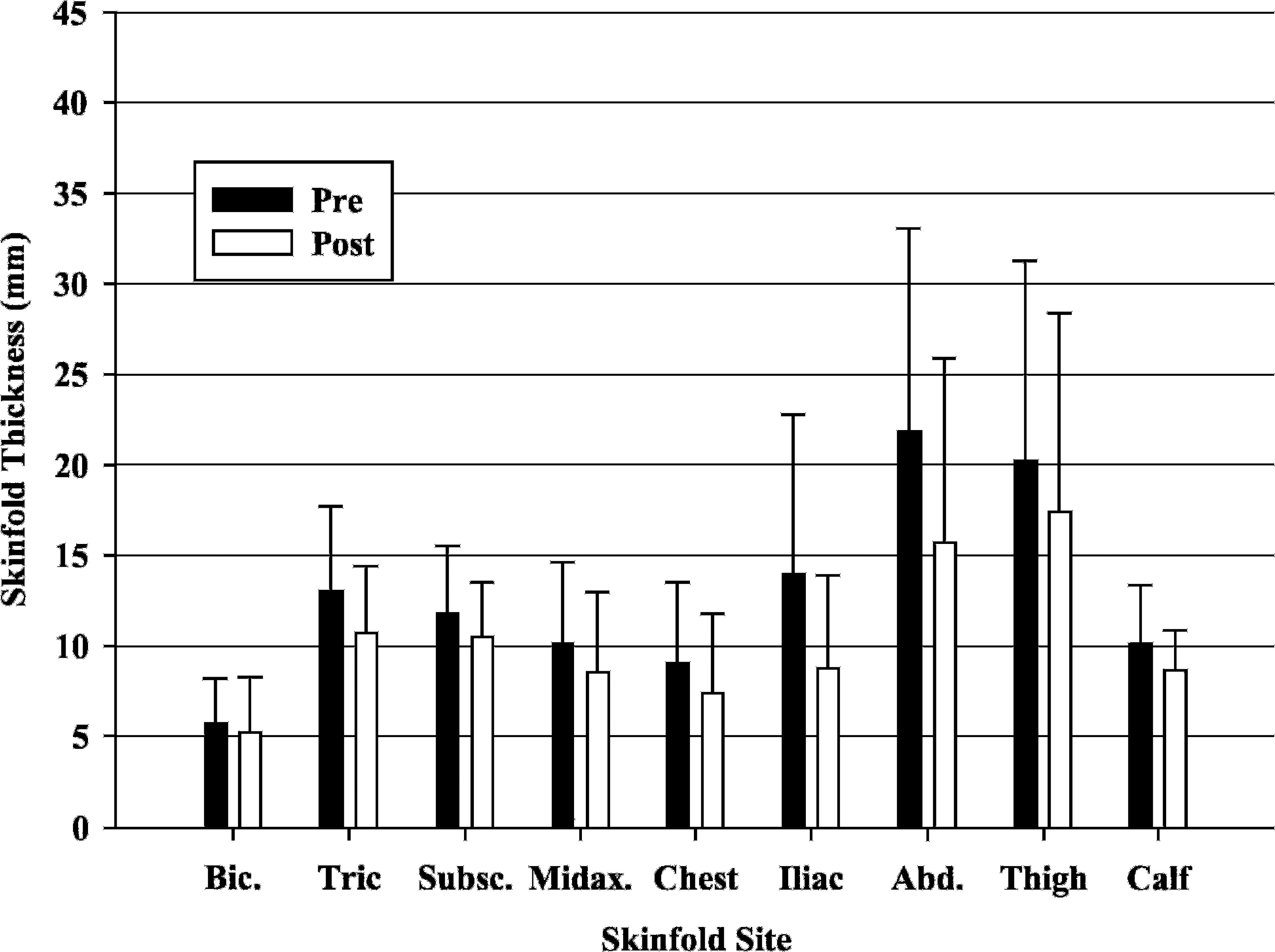
Male pre- and postmeasures of skin-fold thickness (mean ± SD) for biceps, triceps, subcapular, midaxillary, chest, iliac crest, abdomen, thigh, and medial calf.
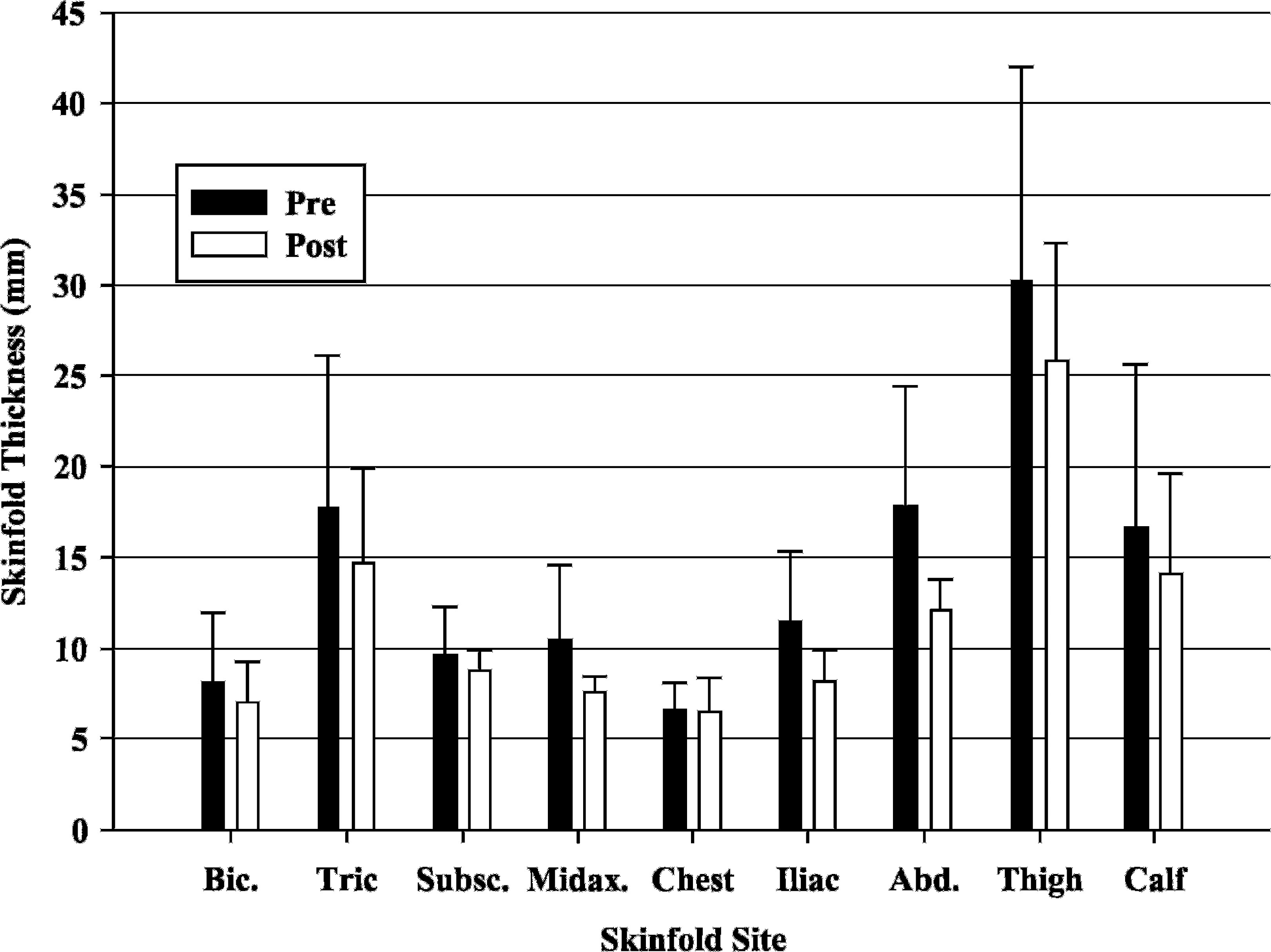
Female pre- and postmeasures of skin-fold thickness (mean ± SD) for biceps, triceps, subcapular, midaxillary, chest, iliac crest, abdomen, thigh, and medial calf.
Changes in body fat, body mass, and corrected limb girths in men and women before and after approximately 10 weeks of reforestation work (mean ± SD)
Discussion
The purpose of this study was to characterize body composition changes for a group of male and female subjects working as seasonal tree planters. The main findings of the study were significantly decreased body fat and body mass in the 17 male subjects during the 10-week period. The greatest individual decreases in body mass of 14.1 kg and body fat of 9.7% (not observed in the same subject) are large when compared with previous studies involving physical activity for a similar time period.7,19
Despite similar decreases in the female subjects, statistical significance was not achieved because of the limited number of female subjects available for study. For the difference in means and SDs found, a post hoc power test revealed that a sample size of 13 female subjects was necessary to achieve statistically significant decreases in body fat and body mass, given α = .05 and β = .80. Unfortunately, recruitment of more female subjects was not possible because of the limited number of women employed in this group of reforestation workers. Although no conclusion may be drawn from the female-group data, with the consistent direction and large magnitude of changes observed, we believe results similar to those in the male-group data would be likely if a larger female sample size were provided; therefore, future research on this group is warranted.
The large change in body composition observed in the male subjects after 10 weeks of physically active work with no forced diet restriction indicates that physical activity provides an effective means of fat loss in this group. The estimated mean daily energy consumption of 4940.9 ± 526.7 kcal shows that the subjects did not have a restricted diet; this is similar to the daily energy consumption reported by Roberts. 1 The mean daily fat intake was 194.2 ± 30.1 g, approximately 3 times greater than the recommended fat intake for a typical 1990-kcal diet. 20 The lack of reduction in skin-fold–corrected limb girths suggests that limb-muscle mass was likely conserved during the study and that the change in mass was primarily due to fat loss. On average, the male subjects lost approximately 55 g of body mass per day during a 70-day period. This large energy deficit is even more striking when the relatively few number of workdays (49.8 ± 3.0 days) in the 10-week period is considered. Subjects were not monitored on nonworkdays, but participation in sports or other exercise-related activities during the work season is generally very unusual in these workers.
The magnitude of fat loss in these subjects is comparable with or exceeds that reported in previous studies involving long-term exercise training. 5 –7,9,10 Previous studies have established a relationship between fat loss as a result of aerobic training and weekly energy expenditure,9,21–23 indicating that energy expenditure was likely very high in our subjects. Evidence suggests that subjects who are obese demonstrate greater fat loss than subjects who are not obese 6 ; because the subjects in this study were not obese, the relatively large fat loss observed in a short time period is unusual. This is also consistent with our finding of a correlation between initial body mass and mass loss.
The magnitude of mass change observed in this study could be correlated with changes in health status. Because this mass change occurred over a relatively short time period, and because reforestation work is seasonal, it is reasonable to assume that at least some of the body composition changes are transient. Repetitive weight loss and regain has been shown to have health detriments. 24 This study provides preliminary data on weight change in reforestation workers, and the possibility that weight change is cyclical in these workers should be investigated further.
Body composition changes were greater in this study than in a previous study of tree planters by Roberts, 1 who found a decrease in body mass of 1.7 ± 1.5 kg and a decrease in body fat of 1.3% ± 1%. In the previous study, however, data were not collected during the initial few weeks of work (data collection occurred after 19 ± 5 and 37 ± 5 days of work) during which time some of the large changes in body composition may have occurred. Because the intense physical demands of tree planting are much greater than normally experienced before the beginning of the season, a large portion of the physiological changes could occur during the first few weeks of work. Therefore, this study adds new and relevant body composition data to those obtained by Roberts. 1
An interesting point from these results is that the male subjects did not appear to increase their energy intake to the point required to balance metabolism. This would not be unusual over a short time period, but it is interesting that subjects did not achieve this balance over the prolonged 10-week period. It should be noted that fat loss was not an intended body composition change in these subjects, and the changes observed seem to be the result of an excessive level of physical activity associated with their work.
One of the main limitations of this study is the limited nutritional data collected. Unfortunately, it was not practical for the workers to keep extensive diet records, and the limited data collected are included only to provide a sample of reforestation-worker diet. It would be inappropriate, therefore, to make conclusions about the body composition changes in light of caloric consumption and diet content. A further limitation of this study was the inclusion of only 1 postmeasure after 10 weeks of highly physical work. More regular measures for a longer period would provide interesting data on the pattern of fat loss in these workers.
We believe that 10 weeks of tree-planting work leads to significant decreases in body mass and body fat in men while maintaining skin-fold–corrected limb girths, suggesting a loss in fat mass and maintenance of non– fat-tissue mass. This striking mass loss and change in body composition adds evidence to the literature of the extremely demanding physical nature of reforestation work. Further study of this extremely active population of workers is warranted.
Footnotes
Acknowledgments
The authors wish to thank the employees and management of Silvaram Holdings Ltd of Prince George, British Columbia, Canada, for their cooperation in this study and Dr Alan Martin for the provision of equipment used to complete this study. This study was not supported by any grant.
*
This study is attributed to the School of Human Kinetics, the University of British Columbia, Vancouver, British Columbia, Canada. The work in this study was presented at the annual meeting of the Canadian Society for Exercise Physiology, October 18, 2002, St John's, Newfoundland and Labrador, Canada.