






Abstract
Introduction
The objective of this study was to document characteristics of hiking during wildland firefighter (WLFF) training and wildfire suppression. For the first time, the overall physical demands during wildland firefighting were evaluated in the field using global positioning systems coupled with wireless physiological monitoring and load carriage prediction models.
Methods
Male (n=116) and female (n=15) interagency hotshot crew and type II WLFFs on wildfires volunteered for this direct observation study. Participants’ heart rate, internal temperature, speed, and elevation gain were monitored throughout training and during wildfire suppression. The Pandolf and Santee equations were used to predict metabolic rate to estimate oxygen consumption of uphill and downhill hiking.
Results
Equipment weight varied by crew type (type II: 24±9 kg and interagency hotshot crew: 28±6 kg; P<0.05). Grade of terrain was steepest during training hikes, and ingress hikes were statistically different from egress and training hikes (ingress: 4±9%, shift: 4±9%, egress: 1±8%, training hikes: 10±9%; P<0.01). Estimated oxygen consumption was highest during ingress hikes and was significantly different from all other hike types on fire assignments (ingress: 22±12, shift: 19±12, egress: 19±12 mL·kg-1·min-1; P=0.01). Oxygen consumption was higher during training hikes (34±14 mL·kg-1·min-1) than during job-related hikes (P<0.01).
Conclusions
The greatest metabolic demand during wildfire assignments occurred during ingress hikes. On average, this was close to the estimated metabolic demand of the job qualification arduous pack test. However, greater metabolic demand occurred for periods during both shift (on the job) and training hikes. These data quantify the demands associated with actual wildland performance of WLFFs and can help define future work capacity testing and training procedures.
Introduction
Wildland firefighting (WLFF) is one of the few occupations that intrinsically requires components of strength and endurance for strenuous labor over long durations. Research on WLFFs has comprehensively evaluated the total energy expenditure (TEE) of wildfire suppression using doubly labeled water methodologies. 1 –3 These data demonstrated an overall TEE averaging 17.5±4.1 MJ·d-1 and 19.1±3.9 MJ·d-1 over 5 and 3 continuous days of work, respectively.2,4 Moreover, these studies revealed a consistent day-to-day pattern of TEE approximating nearly 3 times estimated resting metabolic rates (11.4–26.2 MJ·d-1 or 2868–6214 kcal·d-1) and demonstrated that TEE on the fireline can be a function of body size, sex, self-selected work rates, job assignments, and topography. 1 –6
Considering these energy expenditure values of these 12 to 16 h shifts, the most important and common WLFF job tasks are identified as hiking with loads, cutting and clearing trees and brush, digging containment line down to the bare mineral soil, working with aviation resources, and conducting firing operations to create breaks between burned and unburned terrain. 7 –9 Comprehensive job analyses have consistently demonstrated that the average steady-state energy expenditure of these WLFF tasks is approximately 7.5 kcal·min-1 (22.5 mL·kg-1·min-1).9,10 Prior work suggested that workers could likely sustain 50% of their maximal aerobic capacity during day-long operations, which led to early work capacity testing in the United States and the establishment of a minimum employment standard for WLFFs—the arduous work capacity test (arduous pack test). 7 This 20.5 kg load carriage test on flat terrain for a duration of 45 min has an estimated oxygen consumption of 22.5 mL·kg-1·min-1, although it may vary by person, and tests the ability of an individual to sustain similar amounts of energy needed to complete job tasks, which is in accordance with Uniform Guidelines on Employee Selection Procedures. 11
There is a strong consensus regarding the energy costs of these fireline tasks from research teams in the United States and Australia, yet the energy estimates represent averages of the many job tasks a WLFF performs. If the arduous pack test only qualifies an individual with an average physical requirement, it may miss a critical component of above-average energy expenditures required for some tasks. Petersen et al noted that while the data provide an average energy expenditure of WLFF job tasks, they may not adequately describe physiologic demands associated with successful performance on the job. 12 The definition of success, however, may differ by job and by year based on conditions and environments present during wildfires in the United States, making successful performance difficult to quantify. For that reason, Ruby et al1,2 and Cuddy et al 3 collected data from type I interagency hotshot crews (IHCs) on wildfire assignments, representing some of the most experienced WLFFs in the United States. Fire management typically relies on IHCs to perform tasks crucial to the successful management of wildfires. Additionally, IHCs likely perform their jobs at metabolic demands that exceed that of the arduous pack test. Petersen et al suggested that to fully determine content-valid cutoff scores for the arduous pack test, global positioning system (GPS) tracking could be used to record hiking duration and speed across varied terrains on actual wildfire assignments. 12 The use of GPS on wildfires could help identify expected areas of high-intensity work, such as hiking, and enable a more comprehensive construct of successful WLFF performance.
Hiking with varied loads occurs regularly during wildland fire operations and provides the widest expected range of metabolic demands depending on the terrain, rate of travel, grade, and external load.3,13 Givoni and Goldman 14 first developed an empirical formula to estimate metabolic rate during walking relative to the variation in speed, external load, body weight, grade, and terrain. Pandolf and others further validated this approach using a range of loads and body masses 15 –17 Despite some limitations in the equations,18,19 additional data have helped refine the original versions of the Pandolf (1979) equation. 15 ,17,20–24 As these revisions accommodate the metrics of hiking with a load across varied terrain, these prediction equations can be applied across a broad range of topography to better identify some of the unknown aspects of WLFF metabolic demands.
The purpose of this study was to evaluate WLFF hiking episodes using GPS tracking, direct observation, and physiologic variables to estimate metabolic demand. The amount of direct observations in this study, including several hundred miles of hiking data, is unique and provides a perspective of the physiological responses found in this occupation during actual field operations.
Methods
Subjects
Male (n=116) and female (n=15) WLFFs participated in this study (see Table 1 for participant characteristics). Females typically account for about 10 to 15% of WLFF crews; thus, this was a representative sample. Metabolic data are reported as an aggregate for males and females to maintain statistical power, and additional female data are being collected for future reports. Participants were recruited on large wildfires in the western United States and a different crew was observed each day. Participants were recruited for one work shift from available resources the night before the observation period and typically had at least one day of work on the fire before their involvement in the study. Before participating in the study, participants provided written, informed consent approved by the University of Montana Institutional Review Board.
Participant descriptive data for all hike types
BMI, body mass index; IHC, Interagency Hotshot Crew; M, male; F, female.
Data shown as mean±SD.
Body weight while fully clothed (with fire boots) for all hike types combined.
Body weight while fully clothed (with fire boots) subtracted from weight while subject is carrying all necessary fireline equipment including pack and hand tool (total weight).
Indicates difference compared with IHC (P<0.05).
Indicates difference compared with males (P<0.05).
To provide a more comprehensive evaluation across crew types, both IHC and type II crews were included (68% and 32% of the total sample, respectively). However, the amount of training hike data for type II crews was limited and was therefore not included in the data analysis. On wildfire incidents, IHCs are the most common type I resource. These crews are diverse teams of career and temporary employees who uphold a tradition of excellence, advanced firefighter qualifications, and have solid reputations as multiskilled professional firefighters. 25 The US Department of Agriculture, Forest Service, US Department of Interior, Bureau of Land Management, National Park Service, and the Bureau of Indian Affairs and Tribal programs all employ IHCs. As such, these IHCs are a national resource and they may be sent anywhere in the United States and occasionally to Canada and Mexico to assist with wildland fires. The crews travel by truck, crew carriers, or plane to arrive at fire staging areas. Crews then either hike or are flown in by helicopter to more remote fire sites. Work shifts frequently exceed 12 h or longer and crewmembers pack all necessary water, food, and supplies accordingly. 26
Although IHCs typically consist of 20 to 22 crewmembers, type II crews can range from 3 to 20 crewmembers depending on their purpose. 27 Twenty-person type II and type II initial attack crews may be used in similar situations as IHCs or in a cooperative effort to complete tasks assigned to IHCs on a large fire. Type II resources can also include wildland fire engine crews consisting of 3 to 5 crewmembers and a heavy-duty, off-road vehicle capable of carrying a minimum of 1893 L (500 US gal) of water. Another component of type II resources, engine crews, are used for patrolling, initial attack, providing structure protection, and conducting mop-up activities. 27
Experimental Design
Field data were collected during the fire season (May–September) in the western United States from 2013 to 2015. Before data collection, the National Technology and Development Program trained a cohort of wildland firefighters to perform direct observation methodologies. The ability of these trained researchers to function amid wildfire suppression activities allowed for direct observation of research subjects throughout their respective work shift without compromising safety or performance. Each subject was kept in sight and directly observed by these trained observers for the duration of their work shift, from the moment they were equipped with data recording devices before breakfast until the conclusion of the day’s work shift. This continual observation was done to document any anomalies that occurred in the data and to ensure the validity of load carriage values and classification of activities performed.
The morning of each trial, 2 to 3 subjects from a crew arrived at the field laboratory (generally at about 0600) after an overnight fast. Participants ingested an initialized wireless thermometer capsule (Jonah ingestible sensor, Mini Mitter, Bend, OR) and were fitted with a Hidalgo Equivital Physiological Monitor (Equivital, UK) to record heart rate and core temperature. A GPS travel recorder (BT—Q1000XT, QStarz International Co Ltd, Taipei, Taiwan) was attached to their pack. Subjects then ate breakfast before their work shift. After morning operations and briefings were completed, 3 to 4 members of the research team joined the participants and followed them for the duration of their work shift. During the observation period, members of the research team did not participate in job activities but stayed at a distance from the subjects to monitor (but not impede) activities. At the end of each work shift, the instrumentation and equipment were returned and data were downloaded and cataloged before preparation for new subjects the following morning.
Equipment Weight
Equipment weight was obtained using a calibrated digital scale (Taylor Precision Products, Model 7329B, Oakbrook, IL) on a solid, level surface. First, subjects were asked to step on the scale fully clothed (including fire boots) with pack, equipment, and tool(s). Subjects then shed the equipment weight (pack, equipment, and tools) and once again stepped on the scale. Body weight (including shirt, pants, and fire boots; approximate weight=4 kg) was subtracted from total weight to calculate equipment weight. Fire boots were not removed for weight measurements since they were collected in a fire camp or remote wilderness setting. WLFF equipment weights can consist of 4 to 6 L of water, additional hydration beverages, food for 12 to 24 h, and equipment necessary to complete the given job tasks. Outside of the weight in the pack itself, equipment weights also include the assigned tool for the individual (chainsaw or hand tool, 11.4 kg and 3.6 kg, respectively), personal protective equipment, radio, and supplies needed by the crew. These additional items can be, but are not limited to, water containers (18.2 kg), fuel containers (6.8 kg), drip torches for firing operations (6.8 kg), hose (30.5 m sections [100 ft] can weigh up to 10.5 kg each), and often a medical trauma kit, which can weigh over 15.9 kg depending on its contents. Equipment weights were independently verified throughout the work shift using photographs taken during direct observation of the subject and also using aircraft manifest weight estimates of equipment. 27 The amount of liquid in some items may change over the work shift, resulting in some reduction of weight from the aircraft manifest value.
Physical Measurements
Heart rate (HR) and core temperature (TC) were continuously monitored and recorded using the Hidalgo Equivital Physiological Monitor throughout the entire work shift using the methodology mentioned previously. Analysis of ambient conditions was not included with core temperature data in this study. Maximal heart rate (HRmax) 28 was estimated using the equation: HRmax=208 – 0.7 * age. 29 The estimated percentage of HRmax while hiking (%HRmax=hiking HR / estimated HRmax) was used as an approximation of the level of exertion across each type of hike (ingress, shift, egress, and training).
Global Positioning System Data
Individual subject locations were recorded at 1-min intervals using a model BT–Q1000XT GPS Travel Recorder. The device provided latitude, longitude, velocity, and elevation estimates at a logging rate of 1 Hz. It also contained an MTK II chipset with high sensitivity (–165 dBm) and 66-channel tracking. Data were saved to a hard drive and transferred to a computer for filtering and analysis. Several criteria were used to filter GPS data before analysis. Hikes used in the analysis were identified as those achieving steady state (≥10 min in duration) and occurring at hiking speeds greater than 0 m·s-1 (to exclude time standing) and less than 1.8 m·s-1 (upper limit of prediction equations). Poor quality (inaccurate) GPS data were identified and removed by thresholding GPS module accuracy estimates with an accurate estimate of ≥10 m SD. After this process, a total of 5054 min of data remained from the original 7019 min of hiking data that ranged from 10 to 115 min durations per subject. During each work shift, subjects moved independently and selected their own speed.
Classification of Hikes
Hike types were classified into 4 different categories in this study: ingress, shift, egress, and training hikes. Ingress hikes were defined as the morning hike on wildfire assignments from the crew vehicles, or another start point, to the site where the crew would be working for the day. A break lasting longer than 10 min during this hike ended the duration of the ingress hike. Shift hikes were classified as any hiking that occurred during the work shift in between ingress and egress hikes, and other activities. Some fireline activities, such as scouting or swamping debris required hiking but were not recorded in this study due to the variability of these tasks. Egress hikes were defined as the hike leaving the fireline or work site en route back to the vehicles or camp in the evening. Training hikes were hikes that occurred near study participants’ crew home base or district while not on wildfire assignments. Training hike locations and intensities were self-selected by the crews and were included in the study only when the subjects wore the full personal protective equipment, line gear (pack), and hand tools as they would on wildfire assignments. Training hike data from only the IHCs were included in this study.
Prediction of Metabolic Rate
The combination of the 2 prediction models used in this study allowed for the prediction of metabolic rate values during hiking on terrain ranging from −12 to +25% grade. For each hiking session on flat or uphill terrain, body weight, load weight, speed, and grade metrics were applied to an equation developed by Pimental and Pandolf
22
to predict metabolic rate. The Pandolf equation covers standing and walking at any speed up to running (∼2.4 m·s-1) and on grades ranging from 0 to 25%.
15
–18,20,22 Additionally, the equation is validated with loads up to 70 kg, which was not exceeded by any individual in this study. A limitation of the Pandolf equation may be that it does not account for the increase in metabolic cost over longer duration hikes.
17
,30,31 Validation work for the Pandolf equation usually did not exceed 30 min, while most studies have shown that at a constant speed the metabolic cost during a prolonged load carriage (≥2 h) increases over time. Only 8 hikes in this study exceeded a duration of 60 min, and the longest hike observed was 115 min in duration; thus, the metabolic drift was probably minimized. Therefore, the limits of the Pandolf equation were suitable given the conditions of these data. Hikes on grades steeper than 25% (11% of the total data set) were not evaluated due to prediction equation limitations.
15
–18,20,22 The Pandolf equation is shown below.
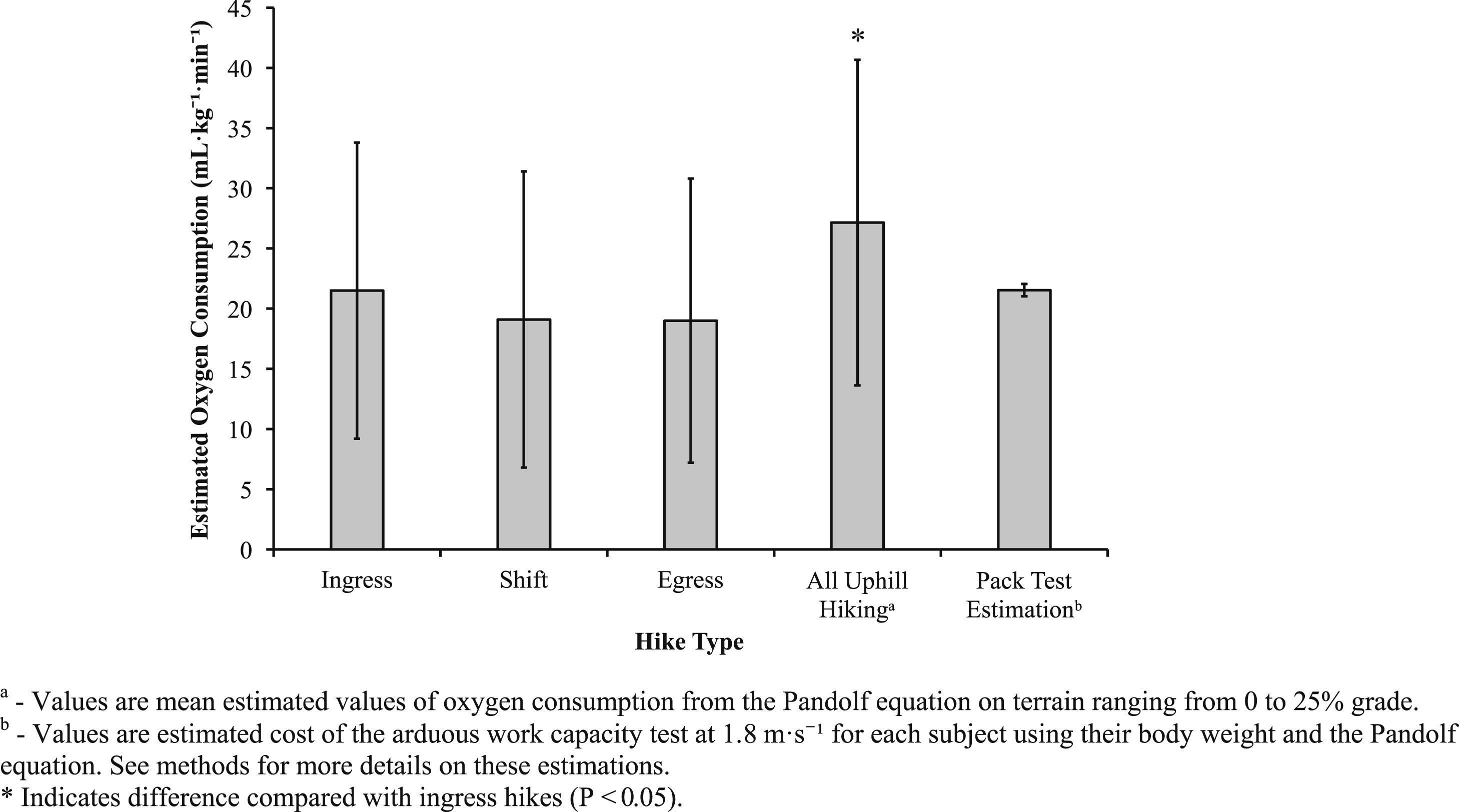
Metabolic demand for hike types occurring on fire assignments and an estimation of pack test demand for subjects in the study. The pack test estimation uses the Pandolf prediction equation and is based on each subject’s body weight and a speed of 1.8 m·s-1 to complete the current arduous work capacity test in 45 min with a load of 20.5 kg (45 lb). Data are expressed as mean±SD.
The Santee et al equation
32
was used to estimate metabolic rate on downhill terrain. This equation was used for all hiking that occurred on grades from <0 to –12%. The Santee model assumes that downhill walking energy costs approximate a U-shape when plotted against grade as it initially decreases from the negative work of gravity when beginning a slow walk downhill. From this model, the minimum cost of downhill walking is approximately 1.3 m·s-1 (2.9 miles·h-1) for all loading conditions. At this speed, a load up to 25% of body mass is ideal for long distances.
33
When walking speeds begin to exceed 1.3 m·s-1 on downhill terrain, the energy cost increases as the eccentric action of the muscles slow down the body and reduce the energy absorbed by the muscles and joints.34,35 Individuals hiking downhill with a load tend to self-select a speed near 1.3 m·s-1.
33
Participants in this study were only slightly slower—the average speed for all downhill segments of hiking on fire assignments was 1.0±0.4 m·s-1. This slower average speed may be due to fatigue experienced at the end of a work shift when many downhill hikes occurred with uneven surfaces, heavier loads and tools carried in their hands, heavy firefighting boots, or a combination of factors. Estimates for downhill hiking were included in all hiking types unless stated otherwise. The Santee equation for downhill hiking is shown below.
Oxygen Consumption
As an estimate of metabolic rate, oxygen consumption (V̇O2 est [mL·kg-1·min-1]) was computed from calculated Pandolf and Santee estimates of watts (1 watt=0.0143 kcal·min-1; 5.05 kcal=1 L of oxygen). An estimated percent of maximal V̇O2 (%V̇O2 max est) was calculated using the age-adjusted prediction equation of HRmax 29 and the Swain et al equation 36 of %HRmax=0.6463 * % V̇O2 max est + 37.182. To estimate the percentage of V̇O2 max est, this equation was reorganized as %V̇O2 max est=(%HRmax – 37.182)/0.6463.
Statistics
All data are presented as mean±SD. Independent samples t tests were used to determine differences in descriptive data by sex and by crew type. Two-way analysis of variance (IHC vs type II and hike types) tests were used to determine differences in the hike (duration, speed, grade, and load carried) and physiological (heart rate, core temperature, and predicted oxygen consumption) variables. Post-hoc analysis was performed after significant main effects between sample means. Data analysis was conducted using SPSS data analysis software (SPSS Inc, Chicago, IL). A probability of type I errors less than 5% was considered significant (P<0.05).
Results
Descriptive Data
IHCs accounted for nearly 67% of all hiking data. Height, weight, body mass index, and equipment weight data are summarized in Table 1. Age did not differ by sex or by crew type. Height, weight, and body mass index did not differ between male IHC and male type II WLFFs. Female WLFFs were shorter, weighed less, and carried less equipment weight than male WLFFs (P<0.01), although there were no differences in hiking speed or Tc between sexes. Equipment weight was lighter for type II crews compared with IHCs (difference of 4 kg; P<0.01). Equipment weight relative to body weight was also lower for type II crews compared with IHCs (P<0.01).
Hike Descriptives
There was a main effect of hike type, where ingress hike duration was longer than shift hike duration (P<0.01) and tended to be shorter than training hike duration (P=0.12; Figure 2A). Ingress hikes were steeper than egress hikes (P<0.01), and the average grade during training hikes was significantly different from both ingress and egress hikes (main effect: P<0.01). Ingress hike speed was less than egress (P<0.01) and tended to be less than training hike speeds (P=0.06). There was also a main effect of crew type on hiking speed for all hike types (ingress, shift, egress, and training hikes combined), where IHCs were slower than type II crews (0.8±0.0 m·s-1 and 0.9±0.0 m·s-1, respectively; P=0.01).
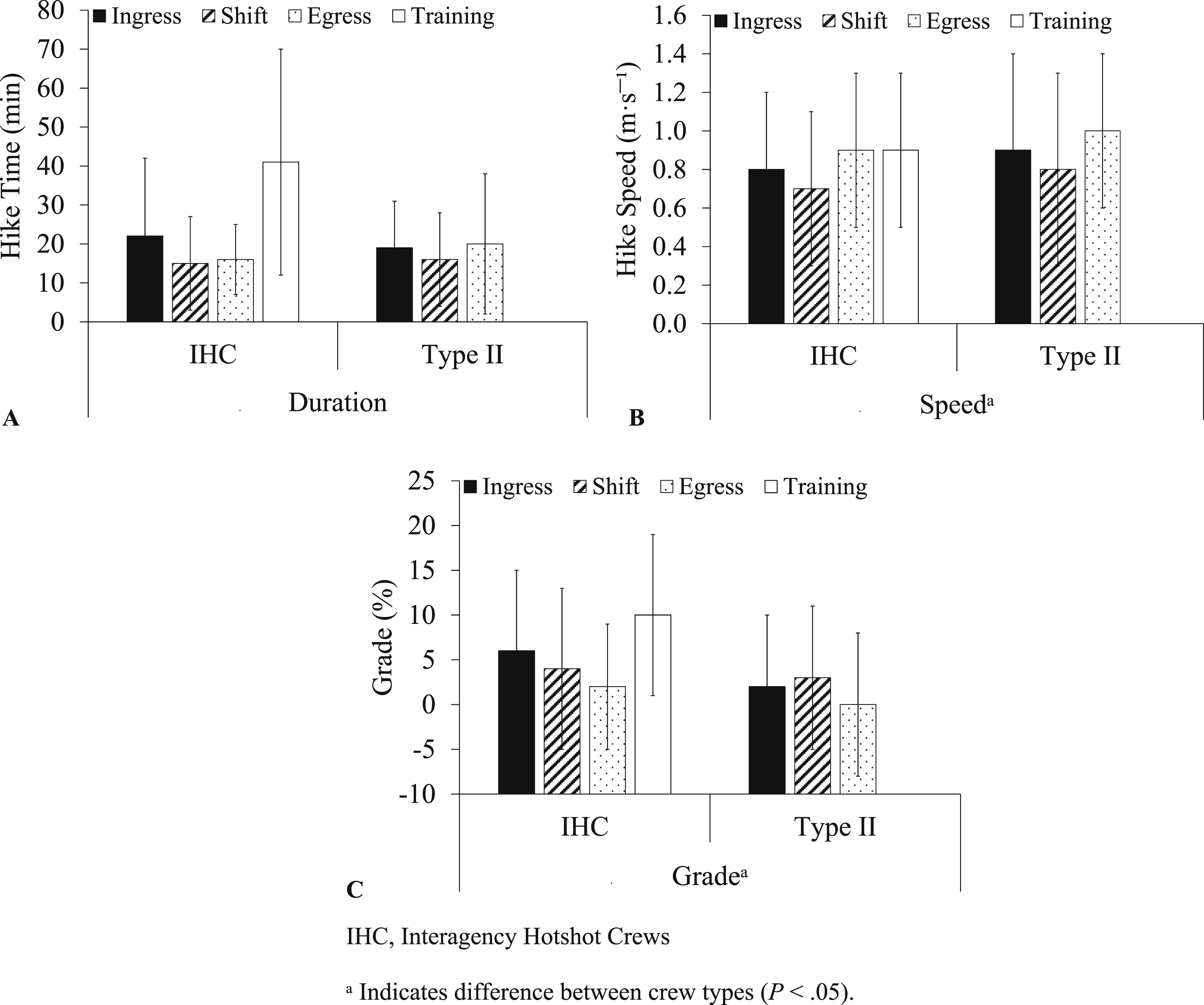
Average hike duration (A), speed (B), and grade (C) comparisons among hike types and between crew type.
Physiological Variables
HR for all hike types combined was lower for type II crews compared with IHCs (124±23 vs 126±25 beats·min-1, respectively; P<0.05) (Figure 3). There was a main effect of hike type on HR, where ingress hike HR was higher than egress hike HR, but was lower than training hike HR (P<0.01). TC during ingress hikes was lower than TC during the shift, egress, and training hikes (main effect: P<0.01).
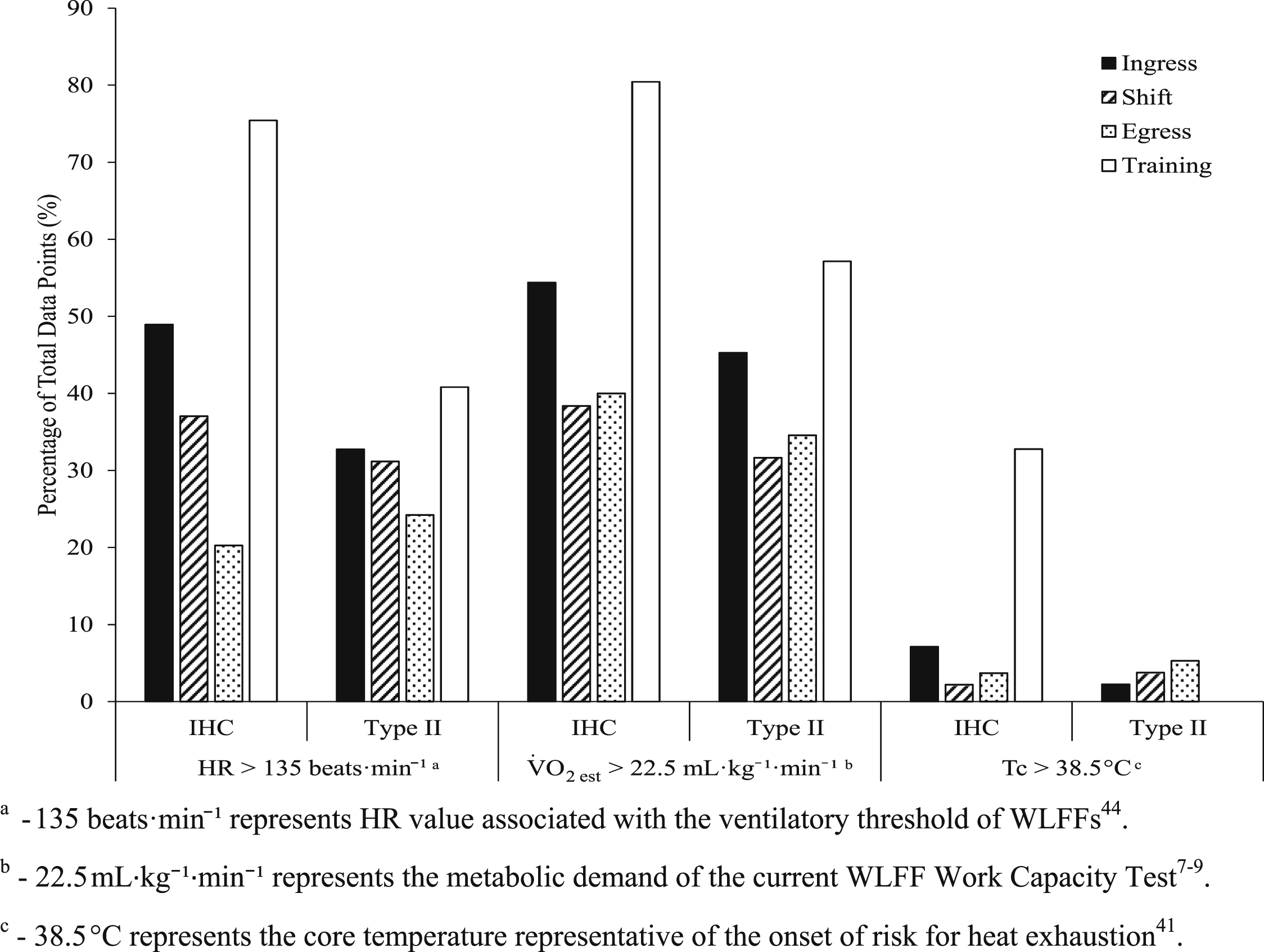
Distribution of metabolic demand among hike types and between crew types in the study.
Of the 117 h of hiking observed, approximately 84 h (72%) had acceptable data to calculate V̇O2 est. V̇O2 est for all hiking (uphill and downhill) during ingress hikes was higher than V̇O2 est during shift and egress hikes, but was lower than V̇O2 est during training hikes (main effect: P<0.01; Figure 3). V̇O2 est for uphill hiking only during ingress hikes was higher than V̇O2 est during shift hikes, but was lower than V̇O2 est during training hikes (main effect: P<0.01). Percent of V̇O2 max est during training hikes (65±22%) exceeded all other hike types (ingress: 47±24%, shift: 46±19%, egress: 40±18%; main effect: P<0.01).
All crew types spent approximately 40% of their hiking time on a wildfire assignment (ingress, shift, and egress hikes) at a HR below 120 beats·min-1. In contrast, IHCs spent 88% of their training hike time at a HR that exceeded 120 beats·min-1 with 47% of the time >160 beats·min-1. All crew types also spent approximately 60% or more of their time on a wildfire assignment at lower V̇O2 est than the estimated V̇O2 during the arduous pack test (<22.5 mL·kg-1·min-1). However, approximately 10 to 20% of the time was spent at V̇O2 est levels that exceeded 35 mL·kg-1·min-1, or 50% higher metabolic demand than the demand of the pack test. IHCs performed at intensities higher than that of the pack test 78% of the time during training hikes. Despite these intensities, no subject in the study exceeded a TC of 39.5°C while working on a wildfire assignment. However, IHCs spent 9% of the time during training hikes with TC ≥39.5°C and 36% of the time with TC > 38.5°C.
Discussion
During hiking and working on actual wildfires, WLFFs have the highest rate of energy expenditure during ingress hikes, which were approximately 20 min in duration at a speed of 0.8 m·s-1 (0.8 m·s-1 ≈ 1.8 mph) up a 4% grade. The average metabolic rate (expressed as V̇O2 est) during ingress hikes were close to estimates during the current arduous pack test (22.5 mL·kg-1·min-1). However, during training and for short periods on the job, the metabolic demand exceeded that of the arduous pack test. These periods of higher metabolic demand embody a pace of work set by emergency condition required by the Wildland Fire Qualification Subsystem Guide 310-1 for an arduous work capacity test. 37 Therefore, a conversation utilizing current expectation, demand, and reality is necessary to ensure the health and safety of wildland firefighters.
There was, as expected, high variation in the duration of hikes—40% of all hikes lasted fewer than 10 min, 42% between 10 and 30 min, and 18% lasted longer than 30 min. Within this variation, there were differences in the assignments given to different crew levels. For IHCs, 40% of ingress hikes had a duration longer than 30 min, while only 23% of ingress hikes for type II crews exceeded that same duration. Overall, ingress hikes were generally longer in duration than other hikes during the work shift and were slower with more uphill hiking and slightly heavier packs (food, water, fuel, etc.) than shift or egress hikes.
Although IHCs hike slower than type II WLFFs on fire assignments, it is likely the result of carrying more equipment weight, longer duration, and more difficult hiking terrain. Female WLFFs carried less absolute equipment weight but when evaluated as a percent of body weight female equipment weights were no different from male counterparts. Despite the impressive energy expenditure of WLFFs in the field, heart rates averaged approximately 66% of the predicted maximum and oxygen consumption was roughly 46% of the predicted maximum, regardless of sex. These moderate workloads did not result in significant metabolically derived heat stress as average core temperatures did not exceed 38°C on fire assignments (Figure 3). IHC training hikes were longer and more intense than job-related hiking as they were approximately 40 min in duration with 10% grade (Figure 2C), and V̇O2 est averaging 37 mL·kg-1·min-1 (Figure 3). This elevated demand resulted in higher average heart rates (152 beats·min-1) and core temperatures (38.1°C) than when subjects worked on wildfires. Crew expectations and utilization while on wildfire assignments may be the reason for this elevated demand as fire management has an expected production factor for type I crews that is higher than type II crews. 38
In most cases, hiking activity in the study began 2 to 4 h into the operational shift. There were some instances when hiking activity began within the first or second h of the work shift, typically when the crew was remotely camped near the fireline rather than the main camp or staging area. Accessing the fireline earlier in the day could be advantageous as cooler ambient temperatures are ideal for physical exertion. The increases seen in core temperature as the day progresses is possibly due to the slow accumulation of body core temperature with sustained work, often in a hot environment. 39
Increases in TC beyond the physiological limits of thermoregulation can result in failure to maintain homeostasis and accumulation of heat in the body and inducing heat stress. 40 A core temperature exceeding 38.5°C over an extended period increases the risk of heat exhaustion and once core temperature exceeds 39.5°C, an individual is at high risk of heatstroke. 41 Although WLFFs performing an ingress hike appear to be generally at a low risk for heat exhaustion or stroke, the ingress hike and increasing daytime temperatures set the TC baseline from which further metabolic demands during the work shift start. Training hike intensities resulted in significantly higher TC than observed during wildfire assignment hiking (Figure 3). This TC suggests that adequate rest and recovery should be encouraged and planned during training. Unlike training hikes, hikes during fire suppression are embedded during long days, interspersed with many other forms of wildfire work, occur where conditions generally become increasingly hot as the day progresses, and there is often a negligible opportunity for heat unloading. This, along with the percentage of hike TC at levels above 38.5°C (Figure 3) supports the need for adequate pacing, rest, and recovery during fire suppression activities to avoid heat injury. For these reasons, WLFFs need to observe potential work:rest ratios when possible to avoid excessive accumulation of heat as previously described.3,6
IHCs had the highest V̇O2 est during ingress hikes on flat and uphill terrain (27±11 mL·kg-1·min-1) with the exception of training hikes (38±12 mL·kg-1·min-1). During training hikes, IHCs simulate ingress hikes in terms of load carriage, but hike at a faster speed (Δ=0.2 m·s-1), for longer durations (Δ=19 min), and at higher metabolic costs (Δ=11 mL·kg-1·min-1). The higher V̇O2 est achieved by IHCs during training hikes resembles the upper end of the normal distribution of ingress hikes that occurred on fire assignments. This suggests that IHCs are preparing at an intensity representative of what they may perceive as the hardest hikes they will encounter on the fireline. Crews may be able to reduce the physiological demand during the ingress hikes by lowering either pack weight, hiking speed, or hike duration to minimize the overall physiological strain of the work shift.
In this population, we hypothesize that the large proportion of high VO2 est that occurred while hiking was due to the heavy weight of necessary equipment, the speed of hiking, and terrain types. Equipment weights in this study (see Table 1) consisted of the weight of the pack, tool weight, and any other equipment needed for the operational shift, such as a drip torch, additional gas, or water hoses. These equipment weights for WLFFs (27±7 kg) are similar to previous United States Army doctrine load weight recommendations of 22 kg (30% body weight) for a fighting load and 33 kg (45% body weight) for an approach march load, although estimated load masses for various infantry units throughout history have ranged from 9 to 45 kg. 42
Figure 1 shows the demand of all uphill hiking that occurred on the fireline (27±14 mL·kg-1·min-1) relative to other hike types. The mean VO2 est during ingress hikes for all terrain types (22 mL·kg-1·min-1) was nearly identical (23 mL·kg-1·min-1) to research supporting the current pack test for United States WLFF 1 ,2,4,9 and is similar to the observed average energy demands of most fireline activities in Australia. 10 Considering the normal distribution of the mean VO2 est of ingress hikes, 68% (±1 SD) of all the hikes were between 10 and 34 mL·kg-1·min-1, with scores occurring more frequently around the low end. These intensity levels are roughly 50% of the WLFF maximal aerobic capacity, which is considered the sustainable level of intensity for long duration activity. 7 These data validate the specificity, criterion, content, and construct validity of the metabolic challenges presented by the current US Forest Service arduous pack test. However, 42% of all ingress hikes in this study occurred at an intensity level that exceeded the arduous pack test and had a mean grade of 4±9%. The current arduous work capacity test occurs on flat terrain, and when completed at the upper time limit of 45 min, requires a walking speed of 1.8 m·s-1. Hiking speed for all hike types that occurred on fire assignments was 0.9±0.4 m·s-1. Thus, although the metabolic costs may be similar, the nature of fire suppression hiking is slower because it occurs on steeper terrain while carrying a heavier load.
The oxygen consumption for the pack test shown in Figure 1 was estimated using the Pandolf equation, assuming each individual in the study performed the arduous work capacity test in exactly 45 min (1.8 m·s-1). Although this data demonstrates the consistency of the average metabolic demands of hiking, it also emphasizes the elevated demand associated with hiking on a positive grade, which included 60% of all hiking performed by WLFFs in the study. As seen in Figure 3, IHCs spend a larger percentage of time at intensities exceeding their ventilatory threshold43,44 than type II crews. IHCs also spent 75% of the duration of training hikes at an intensity above the ventilatory threshold. Interestingly, well-trained endurance athletes have shown success with up to 80% of their training time at intensities below the ventilatory threshold, despite competing at much higher intensities.45,46 These athletes have daily energy expenditure values that are similar to WLFFs and this predominance of lower intensity, long duration training may optimize long-term fitness while maintaining acceptable levels of stress to achieve athletic success. 46
These data show that while the aerobic intensity of the current US Forest Service arduous pack test has construct validity for most hiking activities, adjustments to speed and grade of the test, and current training strategies, may better represent the true occupational demand. The grade values observed in this study—up to 15% on wildfire assignments for IHCs (Figure 2C)—and hiking speeds up to 1.3 m·s-1 are a crucial component in quantifying the specific components of job tasks presented on wildfires in varying terrain. The effect of gravity on load carriage should not be underestimated and the ability of individuals to perform uphill hiking should be considered an important metric in the evaluation of common WLFF job tasks.
Limitations
Data collected from this study were from different firefighters across different seasons. Participants were not selected at random; rather they were recruited from available resources in the fire camps and requested to volunteer in the study. No preliminary testing with the subjects was conducted due to the location on fires of each participating crew across the western United States. As stated in the methodology, participants typically had at least 1 day of work before their involvement in the study. This was due to the unpredictability of location and distance between wildfires. As a result, the exact demand for initial fire suppression activities is not well documented.
Wildland firefighters often have different daily assignments while on a fire for multiple weeks. Typical workdays involve multiple activities (hiking, digging, briefing, rest, etc.) ranging from 10 to 30+ per shift. Following the morning ingress hike did together as a crew, crewmembers will distribute tasks/activities amongst crewmembers to achieve the operational assignment for that work shift. This may involve working in modules building fireline with hand tools, often with sawyers going ahead to clear timber and brush. Other times, crewmembers may have multiple duties including holding line (monitor the situation), mop-up work (lower intensity), handling a saw, hand tool, or commencing firing operations to contest fire with fire. Assignments will change the total daily energy expenditure across crewmembers and may reduce the higher intensity workload of some crewmembers relative to others. The exception might be sawyer work, a specialty job requiring periodic work at a higher energy output.
Conclusion
To the authors’ knowledge, this is the first data collected on WLFFs during actual federally assigned fire suppression that allows prediction of job-associated acute metabolic demands. In total, WLFFs in the study were monitored for 1138 h across 31 fires in 11 states with subjects from 78 different crews. The greatest metabolic demand during these wildfire assignments occurred during ingress hikes. On average, this is closely approximated by the current arduous work capacity test for WLFFs. However, greater metabolic demand occurred for periods during both shift (on the job) and training activities—hiking intensity was higher during training hikes compared with ingress hikes. Together with prior TEE values, these data quantify not only the overall but importantly add information regarding the upper end of metabolic demands associated with actual WLFF performance. The combination of hike duration, equipment weight, speed, and grade across a range of terrain and environment types adds to multiple years of WLFF data to describe the physiologic undertakings associated with this occupation. Furthermore, these data quantify the metabolic demands associated with actual wildland performance in IHC and type II firefighters and can help define appropriate work capacity testing and training procedures.
Acknowledgments: The authors thank the subjects for their investment of time and energy. Additionally, gratitude is extended to the cohort of field researchers for their assistance in field observation.
Author Contributions: Conception (JAS, BCR, SEB, JWD); design (JAS, BCR, JWD); data acquisition (JAS, JWD), interpretation of data (BCR, SEB, CLD, JWD); drafting manuscript (JAS, BCR, SEG, CLD, JWD); revising manuscript (BCR, SEG, CLD, JWD).
Financial/Material Support: This study was supported by funding from the US Department of Agriculture and Forest Service Fire and Aviation Management Group in addition to the National Wildfire Coordination Group, Department of Interior, Bureau of Land Management, National Park Service, Fish and Wildlife Service, and Bureau of Indian Affairs.
Disclosures: The authors declare that they have no competing interests in access to these data or associations with companies involved with products used in this research. The views and conclusions contained herein are those of the authors and should not be interpreted as necessarily representing the official policies or endorsements, either expressed or implied, of the United States Department of Agriculture, Forest Service, National Wildfire Coordination Group, or the Department of Interior.