






Abstract
Objective
Transporting clean drinking water in an easily accessible container is a priority for many outdoor enthusiasts. Two basic hydration systems are commonly used to provide water: the water bottle and the hydration bladder. The authors tested the hypothesis that there were different levels of microbiologic contamination between these 2 systems.
Methods
Sixty-seven water samples were collected using sterile techniques from outdoor enthusiasts at several outdoor recreational locations. These users were then asked to complete a brief survey that reported demographic information and details of water container use. Water samples were then plated on sheep blood agar, and the colony-forming units were counted after 24 hours of growth. The 2 groups were compared using Student's t test.
Results
The 2 groups using water bottles or hydration bladders did not show significant differences in container age, duration of outdoor activity, or duration since last cleaning. The groups differed slightly in their composition of hikers/walkers/runners vs cyclists. The water bottle group had a mean colony-forming unit count per 100 mL of 37 (95% CI 26–48), and the hydration bladder had a mean of 27 (95% CI 17–35).
Conclusions
There was no statistically significant difference between hydration bladders and water bottles in microbial contamination or colonization. Judging from the available data, outdoor enthusiasts should select their water container based on criteria other than the relative exposure to microbes. Additional study is required to replicate this finding in other locations and with improved sample methodology.
Introduction
Consuming potable drinking water is one of the many challenges confronting the outdoor enthusiast. Transport and consumption of potable water during outdoor activities is a common practice for many people engaging in outdoor recreation, work, and military operations. Outdoor enthusiasts frequently purchase reusable water containers for their potable water needs. These consumers are frequently concerned about the convenience, cost, reliability, and cleanliness of their hydration systems. It was the purpose of this research to assess some possible differences in microbial content between the 2 most common types of water containers: water bottles and hydration bladders.
Although the water bottle is the traditional carrier, the hydration bladder is an increasingly popular choice. A hydration bladder is a soft, plastic bladder placed on the consumer's back with a drinking tube that leads out of the backpack to a bite valve located near the consumer's mouth. A water bottle is a plastic container with a treaded or press-fit cap that can be removed or opened for consumption.
Consumers frequently have preferences as to which system better serves their needs. Some consumers prefer water bottles because of a perception that they are inexpensive, easily replaced, lightweight, simple to use, and reliable. Other consumers prefer the hydration bladder because they prefer the hands-free use and large reservoir.
There may be differences in microbial colonization between these 2 systems. If either water container is not cleaned adequately, there is a risk of microbial contamination. Water bottles may be cleaned by manual disinfection or placement in a dishwasher, but hydration bladders often require a more elaborate cleaning procedure. They have a reservoir bag, a long drinking tube, and a bite block. Each of these components may be difficult to clean. One manufacturer's webpage lists a 9-step procedure that includes special cleaning tablets. 1 Some manufacturers market specialized drinking tube brushes, cleaning tablets, and hanging racks. Because of the perceived problems of cleaning hydration bladders, users may speculate that water stored in water bottles stays cleaner.
To our knowledge, there is no published evidence that compares the relative hygiene of these 2 systems. It was the purpose of this study to compare bacterial content in water obtained from water bottles and hydration bladders used by a convenience sample of outdoor enthusiasts.
Microbial Contamination
Water that contains microbes is a major source of enteric infection for the general population, as well as outdoor enthusiasts.2,3 Ingesting water that has been contaminated with pathogens can cause morbidity, including invasive or noninvasive diarrheal illness. 4 Such illness can be prevented by assuring that ingested water has minimal amounts of pathogenic bacteria. 5
There is very little information on the last 2 steps of the potability chain (storage and drinking). Both the container and the consumer may be a source of contamination and subsequent colonization. This contamination and colonization during storage may reduce the potability of the water commonly used by people pursuing outdoor activities. Which portable hydration system, water bottle or hydration bladder, has the most microbiologic colonization? The null hypothesis is that both hydration systems have the same amount of colonization from all and pathogenic microorganisms.
Methods
Field Water Collection
Sixty-seven water samples were collected from water bottles and hydration bladders from June to July 2006. The samples were obtained at 3 popular trailheads in a semiurban environment near Albuquerque, NM, frequented by hikers, cyclists, runners, and other outdoor athletes. The first was a paved trail frequented by cyclists, walkers, and runners in a city open-space area adjacent to the Rio Grande. The second site was at the Embudo trailhead, in the Sandia foothills. The third site was located at the Sandia Crest parking lot, near the summit of Sandia Mountain, approximately 20 road miles (32 km) from the city.
Convenience samples were collected from outdoor enthusiasts who were randomly selected and agreed to participate in the study. Attempts were made to avoid selection bias by approaching all potential study participants without regard for demographic characteristics. The investigators were introduced as medical students conducting an experiment to evaluate water containers. Participation was voluntary and required a 5-minute interview for data collection and water sample collection from their personal container. This study was exempted from Institutional Review Board approval because there was no potential for harm and no individual identifying characteristics were collected.
Survey data were obtained in English by the investigators as the water samples were collected. The investigators used a questionnaire to elicit demographic data, activity during water use, time engaged in activity, original water source, time since filling water container, time since most recent container cleaning, method of container cleaning, and how long he or she owned the container (Appendix A, available at
As the survey was conducted, water samples were collected using sterile pipettes into 2-mL sterile vials using no-touch technique. Water samples were collected from the reservoir rather than the water bottle lip or hydration bladder mouthpiece to avoid direct inoculation with mouth flora. Care was taken to collect samples uniformly.
Water Analysis
The samples were transported to the laboratory out of direct sunlight in a refrigerated container. The vials were stored for <24 hours at 4°C. Serial dilutions were prepared in sterile water to a dilution of 1:10 and 1:100. Twenty microliters of a sample or its serial dilution were dispensed, in duplicate using sterile pipette tips, into commercially prepared blood agar (tryptic soy agar) with 5% sheep blood plates (Remel, Lenexa, KS). The inoculum was plated evenly on the surface of the agar plate. Each plate was duplicated using the same methodology. Two positive control plates were prepared in the same fashion using a direct 20-μL sample of the investigator's saliva. Two negative control plates were also prepared using 20 μL of sterile water.
The plates were inverted and incubated at 37°C for 24 hours and then examined for growth. Each plate was hand counted twice by each of the investigators. The plates were examined directly after removal from the incubator. The colony-forming units were hand counted, and the original colony-forming units in the sample were calculated by multiplying the dilution factor by the observed colonies.
Spreading growths were counted as single colonies, but attempts to delineate chains of individual colonies were also made. If multiple dilutions showed growth, the least diluted sample was counted as long as the count did not exceed 300. The positive controls were not serially diluted. Microscopy was not utilized to further resolve the plate counts. No attempt was made to determine the species of the colony-forming units.
Data Analysis
Total bacterial colony forming units per 100 mL represented the main dependent, continuous variable. A sample size calculation was done that showed a need for at least 30 samples from water bottles and 30 samples from hydration bags. Sufficient samples were collected to assess a 20% difference in bacterial counts between the water bottle group and the hydration bladder group. Other possible factors were not analyzed due to the small sample size. The mean colony-forming units per 100 mL were compared between the hydration bladders and the water bottles using Student's t test, assuming a 2-sample equal variance. Heterogeneity between subgroups was assessed using Student's t test as well.
Results
Sixty-seven water samples were collected. The numbers of samples collected in the water bottle and hydration bladder group were 33 and 34, respectively. The table shows the similarity between the populations of participants that use water bottles and hydration bladders. For all continuous variables, a P value was calculated and shown to be nonsignificant. Each P value is >.1, indicating that no significant heterogeneity exists between the 2 groups for any variable. The variance of the 2 groups differed slightly but matched a P value with the unequal variance test.
Comparison of sample groups
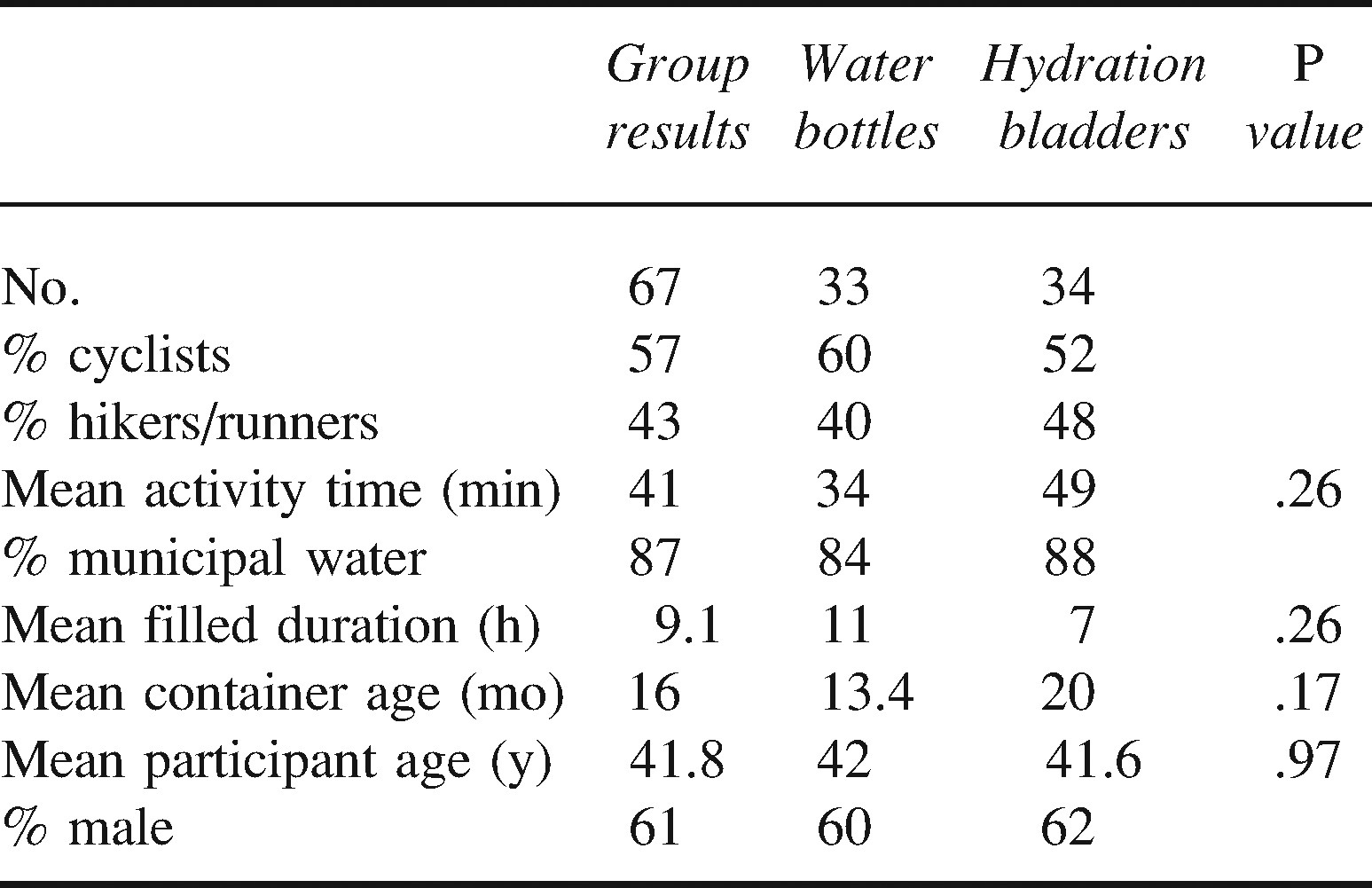
The water bottle group did have a higher percentage of cyclists (60%) compared with the hydration bladder group (52%). Males represented 61% of the sampled population. The water bottle group had a mean colony-forming unit per 100 mL count of 37 (95% CI 26–48) per sample, and the hydration bladder group had a mean of 27 (95% CI 17–35) per sample. There was no difference in colony-forming units per 100 mL between hydration bladders and water bottles (P = .62, Student's t test).
Discussion
This study did not identify any significant differences in microbial colonization between hydration bladders and water bottles. Although outdoor enthusiasts should interpret these results with caution, these results do not support the opinion that hydration bladders are more prone to microbial contamination. Although a trend towards increased colony-forming units was noted in the water bottle group, these results were not statistically significant. The investigators cannot recommend one form of water container over the other with these data. Outdoor enthusiasts should make their choices based on personal convenience preference rather than protection from microbial exposure.
The study population included a relatively small sample size and a convenience sample. With this survey design, both sampling and response bias were possible. For example, serious athletes, who might be the heaviest users of water containers, may be less likely to interrupt their training to participate in the study. People who are more fastidious about cleaning or storage methods may have been more likely to participate in this study. Some participants could not remember exactly when they cleaned or purchased their container, and participants may have reported more frequent cleaning or a more recent purchase to gain the approval of the investigators. We did not gather detailed participant demographics, such as frequency of container use, cleaning method, and whether they had used the container to carry beverages other than water in the past. A possible additional source of error could have been due to residual chlorination from the municipal water supply that may have disinfected the contents of the containers regardless of the baseline level of contamination. Additional studies using nonchlorinated water may clarify this question in the future.
Because the study was powered to examine the difference only between hydration bladders and water bottles, the influence of other factors related to the composition of the containers could not be determined. This study collected samples only from the water reservoir and not the mouthpiece of hydration bladders. The valve design of hydration bladders may promote bacterial colonization of the valve and tubing. Specimens obtained from the tubing or the valve itself might produce results different from those reported in this study. Different containers use different materials, and so the material composition of some hydration bladders or water bottles might also affect microbial contamination. This study did not collect data to distinguish between manufacturers or materials of hydration bladders. A future analysis may assess the effect of materials used in water containers.
Our study did not collect information about the various cleaning methods utilized in the subjects’ water containers. Therefore, we cannot analyze this potential cofounder in this analysis. Finally, this study did not characterize the species of bacteria isolated from water bottles. We do not know if these organisms are human pathogens, human commensals, or bystander environmental microbes.
Despite these limitations, the study groups and equipment were felt to accurately represent the population of outdoor enthusiasts in semiurban environments. Results of this study should not be applied to backpackers or campers using natural water sources.
Conclusions
Although this study is limited in sample size, no significant difference was found in bacterial contamination of hydration bladders vs water bottles. Future studies with larger sample sizes may reveal more subtle differences in microbial colonization of different containers. The sample size was too small to adequately analyze the data for gender, duration of activity, method of cleaning, water source, and time since cleaning. At this time, the investigators advise outdoor enthusiasts to use the water container that best meets their needs without concern for increased exposure to possibly pathogenic microbes. Cleaning methods are presumed to be important and should be studied further.