






Abstract
Objectives
Cold water temperature is a significant factor in North American drownings. These deaths are usually attributed to hypothermia. Survey questions were administered to 661 attendees of cold-stress seminars—including medical, rescue, law enforcement and lay attendees—to determine general knowledge of the effects of ice water immersion and responses to 2 public service educational slogans.
Methods
Five questions were posed at the beginning of seminars to 8 groups (ranging in size from 46 to 195) during a 2-year period. Π2 analyses were used to determine if responses within any occupational category differed from the group responses.
Results
A high portion of respondents greatly underestimated the time to become hypothermic in ice water (correct answer >30 minutes; 84% stated 15 minutes or less) and the time until cooling was life threatening (correct answer >60 minutes; 85% stated 30 minutes or less). There were no occupational differences in these responses. Most of the respondents identified a correct cause of death during cold stress (81% stated cardiac arrest, hypothermia, or drowning). Although both educational slogans had some advantages, between 40% (Slogan #1) to 50% (Slogan #2) of respondents did not respond correctly.
Conclusions
The majority of respondents underestimated the time available for survival during ice water immersion. It is important to educate the public accurately to decrease the probability of panic under these circumstances. More work is required to develop effective educational slogans that provide proper information and actions for victims of cold-water immersion.
Introduction
Cold water temperature is a significant factor in North American drownings. In Canada between 1991 and 2000, 21% (282) of recreational boating drownings occurred in extremely cold water of below 10°C. 1 Of the 14% of boating drownings that occurred with victims wearing a personal floatation device, most were in cold water. Additionally, 232 snowmobilers drowned after breaking through the ice, and 218 victims died after falling through the ice during other activities.
Historically public education sources have equated cold-water immersion with hypothermia; thus cold-water deaths are usually attributed solely to hypothermia even by authorities such as the Canadian Red Cross. 1 Because many, if not most, cold-water deaths occur quickly, the general impression is that hypothermia occurs quickly under these conditions. This principle is reinforced through written and other media forms. 2 In reality, even in extremely cold water, adults require 30 minutes or more to become clinically hypothermic, and 1 or more hours to become severely hypothermic. 3 –7 Thus most cold-water drownings occur because of uncontrolled breathing or physical incapacitation when victims would actually still be normothermic.8,9
The incorrect assumption that hypothermia occurs quickly in cold water could result in victims greatly underestimating their potential survival time. Consequently, a victim could be more prone to panic and initiate actions without proper evaluation. These actions will often exacerbate the situation and even cause premature or preventable death. 10 We believe that a realistic understanding of the possible survival time in cold water would help decrease panic and promote rational decision making, which might increase the probability of survival. A quantitative evaluation of the perceived effects of, and mechanisms for death during, cold-water immersion would be valuable in determining a public education strategy for cold water safety. We are unaware of any prior work in this area.
During a period of 2 years, one of the authors had the opportunity to conduct a short optional survey before several “cold-exposure” presentations to several hundred individuals from diverse backgrounds. Three questions determined the understanding of cold-water immersion and hypothermia; this provided some direction for the remainder of the presentations. Results from the first 55 questionnaires supported the hypothesis that the threat of hypothermia in cold water was generally overestimated and that effective educational strategies were indicated. For the remainder of the presentations 2 additional questions were included to determine the “take home message” provided by 2 educational slogans related to cold-water immersion.
One slogan indicates that in ice water, victims “have between 7 and 70 seconds to save their lives” (a public service announcement based on Reference 11). The second slogan indicated that in ice water, victims have “1 minute to get their breathing under control, 10 minutes of meaningful movement, and 1 hour before becoming unconscious due to hypothermia.”12,13
We hypothesized that most respondents would underestimate the time required to become hypothermic in ice-cold water, but that medical and rescue/law enforcement professionals would have a better understanding than nonprofessionals. Also, the “1 minute–10 minutes–1 hour” slogan was expected to elicit more correct responses than the “7–70 seconds” slogan.
Methods
During 2003–2004, one of the authors provided seminars and presentations on cold stress and thermoregulation to various groups. Previously, seminars began with an informal show of hands and/or verbal responses to several questions to determine the audience understanding of effects of cold-water immersion; this was done to better inform the direction of each seminar. During the study period, the questions were presented in written form to attendees who were given the option to write down their answers and hand them in for evaluation. The responses were anonymous and voluntary. Only written responses were used for the analysis. After collection of the responses, informal responses and previous results were used to introduce the seminar.
Survey Questions
Questionnaires were completed by 661 respondents from 8 audiences (ranging in size from 46 to 195), including snowmobile groups, the Wilderness Medical Society, emergency medical services, rescue and law enforcement, and military personnel. The questions were simple and could be administered in a short period of time. Respondents were asked to provide their age and occupation. No attempt was made to quantify what level of cold-related training the respondents already had. However, they were asked not to participate if they had previously attended a seminar by the presenter. It is estimated that 80% to 90% of attendees completed the surveys.
The first group of 55 respondents was presented with the following 3 questions: If you fall in ice water, with regular winter clothing on, how long do you think it will take to become hypothermic? How long until the cooling is life threatening? What would be the cause of death? Preliminary analysis from this first group supported the hypothesis that most responses would underestimate the time required to become hypothermic in cold water. It was decided that further seminars would provide a good opportunity to test the efficacy of 2 potential public service educational slogans. Thus 2 additional questions were included at subsequent seminars: What is the message you get from the following slogan: “Remember, if you fall through the ice you have between 7 to 70 seconds to save your life”? What is the message you get from the following slogan: “Remember, if you fall through the ice you have 1 minute to get your breathing under control, 10 minutes of meaningful movement, and 1 hour before you become unconscious due to hypothermia”?
Data Analysis
Participants listed more than 30 different occupations. For analysis, occupations were classified according to the following 5 categories: Medical included physicians, nurses, emergency medical services personnel, psychologists, dentists, and occupational/physiotherapists; Rescue/Law Enforcement included police/security, military, firefighters, and divers; White Collar included administrators/managers, engineers, students, teachers, clergy, journalists, and sales personnel; Blue Collar included farmers, mechanics, truckers, foresters, and tradespersons; and Other included other occupations or nonspecific responses.
Responses to each question were categorized as follows:
Responses for Question 1 were classified according to the following time periods: up to 2 minutes, 3 to 5 minutes, 6 to 10 minutes, 11 to 15 minutes, 16 to 30 minutes, 31 to 60 minutes, or more than 60 minutes. Any answer indicating a time longer than 30 minutes was considered correct. Responses for Question 2 were classified according to the following time periods: up to 5 minutes, 6 to 10 minutes, 11 to 15 minutes, 16 to 20 minutes, 21 to 30 minutes, 31 to 45 minutes, 46 to 60 minutes, 61 to 90 minutes, or more than 90 minutes. Any answer indicating a time longer than 60 minutes was considered correct. Responses for Question 3 were classified according to the following causes of death: cardiac, brain, respiratory, multiorgan failure, shock, drowning, hypothermia, or other. Answers including cardiac, shock, drowning, or hypothermia were considered correct.
Responses for Questions 4 and 5 were categorized based on either proposed actions, perceived time available for survival, or described effects of immersion. Responses were considered correct if proper actions or effects were described and/or if the response indicated that there was sufficient time to think and form a plan for escape/rescue. Responses were considered incorrect if improper actions or effects were described and/or if the response indicated that an incorrectly short period of time was available for escape/rescue. The simple statement “get out of the water” was categorized separately because this is intuitive and does not indicate any factors that would affect the success of exit. Finally, a separate category included responses that either did not relate to the time period of immersion or to the question in general (eg, dry off clothing).
For each question, the proportion of responses within each category was determined for each occupation. These proportions were compared with the overall response of the whole group using a Π2 analysis. A P value of less than .05 was considered significant. In order to compare the effectiveness of the 2 educational slogans, the responses to Question 4 were also compared to the responses to Question 5 using a Π2 analysis.
Results
The 661 survey respondents consisted of the following occupational groupings: 242 medical, 75 rescue/law enforcement, 201 white collar, 39 blue collar, and 104 others.
Time and Hypothermia
In response to Question 1, 84% of the group responded that hypothermia would occur in 15 minutes or less; 54% actually indicated 5 minutes or less (Figure 1). Only 5% of the group correctly responded that it would take longer than 30 minutes to become hypothermic. There were no occupational differences in the proportion of responses within each response category.
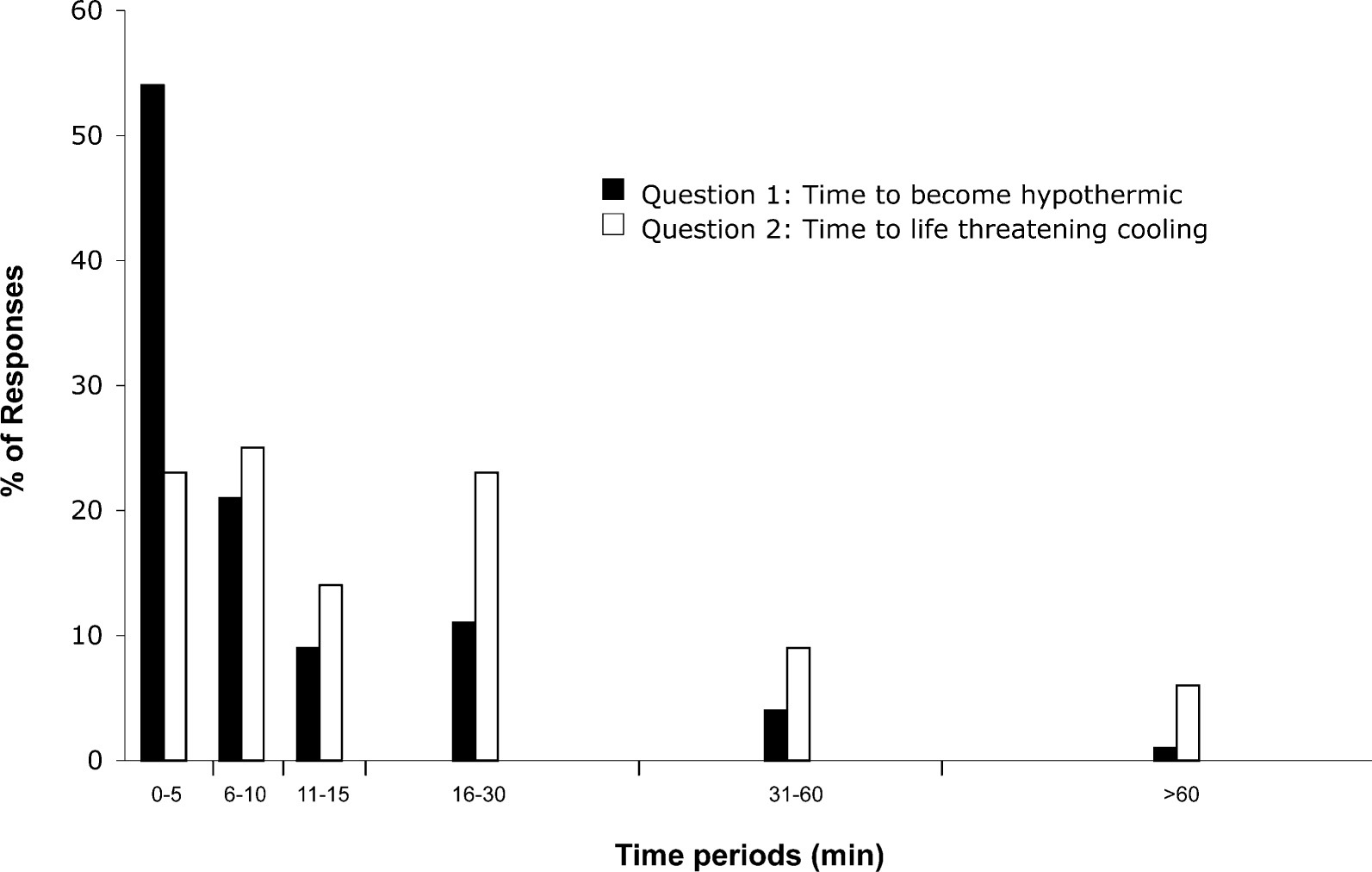
The percentage of responses to Questions 1 and 2 for each time period (n = 661)
In response to Question 2, 85% of participants responded that cooling would become life threatening in 30 minutes or less; 62% actually responded that it would take 15 minutes or less (Figure 1). Only 6% of the group correctly responded that it would take longer than 60 minutes for cooling itself to be life threatening. Again there were no occupational differences in the proportion of responses within each response category.
Cause of Death
In response to Question 3, 81.4% of the respondents chose answers that were technically correct although the specific physiological cause (cardiac 47.3%) was preferred to general malady categories such as drowning (24.5%) or hypothermia (9.6%). Blue collar workers were less likely to list drowning and more likely to list hypothermia as a cause of death compared to the whole group (P < .001). Others were less likely to list hypothermia and more likely to list shock as a cause of death (P < .025).
Educational Slogans
In 605 responses to Question 4 (Slogan #1, “7 to 70 seconds”), there were more correct (62%) than incorrect (34%) answers, whereas 4% did not respond (Figure 2). For this slogan, medical personnel were more likely (P < .001), whereas white collar workers were less likely (P < .001), to use the correct, but general, response to “get out of the water.”
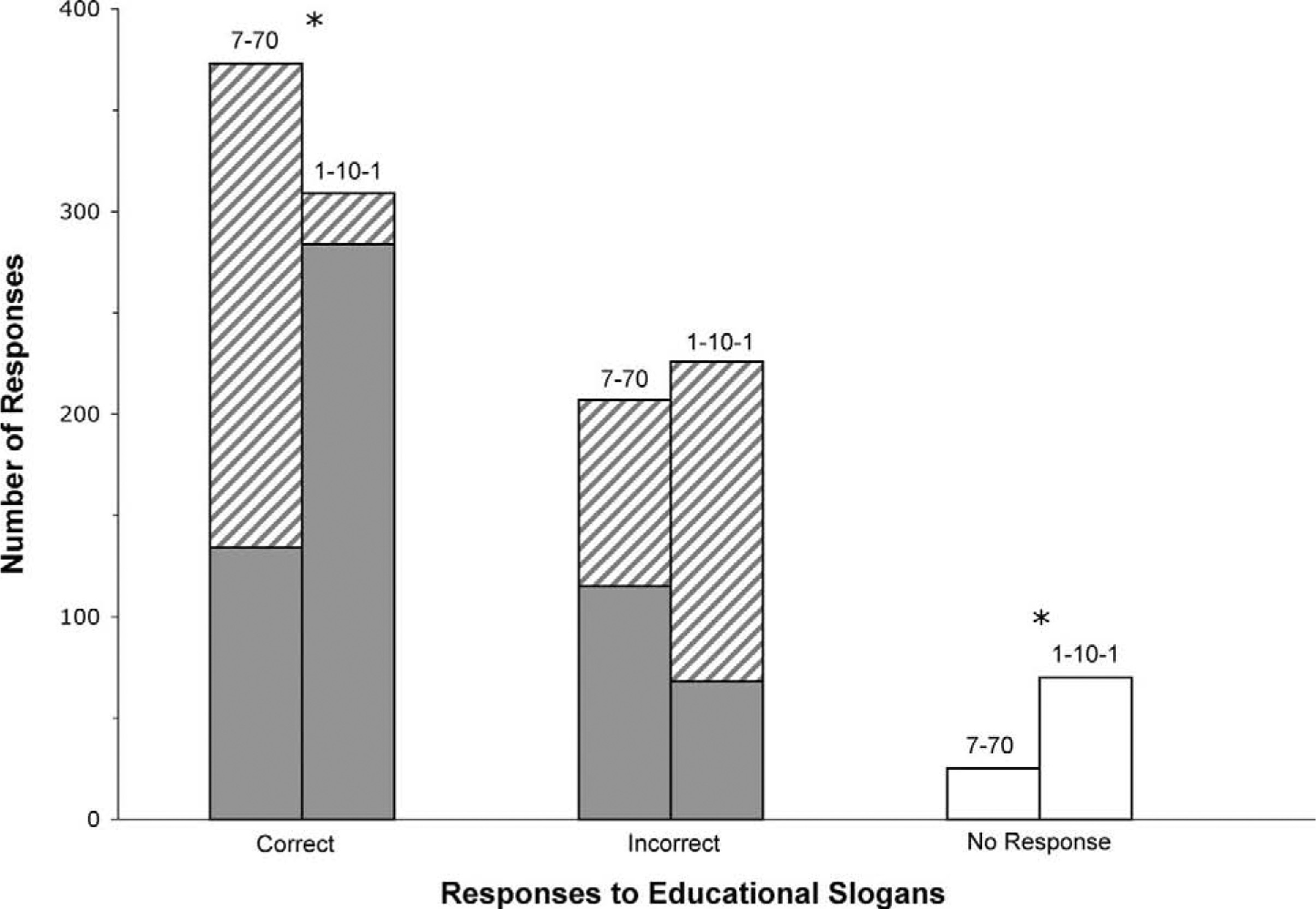
Responses to 2 educational slogans regarding ice-water immersion: Slogan #1 labeled “7–70”; Slogan #2 labeled “1–10–1” (n = 605). Correct answers: solid bars, specific statements about action, timing, or consequences of cold; hatched bars, general response “get out of the water.” Incorrect answers: shaded bars, specific statements about action, timing, or consequences of cold; open bars, general responses that are irrelevant or unrelated. * indicates the difference in the number of responses to the 2 slogans (P < .001)
Compared to Question 4, Question 5 (Slogan #2, “1 minute–10 minutes–1 hour”) elicited fewer correct responses (51%) and a similar amount of incorrect responses (37%), whereas more did not respond (12%) (P < .001). There were no occupational differences in the responses to this slogan.
Although there were fewer correct responses to Slogan #2, more than twice as many correct responses included specific statements about action, timing, or consequences of cold, and fewer general responses of “getting out of the water” (P < .001). Conversely, Slogan #2 elicited more irrelevant/unrelated responses within the incorrect response category (P < .001) than did Slogan #1 (Figure 2).
Discussion
To our knowledge this is the first study to quantify—in a large diverse group of respondents—knowledge of cold-water immersion and responses to public education slogans. Our first hypothesis was confirmed. Respondents greatly underestimated the time within which a victim would become hypothermic and experience life-threatening consequences during ice water immersion while wearing winter clothing. Our second hypothesis was not supported, as medical and rescue/law enforcement personnel did not generally respond differently from other occupations. Our third hypothesis was also not supported, as there were advantages and disadvantages of both educational slogans regarding cold-water immersion.
In recent years 3 phases of cold-water immersion have been described. 14 In ice water, death is possible, but from a different cause, during each phase. The initial phase—the Cold Shock Response—includes respiratory and cardiac events that last up to 1 to 2 minutes. Gasping and hyperventilation can cause aspiration of water or fainting and can prevent coordination of swimming or other survival-related movements. 15 Also, victims with underlying cardiac disease may experience sudden death due to vagal arrest or dysrhythmia/ventricular fibrillation.16,17
The second phase—Cold Incapacitation—occurs within 1 to 20 minutes as muscle and nerve cells cool to the point of dysfunction. Death during this phase would occur due to the inability to maintain airway freeboard and subsequent drowning. The third phase—Clinical Hypothermia—occurs only after 30 minutes in adults wearing winter clothing during immersion. Victims would likely maintain consciousness for at least 60 minutes under these conditions. 16
Thus, if victims can maintain airway freeboard, they would normally be able to survive in ice water long past the period that most respondents regard as possible. The incorrect assumption that hypothermia and life-threatening cooling occur earlier than believed can reduce the chance of survival if the mistaken belief causes panic and poor decision making. 18
General Knowledge
Despite the fact that scientific data clearly show the potential to survive in ice water for one to several hours, these survey results indicate that even medical and rescue/law enforcement personnel, who have a specific interest in attending a cold-related seminar, have a poor understanding of the time course of response during ice-water immersion. Responses to questions would be based on either specific cold-medicine training or a general understanding gained from media, individuals, or personal experience. No attempt was made to determine the previous level of specific cold-medicine training for the respondents. However, the results were consistently poor across occupational backgrounds. More than half of respondents thought that hypothermia could occur in under 5 minutes, and 84% thought it could occur in under 15 minutes, both periods within which it is virtually impossible to become hypothermic. Only 5% of respondents were aware that it would take more than 30 minutes for an adult to become clinically hypothermic (ie, core temperature below 35°C). In reality, most cold-water drownings occur because of uncontrolled breathing or physical incapacitation when victims would actually still be normothermic.19,20
This misunderstanding by medical professionals and the general public alike probably results from incorrect information being consistently presented over many years. For example, it is not uncommon for a network television program to have a volunteer enter cold water and state that hypothermia will “set in within minutes.” 21 These results clearly demonstrate the need to change how people think about cold-water immersion.
Public Education
Public education is clearly indicated to properly inform the public of the realistic dangers and responses to cold-water immersion. Two public service educational slogans were tested to determine their effectiveness. The “7 to 70 seconds” slogan has been used in a large metropolitan area. This statement refers to the finding that it is important to recognize a problem and at least start to formulate a self-rescue plan within 7 to 70 seconds to be successful. We felt that it might be interpreted by the public that a victim must be out of the water within this period, thus a victim might be more likely to panic. The authors have proposed the use of the “1–10–1” slogan 12 because of the belief that victims would be less likely to panic if they understood that they had at least 10 minutes of meaningful movement and up to 1 hour of consciousness in ice water.
Both slogans had advantages and disadvantages, however. In general the “1–10–1” slogan resulted in fewer correct answers, mainly at the expense of more blank responses. With the “7 to 70 second” slogan, the slightly larger number of correct responses consisted mainly of the general response “get out of the water.” Also, this slogan resulted in more specifically incorrect responses whereas the “1–10–1” slogan resulted in more irrelevant/unrelated responses. It is clear that neither slogan was a panacea, as 40 to 50% of respondents either failed to respond or gave incorrect responses. It is interesting to note that 2 respondents stated that the information in Slogan #1 was wrong, whereas 8 respondents stated Slogan #2 was wrong. Eight others stated that Slogan #2 was not useful. Indeed, neither of the slogans gave specific instructions of what to do in ice water.
Practical Implications
Our results indicate that individuals from all occupational backgrounds, including medical and rescue/law enforcement personnel, lack the proper understanding of cold-water immersion that would promote proper decision making during sudden accidental exposure. Thus, an effective education process is indicated for professional personnel as well as the general public. Public education initiatives with the proper cold-related information have been lacking in the past. Some instructional videos22,23 have been produced recently; however, these focus on specific target audiences. A more general strategy for educating the public, such as instructional programs and/or public service education slogans, might be successful if they provide the proper message in an understandable way.
In their present form the 2 slogans studied in this survey are unlikely to be effective because of the high proportion of incorrect answers. One of the authors found the “1–10–1” slogan to be effective in seminar situations where the slogan is supported with background information. 24 However, the present survey results indicate that this slogan is less effective when given in isolation, as would be the case in a public service announcement format. Thus, further work is required to develop simple, effective, easy-to-remember slogans that would promote correct actions during a sudden, accidental ice- or cold-water immersion. Such a slogan might be more effective if it focused on specific actions. For example, the content could include the following points: do not panic; survive the first minute by getting breathing under control; and calmly exit the water.
Footnotes
Acknowledgments
The authors would like to thank Sheila Kokay and Nathan Epp for assistance in data processing.
Funding
This study was funded in part by the Natural Science and Engineering Research Council (Canada).