






Abstract
Objective
Considering the adverse effects of exercise-induced cortisol secretion on health in athletes, it is important to determine the environmental and individual factors that contribute to the variations in exercise-induced cortisol secretion. In this study, the effects of cold environment exposure and cold acclimatization on exercise-induced salivary cortisol responses were investigated.
Methods
Short track skaters (n = 11), who usually practice under cold conditions, and inline skaters (n = 11), who usually practice under room temperature conditions, participated in a randomized crossover study. All participants cycled for 60 minutes at 65%

Results
Both short track and inline skaters exhibited clear cortisol responses to exercise under cold and room temperature conditions. The magnitude of the cortisol response, however, was different between skaters and conditions. The inline skaters exhibited significantly higher cortisol values under cold conditions than under room temperature conditions (7.6 nmol/L and 4.2 nmol/L, respectively). However, the short track skaters exhibited significantly higher cortisol values under cold conditions compared to room temperature conditions (8.7 nmol/L and 5.4 nmol/L, respectively).
Conclusions
The effects of cold environment exposure on exercise-induced cortisol response were different between skaters who usually practice under cold or room temperature conditions. These results can be interpreted as acclimatization to either cold or room temperature conditions attenuating the cortisol response, suggesting that acclimatization may be beneficial in reducing the exercise-induced cortisol response.
Introduction
A great number of studies have demonstrated changes in various hormones in response to exercise. 1 One of the hormones that is remarkably responsive to exercise is cortisol, 2 which is released from the adrenal cortex. Cortisol has been shown to increase after various types of activity such as treadmill, heavy resistance exercise, and ultraendurance exercise. 3 –5 Cortisol exerts many actions in exercising humans by increasing the availability of metabolic substrates (glucose production in liver and protein degradation in muscle cells). 6 However, long-term elevation of cortisol, as has been observed in overtrained people, 7 has been implicated in immune suppression. 8 Therefore, it is important to determine the environmental and individual factors that contribute to the variations in exercise-induced cortisol secretion.
Although it is well known that intensity and duration of exercise influence the secretion of cortisol, 9 the effects of environmental factors such as heat and cold on exercise-induced cortisol changes are less understood. It was reported that concentrations of cortisol during exercise were higher in a hot environment.1,10 Brenner et al 10 demonstrated that exercise in heat conditions (40°C) induced a larger cortisol response than exercise at room temperature did. It was also reported that cold conditions11,12 or cold exposure 13 increased cortisol concentration. However, the cortisol response to exercise in cold conditions is unknown. Furthermore, past studies reported that long-term adaptation to cold reduced the activity of the autonomic nervous and endocrine systems.11,14 There is, however, little evidence of the effect of either heat or cold acclimatization on the exercise-induced cortisol response.
The purpose of this study was to explore the effects of cold environmental exposure and cold acclimatization on exercise-induced salivary cortisol response. This study investigated the cortisol response to exercise under cold conditions (5°C) and room temperature conditions (20°C) and made a comparison between the cortisol response of participants who usually practice under cold conditions (short track skaters) and participants who usually practice under room temperature conditions (inline skaters).
Methods
Participants
The participants were male recreational skaters in either short track (n = 11) or inline skating (n = 11). All participants were recruited as volunteers from recreational club members. They had been skating 3 days per week for at least 1 year. They were all nonsmokers and did not have any health problems. The study protocol was approved by the Institutional Review Board of the Keimyung University. Informed consent was obtained from all study participants.
Procedure
In preliminary testing, a graded maximal exercise test was used for determination of


In experimental testing, a randomized crossover study was conducted. All participants cycled for 60 minutes at the skaters’ predetermined kilopond of 65% of


Cortisol Assay
The concentration of cortisol in saliva was determined by an enzyme immunoassay by using the Cortisol EIA Kit (Salimetrics LLC, Pennsylvania, USA). Cortisol assays were conducted according to the manual supplied by the manufacturer. The interassay and intra-assay variations that were reported by the manufacturer were 6.9% and 6.2%, respectively.
Statistic Analysis
Characteristics of the participants (age, height, weight, %fat,


Results
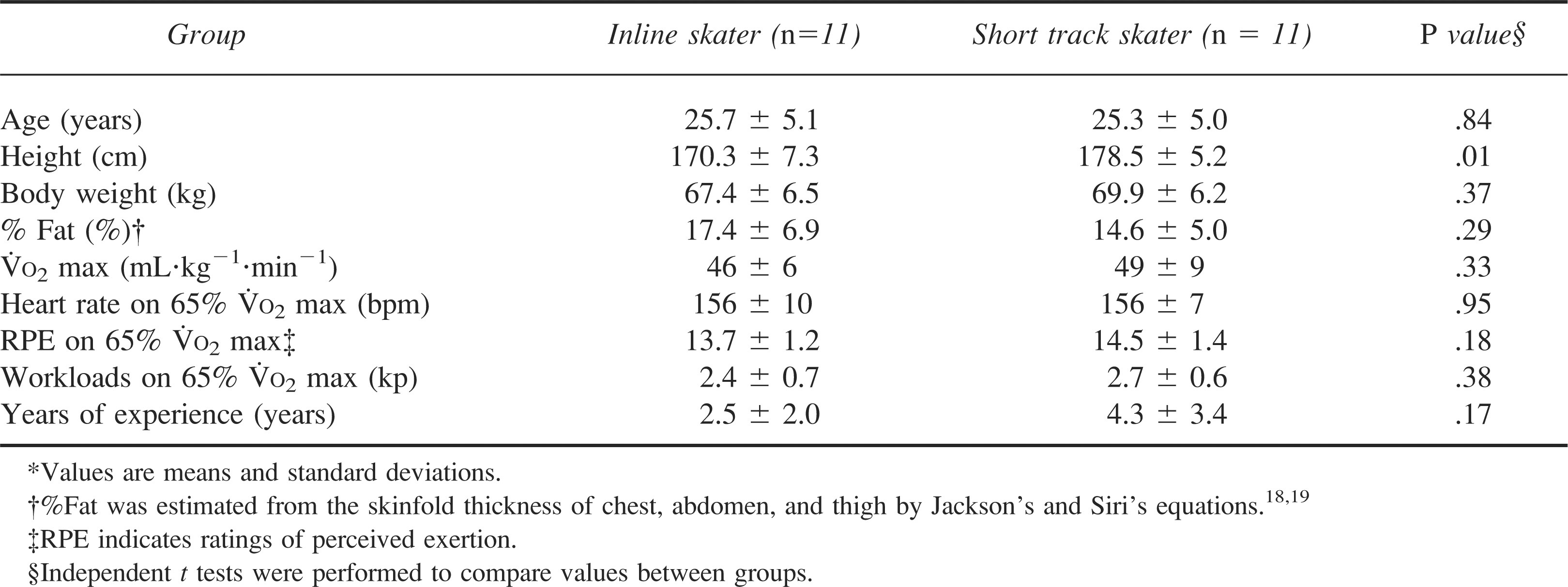
The characteristics of the participants are shown in Table 1. No significant differences in each parameter were found between groups. The trial under cold conditions was not completed by 1 short track skater, and the trials under room temperature conditions were not completed by 2 inline skaters and 2 short track skaters.
Characteristics of participants*
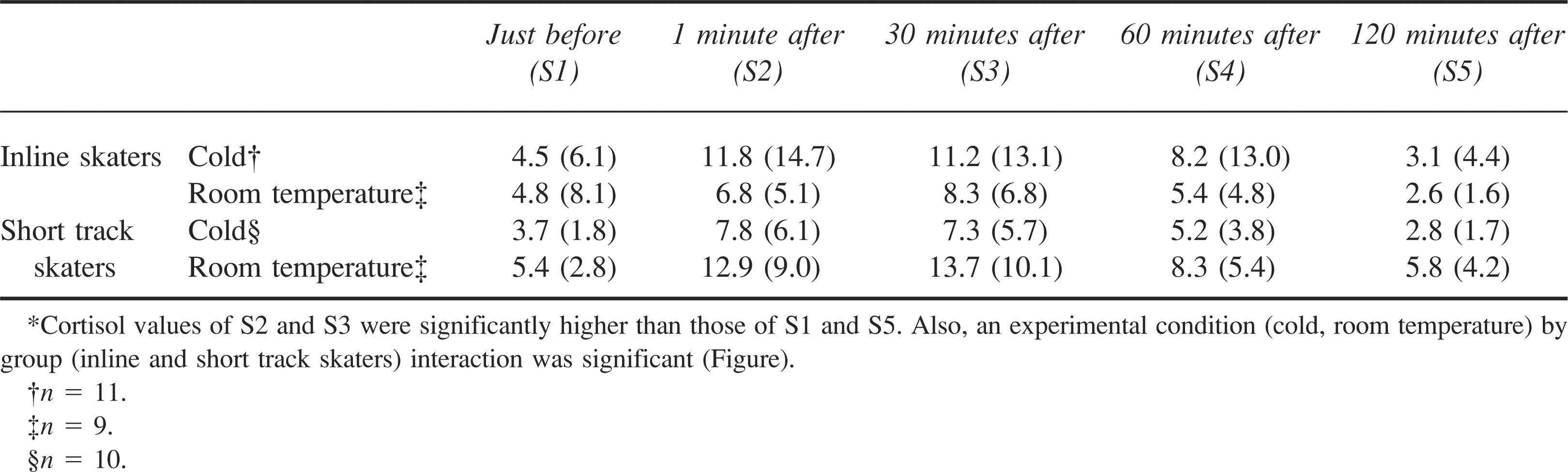
The cortisol data for each condition are shown in Table 2. The linear mixed model revealed a significant main effect of sampling time (F [4.00/155.32] = 8.59, P < .01). Posthoc comparison indicated that cortisol values of S2 and S3 were higher than those of S1 and S5. Also, an experimental condition by group interaction was significant (F [1.00/164.79] = 11.10, P < .01). The interaction is illustrated in the Figure. The inline skaters exhibited higher cortisol values under cold conditions by an average of 80% compared with cortisol values under room temperature conditions (F [1.00/83.62] = 4.01, P < .05). However, short track skaters exhibited higher cortisol values under room temperature conditions by an average of 60% compared with cortisol values under cold conditions (F [1.00/81.41] = 9.92, P < .01).
Means (standard deviations) of cortisol concentration (nmol/L) in each condition*
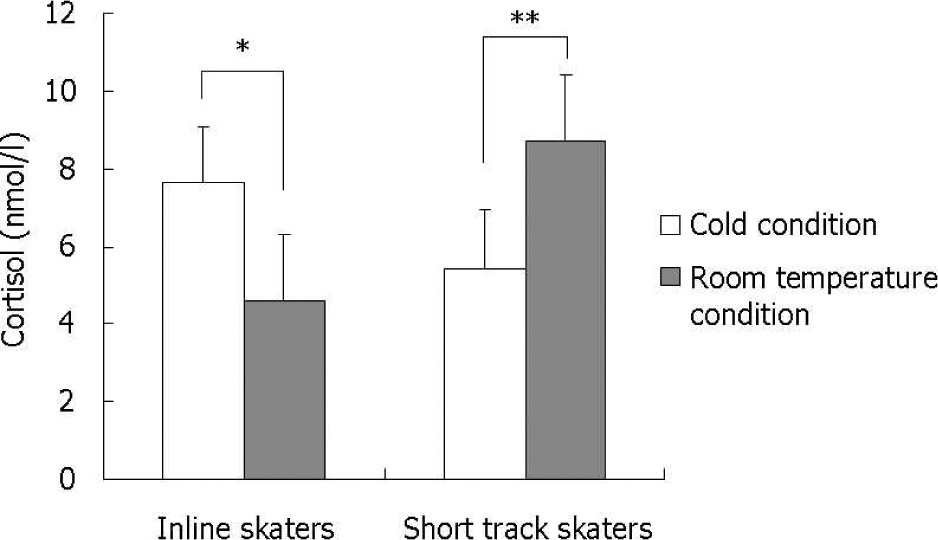
Estimated cortisol values in each condition adjusting for years of experience. Bars are standard error of the mean. **P <.01 *P < .05.
Discussion
The purpose of this study was to explore the effect of the cold environmental exposure and cold acclimatization on exercise-induced salivary cortisol response. As shown in the Figure, the inline skaters exhibited a larger cortisol response under cold conditions than under room temperature conditions (7.6 nmol/L and 4.2 nmol/L, respectively). However, the short track skaters exhibited higher cortisol values under room temperature conditions than under cold conditions (8.7 nmol/L and 5.4 nmol/L, respectively). These results indicated that the effect of cold environmental exposure on exercise-induced cortisol response was not the same for inline and short track skaters and that the degree of cold acclimatization of the individuals determined the magnitude of the exercise-induced cortisol response. Past studies reported that cold exposure increased cortisol levels, and such increases were not observed in people who were acclimatized to cold. 10 –12 This study demonstrated that these findings could be relevant to the case of exercise-induced cortisol response in a cold environment. The effect of cold exposure on exercise-induced cortisol response was not observed in people who were acclimatized to exercising in cold. Moreover, this study demonstrated that the opposite was true: the people who were acclimatized to exercising under cold but not under room temperature conditions exhibited a larger cortisol response under room temperature conditions. Taken together, these results indicated that the participants exhibited a smaller cortisol response under the conditions to which they were acclimatized and a larger cortisol response under the conditions to which they were not acclimatized. Viru et al 9 demonstrated a large interindividual variability in changes of cortisol concentration during exercise. Differences in the acclimatization to exercising under cold or room temperature conditions could be one of the factors that explain the large interindividual variability in cortisol concentration changes during exercise. Such acclimatizations are thought to be adaptive because a larger and frequent cortisol response to regular exercise might impair the body's function, such as immunity, and acclimatized and reduced cortisol secretion would be helpful for avoiding such damages.
These results should be interpreted in the context of some limitations. First, this study was carried out with a small sample. Second, in this study, the short track skaters had more years of experience than had the inline skaters. The differences in the years of experience could influence the results of this study, although the effects of the years of experience were statistically controlled. Third, the participants of cold conditions had recovery periods at room temperature. Temperature differences between cold and room temperature might affect the cortisol response. Fourth, this study could not deny that other factors contributed to the differences in cortisol response between groups and conditions. For example, there is a possibility that psychological stress, such as anxiety, caused by the unfamiliar conditions contributed to the differences in cortisol response. Also, daily diet intakes such as carbohydrate or hydration state could influence the cortisol response.20,21
In conclusion, this study demonstrated that exercising under cold conditions caused a larger cortisol response in people who usually exercised under room temperature conditions and that the effects of the environmental conditions (cold, room temperature) on cortisol response were opposite in people who usually practice in cold conditions. Acclimatizations to exercising in either a cold or room temperature condition could contribute to the differences in the cortisol responses. Additional study could investigate the dynamic relationships between environmental factors and cortisol response to exercise.
Footnotes
Funding
This study was carried out in the Consolidated Research Institute for Advanced Science and Medical Care, partly supported by the Special Coordination Funds for Promoting Science and Technology, Ministry of Education, Culture, Sports, Science and Technology, Japan.