






Abstract
Objectives
The purpose of this study was to derive and validate a rule for duration of search (ie, search time) that maximizes survivors and after which a search and rescue (SAR) mission may be considered for termination.
Methods
This was a retrospective cohort study of all SAR missions initiated in Oregon over a 7-year period, which were documented in a population-based administrative database. The following types of search missions were excluded from analysis: redundant reports of a single search; lost helicopters and airplanes; support of organized events; law-enforcement searches; searches for persons actively avoiding rescue; body recovery missions; and cases without outcome information. The cohort was divided into a derivation cohort (searches from 1997–2000) and a validation cohort (2001–2003). The primary outcome was survival. Variables considered in the model included age, gender, minimum and maximum daily temperatures, precipitation, search time, and whether the search involved an air or water incident. Missing data were handled using multiple imputation. Classification and regression tree (CART) methods were used to derive the model.
Results
The derivation cohort included 1040 searches involving 1509 victims, 70 (4.6%) of whom died. The validation cohort included 1262 searches involving 1778 victims; 115 (6.5%) died. Search time was the only variable retained in the final model, with a cut-point of 51 hours. The derivation model was 98.9% sensitive; the same model run using the validation cohort was 99.3% sensitive.
Conclusions
This time-based model may aid search managers in the decision about starting a search or changing search tactics for missing persons.
Introduction
When the west was settled, the first elected official was typically the town sheriff, who was vested with responsibility for the health, safety, and welfare of the citizenry. To this day, the county sheriffs remain responsible for coordinating search and rescue (SAR) missions in their jurisdictions, to assist those who are overdue, lost, injured, or stranded in the wilderness. Although the exact number of searches conducted each year is unknown, it is estimated that the annual number of SAR missions in the United States might be in excess of 100 000. 1 SAR operations are complex and time-consuming. Distance, terrain, and weather complicate search efforts. Furthermore, under pressure to locate the victim before he/she succumbs to injuries or environmental hazards, SAR personnel may be exposed to the same adverse conditions and risks that compromised the victim.
When a victim is not found in a timely fashion, a decision must be made about when a search and rescue effort should be abandoned or changed to a search and recovery operation based upon the probability of survival. Terminating a search when there is little hope for survival decreases the risk to rescuers and conserves valuable resources. Furthermore, an understanding of the likelihood of survival may be of emotional benefit for both SAR personnel and a victim's family at the termination of an unsuccessful search.
Currently, there is little information about wilderness morbidity and mortality to help determine when to end a search. A study of pediatric wilderness deaths in Washington examined injuries sustained and circumstances of death. This study found that the majority of subjects were male and that drowning was the most common cause of death. 2 Two studies are applicable to SAR likelihood of survival at sea or in relation to hypothermia.3,4 These studies develop guidelines for continuation of SAR operations based upon a predictive model of hypothermia, correlating a higher percentage of body fat and a shorter stature with a longer predicted survival time in cold, wet environment. 4 An additional study evaluates the thermal protection characteristics of outdoor clothing. 5 These studies, taken together, do not provide sufficient data to determine when to stop a land-based SAR mission.
The ability to triage incidents and have tools to predict when a subject may have perished are of the utmost importance when making decisions about whether to commit resources to the field or keep them in the field under what may be dangerous conditions and terrain, but little is objectively known about the factors that predict survival. The purpose of this study was to derive and validate a rule for duration of search (ie, search time) that maximizes survivors and after which a SAR mission may be considered futile.
Methods
Study Design
This study was a retrospective, observational study of all SAR missions initiated in the state of Oregon from January 1, 1997, through December 31, 2003. Victims included in SAR missions during the first 3 years (January 1, 1997, through June 4, 2000) were used to derive the decision rule, and those from the last 3 years (January 1, 2001, through December 31, 2003) were used to validate the rule.
Study Setting and Population
Oregon is a primarily rural state with an estimated population of approximately 3.6 million people. Oregon is home to heavily forested valleys, multiple mountain ranges, and high desert. The state places the statutory responsibility for SAR missions on the sheriff of the county within which the incident occurs. Since 1997, each Oregon county has provided uniform data to the state SAR coordinator who maintains a database of all missions in the state. This database contains information on the SAR subject activities, demographics, recovery condition, and the terrain/environment in which events occurred. The database has been used primarily for budgeting purposes by the state of Oregon. Access to the information was granted for the purpose of this study. Documented SAR missions from 1997 through 2003 are included. Searches conducted by non-SAR agencies were not part of the database. The Oregon Health & Science University Institutional Review Board approved this study.
Study Protocol and Measurements
We analyzed a population-based administrative database (retrospective cohort) in which information about all SAR missions conducted in the state of Oregon was routinely compiled. Available information about search missions included: the counties in which the searches were conducted; the age and gender of each lost person; the activities in which the lost persons were engaged; the types of searches (air, land, water); terrain characteristics; relevant dates, including the dates the lost persons were reported missing, the time the persons were reported missing, and the times the SAR missions were ended; and the outcomes of the search efforts.
The database was initially configured such that each observation represented a search mission; we reconfigured the database so that each observation represented a single lost person. Thus, in the resulting analytic datasets, a given search mission could be represented multiple times if the mission involved multiple lost persons. For the purposes of the statistical analyses, we considered each observation to be independent. In the derivation cohort, 277 (18.4%) of the searches involved multiple lost persons; in the validation cohort, there were 348 (27.6%) searches involving multiple lost persons. All variables were coded identically for both the derivation and validation datasets.
All SAR missions for both the derivation and validation cohorts were examined. We excluded from analysis any missions that involved: 1) redundant reporting of a single search mission (mission was only included once in the analysis); 2) incidents involving lost helicopters and airplanes (small personal flight craft such as hang gliders, paragliders, and ultralight motorized vehicles were retained); 3) SAR units supplementing emergency service (EMS) response at organized events in rural locations; 4) SAR units involved in law-enforcement activities or searches for persons who could be presumed to be actively avoiding rescue, such as searches for stolen vehicles, escapees, runaways, suicidal persons, or evidence searches; 5) body recovery missions, where subject was known to be deceased at the initiation of the search; and 6) cases without outcome information.
Weather conditions prevalent at the time of the search were not recorded in the administrative database. We collected weather data retrospectively by abstracting data from an online archive of National Weather Service weather data gathered from weather stations around the state. 6 For each weather station, we had access to minimum temperature, maximum temperature, and the amount of precipitation for each individual day. For each search mission, we abstracted data recorded at the nearest weather station on the day the search was initiated. Precise location of the search missions was not reliably recorded; it is possible that the nearest weather stations were many miles removed from the actual search location.
Our primary outcome of interest was survival. Within the databases, outcomes were recorded as “found dead,” “found alive,” “remains missing,” or “not found.” Persons for whom the outcome was unknown or was recorded as “remains missing” or “not found” (total n = 161) were excluded from the analysis.
Data Analysis
Variables considered for inclusion in the model were 1) judged a priori to be potentially influential as to the likelihood of survival for missing persons and 2) likely available to searchers at the time a decision to curtail a search would need to be made. Variables considered for inclusion in the rule were age, sex, type of search, month of search, amount of precipitation on the day the search began, minimum and maximum daily temperature on the day the search began, and length of search. To maximize the amount of available information, continuous variables (eg, age, temperature, precipitation, and search time) were included without categorization in the models. Because search time was far superior to any other predictor in identifying survivors, we opted to restrict subsequent analyses to include only search time as a predictor.
To avoid introducing selection bias by only including complete cases (ie, without missing covariate information) and to maintain the population-based sampling design, we used multiple imputation7,8 to handle missing data. We used a Markov chain Monte Carlo method (SAS PROC MI) based on a multivariate normal model. All continuous variables with a skewed distribution were log-transformed for the imputation process. In addition to search time, a number of auxiliary variables were included to assist in the imputation process. 8 Because there was no reason to believe persons from the 2 time periods were inherently different from one another, and to improve the imputation process (ie, increased information to generate imputed estimates), we combined the derivation and validation cohorts for multiple imputation. Through the multiple imputation process, 10 complete (ie, no missing data) versions of the original dataset were generated, each of which was separated by derivation or validation cohort assignment and analyzed separately per standard multiple imputation methods. 9
Classification and regression tree (CART) analysis (version 4.0, Salford Systems, San Diego, CA), a nonparametric method used to classify observations based on a large number of possible predictor variables, 10 was used to assess the most appropriate cut-point for search time (ie, the duration of search time that maximized the number of survivors, while still balancing resource utilization) in the derivation cohort. This search duration was then validated using the validation cohort. We sought a highly sensitive model because we wanted to predict with great accuracy when a search subject might be deceased, without curtailing a search prematurely and missing potential survivors. The sensitivity and specificity of identifying survivors using the time cut point generated from the derivation cohort were calculated by cross-validation, 11 –13 and performance measures were calculated separately for the validation cohort. Binomial 95% CIs were calculated for performance measures in the validation cohort.
Because there was a substantial portion of missing data for search time, we performed several sensitivity analyses. All CART-based analyses (for derivation and validation cohorts) were performed using both the nonimputed sample (ie, using CART methodology with surrogate variables to handle missing data), and the multiply imputed sample. The search time cut points presented were robust to different methods for handling missing data and all sensitivity analyses.
To further assess the likely nonlinear relationship between search time and outcome, we also analyzed a Kaplan-Meier time-to-event curve for survivors compared to decedents, where the “event” was being found. Such an analysis allowed for the graphical display of the proportion of each survival group remaining lost at any given search time.
Data management, descriptive statistics, univariate analyses, and imputation were all conducted using SAS, version 8.2 (SAS Institute Inc, Cary, NC). Multivariate modeling and probability estimation were conducted using Stata, version 9 (StataCorp, College Station, TX).
Results
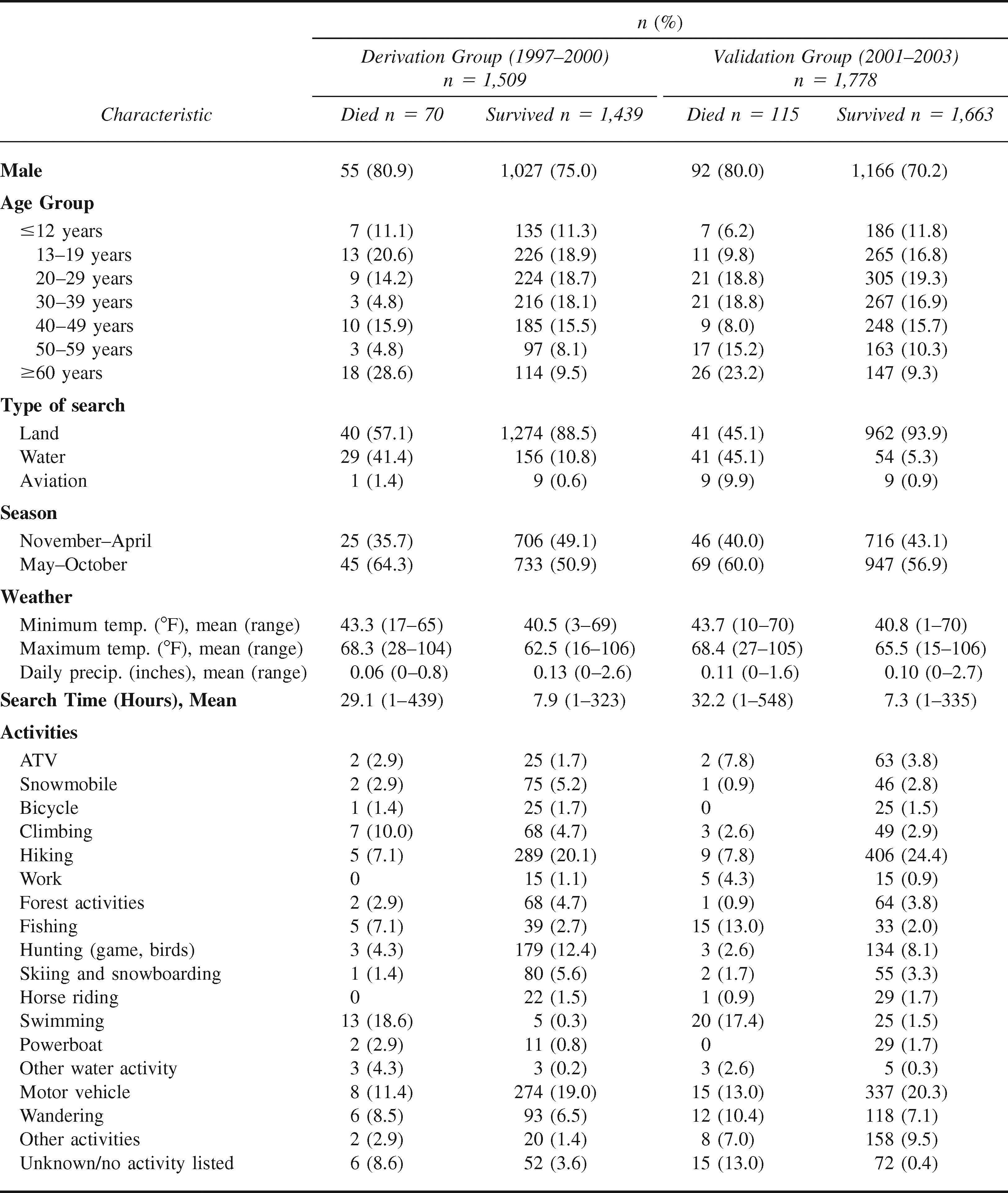
We reviewed 4244 SAR missions for inclusion in the study, of which 2302 missions (3287 persons) were retained for analysis. There were 1040 eligible SAR missions in the derivation cohort, involving a total of 1509 victims. The validation cohort included 1262 eligible missions involving 1778 victims. Table 1 displays the distributions of all the variables considered for inclusion in the model. In addition, the activities in which lost persons were engaged are also described in Table 1.
Distribution of characteristics used to create a decision rule for search and rescue mission termination, Oregon, 1997–2003
Derivation Cohort
In the derivation group, 70 people (4.6%) were found deceased. Search time was missing for 682 (45.2%) records. All variables described above were included for consideration in the initial CART model. Search time was the only variable retained in the final model to predict survival. Two search time values (17 and 51 hours) were selected by CART in the decision tree as critical time points in the search process (Figure 1). If all searches had been terminated at 51 hours, 14 of 1439 survivors (1.0%) would not have been found. This model performs with 98.9% sensitivity and 13.9% specificity.
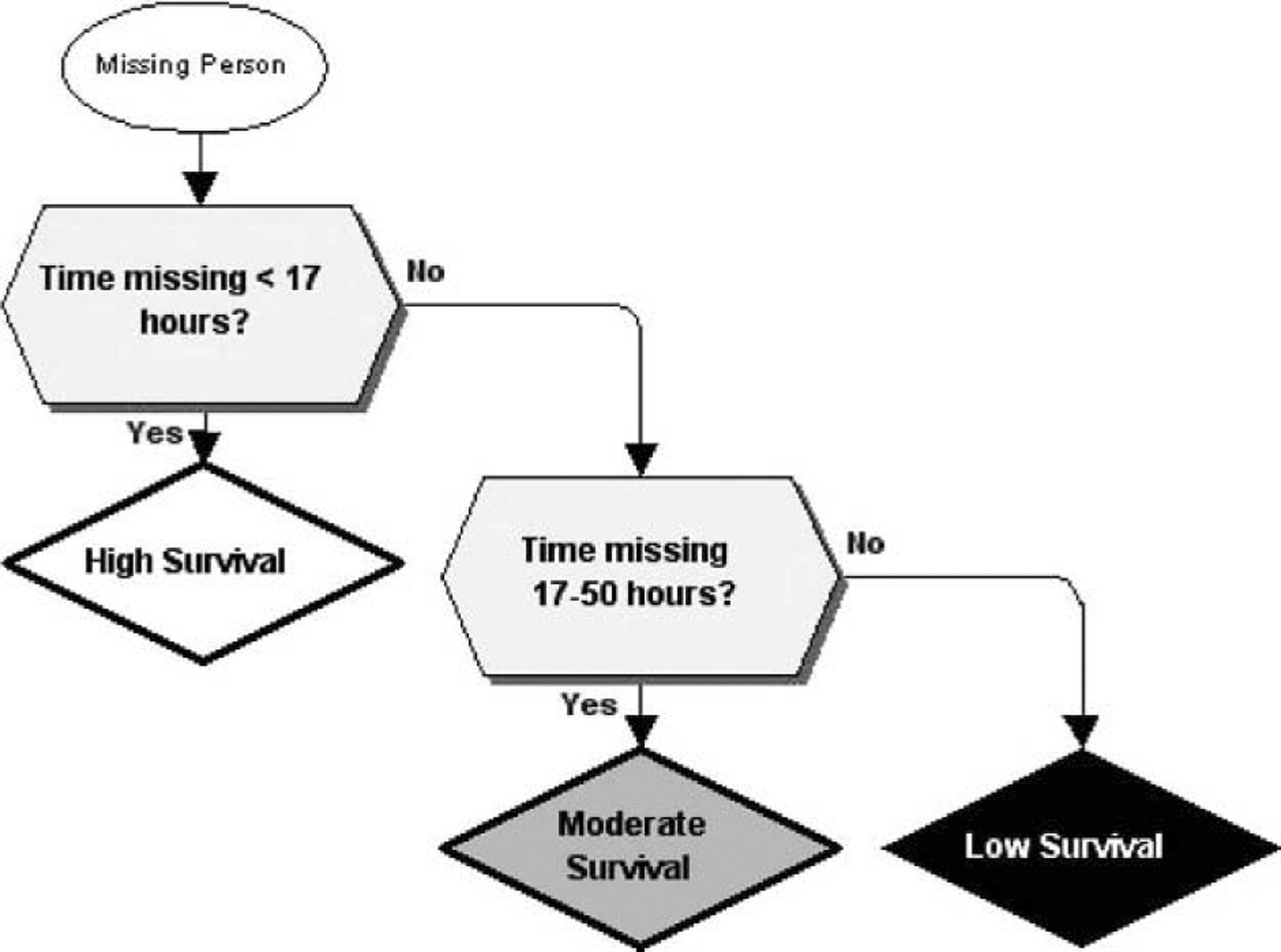
Model produced by CART analysis in the derivation cohort.
Validation Cohort
In the validation group, 115 people (6.5%) were found deceased. Search time was missing in 897 (50.4%) records. Using the imputed validation dataset and the model created with the derivation cohort, we correctly classified all but 20 of the 1663 survivors (1.2%). This validation of the model performs with 99.3% sensitivity and 4.3% specificity.
Search Time and Survival
Figure 2 displays the Kaplan-Meier step function for search times by survival group, decedents vs survivors, limited to searches less than 100 hours in length. Searches yielding deceased victims were systematically longer than searches yielding survivors. In addition, by the estimated cut-off point of 51 hours, nearly all of the survivors have already been located. And by 100 hours, nearly all of the lost persons, deceased or not, have been located.
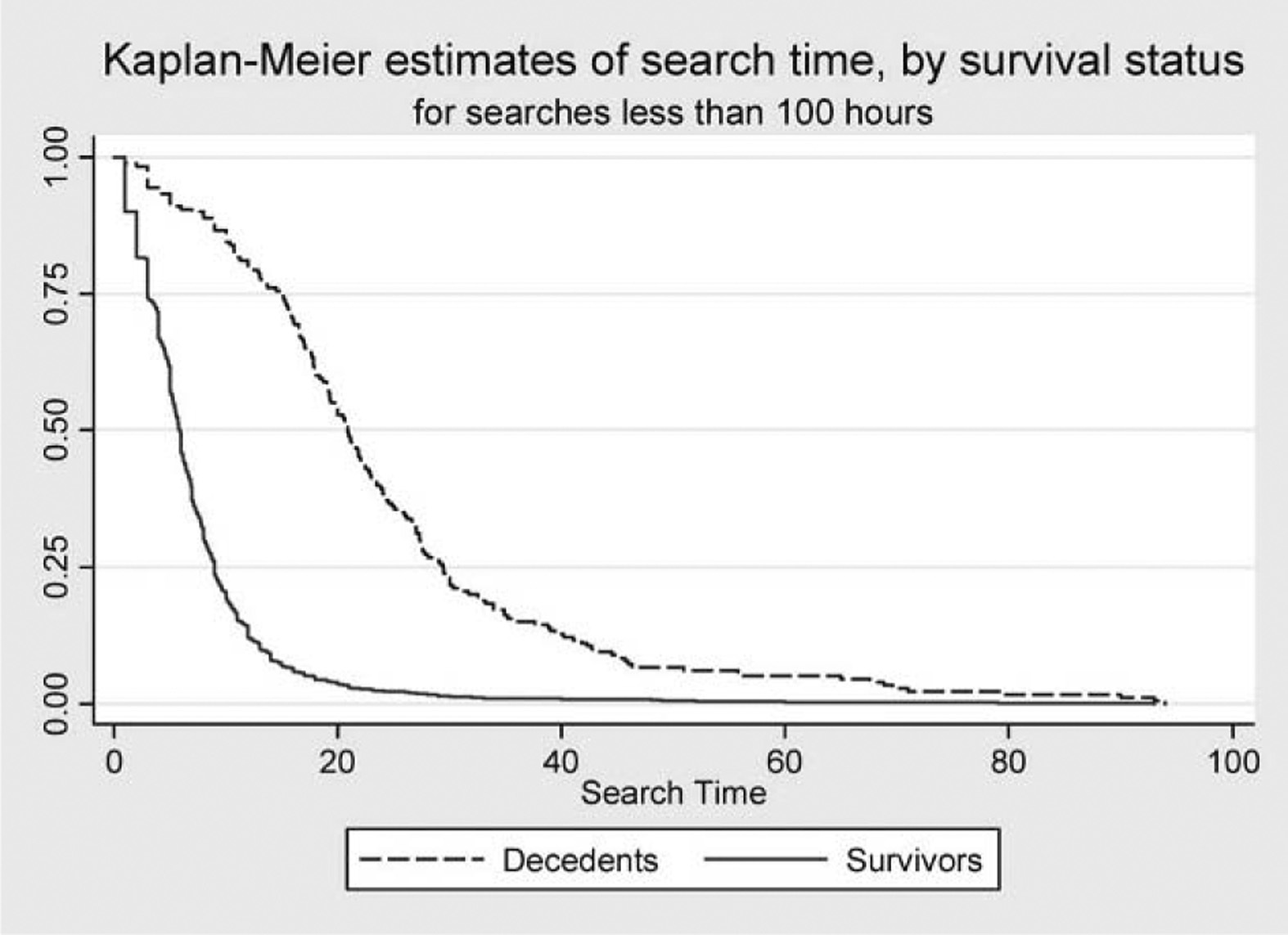
Kaplan-Meier estimates of search times, by survival group (decedent vs survivors), for searches less than 100 hours in duration. Search time was averaged for each subject across each of the 10 imputed datasets.
Other Predictors of Survival
In the derivation dataset, we were able to assess the importance of factors other than time on the likelihood of survival. Age 60 years or greater was associated with decreased survival (odds ratio [OR] 0.25; 95% CI: 0.15, 0.46), as were searches conducted during the months of May through October (OR 0.58; 95% CI: 0.35, 0.95). Land searches were more likely to yield survivors than were water searches (OR 5.9; 95% CI: 3.6, 10.0). Increases in daily high temperature were associated with decreased survival (OR 0.98; 95% CI: 0.96, 0.99). Daily low temperature, precipitation, and terrain were not associated with survival.
Discussion
We used CART methodology to develop a model that may help search managers and EMS physicians determine when to stop a search. In order to assure that the model could be applied, we first derived the rule on one data set and then validated it on a second data set. The model considered multiple search factors. Several of these variables were shown to be associated with survival, but time alone was the strongest predictor of survival. According to the model, using a cutoff time of 51 hours after the person was reported missing is 98.9% to 99.3% sensitive in predicting survival. Put another way, after 51 hours only about 1% of survivors were located. This reinforces the importance of starting the search early with both passive and active search tactics in order to increase the probability of detection within the time period when there is a high probability of survival. We were not able to calculate a confidence interval around the cut-point estimate of 51 hours; if we had, it would be reasonable to consider the upper bound of the confidence interval as a potential cut-point, further maximizing the likelihood of finding survivors. After the 51-hour mark, survival was still quite good; 56.6% of searches in this longer time period found survivors. That these survivors represented only 1% of all lost persons should not minimize the importance of finding these people.
Despite these findings, these data should be used with caution in determining when to change search tactics or terminate a formal search. Although the percentage of survivors was low after our cutoff of 51 hours, there were a small but important number of people found alive after this time. Thus, a search manager might use a cutoff of 2 to 3 days for most searches but consider other factors and extend the search in some circumstances. Those other factors include age and land vs water rescue. We found that if the event occurred on land (rather than water), there was an increased chance of survival. On the other hand, persons older than 60 years or searches conducted in the months May through October were associated with a decreased likelihood of survival. Other factors such as the general health of the subject, fitness level, and preparedness for the environmental conditions may be factors but we were unable to assess such factors because they were not recorded in this database.
It is not surprising that searches involving water are less likely to find a subject alive since drowning is a common cause of wilderness deaths.2,15,16 For land searches, we expected terrain to be an important factor in survival; specifically that individuals lost in flatter terrain would be more likely to survive. However, terrain did not remain in any of our models as an important predictor of survival. Another potentially important factor is the general health of the lost persons. However, we were unable to determine the medical condition of our subjects. Finally, given the vegetation mix in flat terrain throughout western Oregon, the probabilities of detection are reduced dramatically for “fast” search methods, such as aircraft, hasty teams, and confinement; therefore reducing the probability of success within the 51-hour time frame.
Limitations
There are some important limitations to this study. Because we used an administrative dataset that was designed to track person hours and costs of search missions (but which was not designed for research), it did not include information about the health status, physical condition, or preparedness of the lost person. As noted above, these variables likely contribute to survival.
Weather also likely affects the chances of survival, but was not directly recorded in the original dataset. We inferred weather conditions based on data from weather station information (a surrogate measure), but this was a crude measure. Especially in mountainous terrain, the weather in the search area may have varied from that reported at the closest weather station.
The dataset had missing data for key variables, including search time. We used multiple imputation to handle these missing values to avoid the often substantial bias introduced through complete case analysis. To further assess the potential impact of imputing time values, we performed several sensitivity analyses using both imputed and nonmissing values, with qualitatively similar results.
We also limited the cohort to subjects for whom we had clear outcome information, excluding those that were labeled as “remains missing.” We could hypothesize that the search times for these people would be systematically longer than search times for people who were found, but we do not know this for certain. The “remains missing” group was uniformly missing data for the end of search time. Thus, there would have been appreciable bias introduced by including the “remains missing” group, for which we would have to impute 100% of the search times. We therefore chose to exclude this group.
This study reports the experience in the state of Oregon. Oregon has diverse terrain and weather conditions, but the experiences of other states with other weather and terrain may vary.
Conclusion
We developed a model to aid search managers and physicians in the decision-making process for the duration of time to continue searches for missing persons. In our model, time alone was the best predictor. While considering other variables, search managers can use this time-based model to help determine when the probability of finding a survivor is substantially reduced.
Footnotes
Acknowledgments
We would like to acknowledge Rebecca Anderson, student volunteer, for her work on the weather data abstraction for the validation cohort; and Georges Kleinbaum, who provided access to the database, as well as all the people who participate in search and rescue in Oregon.