






Abstract
Wearable materials with thermal management and self-adaptive breathability have attracted increasing attention. In this study, nano-TiO2/polyurethane (PU) membranes were prepared via casting. Properties of fabricated nano-TiO2/ PU membranes were characterized systematically by Scanning Electron Microscope (SEM), Fourier Transform Infrared Spectrometer (FTIR), Thermal Gravity Analysis (TGA), Differential Scanning Calorimetry (DSC), and strength tester. The effects of TiO2 content on waterproofness, moisture permeability, and thermal stability of the composite membranes were studied. The experimental results show that with the increase of TiO2 content, the thermal stability of the composite membranes increased; waterproofness and moisture permeability performance also improved.
Introduction
Traditional waterproof-breathable membranes possess appropriate water vapor transmission ability, but not multifunctional properties, especially self-adaptive breathability when temperature and moisture change. In comparison, an intelligent membrane could maintain human body warmth in cold weather, while it could also keep skin dry and comfortable in a hot and wet environment.
Polyurethane (PU) is a macromolecular compound containing repeating urethane groups (NHCOO-) in its main molecular chain. It is a block copolymer composed of soft and hard segments. The soft segment is polyester or poly-ether with a molecular weight between 1000 and 3000; the hard segment is diol or diamine with low molecular weight and diisocyanate. 1 PU is commonly used as film and membranes due to its good wear resistance, high elasticity, low cost, and easy film and membranes formation.2,3 PU is widely used in tire manufacturing, textile, and other industries, but is not suitable for self-adaptive breathable textile materials when temperature and moisture change.
To improve this self-adaptive property, nanometer-sized inorganic particles were introduced in polyurethane materials. This allowed the membrane to not only retain the original performance, but also achieve new properties. 4 Nano-titanium dioxide (TiO2) as an important inorganic material, which has excellent properties such as strong stability, corrosion resistance, easy preparation, strong
oxidation ability, low solubility, good photocatalysis, and non-toxicity. It is often used as an addition to improve the polymer properties.5-7 Jie reported that a TiO2/PU film prepared by the casting method had improved hydropho-bicity. 8 The TiO2/PU film not only had micro-papillae, but also had a large number of nano structures distributed on and between the micro-papillae. Zheng prepared anatase nano TiO2/PU coatings using the antibacterial properties of TiO2. 9 As the TiO2 mass fraction increases, the antibacterial properties of the composite film gradually increase. Hence, to improve the management of the human body microclimate through the self-adaptive breathable textile materials, nano-TiO2/PU composite membranes were prepared and the properties of fabricated nano-TiO2/PU composite membranes were characterized systematically in this paper.
Materials and Methods
Nano-TiO2 powder was purchased from Shaoxing Lijie Chemical Co. Ltd.; PU; N,N-dimethyllformamide (DMF); and sodium chloride (NaCl) were purchased from Sino-pharm Chemical Reagent Co. Ltd and used without any further purification. Nano-TiO2/PU composite membranes were fabricated by casting formation. In our previous study, it was found that the membrane-forming ability was best when the PU content was 5%. TiO2 was added to 50 mL of prepared PU solution for a TiO2/PU hybrid aqueous dispersion. The mass concentrations of TiO2 were 0 (pure PU), 0.5%, 1%, 2%, 3%, and 5%. The aqueous dispersion was stirred for 0.5 h with a magnetic stirrer to make sure TiO2 was dispersed evenly in the PU solution, then moved to an ultrasonic processor for another 0.5 h. The mixture was poured into a polytetrafluo-roethylene (PTFE) petri dish after defoaming. All of these operations were performed at room temperature. Finally, the petri dishes were put into the oven at 60 °C for drying until the quality no longer changed.
Characterization
Fourier-Transform Infrared Spectroscopy (FTIR)
FTIR spectra of PU and nano-TiO2/PU composite membranes were collected by an FTIR spectrophotometer (PerkinElmer Spectrum, USA) at room temperature in the region of 4000-400 cm−1 with a spectral resolution of 2 cm−1 and 64 scans.
Scanning Electron Microscopy (SEM)
The surface morphologies of PU and nano-TiO2/PU composite membranes were observed on a SU8010 instrument (SEM SU8010, Hitachi, Tokyo, Japan) at 10 kV. Samples were fixed and gold coated, then placed into the SEM machine for capturing microscopic images. The distribution of TiO2 in the prepared TiO2/PU composite membrane was also observed.
Thickness
Thickness of prepared nano-TiO2/PU composite membranes was measured using a YG141 fabric thickness meter. Five points were measured for each sample, and the average value was calculated.
Contact Angle
Hydrophilicity and hydrophobicity of the composite membranes were tested by a URT210-C contact angle measuring instrument (Ziyue Technology) at room temperature, and the water droplet was 2 μL.
Thermal Analysis
Thermal stability of the PU and nano-TiO2/PU composite membranes was evaluated using thermogravimetric analysis (TGA 4000, PerkinElmer, USA) in the range of 30 to 800 °C at a heating rate of 10 °C/min. All the tests were under nitrogen atmosphere protection, and the nitrogen flow rate was 20 mL/min.
Mechanical Properties
Tensile strength and elongation at break were carried out according to ASTM D882 with a rectangular sample of size 40 × 5 mm. The rate of loading rate was 20 mm/min, the test temperature was 30 °C, and the relative humidity was 65%.
Water Vapor Transmission
Water vapor transmission (WVT) of the membranes was measured according to ASTM E96 by using a chamber (YG601 II, Ningbo, China) with controlled temperature and relative humidity. The change of WVT of prepared membranes under various temperature and relative humidity conditions was investigated. The WVT is mass change per unit area of membrane per day (g/m2/day). It is calculated using Eq. 1.

Where, a1 is the initial mass (g) of the test jar before it was placed into the chamber;
a2 is the final mass (g) of the test jar, and a2-a1 is the mass change (g) during the testing process;
t is the time (h) during the testing process; and S is the area of measurement.
Results and Discussion
FTIR Spectra
FTIR spectra of PU and nano-TiO2/PU composite membranes at room temperature are illustrated in Fig. 1. The typical adsorption peak of PU at 3900 cm−1 is assigned to vibration of -NH-. The absorption peaks at about 2900 cm−1 are mainly caused by the stretching vibration of -CH3, and the absorption peaks at 1700 cm−1 correspond to the stretching vibration of C=O. The absorption of -C=O group also appeared at 1720 cm−1, attributed to -C=O bonded and free groups. All of these absorption peaks are found in FTIR spectra of PU and nano-TiO2/PU composite membrane. It was also known that the absorption peak at 500-700 cm−1 is the characteristic vibration absorption from nano-TiO2 in FTIR spectrum of nano-TiO2/PU composite membrane.
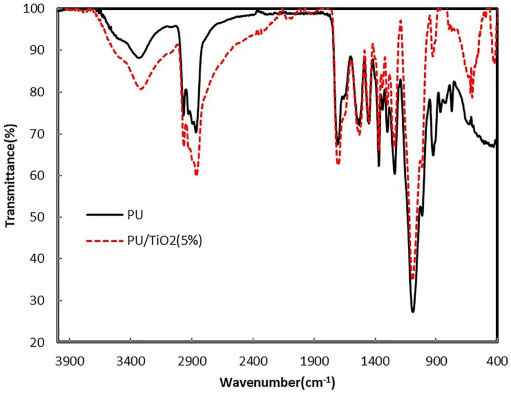
FTIR spectra of PU and nano-TiO2/PU composite membranes.
Surface Morphology and Contact Angle
The appearance of PU and nano-TiO2/PU composite membranes is shown in Fig. 2. The appearance of PU is transparent, and the transparency of composite membrane drops dramatically with increasing TiO2 content, which may attribute to the nano-TiO2 distributed in the matrix of PU, and the pore sizes of composite membranes comparable with the wavelength of visible light, thereby scattering it.
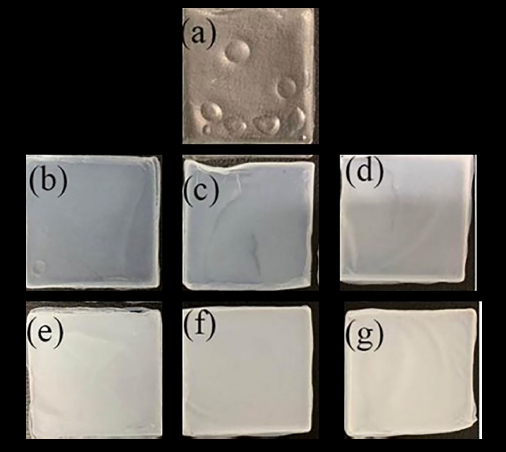
Appearance of (a) PU and nano-TiO2/PU composite membranes with (b) 0.5%, (c) 1%, (d) 2%, (e) 3%, (f) 5%, and (g) 10% TiO2.
The surface morphology and contact angle of PU and nano-TiO2/PU composite membranes were analyzed and illustrated in Fig. 3. It also shows the distribution of TiO2 in the prepared TiO2/PU composite membranes. Fig. 3a is an SEM image of the PU membrane. Fig. 3b-f are SEM images of nano-TiO2/PU composite membranes with the TiO2 mass content of 0.5%, 1%, 2%, 3%, and 5%, respectively. It can be seen from Fig. 3b and c that TiO2 particles are distributed in the matrix of PU evenly. However, Fig. 3e shows that TiO2 is agglomerated. In Fig. 3f and g, it was observed that the surface of the composite membranes is uneven; there are large particles with uneven distribution and much gap between the particles. It was concluded that coagulation of TiO2 occurred when content of TiO2 increase above 3%, which may be due to the size scale of some TiO2 agglomerates bigger than original size in composite membranes. As nanoparticles have a very large surface area/ particle size ratio, nano-TiO2 was unevenly distributed in the composite membranes. This proves that when the content of nano-TiO2 in the substrate of the composite membranes increases, the agglomeration phenomenon becomes more serious, and the surface of the membranes exhibits uneven-ness. 10 In addition, the surface structure of membranes changes from a “calm-lake” model to a “sea-island” model with increasing TiO2 content.
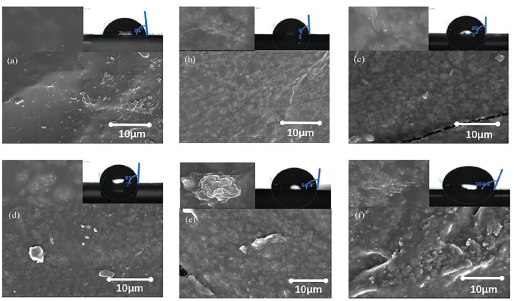
SEM images and contact angles of (a) PU and nano-TiO2/PU composite membranes with (b) 0.5%, (c) 1%, (d) 2%, (e) 3%, and (f) 5% TiO2.
In Fig. 3 and Fig. 4, the water contact angle on the surface of PU is 78°, showing a certain degree of hydrophilicity Tat is because there are -OH, -NHCOO-, and other hydrophilic groups in the PU molecular chain, the surface tension of the material increases, and the contact angle of water on its surface decreases. 11 In comparison, it can be seen from Fig. 3 and Fig. 4 that the water contact angle on the surface of nano-TiO2/PU composite membranes increased from 84° to 104.9° with the nano-TiO2 content increasing of from 0.5% to 3%, indicating the membrane transition from hydrophilic to hydrophobic. The waterproof performance of the composite membranes was gradually enhanced. When the content of nano-TiO2 increased to 3%, the contact angle of the composite membranes reached the maximum. The improvement of the waterproof performance of the composite membranes is due to the high surface energy of the nanomaterials, which makes it difficult for water molecules to spread. As the nano-TiO2 content increases, the waterproof performance of the composite membranes gradually increases. When the content of nano-TiO2 is higher than 3%, the contact angle decreased with further increasing of TiO2 content. This may be because TiO2 agglomerates in the composite membranes.
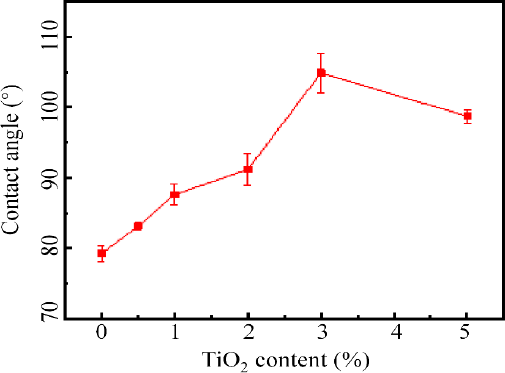
Contact angle value of nano-TiO2/PU composite membranes.
Thickness
The thickness of nano-TiO2/PU composite membrane with various TiO2 content is shown in Table I. The thickness of all the membranes is approximately at the same level, about 0.190 ± 0.002 mm. This indicates that the thickness can be controlled through the casting process. The effect of thickness on the properties can be ruled out.
Sample Thickness Test

TGA
The thermal decomposition of composite membranes can be divided into three parts as illustrated in Fig. 5. The TG curve shows that the first part is from room temperature to 265 °C, when weight of the samples decreases slightly. In this part, the volatilization of the additives and the water between the molecules are the main reason for the reduction of the weight of the membranes. It can be clearly seen that the weight also changed during the temperature increasing from 265 °C to 420 °C. The weight loss in this stage is due to the decomposition of soft and hard segments of PU. Weight loss decreased with increasing nano-TiO2 content, except the nano-TiO2/PU composite membrane with 0.5% nano-TiO2, which has almost the same change as PU membrane in this stage. The third stage is the stable stage at 420 °C-800 °C for carbon formation. At this stage, most of the polymer was carbonized, and the effect of temperature increase on the residue was very little. As shown in Fig. 5, the weight of residues varied with TiO2 content. A residue of 1.5% was observed for PU membrane at 440 °C. Nano-TiO2 did not lose its weight during the whole thermogravimetric process; if the thermal stability of PU in nano-TiO2/PU composite membrane is the same as for a pure PU membrane, at 440 °C, the calculated value of weight residue of nano-TiO2/PU composite membrane with 0.5%, 1%, 2%, and 3% nano-TiO2 was 1.99%, 2.48%, 3.47%, and 4.45%, respectively. In Fig. 5, it is worthwhile to note that at 440 °C, the weight residue of nano-TiO2/PU composite membrane with was 2.47%, 3.07%, 3.76%, and 3.38%, respectively, which was much higher than the calculated value when TiO2 was content no more than 2%. The increased residue confirmed the incorporation of nano-TiO2 into PU to improve the thermal stability. SEM showed that in the range of 0.5% to 2% TiO2 content, TiO2 particles are distributed evenly in the PU matrix. When TiO2 content increases above 3%, the TiO2 particles in composite membranes have uneven distribution. Thermal stability was related to the distribution of nano-TiO2 in PU.
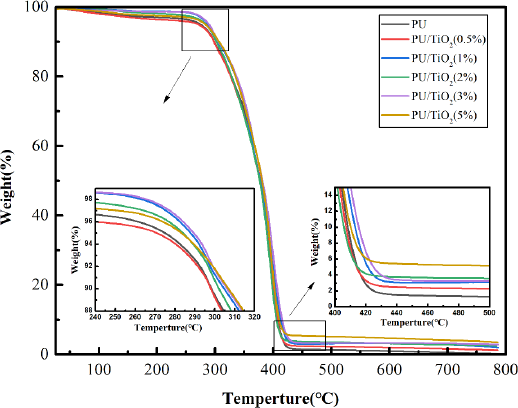
TG curves of nano-TiO2/PU composite membranes with various TiO2 contents.
The DSC curves of PU and nano-TiO2/PU composite membranes with different TiO2 content are shown in Fig. 6. The heat flow is different at the same temperature when nano-TiO2 content changes. This indicates that the enthalpy change (ΔH) and Tg are different. It observed from Fig. 6 that, when TiO2 content is below 3%, Tg decreases with increasing TiO2 content. The Tg of PU is about 60 °C, which drops to about 45° when TiO2 content is about 2% in nano-TiO2/PU composite membranes. However, Tg increased as TiO2 content continued to increase higher than 3%. Tg increases to 70 °C. This phenomenon is related to the dispersion and aggregation of TiO2 in the PU matrix. The results are consistent with those of SEM analysis.
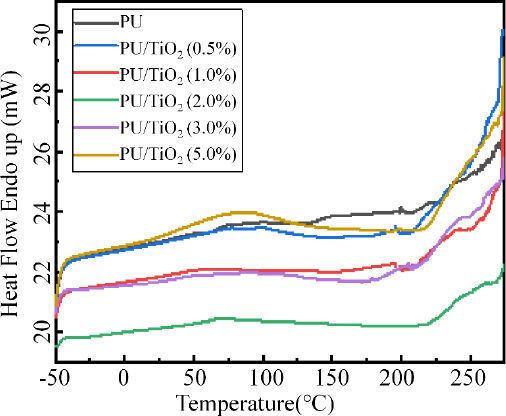
DSC curves of nano-TiO2/PU composite membranes with various TiO2 contents.
Mechanical Properties
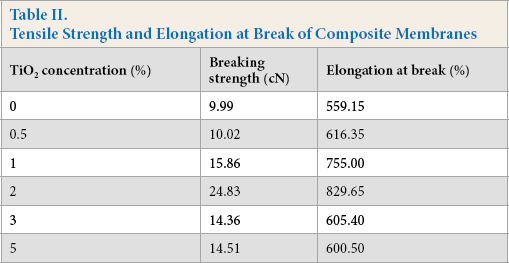
Mechanical properties of membranes with different TiO2 content membranes are shown in Table II. It can be seen from Table II that the tensile strength and elongation at the break of the composite membranes range from 9.99 cN to 24.83 cN and 559.15% to 829.65%, respectively, when the content of TiO2 increases from 0% to 5%. The experimental results show that with the increase of nanoparticles, the tensile strength of the composite membranes shows an increasing trend, which may be due to the orderly arrangement of PU membranes molecules in the drying process and the uniform stress distribution in the stretching process, making the elongation of the composite membranes with large tensile strength relatively high. 12 As the TiO2 content increases, the reaction between nano-TiO2 and PU molecules is equivalent to increasing the proportion of hard segments in PU, making the degree of micro-phase separation greater, so the tensile strength and elongation of the composite membranes gradually rise. When the TiO2 content reaches 2%, the tensile strength and elongation at break of the composite membrane is the highest, reaching 148.5% and 48.4%, respectively, compared with the PU membrane. When TiO2 content continues to increase, the tensile strength and elongation at break of the composite membranes decreases because of TiO2 agglomerated in the composite membranes.
Tensile Strength and Elongation at Break of Composite Membranes
Temperature Sensitive WVT
The WVT of nano-TiO2/PU composite membranes and PU membrane at various temperatures is shown in Fig. 7. The tests were performed at a constant relative humidity of 65%. All WVT of nano-TiO2/PU composite membranes shows an increase with increasing temperature, especially when the temperature increasing from 35 °C to 50 °C. For nano-TiO2 content as about 1% as an example, the WVT of nano-TiO2/ PU composite membrane is 1620 g/m2/day at 35 °C, it achieves 4070 g/m2/day when temperature reaches 50 °C. This behavior indicates that the nano-TiO2/PU composite membrane is sensitive to WVT, which indicates self-adaptive breathable properties with temperature changes. The increases of WVT with increasing temperature may be because when the temperature is above Tg of PU, segmental motion of the PU chain increases, which increases the average radius of free volume holes. The structural change with temperature increases leads to the intermolecular gap becoming large and more water vapor molecules able to transmit through it. 13 It also can be seen from Fig. 7 that when temperature increased from 35 °C to 50 °C, WVT increased as nano-TiO2 content increased from 0.5% to 2%. The WVT dramatically decreased when nano-TiO2 content increased to 5%, possibly because TiO2 agglomerated in composite membranes, which hindered the chain segment motion of PU, so the water vapor molecules transmission path is insufficient.
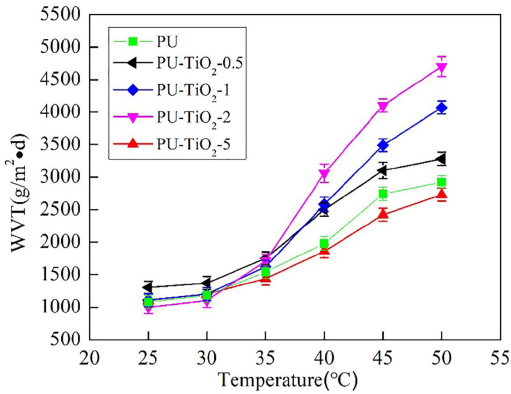
The WVT of nano-TiO2/PU composite membranes at Fig. 7 varying temperature.
Conclusion
Nano-TiO2/PU composite membranes based on thermoplastic PU and nano-TiO2 were prepared by a casting method. With the addition of TiO2, the composite membranes gradually turned white and their transparency decreased. Nano-TiO2 dispersed evenly in PU when the content of nano-TiO2 was lower than 3%. The introduction of nano-TiO2 in the PU membranes can effectively improve the thermal stability of the composite membranes when content of TiO2 is less than 3%. The addition of TiO2 can significantly improve the waterproof property. Water contact angle of composite membranes increased from 84° to 104.9° with TiO2 content increasing from 1% to 3%. This water-proofness can be beneficial to broaden the application field of the membrane. The WVT of nano-TiO2/PU composite membranes increased with temperature, indicates that the nano-TiO2/PU composite membrane has temperature-sensitive WVT characteristics, or is self-adaptive breathable with temperature changes.
Footnotes
Acknowledgments
This work was supported by the Natural Science Foundation of Zhejiang Province, China (LQ18E030006) and Key Laboratory of Yarn Materials Forming and Composite Processing Technology, Zhejiang Province (MTC-2020-23). This work was also supported by the Startup Foundation of Shanghai University of Engineering Science (0239-E3-0507-19-05165).