






Abstract
To improve the comfort of agricultural workers, a T-shirt with a printed active cooling finish was evaluated to determine if it would meet the wash life durability and performance expectations of such an arduous application. Six shirts with a printed phase change material (PCM) finish and six shirts without (control) were washed 50 times to replicate a typical consumer wash life. Shirts were evaluated for absorbency, dimensional change, colorfastness, crocking, abrasion resistance, soil release, and smoothness retention according to AATCC and ASTM standard test methods. Testing was conducted before laundering and after 1, 5, 10, 20, 30, 35, 40, 45, and 50 consumer laundry (CL) cycles. Absorbency and dimensional change were significantly influenced by the PCM finish. Results demonstrate the appropriateness of adopting such a finish technology for agricultural worker clothing applications.
Introduction
In 2012, the Census of Agriculture estimated that there were approximately 3.2 million farmers and farmworkers in the United States. 1 Of those, between 1 and 2.7 million are migrant farmworkers, meaning they temporarily live in the United States through the H-2A Temporary Agricultural Worker program 2 in order to work in fields, orchards, nurseries, and other types of farms. 3 As they are temporary hires, the majority of migrant workers work for less than 150 days per year, typically during peak growing months. 4
During these work periods, migrant workers endure extreme heat with little protection, either in the form of appropriate workwear or precautions taken to reduce the amount of heat exposure. Between 1992 and 2016, 783 US migrant workers died due to environmental heat exposure while another 69,374 were injured. 5 As workers engage in strenuous activity while exposed to environmental heat, their body temperature increases and leaves them more susceptible to heat stress. 5 This type of work environment heightens the risk of dehydration, nausea, heat stroke, heat rash, rhabdomyolysis, and chronic kidney disease. 5
The US National Institute for Occupational Safety and Health (NIOSH) has provided recommendations for employers to implement in their work processes to minimize the negative effects of environmental heat. These recommendations include using fans or blowers, monitoring temperature and modifying working hours accordingly, providing medical monitoring, or providing auxiliary cooling systems. 6 The NIOSH-recommended auxiliary cooling systems include water-cooled garments, air-cooled garments, cooling vests, and wetted overgarments. 6 In addition to these cooling systems, it is believed that other self-cooling garment technologies may be effective in reducing the effects of heat stress in migrant workers.
One such potential self-cooling garment technology is the application of phase change materials (PCMs) printed on the surface of textiles or clothing. PCMs provide users with a way to passively control temperature without the use of liquids, 7 unlike the NIOSH-recommended auxiliary cooling systems, which are add-ons to the clothing system. These auxiliary systems also increase ensemble weight, exacerbating the onset of heat illness. Research has shown that shirts containing PCMs, as well as additional cooling mechanisms, are associated with an 8% increase in exercise capacity when in a hot environment. 8 Therefore, this cooling technology should be explored further for its application in agricultural settings, specifically for migrant farmworkers.
PCMs
PCMs are compounds that change from a solid to a liquid, and vice versa, when a specific temperature is reached. PCMs have the ability to absorb, store, or release energy as latent heat. 9 The process of changing from a solid to a liquid involves the absorption of thermal energy, thus cooling the body, while the reverse change from a liquid to a solid releases the latent heat, providing a warming effect. 10 PCMs should have a high latent heat capacity, the ability to change states multiple times, as well as thermal and chemical stability. 11 PCMs are typically found in the form of paraffin waxes, hydrated salts, fatty acids, 9 and even water/ice. These materials are also known to be safe for consumer use (non-toxic and non-corrosive), readily available, and inexpensive enough to be widely used. 11
As these materials have melting points that are low enough to be melted by the heat of the human body, PCMs must be microencapsulated within a polymer shell to preserve their effect and prevent leakage onto the textile substrate. 12 Microencapsulation provides manufacturers with the ability to easily and effectively affix the PCMs into the fiber structure. 13 Microencapsulated PCMs can be incorporated into textiles through coating/printing, padding, 14 stamping, and impregnation. 15 This study specifically looked at a printed PCM application, which is achieved through the use of a binder. A binder is a solution that serves to embed the microencapsulated PCMs within the fibers of a textile, allowing the PCM to continue working effectively until the binder or fiber degrades. 11
PCM Applications in Textiles and Apparel
PCMs have become increasingly available in consumer apparel such as ski gear, outerwear, and hunting gear. 12 Similarly, PCMs are thought to improve the thermal comfort of those performing in hot environments, such as workers or athletes. In previous literature, PCMs have been tested in a large variety of ways. Some studies have looked at the chemical formulation of PCM microcapsules 16 and characterized the morphology, size, and properties. 12 Other studies have considered the effect that the finish has on a human's exercise capacity. 8 In addition, laundering studies (up to 10 cycles) have been performed to assess how varying amounts of binder effect the adhesion of PCMs to the fabric 13 and to assess tactile surface properties of the PCM-treated fabric. 14 While there is a significant body of research regarding the performance of PCMs for reducing skin temperature in various environments, few durability studies exist. Of those that have been published, garments with PCMs have not been researched, especially across their useful life span. Certain aspects of durability, including dimensional stability, absorbency, colorfastness, abrasion resistance, smoothness retention, and soil release, have not been considered. Furthermore, current literature has only studied PCMs that have been formulated and applied within a laboratory setting. To the authors’ knowledge, no published studies have evaluated the wash life of PCMs in a garment that is currently available on the consumer market.
Therefore, the purpose of this research was to determine if a 100% polyester printed PCM T-shirt could maintain its serviceability (i.e., colorfastness, absorbency, dimensional stability, abrasion resistance, smoothness retention, and soil release) over the course of 50 consumer wash cycles, in comparison to a control T-shirt without a printed PCM. This study addresses the ability of the PCM shirt to withstand such agricultural wear applications (up to 50 wash cycles) from a serviceability standpoint, considering other key performance features (e.g., shrinkage, pilling, colorfastness, absorbency, and soil release).
Methods
Sample
Twelve 100% polyester athletic T-shirts were donated for this study by a leading sportswear manufacturer. Six of these T-shirts had a proprietary, printed, microencapsulated PCM finish applied to the back side (skin side) of the fabric. The remaining six T-shirts were consistent in materials, design, and construction, but were not printed with the PCM finish; serving as the control group for this experiment (Fig. 1). A 4-lb wash load consisting of all twelve T-shirts was created and underwent 50 consumer care cycles.
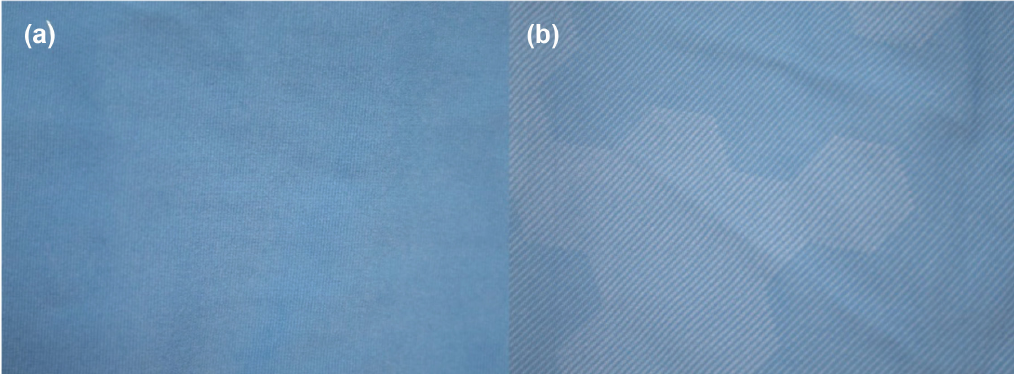
Skin side images of (a) the control garment, without a PCM finish, and (b) the test garment, with the printed microencapsulated PCM, as illustrated by the geometric pattern.
Laundering Procedures
Agricultural workers’ access to laundering facilities is often limited and typically involves the use of residential washers and dryers to care for their work clothing. The 4-lb consumer load consisting of all shirt samples was laundered in a top-load, center agitator (impeller style) residential washer and dried in a residential electric dryer to simulate consumer laundering conditions. The care cycles chosen were reflective of the consumer care instructions on the test garments. The washer was set on a normal care cycle and filled with cold water and 35 g of a national brand consumer liquid detergent. The load was tumble dried on a timed cycle for approximately 40 min on low heat. This process replicated typical consumer laundering as recommended on the garments’ care label. Based on the average lifespan of a consumer apparel T-shirt, laundering cycles were repeated fifty times. 17 It should be noted that the shirts were not “pre-washed” prior to initial testing. Instead, the results are reflective of typical consumer use patterns for which most wear the garment after its initial purchase, prior to the first wash. However, this methodological approach may lead to residual finishes influencing certain performance characteristics, such as absorbency, which will be discussed.
Testing Procedures
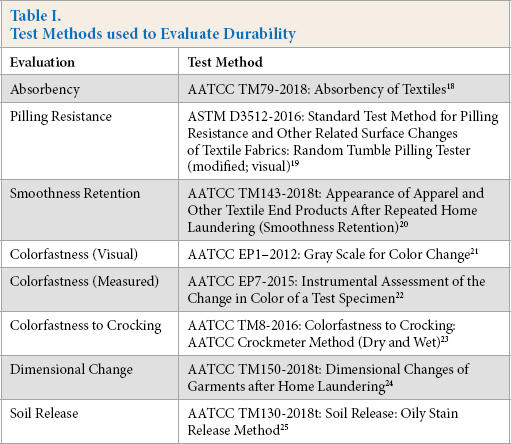
Evaluations of garment durability were performed prior to laundering and after 1, 5, 10, 20, 25, 35, 40, 45, and 50 consumer laundering cycles, according to standards published by the American Association of Textile Chemists and Colorists (AATCC) and the American Society for Testing Material (ASTM). After being hung to condition (70 °F ± 2 °F; 65% ± 2% relative humidity (RH)) for a minimum of 4 h, evaluations were performed on three shirt specimens per shirt type (control and printed PCM). These evaluations, outlined in Table I, included absorbency (water), colorfastness, visual abrasion resistance, soil release, smoothness appearance, and dimensional change.
Test Methods used to Evaluate Durability
Data Analysis
To determine the significance among results after multiple wash intervals, two-sample t-tests, assuming equal variance, were performed using the basic statistical software package available in Microsoft Excel. A p-value of 0.05 was chosen to indicate statistical significance. T-tests were used when analyzing the results of all assessments to determine the significance of any changes that were measured between the printed PCM T-shirt samples and the control T-shirt samples.
Results and Discussion
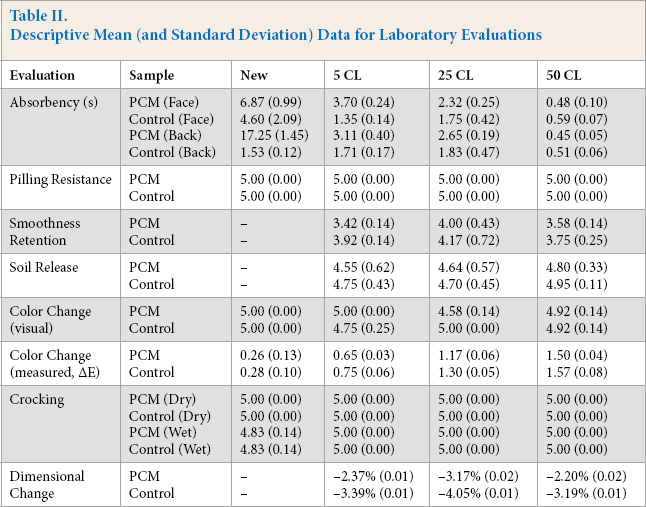
To determine if a printed PCM T-shirt could maintain its durability over 50 laundering cycles, making it potentially suitable for agricultural workwear conditions, multiple performance properties were measured. Results were analyzed before laundering and after 5, 25, and 50 consumer launderings (CL) between a 100% polyester T-shirt with a printed PCM finish (printed) and the same shirt without such a finish (control). The evaluations conducted before laundering represent the performance of the new PCM finish, while the results after 5 washes reflect a garment's performance after residual or temporary fabric finishes have been removed. Product performance after 25 washes represents half of the T-shirt's wash life, and results after 50 washes represent the garment's serviceability over its predicted lifetime. A summary of the performance evaluation results can be found in Table II.
Descriptive Mean (and Standard Deviation) Data for Laboratory Evaluations
Absorbency
Over the course of 50 consumer launderings, the liquid water absorbency of both T-shirt samples increased, with the time before losing specular reflectance decreasing at each wash interval. However, the back side of the printed PCM shirts, where the printed finish was applied, began with a significantly lower absorbency of 17.25s, compared to the control T-shirts. As noted in the methodology, the shirts were not “pre-washed’ prior to testing in their new condition, replicating typical consumer use (initial wear followed by wash). Therefore, the large increase in absorbency on the printed PCM side of the fabric from before laundering to after one wash may be due to the removal of temporary or residual finishes, including that of the PCM finish itself.
The difference in absorbency between the two shirt samples on the back side of the fabric after 5 (p = 0.005) and 25 (p =0.049) washes, was also found to be statistically significant. These results indicate that the addition of the PCM finish likely impeded the printed T-shirt's ability to absorb water, primarily when applied to the back side of the fabric. When comparing the performance of the printed PCM T-shirt after 5 CL to the performance of the same printed shirt after 50 CL, there was a significant increase in absorbency (p = 0.000). The continuous increase in absorbency of the printed PCM T-shirt is shown in Fig. 2.
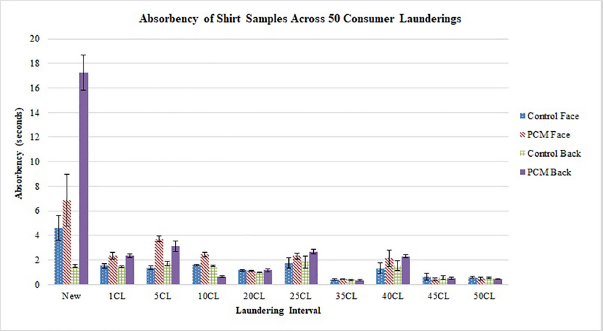
Average absorbency of the control and printed PCM T-shirt samples on the face and back side of the fabric over 50 consumer launderings.
Absorbency is a valuable indicator of the printed PCM fnish's ability to last the useful life of the garment (approximately 50 home launderings). The progressive increase in absorbency over the course of multiple consumer launderings indicates the PCM finish degraded over time and most likely had an effect on moisture management. This degradation is important to quantify across the garment's lifespan as it could significantly negate the benefits of heat stress relief for such applications as agricultural or industrial work.
Appearance Retention
Pilling resistance was visually rated using the ASTM Photographic Pilling Standards which includes the following scale: (1) very severe pilling, (2) severe pilling, (3) moderate pilling, (4) slight pilling, and (5) no pilling. All samples maintained an average rating of 5, indicating no pilling, at all evaluation intervals. These results demonstrate the polyester fabric was not susceptible to pilling during laundering and the application of the PCM finish did not alter this characteristic.
AATCC Tree-Dimensional Smoothness Appearance (SA) Replicas were used to evaluate the smoothness appearance of each sample after laundering using the following scale: (1) crumpled, creased, and severely wrinkled appearance, (2) rumpled, obviously wrinkled appearance, (3) mussed, non-pressed appearance, (4) smooth, finished appearance, and (5) very smooth, pressed, finished appearance. According to ASTM D4154-14 Standard Performance Specification for Men's and Boy's Knitted and Woven Beachwear and Sports Shirt Fabrics, 26 a minimum SA rating of 3.5 is required for a knitted sport shirt fabric to pass fabric smoothness appearance. All samples met or exceeded this minimum performance requirement, except for the printed PCM sample after 5 CL (SA = 3.42), which was significantly different from the control shirt (SA = 3.92, p = 0.013). It should be noted that the control T-shirts achieved a higher average SA rating than the printed PCM T-shirts after all but two wash intervals (35 and 45 CLs), indicating the printed PCM finish could have negatively impacted the smoothness appearance of the T-shirt.
The ability of the printed versus control shirts to release soils readily was evaluated on a single shirt from each sample at each wash interval using corn oil, ketchup, mustard, a fruit drink mix, and mud (dirt and water mixture). The AATCC Gray Scale for Staining used the following scale: (1) very severe, (2) severe, (3) moderate, (4), slight, and (5) no color transfer/staining was used to visually evaluate the release of the applied stains after the laundering cycle. Of the five stains, corn oil and mustard were the only two substances that consistently left noticeable stains on both sample types. Overall, there were no significant differences in soil release between the two shirt types, indicating the PCM finish did not negatively impact staining.
Colorfastness
Visual color change was assessed using the AATCC Gray Scale for Color Change with the following scale: (1) very severe, (2) severe, (3) moderate, (4), slight, and (5) no color change. According to ASTM D4154-14, a minimum grade of 4 is required for a garment to pass colorfastness to laundering. When assessed visually, both types of T-shirts maintained the minimum requirement across all wash intervals analyzed. There was a significant difference (p-value = 0.007) in visual color change between the two types of samples after 25 laundering cycles, with the control exhibiting greater colorfastness. When comparing the average performance of the printed PCM T-shirt after 5 and 25 wash cycles, there was a significant decrease (p = 0.007) in the visual colorfastness rating. However, all samples maintained the minimum rating of 4 set by ASTM D4154.
When measuring color change quantitatively on a spectro-photometer (HunterLab LabScan XE), there was a significant difference in the overall color change (ΔE) between the two samples after 5 (p = 0.026) and 25 washes (p = 0.010). Similar to the visual assessment, there was also a significant difference in ?E when comparing the performance of the printed PCM T-shirt to itself at varying wash intervals, specifically when comparing the results of the 5th interval to those of the 25th (p = 0.000) and 50th intervals (p = 0.000), as well as when comparing the results of the new printed PCM shirts to the results after the 50th interval (p = 0.000). After 50 washings, the ?E values of the control and printed PCM samples were 1.57 and 1.50, respectively, both of which fall near the typical consumer limit of 1.5 ?E. 27
For colorfastness to crocking, color change was evaluated using the AATCC Gray Scale for Staining, which uses the same ratings on a 1-5 scale as the Gray Scale for Color Change, but in relation to staining, or color transfer. Dry crocking evaluations did not change between samples across all wash intervals, with all shirts yielding a rating of 5 (no color transfer). Similarly, wet crocking evaluations yielded a rating of 5 after each wash interval, except for when tested before laundering. Both new shirt samples received an average wet crocking color transfer rating of 4.83. This was likely due to excess dye within the fabric and fibers being released. Regardless, both samples met the minimum performance requirements for sports shirt fabrics according to ASTM D4154-14, which included a rating of 3 for wet crocking and a rating of 4 for dry crocking. There were no significant differences between samples or wash intervals for colorfastness to crocking.
Overall, the appearance retention results, including colorfastness, suggest that there are no significant quality differences between the shirt samples. Furthermore, the ability of both shirt types to meet the minimum performance requirements for men's knit sportswear fabrics set forth in ASTM D4154, even after 50 consumer launderings, demonstrates the sufficient overall appearance retention of the garments.
Dimensional Stability
Dimensional change was measured in three lengthwise (right side seam, left side seam, top of right neckline to bottom hem) and three widthwise (shoulder point to shoulder point, underarm to underarm, and bottom hem) locations across the garment when laid flat. Measurements were taken on three samples of each shirt type at each wash interval. As shown in Table II and Fig. 3, the overall dimensional change of the printed PCM samples was consistently lower than that of the control samples. After 5 washes, the printed PCM samples were able to meet the specifications within ASTM D4154, which sets a maximum of 3% dimensional change, at -2.37% while the control samples exceeded this tolerance at -3.39%. There were significant differences between the average overall dimensional change of the samples at each wash interval (p ≤ 0.05), except for after 10, 40, 45, and 50 washes. These results may reflect the nature of the PCM application, which involved using a binder to hold the PCMs to the fibers. The addition of the binder, along with the printed PCM finish, may have increased the dimensional stability of the shirt by decreasing the shrinkage that occurred over the garment's wash lifespan. These findings may indicate the potential for the finish to add stability to the garment, helping to maintain its dimensions over the course of its useful life.
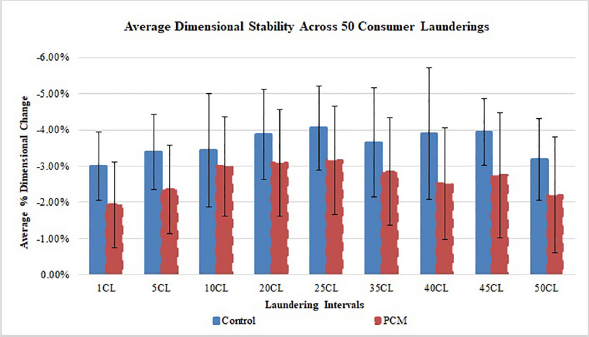
Average dimensional change of each T-shirt type across 50 consumer launderings.
Conclusion
As migrant farmworkers continue to take part in the H-2A program to find seasonal work in the United States, there continues to be a need for personal protective equipment (PPE) and workwear that can better protect this population. Specifically, clothing that can cool the user's body is necessary. While a T-shirt with a printed PCM finish, such as the one studied here, may potentially ft this criteria, 8 it is also important to consider the lifespan of the functional finish and garment.
Within the scope of this research study, the results support the conclusion that a polyester T-shirt with a proprietary, printed PCM finish is durable enough to withstand the typical consumer lifespan of 50 washes. However, as the absorbency results suggest, the PCM finish did potentially degrade over time. Therefore, future research should assess the longevity of PCM finishes to understand how they impact human thermal comfort, as well as why this degradation occurs and how it may be prevented. There is also a need for more simplistic and accessible methodologies to quantify the amount of PCMs on a fabric's surface over the course of its wear and wash life. For the agricultural work application specifically, further research is necessary to evaluate the thermal comfort performance of the PCM finish under real field conditions.
Footnotes
Acknowledgements
This study was partially sponsored by a large, proprietary sportswear manufacturer who provided the T-shirt garments, both with and without the printed PCM finish. This study was also funded in part by an Undergraduate Research Opportunity Program (UROP) materials grant.