






Abstract
The inert chemical structure of poly(ethylene) terephthalate (PET) prevents its dyeability with reactive dyes. In this study, the reactive dyeability of polyester fabrics after enzymatic surface modification with different lipases and cutinase was investigated. The reason for the hydrophilicity of the fiber after enzymatic treatment was thought to be functional groups produced after this process, but their peak intensities in Fourier transform infrared spectroscopy (FTIR) were low and shaded by other functional groups. Scanning electron microscopy (SEM) showed that the enzymatic treatment did not cause any surface damage. A slight staining (
Introduction
In the textile industry, polyester is one of the most essential fibers because of its excellent properties like high mechanical strength and wrinkle resistance, low abrasion and shrinking, recyclability, versatility, and resistance to most chemicals.1,2 The most commonly-used polyester fiber is made of the linear polymer poly(ethylene terephthalate) (PET). PET, obtained by polymerization of terephthalic acid (TPA) or dimethyl terephthalate (DMT) with ethylene glycol, is tightly packaged due to interactions between macromolecules, resulting in resistance to moisture, dyes, and solvents, and superior mechanical properties. 3
PET, like most synthetic fibers, is highly hydrophobic because of the lack of polar groups such as –OH, NH2, and –COOH.4 The poor water absorption abilities of PET make it a challenging task for textile dyeing. Therefore, widely-used water-soluble dyes cannot be used in the PET dyeing process. For this reason, it is only dyed with disperse dyes. 5 PET can be dyed using three methods: carrier, high-temperature, and thermosol methods. 6
Due to the stable chemical structure of PET, it is difficult to change the surface properties. However, surface modification has been reported by various methods, such as corona discharge, 7 plasma treatment,8–11 surface grafting polymerization,12,13 admicellar polymerization, 14 ozone treatment, 15 gamma and UV irradiation,16–19 and chemical modification.20–23 Coating bioactive compounds could also achieve a surface-modified PET.24,25 The aim of most of these studies is primarily to increase the hydrophilicity of the PET. By surface modifications of PET, not only can hydrophilicity, but also low moisture regain, the entanglement of fibers, and the static charge of PET materials, can also be improved.26–28
Alternatively, regardless of being natural catalysts, enzymes can also achieve synthetic polymer modifications and functionalization by catalyzing surface hydrolysis.29,30 Since the reaction is specific and limited in this biocatalytic method, the materials gain new properties without changing the bulk properties. Enzymatic reactions occur under mild conditions, so chemical and energy savings can be achieved. 1 The nitrile hydratase enzyme increased polyacrylonitrile fiber dyeability and hydrophilicity by increasing the number of amidic groups in the fiber. 31 Various lipases,32–37 cutinases,38–45 and esterases46–51 obtained from different sources were also active on polyester.
In this study, dyeability of PET fabric with reactive dyes after enzymatic treatment was investigated. Enzymatic treatment was carried out by applying three different enzymes, single and combined at different concentrations, to raw PET fabrics. In the dyeing process, which was performed as the continuation of enzymatic treatment, a reactive dye was used at different concentrations. The effects of the enzymatic processes on hydrophilicity were observed. After the dyeing, color measurements, and the washing and rubbing fastness of the dyed fabrics were investigated. In addition to these, the structural and chemical changes induced by enzyme-assisted surface hydrolysis of PET fabric were analyzed by scanning electron microscopy (SEM) and Fourier transform infrared spectroscopy (FTIR), respectively.
Experimental
Materials
Plain-weave 100% PET fabric, with fabric weight of 80 g/m2 was procured from Engin Tekstil (Bursa, Turkey). Novozymes supplied the lipase enzymes Stick Away (84 KLU-LV) and Lipex Evity 100 L (100LCLU-SL/g), and cutinase, which was an R&D product of Novozymes.
The bi-functional dye Corafix Red ME-4B-P (C.I. Reactive Red 195) and Segapur RW for washing after reactive dyeing were supplied by Sözal Kimya (Bursa, Turkey). Di-sodium hydrogen phosphate (Na2HPO4) and sodium dihydrogen phosphate (NaH2PO4) used to prepare phosphate buffer were of analytical quality and were obtained from Merck. Sodium chloride (NaCl), sodium carbonate (Na2CO3), sodium bicarbonate (NaHCO3), and 100% acetic acid (CH3COOH) were of technical grade from Tekkim Kimya. All processes were conducted using an ATAÇ Mini Jet Dyeing Machine.
Procedures
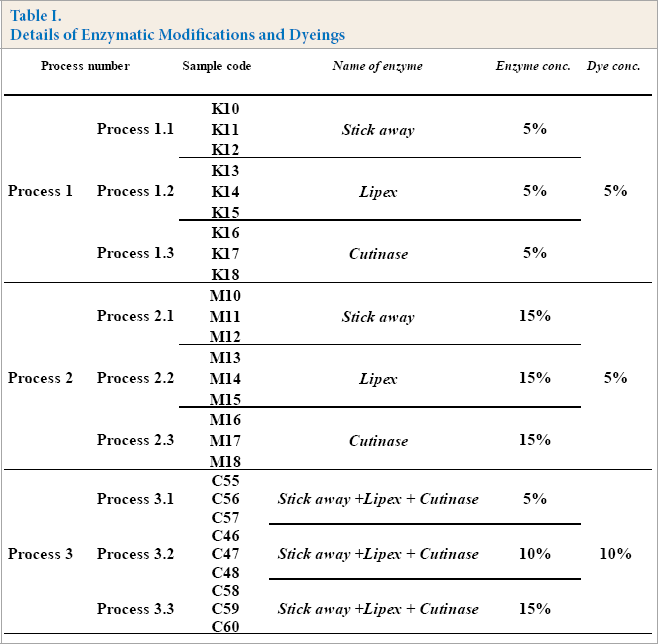
The study mainly consisted of three different processes. In these processes, the fabrics were dyed with reactive dye after being subjected to enzymatic treatment at various concentrations with various enzymes. All experiments were repeated three times. In all wet processes, a 10:1 liquor ratio (LR) was used. Details of the processes are presented below.
Enzymatic Modification
Enzymatic treatment was carried out by treating the PET fabrics with three different enzymes, single or combined. Enzymes were used at concentrations of 5% and 15% owf in single usage, and 5%, 10%, and 15% owf concentrations from each enzyme in combined enzymatic processes. Enzymatic processes were conducted at 70
Reactive Dyeing
The alkalinity of the dyeing baths used in reactive dyeing processes applied to enzymatically-treated samples was adjusted to pH 10.8 with carbonate-sodium bicarbonate buffer. Since it was not possible to perform dyeing in the absence of salt, NaCl was added at a concentration of 60 g/L in all dyeing baths. Fabrics treated with a single use of enzymes were dyed at a dye concentration of 5% owf, and combined enzymatically-treated fabrics were dyed at a concentration of 10% owf. Dyeings were conducted at 90
Table I shows the details of the various processes.
Details of Enzymatic Modifications and Dyeings
Analytical Methods
Enzymatically-modified and dyed PET fabrics were characterized using the following methods.
Hydrophilicity
Water absorbency was measured according to DIN 53 924 (water absorption velocity of textile fabrics; capillary rise method). 52
Fiber Surface Analysis
The surface morphologies of the untreated and treated PET fibers were examined by SEM, using a Tescan Vega3 SBU instrument. The specimen chamber working vacuum was at high-vacuum mode (9 × 10⁻³ Pa). The magnification value was around 810
FTIR-ATR Spectroscopy
The infrared spectra of the modified and dyed PET fabrics were recorded by means of a Nicolet iS50 FTIR spectrophotometer run in attenuated total reflectance (ATR) mode. Each spectrum was obtained by averaging 16 runs. A diamond crystal was used for ATR measurements. Measurements were performed at 20
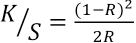
Colorimetry
Fastness Testing
Fastness properties of the modified and dyed samples were determined according to standard methods of EN ISO 105-C06/A1M (color fastness to domestic and commercial laundering), and EN ISO 105-X12:2002-12 (color fastness to rubbing). 54
Statistical Analysis
Analysis of variance (ANOVA) was chosen to analyze the relative influences of parameters in the processes. A value of
Results and Discussion
Hydrophilicity
Changes in the hydrophilicity (by water rising) of the PET fabrics after enzymatic treatments at 15% enzyme concentration are shown in Fig. 1.
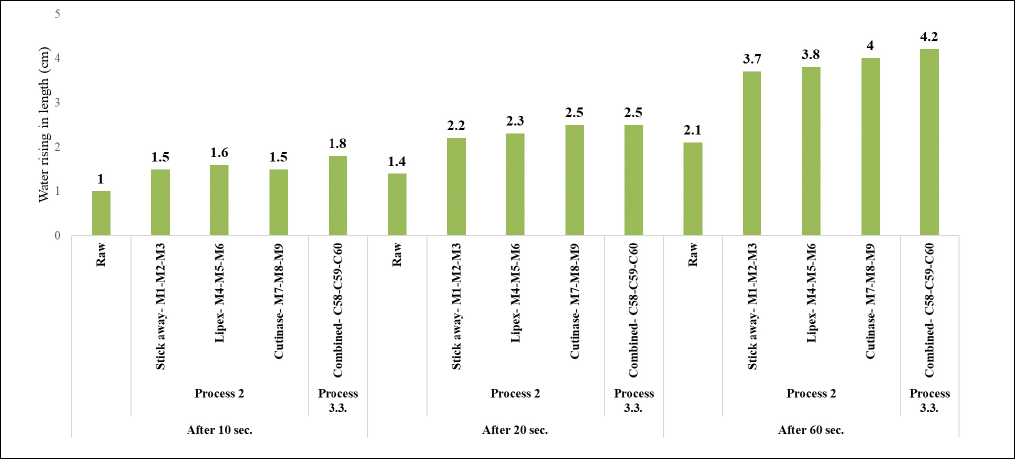
Hydrophilicity of raw and enzymatically-treated polyester fabrics.
The enzymatic modifications increased the hydrophilicity of the PET fabrics by ∼50%-70% as compared to the untreated fabrics (Fig. 1). The rise in wicking height was thought to result from the -OH and -COOH groups formed by enzymatically-catalyzed ester bond cleavage. 52 The extent of this reaction was seemingly limited since no loss of weight or tensile strength was monitored. When the enzymes were used alone or in combination, the effects on the hydrophilicity of the fabrics were similar. This was another result that showed the enzymes effect was stinted. These results showed that enzymatic treatment could be used without weight loss to improve the hydrophilicity of PET fabrics.
Morphological Characterization
Fig. 2 provides surface micrographs of the untreated and enzymatically-modified PET fabrics. The surface of untreated PET fabric was very clear and smooth (i.e., not damaged) (Fig. 2a). After enzymatic treatment, morphological changes in the appearance of PET fibers was observed (Fig. 2b). The enzymatic treatment caused the surface to become rough, but it was limited. The presence of limited degradation was supported by the fabric weight loss after enzymatic treatment (0.01%).
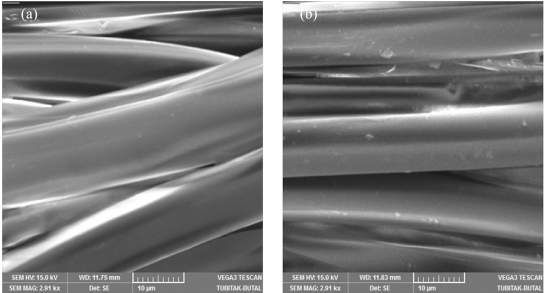
SEM images of fabrics: (a) untreated and (b) C60.
Spectroscopic Characterization
Fig. 3 shows the FTIR-ATR analysis of raw (untreated), combined enzymatic-treated, and C60 samples, and dye. The combined enzymatic process was conducted at 70 °C for 45 min at pH 8 with a 15% concentration of each enzyme. The processes applied to the C60 sample were given in Table I previously.
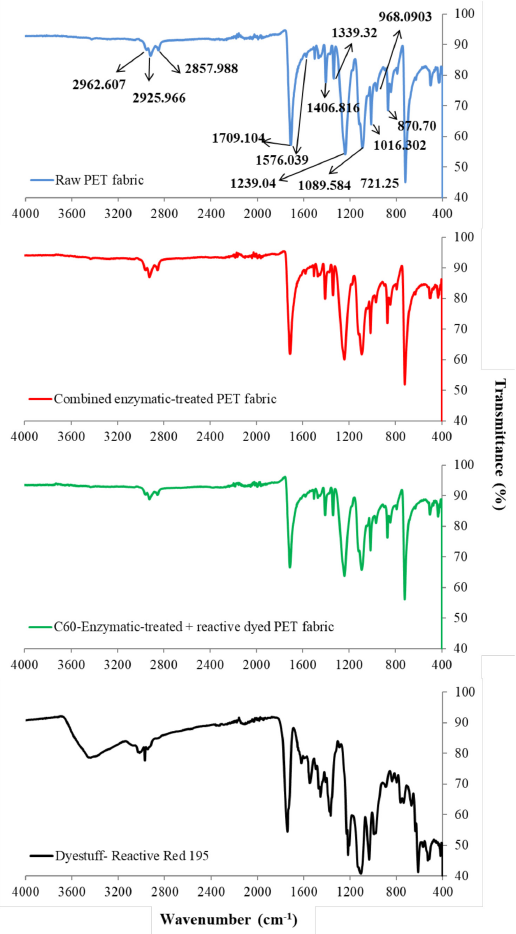
FTIR-ATR spectra of untreated and treated PET fabrics
For raw PET fabric, the peak at 1709 cm−1 was characteristic for the stretching vibration of the C=0 (carboxylic acid group).
55
The stretching vibrations of C-O at 1089 and 1239 cm−1 also confirmed the presence of the ester linkages.
20
The stretching vibrations of the C-H bond in the phenyl rings were observed with a small peak at 1576 cm4. C-C phenyl ring stretching showed a band at 1406 cm−1.56,57 Peaks at 2962, 2925, and 2857 cm−1 were assigned to asymmetric and symmetric stretching CH2 (C-H).
58
Peaks at 1339 and 1016 cm–1 were attributed to the presence of carboxylic esters or anhydrides, and 870 cm–1 was attributed to C-C out-of-plane bending vibrations of the benzene rings.
59
The peaks at 968 and 721 cm–1 were respectively assigned to the C=C and C-H bending of ethyl groups.
60
Combined enzymatic processes did not cause differences in the raw fabric (Fig. 3). In addition, there were no remarkable differences between the spectra of C60 and the others, except for the dye. This could be due to the coloring remained at the staining level (max.
Color Measurements
Color coordinates of the samples after enzymatic treatment and dyeing are shown in Table II. The use of enzymes in increased concentrations and in combination not only caused a decrease in the lightness values of the color, but also shifted the color to red and blue, and increased the color saturation. In Process 3, the effect of the increase in dye concentration on the color coordinates was thought to be greater than that of the enzymes. Although the concentration of each enzyme tripled in Process 3.3 compared to Process 3.1, the changes were very limited. In general, it was observed that the changes in hue angles were very small, around one. Comparing color coordinates, it was seen that Lipex, a lipase, treatment had a little greater effect on the PET than the others.
Color Coordinates of Samples
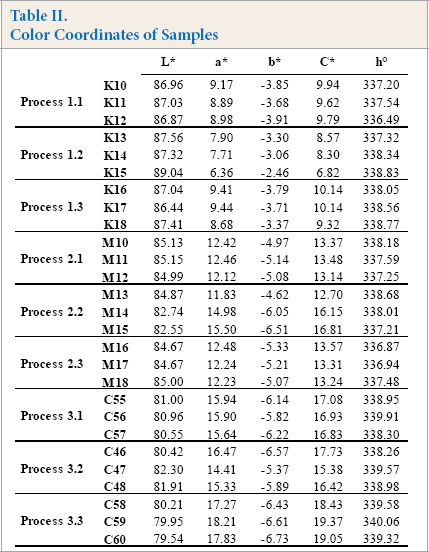
Fig. 4 shows the effect of enzymatic modification with three different enzymes on
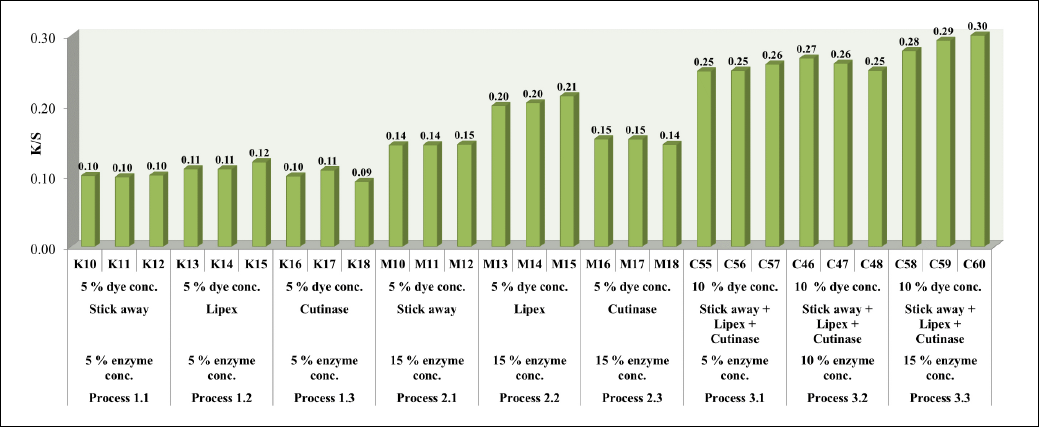
Color strength values of enzymatically-treated and reactive dyed PET fabrics.
Washing and Rubbing Fastness
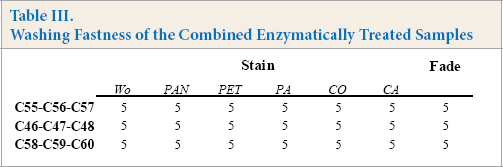
The ratings of washing and rubbing fastness of samples treated with enzymes as combined and dyed (Process 3) are shown in Tables III and IV, respectively.
Washing Fastness of the Combined Enzymatically Treated Samples
Rubbing Fastness of the Combined Enzymatically Treated Samples
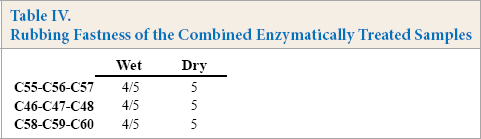
Both fastness results of the samples obtained from reactive dyeing after enzymatic treatments were good to excellent.
These fastness values could result from either the dye bonding to the fibers or to the low color strength obtained after dyeing. Since it was not possible to dye the PET fabric with the reactive dye by any of the conventional methods, no comparison was applicable.
Conclusions
In this study, the dyeability of PET fabrics with a reactive dye after enzymatic modification was investigated. Enzymatic treatment provided the fabric with a slightly hydrophilic surface. The FTIR-ATR spectra showed that the enzymatic-treated-dyed PET samples were not different from those of the raw fabric. Moreover, no changes on the fiber surface after enzymatic treatment was also observed by SEM. Although the combined enzymatic processes performed before reactive dyeing with the 15% enzyme concentration provided the highest color strength (
Footnotes
Acknowledgments
The authors express their sincere thanks for funding this study with the project “OUAP (MH)-2019/5 Pamuklu Materyallerin Reaktif ve Direkt Boyar Maddeler ile Boyanmasinda Atik Yükünü Düsürecek Alternatif Yöntemlerin Incelenmesi” by the Scientific Research Projects Department of Bursa Uludag University.