






Abstract
Novel coatings containing silver nanoparticles (AgNPs) with strong bonding and controllable antibacterial activity on polyamide 6,6 fabric were produced by dielectric barrier discharge (DBD) plasma-assisted deposition at atmospheric pressure and hexamethyldisiloxane (HMDSO) layers. Silver ion release was tuned using a “sandwich” coating structure to prolong the antibacterial effect. The novel spray-assisted deposition increased deposition rates of AgNPs using atmospheric pressure DBD plasma treatment when an HMDSO layer was applied. An increase in AgNPs deposition in plasma treated samples and antimicrobial activity against Gram-negative (
Introduction
Medical textiles are used in a range of applications, from bandages, dressings, sutures, and surgical clothing to implants such as scaffolds, stents, and meshes. 1 Infections associated with these devices are responsible for at least 2–7% of post-operational complications, increasing mortality and healthcare costs. 2 Silver has been used as an antimicrobial agent for centuries, with the emergence of nanotechnology revealing new advantages for its use. Silver nanoparticles (AgNPs) present a large surface-volume area, improving the interaction with microorganisms and, consequently, enhancing the silver antimicrobial effect. 3 Conventional antibacterial coatings by wet chemistry, lowpressure plasma, and sputtering have several drawbacks, but the most important is their uncontrollable antibacterial activity that can generate antimicrobial resistance. 4 Additionally, AgNPs can pass through layers of the skin and accumulate in the body organs, promoting renal, hepatic and neurological disturbances.5,6 Incorporating AgNPs in nanocomposites through synthetic polymers is a suitable alternative to obtain controllable AgNPs release. This technique allows more efficient AgNPs immobilization than that of a simple coating. 7 Dielectric barrier discharge (DBD) plasma treatment at atmospheric pressure is an environmentally-friendly method to modify materials. This treatment can increase the surface energy by introduction of new polar functionality, enhancing the material's adhesion and wettability. 8 This non-thermal plasma process is able to create charged molecular fragments and atomic species, promoting new reactions. 9 Hexamethyldisiloxane (HMDSO) has been used as a suitable precursor to obtain coatings on metals. HMDSO is volatile at room temperature, non-toxic, non-flammable, inexpensive, and available from commercial sources. 10
In this work, a new generation of coatings containing silver nanoparticles (AgNPs) was produced, using dielectric barrier discharge (DBD) plasma-assisted deposition at atmospheric pressure. Low concentrations of AgNPs dispersions in water and HMDSO were prepared and applied in different configurations, including a barrier layer of pristine HMDSO, to control AgNPs ion release. Reflectance measurements, static contact angle, scanning electron microscopy (SEM), energy dispersive spectroscopy (EDX), and X-ray photoelectron spectroscopy (XPS) were used to characterize the samples. Antibacterial activity was determined for both Gram-positive
Experimental
Materials
Commercial polyamide 6,6 (PA6,6, Lemar Lda., Portugal) fabric, with a weight per unit area of 110 g/m2, warp density of 50 threads/cm, and a weft density of 32 threads/cm were used in this study. The fabric was pre-washed with 1 g/L of a non-ionic detergent (Lutensol ON 30, BASF) solution at 60 °C for 60 min, then rinsed with distilled water, and dried at 40 °C. All the other reagents were analytical grade purchased from Sigma Aldrich (St. Louis, MO, USA) and used without further purification.
Procedures
DBD Plasma Treatment
DBD plasma treatment was performed in a semi-industrial plasma prototype machine (Softal GmbH, University of Minho) working at room temperature (RT) and atmospheric pressure in air, using a system of metal electrode coated with ceramic and counter electrodes coated with silicon having a 50-cm effective width, a gap distance fixed at 3 mm, and producing the discharge at high voltage (10 kV) and low frequency (40 kHz). The discharge power supplied by the electrodes and the speed was variable, with a maximum discharge of 1.5 kW and speed of 60 m/min. The applied dosage on PA6,6 fabric was 5 kW min/m2. The machine was operated at optimized parameters: 1 kW of power and a velocity of 4 m/min. 11
AgNPs Dispersions Preparation and PA6,6 Fabric Composites Preparation
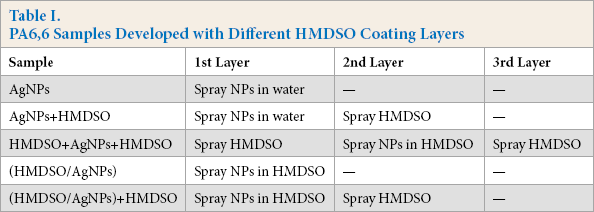
Composites were obtained with 20 nm AgNPs using 10 × 10 cm PA6,6 samples with and without DBD plasma treatment by spray. Water and HMDSO AgNPs dispersions (10 mg/mL) were prepared by sonication for 30 min in a Branson 3510 bath and 30 min in an Optic Ivymen Sytem CY-500 with a tip. The layers were applied on both sides with the spray system pressurized at 1.5 bar and maintained at a distance of 5 cm to the substrate. The different structures developed are presented in Table I. A curing step was used between each layer. The samples were dried at 25 °C.
PA6,6 Samples Developed with Different HMDSO Coating Layers
Washing Fastness
The washing fastness of samples was assessed after five washing cycles in a laboratory-dyeing machine (Ahiba, Datacolor, Lawrenceville, NJ, USA) at 75 °C and 40 rpm for 15 min with 0.1 g/L of non-ionic surfactant at a liquor ratio (LR) of 1:30.
Analytical Methods
Reflectance
The samples with AgNPs were analyzed using a Datacolor Spectraflash SF 600 Plus CT spectrophotometer with D65 light, and 10° observer angle over the range of 390 to 700 nm and expressed in reflectance (%R). Reflectance measurements were made three times in different fabric positions and the average was calculated.
Thermogravimetric Analysis
TGA measurements were carried out on an STA 7200 Hitachi (Tokyo, Japan). TGA plots were obtained within the range of 25 to 900 °C under nitrogen atmosphere (200 mL/min) at 10 °C/min. Specimens were left at RT (25 °C) until equilibrium was reached and placed in an alumina pan. Data was plotted as weight loss percent versus temperature, and the mass of dried residues calculated for each case. Derivative thermogravimetric (DTG) analysis was also performed to identify the maximum peaks of the thermal transformation events.
Contact Angle
The water surface wettability of PA6,6 samples was characterized by static contact angle measurements based on the sessile drop principle using Dataphysics OCA 20 equipment (Filderstadt, Germany) and SCA 20 software with a video system to capture images in static and dynamic modes. All experiments were replicated three times and the data were reported as mean ± standard deviation.
SEM and EDX
Morphological analysis of fabrics were carried out using ultrahigh resolution field emission gun scanning electron microscopy (FEG-SEM, NOVA 200 Nano SEM, FEI Co.). Secondary electron images were performed with an acceleration voltage of 5 kV. Backscattering electron images were realized with an acceleration voltage of 15 kV. Samples were covered with a film of Au-Pd (80–20 wt%) in a high-resolution sputter coater (208HR, Cressington Co.), coupled to an MTM-20 Cressington high-resolution thickness controller. Atomic compositions of the membrane were examined with the energy dispersive spectroscopy (EDX) capability of the SEM equipment using an EDAX Si(Li) detector and an acceleration voltage of 5 kV.
XPS
XPS analyses were performed using a Kratos AXIS Ultra HSA, with Vision software for data acquisition and CasaXPS software for data analysis. The analysis was carried out on a monochromatic Al Kα X-ray source (1486.7 eV) operating at 15 kV (150 W), in fixed analyzer transmission (FAT) mode, with a pass energy of 40 eV for regions of interest and 80 eV for survey. Data was acquired at a pressure less than 1 × 10⁻⁶ Pa, and a charge neutralization system was used. Spectra were charge corrected to give the C1s spectral component (C–C and C–H) a binding energy of 285 eV. High-resolution spectra were collected using an analysis area of ∼1 mm2. The peaks were constrained to have equal full width at half maximum (FWHM) to the main peak. This process has an associated error of ±0.1 eV. Spectra were analyzed for elemental composition using CasaXPS software (version 2.3.15). Deconvolution into subpeaks was performed by least-squares peak analysis software, XPSpeak version 4.1, using the Gaussian/Lorenzian sum function and Shirley-type background subtraction. No tailing function was considered in the peak fitting procedure. The components of the various spectra were mainly modelled as symmetrical Gaussian peaks, unless a certain degree of Lorentzian shape was necessary for the best ft. The best mixture of Gaussian–Lorentzian components was defined based on the instrument and resolution (pass energy) settings used, as well as the natural line width of the specific core hole.
Antimicrobial Analyses
Antibacterial testing was performed with a slightly modi-fed ISO 20743-200512 standard for the determination of the antibacterial activity of textiles, immediately after sample preparation. PA6,6 samples (0.05 g) were used. The samples (initial, washed and control samples), were placed in 24-well cell culture plates. On each of the samples, 50 μL of the 105 CFU/mL bacterial inoculum was deposited.
Results and Discussion
Quantification of AgNPs on PA6,6 Samples by Diffuse Reflectance Spectroscopy
Since the nanoparticles and the HMDSO coatings have a negligible weight, reflectance measurements were performed to characterize the samples containing AgNPs and HMDSO layers in terms of AgNPs relative concentration (Fig. 1). 13 Following the principle that silver nanoparticles are able to absorb light in the visible spectra, the reflectance values indicate the relative amount of AgNPs on a sample. Thus, the AgNPs concentration was inversely proportional to reflectance measurements. A low reflectance percentage indicated a high AgNPs concentration on the fabric. 14
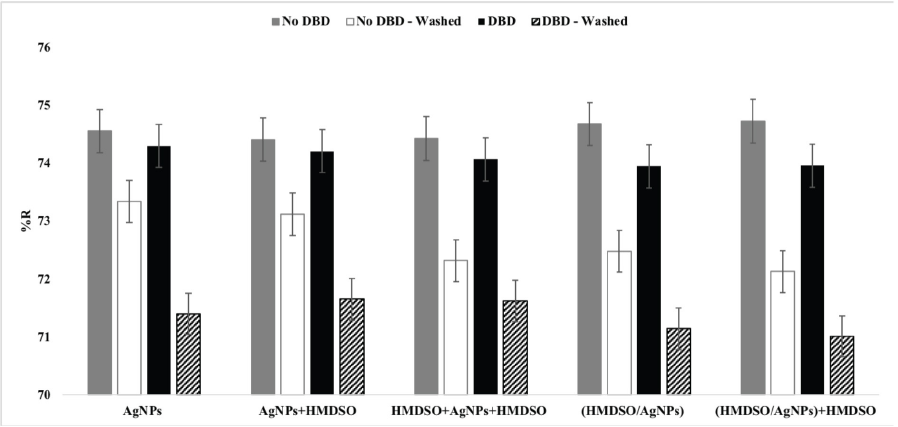
Reflectance measurements at 420 nm of untreated and DBD plasma treated PA6,6 samples with AgNPs obtained by spray before and after five washing cycles.
The UV-Vis spectrum of 20 nm PVP-AgNPs showed the maximum absorbance value at 420 nm, and therefore just this wavelength was used. 15 The results show that DBD plasma treatment decreased the reflectance values in all tested samples. The effect was more noticeable for the AgNPs dispersed in HMDSO (HMDSO/AgNPs). The untreated PA6,6 samples displayed similar reflectance values regardless of the solvent and the configuration of the layers used. The improvement in AgNPs adhesion promoted by DBD plasma treatment and the HMDSO layer can be attributed to increased surface roughness and chemical modification of the surface (e.g., oxygen addition). Several reports have shown microroughness formation during the DBD plasma treatment due to the etching process that could promote the anchorage of carboxylic groups.16,17 The deposition of HMDSO using air as a carrier gas increased inorganic silicon dioxide formation, which also increased the surface roughness. 10 AgNPs dispersions prepared in HMDSO tend to agglomerate. However, the silicon dioxide coating after deposition also supports AgNPs adhesion onto textile materials. 18 After five washing cycles, the reflectance values decreased in all samples, but was more evident in DBD plasma-treated samples. These results were not comparable with the unwashed samples. The sharp decrease in reflectance was attributed to the change in the silver oxidation state due to the washing process and to the reaction of metallic silver and silver ions with plasma-generated oxygen reactive species. Oxidized silver (e.g., AgO and Ag2O) display larger absorption bands than metallic silver.19,20
Static Contact Angle
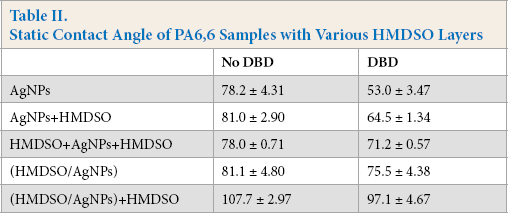
The contact angle of samples without and with DBD plasma treatment were measured to analyze the fabrics wettability (Table II). Both the surface chemical composition and the surface morphology interfere with wettability properties of a solid surface. 17 Samples with DBD plasma treatment showed a smaller contact angle under all conditions tested, suggesting more roughness and polar groups in the surface of plasma treated samples as explained above. Despite the change in surface topography, and because DBD plasma is a surface treatment, no changes in the mechanical properties can be observed in the PA6,6 fabric, as shown in previous work.14,21 Nevertheless, a thermogravimetric analysis was performed and no significant differences were observed (data available from author upon request).
Static Contact Angle of PA6,6 Samples with Various HMDSO Layers
SEM and EDX Topography Analysis
SEM analyses of untreated and DBD plasma treated PA6,6 samples were performed at different magnifications to analyze the AgNPs distribution from the different tested methods. In this work, data for AgNPs+HMDSO with and without DBD plasma treatment are shown (Fig. 2), although all samples demonstrated retention of AgNPs on the surface. Despite the very small concentration of AgNPs used in this work, SEM images were able to confirm the presence of AgNPs on the fabric surface and a slight improvement in the nanoparticle distribution by plasma treatment (Figs. 2b and d). However, SEM analysis was not able to demonstrate if plasma treatment was able to improve the loading of nanoparticles on the fabric. For this reason, reflectance and XPS spectroscopic analyses were also performed.
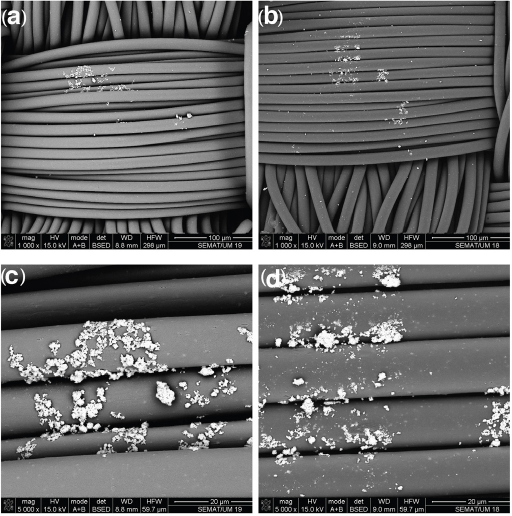
SEM micrograph at 1000× and 5000× of untreated (a, c) and plasma treated (b, d) PA6,6 fabrics.
EDX analysis of the AgNPs+HMDSO sample showed silver peaks (Fig. 3), however very similar results were obtained for all other samples because of the deep probe depth of the EDX technique. The characteristics peaks of silver (AgLI, AgLa, AgLb, and AgLg) were observed in the EDX spectrum between 2.5 and 3.4 keV. Other elements were detected in the EDX spectra such as carbon, oxygen, and silicon, corresponding to PA6,6 atomic components, DBD plasma treatment, and HMDSO layers.
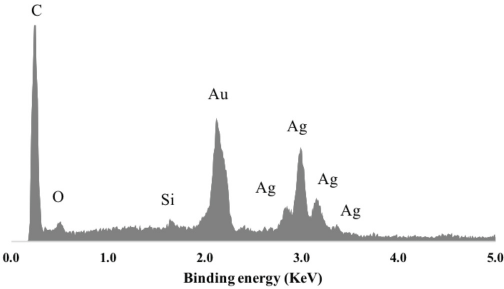
EDX analysis of AgNPs+HMDSO PA6,6 sample with DBD plasma treatment.
XPS Analysis
XPS analysis was used to detect the surface atomic percentage of oxygen, carbon, nitrogen, and silver in the samples (Table III). Samples with DBD plasma treatment showed greater oxygen content in all tested samples. This can be explained by the new groups produced by DBD plasma treatment. Silver was only detected in the samples without an extra HMDSO layer such as AgNPs in water and (HMDSO/AgNPs) due to the surface nature of the XPS analysis technique. In samples with DBD plasma treatment, the silver content was significantly higher (1.5 and 5.3 at.%) than untreated samples (0.1 and 1.1 at.%). Additionally, the AgNPs dispersed in HMDSO also suggest an improvement in nanoparticle deposition. The samples with an additional HMDSO layer (AgNPs+HMDSO and (HMDSO/AgNPs)+HMDSO) did not show silver peaks, confirming the protection ability of the HMDSO barrier layer upon the layer containing AgNPs.
Atomic Percentage Results of Untreated and DBD Plasma Treated Samples by XPS Analysis a
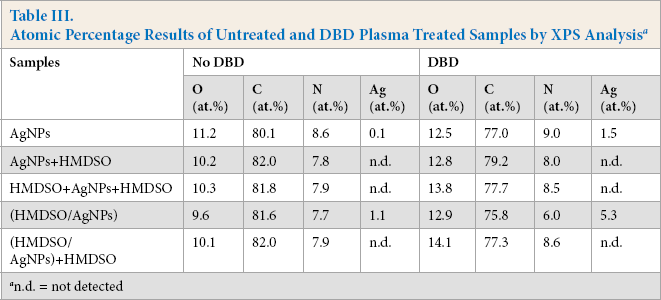
n.d. = not detected
Antimicrobial Activity
Antibacterial activity of PA6,6 samples was evaluated against
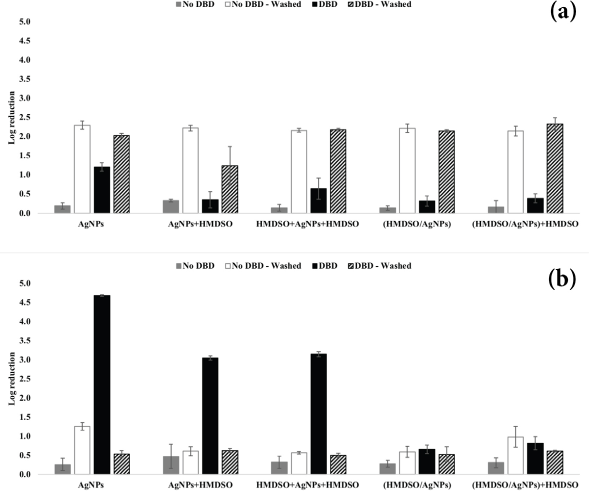
Antimicrobial activity against
After washing, the antimicrobial effect on
Conclusions
The results obtained in this study demonstrated the enhancement of AgNPs adhesion when roughened surfaces and newly reactive oxygen species are provided by DBD plasma treatment and HMDSO deposition, allowing the development of antimicrobial wound dressings using very low concentrations of AgNPs. A final HMDSO layer to control the release of AgNPs and Ag+ ions was effective against
Footnotes
Acknowledgements
This work was funded by European Regional Development funds (FEDER) through the Competitiveness and Internationalization Operational Program (POCI) – COMPETE and by National Funds through Portuguese Fundação para a Ciência e Tecnologia (FCT) under the project UID/ CTM/00264/2019. Ana Ribeiro acknowledges FCT for its doctoral grant SFRH/BD/137668/2018. Andrea Zille also acknowledges financial support of the FCT through an Investigator FCT Research contract (IF/00071/2015) and the project PTDC/CTM-TEX/28295/2017 financed by FCT, FEDER, and POCI in the frame of the Portugal 2020 program.