





Abstract
Due to disproportionate rates of American football players experiencing heat illness injuries and fatalities, there is a need to focus on the thermal comfort of athletes. Intolerance of internal metabolic heat production is a result of insufficient air flow in athletic uniforms. The application of clothing ventilation may significantly improve the thermal comfort of the athlete. Therefore, the purpose of this research was to investigate the thermal comfort of ventilated football uniforms based on ventilation type (traditional mesh versus laser micro-perforated). Ventilated football uniforms were evaluated for air permeability and subjective thermal comfort. Heart rate, perceived exertion, perceived comfort, and thermal sensation were collected during a human wear trial. Findings indicate differences in air permeability and thermal comfort perceptions between the ventilated uniforms.
Introduction
Many researchers have reported the challenges of thermoregulation in athletes during participation in sports or exercise in hot, humid conditions.1–4 Considering these studies, there has been little research focusing on the group of athletes with the greatest disproportionate rates of death due to external heat stroke (EHS): American football players. 1 There is a need for research that concentrates on the thermal comfort of football players and the many challenges these athletes face when participating in practice, preseason, or competition conditions. Thermoregulation requires a balance between heat production and heat loss. Hyperthermia occurs when the internal core body temperature exceeds its tolerance (40 °C), leading to decreased function in muscle movement and other heat strain symptoms (e.g., fatigue, dizziness, headache, nausea, fainting, and heat stroke). 3 EHS is the most serious of heat illnesses and can be fatal. There are multiple factors that influence thermoregulation including environmental conditions, athlete hydration, physical fitness, and the clothing ensemble worn.
Product innovators have changed the way we envision football uniforms in collegiate athletics by incorporating material ventilation and ventilation openings. A new ventilation technology recently introduced in the market is that of laser micro-perforation. 5 Laser perforation is a feature that may potentially increase the permeability of the clothing system through the incorporation of small apertures. These small openings are created by a laser beam that melts away the fabric material, leaving a fine-edged finish.
Laser-perforated apertures are beginning to replace traditional mesh ventilation in uniforms to maximize thermoregulation. 5 The small apertures may enable greater gas and vapor exchange, or in this case, the evaporation of sweat during exercise.
The incorporation of laser-perforated apertures in football uniforms should be evaluated as it may allow for sweat to evaporate more freely. To the researchers’ knowledge, this new material technology has not been validated against traditional mesh ventilation designs. Therefore, the purpose of this research was to investigate the breathability and thermal comfort performance of football uniforms with different types of material ventilation, including laser micro-perforation.
To accomplish the goals of this study, the following research objectives were established:
To assess ventilation design techniques for their breathability and air permeability.
To evaluate the subjective thermal comfort of human athletes during physical activity when wearing football uniforms with ventilation apertures.
To determine whether laser micro-perforation improves, maintains, or decreases the subjective thermal comfort of the athlete as compared to traditional mesh clothing ventilation.
Human Physiology and Heat Stress
Human physiology is the science of mechanical, biochemical, and physical processes that assist body functions. The focus of physiology is how the internal systems of the human body work and interact with our environment. When clothing is worn, it has a direct impact on the human body's environment and can either positively or negatively affect the wearer's comfort. The comfort of functional clothing is important for the well-being and safety of the wearer. 6 Each component of an athletic uniform should serve to protect the athlete and provide adequate breathability, mobility, and comfort.
Athletic gear is designed first and foremost for the safety of the athlete: to protect against physical contact. Football athletes participate in collisional activity that involves impact with opposing athletes or inanimate matter. But thermal comfort must also be considered to avoid incidents of heat strain. There has been little research addressing the subjective thermal comfort of athletic wear, especially football athletic uniforms.
Football uniforms serve as a portable environment against external elements and physical impact. 7 In addition to protection, thermal comfort must be considered. Wearing protective clothing in hot environments may exacerbate issues, such as heat stress, that can have detrimental effects on the wearer's ability to lose heat. To prevent overheating of the human body, it is beneficial to release high levels of perspiration, as it helps to maintain the athlete's thermo-regulatory system. 8 Since clothing can inhibit the dissipation of heat and the transfer of moisture, it is also important to examine heat stress reduction methods. 8 Increasing air and moisture exchange between the environment and the wearer by transporting heat away can alleviate the onset of heat stress. An effective method for increasing heat loss in protective clothing ensembles is through material ventilation and garment openings.9–11
Clothing Ventilation
Football athletes are presented with the challenge of competing in rigorous physical activity during the hottest months of the year in many areas of the United States. In addition, they don uniforms that add to their metabolic heat production, which can lead to heat stress. 11 Although football uniforms serve the purpose of protecting athletes from injury, an increase in metabolic heat storage and the inability to dissipate that heat can lead to unintended heat related consequences. Recommendations for heat acclimatization provide suggestions for creating “safe” environments for the athlete, however, there has been limited research presented discussing the modifications to football uniforms that could provide an optimized balance between protection and thermal comfort. Uniforms may incorporate design elements, such as ventilation, that facilitate heat transfer and sweat evaporation. To alleviate heat stress, clothing ventilation may be incorporated that provides the flow of air over skin, passing through fabric layers and/or garment openings. 9
Ventilation designs have been implemented in athletic wear in a variety of ways to increase air flow and thermal comfort. 12 Ho, et al. (2011) studied the influence of ventilation in clothing and the effect on thermal comfort, suggesting that the creation of small apertures in design enhances cooling efficiency. 13 These apertures especially enhance heat transfer in walking and windy conditions, 13 which are typical of the conditions in which football athletes perform. The National Collegiate Athletic Association (NCAA) provides rules regarding the elements of game uniforms for football, with flexibility in the various configurations to be worn depending on weather conditions. There are no regulations, however, covering configurations of uniforms worn during practice sessions. 14
Product developers have elevated the concept of heat loss in football uniforms by developing various ventilation designs to be incorporated in the fabric material, such as mesh and laser micro-perforated ventilation.15,16 It is important to understand which type of material ventilation, based on air permeability and surface area, will provide the most beneficial improvement in thermal comfort for the football athlete. Therefore, this study assessed the performance of two ventilation designs (mesh and laser micro-perforated) when incorporated in football uniforms, to determine which ventilated designs significantly improved permeability and thermal comfort during performance.
Mesh Ventilation
Mesh is an interlaced material commonly incorporated into clothing; sometimes serving as an aesthetic design feature or, in athletic apparel, as a heat stress preventative. Mesh ventilation is commonly used in athletic and outdoor apparel for increased permeability; to facilitate ventilation and to decrease thermal insulation and evaporative resistance.16,17 Clothing serves as protective gear during physical activity, but can also impede heat transfer from the athlete; paradoxically compromising an athlete's protection.8,18Mesh fabric can be applied as an addition to athletic clothing to facilitate heat transfer and possibly protect the athlete from heat stress and illnesses. Previous research suggests that mesh may create significant air flow leading to increased convective and evaporative heat transfer and decreased sweat storage during performance. 11
Laser Micro-Perforation
Laser-perforated ventilation is a new technology incorporated directly into the base fabric of the uniform. Laser micro-perforation is the creation of small, identical apertures in the fabric material to help increase permeability. 16 The application of laser-cut apertures may enhance the transport of air and vapor through the fabric barrier and decrease heat transfer resistance. Therefore, the engineering of laser micro-perforated material in football athletic uniforms should allow for increased convection and evaporation to exchange heat from the body to the environment. For this study, it is assumed that because the laser micro-perforated ventilation is perforated into the base fabric, the uniform will be lighter weight (reduced seams) and less cumbersome.
During performance, when an athlete dons a clothing system that does not include ventilated designs, heat loss is lowered, and the athlete becomes hotter than the ambient environment. 1 With the incorporation of clothing ventilation, small apertures should increase permeability and allow fluid (i.e., sweat) to flow through the openings. When fluid, such as sweat, evaporates into the environment, the body begins to cool. 2 Therefore, comparisons between ventilation types in this study will inform athletic apparel product developers as to which designs are most effective for improving overall athlete comfort.
Methods
Ventilated Uniforms
All test garments (unwashed game day jerseys) met the NCAA standard for athletic football uniforms and each incorporated a unique ventilation design: 1) mesh ventilation (MV) and 2) laser micro-perforated ventilation (LMP). A single new uniform (jersey shirt and pants) of each ventilation design type (MV and LMP) was worn by all participants in the study and was laundered according to care label instructions before the first test session and between trial sessions. Previous similar studies have been conducted in which test garments were laundered between trials; however, these studies did not assess ventilation of football uniforms for thermal comfort.19,20 The authors acknowledge the lack of funding to purchase new uniforms for each subject as a limitation of this study. The MV and LMP vented jersey tops are illustrated in Fig. 1.
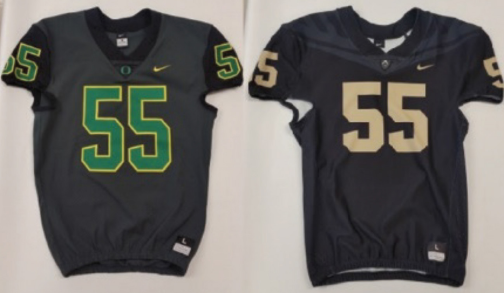
Laser micro-perforated (left) and traditional mesh ventilation (right) uniform shirts.
Detailed fiber content, surface area, and uniform weight are provided in Table I for each garment. Both uniforms were constructed with synthetic fiber contents, with the MV uniform fabricated from polyester, while the LMP uniform consisted of nylon. The uniforms were also similar in overall garment weight, with the LMP pant weighing slightly less (200 g) than the MV pant (300 g). It should be noted that the slight differences in fiber content and garment weight could potentially impact human comfort perceptions. However, further research, outside the scope of this study, is needed to determine the potential significance of these differences on garment level comfort.
Ventilated Uniform Characteristics, Surface Area, and Weight
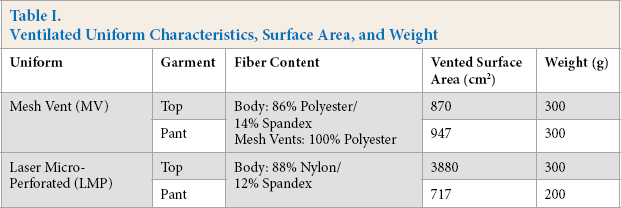
To compare air permeability based on ventilation, the surface area of each vent panel was measured and an average vented surface area (cm2) was calculated for each uniform (Table I). This follows similar methodology used in previous literature to quantify vented surface area. 8 By measuring the length and width (cm) of each ventilated panel in the top and pants of each uniform, an overall surface area can be determined. For example, a single panel that measured 26.8 cm in length by 23.5 cm in width was calculated to have a surface area of 629.8 cm2. The surface area of all vented panels and sections were summed together for each jersey top and jersey bottom. Finally, an overall surface area for each uniform (jersey top and bottom) was calculated.
The MV uniform included the least amount of vented surface area (1817 cm2) compared to the LMP (4597 cm2) uniform. The MV uniform was vented on the sides only in both the jersey top and pants. The LMP uniform incorporated ventilation in the torso and lower back regions of the uniform top, as well as in the hamstring area of the jersey pant. The MV uniform (top, pants, and base layer shirt) weighed 800 g while the comparable LMP uniform weighed 700 g.
Air Permeability Testing
ASTM D737, Standard Test Method for Air Permeability of Textile Fabrics, was followed to determine the rate of air flow passing through the fabric structure of each ventilated uniform. 21 A Textest FX 3300 Air Permeability Tester III was used with the pressure set to 125 Pa. The unit of measure was cm3/s (cm3/s/cm2), which represents the air flow through a fabric at a constant pressure drop. Each garment (jersey top and pants) was measured three times in multiple locations. Results were combined to calculate an overall average air permeability for each jersey top, jersey pant, and overall uniform.
Wear Trial Participants
For the thermal comfort human wear trial, eight healthy, male participants between the ages of 21 and 31, who were ft to perform moderate physical activity, participated as volunteer subjects. Participants provided informed consent prior to participating per Institutional Review Board (IRB) requirements. During an initial trial session, each subject's height, weight, and age (used to calculate 90% maximum heart rate) was recorded.
For the wear trial, each participant served as their own control and wore each of the test garments. Every participant completed two trial sessions, each assigned to wear the MV and LMP uniforms at random. Test garments were provided to the subjects and included a uniform top, uniform pant, and the same base layer undershirt worn underneath both uniforms. Participants wore their own socks and tennis shoes. Subjects were instrumented with a polar heart rate watch and monitor to observe and record heart rate during the trial sessions.
Wear Trial Protocol
Once subjects were dressed in the randomly assigned uniform, blood pressure and resting heart rate were recorded before entering the environmental test chamber. Each test session took place in a controlled environmental chamber with conditions reported at 26 ± 3 °C and 65% ± 5% relative humidity (RH). Participants entered the chamber and began a seated rest period for ten minutes to become acclimated to the conditions. While subjects were sitting for the ten-minute acclimation period, a comfort sensation pre-exercise survey was completed which measured the participant's baseline thermal comfort before performance. Following the ten-minute acclimation period, subjects began the protocol by walking on a treadmill at 3.5 mph with 0% incline. Each participant completed three walk/jog cycles: walking for two minutes at 3.5 mph followed by jogging for 10 minutes at 5 mph. At the end of the three walk/jog cycles, subjects entered a cool down period by walking at 2.5 mph for the final five minutes.
Participants provided subjective thermal comfort sensations at the end of each walk and jog cycle during the exercise protocol. These ratings included perceived exertion, perceived comfort, and perceived temperature sensation. Exercise ended when subjects either completed the full protocol (41 minutes) or were terminated by the researchers due to reaching 90% of their calculated maximum heart rate. Subjects were also given the option to terminate themselves from the exercise at any time, but no instances of self-termination occurred. Following the end of the exercise protocol, subjects entered another ten-minute seated rest period in the controlled environmental chamber. During this final seated rest period, subjects completed the thermal comfort sensation post-exercise survey. At the conclusion of the ten-minute rest period, participants were asked to exit the environmental chamber and continued to rest until their heart rate decreased. Participants were then cleared by research investigators.
Thermal Comfort Instruments
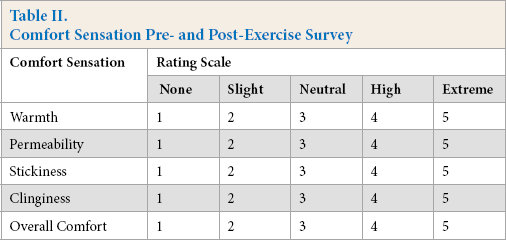
A pre- and post-exercise survey was administered to gauge thermal comfort sensations before and after the exercise protocol. Comfort sensation parameters are given in Table II. This survey was adapted from Fan and Tsang. 19 Overall comfort, warmth, permeability (breathability), stickiness, and clinginess were rated by each subject on a scale from “None” to “Extreme.” The average comfort sensations of all subjects when wearing each of the ventilated football uniforms were analyzed for significant differences within suits and between suits before and after exercise.
Comfort Sensation Pre- and Post-Exercise Survey
Ratings from the ISO 10551 Perceived Comfort scale (2001), Borg Perceived Exertion Rating scale (RPE), and the ISO 10551 Temperature Sensation scale (1995) were taken two minutes into the protocol and then at the end of each walk and jog cycle (12, 14, 24, 26, 36, and 41 minutes). The perceived comfort scale asks the subject, “How do you perceive your whole body comfort at this moment?” and goes from “0” meaning “comfortable” to “4” meaning “extremely uncomfortable .” 22 Borg's perceived exertion scale asks the subject, “How do you perceive the exercise at this moment?” and goes from 6 to 20 corresponding to “extremely light” to “extremely hard” perceived exertion, respectively.23,24 Temperature sensation was also collected by asking, “How do you perceive your whole body temperature at this moment?” on a scale from +4, meaning “very hot” to –4, meaning “very cold.” 25
Statistical Analysis
To determine the statistical significance of the measured differences in air permeability and thermal comfort between uniforms, two sample t-tests, assuming equal variances, were performed. T-tests were used instead of ANOVA because it is the simplest and the most straightforward version of a test for the specific conditions presented in this research. All data was tested for normalcy and normal distributions were confirmed through a probability plot and the Anderson-Darling test statistic. A p-value less than 0.05 was chosen to indicate a significant difference in air permeability and the subjective thermal comfort parameters between the MV and LMP vented uniforms.
Results
Air Permeability
The average air permeability of each garment (top and pants) for each uniform is depicted in Fig. 2. Overall average air permeability was greatest for the MV (208 cm3/s/cm2) uniform followed by the LMP (76 cm3/s/cm2) uniform. The MV jersey exhibited significantly greater (p < 0.01) air permeability than the LMP top and pants. Differences in the base fabric (without ventilation apertures) of each uniform were also analyzed. The MV uniform base fabric was significantly (p < 0.05) more permeable than the LMP uniform. Permeability of the vented fabric panels in each jersey top and pant was also analyzed. For the MV uniform, the traditional mesh vent panels had an average air permeability of 363 cm3/s/ cm2 while the LMP ventilation apertures had an average air permeability of 102 cm3/s/cm2.
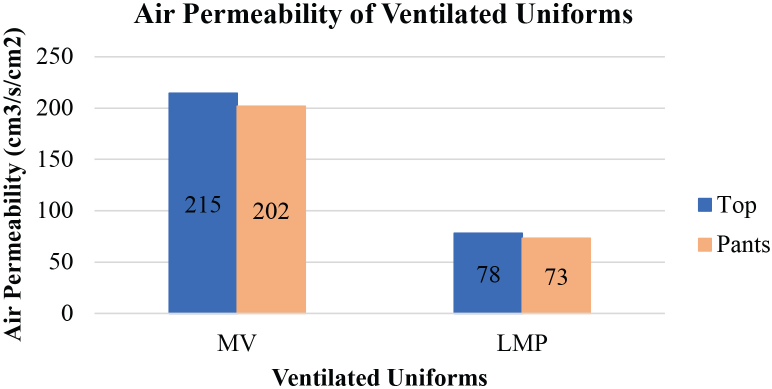
Air permeability of ventilated uniform garments (top versus pants).
Thermal Comfort
Pre- and Post-Exercise Comfort Survey
Overall comfort, warmth, air permeability, stickiness, and clinginess were variables evaluated on the pre- and post-exercise comfort survey (Table II). Surveys were administered before and after the exercise protocol and each variable was rated on a scale from 1, indicating “none,” to 5 which indicated “extreme.” 19 The five variables were analyzed for significant differences between pre- and post-exercise for each ventilated uniform, as well as, differences between uniforms at the beginning and end of the exercise protocol.
For the overall comfort ratings, there were no significant differences before and after exercise for the MV uniform. There was, however, a statistically significant difference (p < 0.05) in the overall comfort sensation of the LMP uniform pre- and post-exercise. Comfort was found to significantly decrease after exercise when subjects wore the LMP uniform. Comparisons between uniforms for overall comfort before exercise found no differences regardless of the type of fabric ventilation or the amount of surface area ventilated in the uniform. All subjects rated the uniforms a 3 (neutral) during the pre-exercise survey. The overall comfort sensation rating for each uniform before and after exercise is shown in Fig. 3.
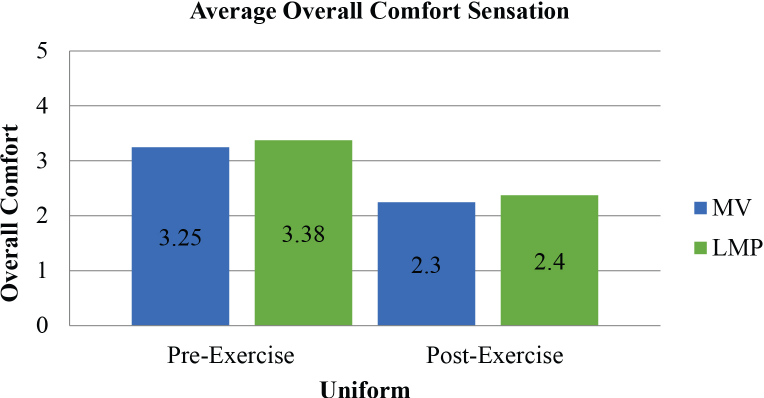
Average overall comfort sensation pre- and post-exercise for each vented uniform.
Significant differences (p < 0.05) were found for warmth sensations pre- and post-exercise for both uniforms. Results indicate participants were warmer after exercise (3.5–3.75; Neutral) than before (1.875; No Warmth), regardless of the vented uniform worn. There were no significant differences in warmth between uniforms at either the pre- or post-exercise time period. For permeability, there were no significant differences before or after exercise within or between uniforms.
Both uniforms increased in stickiness after the protocol as compared to before the protocol. These differences were significant (p < 0.05) for both uniforms when comparing pre- and post-exercise ratings. Subjects indicated a pre-exercise stickiness of “slight” with a post-exercise rating of “high stickiness” regardless of the type of fabric ventilation. There were no significant differences between uniforms, however, for stickiness at either the beginning or end of the exercise protocol. There were also statistically significant differences (p < 0.05) in the clinginess rating of both ventilated uniforms before and after exercise, but no significant differences between uniforms. All uniforms were rated as having “none” to “slight” (1.5) clinginess sensations before the protocol, regardless of the uniform, and all increased in clinginess after exercise (2.75–3.25).
Perceived Thermal Comfort Ratings
Average perceived thermal comfort, exertion, and temperature sensation ratings are illustrated in Fig. 4 for each suit. Perceived exertion is rated on a scale from 6 to 20 corresponding to “extremely light” to “extremely hard” exertion. Differences between uniforms for perceived exertion were minimal with average ratings indicating “very light” to “light” exertion. The LMP uniform was rated as having the lowest perceived exertion to complete the exercise protocol. Perceived temperature differences were also minimal between suits with average ratings between “slightly warm” to “warm” for all uniforms. Both uniforms were rated between “slightly uncomfortable” and “uncomfortable”.
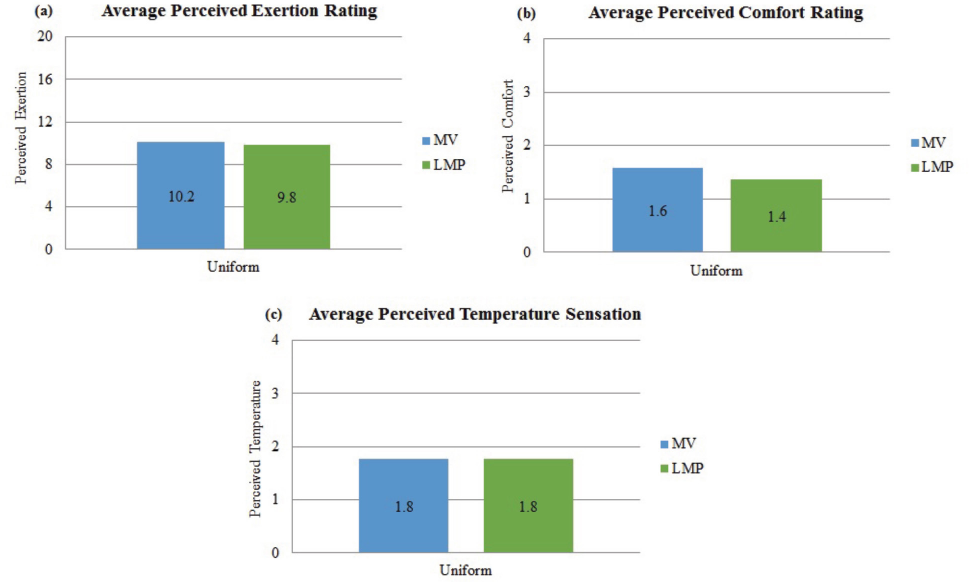
Average perceived (a) exertion, (b) comfort, and (c) temperature sensation ratings for each uniform during the exercise protocol.
The ventilated suits were analyzed for statistically significant perceived thermal comfort differences by pairwise comparisons with each suit serving as its own control. Based on the perceived exertion and temperature sensation ratings, there was reported to be no significant difference between the ventilated uniforms during the exercise protocol. However, when analyzing the perceived comfort ratings, significant differences (p < 0.05) were found. At the end of the first walk/jog cycle, the LMP uniform was rated as significantly more comfortable than the MV uniform. However, by the end of the second walk/jog cycle, the improvement in thermal comfort for the LMP uniform was no longer present.
Discussion
The purpose of this research was to investigate the breath-ability and thermal comfort of ventilated football uniform design technologies including traditional MV and LMP. Air permeability readings were taken for each uniform in the base fabric and vented regions. A human wear trial was conducted to measure pre- and post-exercise comfort sensations, as well as perceived exertion and temperature sensations during exercise. A goal of this research was to develop a better understanding of the type of ventilated design that is most effective for improving thermal comfort when implemented in athletic football uniforms.
Air permeability results indicate limitations in the design of the LMP vents. Surprisingly, although the LMP uniform had the largest ventilated surface area (4597 cm2), it had the lowest air permeability. This indicates the LMP apertures may not be large enough in diameter to effectively allow for air and moisture to pass through the vented fabric structure. A correlation analysis was conducted between air permeability and the surface area of each uniform. No relationship (r = –0.52) was found.
For the pre- and post-exercise comfort sensation analysis, both uniforms were found to have significantly reduced comfort according to the warmth, stickiness, and clinginess parameters, regardless of ventilation type. Permeability sensation ratings also indicated a reduction in breathability after exercise, but differences were not significant.
No statistically significant differences were found between uniforms for the overall average perceived scale ratings. The LMP uniform was determined to have the lowest perceived exertion, and while this difference was not significant from a statistical standpoint, the participants in this study did detect this difference on the subjective comfort level, which gives this finding practical meaning. The MV vent had the highest subjective ratings for all three parameters, indicating it was the least comfortable uniform worn in the wear trial.
Conclusions
A primary objective of this research was to determine whether laser micro-perforation (LMP) ventilation improves, maintains, or decreases the thermal comfort of the athlete compared to traditional mesh ventilation (MV). Although the LMP uniform had the greatest ventilated surface area, it did not demonstrate statistically significant improvements in overall subjective comfort compared to traditional M V. The LMP uniform did show promise early on in the exercise protocol in some subjective thermal comfort parameters, including perceived exertion and perceived comfort.
Limitations of this study include the small uniform sample size (only two uniform ventilation types) and the inability to conduct physiological comfort measurements, including core temperature, skin temperature, and physiological strain. Unfortunately, due to limited budgetary resources, those measurements and additional uniforms were not assessed within the scope of this research. The slight differences in fiber content and garment weight were also potential limitations.
Future research should assess uniforms of the same fiber content as moisture management properties do differ on the material level. Further research should also be conducted to determine the significance of these differences on garment level comfort perceptions. The difference in fabric weight in the LMP pants may be attributed to the inherent nature of the ventilation design itself, which allows a reduction of seams, and therefore, garment weight.
Continued improvement of the LMP ventilation technology should be explored. The LMP process saves time, labor, and cost during manufacturing, as it cuts out the need for additional fabrics, pattern pieces, and steps in construction. Future research should continue to evaluate this new technology to further its development. Specifically, incorporating larger aperture openings in the vent design should be investigated, as it may drastically improve air permeability and thermal comfort. Future research should also expand this study by including additional uniforms with other types of ventilation (e.g., open mesh chain mail designs) and include physiological measurements. The placement of vents should also be evaluated according to body sweat mapping studies specific to athletes. There is still much work to do to close the gap in the literature and to optimize the balance between the thermal comfort and protection of athletes.