






Abstract
The purpose of this research was to determine the effect of firefighter's self-contained breathing apparatus (SCBA) on heat loss through clothing ventilation openings in structural firefighter turnout suits. Passive and active ventilation openings were fabricated into structural turnout suits and tested with and without the SCBA to determine the effect on clothing ventilation. Turnout suits were evaluated under two test conditions on a sweating manikin to measure thermal and evaporative resistance. A predicted total heat loss (THL) value was calculated for each suit and compared to a control turnout without ventilation openings. A significant improvement in heat loss was measured when the SCBA harness, mask, and thermal hood were removed from the structural ensemble. Results showed the SCBA harness significantly decreased heat loss in firefighter turnouts.
Introduction
Firefighting is a dangerous occupation, with most injuries and fatalities attributed to heat and cardiovascular strain. 1 Firefighters currently experience negative levels of heat stress, due to excessive clothing insulation, during the majority of the firefighter's working conditions. A structural firefighter turnout ensemble in the United States consists of the turnout coat, pants, helmet, thermal hood, self-contained breathing apparatus (SCBA), gloves, and boots. The turnout coat and pants themselves (i.e., turnout suits) consist of a three-layer base composite which includes a durable, protective outer shell; a thin, impermeable moisture barrier; and a thermal liner that provides most of the thermal protection.
The element of the turnout ensemble that is most burdensome is the SCBA. 2 This breathing apparatus is necessary in active fire scenarios as it allows firefighters to have fresh, clean oxygen to breath when entering the harsh conditions of a structural fire. The SCBA is required for respiratory protection and protects against elevated heat, carcinogens, and reduces the risk of asphyxiation. 3 It is an essential piece of personal protective equipment (PPE) when fighting structural fires and in other working conditions such as hazardous-material incidents. 4 While the SCBA provides critical respiratory support, it can also be very cumbersome and adds a substantial amount of weight to the physical work performed by the firefighter.5–9 It makes up over fifty percent of the entire ensemble weight, 2 contributing to increased levels of strain when worn. Not only does the SCBA increase the amount of heat produced by the body, it sits in the region of the body where the sweat rate is highest, 10 negatively impacting the wearer's comfort. The weight of the SCBA has been identified as the factor which negatively affects physiological strain the most, along with its impermeability and ft, by increasing heart rate and oxygen consumption rate.5,6,8
Activities performed by firefighters often involve carrying, pushing, pulling, holding, turning, wielding, throwing, or lifting; all of which are hindered when wearing the heavy, restrictive SCBA. 11 While the SCBA should be worn during firefighting and hazardous materials incidents, when firefighters perform other “normal” working tasks, such as vehicle extrications, rescue operations, and even fire investigations, the SCBA is not part of the required PPE protocol. Although necessary during active fire activities, firefighters only spend 10–20% of their time in a structural fire scenario. 1 During other working conditions, the excessive insulation of the turnout suit, which is designed to protect the wearer against the worst-case flashover scenario, leads to a negative impact on physiological comfort for 80–90% of a firefighter's working time. 1
To prevent injuries and potential fatalities caused by heat strain from excessive insulation, clothing ventilation openings may be incorporated into structural firefighter turnout suits.9,12 Previous studies assessed clothing ventilation in structural firefighter turnout suits12–14 and determined that both passive and active ventilation openings were effective for improving heat loss throughout the clothing system, depending on placement within the garment. Active ventilation openings may be opened or closed depending on the work conditions and protection requirements, whereas, a passive vent is constantly working to release heat at all times and may not be opened or closed. 9 Past research, however, did not consider the full turnout suit ensemble including the SCBA and how it may hinder ventilation through designed openings.
In this study, multiple ventilated suits were assessed with the SCBA to determine the impact on heat loss through designed ventilation openings. Each suit was tested with the SCBA, assuming a structural fire scenario, and without the SCBA, assuming normal working conditions, such as a goodwill call or vehicle extrication. In the full structural turnout ensemble, the SCBA may potentially eliminate any benefit of vents placed in the back of the coat or other regions where the harness rests. During the 80–90% of a firefighter's working time when they are not exposed to thermal or chemical hazards, vents could be opened to provide heat stress relief. Therefore, the effect of the SCBA on ventilation openings in structural firefighter turnout ensembles should be explored to determine the most ideal design implementation.
Methods
A structural firefighter turnout suit without ventilation openings was used as a control garment. Passive ventilation openings were fabricated around the circumference of the chest, upper arms, and thighs in a single turnout suit. Active vertical openings were implemented in the vertical side seams of the coat and pants. All three layers of the base composite were vented for both passive and active vent designs. Each turnout suit, including the control, was evaluated with the SCBA and without the SCBA to determine the impact of the SCBA on clothing ventilation and garment heat loss.
All three suits were tested for thermal resistance, evaporative resistance, and predicted total heat loss (THL) using a sweating thermal manikin. The manikin was dressed in the turnout coat, trousers, gloves, boots, and helmet when testing without the SCBA. When the SCBA was worn, the SCBA mask and thermal hood were donned, as well. A standard issue cotton T-shirt, athletic shorts, and socks were worn underneath the turnout suit as base layers.
Sample
Garments evaluated for ventilation were all made from the same outer shell (para- and meta-aramid blend), moisture barrier (polytetraflurorethylene laminate), and thermal liner (aramid batting quilted to aramid facecloth) materials. All three turnout suits (passive vent, active vent, and control) were constructed according to the same pattern. Fig. 1 illustrates all three turnout suit designs. The control suit did not contain any ventilation openings. The passive ventilation openings vented the turnout through all three layers, exposing the wearer's base layers to the external environment. These vents were placed horizontally around the circumference of the mid-torso, upper arm, and mid-thigh regions of the suit. The active vent suit included long, vertical openings which were cut in the vertical side seams of the coat, from the bottom of the middle torso trim to the top of the lower hem trim. The same vent concept was implemented in the trousers. Openings were cut starting underneath the waistline to below the pockets, on the side seams.
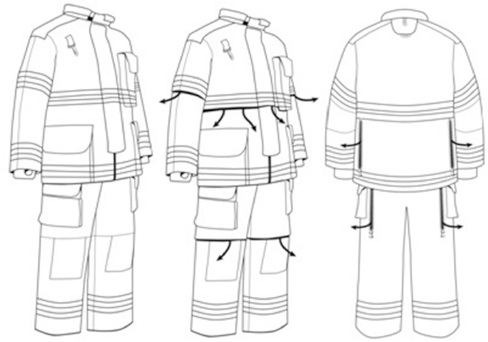
Illustration of control, passive open ventilation, and active vertical ventilation turnout suit designs.
Procedures
Conditions
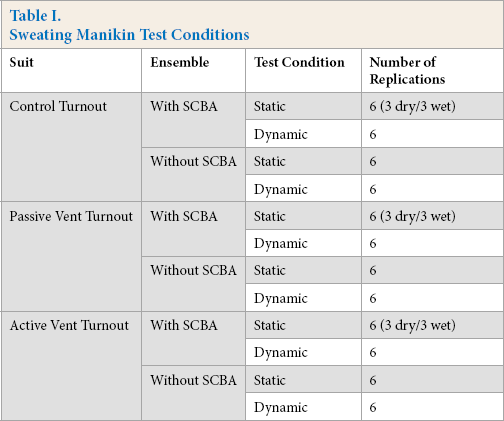
Each turnout suit was tested with the SCBA and without the SCBA (Fig. 2). For both ensemble types, suits were evaluated under two different test conditions: static (manikin standing still with 0.4 m/s still air speed) and dynamic (manikin walking with 2 m/s air speed). For each suit, ensemble, and test condition, six replications (three dry manikin tests and three wet manikin tests) were performed and an average THL was calculated. Table I captures the test replications conducted.
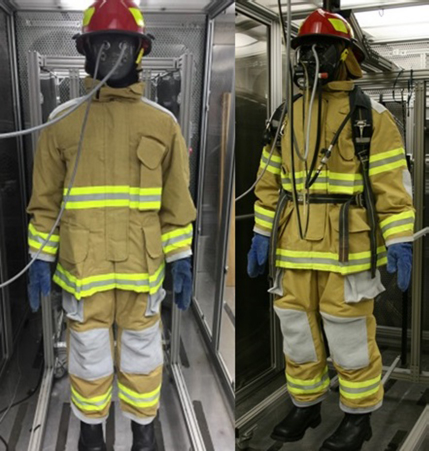
Manikin ensemble testing without the SCBA (left) and with the SCBA (right).
Sweating Manikin Test Conditions
Total Heat Loss (THL) on a Sweating Manikin
The thermal insulation and evaporative resistance of each turnout suit, with and without the SCBA, were measured using the following test methods: ASTM F1291-10 Standard Test Method for Measuring the Thermal Insulation of Clothing Using a Heated Manikin 15 and ASTM F2370-10 Standard Test Method for Measuring the Evaporative Resistance of Clothing Using a Sweating Manikin. 16 The average dry and wet heat loss of the three replications were calculated for each turnout suit. From these measurements, an overall THL value for each turnout suit was determined under static and dynamic test conditions when donning the SCBA and without the SCBA.
Manikin evaluations were measured in a 23 °C/50% relative humidity (RH) environment for thermal resistance and a 35 °C/40% RH environment for evaporative resistance.15–17Because manikin THL calculations are based upon measurements taken in two different environments, the heat loss values are predictive rather than actual measurements.17 Thepredicted THL (Qt) for a 25 °C and 65% RH environment was calculated based on the thermal and evaporative resistance measurements (Rt and Ret, respectively) from the sweating manikin according to Eq. 1. 17

Qt (predicted, T,RH) = predicted manikin THL for specified environmental conditions (W/m2), T = specified temperature condition (°C), RH = specified relative humidity (%), Ts = specified temperature at the manikin surface (°C), Ta = specified temperature of the local environment (°C), Ps = calculated water vapor pressure at the surface of the manikin (kPa), Pa = calculated water vapor pressure in the specified local environment (kPa), Itot = total thermal resistance of the clothing ensemble and surface air layer (°C•m2/W), and Itot, e = total evaporative resistance of the test ensemble and surface air layer (kPa•m2/W).17,18
Further analysis was conducted for the turnout suits tested in the structural fire ensemble. The THL value for each suit was divided by the upper and lower body manikin zones to determine an overall coat and trouser THL for each ventilation design tested.
Statistical Analysis
To determine the statistical significance of the measured differences in predicted manikin THL between suits, two-sample t-tests, assuming equal variances, were performed. All data was tested for normalcy and normal distributions were confirmed through a probability plot and the Anderson-Darling test statistic. A one-way ANOVA, single factor, was conducted with each data set (for each condition and ensemble) to determine if significant differences were present. If differences were identified between the results, t-tests were carried out. All sets of data in this study showed significant differences, therefore, t-tests were conducted comparing suits, ensemble type, and test condition. A p-value less than 0.05 indicates a significant difference in THL between the control suit and the ventilated suit.
Results
The predicted manikin THL results of each suit, in a 25 °C, 65% RH environment, were compared between two different structural firefighter ensembles: with SCBA and without SCBA. A graphical illustration of all three suits, in both ensembles, is shown for the static test condition in Fig. 3 and for the dynamic test condition in Fig. 4. Error bars represent standard deviation of the data and the statistical difference between suits under each condition.
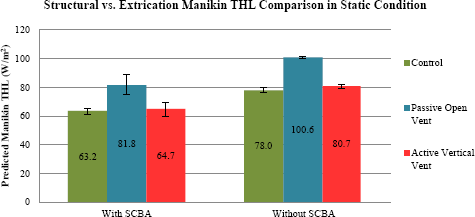
Predicted manikin THL results for ventilated designs in a structural turnout suit with SCBA and without SCBA, under the static test condition.
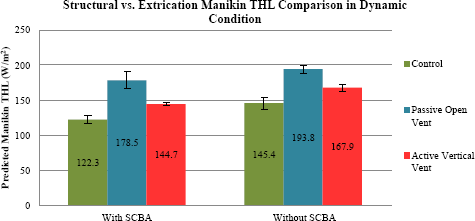
Predicted manikin THL results for ventilated designs in a structural turnout suit with SCBA and without SCBA, under the dynamic test condition.
All suits tested had significantly higher THL values when wearing the ensemble without the SCBA harness, mask, or thermal hood, including the control turnout suit. The only exception was the passive vent suit under the dynamic test condition. While the THL value of the passive vent increased when removing the SCBA (by 15.3 W/m2), it was determined not to be statistically significant (p < 0.05) when walking and wind was present. For the active vertical vent suit, however, the improvement in THL value when removing the SCBA was statistically significant (p < 0.05) under both test conditions. Even the control had a significantly higher THL value (p < 0.05) when removing the SCBA, mask, and thermal hood, regardless of the test condition. These results demonstrate the hindrance of the SCBA on clothing ventilation and heat loss.
As the SCBA sits on the upper body and restricts the turnout coat, segmented THL values were determined for the turnout coat (upper body regions) and turnout trousers (lower body regions) when wearing the SCBA. When comparing the THL values from the upper (coat) and lower (trousers) body zones on the same scale, from 0 to 250 W/m2, significantly greater heat loss occurred in the turnout trousers than in the turnout coat. For example, the passive open vent under the dynamic (walking with wind) condition had a THL of 220 W/m2 in the trousers compared to 136 W/m2 in the coat. Figs. 5 and 6 illustrate these results.
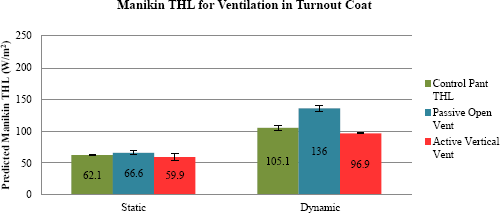
Predicted manikin THL results for ventilated designs in the turnout coat only when donning the SCBA.
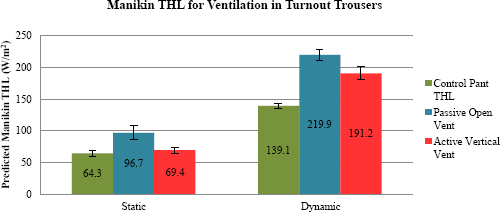
Predicted manikin THL results for ventilated designs in the turnout trousers only when donning the SCBA.
Discussion
Firefighting turnout suits worn without the SCBA, mask, or thermal hood demonstrated significantly greater heat loss, regardless of forced convection (wind or body motion), when compared to the traditional ensemble, which includes the SCBA. These significant increases in heat loss can be attributed to the removal of the SCBA. Presence of the SCBA compresses the back of the coat and creates pockets of air that do not allow air movement throughout the clothing microclimate. By removing the SCBA, the clothing microclimate is no longer restricted and air may flow more freely throughout the garment's microenvironment and directly through ventilation openings to the external atmosphere. This provides justification for implementing ventilation openings in turnout suits for activation during normal working conditions when the SCBA is not worn. Scenarios in which the SCBA should be worn, such as a structural fire or hazardous materials incident, present significant threats that would require ventilation openings to be closed for the firefighter's thermal and chemical protection.
From the results shown in Figs. 4 and 5, ventilation had a greater impact when placed in the lower body region of a protective clothing garment, particularly when additional PPE was donned on the upper body, such as an SCBA. The SCBA limited ventilation in the turnout coat for both passive and active ventilation vents as they were largely placed in the lower back region where the SCBA air pack rested. However, the passive ventilation suit had the greatest overall THL values and the greatest heat loss when both the upper and lower body regions were isolated for coat and trouser heat loss, compared to the active vent suit and the control with no ventilation openings.
Because the lower half of the body is often moving, a pumping motion is created which forces air inward and outward of the clothing system. For this reason, convective air flow was also greater in the trousers than in the coat when the SCBA was worn. While the arms functioned in a similar way, the SCBA rested in the back region of the coat and restricted air movement throughout the clothing microclimate. Therefore, results from this study demonstrates that the most ideal design implementation for structural turnout suits was to construct ventilation openings in the lower body region of the turnout trousers.
Conclusion
Use of the SCBA demonstrated a detrimental reduction in heat loss of turnout suits, even when ventilation openings were incorporated. However, under most working conditions, the SCBA is not required to be worn as part of the ensemble as respiratory hazards do not always pose a threat. Therefore, clothing ventilation designs should be implemented into structural firefighter turnouts for further evaluation on the human wear level. Future testing should be conducted in a normal working scenario in which the SCBA is not worn. Such activities can constitute up to 99% of a firefighter's time. 19 Given the impact of the SCBA on air flow through the garment, ventilation openings should be implemented in such scenarios as vehicle extrication or urban search and rescue, when the SCBA is not worn and the risks of flame and chemical exposure are not present.