






Abstract
Herbal products have been used in textile dyeing since ancient times. Based on current consumer demands, use of natural dyes in dyeing is increasing once again. The main goal of this study is to investigate the metameric properties of natural dyes, an important issue for textile dyeing. For this aim, wool fabrics were dyed with different natural dyes according to the pre-mordanting method. Spectral measurements of dyed samples were performed and color changes under different illuminants were assessed for metamerism. It was statistically observed that the type of natural dye, dye concentration, and the type of mordanting agent were responsible for metamerism to different extents. From the results, madder showed the greatest metamerism, while alkanet root showed the least.
Introduction
Color is an important sensory input, providing us with essential information about our world 1 and playing a pivotal role in our daily life. 2 It is also the main attraction of fabrics. Manufacture and use of synthetic dyes for fabric dyeing have become a massive industry today, but the use of synthetic dyes has adverse effects. 3 The use of natural dyes has many advantages, such as low toxicity, fewer allergic reactions, and bio-degradability, as they are obtained from animal or plant matter without extensive chemical processing. However, the use of natural dyes declined with the advent of synthetic dyes. 4 For wool dyeing, acid, chrome, metal-complex, and reactive dyes may all be used. 5
The color of an object is a sensation rather than a particular property. 6 Metamerism is the name given to the phenomenon in which a pair of color stimuli, differing in spectral distribution, match in color under certain conditions, and not in others. 7 The degree of deviation from matching is known as the degree of metamerism and can be expressed by the metamerism index. 8 Metamerism and inadequate color constancy can cause serious problems within the entire textile production chain. 9 Four types of metamerism are recognized: illuminant metamerism, observer metamerism, field size metamerism, and geometric metamerism. 10 There-fore, metamerism is a common problem in color-producing industries, particularly when the batch and the standard are prepared using different colorants, or if two different materials are being compared. 11 Several researchers have studied the metameric properties of colors. For example, Sluban et al. reported a general metric for the magnitude of observer metamerism. 6 In another study, Peyvandi et al. reported the illuminant metamerism potentiality of metameric pairs. 8
Studies on the metamerism of natural dyes are limited. In this paper, the color-shade changes of natural dyes under different illuminants were examined and the effects of the natural dye concentration and source type, and mordant type, were investigated.
Pomegranate peel, madder, alkanet root, pennyroyal plant, and hibiscus were used as the natural dye sources in this study. Pomegranate has been cultivated from early antiquity for its valuable fruit.
12
The major coloring component in pomegranate is tannins, extracted from the fresh and dried peels.
13
Madder (
Experimental
Materials
In this research, 100% wool woven fabrics with a weight of 160 g/m2 were used. The fabrics were in pretreated form and therefore ready for dyeing. These pretreated fabrics were colored via the pre-mordanting method using five different natural dyes. The pomegranate peels, madder, pennyroyal plant, alkanet roots, and hibiscus were each dried and ground (Fig. 1) and then directly added to the dyebath.
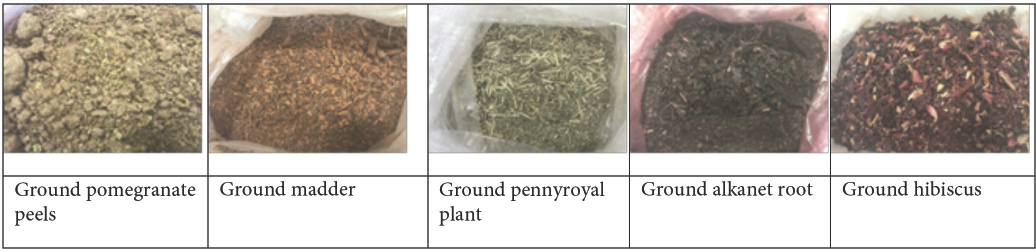
The dried and ground forms of the natural dye sources used.
Method
The five selected natural dye sources were used in dyeing wool with different mordanting agents. The pre-mordanting agents used and a trial plan is given in Fig. 2.
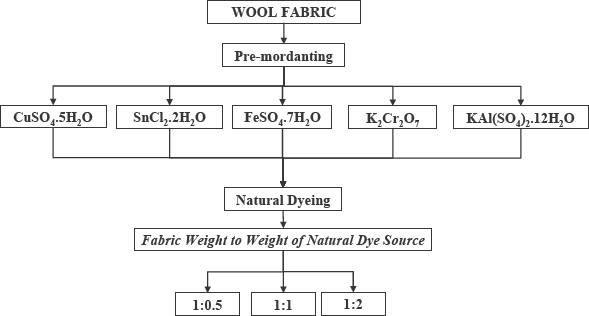
Trial plan for natural dyeing of wool fabrics.
The concentrations of mordanting agents used were 3% w/w copper (II) sulfate (CuSO4∙5H2O), 3% w/w tin (II) chloride (SnCl2∙2H2O), 3% w/w iron (II) sulfate (FeSO4∙7H2O), 3% w/w potassium dichromate (K2Cr2O7), and 20% w/w alum (KAl(SO4)2∙12H2O). For pre-mordanting, the fabrics were treated with the mordanting agent using a 1:50 liquor ratio (LR) at 100 °C for 1 h. After squeezing (the pickup value was 80%) the pre-mordanted samples, the fabrics were dyed. The dyebath, containing the natural dye at different concentrations (1:0.5, 1:1, and 1:2 fabric weight to weight of natural dye source), was processed at 40 °C for 10 min, the bath was heated to 100 °C for 40 min, and dyeing was conducted at 100 °C for 1 h at an LR of 1:50. After dyeing, the dyed samples were washed, rinsed, and subsequently dried at room temperature.
Metamerism Study
For the evaluation of the color change in the presence of different illuminants, color measurements of the fabrics dyed with five natural dyes using various mordants were performed with a Konica Minolta 3600d spectrophotometer under illuminants D65, F2, F11, and A. The CIE L*a*b* values of the samples under different illuminants were determined. The color differences (ΔE values) of the samples under illuminants F2, F11, and A compared to illuminant D65 were calculated (Eq. 1), and these values were used as a measure of sample metamerism.

The resulting ΔE values were then analyzed statistically by ANOVA and the mean differences subgroups were also compared by use of the post-hoc Duncan test. For this analysis, an SPSS statistical package was used.
Results and Discussion
Metamerism is the phenomenon of the two colors that match under one condition, but fail to match under a different condition. 10
It is expected that fabric color will change under different illuminants. Color changes can also be caused by the mordanting agents, as well as the natural dye sources and concentrations, used. The dyes and mordants combinations used were tested to see which had the most significant effect on the ΔE values after the illuminant change.
This study intends to show under which illuminants the samples’ colors significantly changed. It also intends to discover whether dye concentration, natural dye source, and mordant type had a significant effect on ΔE values after changing the illuminant.
ΔE Values under Different Illuminants
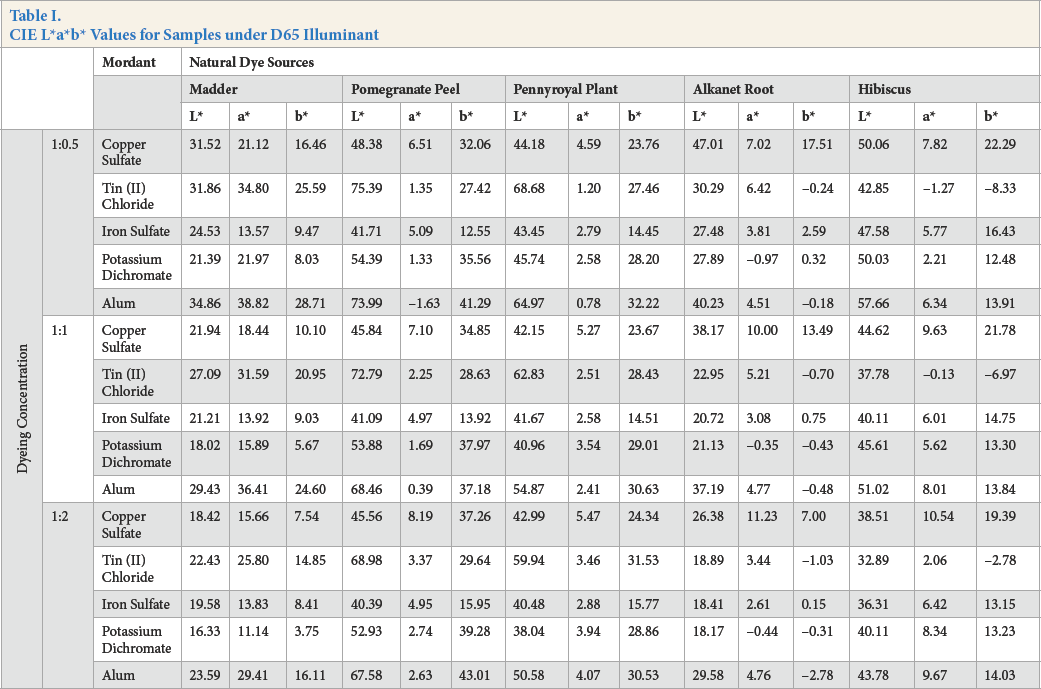
CIE L*a*b* values of the samples under the D65 illuminant are given in Table I.
CIE L*a*b* Values for Samples under D65 Illuminant
Greater ΔE values of samples indicates a greater color change under different illuminants. Combinations of pairs in the same garment that had greater color change (i.e., ΔE values, as calculated in the Experimental section of this study) under different illuminants showed a greater risk for metamerism. In this study, it was assumed that greater ΔE values (i.e., a greater ability to show different colors under different illuminants) based on measurements under illuminant D65, was indicative of greater metamerism. Therefore, combinations of pairs in the same garment having the lowest ΔE values among illuminants showed the least risk of metamerism, which was the desired result for dyed fabrics.
The ΔE values of samples were calculated by use of L*a*b* values for the same sample under different illuminants. In other words, the L*a*b* values of the sample under illuminants A, F2, and F11 were compared with those values under illuminant D65. These ΔE values are shown for different natural dye sources and concentrations, and mordanting materials, in Table II.
Color Differences (ΔE) of Samples Under Various Illuminants Based on D65 Illuminant
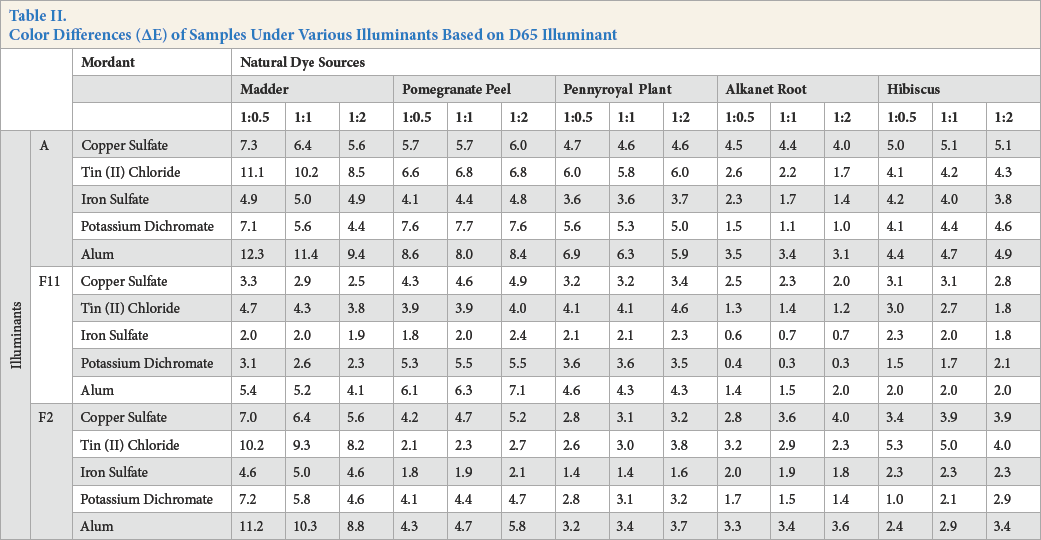
ΔE values varied between 0.4 and 12.3 for a dyeing concentration of 1:0.5 (Table II). The maximum value was observed from madder dye with alum mordant under illuminant A. The minimum value was observed from alkanet root with potassium dichromate mordant under illuminant F11.
ΔE values showed variations with the change in illuminants. In other words, the fabrics dyed with same natural dye source and mordanting agents at the same dye concentration showed significant shifts in their colors with changing illuminants. There were significant changes in ΔE values when various mordanting materials were used. For example, the ΔE value for the sample dyed with pomegranate peel using tin (II) chloride mordant was 5.3 under illuminant F2, whereas it decreased to 1.0 with potassium dichromate mordant under the same illuminant.
ΔE values varied between 0.3 and 11.4 for a dyeing concentration of 1:1 (Table II). In most cases, similar maximum and minimum ΔE values were observed for the same dyes and mordants under the stated illuminants as with the 1:0.5 dye concentration. ΔE values showed significant variations with different illuminants, even when the same natural dye source and concentration, and the same mordanting agent, were used. Significant changes in ΔE values were observed for the various mordants. For example, the ΔE value of alkanet root decreased from 4.4 for copper sulfate mordant to 1.1 for potassium dichromate mordant under illuminant A.
ΔE values varied between 0.3 and 9.4 for a dyeing concentration of 1:2 (Table II). In most cases, similar maximum and minimum ΔE values were observed for the same dyes and mordants under the stated illuminants as with the 1:0.5 dye concentration. ΔE values showed significant variations with various illuminants for the samples dyed with same natural dye source and concentration, and the same mordanting agent. A significant variation in ΔE values was observed with different mordanting agents as with the 1:1 dyeings. For example, the ΔE value of pomegranate peel decreased from 5.8 with the alum mordant to 2.1 for the iron sulfate mordant under illuminant F2.
The natural dye source, mordant type, and illuminant type were important parameters for color changes. Overall, the greatest ΔE values were observed with madder dyeings, whereas the smallest ΔE values resulted from alkanet root dyeings. Statistical analysis was also performed to investigate the observed variations in detail.
Statistical Evaluation of ΔE Results
Measured data from the dyed wool fabrics and their results were analyzed by ANOVA and post-hoc Duncan models using the SPSS (v10.0) statistical software package. Evaluations were based on ΔE values. Interpreted analysis results are given in Table III. F values were used in the interpretation of ANOVA results.
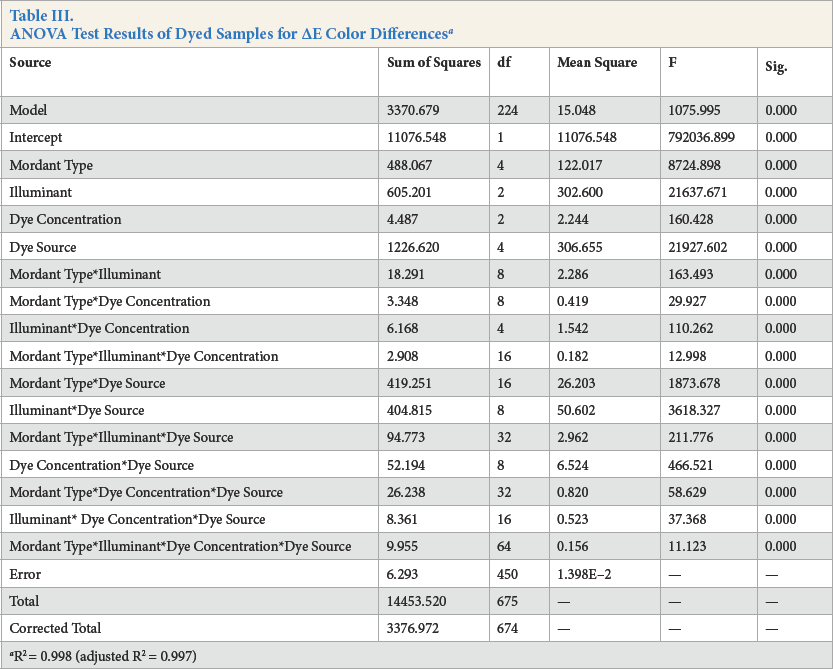
After examining the F values, which is the ratio of the mean square for factors to the mean square for error (i.e., a comparison of variance between samples to variance within the same samples) from Table III, it was deduced that the natural dye source was the most important factor for determining metamerism. Following in importance after the dye source was the illuminant, followed by the mordant type. Although important, the dyeing concentration had the least impact on metamerism. The interaction of individual parameters with each other was also included in the statistical results.
From the ANOVA test, it was found that all the tested factors (mordant type, natural dye source and concentration, and illuminant) had a significant effect on ΔE values. By performing Duncan post-hoc tests on the factors, the difference between the levels for each factor was examined (Tables IV–VII). Factor levels were grouped to different subsets if a statistically significant difference was found between them.
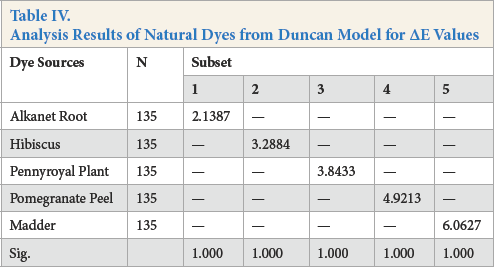
To analyze the effect of dye source on metamerism, a Duncan post-hoc test was conducted on ΔE values, with the results given in Table IV.
Analysis Results of Natural Dyes from Duncan Model for ΔE Values
Analysis Results of Illuminant Type from Duncan Model for ΔE Values
Analysis Results of Mordant Type from Duncan Model for ΔE Values
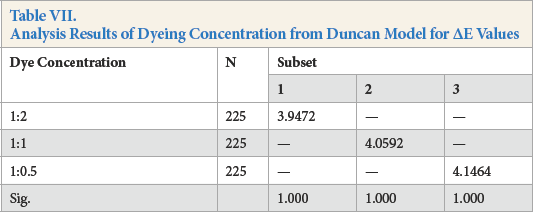
Analysis Results of Dyeing Concentration from Duncan Model for ΔE Values
Dyeing wool with the madder dye plant gave the greatest metamerism (i.e., the greatest ΔE values when the illuminant was changed) among all dye sources tested. This was followed by (in decreasing order of metamerism) pomegranate peel, pennyroyal plant, hibiscus, and alkanet root, which had the least metamerism. In general, by looking at CIE L*a*b* values in Table I, dyed samples with values closer to the blue axis had relatively smaller ΔE values under different illuminants, whereas ones with values closer to the red axis had greater ΔE values. This may partially explain the metamerism results with the five natural dyes tested. However, the large diversity of coloring chemicals in the madder plant may also contribute to its high degree of metamerism.
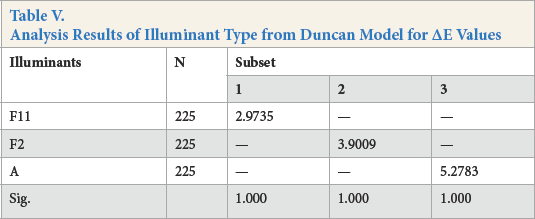
ΔE value differences (for the test wool samples dyed with the five natural dyes) due to changes in illuminants are shown in Table V. It was found that the greatest ΔE values (i.e., greatest metamerism) when compared to the D65 illuminant came from illuminants A, F2, and F11, in decreasing order of metamerism. These results were related to the different characteristics and spectral power distribution of the illuminants. Among the tested illuminants, illuminant A had a dramatically different spectral power distribution from illuminant D65.
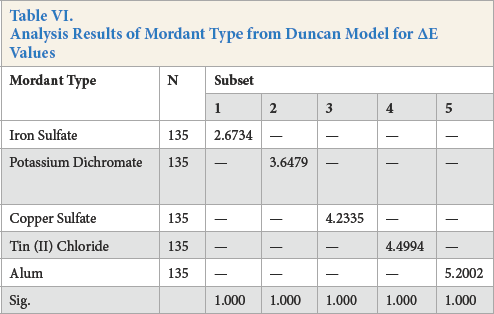
Table VI shows that the greatest ΔE values occurred with alum mordant, tin chloride, copper sulfate, potassium dichromate, and iron sulfate, in decreasing order of metamerism. Dye-mordant interactions, variously formed bonds, chemical reactions, and mordant types had various effect on metamerism in dyeing with mordants. Iron sulfate, which generally gave green-blue shades in colored samples, gave the lowest ΔE values of the series. It was also observed that the blue-green shades produced by iron sulfate on wool had minimal ΔE values with changing illuminants.
In Table VII, results showed good agreement with each other for different dyeing concentrations. It was observed that ΔE values were maximized for a dyeing concentration of 1:0.5, followed by dyeing concentrations of 1:1 and 1:2, in decreasing order of metamerism. In other words, it was observed that metamerism was minimized at greater dye concentrations.
The complete experimental analysis showed that illuminant A had a greater significant effect on sample color change (i.e., ΔE values) than illuminants F2 and F11 based on illuminant D65. It was also observed that during this color change, the samples’ color was of great importance. Red-shade samples showed the greatest amount of color change with the change of illuminants. Blue-green shade samples, however, were more stable during the change of illuminants. Therefore, under the dyeing conditions used in this study, red-shade dyed samples showed greater color change than blue-green-shade dyed samples. As a result, the samples dyed with madder in the presence of alum and samples dyed with alkanet roots in the presence of iron sulfate had a high metameric index when observed in pairs (Fig. 3).
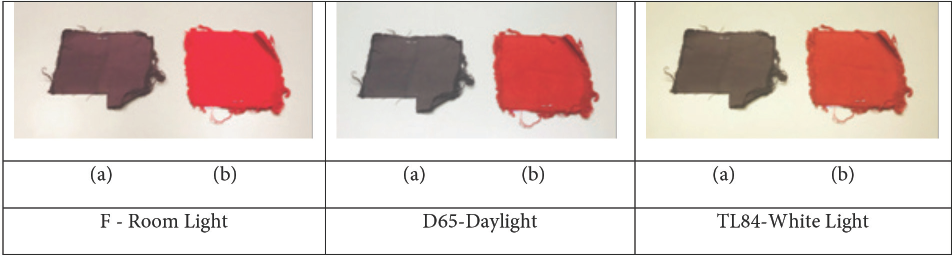
The photos of the dyed samples under different lamps in a light box. (a) sample dyed with alkanet in presence of iron sulfate and (b) samples dyed with madder in presence of alum.
Conclusion
Natural dyes can be used for coloring textile materials. These dyes can present different opportunities and benefits for both manufacturers and consumers. This study was designed to study the metameric properties (color change of the same sample under different illuminants) of natural dyes and natural dyeing. The color differences (i.e., ΔE values) of the same sample under different illuminants compared to the D65 illuminant were measured and used to determine the degree of metamerism. The effects on metamerism, including various factors such as natural dye source and concentration, light source, and mordant type were tested, and statistical analysis was carried out. The statistical results showed that the most important factor for metamerism was the dye source color. Madder dyed wool gave the greatest ΔE values (i.e., had the greatest degree of metamerism) in this study. The greatest ΔE values were observed by illuminant A as compared to illuminants D65. The mordanting agents were also tested. The degree of metamerism based on the mordants decreased in the following order: alum, tin chloride, copper sulfate, potassium dichromate, and iron sulfate. Natural dye concentration had a statically significant effect on metamerism, but this effect was not as dominant as the other factors. The metamerism effects observed with the natural dyes and mordants tested varied widely. In general, the blue-green natural dye colors on wool were less susceptible to metamerism than the red-pink-orange colors.
The extent of metamerism in textile products dyed by natural dyes and mordants needs to be carefully examined to ensure that metamerism is minimized, leading to customer satisfaction under different lighting conditions.
Footnotes
Acknowledgment
This work was supported by Research Fund of the Erciyes University. Project Number: FYL-2015-5857.