






Abstract
Proso millet (Panicum miliaceum) is an economically important crop in the United States for low-end uses such as birdseed and livestock feed. The current study is directed at using starch extracted from proso millet for higher value-added applications, such as a thickener in textile printing. The paper describes a method of extracting starch from proso millet followed by physiochemical characterization of the extracted starch using standard methods. Characterized starch was incorporated as a thickener in a vat dye print formulation and printed on a 100% cotton fabric. Results showed starch from proso millet possessed desirable thickener properties such as excellent paste clarity, viscosity, solubility, shear stability, and crystallinity. Proso starch printed fabric demonstrated good color value, flexibility, crockfastness, and washfastness.
Introduction
Millet is the term used for several small-seeded annual grasses. 1 Millets originated in eastern or central Asia and were important in Europe during the Middle Ages before the cultivation of corn and potatoes. They are important crops in semi-arid regions, due to their short growing season. 2 Of all the millet species, proso millet (Panicum miliaceum) is the primary millet in world markets and is the only millet that is globally traded. 3 Proso millet is also the only species of economic importance in the United States. 1 Most of the US proso millet crop is produced in Colorado, Nebraska, and South Dakota, with Colorado typically producing over 50% of the crop. Currently, proso millet produced in the United States is used primarily for birdseed and livestock feed; uses that are at the lower end of commercial value.
Compared to other cereal grains, limited research has been conducted on millets as a value added product for other end uses. 4 Therefore, the purpose of this research was to investigate higher value-added uses for proso millet, with a particular focus on starch extracted from proso millet. It should be noted that the cost of proso millet starch (US$540/metric ton) is comparable with corn starch (US$500/metric ton) and tapioca starch (US$580/metric ton) and less than potato starch (US$650/metric ton). 5 Additionally, as an example of its application, the starch was used in a textile printing application. Such additional uses for proso millet have the potential of providing supplemental revenue for US farmers and agriculture.
Experimental
Materials
The “Plateau” (waxy type) variety of millet (Panicum mili-aceum) was used for this study. Starch was extracted from proso millet using an alkaline steeping method. 6 For printing, a 100% cotton print cloth (catalog #1403001) from Testfabrics Inc. was used. 7 Screens and other printing equipment were obtained from Silk Screen Supplies. 8 The dyes used were C.I. Vat Red 13 and C.I. Vat Blue 6. Standard reagent grade chemicals for formulating print pastes, such as sodium hydroxide, iodine solution, urea, glycerin, potassium carbonate, sodium formaldehyde sulfoxylate, and soda ash, were purchased from Fisher Scientific. 9
Procedures
Alkali Extraction
Proso millet cereal grains were milled in a blender to a fourlike consistency and then steeped in a 2.5% (w/w) solution of sodium hydroxide for 24 h. The supernatant water was then drained and the rest of the residue was filtered through a 40-mesh screen. The process was repeated two more times and the resultant slurry was then washed, filtered through a 200-mesh screen, washed with distilled water and centrifuged at 4000-5000 rpm for 10 min. The upper dark gluten-rich material was scraped out and discarded and the remaining solids were washed, filtered, and dried to obtain pure starch granules. 6 The weight of the final product was measured. The extracted starch was then characterized.
Swelling Power Determination for Starch Granules
The swelling power of starch granules was determined as the ratio in weight of the wet sediment to the initial weight of the dry starch (g/g).9,10 Starch (1 g) was heated with 30 mL of water to 95 °C for 1 h using a mechanical shaker. Lump formation was prevented by using a magnetic stirrer. The mixture was then centrifuged at a 1600g relative centrifugal force (rcf) for 10 min. The supernatant solution was carefully removed and the swollen starch sediment was weighed. 11
Paste Clarity
The clarity of starch paste is an important attribute of starch since the light reflectance of pastes is closely related to optical homogeneity within swollen granules. 12 Starch pastes were produced by suspending 50 mg of starch (dry weight basis) in 5 mL water. The paste was placed in a boiling water bath for 30 min. The solutions were then shaken thoroughly at intervals of 5 min. After cooling to room temperature (RT), the percent transmittance at 650 nm was determined using a HunterLab ColorQuest XE spectrophotometer. 12
Iodine Binding Capacity
The amylose content of starch samples was determined colorimetrically by assessing the iodine binding capacity using a method reported by Juliano. 13 To ∼100 mg of starch (dry weight basis), 1 mL of ethanol was added to wet the sample. The sample was then dispersed by addition of 9 mL of 0.1 M sodium hydroxide solution and the mixture was left to stand overnight. An aliquot of the above starch mixture (∼0.5 mL) was pipetted out, 0.1 mL of acetic acid and 0.2 mL of iodine solution were added, and the volume was made up to 10 mL with distilled water. After vigorous mixing of the solution, its absorbency was checked immediately using a spectrophotometer at 720 nm to determine the intensity of the solution's deep blue coloration.
Starch Powder Color
Starch color is an important physical attribute in textile printing because it influences the color of the print on the fabric. The extracted starch powder was contained in a clear plastic bag and color was analyzed using a HunterLab ColorQuest XE spectrophotometer on the basis of its Whiteness Index (WI).
Crystallinity Determination
The X-ray diffraction (XRD) pattern of a pure substance is like a fingerprint of the substance and is used to determine changes in crystallinity throughout the sample. 14 XRD analysis was done using a Scintag X2 Teta-Teta X-Ray Powder Diffractometer at an angular (θ–2θ) range of 4° to 50°, with a 1 s wait time between angles.
Termal Stability of Starch Paste
A differential scanning calorimeter (DSC) was used to record the thermal behavior of proso millet starch granules. Starch samples of 3 mg (dry weight basis) were weighed in an aluminum pan and 7.5 μL of distilled water was then added. The pan was sealed, left overnight at RT to attain equilibrium. The pan was later heated from 35 °C to 130 °C at a rate of 10 °C/min. 15 The thermal properties of the starch samples were recorded and analyzed.
Rheological Properties of Starch Paste
The viscosity of starch solution samples and the internal structural bonding can be determined by rheological analy-sis. 16 Starch solutions (3% concentration) were prepared by adding distilled water and then cooked in a water bath for 15-20 min at 95 °C with constant stirring to avoid lump formation. The gelatinized starch samples were then allowed to cool down and a Brookfield viscometer (Model DV-E) was used to determine the apparent viscosity at a uniformly increasing shear rate of 5-50 rpm at 25 °C. 17
Shear Stability of Starch Paste
Shear stability of millet starch was determined for 5% (w/w) aqueous starch suspensions using the method reported by Praznik et al. 18 The starch suspension was equilibrated for 30 min in a water bath at 95 °C with constant stirring. The viscosity profiles were determined using a rheometer for shear rates of 100 s–1 (5 min), 1000 s–1 (5 min), and again at 100 s–1(5 min). Percent shear stability was computed as the ratio of viscosity at the end of the first period (Apparent Viscositybefore) and viscosity after the second period (Apparent Viscosityafer) of shear stress.
Storage Stability of Starch Paste
A useful characteristic of starch pastes is the maintenance of viscosity upon storage. Storage stability of a 15% (w/w) proso millet starch suspension was tested using the method reported by Sangseethong et al. 19
Print Paste Formulation
Characterized starch was used as a thickener in a vat dye formulation, followed by printing on a 100% cotton print cloth using the pre-reduction method. A 10% concentration of thickener was prepared by using a 1:9 ratio of proso millet starch to water on a weight basis and cooked in a water bath for 30 min. The print paste formulation on weight basis was as follows: vat dye, 2%; urea + glycerin (1:1), 1%; potassium carbonate, 16%; sodium formaldehyde sulfoxylate, 16%; and 10% thickener paste for sufficient viscosity. 20
All the printing ingredients (except the thickener and sodium formaldehyde sulfoxylate) were stirred in and kept at 60 °C for 30 min. After cooling, the remaining ingredients were added. The printed fabric was dried at 80 °C for 1 min and steamed in the absence of air at 102 °C for 20 minutes for fixation. To oxidize and develop the color, a solution containing 2% soap solution and 2 g/L soda ash was used. The fabric was finally rinsed in cold water and air dried.
Evaluation of Printed Textiles
Color depth was evaluated using a HunterLab ColorQuest XE spectrophotometer using the Kubelka Munk equation at the wavelength of maximum absorption. The higher the K/S value, the better the color depth.
Bending length was used to evaluate the stiffness imparted to the fabric by the thickener in the printing paste. ASTM Test Method (TM) D1388 was used to determine the bending length of the fabrics.
The dry and wet crockfastness of the printed samples was evaluated using AATCC TM 116. AATCC TM 61 was used to evaluate the washfastness of the printed fabrics.
Comparison of proso millet starch printed fabrics were made to sodium alginate printed fabrics. The print quality of proso millet starch printed fabrics was also benchmarked against samples printed with sodium alginate as the thickener using identical print formulations.
Results and Discussion
Proso Millet Starch Properties
The physiochemical characteristics of starch extracted from proso millet are summarized in Table I. The swelling power of starch determines the hydration ability of starch granules. The higher the swelling power of starch, the greater the solubility and paste clarity, and the lower the viscosity of the starch paste. 21 The swelling power of millet starch was 21.47% at 0 kGy which is comparable to that of wheat starch and potato starch previously reported by other researchers (Table I). 22 Therefore, millet starch has suitable swelling power for textile printing applications.
Characteristics of Proso Millet Starch
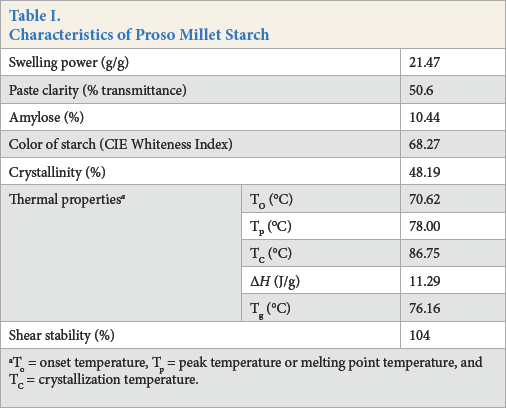
To = onset temperature, Tp = peak temperature or melting point temperature, and TC = crystallization temperature.
The analysis of starch paste clarity was done by measuring transmittance with relation to water at 650 nm based on a technique reported by Craig et al. 12 The value for millet starch was 50.6%, which was comparable to the transmit-tance of waxy corn 12 and wheat 12 starches. In practice, this value for transmittance means that resultant printing formulations will be clear and ideal for printing on fabric. Hence, the use of millet starch would not adversely affect the quality and color of printed fabrics.
Amylose in starch binds with molecular iodine to form a complex that produces a deep blue color. 23 In the presence of iodine, the millet starch produced a reddish yellow color (Fig. 1). This indicated a low amylose content (10.44%) as shown in Table I. Stated differently, this means that millet starch contained a large amounts of amylopectin that contributed to the increased paste clarity and to the crystal-linity of the starch. 14
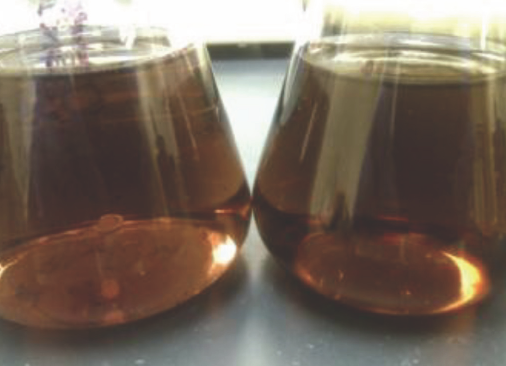
Reddish-yellow proso millet starch-iodine complex solution.
Starch color impacts the color of the print on the fabric. Particulates present in starch could interact with dye molecules and alter the color of print on the fabric. The extracted proso millet starch had an inherent bright white color (WI of 68.27). Proso millet starch had superior whiteness compared to amaranthus starch, 21 wheat starch, 20 corn starch, 24 and sorghum starch, 25 and was suitable for textile printing.
The diffraction pattern of the extracted starch showed several narrow high intensity peaks at various θ–2θ angles. Since the amorphous component of the polymer contributes to broad peaks and crystalline component results in sharp narrow peaks, 13 the millet starch was observed to be more crystalline in nature (Table I). This result inferred the presence of amylopectin in greater amounts than amylose in proso millet starch.
The thermal properties of proso millet starch were characterized by a high peak temperature (TP) of 78 °C, which is corroborated by reports in the literature 26 and is comparable to those of rice, maize, tapioca, and arrowroot starches. 26 According to Barichello et al., 27 the high glass transition temperature (Tg) of starch molecules is a result of a high degree of crystallinity. Since millet starch has high crystallinity, it resists changes in phase, resulting in high melting point (TP) and gelatinization temperatures (Fig. 2). The enthalpy of gelatinization (ΔH) indicates the amount of thermal energy required in the process of gelatinization, which is an endothermic process. The ΔH value increases with the amylopectin content. 28 The extracted proso millet starch therefore has a high amylopectin content.
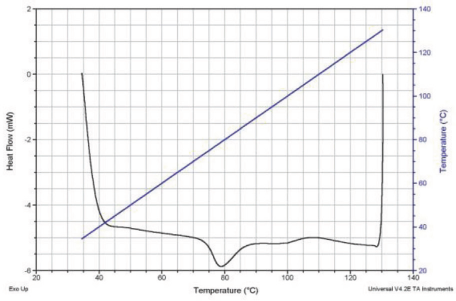
DSC curve of proso millet starch.
For viscosity, the data was plotted as a function of shear rate (Fig. 3). Viscosity decreased with increasing shear rate. Since a starch-water system is a non-Newtonian fluid, its viscosity depends on the shear rate and therefore the behavior is similar to a shear-thinning fluid.
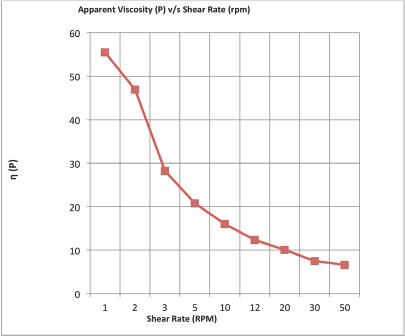
Viscosity of proso millet starch.
Additionally, shear stability measurements showed the final viscosity was higher than the initial viscosity at the same shear rate. Thus the shear ratio of millet starch was greater than 1 and the percentage shear stability was calculated to be 104. The increase in final viscosity could be the result of the shear-induced response of the millet starch suspensions. The shear stability of millet starch was comparable to wheat and amaranthus starches. 18
The storage stability of millet starch was determined by recording the viscosity at various shear rates after 0, 1, 2, 4, and 8 h. Fig. 4 shows the trend in viscosity at various shear rates for various time periods. A slight increase in viscosity was observed before the gradual decrease at the end of the 1st, 2nd and 4th h. This anomaly could be attributed to the change in molecular and supermolecu-lar conformations of the millet starch granules at high temperatures. 18 Thus, the millet starch molecules exhibit potential storage stability for at least several hours when stored in a controlled environment.
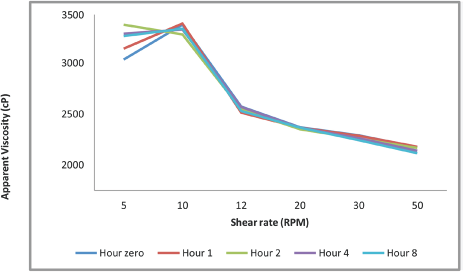
Storage stability profile of millet starch suspension at 50 °C.
Evaluation of Printed Fabrics
Color depth (K/S) values of fabric samples printed using millet starch and sodium alginate are shown in Table II. The K/S value of red proso millet starch printed fabric was higher than that for the sodium alginate printed fabric (Fig. 5). For the vat blue dye, color depth values for both printed fabrics were comparable.
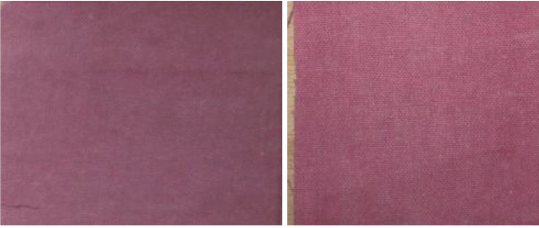
Fabrics printed with Vat Red 13 using Proso millet starch (left) and sodium alginate (right).
Evaluation of Samples Printed with Proso Millet Starch and Sodium Alginate
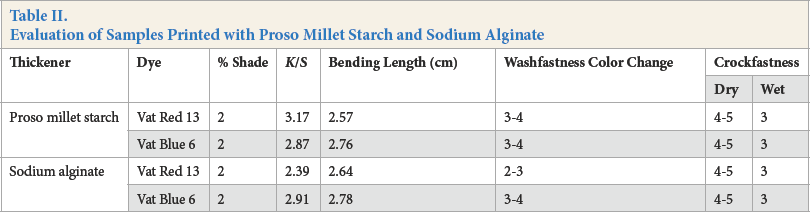
The stiffness (flexibility) of the printed fabrics was judged by determining the bending length of the fabric. The results in Table II indicate that the bending length of proso millet starch printed samples was slightly less than that of sodium alginate. This is mainly due to the good solubility and washability of millet starch, without leaving any undesirable residue on the fabric.
Crockfastness results (Table II and Fig. 6) show that, in both the dry and wet state, there were no difference in proso millet starch printed fabrics when compared with sodium alginate printed fabrics.
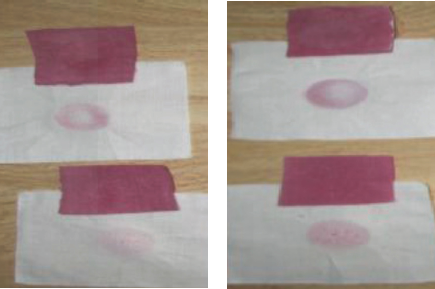
Dry (bottom) and wet (top) crockfastness of fabrics dry printed with Vat Red 13 using proso millet starch (left) and sodium alginate (right).
Washfastness tests showed similar fastness ratings for both proso millet starch and sodium alginate printed samples (Table II). Vat dyes have good washfastness properties. The use of proso millet starch did not negatively affect the washfastness of the vat dyes. In case of the red vat dye, the millet starch sample performed better than the sodium alginate sample, as shown in Fig. 7.
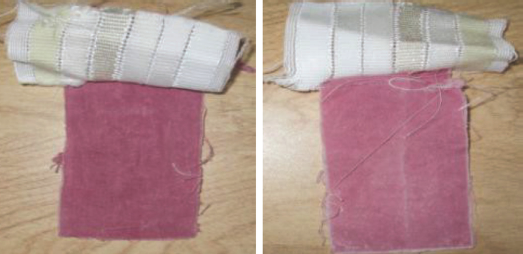
Washfastness of fabrics printed with Vat Red 13 using proso millet starch (left) and sodium alginate (right).
Conclusions
The use of proso millet starch as a thickener in vat dye printing on cotton textiles is a viable option as demonstrated by the results of this study. Physiochemical studies of proso millet starch indicated its excellent potential as a thickener, which was confirmed by evaluation of printed fabrics in terms of color depth, flexibility, crockfastness, and washfastness. Proso millet is an underutilized crop that has commercial potential for value-added uses and may provide supplemental revenue for farmers.
Footnotes
Acknowledgement
This research was supported by the US Department of Agriculture via a grant by the Colorado Agricultural Experiment Station under Project COL00627.