






Abstract
Antarctic krill proteins (AKP) were grafted onto polyacrylonitrile (PAN) to improve its hygroscopicity. AKP, extracted from Antarctic krill, was activated by maleic anhydride and then reacted with PAN in water to prepare PAN-graft-AKP (PAN-g-AKP). PAN-g-AKP was dissolved in
Introduction
Polyacrylonitrile (PAN) is a fiber-forming polymer with great film-forming, chemical stability, and bacterial erosion resistance properties. Electrospinning has been successfully used in the production of PAN nanofibers. These nanofibers possess good specific surface area, porosity, and mechanical strength, and the fiber morphology can be adjusted by preparation conditions.1–3 PAN has been widely used in biological engineering, composite material, filtration separation, and sensors and photoelectric device areas. As its inherent hydrophobicity can lead to easy fouling, PAN functionalization is an active research area.4–6
Antarctic krill comprises one of the most abundant life forms on earth based on weight, having a biomass of 6.5 × 10⁸ to 10 × 108 tons and 18% to 20% of the protein content. There exists a widespread use of krill in the food processing, health care industries, and other fields. Krill shell contains abundant fluorine (40× greater than the human body's fluorine allowance)—fluorine will rapidly seep into shrimp after death, thereby losing edible value and wasting resources.7,8 Therefore, how to make use of Antarctic krill effectively has practical significance. In view of Antarctic krill's high protein content, we combined protein extraction technology and fiber molding technology in the copoly-merization of protein and acrylonitrile, after the protein was activated using maleic anhydride. A PAN-Antarctic krill protein (AKP) graft (PAN-g-AKP) was synthesized and fibers were prepared by electrospinning, improving the hydrophilcity of the resulting PAN-g-AKP nanofiber over PAN.
Experimental
Chemicals
Antarctic krill shrimp powder was provided by Liaoning Fishery Group. Sodium hydroxide (NaOH, analytical reagent grade) was purchased from Xilong Chemical Co. Ltd. Acrylonitrile monomer (AN) and maleic anhydride (MA) were purchased from Tianjin Fuchen Chemical Reagent Co. Ltd. Concentrated hydrochloric acid (36 wt%) was purchased from Tianjin Kaixin Chemical Industry Co. Ltd.
Protein Extraction
A 3 wt% NaOH solution was prepared. Antarctic krill shrimp was then mixed with the NaOH solution at a mass ratio of 1:20 in a three-necked flask. Ten the mixture was stirred for 5 h at 70 °C. Afterwards, the filtrate was obtained by filtering the mixture using a suction funnel connected to a vacuum pump (SH2-D, Yingyuyuhua Co.). The filtrate was gradually titrated with a 5 wt% HCl solution to a pH value of 6, and the white flocks recovered by filtration. Finally, the AKP protein powder was obtained by washing the white flocks 3–5× and drying at 60 °C in a vacuum oven.
PAN-g-AKP Preparation
MA and a little water were added into a three-necked flask and stirred at room temperature (RT) in a water bath until the MA was completely dissolved. AKP powder, having the same weight as the MA used, was mixed with 1 wt% NaOH solution to prepare 5 wt% AKP solution. Afterwards, the prepared AKP solution was added to MA dropwise, reacting for 30 min at 60 °C to obtain acylated AKP.
AN and potassium peroxodisulfate (5 wt% based on AN weight) were then synchronously added dropwise into the three-necked flask containing acylated AKP, and the reaction continued for 5 h at 60 °C, during which time a white precipitate appeared. In this step, the weight ratio of AN to AKP was 95:5, 93:7, 91:9, 89:11, 87:13, and 85:15, referred to as AKP contents of 5, 7, 9, 11, 13, and 15 wt%, respectively. The PAN-g-AKP was obtained after washing of unreactive AKP and AN from the precipitate. Finally, a solid product was obtained by heating in a drying oven. The schematic diagram of the grafting process between AKP and PAN is shown in Fig. 1.
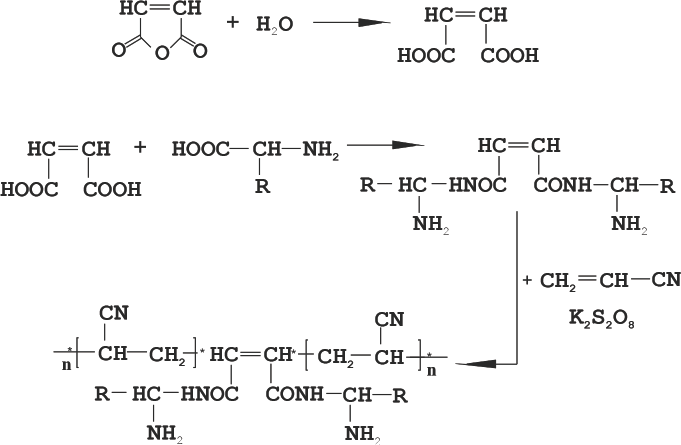
Schematic diagram of AKP and PAN grafting process.
Electrospinning of PAN-g-AKP
The PAN-g-AKP with different AKP contents were dissolved in DMF and stirred for 4–6 h at 70 °C to prepare a uniform spinning solution. The PAN-g-AKP content was 14 wt% and the DMF content was 86 wt%. During electrospinning, each of the as-prepared solutions were placed in a 1 mL syringe and was fed by a syringe pump at a speed of 0.04 mm/s. The stainless-steel needle (0.5-mm ID) was connected to a high voltage supply (FM-1206, Beijing Fuyouma Technology Ltd.) with a voltage of 27 kV. Aluminum-foil paper was wrapped around a rotating drum, with a rotating speed of 2000 rpm, as the collector. The distance between the needle and the collector was fixed at 20 cm. The fibers were dried under vacuum at RT for 24 h to remove residual solvent.
Water Retention Test
Water retention testing was performed according to DIN 53814-1974 (Testing of textiles determination of water retention power of fibers and yarn cuttings). PAN-g-AKP fibers were soaked in deionized water for 24 h at 20 °C. Ten the fibers were centrifuged for 20 min to remove water, and the weight of the fiber was recorded (

Characterization
FTIR spectra of samples were taken with a Spectrum One-B (PerkinElmer Co.) using a scan range of 4000–400 cm−1. The fibers were gold coated and the morphology was observed by SEM (JSM-6360LV, JEOL) at a voltage of 20 kV under low vacuum. The average diameter of the electrospun fibers was obtained using a UTHSCSA Image Tool Program to measure from at least five SEM images per sample. The crystalline behavior of the samples was investigated by wide angle XRD (D/Max 3B, Rigaku); tube voltage, 20 to 60 kV; tube current, 2.5 to 80 mA; and Cu target, scanning from 2θ = 10× to 80× at a speed of 4×/min. TGA experiments were conducted by using a thermoanalyzer instrument (TGA-Q50, TA Co.) with the heating rate set at 20 °C/min. TGA curves were recorded in a range from 20 °C to 700 °C using 40 mL/min of nitrogen. Differential scanning calorimetry (DSC) was performed using the Switzerland Mettler DSC-2; the dry nitrogen flow rate was set at 20 mL/min, and the DSC curves were recorded in a range from 20 °C to 400 °C at a scanning rate at 10 °C/min.
Results and Discussion
FTIR study
The FTIR spectra of pure PAN, AKP, and PAN-g-AKP are shown in Fig. 2. The absorption peaks of -C≡N at 2243 cm−1were characteristic for PAN, and the absorption peaks of amide I band -C=O at 1654 cm−1, amide II band and -NH- at 1541 cm−1, and amide III band -C-N at 1242 cm−1 were characteristic for AKP (Fig. 2, spectrum c). Comparing Fig. 2, spectrum b with Fig. 2, spectra a and c, characteristic peaks of both PAN and protein appear in Fig. 2, spectrum b, demonstrating successful grafting. Weakening of amide II band -NH- and disappearance of amide III band -C-N- suggest that the -C-N- linkage was broken and the peptide linkage was destroyed. In addition, the decreased strength (from 20 of PAN to 17.9 of PAN-g-AKP) of the characteristic PAN peak illustrates that -C≡N group content was reduced to some extent, which also proved that the grafting reaction between PAN and AKP occurred. 9
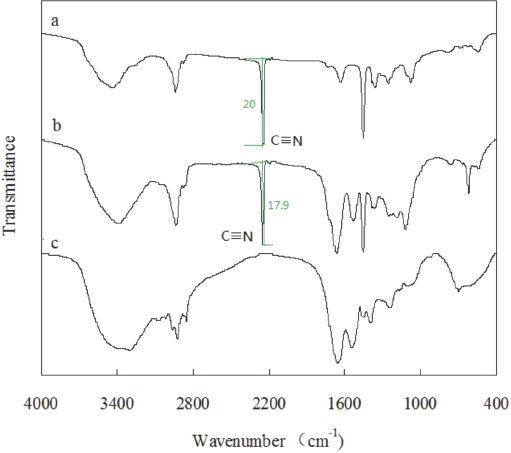
FTIR spectra of a) PAN, b) PAN-g-AKP, and c) AKP.
Fiber Morphology
The morphology of the electrospun fibers is primarily influenced by the type of polymer, the solution properties (e.g., concentration, viscosity, surface tension, conductivity, and solvent polarity) and the process parameters (e.g., applied voltage, flow rate, and distance between needle and collector).10–13 Since the type of polymer and electrospinning parameters were included in this work, the morphology of the electrospun fibers mainly depends on the AKP content. AKP content has significant influences on viscosity, surface tension, conductivity, and fiber morphology.
Typical SEM images of electrospun PAN fibers and PAN-g-AKP fibers with different AKP contents are shown in Fig. 3. The average diameters of the seven types of the fibers studied are given in Fig. 3h. All of these fibers had smooth surfaces and cylindrical shapes without beads, as shown in Fig. 3a–g. In addition, the average diameter of the fibers increased with increased AKP content in the fibers (Fig. 3h). This might be attributed to the increased viscosity of the spin dope associated with the addition of AKP. AKP addition can promote hydrogen bonding between PAN-g-AKP molecules, resulting in increased viscosity. Higher viscosity leads to higher deformation resistance and smaller drawing of the fibers in the electric field. Similar results were extensively reported in the literature.14-15
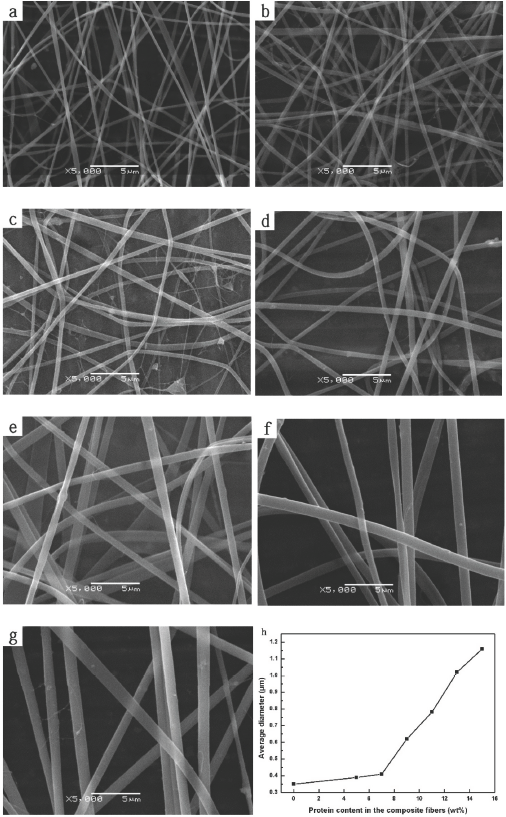
SEM images of electrospun PAN and PAN-g-AKP fibers. AKP content: a) 0 wt%, b) 5 wt%, c) 7 wt%, d) 9 wt%, e) 11 wt%, f) 13 wt%, g) 15 wt%, and (h) the average fiber diameter of all fibers.
Crystallinity
XRD patterns of pure PAN, AKP, and PAN-g-AKP fibers with different AKP contents are shown in Fig. 4. PAN has two strong diffraction peaks at 2θ = 17° and 2θ = 29.5° (Fig. 4a), and AKP has a broad diffraction peak at 2θ = 20.1° and two strong diffraction peaks at 2θ = 31.6° and 2θ = 45.3° (Fig. 4h), suggesting both PAN and AKP have good crystalline structure. Compared with pure PAN and AKP, PAN-g-AKP fibers have four diffraction peaks with similar diffraction patterns and diffraction angles (Fig. 4a–h), which means that both PAN and AKP preserve their crystallization capacity in the graft. The diffraction peak at 2θ = 20.1° in AKP was originally weak and broad—the three-screws structure of AKP is broken to some extent during grafting,14,16 losing part of its crystallization—it almost disappears in the grafted fibers. The reserved diffraction peaks in the PAN-g-AKP fibers were weaker than in both pure PAN and AKP. It can be inferred that PAN and AKP weaken each other's degree of crystallization. This is due to the grafting reaction between PAN and AKP molecules, which link together two types of chains, limiting each other's movement of each other and leading to the reduction of whole grafting chains. Additionally, with the increase in AKP content, the diffraction peaks at 2θ = 17° became weaker, indicating that the degree of crystallization of the fibers decreased with increased AKP content. This is due to the increased hydrogen bonding of AKP with greater AKP content.17–20
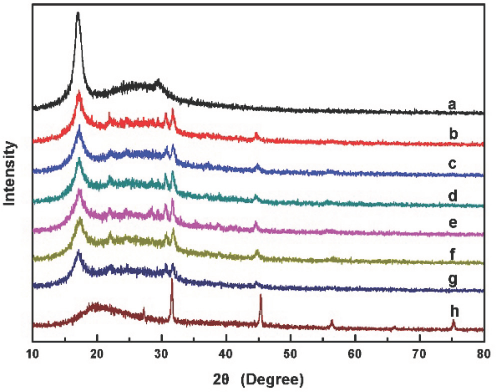
XRD curves of electrospun fibers: a) PAN, b) 5 wt%, c) 7 wt%, d) 9 wt%, e) 11 wt%, f) 13 wt%, g) 15 wt%, and h) AKP.
Thermal Stability
Termogravimetric analysis (TGA) and derivative ther-mogravimetric analysis (DTGA) of PAN-g-AKP fibers with different AKP contents are shown in Figs. 5 and 6. The initial decomposition temperature of pure PAN was 300 °C and the char yield at 700 °C was about 60%, while those for AKP were 150 °C and 15% respectively, which indicates that the heat stability and heat resistance of PAN were much stronger than those for AKP (Fig. 5). As seen in Fig. 6B, the degradation temperature range of AKP was extremely large, indicating a very broad molecular weight distribution of AKP.
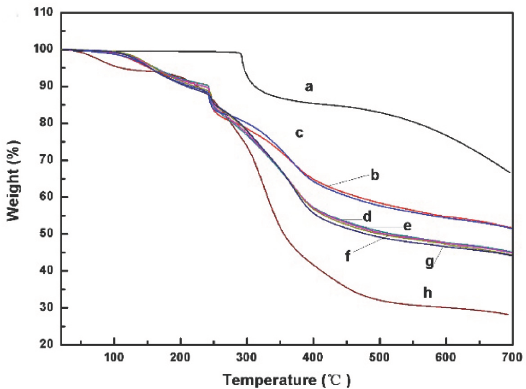
Termogravimetric analysis (TGA) curves of electrospun fibers: a) PAN, b) 5 wt%, c) 7 wt%, d) 9 wt%, e) 11 wt%, f) 13 wt%, g) 15 wt%, and h) AKP.
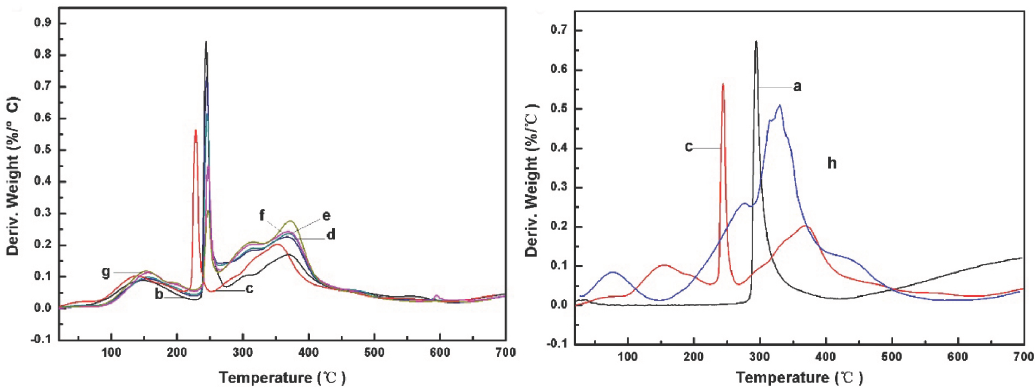
Derivative thermogravimetric analysis (DTGA) curves of electrospun fibers: a) PAN, b) 5 wt%, c) 7 wt%, d) 9 wt%, e) 11 wt%, f) 13 wt%, g) 15 wt%, and h) AKP.
DTGA curves of the fibers (Fig. 6) show that there were three stages of fiber degradation. The first stage was the weight loss occurring at 100–240 °C, which corresponded to AKP degradation in the fibers. The second stage was the weight loss occurring at 240–280 °C, which was attributed to PAN decomposition in the fibers, accompanied by cycli-zation dehydrogenation reactions. The third stage was the weight loss occurring at 280–500 °C, which corresponded to AKP macromolecule degradation in the fibers. Since the dehydrocyclization of PAN generates a trapezoidal structure that can withstand thermolysis in the process of further heating, the weight loss rate reduced gradually as temperature increased, down to zero above 500 °C. 9
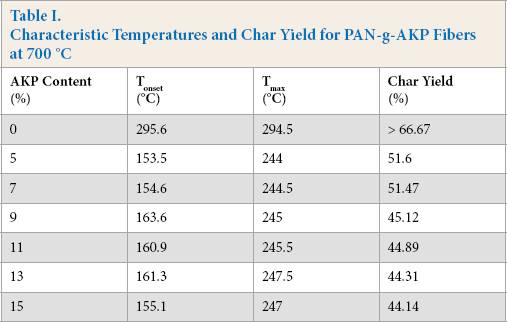
The 5% weight loss temperature (i.e., the onset decomposition temperature Tonset), the maximum decomposition temperature (Tmax) and the char yield at 700 °C are given in Table I. Tonset values for the fibers with 5% AKP content were 132–143°C, less than that for pure PAN (Fig. 5 and Table I). This was attributed to the poor heat stability and heat resistance of AKP. In addition, Tmax values decreased by 47–51 °C and the char yield at 700 °C also decreased with increased AKP content (Table I). These decreases indicate that the thermal stability of the PAN-g-AKP fibers deteriorated when compared to ungrafted PAN. The PAN structure in PAN-g-AKP fibers is modifted, thus less dehydrocyclization can occur, leading to a decrease in trapezoidal structures.
Characteristic Temperatures and Char Yield for PAN-g-AKP Fibers at 700 °C
Thermal Properties
DSC curves were acquired from the heating and cooling of electrospun fibers. Since the PAN decomposition temperature was lower than the melting temperature, there were no cooling curves in Fig. 7, and the corresponding data are given in Table II. Decomposition is an exothermic process, therefore DSC peak intensities for all fibers were lower than that of pure PAN. Δ
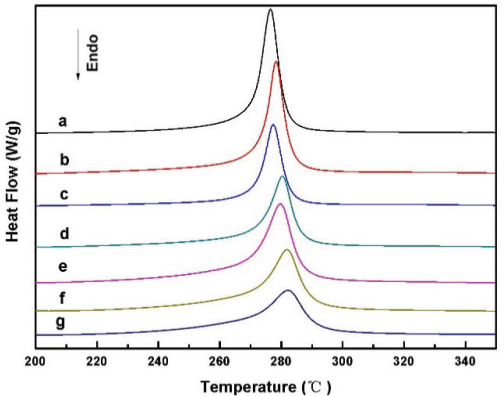
DSC curves of electrospun fibers: a) PAN, b) 5 wt%, c) 7 wt%, d) 9 wt%, e) 11 wt%, f) 13 wt%, and g) 15 wt%.
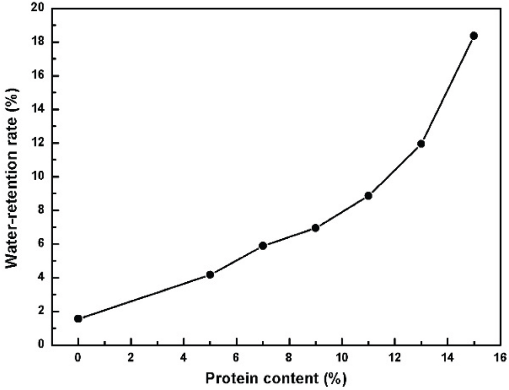
Water retention rate of PAN and PAN-g-AKP fibers.
Termal Properties of PAN-g-AKP Fibers with Various AKP Contentsa
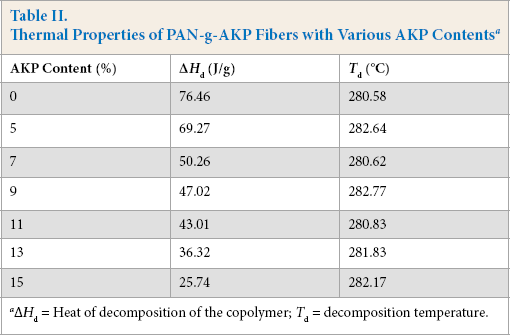
Δ
Water Retention Rate
The water retention rate of pure PAN was 1.56%, with the value for PAN-g-AKP fibers increased to 4.18% when the AKP content was 5 wt%. The water retention rate of the fibers increased gradually to 18.36% for PAN-g-AKP fibers with an AKP content of 15 wt%, indicating that the hygro-scopicity of the fibers was greatly improved. Because of the abundant hydrophilic groups in AKP that can promote the formation of hydrogen bonds, introducing AKP into the fibers by grafting can promote the hydrophilic performance of grafted copolymers such as PAN-g-AKP fibers.
Conclusions
AKP extracted from Antarctic krill shrimp meat was reacted with PAN to obtain the graft copolymer PAN-g-AKP. PAN-g-AKP fibers, with an average diameter of 0.35 μm to 1.16 μm, were prepared by electrospinning. FTIR showed that AKP peptide bonds were broken during the grafting reaction. SEM images indicated that the fibers of different AKP content had a good morphology with a smooth surface even when the AKP content reached 15%, and the average diameter of the fibers increased gradually with increased AKP content. XRD analysis showed that the crystallinity of PAN-g-AKP fibers decreased with increased AKP content. TGA and DTGA analysis suggested that the incorporation of AKP decreased the onset thermal degradation temperature and maximum weight loss temperature. The char yield at 700 °C for the PAN-g-AKP fibers decreased with increasing AKP content. TGA results indicate that thermal stability of PAN-g-AKP fibers was worse than that of PAN. DSC measurements indicate that the decomposition heat of PAN-g-AKP fibers decreased with increased AKP content. Water retention rate measurement values increased to 18.36% from 1.56% after AKP was grafted, indicating that the hygroscop-icity of the PAN-g-AKP fibers was improved.
Footnotes
Acknowledgment
This project was funded by the National Natural Science Foundation of China (No: 51373027) and the Education Department of General Item (No:LR2012017).