



Abstract
In order to ensure thermal comfort and reduce energy consumption, a new composite based on Portland cement and date palm fiber was studied in this work. Our main objective is to study the possibility of integrating and using this new material as a thermal insulation material in the exterior coatings of buildings. Several composites were prepared for different weight concentrations (from 0% to 5%) of date palm fibers. The studied materials were analyzed by Fourier transform infrared spectroscopy (FTIR), X-ray diffraction (XRD), thermogravimetric analysis (TGA), and scanning electron microscopy (SEM). In addition, the hot wire method was used to measure thermo-physical properties. The results show that the addition of fibers has no effect on the chemical composition of the matrix, as shown by FTIR and XRD analyzes which proves the chemical stability. The results of the TGA analysis indicate that the inclusion of date palm fibers has an effect on the thermal characteristics of the matrix. The SEM analysis shows that there is good adhesion between the Portland cement and the plant fibers used and that the date palm fibers are well incorporated into the matrix, the SEM images also showed that the inclusion of the fibers increases the porosity. In addition, the results showed that the addition of the fibers of date palm a marked decrease in thermal conductivity, which makes the material insulating. Thus, the use of fibers in cement seems to be a promising option that allows it to be applied as a thermal coating material in buildings.
Introduction
Overconsumption of energy in the construction sector leads to the depletion of non-renewable resources and atmospheric pollution (global warming). The building sector is one of the main sectors that requires high energy consumption, because it is responsible for about 40% of the annual energy consumption in the world.1,2 Using energy for cooling and heating increases energy consumption and emissions, so researchers aim to reduce energy consumption, emissions, and waste.3,4 Reducing energy consumption has been the subject of several research studies aimed at improving the thermal insulation of walls as well as the choice of constituent materials. 2 Several materials are used as thermal insulators only the use of some of these insulators is always dangerous for humanity. The production of polystyrene thermal insulation panels is estimated to have an emission intensity of 3.4 kgCO2/m2. 5 Additionally, exposure to fiberglass dust has been found to pose a high risk of respiratory problems by reducing lung performance function. 6 Also, the use of materials such as glass wool and fiberglass is limited because their use can also cause respiratory health problems. 6 The solution to this problem is the development of thermal insulation based on biomaterials which respects the environment by reducing carbon emissions. In recent times, the composites reinforced with natural fibers in the polymeric matrix have found widespread applications in the construction, marine, automotive fields/sectors, etc.7,8 Their usage as reinforcement in the polymer-based composite has gained increased attention due to the attractive features of natural fibers such as: renewable nature, better mechanical properties, larger surface area to volume, good fiber aspect ratio, and stiffness. In this context, the use of sustainable constructions using new low-cost insulating materials based on natural resources is essential. Among these new materials, we found biosourced material composed of mineral binders reinforced with plant fibers (vegetable waste) in order to take advantage of the physical properties of organic reinforcement and the mechanical properties of inorganic binder. 9 Several types of vegetable matter such as (hemp, straw, linen, bamboo, cork, date palm, etc.) have been used as reinforcement by mixing with other compounds (cement, clay, sand, gypsum, mortar, concrete, etc.) to obtain a biocomposite. 10 Charai et al. 11 evaluated the thermal impact of adding sawdust with different percentages to clay materials on earthen construction, they showed that for an addition of 10% sawdust the thermal conductivity decreases by 30% and that the thermal resistance of earth building envelopes improves by 31%. Hadji et al. 12 aimed to determine the thermal conductivity of traditional construction materials obtained by mixing two types of earth used in Algeria with quantities of straw. They found that these materials have a high heat capacity. Moreover, according to the literature,13 –15 studied the addition of natural fiber to plaster or gypsum. The incorporation of these fibers gives new compounds with satisfactory thermal properties for use in the construction sector. Date palms have several renewable parts, with a great world production estimated at more than 1,200,000 toe, 410,000 leaves, and 300,000 clusters per year. 16 Agoudjil et al. 16 have studied the thermophysical, chemical and dielectric properties of date palm wood. The thermal conductivity results show that the date palm wood is a good candidate for the development of insulating materials. Many researchers have used date palm wood to reinforce building materials. Kriker et al. 17 evaluated the mechanical properties of concrete with date palm fibers. Benmansour et al. 10 developed a new material containing mortar and date palm fiber for building insulation. Their results indicate that the use of date palm fibers (DPF) in the mortar makes it possible to obtain a composite offering good thermal resistance and mechanical properties that can be used in the building construction as insulating biocomposite building materials. Boumhaout et al. 18 also studied experimentally the mechanical properties and the thermophysical properties of the mortar reinforced with date palm fiber. Abani et al. 19 studied the thermal behavior of plaster reinforced with (DPF). Gypsum reinforced with DPF has also been the subject of an experimental study by Chikhi et al., 20 they have indicated that the addition of 5% of (DPF) to the gypsum leads to obtain a composite material presenting a thermal and mechanical properties making it as a good candidate for the development of efficient and safe insulating materials. 20 Moreover, Chennouf et al. 21 have studied the hygienic characteristics of the reinforced concrete with an addition of DPF. The reported results showed that the studied composite had excellent hygrothermal properties. Haba et al. 9 reported results on the measurement of water vapor permeability, sorption isotherm, moisture diffusivity, and thermal conductivity of these new biocomposite materials. On the other hand, Dehghani et al. 22 studied the physic chemical properties of treated date palm fibers. Based on their reported interesting experimental results; authors have concluded that the inclusion of DPF in building materials was a very promising initiative to get a new low cost insulation material. However, the above studies are limited to mechanical, thermal, and hygric properties. A numerical study of the thermal conductivity of date palm fiber composite was carried out by Haddadi et al. 23 in which they found out that the addition of natural fibers generates porosity in the matrix which leads to low thermal conductivity, and that latter depends on the pore size. Also new research,6,24 is interested in the use of thermally insulating material based on date palm fibers for applications in the building sector. In another work focused on the experimental study of the thermophysical properties of adobes based on raw earth reinforced with different date palm fibers made by Mellaikhafi et al., 25 the authors found out that the thermal insulation improves by about 30% for a mass fraction of 6% of petiole, palm fiber mesh and bunch fibers and about 40% and 48% for a 6% mass fraction of trunk fibers and pinnate leaf fibers respectively. The incorporation of natural fibers into a mineral composite requires, before any application in construction, a physico-chemical characterization of the compounds prepared. This work aims to develop a material that can meet the thermal comfort requirements of the construction by reducing energy consumption and ensuring a healthy environment by minimizing greenhouse gas emissions. Indeed, the goal is to improve the thermal performance of materials prepared in Portland cement with the addition of different mass fractions of date palm fibers. The main results related to the use of date palm fiber in Portland cement have been found thanks to: Fourier transform infrared spectroscopy (FTIR), X-ray diffraction (XRD), Thermo Gravimetric Analysis (TGA), Scanning Electron Microscopy (SEM), and hot wire method of measuring thermo-physical properties. The objective of this study is the use of these materials in the wall covering in order to obtain a better thermal insulation.
Measurements methods
Several characterization techniques were used to determine the effect of adding DPF on the Portland cement physicochemical properties.
Scanning electron microscopy (SEM)
Scanning electron microscopy (SEM) was performed to observe the morphology of the date palm samples. The microscope used is a Tescan VEGA3 (Brno, Czech Republic), with an acceleration voltage of 30 kV.
FTIR analysis
The JASCO FT/IR-6300 (France) Fourier Transform Infrared Spectrometer was used to measure the influence of adding DPF on the chemical composition of Portland cement. The spectra were recorded in the 4000–600 cm−1range and the intensities of the bands were expressed in transmission factor (% T).
X-ray diffraction (XRD) analysis
The X-ray diffraction (XRD) of biosourced materials was performed with a copper anode and CuKα radiation at 45 kV and 40 mA in the 2θ = (20–65)° range using the X’Pert PRO PANalytical diffractometer (United Kingdom).
Thermo gravimetric analysis (TGA)
The NETZSCH Jupiter STA 449 F3 calorimeter (NETZSCH, Selb, Germany) was used to study the thermal properties of biosourced materials. Thermogravimetric analysis (TGA) has been done in the temperature range of 21°C−320°C at a heating rate of 10 K/min, resulting in an Al2O3 crucible. The measurements were carried out in a nitrogen atmosphere with a flow rate of 20 ml/min.
Thermal conductivity
The transient hot wire method was used to measure the thermal conductivity of the second series of samples (BPC, BBM1, BBM3, and BBM5). This measurement is based on analysis of the temperature response of the analyzed material to heat flow impulses. The heat flow is induced by electrical heating using a resistor heater in direct thermal contact with the surface of the sample. The uncertainty on thermal conductivity is calculated for four performed measurements.
Materials and samples preparations
Materials
Portland cement (PC)
The matrix used is cement (CIMENT PORTLAND A LA POUZZOLANE CEM II/A-P 42.5 N) supplied by the company of cements of HAMMA BOUZIANE-CONSTANTINE “SCHB” subsidiary of the Industrial Group of Cements of Algeria “
The chemical composition of this matrix is reported in Table 1.
The chemical composition of Portland cement.

Date palm fiber (DPF)
The natural fiber used in this study is the date palm fiber collected in Biskra (Algeria). The wooden parts of the used date palm are the twigs of the bunch (cluster) shown in Figure 1. The fiber was used after being dried at 60°C in the laboratory’s Memmert oven for 24 h and ground using an electric grinder. The choice of this renewable part of the date palm was based on its good thermophysical properties (used as natural thermal insulation material due to low thermal conductivity).
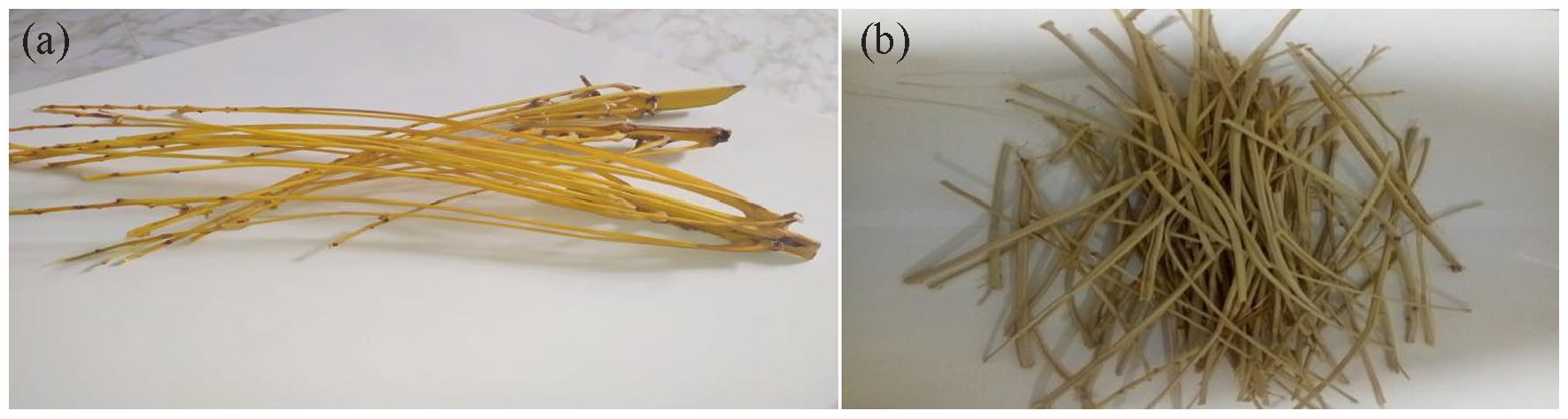
Date palm bunch: (a) bunch harvested and (b) cluster cut to a length of 5 cm before crushing.
Sample preparation
For the preparation of bio-based materials, two different sets of samples were developed:
The first series consist of five samples with the same weight, composed of Portland cement noted PC, BM1, BM3, BM5 corresponding to the addition of the four weight fractions 0%, 1%, 3%, and 5% of DPF, respectively. Each sample is well mixed until homogenous.
The second series consist of four samples with the same weight composed of Portland cement (BPC, BBM1, BBM3, BBM5) mixed with four weight fractions (0%, 1%, 3%, and 5%) of DPF with the addition of progressive water corresponding to the weight of the added fibers. The mixtures are cast in molds of 10 cm × 10 cm × 10 cm. The samples were extracted from the molds after 72 h and allowed to cure for 28 days in the laboratory under ambient conditions.
- The DPF and the first series of samples composed of Portland cement and five bio-based materials were devoted to physicochemical characterization using the FTIR, XRD, and TGA methods.
- The second set of samples was performed to measure the thermal conductivity of Portland cement and bio-based materials composing these samples using the hot wire method.
Figure 2 shows an image of the samples from the second series.

Picture of the samples: BPC, BBM1, BBM3, BBM5.
Results and discussion
SEM analysis
Figure 3 shows the SEM images recorded on date palm bunch sample for a transverse direction of the fibers. The SEM micrograph (Figure 3(a) and (b)) of the raw fiber shows that the surface contains man-made impurities (sand and dust) and some components (residual lignin). Figure 3(a) shows that the date palm fiber is cylindrical and irregular in shape with numerous filaments allowing adhesion between the fiber and the polymer matrix. These same observations are also reported in the literature, on the petiole fibers 16 and the fibers of the mesh surrounding the stem of the date palm. 26

SEM images of: (a and b) DPF, (c) PC, and (d) BM5.
Figure 3(c) and (d) shows the SEM images of the pure Portland cement (Figure 3(c)) and the BM5 sample which consists of the Portland cement and 5% date palm fibers. The comparison shows the appearance of pores after the addition of fibers. Thus, the addition of natural fibers in the matrix generates porosity and the presence of air. The same result on the influence of the addition of natural fibers on the porosity was reported by Haddadi et al. 23
FTIR analysis
The aim of the FTIR analysis was to know the chemical composition of the natural fibers used in this study. Figure 4. shows the FTIR spectrum recorded on DPF. The recorded spectrum indicates an absorption band located at 3322 cm-1 attributed to a valence vibration of the hydroxyl group O-H in cellulose. 27 Valence vibrations of the C-H group corresponding to CH and CH2 bond (cellulose-hemicellulose) appear at 2845 and 2921 cm-1. 27 The carbonyl bond at 1731 cm-1 corresponds to the valence vibration of the C=O bond (ester and carboxylic acid groups of hemicellulose). 28 The absorption bonds located at 1453 and 1372 cm-1 correspond respectively to the vibration of deformation of the C-H bond in lignin 28 and to the vibration of deformation of the C-H bond in cellulose and hemicellulose. 29 The valence vibration of the C-O bond in cellulose and hemicellulose is located at 1032 cm-1.29,30 The three absorption bands located at 1509, 1325, and 1241 cm-1 correspond respectively to the components of lignin (C=C aromatic skeleton), 28 the vibration of deformation of the OH bond of the CH2 bond 30 and to the CH band of hemicellulose. 31

FT-IR spectra of date palm fiber.
The asymmetric vibration of the C-O-C bridge of β-glucose is located at 1157 cm-1.29,30 and the bond (C-O-C) of β-glucose is located at 897 cm-1.29,30
The bond located at 1600 cm-1 corresponds to the deformation of the OH groups of the adsorbed water.27,29 The date palm fiber compounds according to the FTIR analysis are: cellulose, hemicellulose, and lignin.
Figure 5 Shows the recorded FTIR spectra on PC and on a mixture of PC and DPF samples. The interpretation of the Portland cement (PC) FTIR spectrum provides the following information:

FTIR spectra recorded on: (a) PC, (b) BM1, (c) BM3, and (d) BM5.
The spectral data of the sample reveal an absorption band around 909 cm-1 corresponding to the valence vibration modes of the Si-O bond of the C2S and C3S siliceous phases. 32
The bands located at 1462, 879, and 750 cm-1 are attributed respectively to ν3, ν2, and ν4 CO3–2.33,34 These absorption bands indicate the presence of calcium carbonate (CaCO3), which is certainly due to a slight carbonation of the clinker. In addition, the bands at 1098 and 658 cm-1 correspond to the extension of the S-O band of the sulfates (SO42-), characteristic of the presence of gypsum (CaSO4). Indeed, a characteristic water band appears at 1645 cm-1. 35
The comparison of the FTIR spectra of the different samples shows that the O-H bond located between 2900 and 3700 cm-1 became larger and more pronounced with increasing fiber content. This is probably due to the hydroxyl groups of the fibers. The FTIR spectra have shown that there is good adhesion between the mineral matrix and the fiber.
X-ray diffraction (XRD) analysis
Figure 6 presents the XRD diagram of the DPF which shows a principal peak at 2θ = 21.5° corresponding to the crystallographic plane (002) of cellulose I. 36
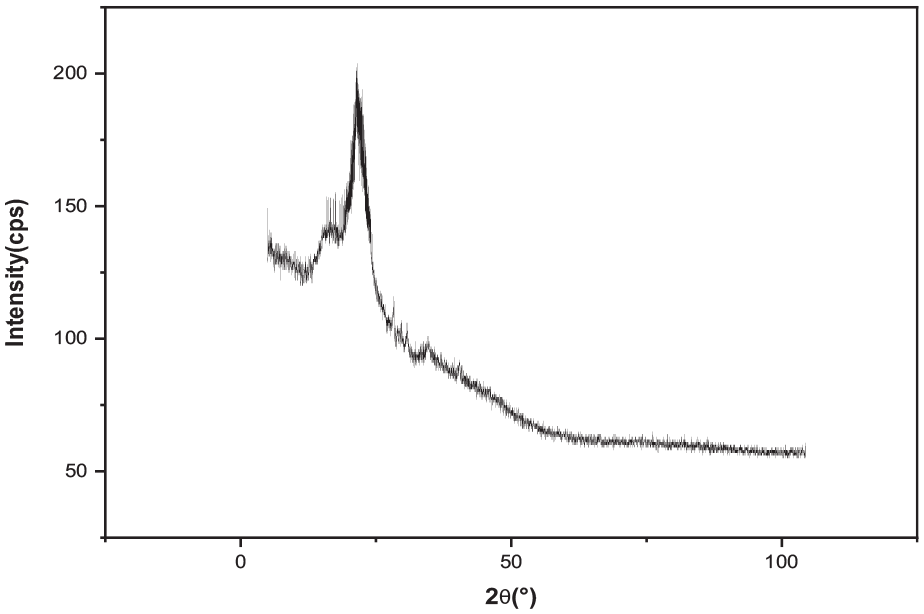
XRD patterns of date palm fiber (DPF).
Other peaks are at about 2θ = 16.24 ± 0.01° and 34.42 ± 0.01° correspond, respectively, to the crystallographic planes (10-1) and (040) of the native cellulose (cellulose I). 36
The XRD diagrams of PC and mixture PC and DPF are illustrated in Figure 7.

X-ray diffraction analysis (XRD): (a) PC, (b) BM1, (c) BM3, and (d) BM5.
The X-ray analyzes show that the PC sample (Figure 7(a)) consists mainly of four different mineral phases: Alite C3S, Belite C2S, Celite C3A, and Ferrite C4AF. 37 These mineral phases are defined in Table 2 for biobased materials. Concerning BM1 (Figure 7(b)), BM3 (Figure 7(c)), and BM5 (Figure 7(d)) samples, we notice the same mineral phases. The XRD diagram of the BM5 sample shows an additional peak to those of the PC at 2θ = 22°, corresponding to the crystallographic plane (002) of cellulose I. 29
The mineral phases of Portland cement.

The cellulose peak did not appear in samples BM1 and BM3 due to the low percentage of fibers. XRD analysis shows that the fibers have been incorporated into Portland cement.
The XRD results obtained show that there is no change in the mineralogical composition of Portland cement after the addition of fibers. Thus, the addition of date palm fibers does not affect the crystal form of the matrix.
Thermo gravimetric analysis (TGA)
The thermogravimetric analysis was carried out in order to study the loss of weight introduced by high level of temperature on the chemical composition of the studied fibers. The results of the TGA are presented in Figure 8. The TGA curve of the DPF shows that they degrade in two stages. The first stage from 40°C to 120°C, which is due to the evaporation of humidity, the second from 180°C to 320°C, which is linked to the degradation of hemicellulose. 22 The results of the TGA analysis show that the date palm fibers begin to decompose at around 180 ± 1°C. The TGA curves in Figure 8 show a loss in weight of the PC, BM1, BM3, and BM5 samples with the increase of temperature corresponding to the evaporation of free water. By comparing the different curves, a significant difference in weight loss is observed in the samples: BM1, BM3, and BM5 from 180°C to 320°C which is due to the degradation of the hemicellulose of the added fiber. 22 From 23°C to 50°C, a difference of 0.5 ± 0.01% in weight loss is observed in the samples BM1 and BM3, on the other hand this difference is almost zero for the sample BM5. From the obtained results, we may conclude that BM5 sample is useful for a wall covering applications.
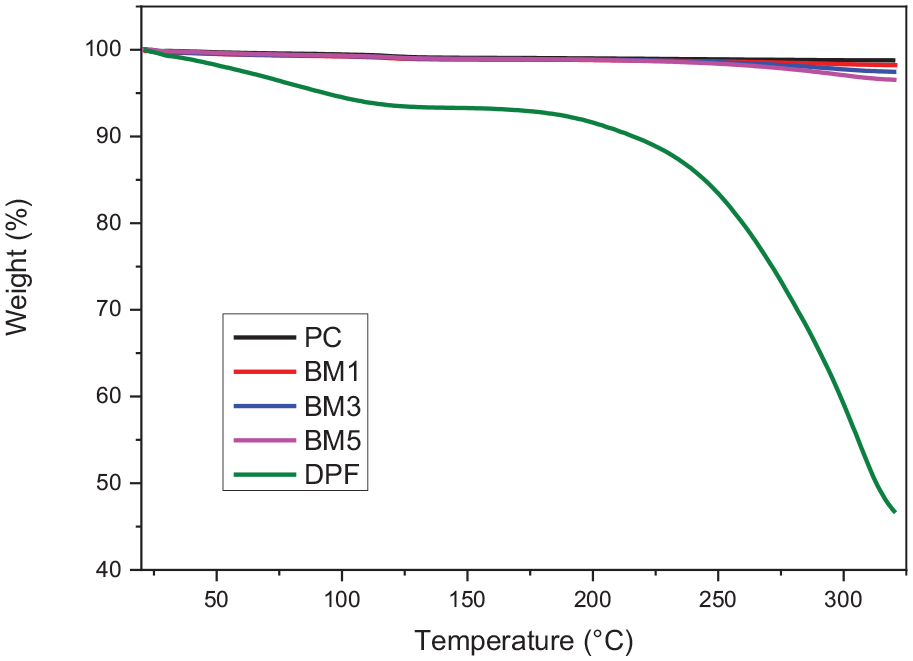
TGA graphs of PC, BM1, BM3, BM5, and DPF.
According to the TGA analysis, the processing temperature of Portland cement based on date palm fibers must therefore be less than 50 ± 1°C.
The difference in mass loss between the sample of pure Portland cement and the samples reinforced with date palm fibers shows that the thermal characteristics of the matrix are affected by the addition of fibers.
Thermal characterization
Figure 9 represents the evolution of thermal conductivity as a function of the fiber content in the prepared materials. It is observed in this graph that the addition of DPF in the cement matrix reduces the thermal conductivity of Portland cement despite the low percentages of weight added. This reduction is due to the low thermal conductivity of the palm fibers compared to that of the matrix

Thermal conductivity as a function of the concentration of the fibers.
For a weight concentration of 1% the thermal conductivity has already decreased but the decrease is not really significant, on the other hand, the value of the thermal conductivity decreases by more than half of initial value after adding a weight concentration of 3%. The results obtained show that the effect of the fibers concentration on the thermal properties is significant. The evolution of thermal conductivity in Figure 9. showed that the decrease in thermal conductivity is 73.4 ± 0.1% for a fiber content of 5%. This decrease is directly linked to the insulating nature of the date palm fibers. Similar behavior has been reported by Benmansour et al., 10 they studied the impact of adding date palm fibers to the mortar (cement + sand). Their results for a fiber weight percentage of 5% show a reduction in thermal conductivity of about 52.5%. The BBM5 sample has the best insulating power with a thermal conductivity of 0.24 ± 0.001 Wm-1.K−1. In fact, from the obtained results in this work, we can clearly confirm that the addition of natural date palm fibers significantly improves the thermal insulation characteristics of composites.
Conclusion
The objective of the present study was to explore the potential of date palm fiber as a reinforcement to improve the thermal characteristics while maintaining the chemical properties of the matrix. Incorporating date palm fibers into Portland cement retained the chemical properties. Moreover, the results of the experimental tests of the Portland cement/date palm biocomposite showed improved properties compared to the composite without reinforcement.
The following conclusions can be drawn from this investigation:
The results of the chemical analyzes revealed that there is a good matrix-fiber adhesion and that after the addition of date palm fibers in the Portland cement, there was no influence on the level of the chemical characteristics and that the new materials are chemically stable. Thus, the addition of natural fibers does not affect the microstructure of the matrix. The thermal stability was shown by the TGA results with an acceptable mass drop after integration of the date palm fiber. On the other hand, SEM images showed that the incorporation of date palm fibers leads to the formation of pores and voids, which improves the thermal behavior of the composites.
The thermal conductivity results show that the addition of date palm fibers significantly reduces the thermal conductivity of the material and that the material prepared with 5% addition of date palm fiber is the best candidate for its high thermal insulation capacity. Similarly, the incorporation of date palm fiber in Portland cement leads to a marked improvement in thermal properties.
The biobased composites developed in this study have an interesting thermal conductivity with sufficient chemical properties to be used as wall coverings and considered as an inexpensive insulation material.
Footnotes
Funding
The author(s) received no financial support for the research, authorship, and/or publication of this article.
Declaration of conflicting interests
The author(s) declared no potential conflicts of interest with respect to the research, authorship, and/or publication of this article.
