






Abstract
In this study, electrically conductive polypropylene (PP) and jute nonwoven fabrics were synthesized by a chemical oxidative polymerization process using pyrrole as a monomer and iron chloride hexahydrate as an oxidant. After fabric production, electrical, morphological, and electromagnetic properties were determined. The deposition of polypyrrole (PPy) on nonwoven fabrics was confirmed by scanning electron microscopy (SEM) analysis. Electrical properties were evaluated as surface resistivity using two probe flat plate electrode systems. The electromagnetic interference shielding of PPy-coated fabrics (PP and jute nonwovens) and composites was measured as shielding effectiveness (SE) in the frequency range of 100 MHz to 1.5 GHz using the co-axial transmission line method.
Introduction
With the increasing use of electronic products and telecommunication equipment, electromagnetic interference (EMI) has become a major problem, as it not only reduces the lifetime and the efficiency of electronic instruments, but also affects human health. 1 Hence, shielding of humans and devices from electromagnetic fields is becoming important. To mitigate the impact of EMI, shielding materials have been widely investigated. Typically, metals have been used for EMI shielding materials, as they have high conductivity and dielectric constants.
Textiles can also provide protective clothing for humans exposed to high frequency electromagnetic fields, to fulfill safety requirements for minimizing non-ionizing radiation exposure. To obtain shielding textiles, metalizing fabrics— using metal fibers, filaments or conductive yarns woven into fabrics—is an approach suitable for industrial scale processes.2,3 However, metals have disadvantages, such as their weight, corrosion properties, and poor processibility. 4 Another approach is to incorporate conducting fillers, in the form of fibers injected into synthetic fabric during the molding stage. As the fibers are closely spaced, continuous conductive paths can be easily established.5,6
An alternative method is to coat natural and synthetic fabrics with intrinsically conducting polymers (ICPs), such as polypyrrole (PPy) and polyaniline.7–9 In general, conjugated polymer layers can be synthesized onto textile substrates, using an oxidative chemical polymerization process, by immersing the fabric in a solution containing monomers, an oxidant, and a doping agent. However, it was observed that PPy-coated conducting fabric had an ageing problem.10,11
In the present work, jute and PP nonwoven fabrics were coated with PPy using a chemical oxidative polymerization process. Comparisons of morphological, electrical, and electromagnetic properties of conducting jute and PP fabrics were made. To overcome problems related to ageing, conducting fabric composites were prepared. The electromagnetic properties of these materials were also studied.
Electromagnetic Shielding Definitions
EMI shielding effectiveness (SE) is described as the attenuation of an electromagnetic wave produced by its passage through a shield. It is measured as the ratio of field strength that is incident on the barrier to the magnitude of the field strength that is transmitted through the barrier and expressed in (dB), calculated according to Eq. 1.

P1 and P2 are received power with and without the material present respectively. SE can also be represented as the sum of reflection loss, absorption loss, and multiple reflections in Eq. 2.

RdB is the reflection, AdB is the absorption loss of the wave as it moves through the barrier, and MdB is the effect of multiple reflections and transmissions. Methods used to measure EMI SE are the open field or free space method, the shielded box method, the shielded room method, and the coaxial transmission line method. Of all methods mentioned above, the coaxial transmission line method is now the preferred one. The major advantage of this technique is that results obtained in different laboratories are comparable. In addition, the coaxial transmission line method can also be used to resolve the data into reflected, absorbed, and transmitted components.12–14
Experimental
Materials
PP (125 g/m2) and jute fabric (236 g/m2) were procured from Terram Geosynthetics and Uniproducts. Pyrrole (99%) monomer was obtained from Merck and was used after double distillation at 85 °C. Iron chloride hexahydrate used as an oxidant was obtained from Loba Chemie, epoxy resin (Lapox-12) and hardener (k-6) for making composites were procured from Atul Polymer. Composites were prepared using a compression molding machine.
Preparation of Conducting Fabric
Polymerization of pyrrole on fabric samples was carried out by an in situ chemical oxidative polymerization process. The 30% pyrrole solution was made by dissolving it in distilled water and then allowing to cool at 4-5 °C. After that, fabric samples were soaked in the solution for 1 h at 4-5 °C. Iron chloride hexahydrate oxidant was separately dissolved in distilled water and added to the soaked fabric solution. The fabric was continuously treated in the jigger machine (maintained at low temperature), with the polymerization reaction completed in 3 h. The molar ratio of pyrrole to oxidant was fixed at 1:2.33 and material-to-liquor ratio (LR) was 1:40. Fabric samples were removed after the completion of treatment, washed with distilled water, dried, and then conditioned under standard atmospheric conditions (27 °C and 65% relative humidity (RH)). 11 PPy- coated fabrics (PP and jute nonwovens) thus obtained were characterized for various properties. A summary of the reaction steps to prepare these treated fabrics are given in Fig. 1.
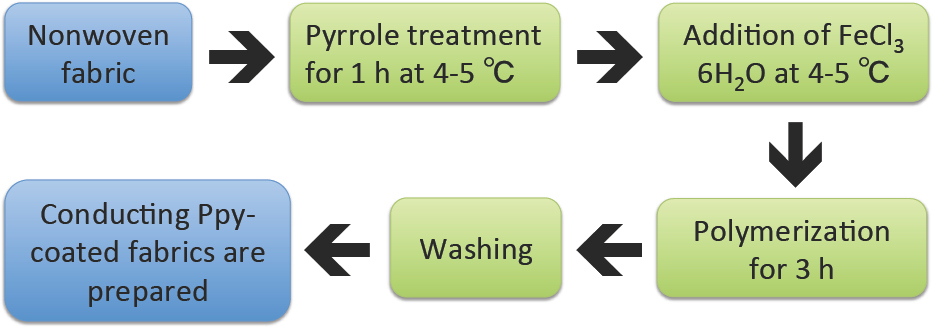
Reaction steps for the preparation of PPy-coated fabrics.
Preparation of Conducting Fabric
Laminate Composite
Conducting fabric laminated composite was fabricated using the compression molding technique. The low temperature curing epoxy resin Lapox-12 and corresponding hardener (k-6) were mixed in a ratio of 10:1 by weight as recommended. Mixing was done thoroughly before the PPy-coated fabrics were reinforced in the matrix body, cured at room temperature for 12 h, and then post-cured at 110 °C for 8 h.
Chacterization
Electrical Conductivity
The electrical conductivity of PPy-coated fabrics were evaluated for surface resistivity (ohm/square) by the two probe method according to AATCC Test Method 76-2005.
Morphology Studies
The morphology of PPy-coated fabrics and composites were studied using a model JEOL-JSM 5400 scanning electron microscope (SEM).
EMI SE
An EMI shielding test was done to measure the SE of PPy-coated fabrics and their composites according to ASTM D4935-99 (at a frequency range of 100 MHz to 1.5 GHz) using a circular coaxial transmission line holder. A network analyzer (with a range of 9 KHZ to 4.5 GHz) from Agilent (Model E 5071C) and an SE test fixture from Electrometric (Model EM-2107A) were used for measuring SE.
Mechanical Properties
Tensile Test
Tensile properties of PPy-coated fabrics were determined according to ASTM D3039 using a cross head speed of 2 mm/min. The measurements were performed using a Tinius Olsen machine (Model H50KL).
Flexural Test
The three-point bending test was also performed on PPy-coated fabrics according to ASTM D790-03 using a Star Universal testing machine with a crosshead speed of 1 mm/min.
Results and Discussion
Electrical Conductivity
The surface resistivity of untreated PP and jute nonwoven fabrics lies in the range of 1012-1014 ohm/square. The surface resistivity was observed to decrease substantially for the treated fabrics: to 120 ohm/square for PPy-coated PP fabric and to 20 ohm/square for PPy-coated jute nonwoven fabric. The decrease in resistivity was due to delocalization of pi electrons in the PPy moiety.
During oxidative polymerization, the polymer chain undergoes partial doping, leading to the formation of charge carrying species (i.e., polaron and bipolaron). The polaron unit is composed of a positive charge and unpaired electron that extends over four pyrrole units and the bipolaron unit extends over four pyrrole units, having two positive charges giving rise to electrical conduction in PPy.15,16
The surface resistivity of PPy-coated PP nonwoven fabric was superior to that for jute nonwoven fabric. This is also confirmed by its morphological analysis.
Morphological Studies
The morphology of the original PP and jute nonwoven fabrics is shown in Figs. 2a and b. The surface was very clean and smooth. Figs. 2c and d show the morphology of PPy-coated fabrics. PPy-coated nonwoven fabrics were less clean and smooth than the original fabrics and show the presence of PPy in form of globular aggregates on the fiber surface. SEM shows that the heavy deposits seen on the surface could be either be due to surface coating or to PPy diffusing into the fibers’ structure. 15 Previous work reported for cotton fabrics 15 shows that PPy diffuses into the fibers as well as deposits on the surface. To check for such diffusion, cross-sectional SEM views of the fibers at higher magnification were used. From Figs. 2e and f, sufficient diffusion was observed in jute fibers, whereas for PP fibers, no diffusion occurred, with only surface adsorption taking place.
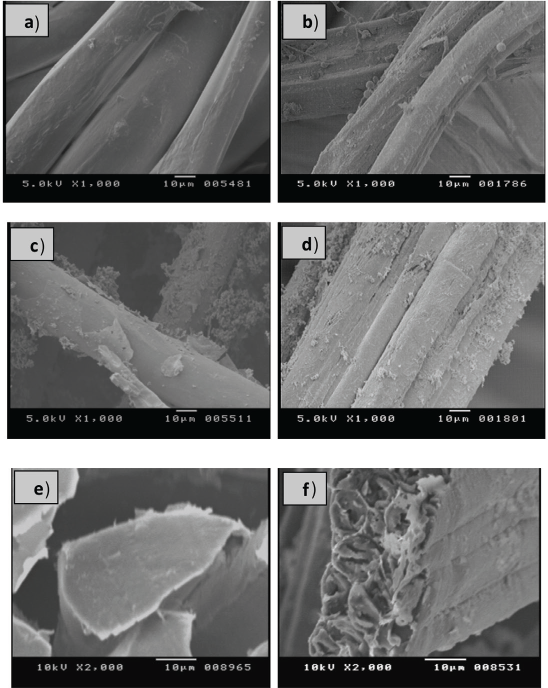
SEM micrographs. a) original PP nonwoven, b) original jute nonwoven, c) PPy-coated PP nonwoven, d) PPy-coated jute nonwoven, e) PPy-coated PP nonwoven, and f) PPy-coated jute nonwoven.
EMI Shielding Properties
Figs. 3a and b depict the average SE value of the PPy-coated fabrics and their composites, in the frequency range of 100 MHz to 1.5 GHz. It was observed that the PPy-coated jute nonwoven fabric EMI SE value (20 dB) was greater as compared to PPy-coated PP nonwoven fabric (14 dB). Electrical conductivity results for PPy-coated fabrics also supported the EMI shielding study. To overcome the problem of atmospheric ageing of PPy-coated fabrics, laminates were prepared and atmospheric degradation was studied in terms of SE values. The ageing characteristics of PPy-coated fabrics and laminates were analyzed from 0 to 21 days of sample storage in ambient atmosphere. From Figs. 3a and b, it was concluded that, with the passage of time, the PPy-coated fabrics tested showed reductions in EMI SE values, whereas, for the PPy-coated fabric composites tested, there were no significant changes in EMI SE values.
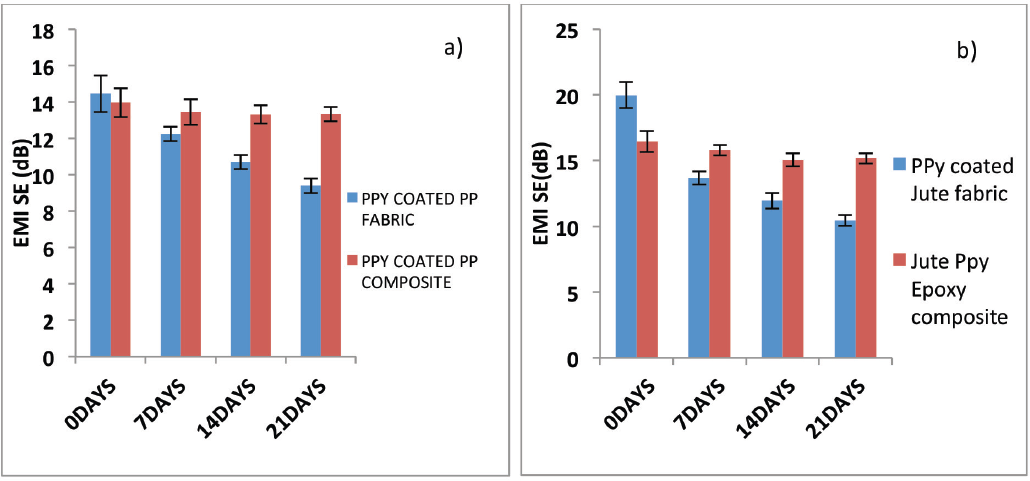
Atmospheric ageing studies of PPy-coated a) PP fabric and its composite, b) jute fabric and its composite.
Composite Mechanical Properties
As the PPy-coated jute fabric composite gave the greatest SE value in this study, the mechanical properties of this composite was studied. Figs. 4a–c show mechanical property results, including tensile strength, tensile modulus, and flexural strength. PPy-coated jute fabric composite showed a decrease in tensile strength and an increase in tensile modulus, although the flexural strength showed no significant change as compared to the non-PPy (uncoated) jute fabric composite.
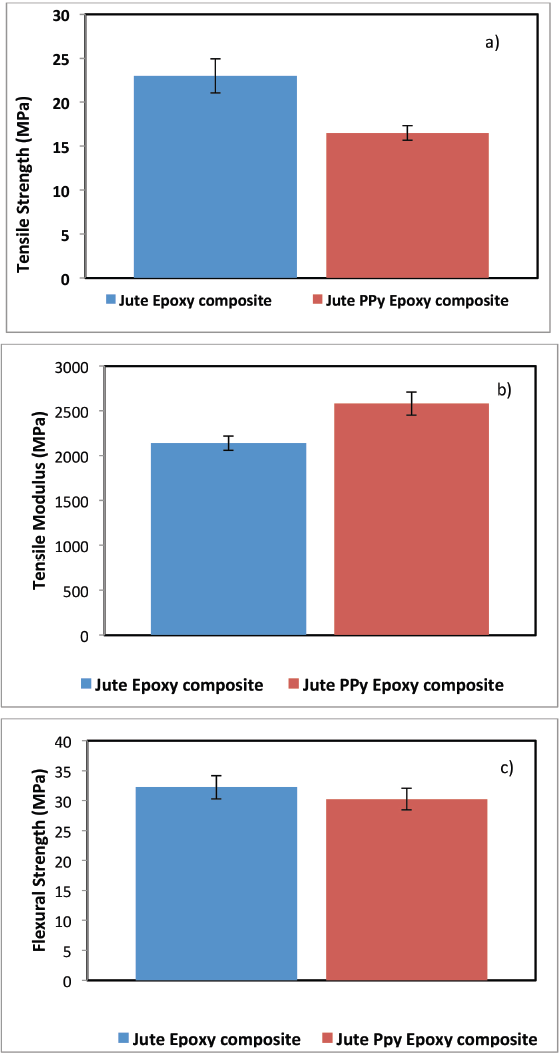
Mechanical properties of jute epoxy composite. a) tensile strength, b) tensile modulus, and c) flexural strength.
Conclusion
In summary, PPy-coated fabrics (PP and jute nonwovens) can be easily synthesized using chemical oxidative polymerization. SEM morphological studies confirmed the coating of PPy on treated PP and jute nonwoven fabrics. The surface resistivity of the original PP and jute nonwoven fabric decreased by a factor of 10 to 102 ohm/square from its initial value after PPy treatment of PP and jute, respectively. Results show that PPy-coated jute nonwoven fabric was more conductive when compared to PPy-treated PP nonwoven fabric. EMI SE values for PPy-coated fabrics were measured using the coaxial transmission line method. The EMI SE value was greater for PPy-coated jute nonwoven fabric than the PPy-coated PP nonwoven fabric. The SE value of PPy-coated jute nonwoven fabric was reduced by making it an epoxy composite. PPy-coated fabrics lost SE value over time due to atmospheric ageing.
For the PPy-coated fabric epoxy composites, no significant SE value loss was observed. Further mechanical studies of PPy-coated jute composites showed no drastic changes as compared to the non-PPy (uncoated) jute composite. Hence, the laminates increased the life span of PPy-coated fabrics, with less change in EMI SE values.