





Abstract
Despite studies indicating the differential use of stitch density with respect to textile apparel, there is little information on the effect of stitch type and stitch density (stitches/cm or spc) on the seam properties of leather clothing. An experimental investigation of the effect of two different types of stitches (i.e., chain stitch and lock stitch with variations in stitch density of 3, 4, 5, and 6 spc) has been reported. Lock stiches performed better than chain stiches with regards to seam strength, seam elongation, and seam efficiency. A stitch density of 5 spc was found to be optimal for sewing leathers. Further increases in stitch density damaged the fabric by cutting and weakening the fabrics.
Introduction
Seam quality is an important parameter affecting garment performance. 1 A stitch consists of one or more strands or loops of threads. It is formed by threads, which are passed through the material by hand or machine. A stitch can be formed within the material though, or on the material. 2 Stitch type and stitch density influence the quality of garment seams. 3 A seam is an assembly of regularly recurring stitches. A literature survey reveals that chain stitches are less widely used than lock stitches. 4
It is generally agreed that the seam strength, efficiency, and elongation increase as stitch density increases. However, in the present study, this was found not to be the case. In this paper, an attempt was made to study the relative performance of the two types of stitching, with the variation of stitch density, to judge the suitability of the sewn leather product.
Materials
Leather
Commercially-available sheep nappa garment leathers with a thickness of 0.6 ± 0.05 mm were procured with an average size of 4 ± 0.5 sq. f. Leather, being a natural material, has strength that varies in parallel and perpendicular directions to the backbone. Hence, specimens were cut in two directions parallel and perpendicular to the backbone, especially in the butt regions.5,6
Sewing Tread
Coats core spun thread (polyester and cotton fiber, ticket number-50, thread strength-29.3 N, extension at break-17.3%, and diameter-0.23 mm) was chosen for the study.
Sewing Machine
Lock Stitch Machine
A Pfaff single needle lock stitch sewing machine (Model No. 1245) was used to produce the lock stitches. The machine was run at a speed of 2800 rpm for varying stitch densities of 3, 4, 5, and 6 stitches per cm (spc). Seams produced by this type of machine lie fat and are less bulky than other types.
Chain Stitch Machine
Chain stitches were made using a Singer machine (Model No. 791D200AW). The machine was run at a speed of 2850 rpm with varying stitch densities of 3, 4, 5, and 6 spc.
Methods and Measurements
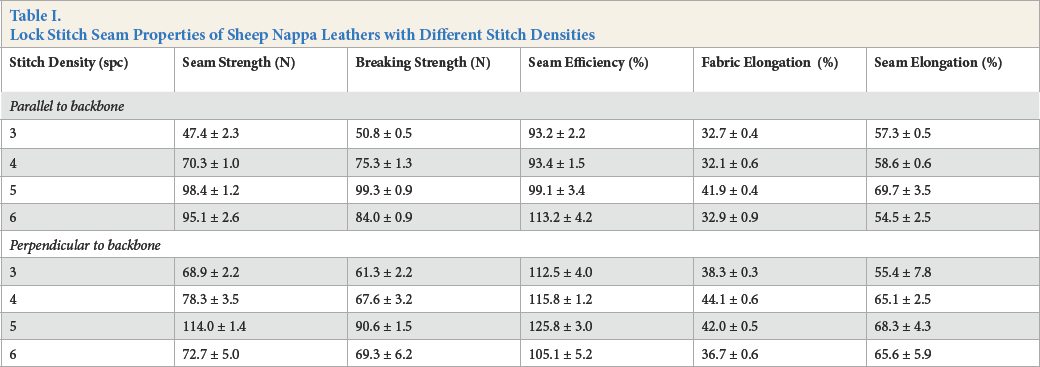
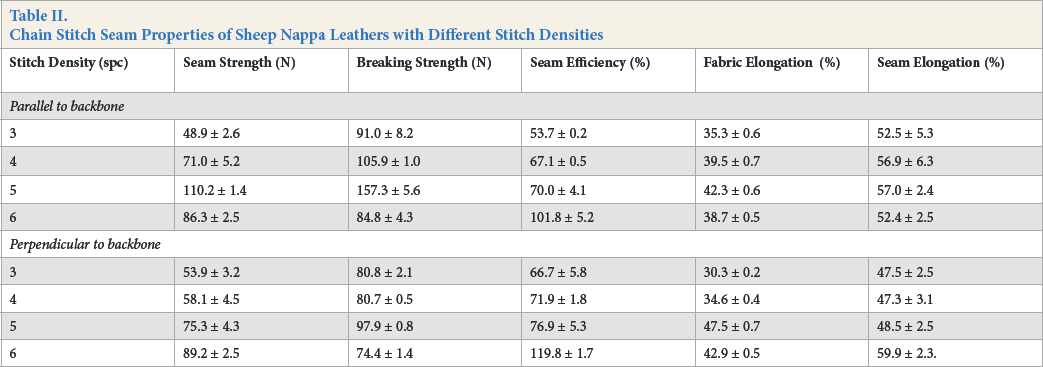
Rectangular test specimens (100 × 50 mm) were cut from the leather in both parallel and perpendicular directions to the backbone. Two different stitches (a plain lock stitch seam and a chain stitch seam) were made, each at the center of a single rectangular specimen, with varying stitch densities. Seam strength was measured as per test method (TM) ISO 17697. 7 Breaking strength and percentage elongation was evaluated as per SATRA TM 29. 8 All samples were conditioned for 48 h and tests were conducted using an Instron universal tester (Model 4501) under standard experimental conditions. Five samples were prepared for each stitch density to ensure consistency in sample production. Tests were performed at a machine speed of 100 mm/min for seam strength and breaking strength. Seam properties of sheep nappa garment leathers were measured and the results presented in Tables I and II.
Lock Stitch Seam Properties of Sheep Nappa Leathers with Different Stitch Densities
Chain Stitch Seam Properties of Sheep Nappa Leathers with Different Stitch Densities
Results and Discussion
Changes in seam properties with changes in stitch density for different types of stitches are reflected in Figs. 1a–3b.
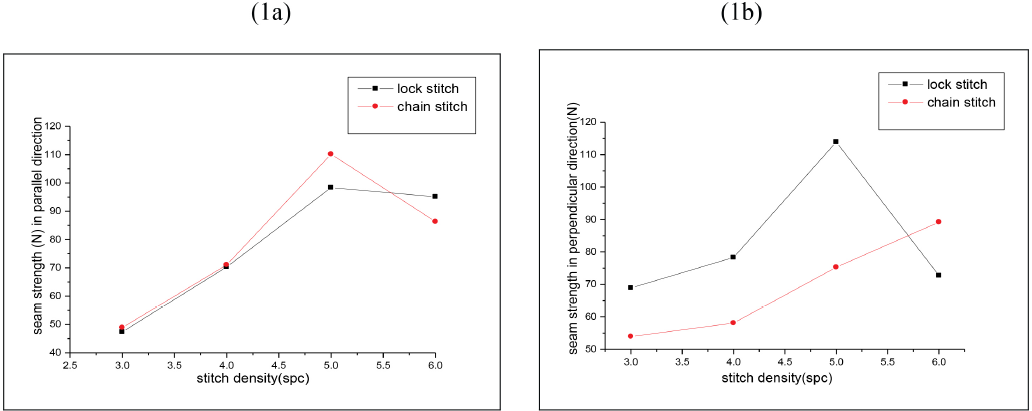
Effect of stitch density on seam strength of sheep nappa leathers a) in parallel direction and b) in perpendicular direction.
The stitch type determines the potential amount of thread in the seam, independent of stitch density and the thread tension. Under standard sewing conditions (machine speed of 1400 rpm), a lock stitch provided thread consumption of 2.08 m and a chain stitch provided a thread consumption of 4.80 m for a 1 m seam. If an inappropriate stitch was selected, there would not be enough thread—even a slight strain would cause the seams to break. Treads used in lock stitch seams are more susceptible to shearing each other than chain stitch seams because of the way the threads are interlocked, rather than interlooped, together. Seams with less spc were reported to be sewn faster than those with more spc. 1
Seam Strength
Seam strength is the load required to break a seam when it is stressed under experimental conditions. Measurement of seam strength is an essential part of garment quality control. The material is tested for the point at which seam breakage occurs.
The effect of stitch density on the seam strength of leathers was very significant. With increased stitch density, the seam strength gradually increased and then subsequently decreased (Figs. 1a–b). Seams with 5 spc were the strongest in nearly both directions. For the lock stitch, the increase in seam strength (parallel) was less for a stitch density of 5 spc, compared to that of a chain stitch. The lock stitch exhibited a significantly greater seam strength than the chain stitch, particularly for the seam stitched with a stitch density of 5 spc. The difference was large and, thereafter, it sharply declined.
When stitch density was increased (i.e., from 3 spc to 5 spc):
The modular length between two stitches decreased, leading to greater values of seam strength
The thread consumption increased and the rate of seam strength increased as the thread quantity shared the load
The gripping of the two specimens increased and hence, seam strength increased
With an increased number of spc, the strength of the seam increased, because of the increased number of threads, which provided greater resistance to mechanical stress
As the spc increased, due to less sewing thread per stitch and the compact structure of the seam, seam grinning decreased leading to enhanced seam strength
On further increase of stitch density from 5 spc to 6 spc, the seam strength decreased because:
The needle punching frequency per unit length of fabric increased
The sewing thread tension increased resulting in uneven distribution of tension on the thread. As a result, the sewing thread on certain parts of the stitched fabric bore extra tension. When an external force was applied to the stitched samples, the stitches that bore the most loads broke first, thereby reducing the seam strength
Too many stitches damaged the fabric/leather by cutting the fibers enough to weaken it
Excessive spc also contributed to seam puckering—wavy seams, thereby reduced the strength and speed through the machine and resulted in production loss
Furthermore, a greater number of spc required long sewing cycles to complete the seam. Long sewing cycles translates into high labor costs and lower production levels. Therefore, it is clear that, when the stitch density is increased, the thread consumption would be greater, providing a better gripping of two specimens, leading to a high seam strength. However, this cannot compensate for the seam strength reduction. The seam strength decreased when the stitch density increased in both directions for chain and lock stitches.
Seam Elongation
Elongation is the measure of fabric's ability to be stretched during fabrication. 9 It is also the ratio of the extension of material prior to stretching and after stretching expressed as percentage.
It was observed (Fig. 2a) that seam elongation increased with an increase in the stitch density of the thread and then decreased. The lock stitched fabric showed greater percent elongation at break than the chain stitched fabric at all levels of stitch density. There was a very sharp rise in percent elongation from 4 to 5 spc in a lock stitch fabric, whereas a very marginal rise was observed for the chain stitch fabric. In the perpendicular direction (Fig. 2b), the chain stitch fabric registered an increase throughout. Furthermore, when the stitch density was increased, thread consumption and extension were greater. 10
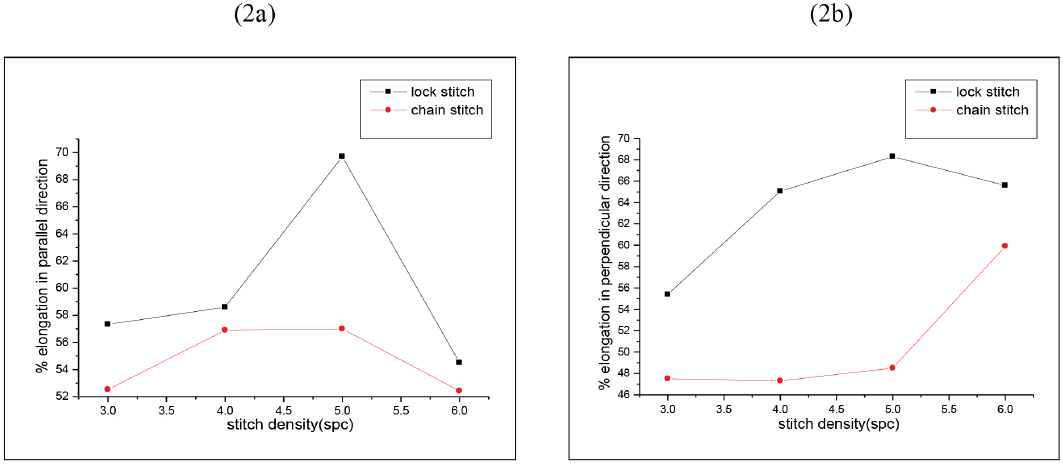
Effect of stitch density on seam elongation of sheep nappa leathers a) in parallel direction and b) in perpendicular direction.
When the stitch density increased:
The thread consumption increased and the extensibility rate of a lock stitch increased.
The elongation became greater at higher breaking loads for seams stitched with high stitch densities
The breaking point of stitch extensibility in both directions increased, and then subsequently decreased, due to the structure and properties of stitches.
The present study tested elongation for seams and fabric. It ranged between 30% to 47% for the fabric and 47% to 68% for seams. Obviously, the elongation for seams was greater than for the fabric elongation. The data revealed that seams with 5 spc had the greatest elongation in both directions for the two types of stitches.
Seam Efficiency
Seam efficiency is a function of compatibility between fabric, sewing thread, needle, tension, seam type, and stitch density. It is important that the seam of the garment is at least as strong as the fabric or better. 11 Therefore, seam efficiency testing is useful.
Seam efficiency in sewn fabrics is the ratio of seam strength to fabric strength. For interpretation purpose, if the percentage is equal to or greater than 100, the seam is stronger than the fabric. If it is less than 100%, the fabric is stronger than the seam. For lock stitches, the seam efficiency was nearly 100% and even greater in some cases. For chain stitches, the seam efficiency was less than 100%. Seam efficiency differed for four stitch densities. Seam efficiencies of materials with higher stitch densities were greater than those with lower stitch densities.
The seam efficiency of lock stitch fabrics tested were substantially greater than that for chain stitch fabrics (Figs. 3a–b). This shows that the lock stitches were stronger and more durable than the chain stitches.
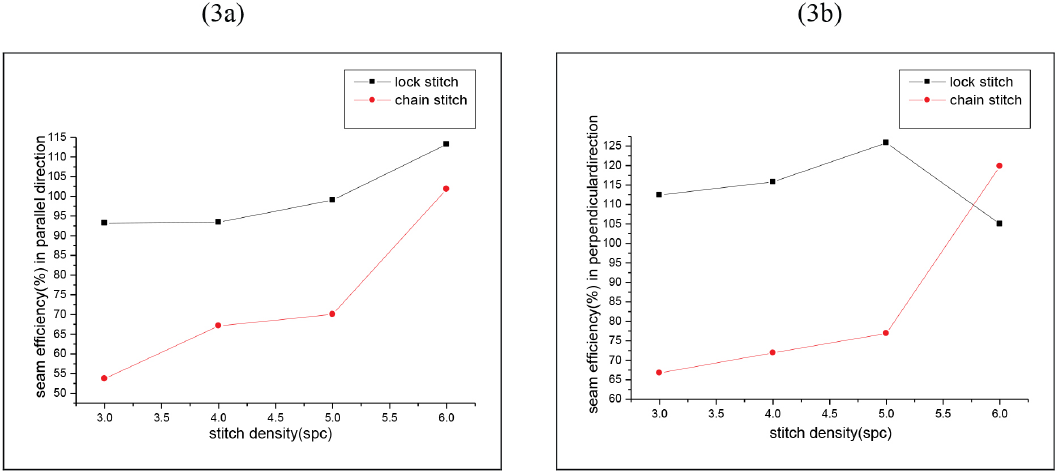
Effect of stitch density on seam efficiency of sheep nappa leathers a) in parallel direction and b) in perpendicular direction.
Optical and Scanning Electron Microscopy (SEM) Studies
The role of hair follicles is important in sheep leathers. Leather hair follicles act as weak points in breaking strength determinations. As stitches are formed, more weak points are created, leading to failure. Sometimes, jamming of hair follicles and stitches might occur leading to the propagation of cracks.
Optical microscopic views for leathers with stitch densities of 3 and 4 spc are shown in Figs. 4 and 5. A tear just away from the stitch line can be seen, which proves that the tear was not influenced by the stitch. This tear might have been due to an inherent material characteristic (i.e., the material itself was weak). SEM studies revealed that the damage was concentrated at the penetration point of the needle used for stitching (Fig. 6 and 7). Fibers in contact with the needle at the penetration point were broken or damaged. In other words, the breakage seemed to be at the stitch hole. Further analysis of the area near the stitch revealed that, with a stitch density of 4 spc, the material was strained to a certain extent, leading to the propagation of minor cracks on the surface (Fig. 8). Also, the number of striations on the surface was greater when compared to fabric containing 3 spc, as shown in Fig. 9.
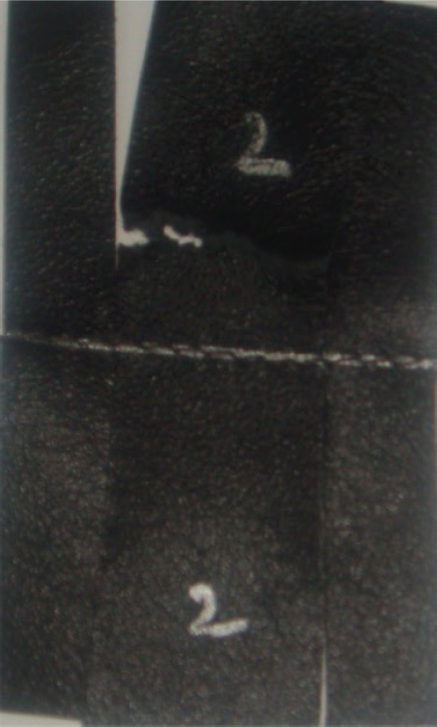
Optical microscopic view of sheep nappa leather specimen with a stitch density of 3 spc.
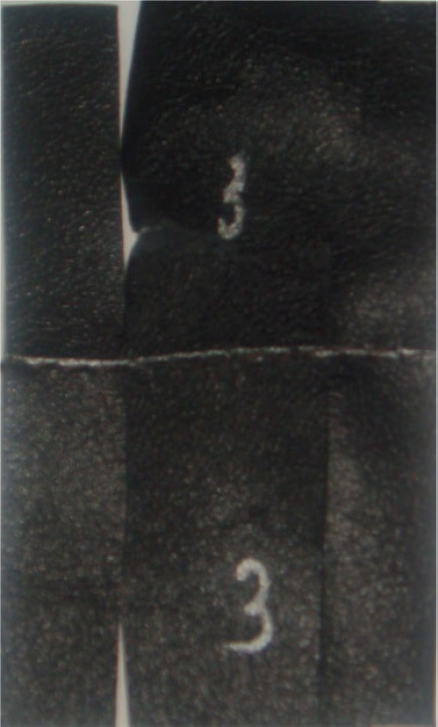
Optical microscopic view of sheep nappa leather specimen with a stitch density of 4 spc.
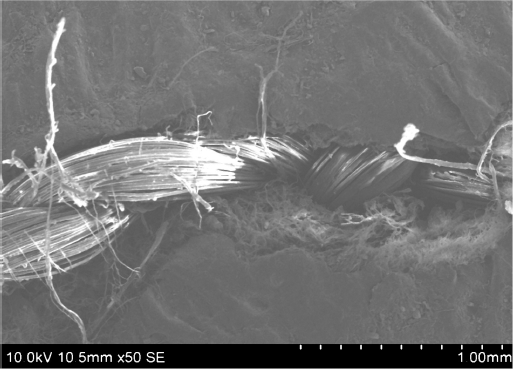
SEM of sheep nappa leather stitched with a stitch density of 3 spc.
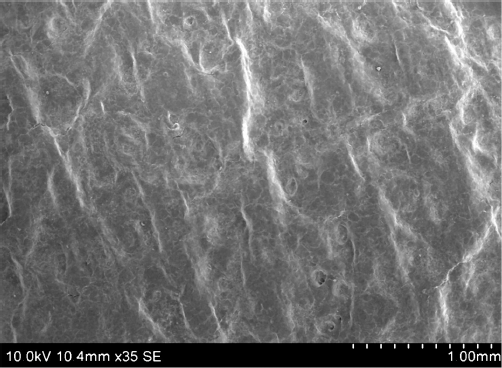
SEM of the surface of sheep nappa leather close to the stitch line stitched with 3 spc.
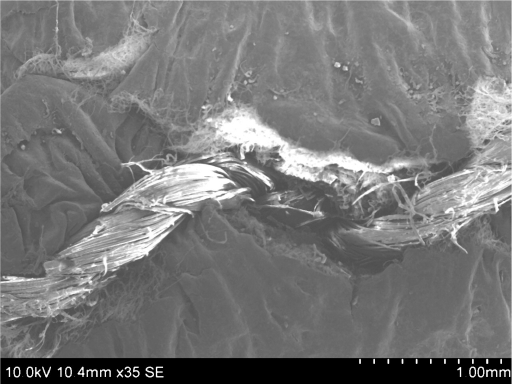
SEM of sheep nappa leather stitched with a stitch density of 4 spc.
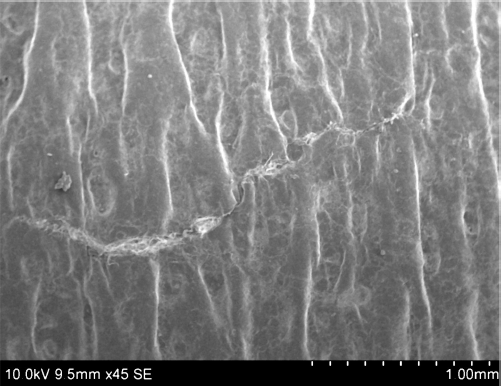
SEM of the surface of sheep nappa leather close to the stitch line stitched with 4 spc.
On increasing the stitch density to 5 spc, the optical microscope revealed that very severe damage had taken place along the stitch line and the area surrounding it (Fig. 10). SEM studies showed that severe rupturing of fiber bundles occurred at different positions along stitch line during sewing (Fig. 11). The material was put under great strain as the stitch density was increased to 5 spc—the number of striations increased considerably on the surface (Fig. 12). Therefore, the resistance to material breakage was greater, leading to greater breaking strength. Stitch holes represented the stress concentration points. As the stress concentration points increased, deeper and wider cracks were propagated.
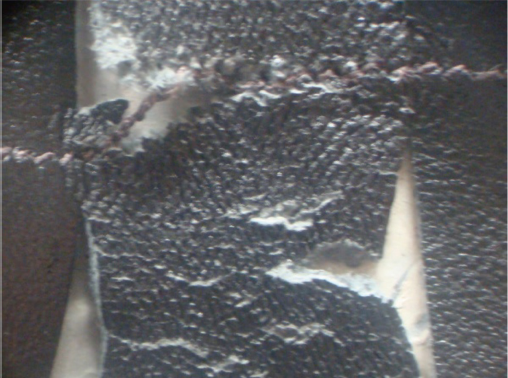
Optical microscopic view of sheep nappa leather specimen with stitch density of 5 spc.
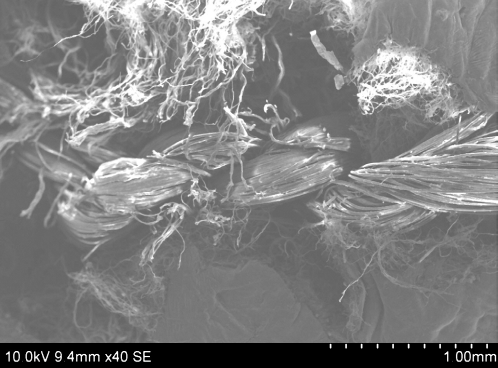
SEM of sheep nappa leather stitched with a stitch density of 5 spc.
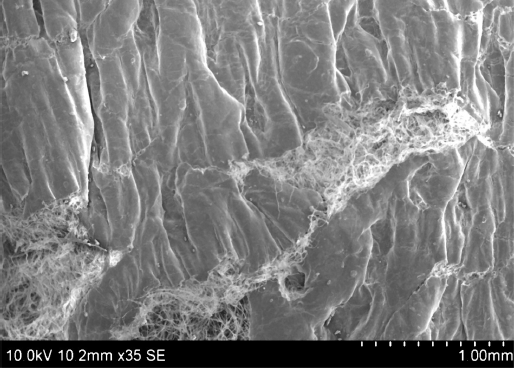
SEM of the surface of sheep nappa leather close to the stitch line stitched with 5 spc.
The optical microscopic view for a stitch density of 6 spc is shown in Fig. 13. The material was damaged and torn apart along the stitch line. The area closer to the stitch did not encounter much damage. SEM studies revealed that fibers along the stitch line were severely damaged (Fig. 14). But propagation of cracks was less dominant and were superficial in the 5 spc fabric (Fig. 15). The greater number of holes/cm weakened the 6 spc material to a greater extent— the resistance to material break was less, thereby leading to a decrease in strength compared to that of 5 spc. It was concluded that a stitch density of 5 spc was the optimal value of seam strength for stitching leather apparel.
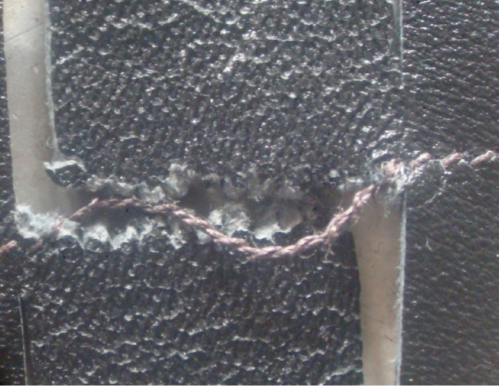
Optical microscopic view of sheep nappa leather specimen with a stitch density of 6 spc at the center.
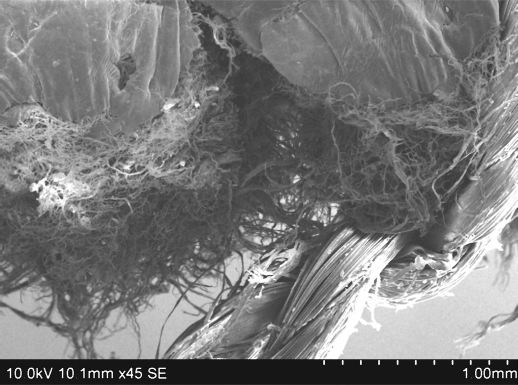
SEM of sheep nappa leather stitched with a stitch density of 5 spc.
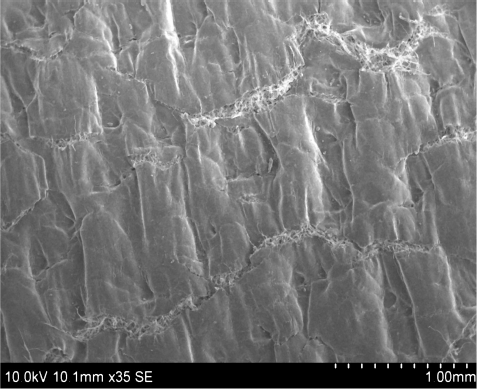
SEM of the surface of sheep nappa leather close to the stitch line stitched with 5 spc.
In all the above cases, breakage was noticed only with leather and not the thread. The probable reason for no thread breakage in this study was likely the high strength of the core spun thread.
Conclusion
The present study revealed that leather fabric seams with 5 spc have the greatest seam strength and elongation. However when the stitch density was further increased, a decrease in the strength and elongation was observed. Appropriate stitch length is an important consideration for preventing seam puckering. The tensile properties of seams were greatly affected by the type of stitches. Lock stitches performed much better with regards to leather seam strength, elongation, and seam efficiency when compared to chain stitches.