






Abstract
Softeners are widely applied textile treatments that affect many textile properties. Color change is an important side effect of textile treatment to consider. This paper evaluates the effect of commercially-available silicone softener particle size on color assessment of knitted cotton fabrics after treatment and repeated laundering using instrumental analyses. The results were also statistically evaluated, showing that silicone softener particle size had a significant effect on color difference after treatment; the larger the softener particle size, the greater the color difference and the darker the appearance. However, the contribution of particle size was insignificant after repeated laundering and ironing.
Introduction
Softeners are used in home laundering and in textile wet processing to improve fabric hand, drape, and various mechanical properties. Silicone softeners are known to render additional performance properties to cotton fabrics, such as improved wrinkle recovery and crease resistance.1–3 Thus, the use of silicone softeners has grown rapidly in the textile industry.
When considering textile fabric treatment, it is important to understand the long-term effects of treatments and, in addition, any possible side effects. Fabric hand certainly plays an important role, along with appearance. Time and temperature dependent tendencies for changes in shade or color, as well as yellowing, are to be avoided.4,5 Changes in color or shade of treated fabrics were attributed to finishing chemical structures, the deposition process around the fiber, the finishing agent acting as a solvent with the dyes, and the particle size.6–8
In this study, the effect of silicone softener particle size on the color assessment of dyed cotton fabrics was examined. For this purpose, three commercially-available silicone softeners differing in particle size were used. Cotton fabrics were impregnated with these softeners in separate baths. Color differences were instrumentally measured and evaluated after application, repeated launderings, and ironing. The contribution of softener particle size was assessed using a completely randomized two-way analysis of variance (ANOVA). The results were evaluated at a 5% significance level.
Experimental
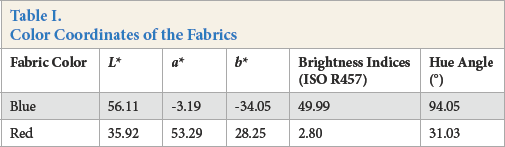
100% cotton single jersey fabric (25 x 10 course/wale, 110 g/ m2) was used in this study. The fabric was scoured, bleached, and dyed with reactive blue and red by the supplier (Fıstık Tekstil). The color coordinates of the fabrics according to D65/10° illuminant are given in Table I.
Color Coordinates of the Fabrics
The commercially available silicone softeners, Silicones 1-3 (all were non-ionic, amino-functional polysiloxanes and had a density of 110 g/cm3 at 20°C with a pH value of 4- 4.5 at 10% concentration), were purchased from CHT Tekstil. The dyed fabrics were then treated with softeners in an uncontrolled laboratory environment by a laboratory type padder. Finishing conditions were as follows: 30 g/L softener, 1:20 bath ratio, 85% pickup, and drying at 120 °C for 5 min.
For color assessments, the color coordinates of samples were measured on a Hunterlab reflectance spectrophotometer (Colorquest II) under D65/10° illuminant with D/0 instrument geometry. Four reflectance measurements were made on each sample, rotating the samples 90° before each measurement. Averages of the percent reflectance values at wavelengths between 400 and 700 nm were recorded. Color coordinates and differences according to the CIELAB (1976) equation were then obtained according to the method and terminology defined in CIE 15.2 as mentioned in AATCC Test Method (TM) 173, Calculation of Small Color Differences for Acceptability, and reported as Δ
Softener particle size measurements were performed with a Brookhaven Instruments 90Plus (Holtsville) using a dynamic light scattering technique based on passing a beam of light through a colloidal dispersion. When this happens, the particles or droplets scatter some of the light in all directions. If the particles are very small compared with the light's wavelength, the scattered light intensity is uniform in all directions (Rayleigh scattering); for larger particles (greater than 250 nm in diameter), the intensity is angle dependent (Mie scattering). If the light is coherent and monochromatic, as from a laser for example, it is possible to observe time-dependent fluctuations in the scattered intensity using a suitable detector, such as a photomultiplier capable of operating in photon counting mode. These fluctuations arise because the particles are small enough to undergo random thermal (Brownian) motion and the distance between them is therefore constantly varying. Constructive and destructive interference of light scattered by neighboring particles within the illuminated zone gives rise to the intensity fluctuation at the detector plane, which, as it arises from particle motion, contains information about this motion. Analysis of the intensity fluctuation time dependence can therefore yield the diffusion coefficient of the particles. By knowing the diffusion coefficient of the particles and the viscosity of the medium, the hydrodynamic radius or diameter of the particles can be calculated via the Stokes–Einstein equation. 9
To determine the silicone softener particle size, an emulsion was prepared by diluting the softener in distilled water in a ratio of 1:10. The polyacrylic measuring cell of the Brookhaven 90Plus was filled with ∼4 mL of the emulsion. The cell was located in the measuring cuvette of the instrument without shaking or mixing for good laser beam passage. The instrument applied a dynamic light scattering technique;10,11 the duration of each measurement was ∼5 min and measurements were repeated three times for each emulsion. The wavelength of the laser light was 670 nm. Size distributions were determined at 90° of the laser beam scattering angle and measurements were carried out at 25 °C.
Costat was used to assess the contribution of softener particle size on the color assessment (Δ
Results and Discussions
Particle Size
Figs. 1a–c show the multimodal size distribution of softeners. Their effective diameter (
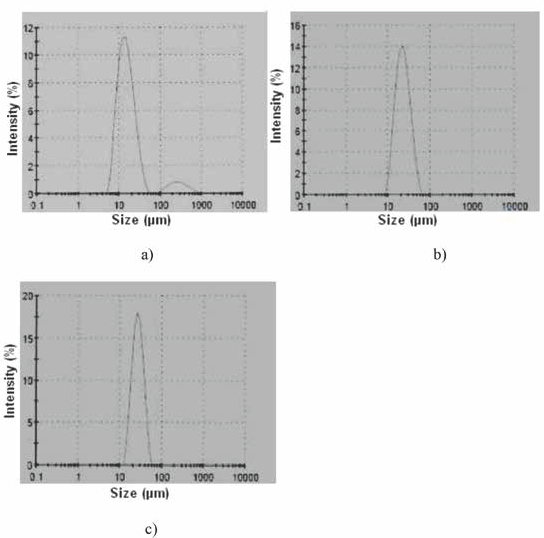
Multimodal size distribution of a) Silicone 1, b) Silicone
Effective Diameter and Polydispersity Values of the Softeners
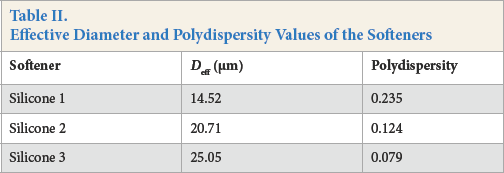
From the multimodal size distributions, it appears that the investigated softener emulsions had nearly one population of particles resulting in a single and narrow peak. For Silicone 1, the main peak was present at around 14 μm with a high intensity (91.4%) and a second peak appeared around 301 μm with a relatively small intensity (8.6%). For Silicones 2 and 3, there were peaks around 20 and 25 μm, respectively. Both Silicone 2 and 3 peaks were at 100% intensity and had larger
ΔE Values
Color change is defined as a change in color of any kind, whether in hue, chroma, or lightness.
13
Color and
Percent Reflectance Values of Treated and Control Dyed Samples
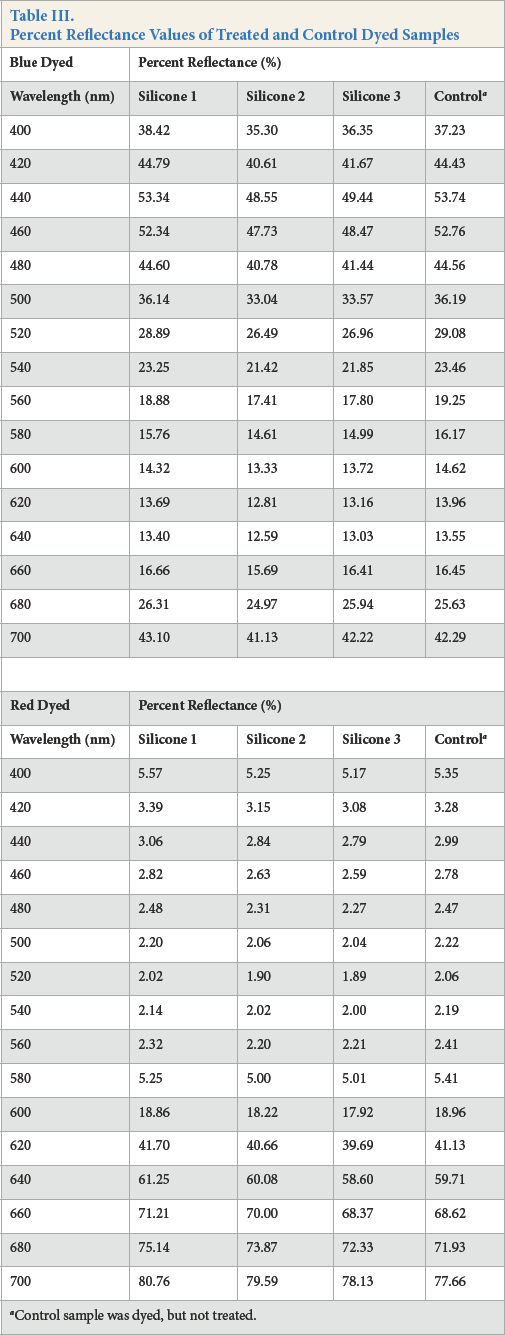
Control sample was dyed, but not treated.
For a randomly rough surface on which the surface height distribution is defined by a Gaussian probability distribution, the reflectance of the rough surface can be expressed by Eq. 1. 14

The reflectance difference
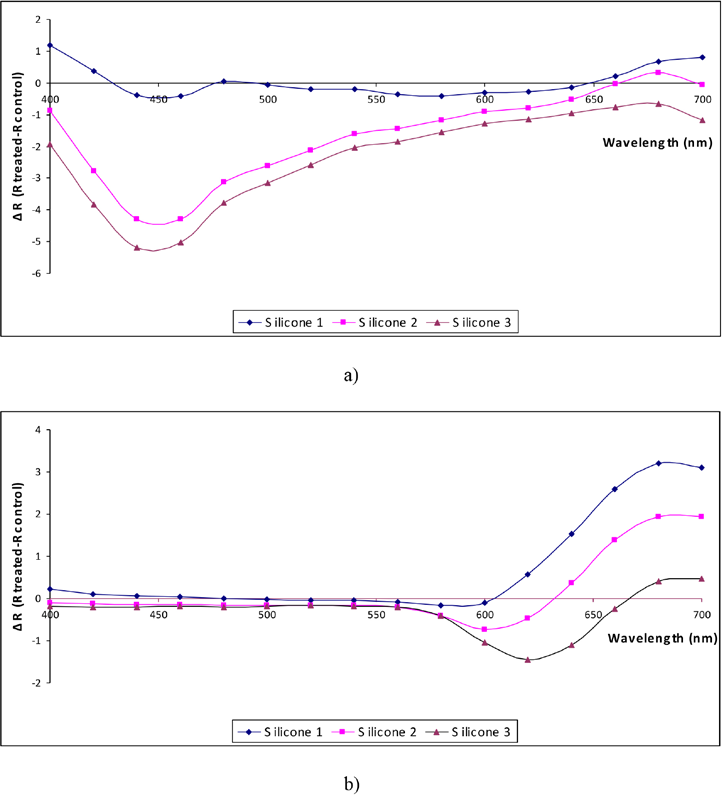
Reflectance changes of treated a) blue and b) red fabrics.
Δ
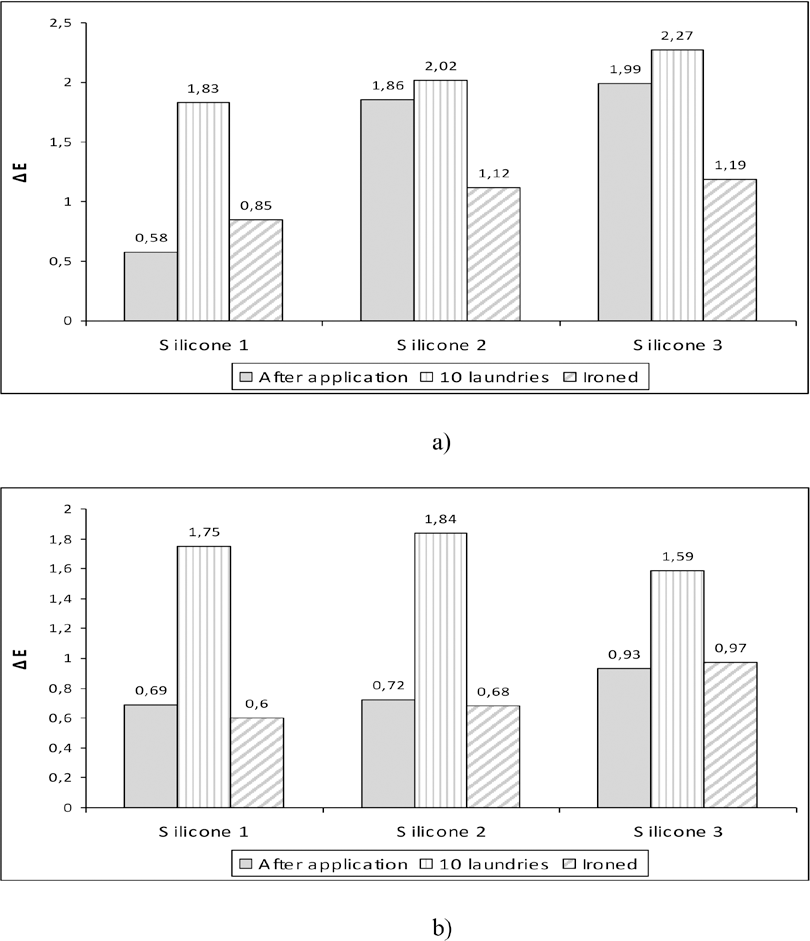
Color differences of a) blue and b) red samples.
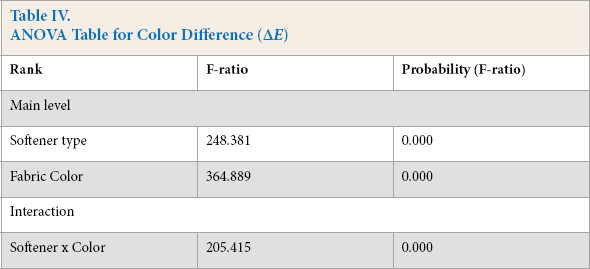
The ANOVA results (Table IV) reveal that both softener type and fabric color had strong contributions to and significant effects on Δ
ANOVA Table for Color Difference (ΔE)
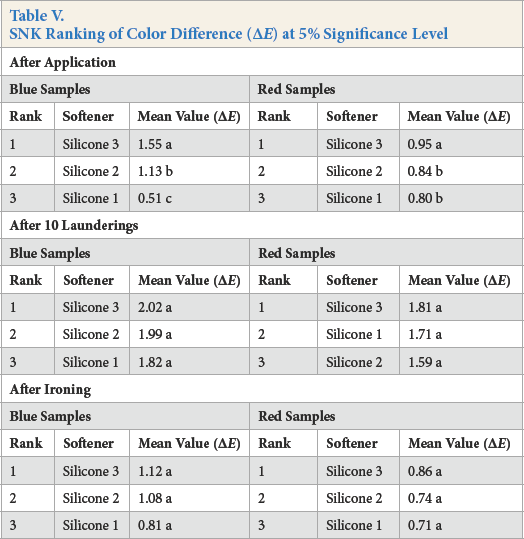
In the SNK rankings, it is observed that the contribution of the softener particle size was significant only after application; differences in softener particle size would change the Δ
SNK Ranking of Color Difference (Δ
Conclusion
This study investigated the effect of silicone softener particle size on the color assessment of cotton fabrics. Samples of two different colors and softeners with three different particle sizes were used. The study showed that softener particle size affected the color assessment of treated fabrics. Fabrics treated with the smaller particle size softeners gave higher percent reflectance values. The smaller softener particle size gave a high surface area and uniform dispersion after application on the textile medium to give a smoother reflecting surface. Also, smaller particle size softeners were found to give smaller Δ
However, the effect of particle size was insignificant when the treated fabrics were subjected to repeated launderings and ironing.