




Abstract
The main purpose of this research is comparing the micro and nano-silicone softeners on the properties of corona plasma discharge-treated cotton fabric. The cotton fabric was treated by corona discharge, and then treated and untreated cotton fabrics were coated by silicone and nano-silicone softeners at different concentrations. The stiffness, water absorption time and crease recovery angle tests were measured. Surface morphology of fabrics was observed by means of Scanning electron microscopy. FTIR/ATR spectroscopy was used for determination of surface chemical bonding. The stiffness and water absorption were reduced upon increasing the concentration of softener, and crease recovery angles of samples were increased upon upraising the softener concentration. Scanning electron microscopy showed that corona treatment on cotton fabric made a rough surface with some cracks on the fiber, and nano particles covered the surface of cotton and corona-treated cotton fabrics. FITR/ATR spectroscopy of corona plasma-treated cotton showed the presence of carboxylic acid group. Corona plasma discharge treatment caused chemical and physical changes on the fiber surface. The nano silicon softener coating can be used on untreated cotton, but corona treatment is more efficient for the silicon softener.
Introduction
The textile industry needs to produce textiles more efficiently with less water usage and less environmental pollution. Plasma corona discharge method is a technique for the treatment of fibres, fabrics and polymeric materials in a dry system, which consists of the application of an electrical discharge. The discharge is an ionized state of air and is achieved by applying high-frequency voltage between the two electrodes [1–3]. The use of gas discharging modifies the surface properties of the polymeric materials. In previous studies, researchers used corona plasma discharge for improving the adhesion of coatings, treating fibers such as wool, mohair, cotton and textiles made from synthetic fibers. Corona and plasma treatments improve wool and mohair yarn strength and shrinkage behavior, increase wetability and soil repellency, reduce the tendency to generate a static charge, increase fabric abrasion resistance and improve carding, spinability and cotton properties after mercerization and cause the decoloration of denim [1–12].
One of the textile finishing procedures is softening finishes. Softeners are used to improve the handle and lubricity of fiber, yarn and fabrics. The improved lubricity inhibits abrasion and enhances soiling resistance and static protection, and reduces pilling, flammability and sewing thread breakage [13–15]. Macro and micro emulsion silicon softeners with high moisture absorbance are commercial classes of ones; however, nano silicones are the new class [13]. Previous research works were carried out on the application of softeners on textiles such as methods for synthesize, combination, properties and effects on physical and chemical properties of fabrics, application of ultrasonic method and various properties of textiles treated with silicone emulsions. Nano-emulsion silicone also was used on atmospheric air-plasma-treated polyester fiber [16–23]. Hashem et al. [24] and Fahmy et al. [25] used silicon micro-emulsion softener in combination with easy care finishes of cotton and viscose, respectively.
According to the previous works of researchers, micro and nano silicon softeners were studied on polyester fabric. The drapeability of nano emulsion treated polyester was increased compared with micro emulsion-treated one. Nano silicones could act as lubricant and reduced the friction between the fibers resulting to decrease bending length. Silicon particle size was an effective parameter on bending length and crease recovery angles of treated fabrics [13]. None of the research studies focused on comparing nano and micro silicon softener on corona plasma discharge-treated cotton fabric. In this study, some physical properties of nano and micro silicon softener on corona plasma discharge treated-cotton fabric were compared.
Materials and methods
Materials
The plain weave bleached cotton fabric of 141 g/m2 was used in this study. Silicon softener Persoftal silicon ASN (Bayer-Germany) nonionic modified polydimethylsiloxane and nano silicon softener Wetsoft AE 200 (Wacker- Germany) modified amino functional polydimethyl siloxane for hydrophilic finish were used. SDC standard detergent without optical brightener from Shirley – UK was prepared.
Methods
The cotton fabric was treated by plasma corona discharge made by Azad electrical industries in Iran. The device consisted of two electrodes in which the samples were placed between them. The experiment was carried out at atmospheric pressure and air conditions, at the power of 1000 W and 2 m/min velocity of electrode roll with 30 passages of the treatment. The untreated and corona-treated cotton fabrics were treated with silicon and nano silicon softener at different concentrations of 1,2,3,4% (owf %). The add-on concentration of softeners on fabrics was calculated based on pure concentration of softener products [13,26,27]. The treatment was carried out by the exhaustion method at the temperature of 80℃ for 45 min at pH of finishing bath 5–6 [13,26,27]. The laundering test was done due to the AATCC-124-1999 standard method for five cycles of washing. The fabric conditioning was due to the standard atmosphere for testing textile, which was 21℃ and 65 relative humidity.
Wetting time of water drop on the surface of fabrics was determined by AATCC-39-1980 standard method. A drop of distilled water was poured from the burette on the surface of the fabric; the time for disappearing of spherical shape of water drop was determined. The distance between the tip of burette and the surface was 10 mm. The mean for 10 measurements was reported. Crease recovery angle of untreated and softener treated cotton fabrics was determined using the AATCC-66 1990 standard method. The stiffness of fabrics was obtained according to the ASTM-D1388-96 stiffness standard test method.
The surface morphology of softening treatment on the untreated and corona treated cotton fabrics was investigated by Scanning electron microscope (SEM) (KYKY, model: EM 3200, made by china) with the accelerated voltage of 23 kV. For investigation of chemical bonding, infrared spectra were recorded in the transmission mode using a Bruker-tensor 27 system FTIR/ATR (attenuated total reflectance) spectroscopy. All data were recorded by means of a ZnSe Internal reflective element in the range of 500–4000 cm−1 with the resolution of 4 cm−1, and 32 scans were taken.
Results and discussion
Figure 1 shows the wetting time of water drop on corona plasma discharge and untreated cotton fabrics with micro and nano silicon softeners. Corona-treated fabrics showed lower wetting time (1.52 s) as compared with untreated cotton (274 s). The lower wetting time indicates higher wettability. Corona plasma treatment on polymeric materials causes physical and chemical changes on the surface. Physical change happens by etching effect. The produced electrons by corona discharge reach the fiber and because of their high energy levels can split covalent bonds. This produces radicals on the surface of the fibre and causes the etched surface [1,2]. The cracks on the surface of fiber are the sites for penetrating water drop.
Wetting time of softener treatment on corona treated and untreated cotton fabrics.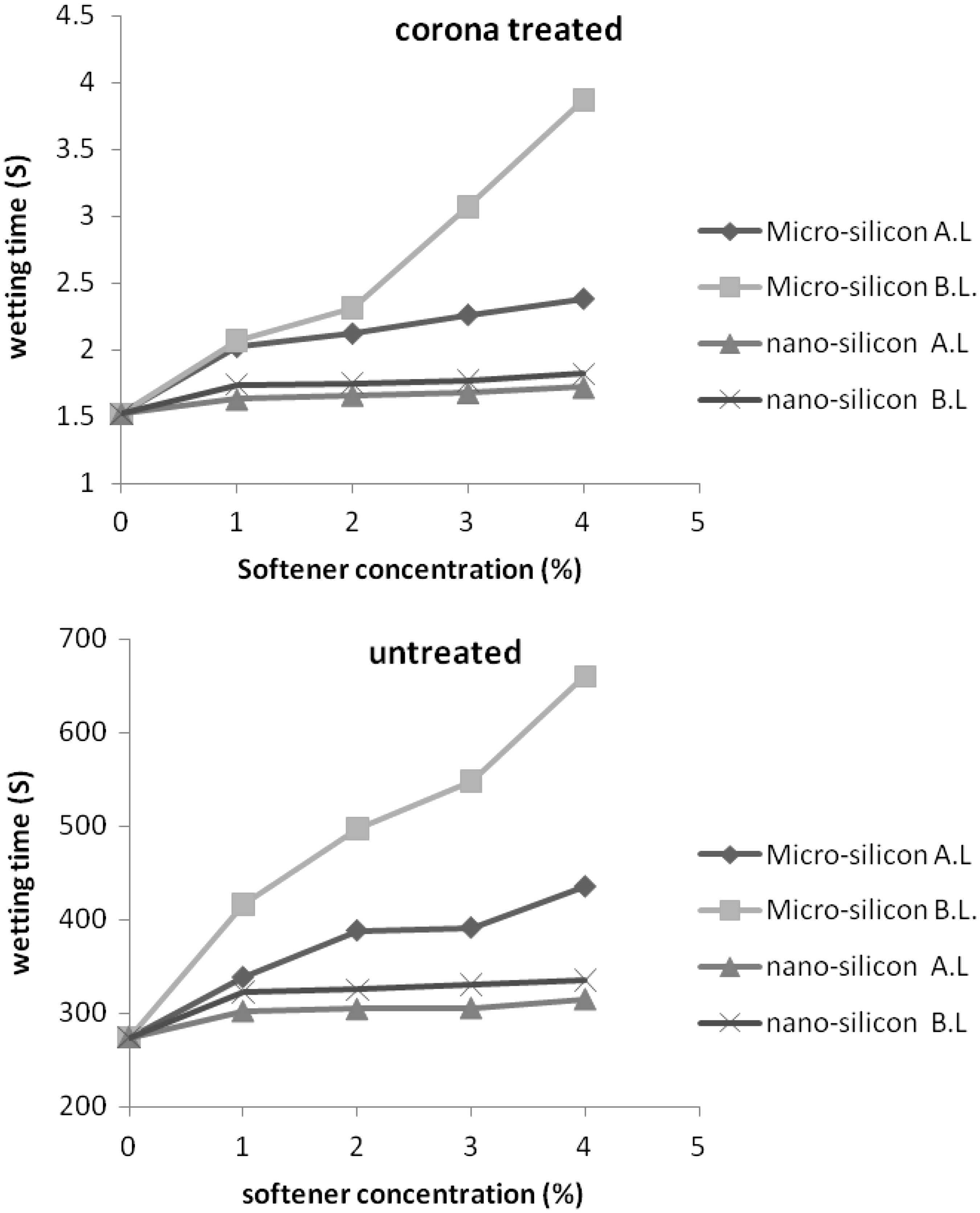
The presence of the particles on the surface of fabric prevented the penetrating of water drop into the fabric and increase of concentration of silicon softeners increased the wetting time of the cotton fabric. The particles made a rough surface so that it blocked the penetration of water drop [28–30]. The mechanism for direction of micro silicon softener is due to the size of softener which is adsorbed on the surface of cotton fabric [31]. For nano silicon coating of cotton fabric, the decrease in wetting time was observed as compared with the micro-silicon softener. The micro-silicon softener on untreated cotton showed 660 s of wetting time, whereas the nano silicon showed 335 s. The micro-silicon softener on corona-treated cotton showed 3.87 s of wetting time, whereas the nano silicon showed 1.82 s. This is due to the penetration of nano silicon between the fibers and yarns structure [29].
Comparison between corona treated and untreated cotton fabrics coated with two kinds of softener showed that corona treatment was effective on absorption of both micro and silicon softeners, and wetting time was the lowest (1.82 s) for corona and nano particles treatment. It seems that higher concentration of micro silicon softener (4%) on both untreated and corona-treated cotton had higher wetting time, therefore lower wettability, whereas nano silicon softener at higher concentration (4%) showed higher wettability. After repeated laundering, some of the micro silicon softeners were removed from the fiber surface and nano silicon softener remained in the fibers.
Stiffness or flexural rigidity (mg.cm) of softener treated and untreated cotton fabrics.

Figure 2 shows the crease recovery angle of silicon and nano silicon softeners on corona treated and untreated cotton fabrics. By increasing the concentration of micro and nano silicon softener, crease recovery angle increased. This increase was because of the presence of softeners. The nano silicon softener might penetrate into the fibers and act as filler in the free space between the fibers. Deposition of a softener within the fabric structure softens the fibers by decreasing the interfiber and interyarn friction. Applying corona treatment caused penetrating the micro and nano softeners particles into the fiber and between the cellulose structures. These particles entered between the polymer structures acted as filler and caused improvement in crease recovery [28,29]. Comparison between nano and micro silicon softener on corona treated and untreated cotton fabrics (Figure 2) showed that corona treatment caused more penetration of nano and micro softener, and nano softener had higher absorption than micro softener. After repeated laundering, crease recovery angles slightly decreased.
Crease recovery angle of silicon and nano silicon softener-treated cotton fabric.
Figure 3(a) and (b) shows the SEM micrographs of untreated and corona-treated cotton fabrics, respectively. The untreated cotton had a smooth surface, whereas corona treatment on cotton fabric showed a rough surface with some cracks on the fiber. This rough surface was produced by high energy electrons of corona discharge. These results confirmed the effect of corona plasma discharge treatment on cotton fiber which showed in previous results more absorption of softener on it. Micro silicon softener on untreated and corona-treated cotton is shown in Figure 3(c) and (d). Figures showed that the softener covered the surface of fibers. Nano silicon softener coating on untreated and corona-treated cotton fabrics is shown in Figure 3(e) and (f). The nano particles covered the surface of cotton and corona-treated cotton fabrics. The SEM images of fabrics revealed a thick layer of coating, which could alter the handling of the fabrics.
SEM micrographs of untreated cotton (a) corona treated (b) micro silicon on untreated (c) micro silicon on corona treated (d) nano silicon on untreated (e) and nano silicon on corona treated cotton fabric (f).
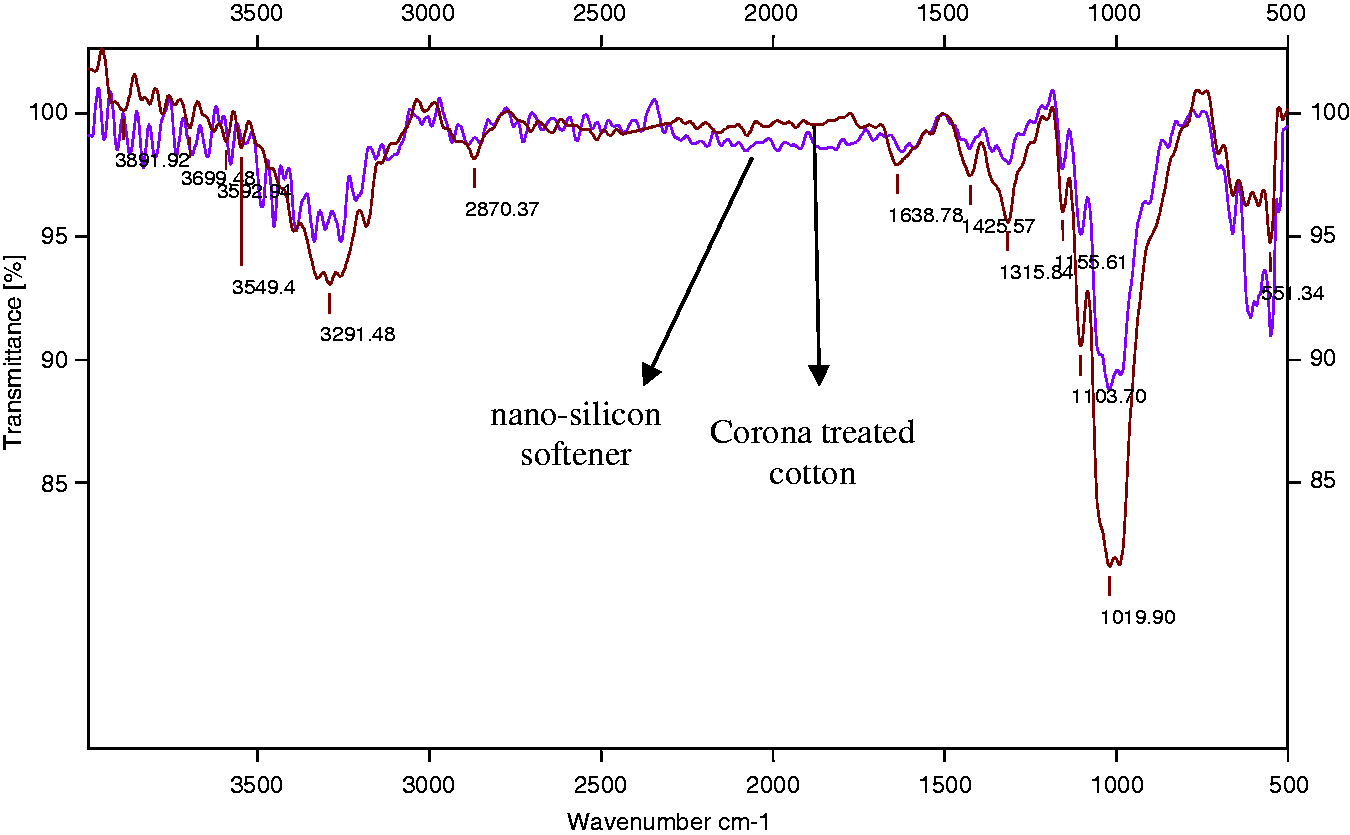
The FTIR/ATR spectra of untreated and corona treated cotton fabrics are shown in Figure 4. The untreated cotton showed absorption in the region of 3291 cm−1 which corresponds to O–H stretching (str) in alcohol and region of 1000–1200 cm−1 corresponds to C–O str or O–H deformation (def) in alcohol that confirms the presence of hydroxyl group [32,33]. Corona plasma-treated cotton showed the absorption in the region of 1637 cm−1 (C–O str in carboxylic acids), 2870 cm−1 (O–H str in carboxylic acids) reveals the presence of carboxylic acid group thus increasing the polarity on the surface of the sample [32,34].The bands at the region of 3291 cm−1 and 2870 cm−1 are related to the hydroxyl groups on corona-treated cotton fabric which has increased intensity for corona-treated cotton. Therefore, despite physical changes on the surface of fiber which allowed the penetrating of the softeners into the structure, chemical changes happened on the surface structure of cotton fiber. This chemical change introduced the sites for absorption of more chemicals and softeners. This is another reason for the increase of wetting of corona-treated cotton.
FTIR/ATR spectra of corona treated and untreated cotton fabrics.
Figure 5 shows the micro-silicon softener coating on corona plasma discharge-treated cotton fabric. The absorption in the region of 3291 cm−1 which corresponds to the hydroxyl groups after coating of micro silicon softener increased. This increase might be because of the hydrophilic structure of micro silicon and also penetration of micro silicon softener into the fiber structure, and thus less effect on the fiber surface. The micro silicon softener penetrated into the fiber through the cracks because of the etching effect of corona plasma discharge treatment. The softener also might be absorbed on the fiber surface, via produced chemical sites by corona plasma discharge treatment. These results are in agreement with the results of wetting time, stiffness and crease recovery angle which showed the penetration of micro silicon softener into the corona-treated cotton, whereas the softener penetrated into the untreated cotton less. Figure 6 shows the nano-silicon softener coating on corona plasma discharge-treated cotton fabric. The nano-silicon-coated cotton fabric showed lower intensity in the region of 3291 cm−1 which is related to the hydroxyl groups of corona-treated cotton fabric. Nano silicon softener covered the surface of fiber so that the hydroxyl groups of cotton were covered by softener.
FTIR/ATR spectra of corona treated and micro silicon softener on corona-treated cotton fabrics. FTIR/ATR spectra of corona treated and nano silicon softener on corona-treated cotton fabrics.
Conclusions
Corona treatment is a useful method to increase the wettability of fibers, therefore more absorption of chemicals. In this research, corona plasma discharge treatment caused chemical and physical changes on the fiber surface. Coating of micro and nano silicone softeners was compared on corona treated and untreated cotton fabrics. Corona-treated fabrics showed lower wetting time, lower stiffness as compared with untreated cotton. The increase of micro and nano silicon softeners concentrations increased wetting time, crease recovery angles and decreased stiffness of cotton fabrics. Comparison between micro and nano silicon softener showed that nano silicon softener-coated fabric had lower stiffness and wetting time. Coating of nano and micro silicon softeners on corona treated and untreated cotton fabrics showed that corona treatment caused more chemical and physical absorption of nano and micro softener, and nano softener had higher absorption than micro softener. The nano silicon softener showed more absorption on both untreated and corona-treated cotton fibers, because of its small size. Silicon softener had more absorption on corona-treated cotton. Therefore, nano silicon softener coating can be used on untreated cotton, but corona treatment is more useful for the silicon softener, and for industrial benefits the use of nano silicon softeners do not need pretreatment of corona discharge.
Footnotes
Declaration of Conflicting Interests
The author(s) declared no potential conflicts of interest with respect to the research, authorship, and/or publication of this article.
Funding
The author(s) received no financial support for the research, authorship, and/or publication of this article.