






Abstract
To investigate, in real time, the transport and secretion of pituitary hormone, we have developed an experimental pituitary cell line, GH3 cell, which has secretory granules of growth hormone (GH) linked to enhanced yellow fluorescein protein (EYFP). This stable GH3 cell secretes secretory granules of GH linked to EYFP on stimulation by Ca2+ influx or Ca2 release from storage. This GH3 cell will be useful for the real-time visualization of the intracellular transport and secretion of GH.
W
The rat GH cDNA clone pRGH-1 and the EYFP-expression construct pEYFP-N1 were obtained from the American Type Culture Collection (Manassas, VA) and Clontech Laboratories, Inc. (Palo Alto, CA), respectively. The GH-EYFP fusion construct pCMV-Sig-EYFP-GH-1 was derived from pEYFP-N1 and contained a sequence encoding the rat GH signal peptide (1 to 26 in the rat GH amino acid sequence) and the EYFP-coding segment, followed by another rat GH coding sequence (27 to 217 in the rat GH amino acid sequence).
GH3 cells were maintained at 37C in a 5% CO2 in DMEM/Ham's F-12 medium supplemented with 2.5% heat-inactivated FBS, 10% horse serum, 100 U/ml of penicillin, and 100 μg/ml of streptomycin.
Transfection of GH3 cells was performed using lipofectamine 2000 (Invitrogen Corporation; Carlsbad, CA). Briefly, GH3 cells at 70% confluency on poly-
To prepare whole-cell extracts for immunoblot analyses, transfected cells were heated at 100C in Laemmli sample buffer for 10 min, sonicated, and cleared by centrifugation. The extracts were fractionated on a 12.5% and blotted onto a nitrocellulose membrane. For the detection of GH-EYFP fusion proteins, anti-rat GH polyclonal antibody (National Institute of Diabetes and Digestive and Kidney Diseases; Bethesda, MD) and anti-rabbit IgG-HRP Fab (Amersham International plc; Buckinghamshire, UK) were used as primary and secondary antibodies, respectively, and signals were detected with ECL-Plus chemiluminescence reagents. The Western blotting showed a 22-kDa band of native GH protein and a 75-kDa band of GH-EYFP fusion protein (Figure 1).
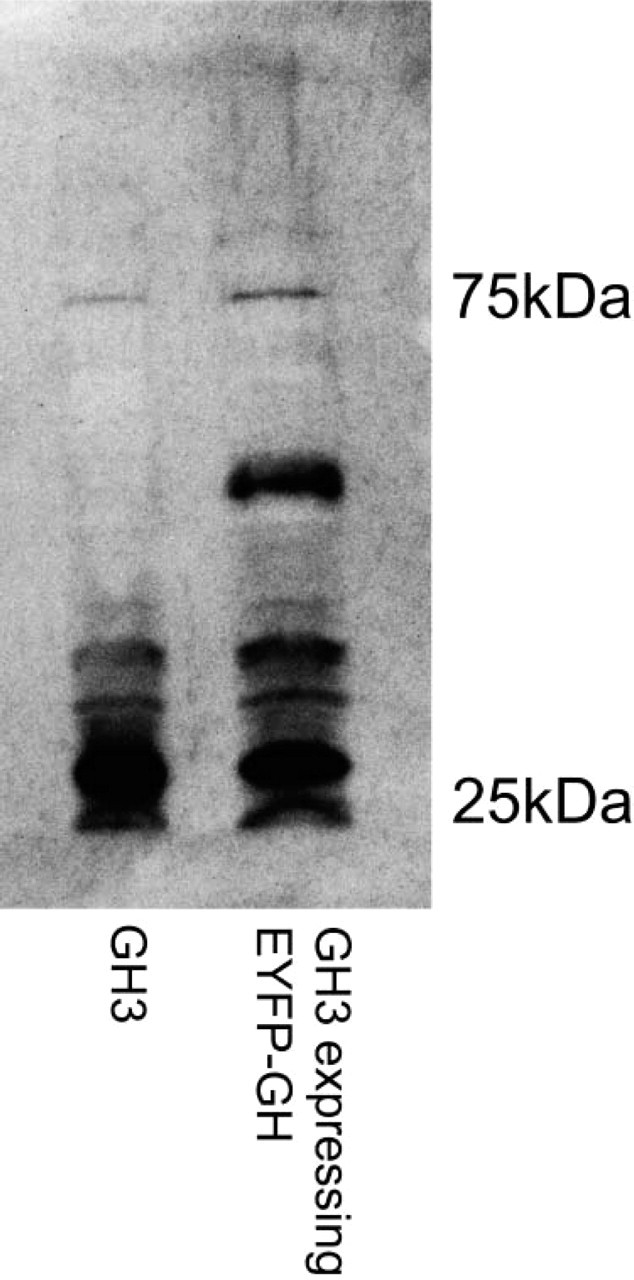
The Western blotting showed a 22-kDa band of native growth hormone (GH) protein and a 75-kDa band of GH-enhanced yellow fluorescein protein fusion protein.
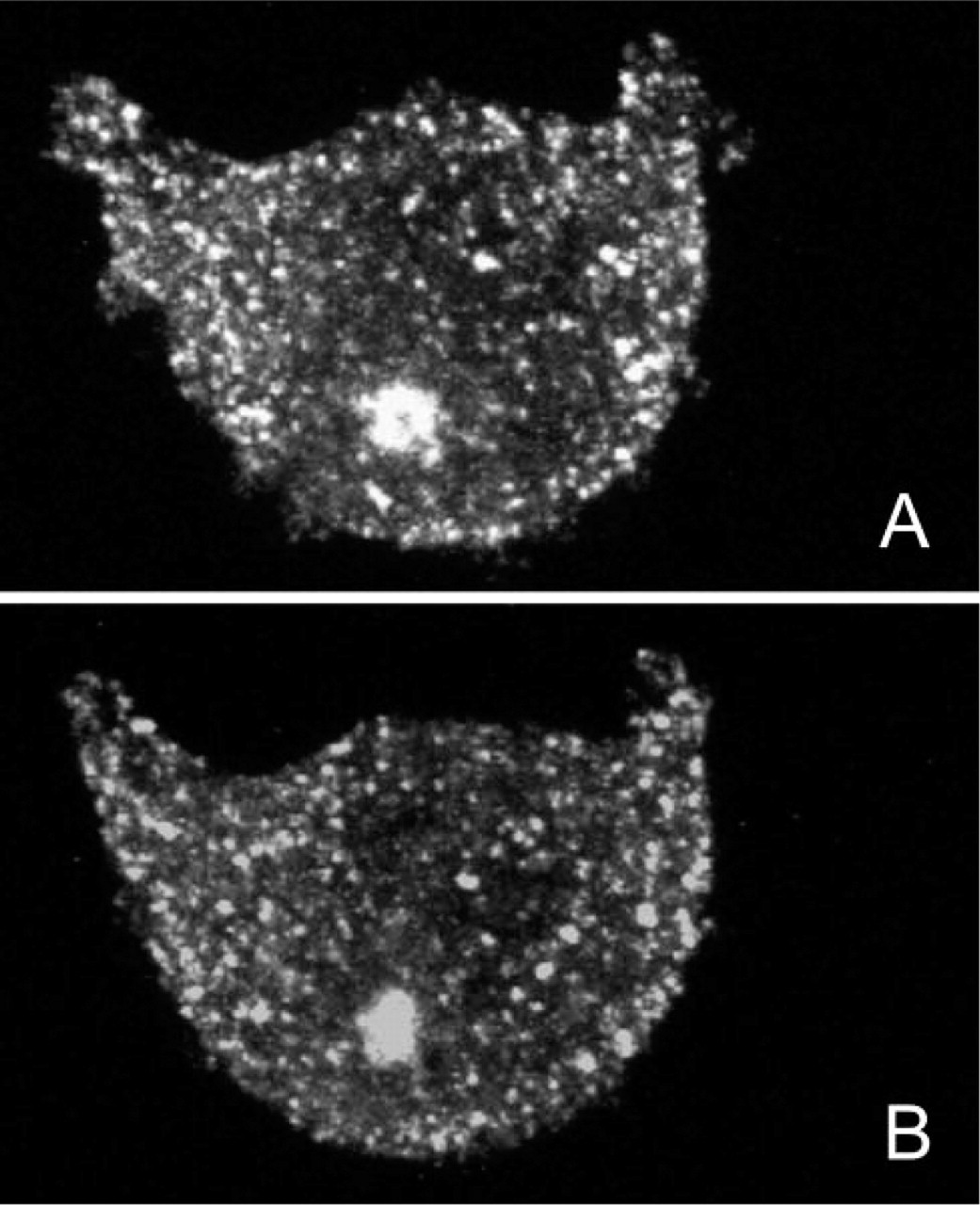
Cells were incubated with culture medium of high K 60 mEq/L concentration and were observed under confocal laser scanning microscopy (CLSM), which showed that granules of GH were secreted (Figure 2). Cells were stimulated with thyrotropin releasing hormone of 10−7 M concentration and observed under CLSM, which showed that granules of GH were secreted (Figure 3). Cells were treated with thyrotropin releasing hormone 10−7 M and nitrendipine 1 μM and were observed under CLSM, which showed that only a few granules of GH were secreted (Figure 4). Control experiment with no treatment showed no secretion of secretory granules (Figure 5).
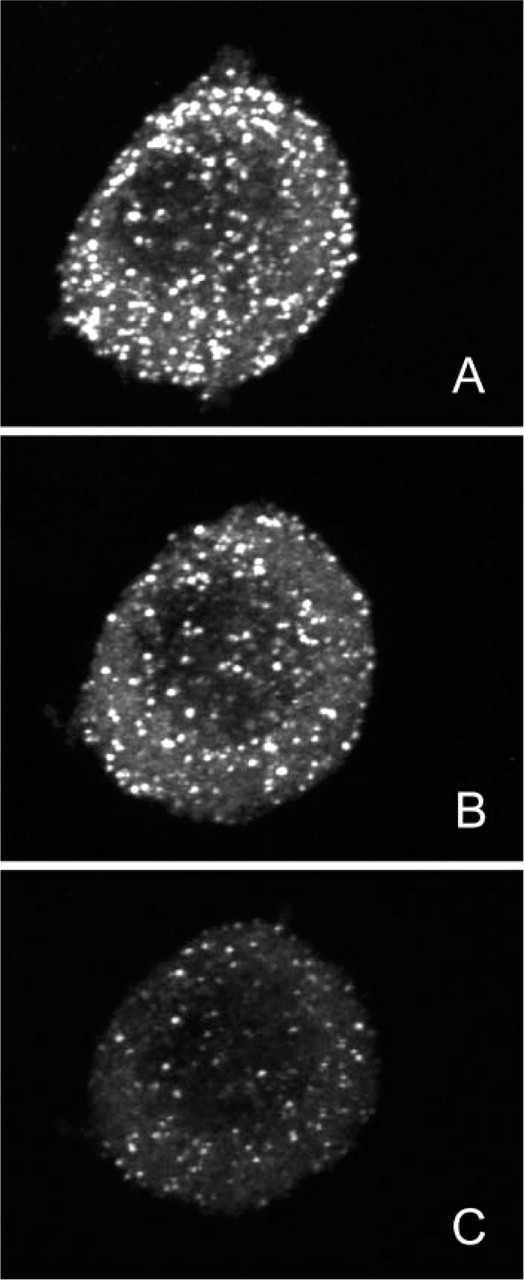
When cells were incubated with culture medium of high K 60 mEq/L concentration, granules of growth hormone were secreted. (
Green fluorescent protein (GFP) has been used widely in cell biology for the real-time visualization of cellular processes (Tsien 1998). GFP has been used as a marker that can be attached to proteins without alterations in its fluorescence. The function of the protein itself is usually unchanged. The GFP linked to protein allows us to trace, in real time, the intracellular distribution, transport, and secretion of the molecules. In the field of pituitary hormone research, there are few reports that describe the establishment of transgene expressing pituitary hormone linked to GFP. It is critically important to produce a sequence that would target itself to the right cell types, but not alter the physiology of the cells themselves. The signal peptide is critical to allow entry into the rough endoplasmic reticulum. Recently, Magoulas et al. (2000) produced a construct encoding the gene for enhanced GFP (EGFP) linked to sequences of human GH. They used two different lengths of the 5’ coding sequence of the GH gene fused with EGFP: one had the longer sequence corresponding to the first 48 amino acids of GH, and the other had the shorter sequence corresponding to the first 8 amino acids of the GH signal peptide. They transfected both constructs into GC cell line that produces GH normally. Stably transfected GC cells translated both the smaller and larger constructs. The shorter construct that contained the GH signal peptide had a relatively uniform distribution of fluorescence, whereas the longer construct showed a more punctate distribution, suggesting that the longer GH protein had been sorted through the Golgi complex to a granule compartment. Magoulas et al. (2000) used the longer version of the EGFP-GH construct to generate transgenic mice expressing EGFP linked to GH sequences. However, there have been no reports that described the establishment of a stable cell line expressing pituitary hormone linked to GFP. Therefore, to investigate, in real time, the transport and secretion of pituitary hormone, we have developed a stable experimental pituitary cell line, GH3 cell, which has secretory granules of GH linked to EYFP. This GH3 cell has secretory granules of GH linked to EYFP, and secretes this molecule on stimulation by Ca2+ influx or Ca2+ release from storage. This GH3 cell will be useful for the real-time visualization of the intracellular transport and secretion of GH.
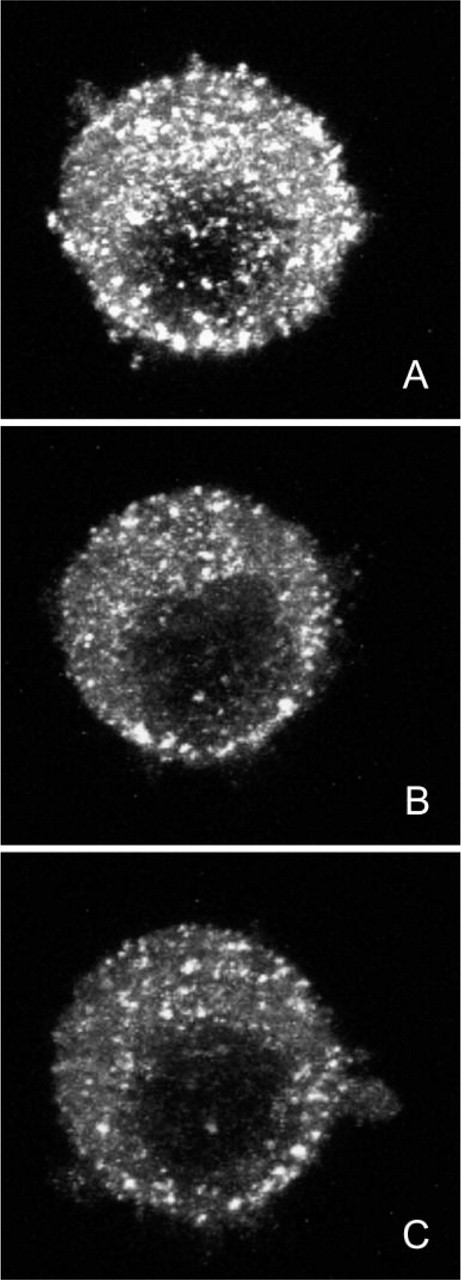
When cells were incubated with culture medium of thyrotropin releasing hormone of 10−7 M concentration, granules of growth hormone were secreted. (
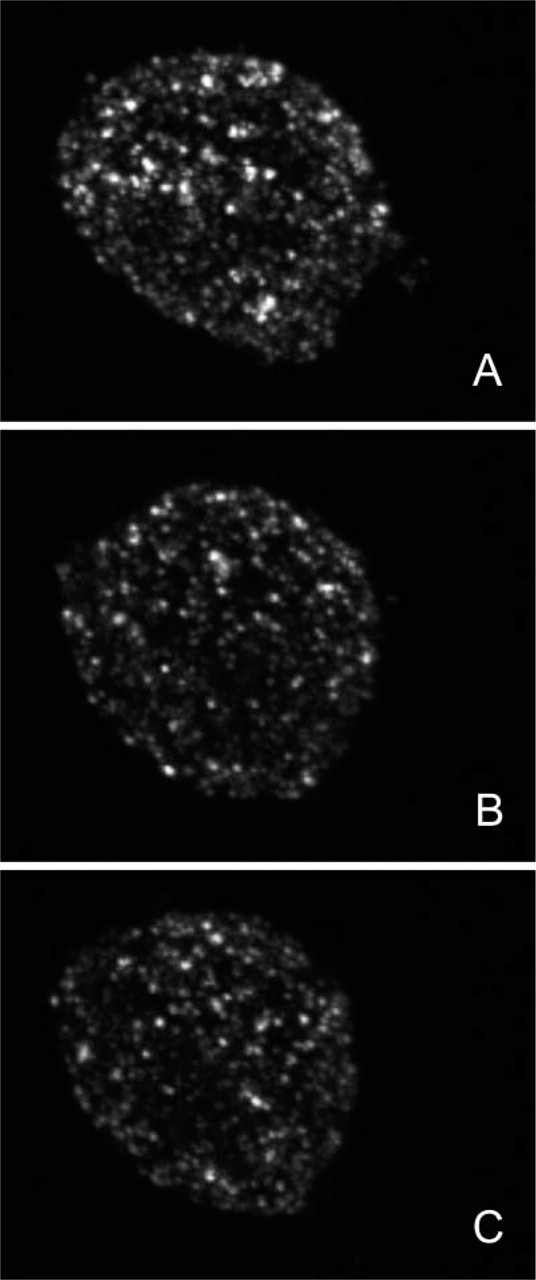
When cells were incubated with culture medium of thyrotropin releasing hormone 10−7 M and nitrendipine 1 μM, only a few granules of growth hormone were secreted. (
Control experiment with no treatment showed no secretion of secretory granules. (