




Abstract
Lipid signaling molecules are essential for maintaining intestinal mucosal barrier homeostasis. Over 80% of polyunsaturated fatty acids (PUFAs) are metabolized through the cytochrome P450 epoxygenase (CYP)-soluble epoxide hydrolase (sEH) axis, generating bioactive epoxy and diol fatty acids. However, the expression patterns and functional roles of these enzymes in the intestinal epithelium remain poorly defined. To address this, we used RNAscope in situ hybridization and publicly available single-cell RNA sequencing (scRNAseq) datasets to map the cell-type-specific expression of PUFA-metabolizing enzymes in the small intestine. In humans, we identified three major epithelial expression patterns: (1) stem-cell-dominant (CYP2E1), (2) enterocyte-dominant (CYP1A1), and (3) widespread expression across epithelial subsets for key CYP epoxygenases (CYP2C8, 2C9, 2C18, 2C19, 2J2, 2S1), sEH, and additional CYPs (3A4, 4A11, 4F2, 4F3, 4F8, 4F12). In mice, five distinct expression patterns were found: (1) stem cell and transit-amplifying cells (CYP2E1), (2) transit-amplifying dominant (CYP4F18), (3) transit-amplifying and enterocytes (CYP2C44), (4) enterocyte-dominant (CYP1A1), and (5) broadly expressed across all epithelial clusters (sEH, CYP2B10, 2S1, 2C55, 4F13, 4F16). Furthermore, in a radiation-induced small-bowel injury-regeneration model, we observed dynamic changes in CYP expression patterns. These findings provide the first high-resolution single-cell atlas of CYP–sEH axis enzymes in the intestinal epithelium, offering key insights into their potential roles in epithelial differentiation, injury response, and mucosal barrier integrity. This foundational work enables future studies to define the biological functions and therapeutic relevance of PUFA-derived lipid mediators in intestinal health and disease:
This is a visual representation of the abstract.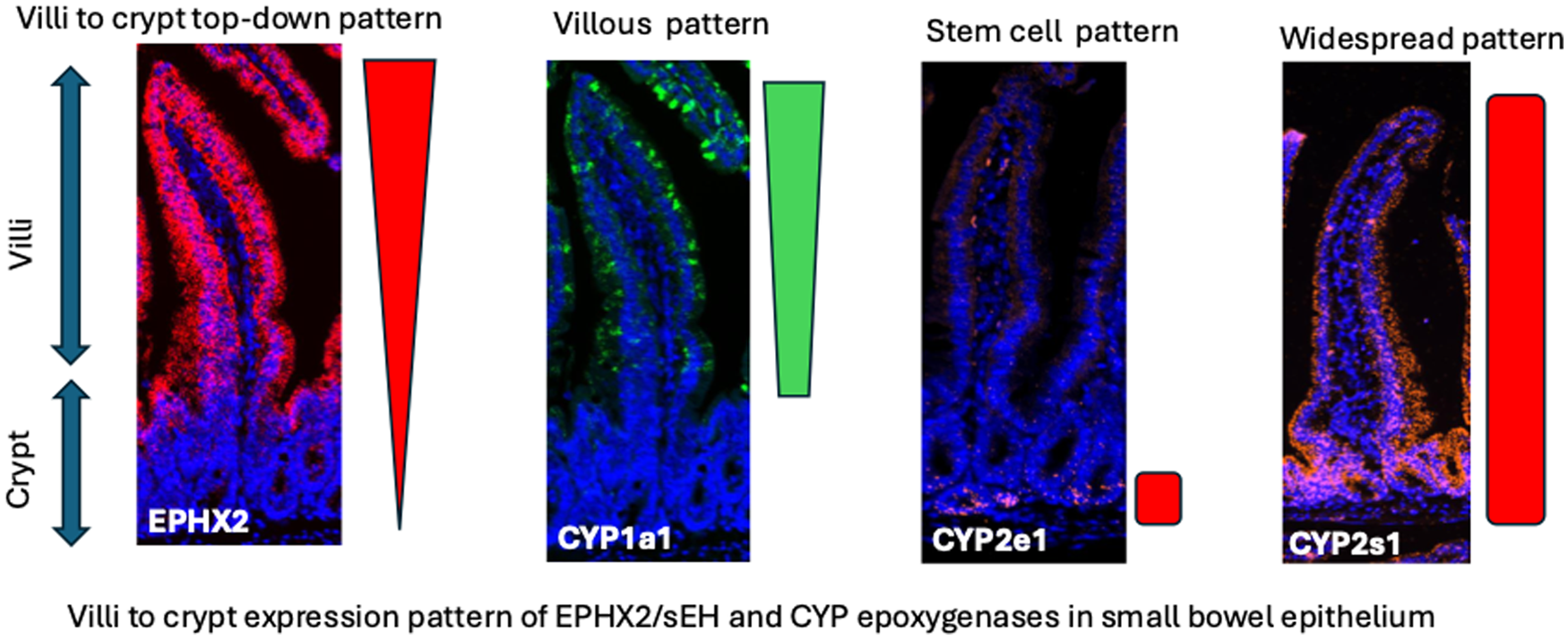
Keywords
Get full access to this article
View all access options for this article.
References
Supplementary Material
Please find the following supplemental material available below.
For Open Access articles published under a Creative Commons License, all supplemental material carries the same license as the article it is associated with.
For non-Open Access articles published, all supplemental material carries a non-exclusive license, and permission requests for re-use of supplemental material or any part of supplemental material shall be sent directly to the copyright owner as specified in the copyright notice associated with the article.
