






Abstract
Pinworms (Nematoda: Oxyurida) are common contaminants in most laboratory rodent colonies. The aim of the study was to monitor the transmission of
Oxyurids (
Effective control measures must be based on the use of adequate hygienic measures to remove parasitic eggs from the environment as well as the introduction of a chemotherapy regimen. However, the direct transmission of these parasites through contaminated food, water and bedding results in continual re-exposure to the parasite, making the control of pinworms in animal holdings quite difficult. 5 To create a truly effective control programme, it is essential to possess sufficient knowledge of the epidemiology of this infection period. However, epidemiological studies of these parasites are published sporadically, with none at all appearing in recent times.6,7
The aim of this study was to monitor the transmission of
Materials and Methods
The study was carried out at the Academy of Science of the Czech Republic (Physiology Institute). This Institute has 25 breeding rooms, each measuring 12 m2. The rats (in groups of 2–3 per cage) were kept in type K5 clear styrofoam cages. Breeding cages were placed on shelves next to each other; there were in total 55 cages with 143–146 rats in each room. Wood shavings were used for bedding. The room was maintained at 22 ± 2°C and 55 ± 5% relative humidity, and at a 12/12 h light/dark cycle. The air was automatically ventilated 10–15 times per hour. Pellet rodent food and tap water in drinking bottles were given
Pinworm egg detection in breeding room dust
Breeding room dust was investigated using special grids (grid area of 10 cm2, Figure 1a). A thin layer of paraffin oil was applied to the grids, and they were placed on shelves between the breeding cages. The grids were examined after 24 (1140 grids), 48 (924 grids) and 72 h (827 grids) using a microscope (magnification ×40 to ×100).
Devices for passive and active dust collection. (a) The grid for detection of pinworm eggs in breeding room dust. (b) The suction chamber for detection of pinworm eggs in breeding room dust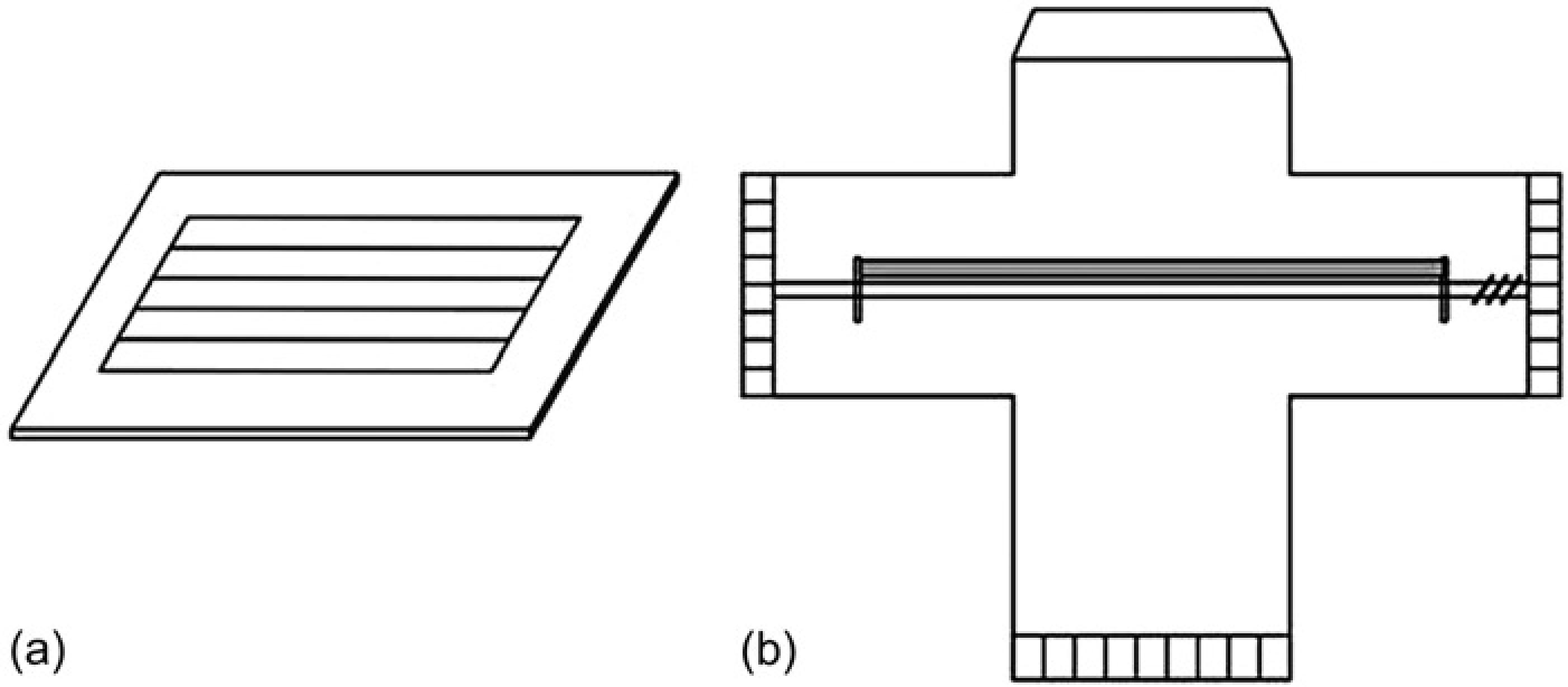
To conduct a parasitological examination of the dust, a suction chamber was also used (Figure 1b). A slide with a thin layer of paraffin oil was fixed to a frame. The frame was inserted into the chamber, which was subsequently attached to the vacuum cleaner. The dust was vacuumed from a 50 cm2 area of the shelves over a three-year period, usually three times a week. A total of 478 slides were used. The slides were covered with coverslips and examined using a microscope (magnification ×40 to ×100).
Pinworm egg detection in the ventilation system
Samples were collected from suction holes of the ventilation system using a thin spatula and placed into the beaker. After adding a small amount of water (about 10 mL), the material was mixed and strained into a centrifuge tube. After centrifugation (2000 rpm for 2 min), the supernatant was poured out and discarded, leaving only a single pellet in the tube. Each of the tubes was then filled with its assigned flotation solution (Breza solution) to the previous 10 mL mark. The pellet and the solution were mixed and centrifuged for 2 min at 2000 rpm. The coverslip was added after the centrifuge had stopped and the entire area under the coverslip was examined. Samples were collected every two months over a three-year period.
Breza solution: saturated solution magnesium sulphate (MgSO4), saturated solution sodium thiosulphate (Na2S2O3), H2O (ratio 3:3:1), density 1.25–1.30 g/cm3. 8
Pinworm egg detection in breeding cages
Samples were collected from breeding cages after emptying the litter. The walls and bottoms of the cages were rinsed using a squeeze bottle with a small amount of water (approx. 50–70 mL). Water was poured into a beaker and left to settle for 15 min. The sediment was centrifuged for 2 min at 2000 rpm. After centrifugation, the supernatant was poured out, and each of the tubes was then filled with its assigned flotation solution (Breza solution). After centrifugation, the samples were examined in the abovementioned manner. In total, 563 cages were examined prior to being washed and 425 cages after being washed.
Pinworm egg detection on the hands of technical staff
Using adhesive tape, samples were collected from the hands of technical personnel working with animals (124 hands in total). A cushion finger was covered with strips of adhesive tape, which was then glued to a glass slide and examined using a microscope (magnification ×40 to ×100).
Results
The percentage of positive grids increased slightly over exposed time, from 5.5% (after 24 h) to 8.2% (72 h) (Table 1). Similar values were also found when using the suction chamber (7.6%). Many more pinworm eggs were found in the ventilation system (28.7%).
Pinworm egg detection in the breeding facility
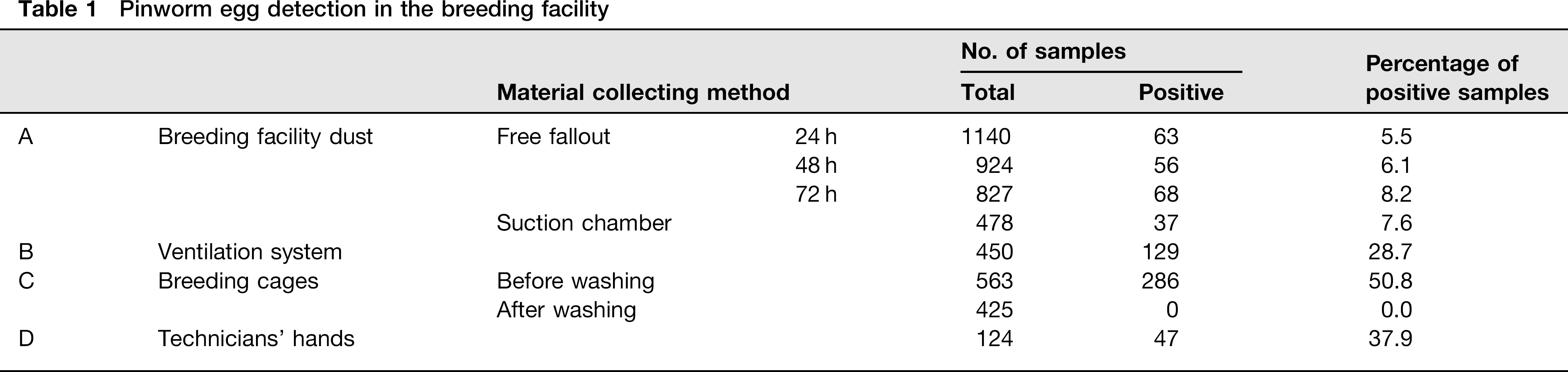
Half of the samples taken from the breeding cages (prior to being washed) were positive for pinworm eggs (50.8%) (Table 1). Technical staff hand examination indicated a positive detection in 37.9% of cases (Table 1).
Discussion
Tracking the possible transmission of pinworm infection in laboratory rat breeding facilities is an important step in introducing effective preventive measures.
In this study, the presence of pinworm eggs in breeding room dust, caged laboratory rats, as well as on the hands of technical staff was monitored. The possibility of pinworm egg transmission through air has been previously mentioned in literature; however, information is very sporadic and lacks precise data.5,6,9
This study demonstrated the occurrence of eggs in breeding room dust, despite the low numbers of positive samples (5.5–8.2%). However, collecting eggs in the ventilation system proved to be much more effective – in this case 28.7% of the samples tested positive. Of course, this was due to the duration of the material accumulation in the device (2 months). The number of eggs on the grid is not reported in this study, with the exception of one case wherein one or two eggs were repeatedly determined. These experimental results clearly point to the possibility of pinworm egg transmission through air. The eggs can then contaminate food and water, aid in breeding establishments and subsequently serve as a potential source of infection for animals.
Another means of pinworm egg transmission in laboratory rodent breeding facilities is through direct contact. Transmission in this way has been described in literature, although experimental work on this issue is lacking.5,10 This study focused on monitoring the possibility of transmission through contaminated laboratory aids (breeding cages) and technical staff.
Prior to being washed, 50.8% of breeding cages tested positive, while technical staff hand screening indicated positive detection in 37.9% of cases.
From these results it is clear that air, contaminated equipment and technical personnel who work in laboratory animal breeding facilities may serve as a transmission vector of pinworms eggs. These eggs are highly resistant to various environmental factors such as cold temperatures, drying and exposure to disinfectant. However, pinworm eggs are sensitive to heat, which is used to facilitate their elimination. 7
A very important feature of eggs is their light weight, which allows them to be transmitted through the air, allowing contamination of large areas.
9
For this reason it is recommended to periodically eliminate breeding room dust using disinfectants. Disinfectants must be used at approved concentrations in order not to irritate the animals; however, they must be effective against pinworm eggs as well other pathogenic agents. Dix
However, regular cleaning designed to mechanically remove infectious material remains the basis of prevention.
Footnotes
Acknowledgements
The authors have no financial or personal relationships with individuals or organizations that could inappropriately influence or bias this work. This study was supported by the Research Project of the Institute of Physiology, Academy of Sciences of the Czech Republic, v.v.i. No. AV0Z50110509. All manipulation in the breeding facility was conducted in compliance with the Animal Protection Act.