






Abstract
In this study, we investigated the prevalence of infectious microorganisms (viruses, bacteria, fungi and eukaryotic parasites) in mice from different pet shops in Germany; such animals may compromise the hygienic integrity of laboratory animal vivaria if private pet holders act as unintended vectors of infections carried by them. House mice sold as pets or feed specimens were purchased from different pet shops and tested for a comprehensive panel of unwanted microorganisms. We found a number of microorganisms in these pet shop mice, the most prevalent of which were
Laboratory animal facilities invest a great deal of time and money to keep their vivaria free from unwanted microorganisms. Direct contact to infected conspecifics is clearly the most important risk factor, 1 hence sophisticated quarantine and testing regimes are usually in place to prevent infections brought in by imported animals. However, other latent threats to the specific pathogen free (SPF) status of laboratory rodents may lie in simple, yet not fully controllable routes of infection with a more indirect and/or covert nature. One such route is potentially provided by rodents used as private pets or feed specimens. Virtually all rodent species used in medical research (e.g. mice, rats, guineapigs, hamsters, gerbils) are also sold in pet shops. As these shops presumably have much lower hygienic standards than those applied by established laboratory animal breeders, an influx of infectious agents by pet-owning researchers or animal keepers is a risk for laboratory animal facilities.2,3 In order to minimize the risk posed by this potential route of infection, it is important to get a clear picture of its extent, i.e. the array of infectious organisms circulating in pet populations. We therefore investigated the prevalence of unwanted microorganisms in mice from different pet shops in Germany.
Animals were purchased from six different pet shops (5 in North Rhine-Westphalia, Germany, 1 in Brandenburg, Germany). In each pet shop, we assessed the origin of the mice being sold and took care that none of the shops obtained their animals from the same breeder. Hence each shop represented an independent breeding population. We obtained 2–6 mice from each pet shop (depending on availability) to a total of 11 females and 17 males. These animals entered the study at a minimum age of 12 weeks. Each individual was sacrificed by cervical dislocation and tested for viruses, bacteria and parasites as listed in Table 1. Prevalence was defined as the percentage of animals found positive for the agent tested. For serological analyses, the presence of agent-specific antibodies was generally determined by using validated in-house immunofluorescence assays as the primary test method. In-house or commercially available enzyme-linked immunosorbent assays (ELISA) or in-house haemagglutination inhibition assays were used as confirmatory test methods (Table 1). In-house assays were carried out as previously described;
4
commercial ELISA (Charles River Laboratories, Wilmington, MA, USA) were performed according to the manufacturer's standard protocol. For bacteriological and fungal analyses, tissue samples, swabs and intestinal content of each animal were cultured on blood agar plates (Oxoid GmbH, Wesel, Germany, bioMérieux, Nürtingen, Germany). Further bacteriological investigation was carried out using Gram staining, selective agar plates (Brilliant Salmonella, ColiC – Oxoid GmbH; McConkey, SAID – bioMérieux), oxidase test (bioMérieux), commercial biochemical test systems (ID 32 E, API 20 E, API 20 NE, API Coryne, RAPIDEC Staph, ID 32 Staph, Rapid ID 32 Strep –bioMérieux; Remel RapID STR – Oxoid GmbH) and polymerase chain reaction (PCR) assays (for identification of Pasteurellaceae and
Screening panel and results
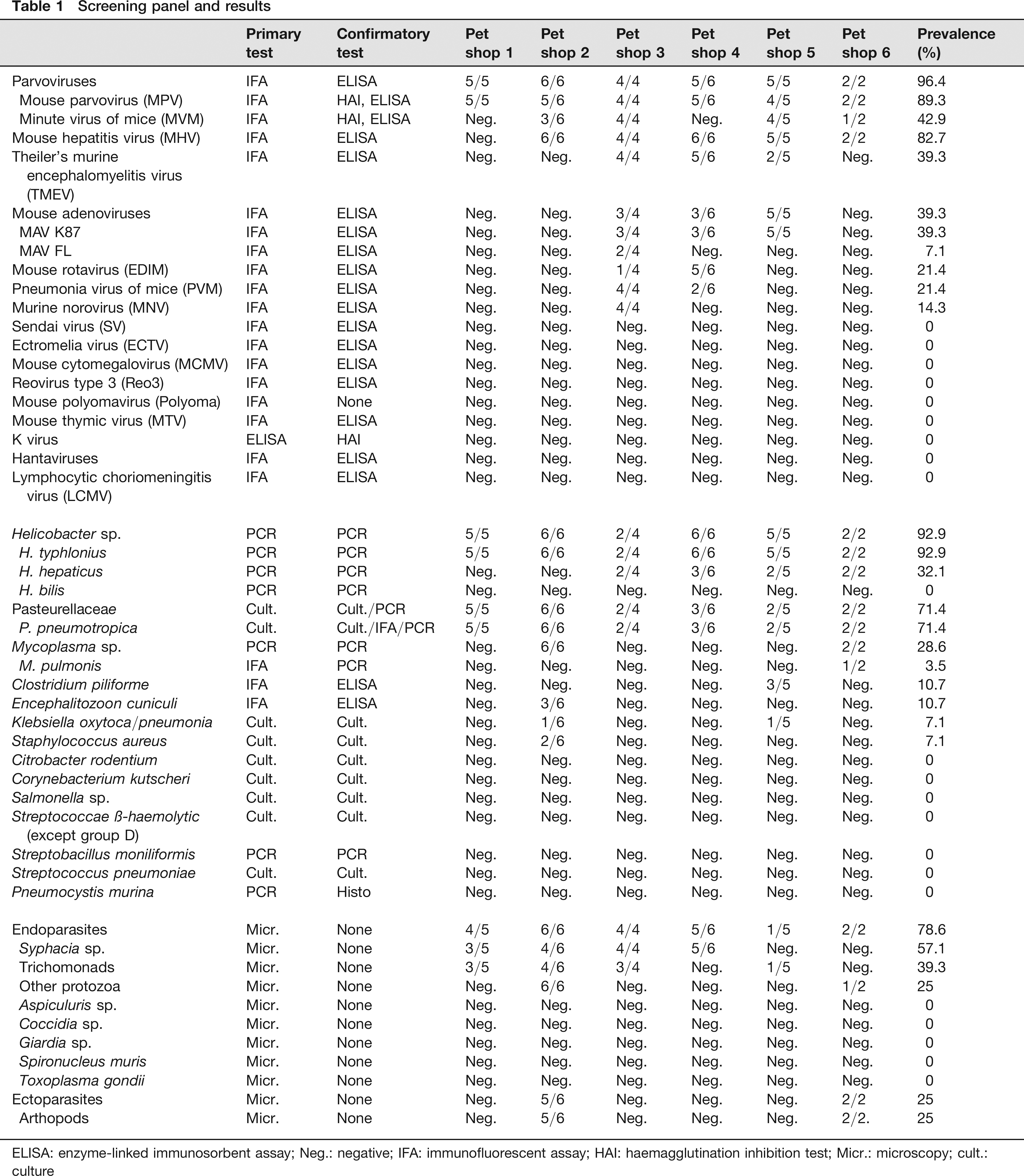
ELISA: enzyme-linked immunosorbent assay; Neg.: negative; IFA: immunofluorescent assay; HAI: haemagglutination inhibition test; Micr.: microscopy; cult.: culture
Parasitological investigations were carried out using light microscopy. Wet smears of caecal content and small intestine were examined immediately after euthanasia (within 10 min) for intestinal protozoa and
All mice except one (96.4%) tested positive for parvoviruses, mostly mouse parvovirus (MPV) (89.3%). Also, about 80% of mice had antibodies against mouse hepatitis virus (MHV). Other viruses had somewhat lower, yet still noticeable prevalence (i.e. minute virus of mice [MVM], Theiler's murine encephalomyelitis virus [TMEV], MAV K87, mouse rotavirus [EDIM], pneumonia virus of mice [PVM]: all between 20% and 50%). Circulating viruses with relatively low prevalence were murine norovirus (MNV) (14.3%), followed by MAV FL (7.1%). The other viruses in our test panel were not found.
More than 70% of the mice tested positive for at least one endoparasite. The most prevalent parasitic infection was
To the best of our knowledge, this study represents the first comprehensive microbiological screen of pet shop mice. Our results show that mice sold in randomly chosen pet shops harbour a wide array of infectious microorganisms that have been listed by the Federation of European Laboratory Animal Science Associations as ‘unwanted’ in stocks of laboratory rodents 13 due to their potential to cause clinical disease and/or to influence the outcome of medical experiments.
The prevalence rates of the organisms most commonly detected in pet shop mice, especially of parvoviruses, MHV,
The most seroprevalent viruses in pet shop mice were parvoviruses (especially MPV) and MHV, all of which have been shown to be among the most commonly detected viruses in laboratory mice, too.14–18 Parvoviruses are highly resistant to environmental challenges such as desiccation or changes in temperature19–22 and may affect research results by altering their host's immune functions,22–25 development or growth of neoplasms 25 or tumour allograft rejection. 24 On the other hand, the prevalence of MNV was much lower in pet shop mice (14.3%) than in laboratory mice (around 32%). According to recent studies, the latter appear to be infected with this virus more often than with any other virus which is routinely tested for,16,17 mostly because its detection only became possible with the development of appropriate test systems a few years ago.26–28
Where bacterial and fungal infections are concerned, the prevalence ranking in pet shop mice broadly mirrors results from laboratory mice, which were also reported to harbour
With regard to eukaryotic endoparasites, the relatively high infection rate of pet shop mice with
Interestingly, the pet shop mice of this study harboured a number of microorganisms that had much lower prevalences or were even absent in similar studies conducted on wild mice in North America,
38
Australia
39
and Western Europe.
40
For example, MPV had prevalences of only 12%, 33% and 59% in wild mice, respectively, compared with nearly 90% in our sample. Similarly, only 0–2% of wild mice but nearly 40% of the pet shop mice tested positive for TMEV. PVM could not be detected in any of the wild mouse studies,38–40 but was found in about 21% of our sample. The same appears to be true for certain non-viral organisms like E.
In Germany, more than one out of three households own at least one pet, totalling 22.6 million pets in Germany overall. Of these, 5.6 million (in 5.4% of all households) are small animals, predominantly rodents including mice. The latter are being held either for their own sake or as food for other (carnivorous) pets, e.g. reptiles, which represent an additional 0.4 million (1.2% of all households) terraria (all data refer to 2009;
Footnotes
Acknowledgements
We thank the two anynomynous reviewers for constructive comments on an earlier version of this manuscript.