






Abstract
The severity classification of procedures using animals is an important tool to help focus the implementation of refinement and to assist in reporting the application of the 3Rs (replacement, reduction and refinement). The recently revised Directive that regulates animal research and testing within the European Union requires Member States to ensure that all procedures are classified as ‘non-recovery’, ‘mild’, ‘moderate’ or ‘severe’, using assignment criteria set out by the European Commission (EC). However, these are focused upon terrestrial species, so are of limited relevance to fish users. A Working Group set up by the Norwegian Consensus-Platform for the 3Rs (Norecopa) has produced guidance on the classification of severity in scientific procedures involving fish, including examples of ‘subthreshold’, ‘mild’, ‘moderate’, ‘severe’ and ‘upper threshold’ procedures. The aims are to complement the EC guidelines and help to ensure that suffering in fish is effectively predicted and minimized. Norecopa has established a website (www.norecopa.no/categories) where more information on severity classification for procedures using fish, including field research, will be made available.
Background
An effective prediction of the effects of a research protocol on the animals concerned helps to ensure that any pain, suffering or distress they may experience will be effectively anticipated, recognized and alleviated. This is essential not only for animal welfare but also for scientific validity, because physiological and behavioural responses to suffering can significantly affect data quality. Severity classification is thus an important tool to help focus the implementation of refinement, including monitoring its progress, and to assist in reporting the application of the 3Rs (replacement, reduction and refinement) of Russell and Burch, 1 which is now an integral part of the legislation on animal research and testing in many countries. Predictions of severity are also fundamental to the harm–benefit assessments undertaken by bodies such as regulatory authorities and ethical committees when deciding whether or not a project should be licensed or funded.
There may also be a legal requirement to predict and classify severity. For example, the new Directive regulating animal use within the European Union, which must be implemented within all Member States by January 2013, requires the severity of each procedure to be classified on the basis of the ‘degree of pain, suffering, distress or lasting harm expected to be experienced by an individual animal during the course of the procedure’, with the aim of enhancing transparency, facilitating the project authorization process and providing tools for monitoring compliance. 2 Member States will have to ensure that all procedures are classified as ‘non-recovery’, ‘mild’, ‘moderate’ or ‘severe’ on a case-by-case basis, using the assignment criteria set out in a European Commission (EC) Working Group report on severity classification. 3 This focuses heavily on procedures that are relevant to terrestrial laboratory animal species.
One of the activities of Norecopa, Norway's Consensus-Platform for the Replacement, Reduction and Refinement of animal experiments, is to arrange international consensus meetings on harmonization of the care and use of animals in research. At a Norecopa meeting in September 2009, the participants produced a consensus statement describing actions that should be taken to advance the welfare of fish in research. 4 Norecopa subsequently produced a list of tasks needed to increase the implementation of the 3Rs in fish research. 5 One of these tasks was to produce the present document, which aims to complement the EC report on severity classification by providing examples of scientific procedures using fish. These are listed in Tables 1–5. Some relevant examples from the EC report, with comments where appropriate, have been included in the tables, to aid comparison. Norecopa has established a website (www.norecopa.no/categories) where more information on severity classification for procedures using fish, including field research, will be made available.
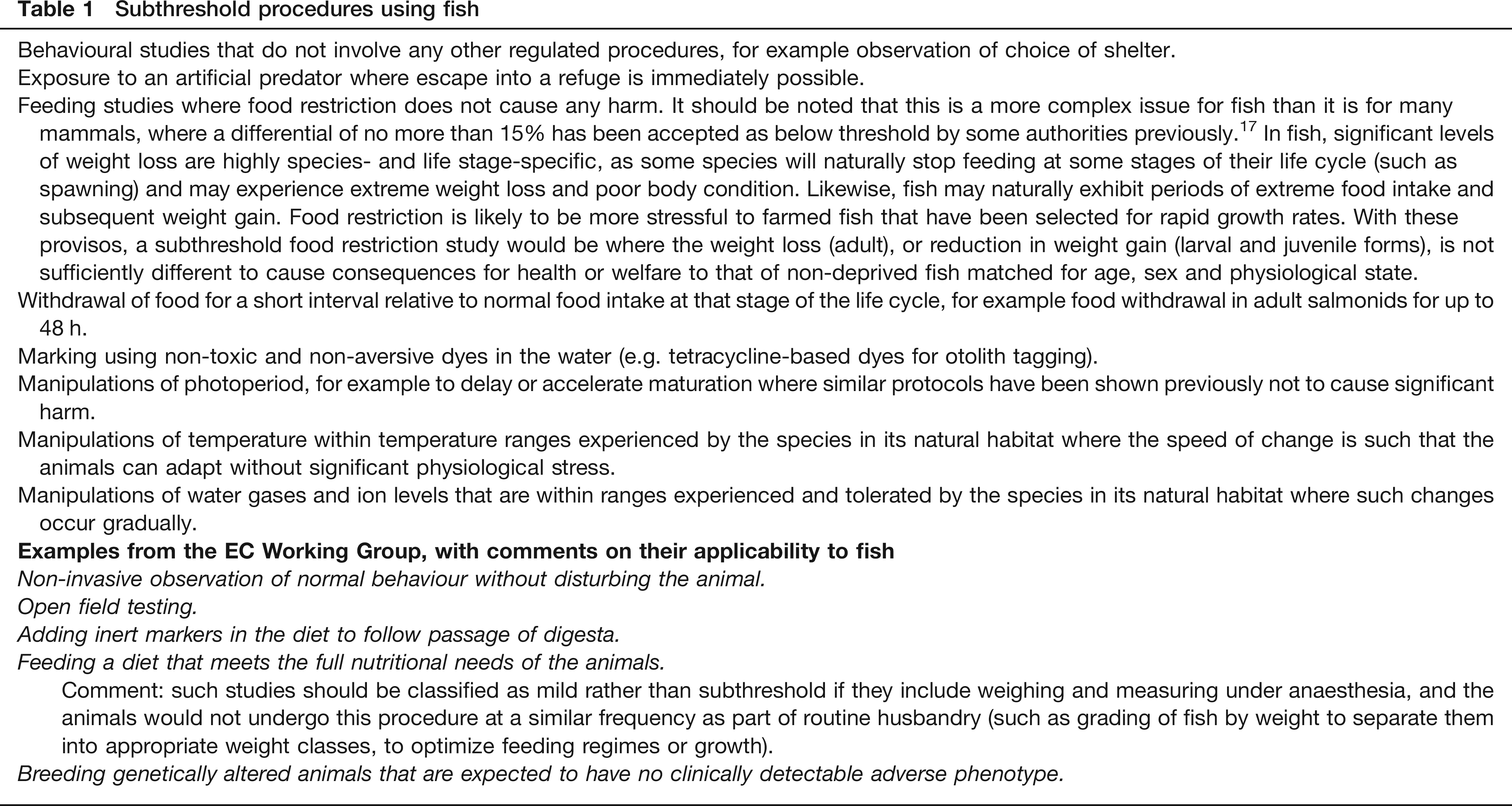
Subthreshold procedures using fish
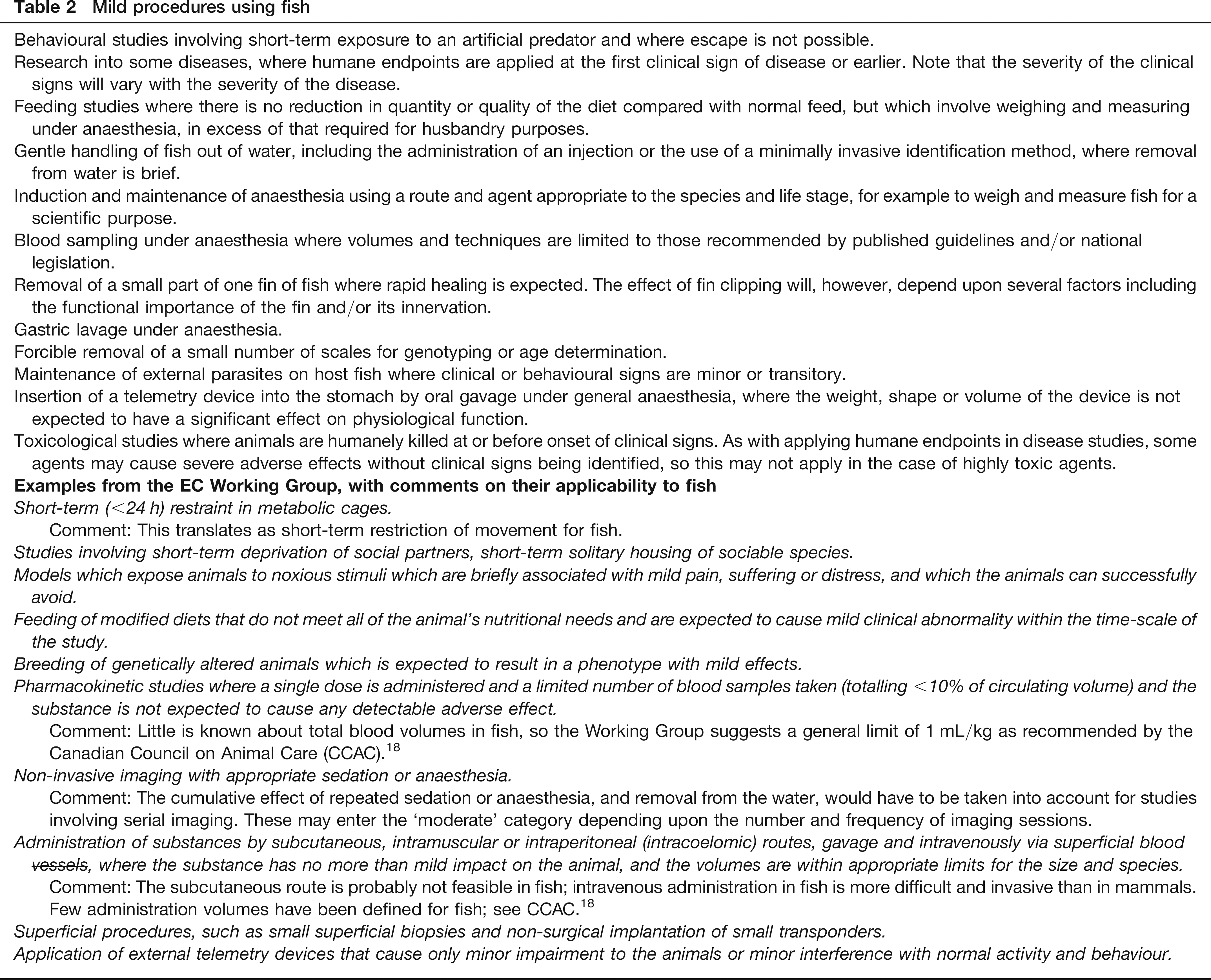
Mild procedures using fish
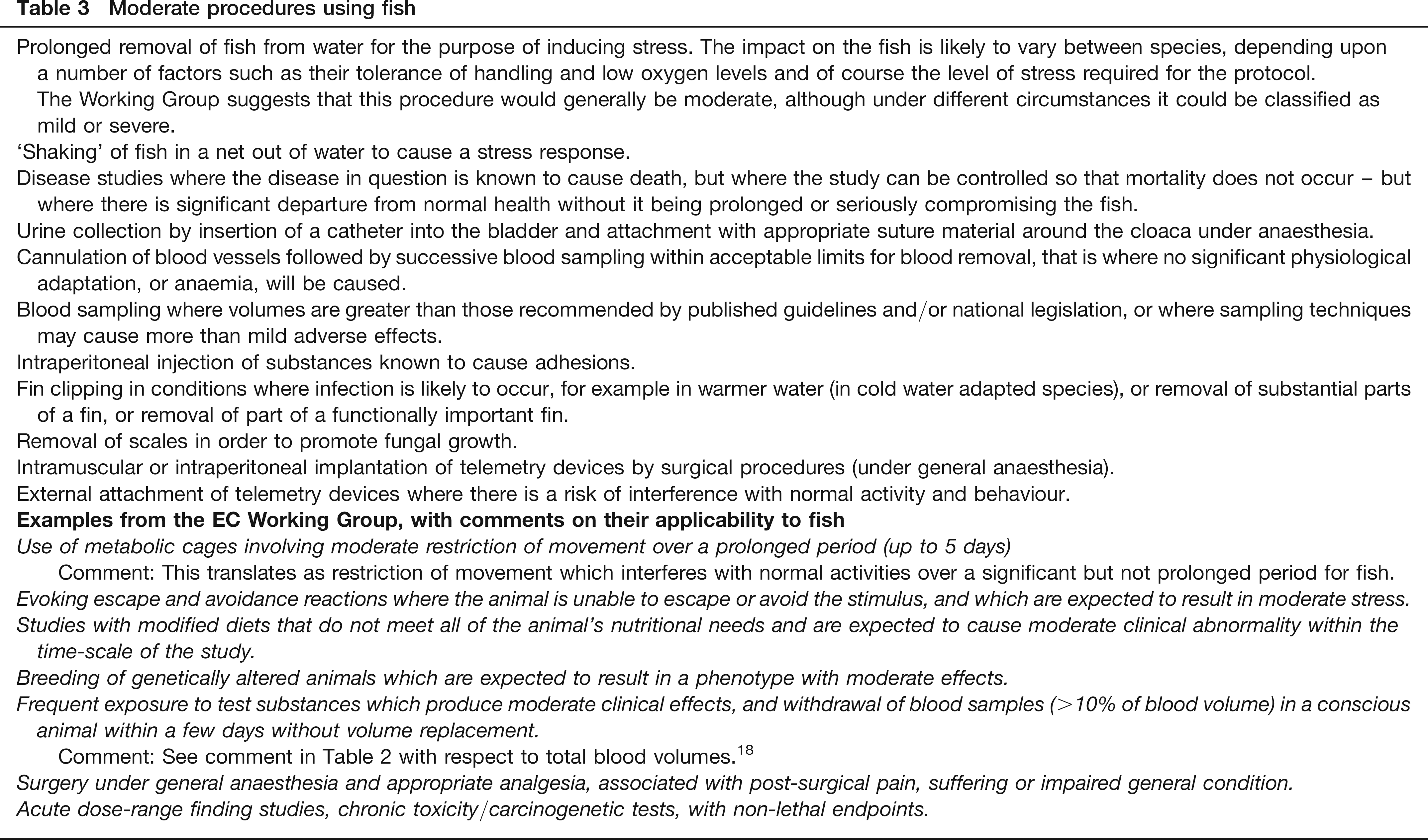
Moderate procedures using fish
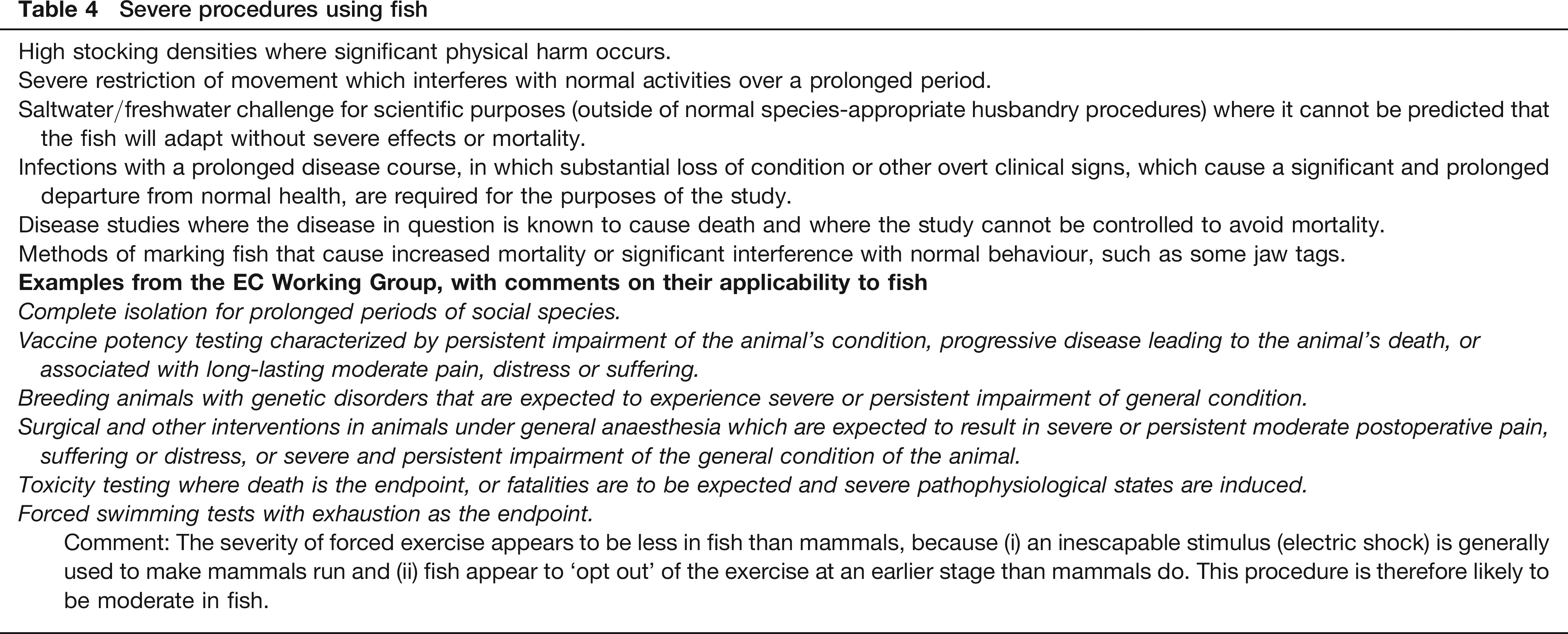
Severe procedures using fish
Upper threshold procedures using fish

Special considerations for fish species
Classification of the severity of procedures when using fish can be problematic for a number of reasons.
Removal of fish from water can increase severity
Many protocols involve catching and handling fish, which in itself can be difficult, and some protocols involve exposing fish to air. Although fish are routinely removed from water for many procedures (such as vaccination) without complications, the possibility of injury should always be considered. Removal from water can cause complications such as scale loss or gill collapse and can cause stress even in the absence of any physical injury. This can add to the overall severity of the procedure, with both scientific and animal welfare implications.6–9 For example, the results of toxicological trials have been affected by the degree of handling stress and disturbance experienced by fish. 10
It is good practice to avoid handling fish, or to handle them in containers to avoid exposure to air, where possible. 11 Handling could be refined by using sedation or anaesthesia, noting that some anaesthetic and sedative agents may be aversive, so that any potential benefits of using these would need to be considered against the stress caused to the fish. Ideally, the anaesthetic or sedative would be added to the home tank to avoid handling, although this may not always be practicable.
The Working Group suggests that it may be possible to reduce the negative impact of stressors, such as netting, by training the fish to associate them with positive events. For example, one approach could be to offer a food reward as the fish enters the net, delaying routine feeding until after this procedure if necessary.
The severity of many procedures is species-specific within fish
There are over 25,000 species of fish, living in a wide range of habitats. To treat ‘fish’ as one group is probably even less meaningful than to attempt to produce guidelines for ‘mammals’. As fish are the most diverse of all vertebrate classes, it is highly likely that the impact of a given procedure will vary between species. Criteria for the categorization of severity in fish within individual projects should thus address species-specific and individual variations in the suffering associated with procedures and other stressful events such as capture, handling and immobilization, particularly when procedures are performed out of water.
In addition to the high degree of interspecific variation, many species of fish undergo large physiological changes as a natural part of their life cycle. This may well mean that the same procedure will affect different age groups in different ways. For all of these reasons, this report can only provide general guidance and should be interpreted in conjunction with specialist advice on each species. There is unfortunately a lack of species-specific guidelines on refining fish care and use at present; however, this should not be used as an excuse to accept lower standards than those that would be applied to terrestrial vertebrates.
The detection and alleviation of pain, suffering and distress in fish can be problematic
A recent report identifying knowledge gaps relating to the welfare of fish used in research highlighted the need for better indicators of pain, suffering and distress. 12 Currently available indicators include clinical signs in individual fish (for example, respiratory rate, food consumption and health status) and signs of stress in groups of fish (such as social behaviour and activity level). These indicators should be observed and recorded daily. 11
Techniques to manage pain in fish are in their infancy and are largely based on extrapolations from protocols developed for use in mammals. There is an urgent need to develop effective methods to detect and alleviate suffering for each of the commonly used species. Better indicators would not only facilitate the correct prediction and classification of severity, but would also help to ensure adequate pain alleviation, which could allow the transfer of a procedure to a milder severity class.
Societal perceptions of fish can vary
There has traditionally been more tolerance of stress, disease and mortality as an endpoint in fish research, compared with research using mammals, which probably reflects general attitudes to fish in society. 13 Any such attitudes should be challenged within a research setting.
Mortality rates in fish can be naturally high
Assessment of the severity of a procedure in fish is complicated by the fact that high mortality rates are often observed in natural populations, particularly during the developmental stages. This may sometimes make it difficult to distinguish deaths caused by the experiment from natural mortality, although mortality of adult fish is more likely to be a result of poor techniques or husbandry standards than is larval mortality.
Severity classification for procedures using fish
The examples in Tables 1–5 follow the classifications used in the EC report. Those that are identical to (or closely resemble) examples given in the EC report are grouped together in the bottom half of the tables.
When considering these examples, it is important to note that it is assumed that all procedures, including capture and handling, are fully refined and performed optimally by competent persons. Also, assessment of severity should include an overall assessment of the total harm or distress produced by a procedure or study, that is, the cumulative suffering caused by potentially distressing elements. For example, factors such as water quality parameters, handling techniques and husbandry can all affect cumulative severity. Repeated procedures that are not particularly invasive or even below threshold may, over a period of time, result in significant suffering for the animal concerned; particularly if they are not given sufficient time to recover between them. This is especially relevant for fish where procedures involve removal from water, for example repeated blood sampling may result in greater cumulative suffering for fish than mammals. All of this should be borne in mind, especially when considering the procedures classified in this document as ‘mild’ (see Table 2). Other points to note are that the duration of a procedure is relevant to its severity classification, and changes in the definition and application of an endpoint may move a procedure from one category to another.
The guidance in this document differs from the EC report in that it takes account of identification methods such as marking and tagging, because in fish these can be sufficiently invasive to contribute to the cumulative severity of the procedure, even if the tagging is conducted for husbandry purposes. In such cases, the impact on the animal should be taken into account, regardless of the different purposes of the procedures. For example, the introduction of a coded wire tag (CWT) into the nose, dorsal fin or other cartilagenous area has the potential to cause discomfort or pain. There are other issues associated with tagging aquatic species that can add to severity; for example, Carlin tags may be fouled by seaweed and shellfish, leading to increased mortality rates. 14 In addition, the Working Group believes that there is a need for more research into the effects of commonly used marking methods such as removal of the adipose fin, which may have greater consequences than commonly believed. 15
The EC report also contains many examples of procedures that are not commonly conducted on fish. There are also a number of procedures, such as electrofishing for capture 16 that are not used in mammals and where the severity of the technique is likely to vary considerably between species and is also dependent upon the equipment used.
Subthreshold
The examples in Table 1 are considered to fall below the lower threshold for regulation under the EC Directive. The EC Expert Group Report defines this as follows:
The lower threshold is exceeded if the animals may experience a level of pain, suffering or distress equivalent to, or higher than that caused by the introduction of a needle. Furthermore, the administration of anaesthesia for scientific purposes (excluding euthanasia) will bring a procedure above the lower threshold. Other types of lower thresholds are necessary for determining equivalence for specific research procedures ... It is important to note that applying several such (‘below threshold’) techniques together in one animal may require the procedure to be classified as mild or higher. 3
Mild
The examples in Table 2 correspond to the ‘mild’ category in the EC Directive. The EC Expert Group Report defines this as follows:
Procedures on animals as a result of which the animals are likely to experience short-term mild pain, suffering or distress. Procedures with no significant impairment of the wellbeing or general condition of the animals. 3
Moderate
Table 3 lists examples within the ‘moderate’ category in the EC Directive, defined by the EC Expert Group Report as:
Procedures on animals as a result of which the animals are likely to experience short-term moderate pain, suffering or distress, or long-lasting mild pain, suffering or distress. Procedures that are likely to cause moderate impairment of the wellbeing or general condition of the animals. 3
Severe
The examples in Table 4 would be ‘severe’ according to the EC Directive, defined by the EC Expert Group Report as:
Procedures on animals as a result of which the animals are likely to experience severe pain, suffering or distress, or long-lasting moderate pain, suffering or distress. Procedures that are likely to cause severe impairment of the wellbeing or general condition of the animals. 3
Upper threshold
Table 5 lists examples of procedures that the Working Group believes would fall above the upper threshold. According to the EC Expert Group Report:
The upper threshold is exceeded if the animals may experience severe pain, suffering or distress which is likely to be long-lasting and cannot be ameliorated. 3
Article 55 of Directive 2010/63/EU permits Member States that deem it necessary to allow the use of a procedure that exceeds the upper threshold to adopt a provisional measure to allow the procedure. 2 The Member State must then inform the Commission, which will put the matter before a Committee which will decide whether to permit the provisional measure or require it to be revoked. The EC Working Group Report did not provide any examples of procedures above the upper threshold.
Conclusion
Many procedures that are commonly performed on terrestrial laboratory animals have very different welfare implications when applied to fish, partly because of the inherent difficulties in the capture and handling of aquatic species. This, coupled with the biological variation exhibited in the large number of fish species involved, and our limited understanding of their welfare requirements, makes it difficult to offer detailed guidelines for classifying the severity of procedures on fish. Many common procedures are undoubtedly a greater challenge in fish than in terrestrial animals: these include (but are not limited to) marking, blood sampling, anaesthesia and analgesia.
The examples in this document are intended to facilitate severity classification, be an aid to discussion and to stimulate further research in this area. It will be up to the individual regulator, researcher and animal welfare officer to ensure that the 3Rs are fully implemented, including humane endpoints, regardless of the category in which a procedure has been placed.
Footnotes
Acknowledgements
The authors are very grateful for comments that have been received from participants at Norecopa's international consensus meetings and other fish experts during the development of this document. We welcome further comments, which may be sent to Penny Hawkins (