






Abstract
Rodent toxicity studies typically use water bottles to administer test chemicals via drinking water. However, water bottles provide inconsistent exposure of volatile chemicals due to varying headspace, and lead to excessive waste of test material. To refine drinking water toxicity studies in rodents by enhancing sample quality and consistency, and minimizing waste, we designed and implemented a novel water delivery system that keeps the water chilled, headspace free and protected from light. Materials used were resistant to chemical interaction. In this gravity-fed system, a 6-L Teflon® water bag, stored in a polystyrene cooler on the cage rack, was connected to a stainless steel manifold delivering water to five cages via specialized drinking valves. Due to the absence of headspace in the water bag, this system allows consistent exposure of volatile chemicals. In addition, small diameter tubing throughout the system reduces the amount of test material residing in the system and minimizes chemical waste.
In rodent toxicity studies involving drinking water exposures, water bottles are typically used to administer drinking water containing the test chemicals. Water bottles are advantageous in that they are readily available and allow the measurement of water consumption of individual animals; however, they also present several limitations that are of concern for some toxicity studies. Considerations in a water delivery system include (1) inconsistent exposure of volatile chemicals due to varying headspace, (2) reduced stability of heat-sensitive chemicals, (3) instability of light-sensitive chemicals, (4) interaction of chemicals with the materials in the water delivery system, (5) leaching of chemicals from materials used in the water delivery system and (6) excessive waste of test material. The ability to conduct
To address these concerns in a recently conducted multigenerational reproductive toxicity study of a mixture of disinfection by-products in rats,3,4 we designed and successfully implemented a novel water delivery system that keeps the water chilled, headspace free, protected from light, and is made with materials that are resistant to chemical interaction. This gravity-fed system's main components include water bags, polystyrene coolers to hold and insulate the water bags, tubing to distribute the water to several cages and specialized drinking valves to deliver the water to the animals. Stainless steel, fluorinated ethylene propylene (FEP), and perfluoroalkoxy (PFA) materials were used to minimize adsorption of test chemicals to the delivery system and also to minimize leaching of contaminants into the treated water. Small diameter tubing was used to reduce the amount of water residing in the tubing and to minimize waste of test material.
Water bags (8″ × 6″ × 8″ h, 20.3 × 15.2 × 20.3 cm, approximately 6 L capacity) were custom made (Welch Fluorocarbon, Dover, NH, USA) of Teflon® FEP (5.0 mil, 0.005″, approximately 0.13 mm thick). Each bag was equipped with a sealable flat tube at the top to release air and a water port at the bottom of a wide side (Figure 1); the port was equipped with a 1/4″ (0.635 cm) stainless steel fitting (Swagelok®, Solon, OH, USA), a silicone rubber gasket (0.062″, 0.157 cm thick) on the outside of the bag and a Teflon® PFA washer (60.0mil, 0.06″, approximately 1.52 mm thick) on the inside of the bag. Each bag fit snugly inside a polystyrene cooler (outer dimensions: 11″ × 9″ × 12″ h, 27.9 × 22.9 × 30.5 cm; inner dimensions 8″ × 6″ × 9″ h, 20.3 × 15.2 × 22.9 cm). A hole, approximately 2.5 cm diameter, cut on a wide side of the cooler, allowed PFA tubing (1/4″ outer diameter, 0.062″ wall, approximately 15 cm long) to extend from the bag's water port to a manifold. The tubing was covered with black duct tape to keep out light. A quick connect body (Swagelok®) was attached at the end of the tubing for easy joining of the bag-cooler unit with the manifold or a pump. Pumps (Micropump®, Vancouver, WA, USA), with magnetic drive stainless steel pump bodies with PTFE (polytetrafluoroethylene) bushings and O-rings, were used to transfer water into and out of the bags.
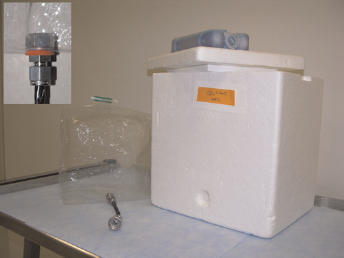
The water bag (left) incorporates a flat tube (with a clip-and-seal) on top to release air and is equipped with a port fitting (inset), which is connected to a perfluoroalkoxy (PFA) tube wrapped in black duct tape. The bag fits snugly inside a polystyrene cooler (right) which has a hole to accommodate the PFA tube. An ice pack (shown here on top of the cooler) is placed in the cooler on top of the bag
Each bag-cooler unit was placed on top of the cage rack in line with a vertical manifold that distributed water to the five cages below (Figure 2). The manifold, supported by a vertical aluminum bar, was comprised of a quick connect stem (Swagelok®) at the top (for easy connection to the quick connect body on the Teflon® tubing), stainless steel tubing (1/8″, 0.318 cm, outer diameter; 0.028″, 0.071 cm, wall thickness), five stainless steel male branch tee fittings (Swagelok®), and a stainless steel cap (Swagelok®) at the bottom. The cap was removed when flushing the line. These assemblies were located at the back of the rack.
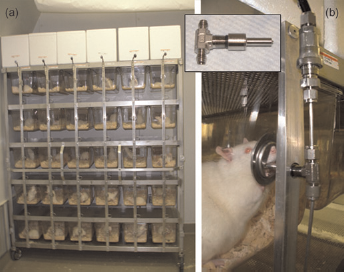
(a) Coolers containing Teflon® water bags sit on top of the animal rack; each cooler-bag unit provides water to the five cages below it. (b) A rat is shown drinking from a drinking valve which is connected to stainless steel tubing via a branch tee (inset). A quick connect assembly joins the stainless steel tubing to perfluoroalkoxy (PFA) tubing (covered with black duct tape) which extends from the bag-cooler unit above
Modified drinking valves delivered water from the manifold to the animal cages. Sipper Sack® drinking valves (Edstrom®, Waterford, WI, USA) were machined to press fit into the reamed out bore of the male pipe end of the branch tee (Figure 2); in some cases, a Viton® O-ring was used to seal the connection. These drinking valves were designed to operate under low water pressure and prevent backflow of contaminants into the water supply.
Routine operation of the watering system involved filling each water bag with the appropriate water for its designated treatment group; weighing the bag-cooler unit; placing it on the cage rack, and connecting it to the manifold. Prior to each use, drinking valves were checked manually to ensure that there were no air traps in the manifold and that the system was operating properly. A frozen ice pack (e.g. Blue Ice® Block, Rubbermaid Inc, Atlanta, GA, USA), placed in the cooler on top of the bag, was replaced daily to keep the water chilled. The bag-cooler unit was weighed periodically to determine water consumption.
Because each bag supplies water for up to five cages, it is not possible to measure water consumption for individual animals; however, statistical models may be used to estimate individual consumption values (manuscript in preparation). As in studies with multiple animals housed per cage, water consumption can still be compared across treatment groups. Also, when allocating animals to treatment groups, cages in the same treatment group must be placed in columns in order to share the same water bag. Although such cage placement is restricted by column, it avoids confounding by horizontal cage row, which is known to affect body weight and other endpoints.5–7
In closing, we successfully implemented this system to deliver treated water to rats in a multigenerational toxicity study.3,4 This system, suitable for rats as well as other laboratory rodents, offers several important features. In addition to enhancing stability of temperature- and lightsensitive chemicals, it allows consistent exposure of volatile chemicals due to the absence of headspace. Moreover, use of the system reduces the amount of labour involved when feeding water to large numbers of animals and also minimizes the amount of chemical waste.
Disclaimer
The information in this document has been funded wholly by the US Environmental Protection Agency. It has been subjected to review and approved for publication by the National Health and Environmental Effects Research Laboratory and National Risk Management Research Laboratory. Approval does not signify that the contents reflect the views of the Agency nor does mention of trade names or commercial products constitute endorsement or recommendation for use.
Footnotes
Acknowledgements
We thank David Midgley and Scott Behner for designing the water bags used in this system.