



Abstract
There is growing evidence that bainitic ferrite which retains a substantial amount of carbon in solid solution does not have cubic symmetry. We provide additional data on a different nanostructured bainitic steel to support this evidence, based on synchrotron X-ray diffraction experiments. The data are consistent only with a displacive transformation mechanism for bainite.
Introduction
It has been demonstrated that large concentrations of carbon remain in solid solution within defect-free regions of bainitic ferrite;1–3 this evidence has come to light because of the discovery of nanostructured bainite which forms at exceptionally low temperatures.4–6 The carbon concentrations observed in solution require explanation because the bainite forms at temperatures where the ‘excess carbon’ ought to partition into the residual austenite given the paraequilibrium phase diagram between body-centred cubic ferrite and austenite. The process of carbon diffusion is certainly not limited by the lack of thermal activation in the time and temperature domain where bainite forms. 7
A possibility suggested by first-principles calculations, and the fact that the bainite forms initially by a diffusionless, displacive transformation mechanism, is that the symmetry of the ferrite is not cubic. In steels, the Bain strain 8 would then necessarily leave the ferrite in a tetragonal state since randomly distributed carbon atoms in austenite would effectively be ordered into just one of the three sub-lattices of octahedral sites in the ferrite (e.g. Refs. 9–11). The first-principles calculations 12 then suggested that the equilibrium solubility of carbon in the tetragonal ferrite that is in contact with austenite would increase significantly, thus explaining the reluctance of carbon to partition into the austenite. The tetragonal ferrite should eventually relax towards the cubic form as processes associated with tempering take hold, but at a rate slower than expected with the cubic form.
In this scenario, it is possible to detect tetragonality in the bainitic ferrite containing the excess carbon. The first evidence for this was reported in nanostructured bainite characterised using synchrotron X-rays 13 in a steel of composition Fe–0·84C–2·26Mn–1·78Si–1·55Co–1·47Cr–0·25Mo–0·11V (wt-). In an independent study, different thermal expansion coefficients measured along the unit-cell axes for ferrite have been found in a lower carbon alloy. This is only possible with a non-cubic unit-cell. Similarly, other X-ray diffraction data and lattice imaging using high resolution microscopy are consistent with residual tetragonality in the bainitic ferrite lattice. 14
The purpose of the present work is to supplement the evidence with new data on a different steel capable of transforming into nanostructured bainite, currently part of a separate study. The chemical composition is Fe–1·037C–3·89Si–1·97Mn–0·24Mo–1·43Al (wt-). Material was homogenised and samples spark machined to 3 mm diameter rods. These rods were sealed in quartz ampules filled with argon and austenitised at 1050°C for 30 min. While hot, the samples were transferred to a low temperature oven capable of controlling the temperature to a precision of ±0·1. Once in the oven, the quartz ampules were smashed and the sample left to air-cool. Two isothermal transformation heat treatments were conducted, at 200°C for 10 days, and at 300°C for one day. Under these conditions, bainitic ferrite is expected to form with the maximum dissolved carbon content. Samples were finally turned on a lathe to a diameter of 2 mm to maximise X-ray transmission and improve temporal resolution; using optical microscopy, no plastic deformation could be detected at the surface to a depth of <5 μm. The experiment was performed on the P02·1 beam line at DESY, Hamburg, Germany. The X-rays (wavelength = 0·2069 Å) were measured by an area detector and recorded as a TIFF with 32-bit dynamic range.
It was found during analysis that it was impossible to achieve a satisfactory fit using Rietveld refinement if carbides were included and therefore only austenite and ferrite were included in analysis. During Rietveld analysis, the background function (fifth order polynomial), incident X-ray intensity, austenite phase fraction and for both phases: lattice parameter(s), crystallite size and microstrain were refined. All other parameters were fixed. The phase fraction of ferrite was set to be the residue of the sample. Microstrain and crystallite size were assumed to be isotropic.
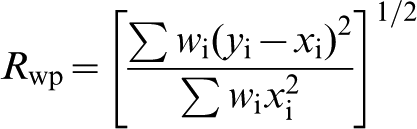
The goodness-of-fit for each refinement was assessed by using the weighted profile R-factor Rwp. Rwp is defined in equation 1, where xi is the observed intensity at the ith data point, yi is the calculated intensity, wi is equal to the inverse of the square of the standard uncertainty in the observed intensity  and the summations are taken over all data points used in the refinement.16,17 Equation 1 shows that fits better matching the data have lower Rwp.
Results and discussion
The results for the sample transformed at 200°C are given in Fig. 1. Figure 1a shows the evolution of the austenite lattice parameter and weight fraction during heating and Fig. 1b shows the ferrite lattice parameters and c/a parameter ratio. The equivalent results for the sample transformed at 300°C are given in Fig. 2. Note that the initial expansion of the austenite lattice parameter is as the sample is heated to 500°C with very little change in its weight fraction. The reduction in lattice parameter (a γ ) occurs as the austenite decomposes. The reduction in lattice parameter at constant temperature implies that carbon leaves solid solution within the austenite.18,19 At the temperatures being considered, carbon is less stable in solid solution in ferrite than austenite, the carbon lost from the austenite cannot enter the ferrite and the only possibility is that the carbon precipitates as carbides.
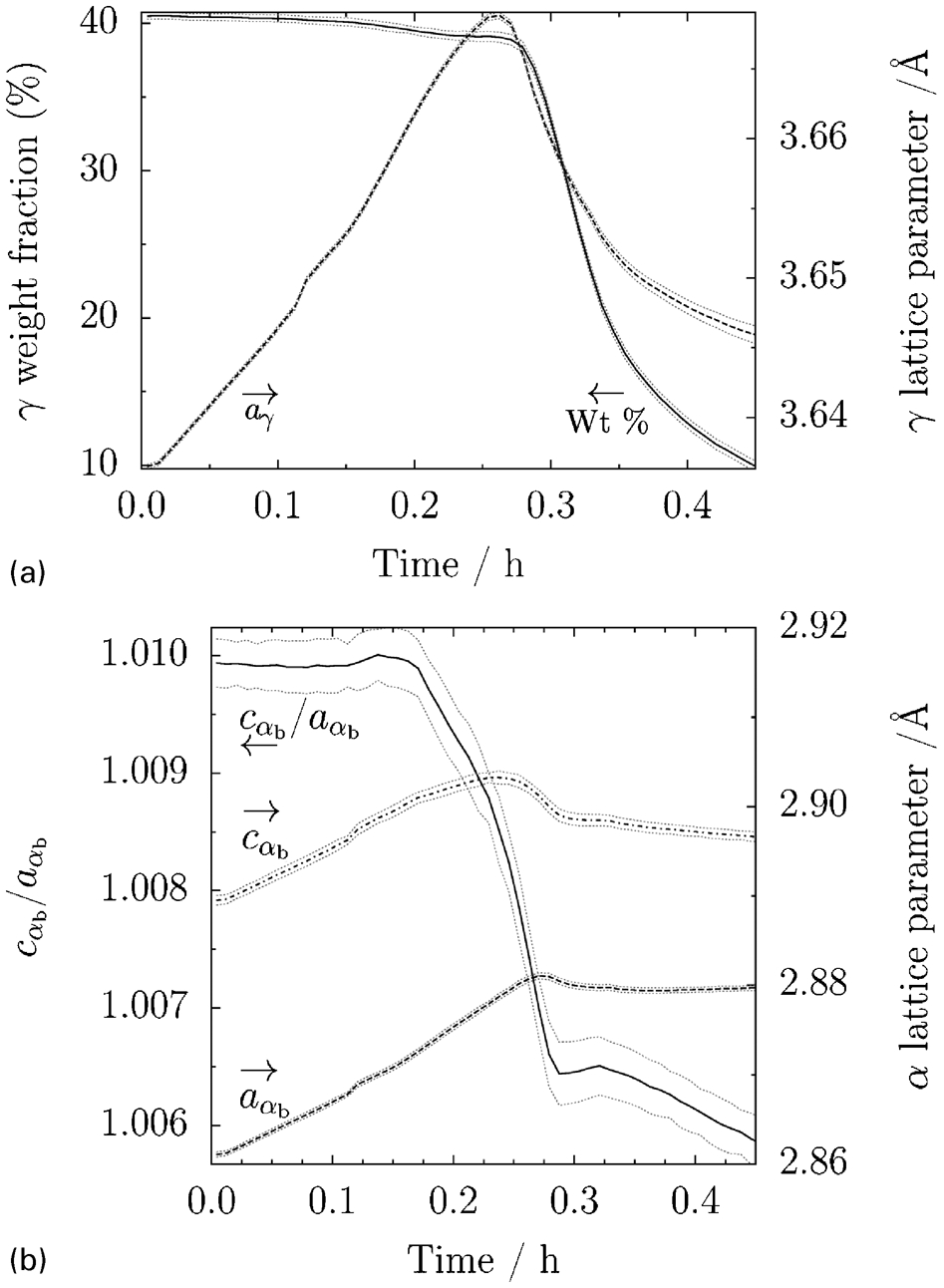
Results of Rietveld refinement on sample transformed at 200°C: sample was tempered at 500°C for time indicated on horizontal axis; dashed lines represent ± uncertainty in each refined parameter quoted by MAUD
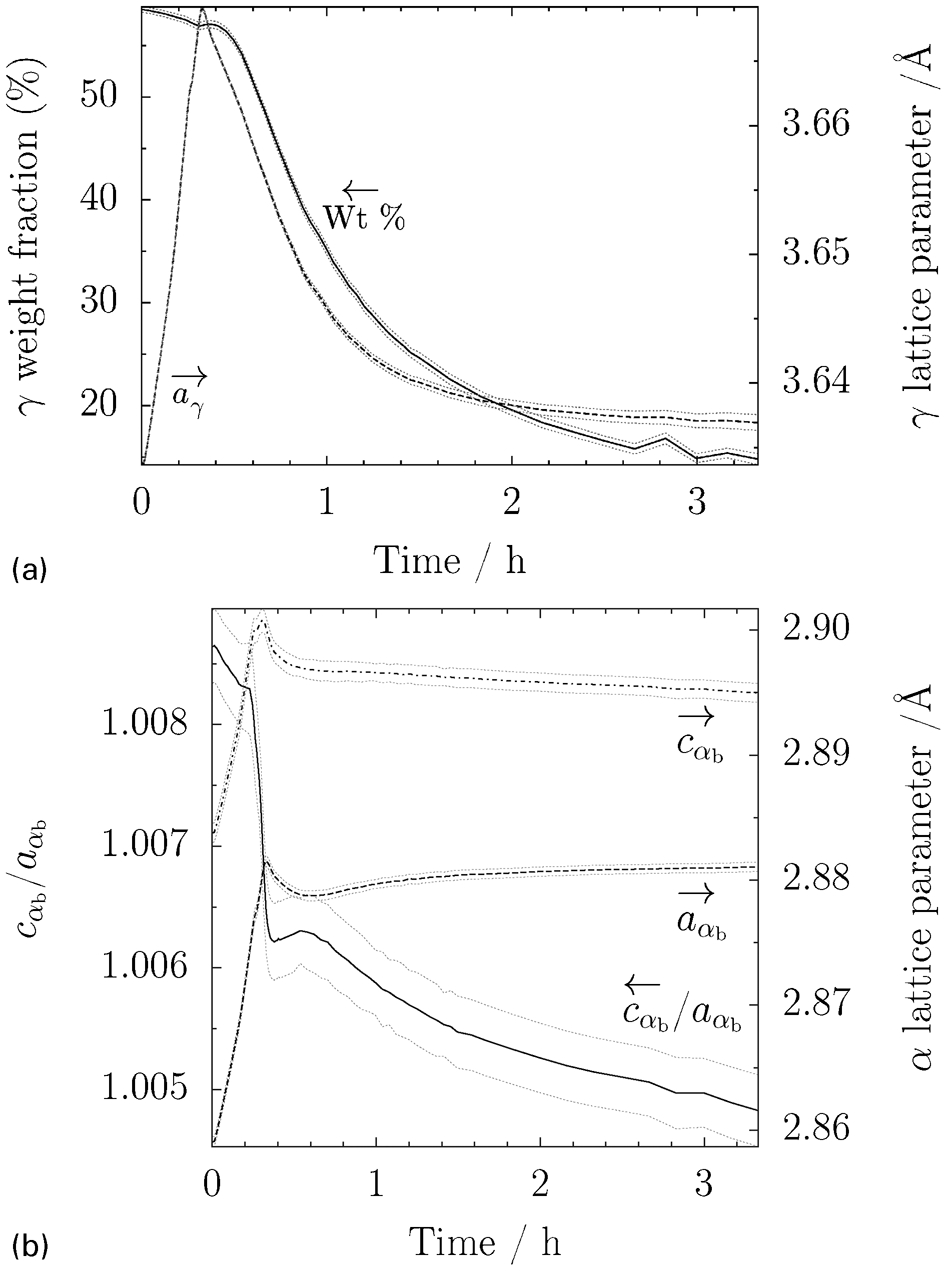
Results of Rietveld refinement on sample transformed at 300°C: dashed lines represent ± uncertainty in each refined parameter quoted by MAUD
The Rwp values for the body-centred cubic (BCC) and body-centred tetragonal (BCT) ferrite for each sample are given in Fig. 3. It is evident that the tetragonal lattice provides a much better fit to the bainitic ferrite unit cell. Austenite fitted well to the face-centred cubic cell, suggesting that there is no geometrical distortion from the two-dimensional detector that might give rise to peak asymmetry in the case of ferrite.
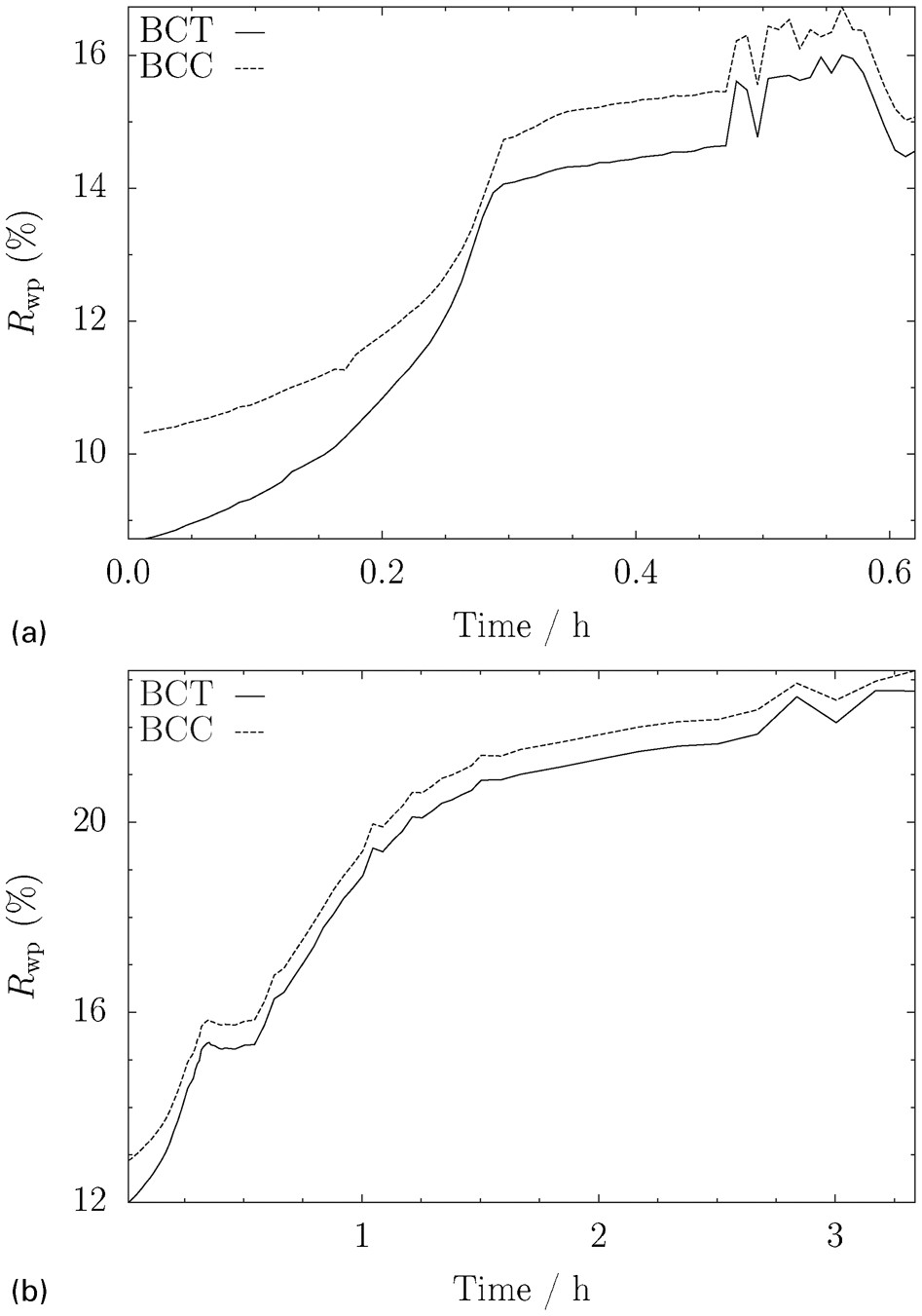
Rwp for BCT and BCC ferrite (smaller Rwp means better fit): a transformed at 200°C and tempered at 500°C for periods indicated on horizontal axis; b as a but transformed at 300°C
The c/a ratio for the as transformed alloy is 1·0099±0·0002 and 1·0086±0·0003 for the samples transformed at 200 and 300°C respectively. The greater c/a ratio is expected for the lower temperature because the bainitic ferrite is known to retain more carbon in solid solution when transformed at lower temperatures.1,5
The values for c/a ratio found here are somewhat greater than those reported previously for a 0·8 wt-C nanostructured bainite transformed at similar temperatures. 15 This is consistent with the current alloy's higher bulk carbon content since the partitioning of carbon following diffusionless transformation would take longer to achieve. 7 It may also be seen that the volume fraction of austenite begins to fall after ∼0·15 h for the sample transformed at 200°C whereas the phase fractions of the sample transformed at 300°C do not change until 0·4 h, despite being exposed to the same heat treatment. This is expected, as the lower the transformation temperature, the more carbon enriched the retained austenite becomes. This leads to a greater driving force for carbide precipitation and more rapid decomposition.
It is observed in both the 200- and 300°C-transformed samples that both a and c ferrite lattice parameters increase during heating. Both lattice parameters decrease slightly at the same time of the austenite phase fraction change. Subsequently, the a-parameter stabilises close to the maximum value. The c-parameter gradually decreases towards the a-parameter as carbon slowly escapes the ferrite and the lattice becomes more cubic. Long term heating would result in the c-parameter apporaching the a-parameter, as the lattice tends towards the body-centred cubic structure.
Conclusions
The combination of atom probe data showing excess carbon in solid solution within the bainitic ferrite, and the observed reduced symmetry of the bainitic ferrite unit cell, along with thermodynamic and kinetic data support the theory that the initial stages of the bainite transformation do not involve diffusion.
The results provide further support for the hypothesis that the reluctance of carbon to partition from the bainitic ferrite into austenite is due to its increased solubility in tetragonal ferrite.
Previous work1,5 has shown that the carbon that is retained in solution in bainitic ferrite increases as the transformation temperature is reduced. This is expected as diffusion becomes slower at lower temperatures. The present work shows that the same effect can be achieved by increasing the average concentration of carbon in the steel. These interpretations are all consistent with theory. 7
Footnotes
Acknowledgements
We would like to thank Rolls-Royce plc and the Engineering and Physical Sciences Research Council for their support during this project. Parts of this research were carried out at the light source PETRA III at DESY, a member of the Helmholtz Association (HGF).