




Abstract
This study explores how project managers in contentious contexts, such as infrastructure projects, shape the inclusion and exclusion of nonmarket stakeholders in early stakeholder engagement. Adopting open strategy theory as a lens, we focus on forms of closure in managerial decision-making. We show that even well-intentioned managers rely on habitual responses—favoring representatives, joint commitment, technical expertise, and internal legitimacy—at the expense of broader inclusion. Using Interpretative Phenomenological Analyses, we give meaning and significance to these patterns of exclusion and contribute to a more reflective and socially responsive approach to stakeholder engagement in the project front end.
Keywords
Introduction
Infrastructure projects inherently present both benefits and losses—they drive economic and urban development while also sparking significant environmental and social controversies (Arts et al., 2021; Busscher & van Geet et al., 2023). In these contentious contexts, project managers may become overly focused on narrowly defined project goals (Babaei et al., 2023; Gil, 2023), neglecting the affected local communities (Di Maddaloni & Davis, 2018). However, the exclusion of nonmarket stakeholders—defined here as the residents and local businesses in the proximity of the project (Di Maddaloni & Sabini, 2022)—often induces resistance and may result in cost growth, project delays, and loss of project legitimacy (Di Maddaloni & Davis, 2018; van den Ende & van Marrewijk, 2019).
While existing project management research links the poor performance of infrastructure projects to inadequate local community engagement, especially in the early stages of the project life cycle or project front end (Aaltonen et al., 2015; Di Maddaloni & Davis, 2018; van den Ende & van Marrewijk, 2019), this issue remains under-addressed. In particular, the inclusion of nonmarket stakeholders in project decision-making is still insufficiently captured in both theory and practice (Di Maddaloni & Sabini, 2022; Lehtinen et al., 2023). This gap is specifically pertinent in the context of contentious projects, such as infrastructure developments, where few studies examine how project managers deal with competing demands of early stakeholder engagement in practice (Gil, 2023; Prebanić & Vukomanović, 2023). This study addresses this gap by integrating open strategy, stakeholder engagement, and project management literature to examine how inclusion and exclusion are enacted during early-stage stakeholder engagement in infrastructure development.
In practice, project managers hold considerable discretion in shaping stakeholder engagement (Di Maddaloni & Davis, 2018; Eckerd & Heidelberg, 2020). This discretion to decide how, when, and with whom engagement occurs introduces inherent tensions, as the inclusion of one group inevitably implies the exclusion of another (Derry, 2012). We draw on open strategy theory to show that efforts to include diverse stakeholders inherently involve new forms of closure—managerial decisions that limit who is heard and what counts as relevant (Dobusch & Dobusch, 2019; Whittington et al., 2011). From this perspective, managerial decisions co-construct inclusion and exclusion, rather than treating exclusion as an outcome of failure or neglect. To situate project managers’ decision-making within an open strategy perspective, we aligned the 16 conflicting managerial choice options in complex infrastructure projects as identified by Klijn et al. (2008) with the five overarching open strategy dilemmas identified by Hautz et al. (2017): process, commitment, disclosure, empowerment, and escalation
Employing an Interpretative Phenomenological Approach (IPA) (Creswell & Poth, 2017; Smith et al., 2022), we capture how project managers themselves experience competing demands in early stakeholder engagement. This interpretive stance enables us to center on the lived reality of managerial discretion, the subtilities, daily routines, and evolving trade-offs as experienced by project managers themselves.
Data collection involved open-ended semistructured interviews with seven project managers who led the early phase of a complex infrastructure project in the Netherlands. The interviews reflected the lived experiences of project managers who had succeeded in co-creating jointly with nonmarket stakeholders (Baartmans et al., 2025). We assume that the more active the cocreation effort, the more pronounced the tensions and underlying competing demands (Dobusch & Dobusch, 2019; Nabatchi et al., 2017). Project managers’ experience with inclusive approaches provides a rich setting to explore how exclusion can still emerge despite intentions toward inclusion.
In doing so, the study responds to calls to examine exclusion in practice (Aaltonen et al., 2024; Di Maddaloni & Sabini, 2022; Lehtinen et al., 2023). We offer an analytical framework that operationalizes forms of closure (Dobusch & Dobusch, 2019) and allows us to give meaning and significance to managerial decisions that shape inclusion and exclusion in early stakeholder engagement. This study shows how even open practices contain exclusions and how habitual responses and seemingly pragmatic decisions may marginalize nonmarket stakeholders. This provides both theoretical and practical insights into how project managers shape inclusion and exclusion in early stakeholder engagement in infrastructure projects.
The remainder of this article is structured as follows. The next section introduces the theoretical background of our framework, followed by a methodology section that outlines the research design. The subsequent findings, discussion, and conclusion sections present the empirical findings, implications, and concluding remarks, respectively.
Theoretical Background
Inclusion and Exclusion in Early Stakeholder Engagement
Early stakeholder engagement is widely acknowledged as a critical success factor for contentious projects like infrastructure developments, contributing to greater legitimacy, conflict mitigation, and alignment with societal goals (Aaltonen et al., 2015; Di Maddaloni & Sabini, 2022; Verweij et al., 2013). Yet in practice, meaningful engagement remains poorly implemented (Prebanic & Vukomanović, 2023). Research underscores that including nonmarket stakeholders, particularly in the early stages of the project life cycle, can bring forward valuable insights into local needs and concerns (Aaltonen et al., 2024; Babaei et al., 2023; Di Maddaloni & Davis, 2018). Furthermore, more positive engagement can occur when project managers actively coproduce joint value through cocreation sessions (Liu et al., 2019), resolve conflicts arising from different understandings (Sorensen et al., 2021), and adopt an inclusive and transparent approach to the management of stakeholders (Di Maddaloni & Derakhsham, 2019).
While meaningful engagement is linked to enhanced project performance, such engagement is also often experienced by project managers as burdensome, time-intensive, and at odds with project constraints such as budget, appraisal criteria, and political expectations (Flyvbjerg, 2014; Klijn et al., 2008; Radulescu et al., 2020). For instance, Gil (2023) argues that when managers lack incentives to enfranchise nonmarket stakeholders, they may ignore the benefits of producing a socially valuable outcome and chose to play by “the rules of the game” (Gil, 2023, p. 2). Consequently, managerial choices in large infrastructure projects frequently constrain broader inclusion (Babaei et al., 2023; Di Maddaloni & Davis, 2018).
Project managers hold considerable discretion in shaping how, when, and with whom engagement occurs (Eckerd & Heidelberg, 2020). This discretion, however, introduces inherent tensions, as the inclusion of one group often implies the exclusion of another (Derry, 2012). Previous research has focused on a wide variety of tensions involved with stakeholder engagement. For instance, Samset and Volden (2016) highlight how an overflow of information narrows down the analytic focus to detailed project-specific issues, often at the expense of overall societal aspects. Wiewiora and Desouza (2022) illustrate how tensions between deciding to collaborate with known or new, thus unknown, stakeholders may result in closed (formal) or more open (inclusive) collaboration. Aubry et al. (2025) argue that tensions in the front end of projects are related to a diversity of values associated with performance and effectiveness. These tensions manifest not just as competing values but as concrete managerial decisions about whom to include or exclude, when, and on what terms. Even when project managers strive for inclusion and transparency, they make decisions that involve exclusions (Eckerd & Heidelberg, 2020). These exclusions are not always intentional or visible but they emerge through subtle decision-making practices in opening up or closing down participation (Aaltonen & Kujala, 2010; Gil, 2023; van de Ende & van Marrewijk, 2019). If not carefully managed, these competing managerial choices may lead to decision paralysis, inefficiency, or strategic fragmentation (Flyvbjerg, 2014).
Understanding how inclusion and exclusion occur requires examining how managers respond to competing demands in early stakeholder engagement: how they define relevance, assess legitimacy, frame participation, and ultimately decide whose voice counts (Gil, 2023). Adopting an open strategy perspective allows us to capture how exclusionary dynamics are enacted through decisions about openness and closure. This shifts the analytical focus from what these tensions mean or represent to how inclusion and exclusion are shaped in practice
Open Strategy as a Lens
Open strategy theory offers a useful lens for addressing the exclusion of nonmarket stakeholders at the front end of infrastructure projects. The literature on open strategy development revolves around the premise that greater value can be created when previously excluded stakeholders—internal or external actors beyond the strategy elite—are included in strategy formulation processes (Whittington et al., 2011). Thus, open strategy stands in contrast to traditional notions of competitive (closed) strategies that depend on control (Pittz & Adler, 2023). From an open strategy perspective, project managers aim to increase transparency and inclusion through ongoing interactions with a broad range of stakeholders (Vaara & Whittington, 2012; Whittington et al., 2011). Inclusion, in this context, refers to involving stakeholders outside the boundaries of the (project) organization, whereas transparency refers to openly sharing strategic information with all involved stakeholders. With openness, more strategic information becomes available, and more individuals can engage in strategic conversations. By engaging a wider array of stakeholders, open strategizing can contribute to the cocreation of broader public value and enhance legitimacy (Hansen et al., 2022; Tavakoli et al., 2017).
As Hautz et al. (2017) argued, however, involving multiple stakeholders generates tensions and dilemmas that require active management. They identify five core dilemmas of open strategy—process, commitment, disclosure, empowerment, and escalation—each reflecting competing demands that managers must weigh. These competing demands point to the reality that opening up is not a one-directional act of broadening participation, but an ongoing series of selective decisions that define with whom, what, and how strategy is developed.
To capture how inclusion and exclusion are coconstructed in this process, we follow Dobusch and Dobusch (2019) in conceptualizing openness and closure as intertwined dynamics. In this view, any act of opening up simultaneously produces closure; for example, the decision to share strategic information with a broader audience is always shaped by prior judgments about what counts as strategic and who is deemed capable of engaging with it. Similarly, invitations to participate already encode decisions about who is considered relevant, thus silently excluding others (Dobusch et al., 2017). Such exclusions resemble the practices of marginal inclusion of nonmarket stakeholders identified by Di Maddaloni and Davis (2018).
By using open strategy theory as a lens, this study seeks to identify and interpret the forms of closure (Dobusch & Dobusch, 2019) embedded in managerial decision-making. We do not treat exclusion as a failure or the absence of openness; rather, we conceptualize it as a situated effect of how managerial decisions about openness and closure are enacted in practice. This enables us to unpack the dynamics through which certain voices become prioritized, while others are marginalized—often unintentionally. In doing so, we advance a more nuanced understanding of how exclusion is not the opposite of openness but emerges through the very practices that constitute inclusion.
Managerial Choices
To further examine how these forms of exclusion unfold in practice, we draw on Klijn et al. (2008), who identify 16 conflicting managerial choices that project managers routinely face in complex infrastructure projects. These competing priorities—such as whether to use the knowledge of stakeholders over more stand-alone fact-finding, or to steer toward consensus versus allow discretion—reflect recurring tensions in stakeholder engagement. Project managers, in their formal role responsible for leading the project team to meet the project's objectives and stakeholders’ expectations, balance competing constraints on the project with the resources available (Project Management Institute (PMI), 2017). They often do not resolve tensions outright but instead seek workable compromises or strategic trade-offs (Aubry et al., 2025; Klijn et al., 2008; Kuitert et al., 2023; Reynolds et al., 2006).
To position managerial choice making within an open strategy perspective, we mapped the 16 conflicting managerial choices from Klijn et al. (2008) onto the five overarching dilemmas identified by Hautz et al. (2017): process, commitment, disclosure, empowerment, and escalation. Table 1 presents a synthesis and provides the basis for our analytical framework. This framework allows us to interpret how project managers open up or close down particular discussions, interests, or actors in their decision-making. By focusing on patterns of recurring closures, our framework supports a deeper interpretive inquiry into the underlying dynamics that guide managerial decision-making in stakeholder engagement—and the exclusions that may arise even from well-intentioned decisions.
Dilemmas and Managerial Choices in Large Infrastructure Projects
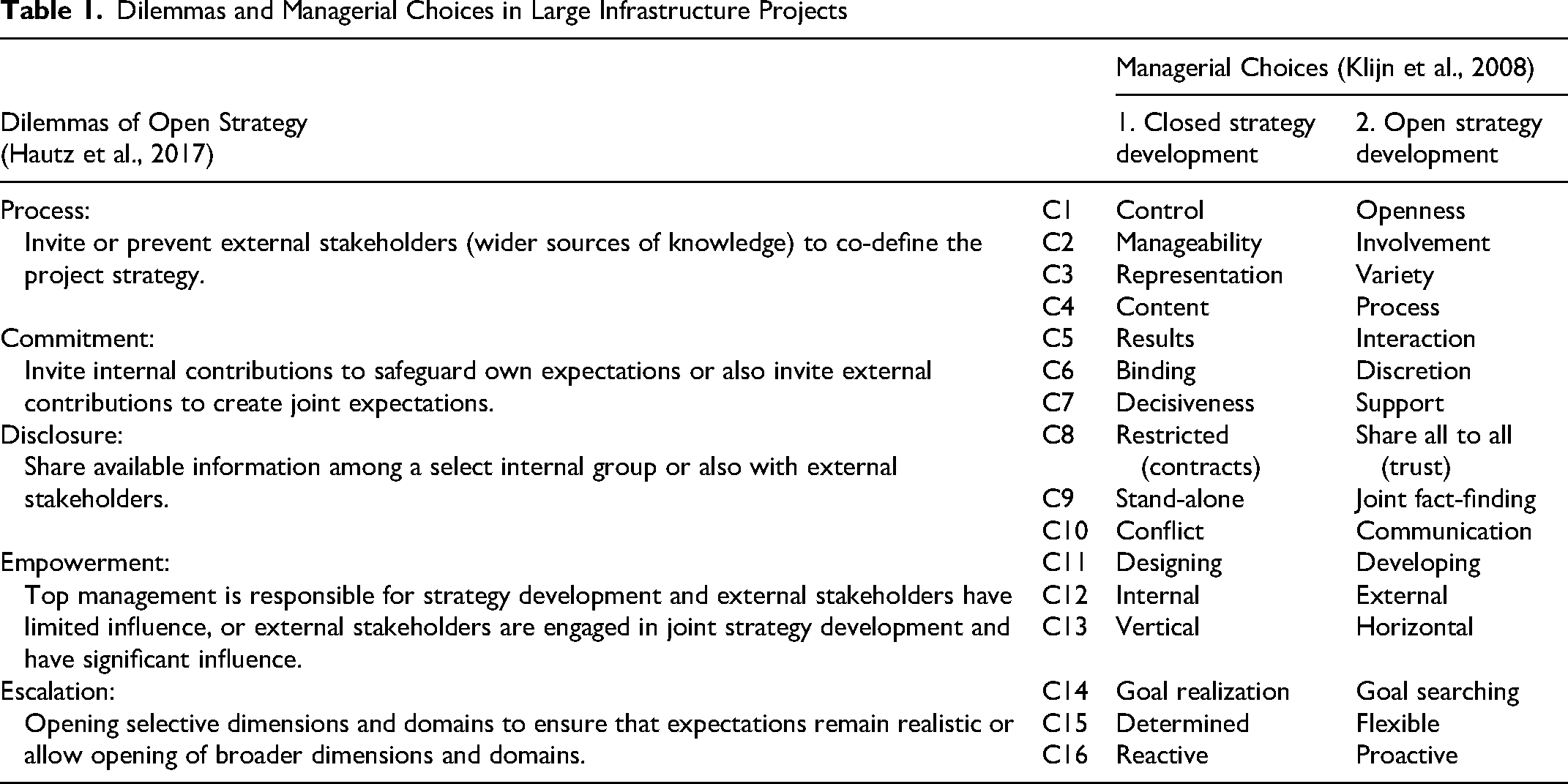
In Table 1, each managerial choice is numbered from C1 to C16. Column 1 reflects more closed options, whereas column 2 reflects more open options.
Process dilemmas (C1–C4) arise when project managers attempt to balance broader inclusion with manageability (Hautz et al., 2017). Although broader participation can improve outcomes (Edelenbos & Klijn, 2009), it complicates coordination and may divert attention to unforeseen issues (Adobor, 2019). C1 (Control–Openness) involves inclusion or exclusion by restricting or widening access to participants (Wiewiora & Desouza, 2022). C2 (Manageability–Involvement) involves determining whether only manageable topics are included or whether broader themes are welcome (Edelenbos & Klijn, 2009). C3 (Representation–Variety) addresses the choice between including formal representatives or more diverse voices (Nabatchi et al., 2017). C4 (Content–Process) distinguishes between outcome- and engagement-oriented interactions (Edelenbos & Klijn, 2009).
Commitment dilemmas (C5–C7) reflect the tension between fostering engagement and sustaining joint commitment. Although commitment fosters collaboration and accountability (Edelenbos & Klijn, 2009; Pinto, 2019), steering too rigidly toward joint commitment excludes individual discretion and distracts from creating joint project interest (Kujala et al., 2019). Additionally, high expectations of influence may backfire, leading to frustration (Hautz et al., 2017). C5 (Results–Interaction) captures the focus on tangible results versus relational quality (Aubry et al., 2025). C6 (Binding–Discretion) contrasts joint commitment, in which actors are bound by the project versus the individual freedom to choose differently (Klijn et al., 2008). For clarity, we use the term “binding” instead of “commitment,” as posited by Klijn et al. (2008). C7 (Decisiveness–Support) concerns timely execution versus seeking broader backing (Jha & Iyer, 2007).
Disclosure dilemmas (C8–C10) involve the extent of information shared. Oversharing may confuse or alienate stakeholders, whereas secrecy breeds mistrust (Hautz et al., 2017). Both options may result in exclusion, underlining the paradoxical nature of these choice situations (Aubry et al., 2025; Samset & Volden, 2016). In complex projects, particularly infrastructure development and environmental planning, decision-making often hinges on expert knowledge. C8 (Restricting–Sharing) concerns whether information sharing is restricted to project boundaries or openly shared with all involved (Flyvbjerg, 2014). C9 (Stand-alone–Joint Fact-Finding) addresses whether knowledge is produced internally or collaboratively (Fischer, 2000). C10 (Conflict–Communication) refers to confronting versus reconciling opposing views (Klijn et al., 2008).
Empowerment dilemmas (C11–C13) revolve around granting participation while retaining control. Without meaningful empowerment, participation risks being tokenistic (Fung, 2006). C11 (Designing–Developing) contrasts blueprint-based versus cocreated solutions (Liu et al., 2019). C12 (Internal–External) addresses the prioritization of project goals (value for the firm) versus societal values (values in use) (Gil, 2023; Liu et al., 2019). C13 (Vertical–Horizontal) distinguishes between focusing on the hierarchy of a project’s parent organization(s) versus unranked broader stakeholder collaboration (Vuori et al., 2013).
Escalation dilemmas (C14–C16) reflect the tension between stability and flexibility. An opening-up strategy can invite demands for further participation (Hautz et al., 2017). Project managers often operate under fixed deadlines imposed by their parent organization, limiting their flexibility in accommodating such demands (Guan, 2007). C14 (Goal Realization–Goal Searching) contrasts the intention to adhere to fixed versus evolving objectives (Pinto, 2019). C15 (Determination–Flexibility) addresses whether the project manager maintains clear goals or adopts more paradoxical thinking in adapting to new circumstances (Kuitert et al., 2023). C16 (Reactive–Proactive) contrasts responsive versus initiatory behavior of project managers (Klijn et al., 2008).
In short, these managerial choice options reflect how project managers, through their managerial decision-making, include and exclude nonmarket stakeholders. Reflecting on forms of closure allows us to uncover how exclusion occurs in practice.
Methodology
Research Approach
To explore how managerial decision-making shapes inclusion and exclusion during early stakeholder engagement, we used Interpretative Phenomenological Analysis (IPA). IPA enables researchers to interpret the meaning participants assign to their experiences and identify the shared significance of a given phenomenon (Creswell & Poth, 2017). It is a participant-oriented qualitative approach that aims to capture how individuals perceive and make sense of a common phenomenon in personally meaningful ways (e.g., Creswell & Poth, 2017; Smith et al., 2022). Prior research indicates that project managers often struggle to describe their work as choices between alternatives (Klijn et al., 2008; Steenhuisen & van Eeten, 2012; Willis & Mastrofski, 2016). IPA is particularly well-suited to support the exploration of these often-implicit choices by illuminating participants’ thoughts, actions, and emotions through their experiences (Creswell & Poth, 2017).
While the literature provides frameworks for analyzing dilemmas and managerial choices (e.g., Hautz et al., 2017; Klijn et al., 2008), our use of these frameworks was not to impose categories from the outset. Instead, they served as analytical scaffolding to guide interpretation of meanings that emerged inductively from participants’ accounts. In line with Flyvbjerg’s (2006) advocacy for a phenomenological approach to case-based inquiry, we sought to close in on the “lived reality” of practice—capturing the subtleties of managerial discretion, habitual responses, and evolving trade-offs as experienced by project managers themselves.
Case Selection
Informed by IPA literature (Larkin et al., 2019; Smith et al., 2022), we employed a purposive sampling strategy for a single perspective on managerial decision-making in contentious projects. For this we selected project managers, based on their formal leadership roles, who had all overseen similar, large, early-phase, and complex infrastructure projects thus were “all bound by the experience of a similar phenomenon (Murray & Wilde, 2020, p. 244).” Traditionally, IPA studies rely on small samples, often between three and 15 participants, to allow for an in-depth exploration of shared experiences, with each participant’s account treated as a case (Pietkiewicz & Smith, 2014). The idiographic and detail-oriented nature of IPA requires close and nuanced analysis, best achieved through focused engagement with a small group of individuals (Murray & Wilde, 2020).
Informed by previous research (Baartmans et al., 2025), we selected those project managers (seven of a total of 12 project managers) who, unlike others in that study, had explicitly adopted an inclusive and transparent approach in developing the project strategy; in other words, they adopted a cocreation approach with nonmarket stakeholders (Tavakoli et al., 2017). We focused on these project managers assuming that when actively involved in co-creation, the competing demands surrounding early stakeholder engagement are likely to be more pronounced (Dobusch & Dobusch, 2019; Nabatchi et al., 2017). All seven project managers had multiple years of experience in the public sector and could be considered senior or “virtuoso experts” Flyvbjerg (2006, p. 221) in managing interactions with societal stakeholders.
Each project manager was involved in a separate project that was in the early or exploratory phase of the 2023 Dutch Multi-Year Program for Infrastructure, Spatial Planning, and Transport (MIRT) (Ministerie I&W, 2022). This program funds all large national infrastructure projects in the Netherlands (Arts et al., 2016; Klakegg et al., 2016). A key objective of this program is to enhance transparency and increase the participation of nonmarket stakeholders (Heeres et al., 2012; van Geet et al., 2019). It constitutes a three-staged process (from exploration, project study, to construction), in which the first stage (exploration) explicitly requires and provides incentives for early involvement of nonmarket stakeholders, potentially resulting in changes to the project’s aim, scope, time, and budget (Klakegg et al., 2016; van Geet et al., 2019).
Data Collection
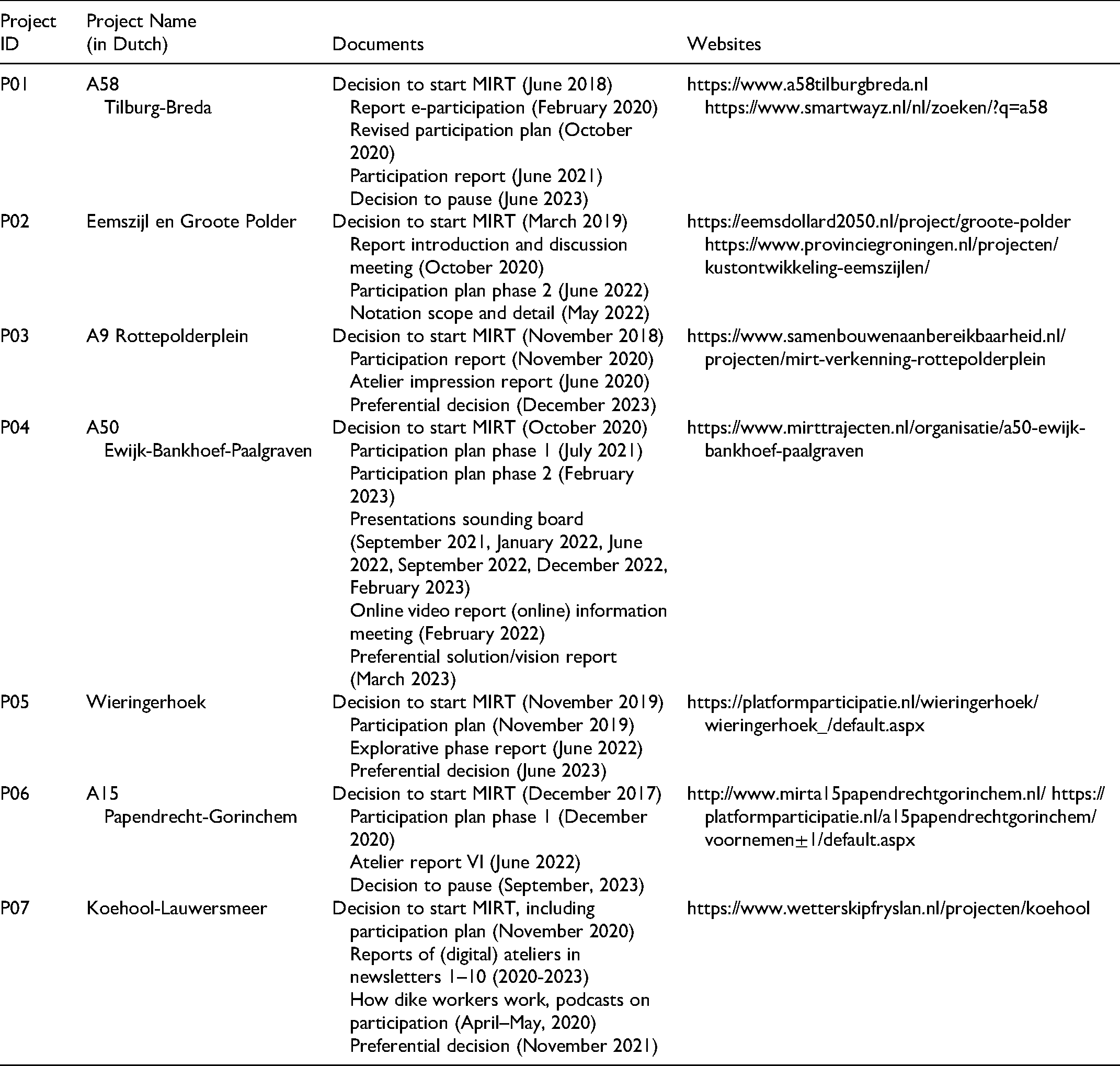
We collected empirical data using open-ended semistructured interviews with the selected project managers; all project managers gave their informed consent for this. Semistructured, in-depth, one-on-one interviews are the most popular method in IPA to “elicit rich, detailed, and first-person accounts of experiences and phenomena under investigation (Pietkiewicz & Smith, 2014, p. 10).” The interviewer (the first author) possesses extensive infrastructure development experience, which facilitated rapport and fostered openness in participants’ responses (Flyvbjerg, 2006; Larkin et al., 2019). While IPA requires that the researcher be familiar with the phenomenon under study, it also necessitates a disciplined effort to defer personal judgments and preconceived notions (Pietkiewicz & Smith, 2014). Instead of imposing our own interpretations, participants’ descriptions guided us in developing an understanding of how their experiences were lived (Murray & Wilde, 2020). We further mitigated the risk of overinterpreting meanings beyond what was grounded in participants’ descriptions through triangulation with project documents. Document analysis primarily focused on reviewing project plans and reports, project websites, and reports from stakeholder meetings (see the Appendix at the end of the article).
We invited interviewees to freely reflect on their project experiences by addressing (1) their primary objectives; (2) how they achieved these objectives; (3) who was involved in the process; (4) what information was shared; (5) key obstacles encountered; and (6) how they were handled. From March to June 2023, we conducted seven interviews, each lasting 45 to 90 minutes. We recorded, transcribed verbatim, and anonymized all interviews and named them PM 1–7. We conducted and transcribed the interviews in Dutch and only translated their quotes into English after data analysis.
Data Analysis
The analysis began by scrutinizing the project documents to contextualize participants’ perspectives. Subsequently, following Smith et al. (2022), we coded the interviews in ATLAS.ti in three consecutive and iterative steps: (1) coding the significant statements or units of meaning; (2) clustering them into thematic groups; and (3) articulating the underlying meanings to explicate project managers’ perceptions.
In the first step, we began with an open, inductive reading of each interview transcript, identifying significant statements related to participants’ reflections on key tensions, trade-offs, or moments of uncertainty in the stakeholder engagement process. Participants’ reflections were often marked by expressions of internal struggle, justification, or emotional intensity—phrases such as “we felt torn,” “this caused friction,” “it was a tough call,” or “we had to push back.” At this stage, we prioritized staying close to participants’ language and framing, rather than imposing predefined categories. This process yielded a total of 171 statements.
In the second step, we thematically clustered these meaning units into emergent patterns that reflected different ways project managers negotiated inclusion, openness, and decision constraints. Only in this step did we begin to interpret these patterns through the lens of our analytical framework (see Table 1), drawing connections to the 16 choice situations identified by Klijn et al. (2008), structured across the five dilemma domains of open strategy theory (Hautz et al., 2017). Rather than deductively assigning codes, we used this framework as a hermeneutic tool—a way to analyze the meaning and significance of participants’ experiences.
In the third step, we revisited the full dataset to synthesize individual interpretations into a shared account of managerial reasoning across the cases. Here, we focused on how managers rationalized what we interpreted as “closed” choices within otherwise open processes—revealing which pressures or strategic imperatives led to the exclusion of certain voices, despite an overarching intent toward inclusion. Importantly, we did not treat open, closed, or balanced as static categories, but as interpretive descriptors that emerged from engaging with the affective, relational, and contextual subtleties embedded in the interviews.
We now briefly illustrate our interpretative approach. One project manager (PM 5) described choosing to maintain the original project scope despite a broad exploration of expansion opportunities: “We identified four huge opportunities for the project, which was a struggle to overcome […] You want to develop a project like this by including all stakeholders from the area […] but at a certain point you have to stand your ground. Including all proposed ideas and opportunities is fine, but you must be able to handle them. Eventually, we felt that some of the opportunities were not the task of our team. Of course, that caused some disappointment, to put it mildly.”
This example reflects an initial orientation toward openness (C1, open), in which multiple nonmarket stakeholders were involved (C2, open), followed by a shift toward closure by prioritizing “decisiveness over support” (C7, closed). The decision to exclude opportunities also reflects a focus on goal realization over goal searching (C14, closed) and a pragmatic stance balancing “results and interaction” (C5, balance).
Findings
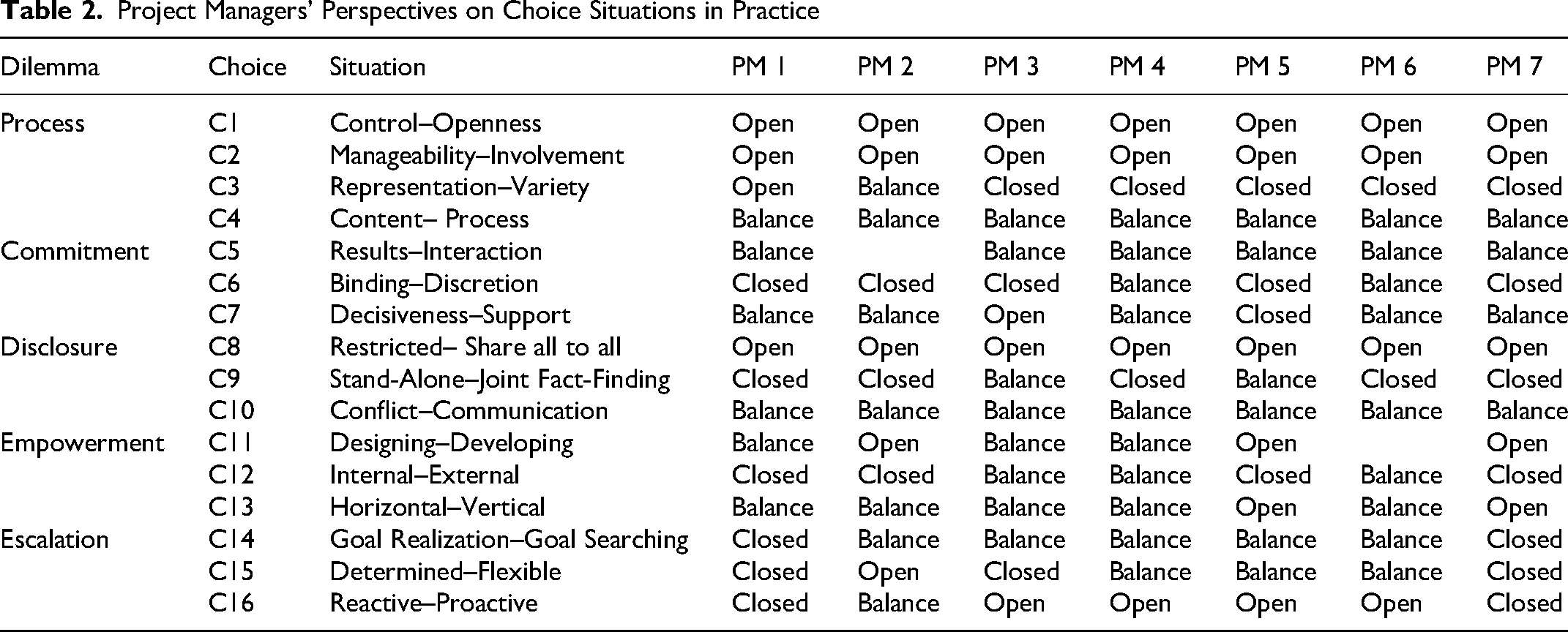
Our findings show that project managers demonstrated a variety of open, closed, and balance orientations. For project manager PM 2 and PM 6, we were unable to relate specific statements to the choice situations regarding C5 (Results–Interaction) and C11 (Designing–Developing). This is indicated by the empty cells in Table 2, which summarizes our findings.
Project Managers’ Perspectives on Choice Situations in Practice
Shared Perspective on Process-Related Choice Options (C1–C4)
Regarding process, project managers demonstrated a shared perspective toward an open and inclusive process in managerial choice situations C1 (Control–Openness) and C2 (Manageability–Involvement). In those situations, project managers consistently described how they favored open options for involving everyone in the proximity of the development, including residents and local businesses, and allowed for iterative and collaborative processes (see Table 2). For C4 (Content–Process), all project managers were keen on explaining how they integrated (‘balance’) discussions on the topic itself with those on how to include the concerns of affected parties. However, while project managers generally enacted openness, closure emerged regarding C3 (Representation–Variety), in which six of the seven project managers favored working with organized stakeholder representatives rather than engaging with individual and more varied stakeholders. Here project managers described an implicit narrowing of the participatory base PM 4 (C3, closed) stated: “I feel it would help if local inhabitants are more organized […]. If stakeholders have latent interests and are not organized in a group, then it is very difficult to even have a conversation with them.”
Similarly, PM 6 (C3, closed) indicated: “We are always looking for that one person that can distinguish between the public and the individual interest. That is why I prefer to work with organized interest groups. They often already need to accommodate multiple interests within their own group.”
Shared Perspective on Commitment-Related Choice Options (C5–C7)
Regarding commitment, all project managers reflected balanced practices for C5 (Results–Interaction), seeking to combine responsiveness with results. As PM 1 (C5, balance) stated, “Of course, you need to involve all stakeholders, but you also need to show results, otherwise you cannot explain that to the outside world.” Additionally, for C7 (Decisiveness–Support), five of seven project managers demonstrated sensitivity to both procedural legitimacy and substantive output without defaulting to closure. PM 6 (C7, balance) clarified: “Decision-making is always at the level of the steering group and actually at the Ministry. But we listen, we do try to listen carefully. From the start, we said we are going for support for the process, not for support for the end-result. This is such a complex project. It will always hurt somewhere.” “Getting everybody on board and committed is like pulling teeth […]. You want them to co-own the project, so you have to push and pull, and involve all levels, really on a personal level tell people that they have to step up or make a decision, and repeat, repeat till they are all on the same page.”
Shared Perspective on Disclosure-Related Choice Options (C8–C10)
Regarding disclosure, all project managers expressed a strong belief in open communication. For instance, related to C8 (Restricted–Shared), PM 2 stated: “Look, when you openly share information, well, it can lead to discussion as it is all a matter of interpretation. But then you have to address that and engage in a conversation with the local community.” Additionally, PM 3 (C10, balance) explained: “The fact that in the end, after a lot of discussion, one of our internal partners vetoed our proposed solution, caused quite a stir and some blunt letters were sent. But well, sometimes you have to accept your loss. Also, I think, it’s no use flogging a dead horse, and that is what we openly discussed and all agreed upon.” “We even received compliments about how we were able to clarify the technical complexity of the project. They said, ‘you deal with ecology and ecosystems, which clearly is complicated, but you succeeded in making us understand what it takes and how we can influence the system.’”
These examples demonstrate that, while information was made accessible to nonmarket stakeholders, project managers mostly relied on technical expertise and made little effort to jointly develop knowledge.
Shared Perspective on Empowerment-Related Choice Options (C11–C13)
Regarding empowerment, most project managers supported participatory design (C11) and emphasized horizontal relationships (C13), signaling openness, although incorporating local needs resulted in some tension between the project manager and internal client. For instance, PM 4 (C13, balance) indicated: “Once we better understood the local situation, we decided to broaden the scope from three alternatives we had at the start, to 10 possible alternatives. Then of course, you feel the pressure from internal to limit the research burden to two or three alternatives. But well, you know, it’s all fine that ideally, we should do so, but then I think, well, this is the way things are here.” “Our director […] made it clear that we had to stick to planning as that was agreed upon on a higher level. We succeeded to deliver the final outcome in time, but that put extra pressure on the process as our partners repeatedly asked for more time.”
Similarly, PM 5 (C12, closed) made clear that: “For this project we have a budget of €250 million. Obviously, you have to account for how to spend that amount of money, that is what the program is all about.” This demonstrates how openness is bound by the funding and reporting structures of the program. Even in balance choices, as expressed by PM 6 (C12, balance), internal legitimacy remained decisive: “Decision-making always rests at the level of the steering group and essentially with the Ministry. But we do try to listen carefully to our local stakeholders.” These experiences illustrate a structural form of closure in which nonmarket empowerment is permitted but rarely decisive.
Shared Perspective on Escalation-Related Choice Options (C14–C16)
Finally, escalation revealed specific differences, with PM 1 and PM 7 enacting full closure across all three managerial choice options (C14–C16). For PM 1 (C14–C16, closed), closure was justified by policy limits and external constraints: “You get the message from the Ministry […], budget restrictions and the nitrogen crisis and so […], then you try to wrap it up as neatly as you can and tie a ribbon around it.” PM 7 (C14–C16, closed) strived to involve all stakeholders. However, they ended up working toward the single goal that their own organization was authorized to accomplish. Ultimately, they valued goal realization over goal searching, was determined to finish the project within the time schedule and responded reactively to claims from other stakeholders for more time. Interestingly, PM 4 and PM 6 (C14–C15, balance; C16, open) were also affected by budget restrictions and the nitrogen crisis; however, project managers succeeded in finding ways to keep their projects moving forward. These examples illustrate that closure in escalation depends not only on external constraints but also on managerial flexibility and improvisation. While some managers closed their scope to ensure project delivery, others sustained partial openness by finding alternative avenues.
Discussion
This study investigates how project managers shape inclusion and exclusion in early stakeholder engagement through their decision-making in infrastructure projects. Using open strategy theory, we conceptualize forms of closure as the situated effects of decisions about how, and for whom, openness is enacted in practice. Instead of treating exclusion merely as a failure or lack of openness, we demonstrate how exclusion is actively constructed through specific closed managerial practices. These include favoring representatives over direct engagement with diverse individuals, prioritizing technical expertise over joint fact-finding, and relying on formal procedures rather than exploratory dialogue. Across all five dilemma domains, our findings reveal recurring forms of closure that resonate with what prior research identifies as ingrained managerial tendencies in complex infrastructure environments. These patterns did not only emerge from the specificities of our seven cases alone; rather, they reflect broader dispositions that shape how project managers experience and navigate early stakeholder engagement.
First, in process-related decisions, managers often described relying on organized representatives rather than engaging diverse individual voices—a tendency well documented in participatory governance research (Derry, 2012; Nabatchi et al., 2017). Our interpretation is that this reliance functioned in a taken-for-granted way of dealing with complexity: Intermediaries were experienced as natural conduits for reconciling diverse interests (Kujala et al., 2019), which reinforces aggregated rather than individual understandings of stakeholder losses and concerns (Di Maddaloni & Derakhsham, 2019; Samset & Volden, 2016).
Second, in commitment-related decisions, managers recounted a strong orientation toward early alignment and joint commitment. While collaboration literature highlights the value of shared commitment (Pinto, 2019), our analysis suggests that this orientation may inadvertently silence voices diverging from dominant narratives (Neef et al., 2022). This mirrors findings from wider literature that managers tend to privilege cohesion and momentum over acknowledging dissenting perspectives, even when inclusion is an explicit aim (Kujala et al., 2019).
Third, for disclosure-related decisions, managers emphasized transparent communication but also describe moments in which they fell back into familiar patterns of retaining control over technical knowledge. This reflects an enduring administrative pattern in which technical expertise structures decision authority (Eckerd & Heidelberg, 2020). Our interpretation is that this pattern of privileging expert knowledge operated in an automatic, taken-for-granted way: Even within open processes, nonmarket stakeholders were excluded from joint fact-finding, narrowing the conceptual space in the early stages of the project (Samset & Volden, 2016).
Finally, in empowerment-related decisions, managers emphasized cocreation while simultaneously experiencing decision rights as bound by institutional arrangements. Prior research shows that internal legitimacy often outweighs external demands in infrastructure governance (Morris, 2013; Samset & Volden, 2016). Our findings suggest that limiting participation reflected not only these structural constraints, but also deeper managerial dispositions. Under pressure, managers found themselves reverting to deadlines, budgets, and organizational mandates as the natural limits of what is possible, reinforcing established boundaries of participation (Vuori et al., 2013).
Taken together, these patterns exemplify what Wood et al. (2021, p. 599) describe as “action slips:” managers inadvertently fall back on familiar ways of working when navigating tensions, even when they intend to be inclusive. Habitual responses or habits refer to repeated behavior that were frequently rewarded in the past and tend to resurface under pressure (Wood et al., 2021). This suggests that the forms of closure identified in our cases reflect not isolated decisions but broader, recurring tendencies in how project managers make sense of and act within the front end of contentious infrastructure projects.
Theoretical Contribution
This study offers two main theoretical contributions. First, it advances research on how project managers respond to competing demands in early stakeholder engagement—an area that, despite increasing attention to stakeholder inclusion, remains undertheorized (Gil, 2023; Prebanić & Vukomanović, 2023). We developed an analytical framework that brings together the 16 conflicting managerial choices identified in project management literature (Klijn et al., 2008) with the five key dilemmas of open strategy (Hautz et al., 2017). Rather than serving as a predefined coding structure, this framework operates as a hermeneutic lens that enables scholars to examine managerial decision-making in relation to openness, highlighting how choices intended to promote inclusion simultaneously produce specific forms of closure (Dobusch & Dobusch, 2019). In doing so, it provides a structured way to analyze how exclusion emerges in practice—not only when managers lack openness, but also when they genuinely attempt to be inclusive.
Second, the study deepens theoretical understanding of the marginalization of nonmarket stakeholders (Di Maddaloni & Sabini, 2022) by conceptualizing exclusion as a situated effect of how openness and closure are enacted in practice. Our analysis identifies recurring patterns of closure, such as relying on prioritizing alignment, or privileging technical expertise, that resonate with ingrained managerial dispositions. These findings extend existing theory by showing how habitual responses, or “action slips” (Wood et al., 2021, p. 599), shape engagement outcomes. In complex environments, managers described how they reverted to familiar ways of working, especially under pressure, reinforcing long-standing “rules of the game” (Gil, 2023, p. 2) and constraining participation. Highlighting the role of such embodied habits contributes to theory by underscoring the limits of individual intention in creating inclusive engagement processes and pointing to the need for reflective and repeated learning practices (Adobor, 2019; Cicmil et al., 2006).
Taken together, these contributions offer a more nuanced understanding of how exclusion emerges through the routines and often unreflective decisions of project managers in the front end of infrastructure projects. By conceptualizing closure as both an individual enactment and as a shared perspective, our framework helps scholars understand how well-intended engagement efforts can inadvertently exclude certain voices and provides a lens for analyzing these dynamics in future research.
Practical Implications
By collaborating with experienced senior project managers, we demonstrated that skilled practitioners often unintentionally revert to habitual responses, particularly under pressure. Our framework equips managers with practical concepts and language to recognize such habits and shape participation more intentionally. Our findings highlight key moments at the project front end, in which closure tends to outweigh openness. Recognizing these patterns enables project managers and their project team members to question routines, such as consistently involving the usual suspects, and to consider more consciously whose voices may be unintentionally excluded. Thus, managers can design more inclusive engagement strategies and create space for underrepresented perspectives.
Limitations and Future Research
This study has several limitations that offer directions for future research. First, it focuses on the single perspective of Dutch project managers within a strong institutional governance framework (Klakegg et al., 2016). Including multiple perspectives, for instance from stakeholder managers and local communities, can enhance the understanding of the relational dynamics (Larkin et al., 2019) inherent in stakeholder engagement. Second, applying the framework to contexts with less experienced managers or weaker institutions could reveal how closure manifests under different conditions (Cicmil et al., 2006). Third, as this study focused on the front-end phase, future research could explore how inclusion and exclusion evolve over the project life cycle (Busscher et al., 2022; Diriker et al., 2022). Finally, incorporating cognitive and emotional dimensions, such as ethical stress or moral disengagement that influence decision-making under tension, may offer richer insights into managerial decision-making in complex project environments (Stingl et al., 2025).
Conclusion
This study examined how inclusion and exclusion in early stakeholder engagement are shaped by managerial decisions in the front end of infrastructure projects. By integrating insights from project management, stakeholder management, and open strategy theory, we developed an analytical framework to identify recurring patterns of closure. Our findings accentuate that any decision to open up strategic processes inherently involves closures. In doing so, we advanced a more nuanced understanding of how exclusion is not the opposite of openness but emerges through the very practices that constitute inclusion. Even though project managers often strive to engage in a meaning-making process, they may also revert to habitual responses. While pragmatic, this may lead to exclusions—in our context: privileging representatives, joint commitment, technical expertise and internal legitimacy—at the expense of broader inclusion of nonmarket stakeholders. Recognizing these patterns helps to explain how well-intentioned engagement can unintentionally reinforce the marginalization of nonmarket stakeholders. Identifying and discussing these exclusions is necessary for creating infrastructure projects that are both technically robust and socially responsive.
Footnotes
Acknowledgments
We would like to thank the anonymous reviewers and the guest editor, Professor Alfons van Marrewijk, for their constructive feedback, which greatly improved this article.
Funding
The author(s) disclosed receipt of the following financial support for the research, authorship, and/or publication of this article: This work was supported by the Dutch Research Council’s Responsive Futures program [Grant Number NWO 439.20.809; 2022]. This program relies on cofounding from the foundation Next Generation Infrastructures (NGInfra). The author(s) have received no further financial support for authorship and/or publication of this article.

Author Biographies
Appendix. Data Sources Used for This Study
| Project ID | Project Name |
Documents | Websites |
|---|---|---|---|
| P01 | A58 Tilburg-Breda |
Decision to start MIRT (June 2018) Report e-participation (February 2020) Revised participation plan (October 2020) Participation report (June 2021) Decision to pause (June 2023) |
https://www.a58tilburgbreda.nl
https://www.smartwayz.nl/nl/zoeken/?q=a58 |
| P02 | Eemszijl en Groote Polder | Decision to start MIRT (March 2019) Report introduction and discussion meeting (October 2020) Participation plan phase 2 (June 2022) Notation scope and detail (May 2022) |
https://eemsdollard2050.nl/project/groote-polder
https://www.provinciegroningen.nl/projecten/kustontwikkeling-eemszijlen/ |
| P03 | A9 Rottepolderplein | Decision to start MIRT (November 2018) Participation report (November 2020) Atelier impression report (June 2020) Preferential decision (December 2023) |
https://www.samenbouwenaanbereikbaarheid.nl/projecten/mirt-verkenning-rottepolderplein |
| P04 | A50 Ewijk-Bankhoef-Paalgraven |
Decision to start MIRT (October 2020) Participation plan phase 1 (July 2021) Participation plan phase 2 (February 2023) Presentations sounding board (September 2021, January 2022, June 2022, September 2022, December 2022, February 2023) Online video report (online) information meeting (February 2022) Preferential solution/vision report (March 2023) |
https://www.mirttrajecten.nl/organisatie/a50-ewijk-bankhoef-paalgraven |
| P05 | Wieringerhoek | Decision to start MIRT (November 2019) Participation plan (November 2019) Explorative phase report (June 2022) Preferential decision (June 2023) |
https://platformparticipatie.nl/wieringerhoek/wieringerhoek_/default.aspx |
| P06 | A15 Papendrecht-Gorinchem |
Decision to start MIRT (December 2017) Participation plan phase 1 (December 2020) Atelier report VI (June 2022) Decision to pause (September, 2023) |
http://www.mirta15papendrechtgorinchem.nl/ https://platformparticipatie.nl/a15papendrechtgorinchem/voornemen±1/default.aspx |
| P07 | Koehool-Lauwersmeer | Decision to start MIRT, including participation plan (November 2020) Reports of (digital) ateliers in newsletters 1–10 (2020-2023) How dike workers work, podcasts on participation (April–May, 2020) Preferential decision (November 2021) |
https://www.wetterskipfryslan.nl/projecten/koehool |