




Abstract
The persistent underrepresentation of women at work questions the value and use of a gender strategy and gender equality and diversity initiatives (GEDI). This study explores equality and equity perceptions of men and women working in male-dominated project-based organizations about their organization’s values, behaviors, treatment of employees, and GEDI use. Drawing on an interpretivist paradigm, in-depth interviews from five project-based organizations were conducted. Findings indicate gendered organizations are not implementing a full range of GEDI, due to their gendered culture and structure. This study identifies important contributions required of leaders in the design and implementation choices for effective GEDI.
Keywords
Introduction
The persistent underrepresentation of women at work raises critical questions regarding the value of a gender strategy and the use of gender equality and diversity initiatives (GEDI) to address workplace inequality. Indeed, the global pace of gender equity reform has slumped to a 20-year low (World Bank, 2023). Women’s equal participation at work remains a major issue and their limited participation particularly in male-dominated organizations, such as construction and engineering, is continually questioned (Baker et al., 2021b). Women’s participation in these industries is the lowest of any industry worldwide, at less than 20% (World Bank, 2023). Overcoming the persistence of male bias, through the recommendation of equal qualification use for men and women seeking work (Singh & Vinnicombe, 2004), has done little to address the unequal situation. Furthermore, ensuring gender diversity on boards through gender quota legislation mandating women on boards (Reddy & Jadhav, 2019) has also proved largely ineffective in encouraging change.
The lack of gender equality in the male-dominated construction and engineering sectors is a persistent problem (Powell & Sang, 2013; Zhang et al, 2021). Engineering and construction organizations are traditionally male-dominated, and predominantly project-based, characterized by a patriarchal culture (Saifuddin et al., 2022). Project-based work practices typically indicate a reproduction of masculinities, such as rationality, efficiency, control, and devotion to work, while feminization is merely in the rhetoric of the organization and the expectations placed on newly recruited women (Lindgren & Packendorff, 2006). Clearly, more research is required into how to challenge bias in male-dominated industries, while also researching design and implementation issues for a gender strategy that substantively pursues equality outcomes.
The development of a gender strategy remains problematic due to the complexity of the argument of what constitutes both equality and equity. A gender strategy involves a vision for combating gender inequality by setting measurable objectives for progress (Workplace Gender Equality Agency [WGEA], 2019). The International Labour Organization (ILO) recommends several common tools and strategies to improve the status of women at work, including gender balance strategies; temporary special measures; staff recruitment and selection systems; and work-life balance and flexible work arrangements (UN Women, n.d.). Yet, the definitions of equality and equity remain misunderstood, confusing any gender strategy implementation. In this study we use the United Nations–supported definitions for both equality and equity where equality refers to the outcome and equity refers to the process of equality attainment. Gender equality refers to the equal recognition, enjoyment, and exercise of all human rights, and fundamental freedoms for both women and men. Gender equity refers to the process(es) of being fair to both women and men (UNICEF, n.d.) where this may be experienced differently. Determining the process of being fair and just remains inconclusive and contestable with extemporaneous implementation, often leading to poor outcomes (French, 2024; Baker et al., 2021b). The design and implementation of gender equality and diversity initiatives continues to be discordant and serendipitous, with mixed results (French et al., 2022). The problem of limited numbers of women at work in male-dominated industries worldwide raises the question: How are gender equality and diversity initiatives (GEDI), valued, designed, and implemented in male-dominated organizations to address the long-term lack of women across different hierarchical levels?
This study explores the equality and equity perceptions of men and women working in various levels of construction and engineering project-based organizations, asking about their organization’s values, behaviors, treatment of employees, and the use of GEDI. For this exploratory study we used an interpretivist paradigm to analyze the lived experiences of participants and to identify and connect theoretical lenses that best explain the phenomena (Cresswell, 2009; Gioia et al, 2013.
Literature
Gender Inequality in Male-Dominated Construction and Engineering Project-Based Organizations
Only 12% of the construction workforce in Australia are women (Australian Constructors Association, 2022), with CEOs accounting for 6.2% and senior managerial women just 14.5%; and with less than 16% of construction organizations having female representation on their boards (WGEA, 2023). In engineering, the statistics are worse, with numbers of women at 13% overall, and the percentage of female engineers who are working in an engineering role at 11% (Romanis, 2022). Addressing this institutional bias (Baker & French, 2018; Reddy, 2019) requires leaders to design and implement context-based policy interventions across multiple levels of the organization to achieve parity. The development of a business case in organizations has been promoted to support the development of equity processes yet bias and sexism persist in male-dominated areas, with male and female roles often remaining segregated (Manfredi & Clayton-Hathway, 2021). The lack of literature regarding the journey into equality for male-dominated project-based organizations encourages our question: How do male-dominated construction and engineering project-based organizations consider industry context and culture in their GEDI design and implementation?
Designing GEDI in Male-Dominated Construction and Engineering Project-Based Organizations
Knowledge of what works to address inequality is lacking, with the term “justice” used intuitively rather than rooted in a specific philosophy (Holck, 2016; Kollen et al., 2018). Galea et al. (2015) argue poor design, weak implementation, and a lack of active maintenance and revision leads to ineffectual equity processes. Organizational leaders are unaware of the systems and practices within their organizations leading to unfair discrimination, with leaders designing initiatives based on organizational needs to fulfill legal compliance and personal views of justice (Baker et al., 2021a; Roberts, 2019). Alsaree and French (2020) argue that supervisors and subordinates view justice differently, so without consultation, any initiatives are often unsuitable to both. Davis et al. (2016) found managerial attitudes to workplace equality and diversity management are poor, with insufficient clarity on key issues and a lack of genuine discussion, rendering the topic invisible. Holck (2016) argues more research is needed to highlight context and expose the structures of privilege and disadvantage. This gap in the literature about initiative design prompted us to ask: What are the types of GEDI implemented specifically to address inequality in male-dominated construction and engineering project-based organizations?
Utilizing GEDI in Male-Dominated Construction and Engineering Project-Based Organizations
Research exploring GEDI efforts and impacts in male-dominated industries has produced inconclusive findings (Smith et al., 2023; Baker et al., 2021b; Baker et al., 2019; French & Strachan, 2015). For instance, Verbeek (2012) and French and Strachan (2015) reveal a lack of connection between GEDI and the representation of women in managerial roles. French and Strachan (2009, 2015) assert that GEDI fail to increase female representation in both overall levels and women’s managerial representation within male-dominated sectors due to the type of GEDI implemented. Galea et al. (2015) argue it is the formulation of GEDI policies that impacts their ability to effectively challenge gendered norms, practices, and narratives within the sector.
Gender equality and diversity initiatives can employ different policy types. Human resources (HR) initiatives improve access to what are often biased organizational systems, while work-life initiatives improve flexibility options (French & Strachan, 2007, 2009, 2015). Few organizations develop gender strategies to incorporate the hard HR areas of recruiting, promoting, training, and retaining women to address systemic bias, with numerous organizations identifying “equal treatment” and “fairness and justice” as the primary reason (Baker et al., 2021b; French & Strachan, 2015). Work-life initiatives are more common, encouraging flexibility for primary caregivers to move in and out of organizations but rarely into the management team (French & Strachan, 2009).
The effectiveness of GEDI in improving women’s workplace representation continues to be disputed and garners attention from both scholars and industry practitioners. While some studies indicate GEDI lead to an increase in women’s representation, a widely examined measure of their efficacy, other research suggests that some of these practices exhibit no impact or might even diminish the intended outcome by reinforcing stereotypes (Kalev et al., 2006; Leslie, 2019; Smith et al., 2023). Hanappi-Egger (2012) identifies the shortcomings of a difference-oriented approach in such programs, suggesting that they fail to support women. Yet, without “gender conscious” processes, a program can fail to support women (French & Strachan, 2015; Konrad & Linnehan, 1995). This gap in the literature regarding GEDI efforts and impact prompts our question: How are GEDI used in male-dominated construction and engineering organization by employees, including managers, professionals, and nonmanagers?
Leaders and GEDI in Male-Dominated Construction and Engineering Project-Based Organizations
Leaders make strategic decisions that shape gender strategy and practice to influence outcomes (Post & Byron, 2015). However, individual idiosyncrasies can affect design decisions. Leaders’ gender can shape GEDI design (Ng & Burke, 2010; Ng & Sears, 2017). Specifically, ensuring gender diversity in the leadership team (including the board and top management team [TMT]) provides the means and the experience to make improved decisions in designing work-life approaches to GEDI (Baker et al., 2019). However, Baker et al. (2021a) found no significant relationship between TMT gender diversity and offerings of either HR or work-life initiatives. These mixed results call for further investigation. Gender equality and diversity initiatives design and implementation needs to examine local institutional texts that govern their context to avoid inconsistency between intentions, implementation, and outcomes (Reddy, 2019).
Leaders continue to select GEDI based on their personal views of justice and individual bias (French et al., 2022). They focus on meeting legislative and industry requirements rather than on developing a strategic business approach and appear trapped by their own indifference to the substantive issues of equality and diversity, reinforcing systemic inequalities (Baker et al., 2021b). Further, Baker et al. (2021b) note that leader blindness to equity, equality, and diversity issues may affect design and implementation decisions. This challenge of leader impact on GEDI design and implementation prompted us to question: What training do leaders undertake in equality and diversity management?
Methodology
A qualitative study allowed for the interpretation of multiple individual experiences with GEDI in male-dominated engineering and construction project-based organizations. Our ontological approach of interpretivism offered the means to explore a major social issue by building a complex holistic picture through analysis of language. Capturing concepts relevant to human experience in organizations to scientifically theorize about that experience requires a systematically inductive approach to concept development. The tradition of using qualitative data inductively offers the opportunity to consider rich theoretical connections to those organizational phenomena (Gioia et al., 2013). Creswell (2009) proposes that raw data be organized, reviewed, grouped into themes, and interrelated and interpreted. Qualitative research also enables the formation of propositions written in a directional form in the final stage of the analysis delineating the interrelationship of elements of the research model (Creswell, 2007; Johnson, 2019).
The researchers approached 10 large construction and engineering organizations with more than 100 employees. Five organizations agreed to participate. A convenience sample was used to recruit individual participants via their organizations’ communications channels (newsletters, intranet, social media). Selection criteria included male and female managers working in roles related to planning, organizing, directing, controlling, and coordinating operational functions. Nonmanagement employees included male and female professionals, technicians and trade, clerical and administrative, sales, and machinery operators and drivers. Participants had to work in the industry for at least three years. Twenty-eight interviews with 13 men and 15 women, including seven managers, seven administration employees, and 14 project management practitioners were undertaken (see Appendix B).
To ensure the quality and trustworthiness of this study, we adhered to the criteria suggested by Shenton (2004), focusing on credibility, transferability, dependability, and confirmability. Credibility was established through semistructured interviews, iterative questioning, and structured data analysis. Data saturation was achieved with 28 in-depth interviews, ensuring the findings truthfully represented the participants’ lived experience. The point where data analysis is complete and no new insights are revealed is saturation (Bowen, 2008).
Participant anonymity, voluntary participation, and a briefing session further enhanced trust. Findings were corroborated with verbatim quotes, existing theories, and data triangulation. Transferability was achieved by providing rich contextual information about the research sites, samples, and methodology, enabling readers to assess applicability to similar settings. Dependability was ensured through a transparent description of research design, data collection, and analysis methods, allowing replication. Finally, confirmability was demonstrated by minimizing researcher bias through critical analysis, triangulation, and participant-derived data, with emerging themes supported by direct quotes. This rigorous approach ensured robust, meaningful, and reliable findings. Semistructured interviews were governed by interview guides—one each for management and nonmanagement (see Appendix A).
Overcoming any potential for researcher bias, the research team reviewed literature from which questions and interview guides were developed and ethics approval gained. To address investigator responsiveness, one researcher undertook all interviews after two trial interviews monitored by a second researcher to review responsiveness and preferred probe questions. A third researcher reviewed every video interview to transcribe and code. The interviewer and coder reviewed the transcriptions and the codes using content analysis and software to check and recheck outcomes ensuring intercoder reliability. After several discussions and consultations, the two coders reached a consensus across all aspects (Cheung & Tai, 2023).
Analysis
Content analysis with NVivo (Version 14) software was performed on the interview transcripts. Initially, 382 codes were identified across 36 themes using the auto-coded theme function. Two researchers reviewed the initial coding structure to ensure the reliability of the analysis, as recommended by Mayring (2004). One hundred codes were recognized across seven themes, with some code embedded within others. An a priori coding structure was used to conduct manual coding for further analysis. The coding system used vertical and horizontal analysis of data (Ghiglione & Matalon, 1978). The horizontal analysis helped identify specific and recurring topics and facilitated the abstraction of similarities, specificities, nuances, and contradictions (Blanchet & Gotman, 1992). Thirty-one codes across four broad themes were noted: (1) gendered organizations; (2) GEDI type and use; (3) organizational and industry challenges; and (4) leadership. See Appendix C for data structure maps. See Appendix D for Hierarchy of Codes
Findings
Women remain underrepresented in construction and engineering organizations more severely than in any other industry. Research has identified equality barriers and the means of addressing these barriers, but little is known about how GEDI processes are developed, perceived, and used. The study addresses this gap through an in-depth qualitative analysis on the perspective of employees’ values, behavior, and treatment on the design implementation and use of GEDI in the name of managing equality. The findings are offered in order of the frequency of code generated by the answers of the respondents: lack of women in management; gendered patterns of values and behaviors; gendered treatment; gendered access to benefits and work allocation; GEDI types and use; organizational and industry challenges; and leadership.
Gendered Organizations
There is clear evidence the organizations in this study are gendered in nature with patterns of distinction between male and female. This fits Acker’s (1990) definition of the gendered organization. Acker (1990, p. 146) defined the gendered organization as a place where “Advantage and disadvantage, exploitation and control, action and emotion, meaning and identity, are patterned in terms of a distinction between male and female, masculine and feminine.” There is also evidence the organizations are using equity processes to address inequality. They have developed and applied numerous GEDI to address the gendered aspects of the work, and these are acknowledged by staff, but processes appear gendered, leaving the outcomes questionable. Our findings reveal numerous gendered lines of demarcation, including (1) a lack of women in management; (2) gendered patterns in work values and behaviors; (3) gendered treatment; and finally (4) gendered access to benefits and work allocation.
Lack of Women in Management
Every participant in the study acknowledged women are not attaining management positions and are not moving up through the organization, with women acknowledging that this is due to biased decision-making and slow progression through a biased promotion system: Takes women longer to get into management roles, unconscious bias is there; women do their jobs so well, offering extra time and effort. I feel we get left there, so our male colleagues take advantage of it and move forward. (FN-M05) We are still trying to break through the glass ceiling. (FM19) There are opportunities for them to put females in those roles, but they don’t do it. (FP21)
Men suggested the lack of women in management is due to fewer women in the pipeline: Opening jobs up for schoolies [students] to get a pipeline going into the industry. (MP08) Employers should assist universities to get more female representation in engineering and grad programs. (MM13) That is a science, technology, engineering and mathematics (STEM) problem, with more women needed in these areas. There are fewer blue-collar hard-labor roles now and more operator roles where it is more about the person’s problem-solving power rather than physical strength. There are not enough women in any of these roles yet. We need more graduates. (MP26)
Gendered Patterns in Values and Behavior
Every participant spoke of work values predominately being shared equally; however, women perceived that values of diversity and flexibility are values only women hold: Authenticity, innovation, dedication, and versatility. I think the staff do feel these values resonate with them. Diversity values not so much. (FN-M23) We have four pillars, respect, energy and effort, attitude, and leadership. We’re pushing cultural diversity within the workforce, but I would not say there is anything for gender diversity currently out there. (FM02)
More than half the participants from all job roles identified the importance of the once-a-year International Women’s Day (IWD) activities and National Association of Women in Construction (NAWIC) events as a means of demonstrating a commitment to gender equality: There is a big focus to shift the dial and change the focus. I think it is about being aspirational, but the demonstration will take time. We have done things for NAWIC, i.e., we support women by paying their fees for this group. That was well received. (FM15) It is a male-dominated industry, but we have many opportunities to manage diversity, e.g., women’s breakfast morning for IWD. (MP08) IWD; engineering is male-dominated, and they are trying to change that. (MP20) It is difficult to extract initiatives and see the causative aspects. It has not improved as much as we would like. We have a mandatory [diversity] course. For IWD we ran a panel in each section or region to address questions about targets, pay gaps, etc. We would not have been able to do this a couple of years ago but today our leaders can run these. (FM28) IWD this year we had a morning tea, and the topic was unconscious bias. The question was, ‘Have you ever thought a young female applicant was too young and would go off and have babies?’ etc. A couple of people said yes. I was very upset. This is unfair bias. Roles have changed in the 21st century. (FN-M11)
Gendered Treatment
Approximately one-quarter of respondents thought there were no differences in treatment or behavior of men and women. However, a significant number of respondents had a story to tell showing how women and men are treated differently, based on values, communication, and history: People go to male or female managers differently to ask questions. Men for hard labor and women for admin. (FM03) A lot of mansplaining goes on. [One] senior woman was always referred to as ‘the one who cried.’ (FP06) If a male does something, he is motivated; but if a woman does it, she is pushy or opinionated. (MP25)
Many participants, both men and women, acknowledged the gendered treatment of men and women. A few people suggested treatment was role-based rather than gender-based, while numerous people (predominantly women) had another view, often attached to a discrimination experience: We don’t have many female engineers, and one of the female engineers had been asking for a specific task to be completed by someone [a man] within the project. Asked multiple times and was consistently overlooked and ignored until she came to him face-to-face, and then an argument ensued. He had done everything anyone else had asked, just not her tasks, specifically so. (FM03) In a group discussion, men will have eye contact with other men while talking to me. (FN-M05) I do notice more admin roles go to women, e.g., taking minutes. I think women get frustrated with this. (FN-M24)
Gendered Access to Benefits and Work Allocation
We found access to the benefits and burdens of work are different for women and men. Managers believe benefits and burdens are shared equally, although they do recognize that there are more men in management making the decisions; but this is predominantly blamed on not enough women coming into the industry of construction, with its long hours and difficult work. However, female managers, nonmanagers, and professionals admit they are working in a biased situation that needs more effective policies to ensure substantive change to equality, particularly through management decision-making: Only three women on the leadership team. (MM27) It is still a lot harder for women because it has been a male-dominated industry for so long. It’s hard for women to start progressing as quickly as a man does out in the field. (FM19) It goes up and down; sometimes I am the only female on projects. (FN-M05) My first interaction was a dinner for women. The managers were talking about a relative coming into the business—a woman. They were talking nepotism at a dinner for women. So inappropriate! (FP06) Some of the bias is unconscious. Some of it is that there is no visible leadership. So, it comes down to old, white, crusty males. Unfortunately, they are in the box seat. (FP21)
Access to the extra burdens of citizenship work was unanimously identified by women as determined to be the province of women alone: Normally one female is asked to do it and then is told that ‘You can ask one of the other females to help you out.’ (FM02) Women take up more of the social roles, e.g., unloading dishwasher. Putting in more hours to get the task done when we don’t have enough resources. Mostly women are going over and above to get things done. (FN-M05) The social events are always arranged by women. We consistently hire women for that role. (FP06) The social tasks are usually done by females. The chair of the social committee is female. The females are considered as more adept in doing social activities; also, personal secretary roles. (FP14)
The men, however, rarely noticed: From my experience, no. People do these things for career progression. And to look good. People doing this are more career focused. We have a lot of industry bodies and some charities that people can get involved in. (MP25)
GEDI Type and Use
Gender equality and diversity initiatives are increasingly called for to assist in the proactive inclusion of women in exclusive systems (French et al., 2022). Our study shows the male and female managers and nonmanagers identified their organization’s gender equality and diversity statement availability and related equity policies in a positive manner. Further, both men and women were able to identify specific types of GEDI including work-life policies, but few were able to identify special measures designed to address gender inequality through HR policies and practices: Yes, there is stuff that is published on diversity policy on the website. (MM13) We are compliant [with legislation] and we have our compliance entered under our website. (FM15) We have a Diversity and Inclusion Policy including key areas and activities. (FN-M16) We do have a diversity policy that is signed off by our Managing Director. The support of the policy definitely highlights the equality position of the company. (FN-M23)
We did find some differences in the views of professionals, both male and female. They were less aware of what their organizations were doing about gender equality, but they were aware of the concept: Not aware if it is publicly available. But it is on an organizational level. (MP08) I know they always post about it and have meetings about it. I don’t know about the website. (MP20)
However, almost no one discussed the specifics of availability of any special measures in HR policies. Only two managers were able to identify any specific HR policies designed to address inequality, and one manager identified HR policies without any specifics. Four managers mentioned their organizations had women in leadership programs without relating these to any special measures HR policies designed for equality. One manager mentioned mentoring women within the organization: We have gender equality initiatives in terms of remuneration, recognition, and reward, a flexible working policy that applies to all, and gender diversity in the assessment and interview process and recruitment. (MM01) I am aware of the HR policies, but I don’t know them, and I would have to go look for them. (MM27)
Every respondent across all roles within the organizations was able to recite the various work-life policies available. Work-life programs were very well understood, discussed, and utilized: I do know the flexibility initiatives absolutely. (MM27) There is Core Flexibility and Elective Flexibility. Core needs less approval. Elective might impact others or payroll, so we need to have a conversion. We have a new Parental Leave policy, parking policy, job share pilot, and sponsorship program pilot. (FN-M12) Sixty staff members and 75% of my staff are on a flexibility work arrangement. Mostly it is work from home. Some part-time and some alternative start and finish times. Works well for my team but doesn’t reflect the rest of the business. (FP06) Lots of inclusion initiatives such as well-being days; flexible working arrangements; training and development opportunities—some targeted at women; corporate members of NAWIC so all employees have a free membership. (FP07)
Several nonmanagers identified the gendered nature of access to work flexibility measures: A recent example was where a male employee requested work from home to support his newborn child. There was management push back because it was a man. Whereas a woman requests to work from home, and it is assumed she needs to care for kids. While the man is expected to have a wife to do it. (FN-M16) I definitely think there is a preconceived notion that flexibility will not work in construction. Because it is unequal, e.g., for people on projects. If it can’t be applied to all, it shouldn’t be applied to anyone, was the approach they took. They are very big on [physical] presence! (FN-M23) Unhealthy conversations go on about women. Flexibility is seen as a woman’s thing. (FP06)
Several managers mentioned specific programs for women, but nothing was discussed about other excluded groups and people were generally unaware of any specific special measures or gender-specific programs: We have gender equality policies regarding recruitment and promotion. More inclusive parental leave. Childcare rebates. Yes! I think that people do support gender equality, but it is the actions you take every day that support outcomes. (FM12) We have flex by design where you can negotiate with your direct managers about working from home or other [arrangements]. We have other programs for women leaders. (FM15)
One female professional with manager responsibilities identified a variety of programs for specific groups: Lots of inclusion initiatives such as well-being days; flexible working arrangements; training and development opportunities—some targeted at women; corporate member[s] to NAWIC so all employees have a free membership. Gender network; family day with stalls to raise money for women in nontraditional roles, etc. Male leaders for change group and parental leave allowances with time for men to take leave too. (FP7)
One male manager noted the different programs available for employing women at entry levels rather than discussing any other means of “including” women throughout the organization: We have been running these programs for increasing the pipeline for about nine months and it is helping. When ‘she’ is dealing with a tough situation ‘she’ can reach out and get advice. In terms of getting female students on site, we have been getting more women into uni[versity] doing engineering. (MM8)
Organizational and Industry Challenges
Culture
Women highlighted the challenges with organizational practices related to maternity leave policies, emphasizing decisions were often based on informal arrangements with supervising managers rather than relying on formal and transparent policies: It is determined by your manager as to what flexible working arrangements you can participate in and whether you are able to work from home. Currently, I work four days a week since I returned from maternity leave. (FM02)
Moreover, decisions regarding access to benefits such as maternity leave are made on a case-by-case basis, creating the potential for unequal treatment: I am nervous about going on maternity leave. It worries me that I don’t understand the rules. In the past, women have gone on maternity leave, but they have not come back because the company did not meet the terms of what they were asking for. That makes me feel uneasy. Some people on ‘mat’ leave now have been approved to extend their leave, so maybe this is assessed on a case-by-case basis. I think this could be improved by reassurance and the company clearly communicating their expectations. (FN-M11)
Additionally, disparities in treatment were highlighted, including superannuation loss, visibility during maternity leave, and access to the same role on returning from maternity leave: They could look into superannuation payment for mothers on leave. This would be a good incentive. (FP07) Women are getting promoted quickly but after children they get support roles so they can do it with children. Engineering roles must change. There’s the challenge. (FP14)
Men acknowledged the impact of the masculine culture that hinders equality. They recognized an unfair distribution of work hours, where men were assigned longer shifts while women had shorter shifts accommodating caregiving through flexible work arrangement:. I have two engineers, one female and one male. She works 38 hours per week and he does 65 hours. But the expectation is that the pay will be the same. This is a very big challenge. Managing a team with one working less hours is problematic. I have to employ women, but I can’t pay them less. Complicated. We are trying to get equal working hours, e.g., everyone works a nine-hour day. (MP08) A recent example was where a male staff employee requested [to] work from home to support his newborn child. There was management pushback because it was a man, whereas a woman requests to work from home, and it is assumed she needs to care for kids. While the man is expected to have a wife to do it. (FN-M16)
Structure
Our study highlights the pressures significantly influencing policies and practices related to diversity and inclusion in male-dominated organizations. Both men and women expressed concerns about the industry’s persistence in enforcing long shifts, extended working hours, and the expectation of total work commitment: Construction is a demanding industry that requires that you work the hours. (MP04) It is a high-pressure job with big hours on-site and this can be a shock in the early years. (FP07) Hours in construction are very long, which makes it harder for many to get in and stay and make their way to senior leadership positions. (FM12)
The prolonged working hours are noted to have a detrimental impact on families, especially when both partners are required to work these extended hours: We have one woman who is considering a family and realizes that she and her partner can’t do it working this way, as they are both in construction. She is looking for flexibility that works for her: 5.5 days per week with 10.5 hours per day. But family life impacts on this. Unless client expectation changes, we can’t change. (MP08)
However, there is a shift occurring. Female managers, and both male and female professional staff, acknowledge a change in the industry, attributing it largely to the work restrictions imposed during the COVID-19 pandemic. These restrictions compelled organizations to recognize the advantages of flexible working arrangements, prompting a departure from traditional isomorphic-driven institutional practices. Even after the cessation of COVID-19 pandemic work restrictions, staff expressed a desire for continued flexibility in their work arrangements: Ten years ago, it was really backward but now it is starting to be better in terms of equality and how they treat people. Five years ago, when I started, it was a s**t show. You were expected to work 12 hours [a day] minimum. But today it is different, it is about managing the people. Making sure people get home to their kids and partners. It is more equal and flexible. (MP20) I have direct reports who work flexible hours. Women with multiple kids under five years old in their house. They would not be in our company if we did not have that framework. They started as young women and now they are older with kids. Twenty years ago, they would have had to leave at about 28 years of age, when they had kids. (MP26) I think COVID-19 has made an impact, and men and women are both interested in flexibility. There are lots of reasons people want to work flexibly, not just kids. There are an array of reasons, and this is not gendered. This reflects modern thinking. (FM12) This has been helped along by COVID-19. In construction, there are still a lot of jobs where you do need to be physically within a site office every day. The flexibility of being there from 6 am [un]til 7 pm every day is being challenged. (FP21)
Professional staff acknowledged that change is occurring, but it is still slow in changing the structure and culture of the gendered organization: Both genders are taking advantage of the flexibility systems and utilizing them in different ways. (Males do early drop-off and females do work from home.) COVID-19 definitely changed the access to flexibility. Facilitation is easier. (MP09) Turnover is a big concern, particularly since COVID-19, which had people thinking about what they want, either financially or in living conditions. (MP17)
Leadership
Many participants discussed leadership in connection with GEDI. Managers spoke about the topic most, followed by nonmanagers and professionals. Findings show that boards, top management, and senior leadership in these male-dominated organizations continue to remain predominantly male, with biased decisions and outcomes: I think our board has only had one female member; the rest are all white males. (FN-M23) No gender equality. Not at the moment! Male dominated at the top. (MM27) Leaders need to stop saying nonsense comments to people about how flexibility is a female thing; you’re pregnant. You know, those real gendered ideas. (FM05) The treatment is not always consistent across staff. (FM16)
However, according to participants, effective gender equality programs require visible and consistent leadership from top management. Managers and their immediate supervisors also play a crucial role. The success of such initiatives depends on CEO buy-in, a gender equality culture embodied by line managers, and their beliefs and attitudes in designing and implementing gender equality programs (Kangas & Lamsa, 2021): We've got some key employees who are involved in the male champions of change. So particularly male leaders. (FP07) I can say definitely from the top down, our CEO, he’s got a very firm view around these things and let’s just say your career opportunities in the business would be severely limited if that was an issue. (MM07) More openness and more allowances for these because it's considered up to the manager. So, it depends on where your manager comes from whether they've ever taken advantage of that or been required to. (FN-M02)
Our research shows that women call for greater leadership support in implementing gender equality policies: Women who want a career and children need support, including maternity leave, paid leave, and job security upon returning to work. (FM03) I do think we have to think about our attire more than men, e.g., what is appropriate in different situations. (FN-M11) Leaders have unsupportive personality types stemming from the conception that they worked in the industry for 30 years—this is not what I got to do 15 years ago, why should I give this to you? (FM05) Old white crusty males in the box seat. (FM21) Can having more females in leadership solve the problem? Yes, definitely. (FM21)
Discussion
This discussion offers answers to the research questions posed in the introduction and literature review, as well as a discussion of findings related to the theories identified (Gioia et al, 2013) and the development of propositions that identify concepts that work together in producing outcomes. “Propositions are often a meaningful addition to qualitative articles in their provision of explicitly stated relationships for researchers to examine in the future” (Johnson, 2019, p.1). The theoretical lenses we use to explain these phenomena through our analysis of our respondents’ lived experiences are discussed here and explored in the implication section.
Little is known about how GEDI are perceived and used in industries where the numbers of women across levels and roles remain persistently low. Hence, the purpose of our study is to answer the question: How are gender equality and diversity initiatives (GEDI) valued, designed, and implemented in male-dominated project-based organizations to address the long-term lack of women across different hierarchical levels? Our findings highlight themes found through the comments of participants in male-dominated construction and engineering industries. Our four propositions highlight the significant relationships influencing equity processes in gendered organizations.
Gendered Organizations
Results identify the gendered nature of the construction and engineering project-based organizations, particularly evident in the limited appointment of women throughout and, specifically, to management teams. Gendered patterns in work values and behaviors were identified, combined with findings that challenge equal access to work allocations; benefits for both women and men; and the continuing gendered nature of the treatment of people. These findings are not dissimilar to those of Acker (1990) more than 30 years ago. Our findings support gendered divisions across multiple areas of access to work and treatment, supported by culture and tradition, and also suggest the persistent nature of these gendered lines of demarcation.
The one difference between our study and that of Acker’s (1990) is our novel finding of the gendered nature of the design and implementation of GEDI. For example, work-life policies designed to ensure flexibility of access to work and caring responsibilities are gendered in use. Women apply through their supervisors who have the power to deny access to this flexibility, while men undertake such opportunities quietly often without formal permission. Men use flexibility for early school drop-offs and pickups (often under the radar of supervisors or with their quiet approvals) and women use flexibility for working from home which is often stigmatized (Ferdous et al., 2022). After the COVID-19 pandemic experience, men have been encouraged to be more open about their flexibility needs to address caring responsibilities, but this is seen as positive for them and without stigma.
Women acknowledge the gendered nature of decision-making as the reason for different treatment and limited numbers of women in management, whereas men suggest that it is due to the limited numbers of women in the “pipeline.” Pipeline theory says that increasing the numbers of women in male-dominated areas will address the inequality in that area. However, this supply-side equation does not account for the discriminatory practices on the demand side of the equation (Schweitzer et al., 2011), with research suggesting any pipeline into a career field is likely to be gendered or leaky where women leave due to various personal reasons and/or a lack of support (Helfat et al., 2006).
Our findings also identify the outdated male norms of these organizations, consisting of long work hours continuing to pressure work-life balance for both genders with men working long hours and women denied access to promotion wherever they do not. The lack of a gender strategy could account for the continuing industry hegemony for this temporal overload. Cole et al. (2024) conceptualize unpaid labor time as wage theft with industry and government the major advocates particularly in low wage, low unionized sectors. Burrow et al. (2015) points to industry culture as a substantial player in encouraging unpaid labor time, whereas Wood (2020) refers to the growth of “flexible despotism” where management implements new workplace control regimes based on the politics of time, using gig workers and online platforms to sustain old patterns of behavior. Metcalf (2019) identifies the construction industry with low wages and low rates of unionization as a place where wage theft and unpaid work proliferates. When it comes to answering the research question of how GEDI are valued in male-dominated project-based organizations we found these organizations to be gendered in their treatment, behavior, and work allocation of individuals and the GEDI were gendered and undervalued in their potential to address gendered patterns. This prompts our first proposition.
Proposition 1. Gendered organizations are supported by gendered demarcation patterns of behavior that include a lack of women in management; gendered treatment of employees; gendered access to benefits and work allocations including GEDI; and the accepted gendered nature of values, behaviors, and treatment (see Figure 1).
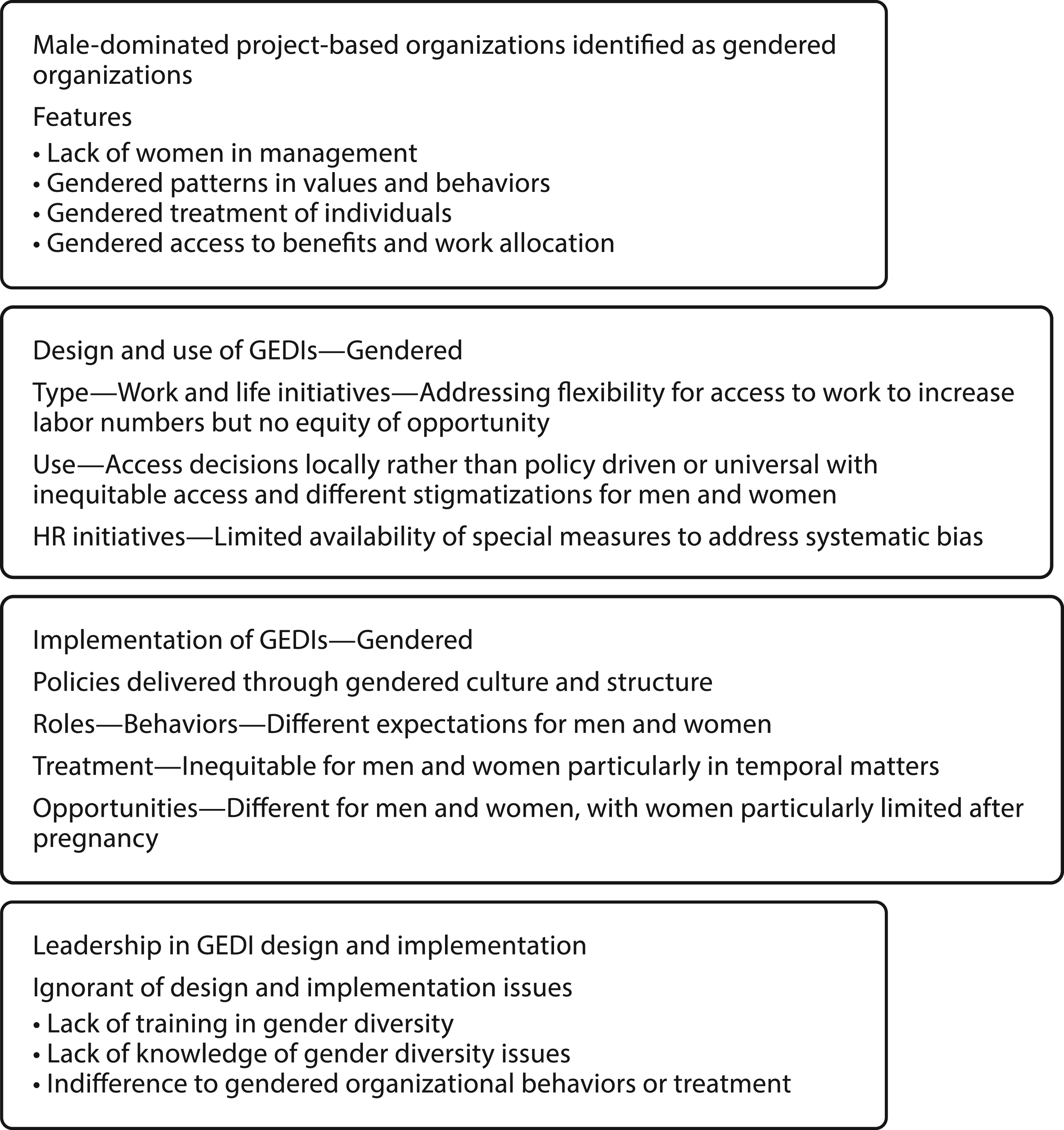
GEDI design and implementation framework.
The recommendation for the underachieving construction and engineering project-based organization in addressing equity, equality, and diversity is to do so through the development of a gender strategy to benefit both women and men. The World Bank (2024) recommends a gender strategy to forward the bold ambition of accelerating gender equality for a sustainable, resilient, and inclusive future. A gender strategy outlines the vision for combating gender inequality and holds the organization accountable by setting measurable objectives for progress. It involves more than mere gender equality statements. “Whether your organization is big or small, a gender equality strategy enables organizations to move beyond an ad-hoc approach to ensure you reach your targeted results” (WGEA, 2019). The United Nations Development Program’s Gender Equality Strategy 2022–2025 (UNDP, 2022, p. 3) acknowledges problems for organizations without a gender strategy, including an alarming backlash against gender equality, and for men, an increase in risky behaviors resulting in violence, poor health, and lower life expectancy.
GEDI Type and Use
Our participant organizations do use two different GEDI types, specifically HR initiatives used to address structural and cultural inequality and work-life initiatives to enable flexibility of access to opportunities for work and caring responsibilities. It is clear from the participant discussion that HR initiatives are limited and not perceived by managers or nonmanagers or professionals as an important element in addressing gender equality and diversity. However, work-life initiatives are in extensive use and are valued principally by women but increasingly by men, allowing them to move in and out of the organization to meet care and life responsibilities. No one identified these initiatives as beneficial to women in a biased system, other than for increasing their ability to access work opportunities and care responsibilities. Women reported access inequalities, whereas men highlighted workload distribution injustices. Gendered disparities in flexibility access are also evidenced in the limiting nature of maternity leave policies.
Evidence indicates the importance of HR GEDI in addressing the lack of women moving into leadership roles. HR initiatives encourage the breakdown of biased structures and discriminatory systems to move members of disadvantaged groups, including women, into management and leadership roles. French and Strachan (2009) note that few organizations develop proactive strategies in the “hard” HR areas, opting instead for strategies that influence work-life opportunities used to increase numbers of women available in the labor market. HR initiatives, including training and mentoring, are linked to increases in numbers of women in supervision roles (French & Strachan, 2015). Further, HR initiatives that include mentoring and networking and career advice have been identified as significant in addressing gender equality in the horse-racing industry (Manfredi & Clayton-Hathway, 2021), whereas specific recruitment strategies in the technology industry are noted as vital to addressing gender bias (Ly-Le, 2022). In architecture, Caven et al. (2015) recognizes that different initiatives are used in different countries. In the United Kingdom, networking and socializing initiatives are popular; in France, it is political activism; whereas in Spain, it is attracting more women through recruitment and selection into higher education.
Yet there remains a discrepancy regarding the use of HR initiatives, which are noted as ineffective possibly due to poor design. In investment banking, gender equality and diversity initiatives are recognized as a niche topic, with many organizations not implementing any specific programs (Hinrichsen et al., 2018). In academia, Grada et al. (2015) recognize that interventions serve only to reinforce underlying inequalities by attempting to fix the women. They recommend professional development training and mentoring underpinned by gender and diversity awareness, empowerment, and peer support. Smith et al. (2023) found that despite various GEDI offered in the engineering sector, many are not successful due to the continuing hegemonic industry norms, poor alignment to desired outcomes, and poor implementation in practice.
Work-life initiatives encourage greater work flexibility and increase the potential labor pool, allowing those with care and life responsibilities to move in and out of the organization, but they rarely extend or increase the numbers of women in management or in leadership roles (French & Strachan, 2009). Baker et al. (2019) show GEDI featuring work-life initiatives may increase the representation of women at both management and nonmanagement levels, but only when there is already an increased number of women in the TMT. This option is certainly not available in gendered organizations with fewer women in senior roles. Further, work-life initiatives may allow for greater flexibility, but they do not address existing structural and systemic inequality, which may be better addressed through well-implemented HR types of initiatives (Baker et al., 2021b).
In answering Question 3 on what types of GEDI are implemented and Question 4 on how GEDI are used to address inequality in male-dominated construction and engineering project-based organizations, we found the extensive use of work-life type GEDI in these gendered organizations but they were implemented and used through a gendered pattern of decisions as to who gets access and how and when, whereas HR GEDI are not well understood, valued, designed, or implemented, prompting our second proposition:
Proposition 2. Gendered organizations use GEDI differently with work-life initiatives that are well understood, valued, and utilized for flexible work opportunities that are offered through gendered decision-making allowing for different caring responsibilities while HR initiatives, including special measures specific to addressing gender equality, are less well identified, understood, valued, or utilized (see Figure 1).
Addressing gender inequality has been the objective of research for more than 30 years, with the Secretary-General of the United Nations suggesting the aim is inclusivity but with little consideration of how to achieve inclusion; there is limited meaningful progress, and goals seem more distant than ever (UN, n.d.). Oxfam advises that the aims are recognition of unpaid and poorly paid care work (Oxfam International, 2020) through restructuring social and workplace systems. The World Bank recommends the aim of achieving legal gender parity through legislation is to change women’s rights (World Bank, 2023). The Group of Seven (G7) Gender Equality Advisory Council (an advisory group to G7 countries) says the aim is the application of programs and policies to implement change at local, national, and international levels (G7 Gender Equality Advisory Council, 2019). The Australian Workplace Gender Equality Agency (Cassells & Duncan, 2021) suggests the aim of effective gender equity is the consistent scrutinizing by organizations of their own data to apply policies to address discrimination and disadvantage.
Cultural and Structural Challenges
Our findings indicate the participants shared joint cultural norms related to work values for their organizations, but they also identified the very different gendered cultural norms, with men expected to work longer hours and women required to petition individually for opportunities of maternity leave and work from home opportunities. The masculine culture prevalent in male-dominated project-based organizations presents significant challenges for both women and men. Western cultural norms, as suggested by Connell (2020) and Kray (2017), often associate masculinity with traits such as self-reliance, emotional suppression, toughness, aggressiveness, and success. These norms, influenced by societal views on gender roles (Eagly & Karau, 2002), shape formal and informal workplace processes and practices within organizations. In sectors dominated by men, this masculine culture that is traditionally associated with arduous physical work (Sandberg et al., 2016) and a macho culture (Cartwright & Gale, 1995) fosters a climate of risk taking, physical exertion, and male social closure (Ankrah et al., 2009; Chan, 2013), permeating work structures and roles. Styhre (2011) argues that deeply embedded masculine ideology often goes unquestioned, leading to poor work-life balance, long working hours, and presenteeism (Baker & French, 2018; Galea et al., 2015; Lingard & Francis, 2007). Women in this environment face disadvantages and exclusion, encountering high attrition rates, stalled career progression, and difficulties in managing both work and family responsibilities (Galea et al., 2015; Watts, 2007). In addressing the question of how male-dominated organizations consider their context, including the gendered nature of organizational culture and structures in GEDI design and implementation, we found gendered organizations did not recognize or consider the context of the gendered biases of culture or structural systems in designing and implementing GEDI, prompting our third proposition.
Proposition 3. Gendered organizations are supported by cultures and structures that encourage gendered policies, practices, behaviors, and treatment (see Figure 1).
Understanding these issues involves examining the underlying structural factors through the lens of institutional theory (DiMaggio & Powell, 1983; Milliken et al., 1998). According to institutional theory, organizations within the same field tend to become homogeneous in structure, processes, and behaviors, known as institutional isomorphism (DiMaggio & Powell, 1983). According to DiMaggio and Powell (1983) these organizational expectations stem from the continuous professionalization of an industry’s working standards, emphasizing commitment to work. This commitment is evident in the emphasis on working long hours and prioritizing client satisfaction, even at the expense of employees’ ability to balance work and family responsibilities. Isomorphism is driven by numerous pressures. Coercive pressures stem from government and the market for legitimacy; mimetic pressures often arise from market uncertainty with organizations modeling themselves on successful counterparts; whereas normative pressures result from industry professionalization, promoting conformity and professional standards (DiMaggio & Powell, 1983).
The legitimacy of long working hours—a long-standing influence on the industry (Baker & French, 2018)—is a normative pressure that is yielding ground to the coercive forces of COVID-19 pandemic restrictions and mimetic influences where these changes are copied across the entire industry. This shift in approaches to flexibility signifies one positive change in the industry, empowering both women and men to exert influence on the prevailing norms and expectations regarding flexibility and decisions about work-life responsibilities. Our participants identified the changing nature of temporal expectations due to the COVID-19 pandemic, encouraging greater flexibility in how and where work gets done.
Leadership
Effective gender equality programs require visible and consistent leadership from top management, according to our research participants. Managers and their immediate supervisors are seen to play a crucial role. Our findings highlight the importance of employee belief that management needs to step up their attitudes in designing and implementing gender equality programs (Kangas & Lämsä, 2021). This view supports needs-based justice, which subscribes to noncomparative justice because the needs of the person or group should be independent of others when it comes to assessing inputs and outputs (Adams, 1965). However, this cannot be achieved if leaders have unsupportive personality types stemming from their traditional conceptions.
Visible and sustained leadership is crucial for a successful gender equality program. Inconsistent leadership can lead to failure (de Vries, 2015). Larrieta-Rubin de Celis et al. (2015) suggest that gender diversity is vital in strategic leadership positions, as it affects the implementation of gender equality initiatives. In answer to our fifth and final question about the existence and breadth of leadership training, we did not find any significant positive responses from leaders discussing their training or its value in equality and diversity management. However, we did identify that almost all respondents expect more from their leaders when it comes to equality and diversity management. Our findings show that for GEDI to be effective, top management leaders must emphasize their importance, middle managers must use them, and functional managers must approve them prompting our final proposition.
Proposition 4. Gendered organizations undervalue equity and leadership training and the importance of diversity in leadership actions across all leadership levels (see Figure 1).
The lack of gender diversity in key leadership positions affects the implementation of gender equality initiatives (Larrieta-Rubín de Celis et al., 2015). Having fewer women on corporate boards, or in top and middle management, affects the deployment of gender equality initiatives (Larrieta-Rubín de Celis et al., 2015). Our findings show that the boards, top management, and senior leadership in these male-dominated organizations remain predominantly male. This inconsistency in implementing GEDI contrasts with procedural justice, which emphasizes fairness in decision-making processes at the workplace (Konovsky, 2000).
Leadership behavior can be further understood through the lens of Inattention Theory, which posits that leaders act based on their own experiences and knowledge, which shapes their attention and perception of the world. This, in turn, influences their actions, the organizational environment, policies, strategies, and culture (Scharmer, 2002). Leaders may have blind spots from their past experiences, making them unaware of their organization’s systems and practices, which can lead to potential discrimination. Employees working with such leaders may feel gender affects their relationship with their manager or perceive an element of bias in their day-to-day interactions. Leadership training to influence attitudes needs to be increased (Kangas & Lämsä, 2021).
Implications
Theoretical
Our findings enabled the construction of four formal directional propositions, grounded in the richness of empirical data and novel discovery, providing fertile ground for future theoretical research and practical recommendations linked to theory (see Figure 1). These propositions may also be useful in bridging the gap between qualitative and quantitative research (Creswell, 2007).
Future research is recommended to explore the theoretical explanations for the gendered organization (see Acker, 1990) and the means to overcome the inequality issues identified by this study. These issues include the features of male domination in organizations and the types and use of GEDI to overcome the gendered design features. It is also important to consider the impact of institutional norms (see DiMaggio & Powell, 1983) at the industry and organizational levels that support ongoing gender biases identified in the gendered organizations. It is vital that more research is undertaken into the significant roles and skills of individual leaders in the design and implementation of effective GEDI. Inattention (see Scharmer, 2002) through a lack of knowledge or a lack of training is simply unacceptable in today’s workplace when that can lead to injustice, including procedural injustice (see Adams, 1965)
Practical
This study's findings have significant practical implications. First, organizations may consider developing comprehensive gender strategies that clearly articulate their organizational vision for gender equality, including measurable objectives. These strategies could extend beyond traditional diversity metrics of numerical representation to address systemic barriers. This could involve development of key performance indicators for achieving gender equality and diversity objectives across all organizational levels. It could also include revision of HR processes to create standardized recruitment and promotion criteria to eliminate bias in project-based performance evaluations. Further, work-life processes need to recognize flexible work arrangements that accommodate the diverse needs of men and women across different organizational levels. These GEDI could include special measures or identity-conscious initiatives that recognize and address the specific challenges faced by women in male-dominated environments.
In addition, construction and engineering organizations could actively manage organizational culture to include regular cultural audits to identify and eliminate practices that perpetuate gender inequality. Finally, the introduction of mandatory leadership training focused on gender bias recognition and on equipping project managers and site supervisors with skills to challenge traditional industry norms.
Limitations
The study has two primary limitations often linked to qualitative research, specifically convenience sampling and sample size. Relying on convenience sampling for recruiting individual participants may introduce self-selection, time, and context bias, as well as limited generalizability of the data. Despite these limitations, our targeted approach enhances the relevance of findings by prioritizing participants directly aligned with the research questions (Saunders et al., 2018). The recruitment of five participating construction and engineering organizations may have introduced sampling bias by relying on the willingness of organizations to participate. While this approach facilitates access to industry-specific insights and ensures practical relevance (Hodgkinson et al., 2001; Wensley, 2011), it may have excluded perspectives from nonparticipating organizations potentially limiting the diversity of viewpoints within the sample.
Footnotes
Acknowledgments
We gratefully acknowledge that this publication has been developed and reproduced with a grant from the Project Management Institute, Inc. and is copyrighted material of and owned by Project Management Institute Inc. (Copyright 2025). Unauthorized reproduction of this material is strictly prohibited.
Declaration of Conflicting Interests
The authors declared no potential conflicts of interest with respect to the research, authorship, and/or publication of this article.
Funding
The authors received no financial support for the research, authorship, and/or publication of this article.
Data Availability Statement
The data that supports the findings of this study are available from the corresponding author, Erica French, upon reasonable request. The participants of this study did not give written consent for their individual data to be shared publicly. Due to the sensitive nature of the research, individualized supporting data is not available but aggregated data is available.

Author Biographies
Appendix A. Interview Questionnaire
INTERVIEW GUIDE, MANAGER (Employee Guide is similar and not included here)
Gender Equality Initiatives
Does your organization publish any gender equality or diversity statement on the company website or in the annual report? Gender equality initiatives include policies for recruitment, retention, performance management, promotion, talent identification, succession planning, training, and development. It also includes work-life balance initiatives, for example flexible working policies, caregiver’s leave, compressed working week, flexible hours of work, job sharing, part-time work, purchased leave, telecommunicating, time-in-lieu, unpaid leave. What are the gender equality initiatives and work-life initiatives offered by your organization to assist employees? Which work–life initiatives have been mostly used by your employees? Do the men and women of your team utilise the work-life initiatives differently? Which gender equality initiatives have proven to be most effective in your organization? Do you believe the gender equality initiatives benefit the employees? How? Do you have key performance indicators relating to thegender equality and diversity policies? Where you have set targets and measure your progress towards the target?
Employee Engagement
I would like to ask you a few questions related to employee engagement. Employee engagement represents the level of enthusiasm and connection employees have with their organization. It’s a measure of how motivated people are to put in extra effort for their organization, what employees value at work, how satisfied they are with their jobs, how loyal they are to their organization, and how committed they are to staying with the organization.
My next question is about ‘citizenship behaviors’ and it may be anything that employees do, out of their own free will, that supports their colleagues and benefits the organization as a whole.
10. What types of actions and behaviors people (that report to you) may be doing that aren’t part of their formal job description? Are there gender differences in types or number of these citizenship actions and behaviors performed by your employees? 13. Do you believe overall gender equality initiatives enhance employee engagement in your organization?
Gender Salience
Gender salience refers to the strength of people’s gender identity and can influence an individual’s attitudes, decisions, and actions. The level of gender salience determines how strongly group-based attachment is felt to a person’s identity.
Gender Diversity
16. Is there gender equality throughout all levels of management and nonmanagement within your organization? 17. Do all employees have an equal opportunity to achieve promotion throughout the management and nonmanagement levels of your organization? 18. Do you believe overall gender equality initiatives enhance organizational performance in your organization?
Appendix B. Demographic Table
Note. *E = Engineering, C = Construction, P = Property.
Participant
Organization Type*
Sex
Age Group
Position
Years of Experience
01
E
M
35–44
M
20
02
C
F
25–34
N-M
3
03
C
F
35–44
M
3.5
04
C
M
< 25
P
0.5
05
C
F
25–34
N-M
10
06
C
F
35–44
P
16
07
C
F
35–44
P
18
08
C
M
35–44
P
20
09
C
M
45–54
P
25
10
E
F
25–34
P
7.5
11
P
F
25–34
N-M
10
12
C
F
35–44
M
16
13
E
M
35–44
P
15
14
C
F
45–54
P
7
15
C
F
55–65
M
8
16
P
F
25–34
M
2.5
17
E
M
45–54
P
29
18
C
F
45–54
N-M
10
19
P
F
35–44
P
10
20
C
M
25–34
P
5
21
C
F
45–54
P
25
22
C
F
45–54
N-M
18
23
C
F
35–44
N-M
7
24
E
F
25–34
N-M
7
25
P
M
35–44
P
10
26
C
M
35–44
P
10
27
P
M
55–64
M
45
28
E
F
45–54
M
6