




Abstract
The question of how project leadership can achieve desirable futures through projects is timely and important, yet under-explored. We synthesize recent insights on future making and socialized project leadership to address it. Our contribution is to frame project leadership for future making as the set-up and maintenance of organizational contexts for participation in collective practices of inquiry to identify desirable futures and achieve project outcomes. We argue that throughout the project life cycle, participants engage with incomplete representations of possible futures, and ask questions that identify and include diverse people, materials, and places to make ethical judgments for better futures.
Introduction
Given significant societal uses of projects and their potential impact on current and future generations, the question of how project leadership can achieve desirable futures through projects is timely and important, yet under-explored. In this thoughtlet, we address this question by synthesizing insights on future making with project leadership from a socialized perspective. While much literature on project and organization management is future-oriented, future making offers an alternative conceptualization of how organizational actors orient themselves to the future (Comi & Whyte, 2018; Whyte, Comi, et al., 2022). This emphasizes the importance of the shared experiential knowledge that ensues from situated practices, as actors collectively engage with the present situation (i.e., the people, places, and materials at hand) to give form to desirable futures. Future making is defined as the work of iteratively “making sense of possible and probable futures, and evaluating, negotiating and giving form to preferred ones” (Whyte, Comi, et al., 2022, p. 1). As this involves collective processes of inquiry, we further suggest that future making includes goal-seeking as well as goal-oriented practices (Gustavsson & Hallin, 2015).
It is useful to synthesize insights from the literature on future making with insights from a research trajectory on project leadership that is informed by organization studies (e.g., Clegg et al., 2023; Kortantamer, 2023; Packendorff et al., 2014; Whyte, Naderpajouh, et al., 2022) to unpack project leadership for future making. The recent work on future making examines the heterogeneous and distributed practices through which futures are both imagined and realized (e.g., Comi & Whyte, 2018; Esposito, 2024; Feuls et al., 2024; Thompson & Byrne, 2022; Wenzel, 2022), especially the emancipatory inquiry that actors undertake as they collectively seek to deliberate on what futures are desirable, who should be included in future making, and how such desirable futures might be realized (Comi et al., forthcoming). The trajectory of work on project leadership offers a socialized perspective, shifting the focus away from the project leader as an individual, to project leadership as an organizational phenomenon, and defining project leadership as the shared work of producing direction (Crevani & Endrissat, 2016) in projects.
While all project leadership is forward looking (Briner et al., 1990), our aim is to understand the kind of leadership that is needed to make desirable futures—understood as collective, value-based judgments of what the future might and should be (Comi et al., forthcoming; Gümüsay & Reinecke, 2024). Project leadership faces new challenges in an uncertain and changing world, with ecological concerns, growing organizational complexity, and rapidly changing technologies (Whyte, Naderpajouh, et al., 2022). Previous understandings are underpinned by a view of project leadership as a goal-oriented practice; for example, Briner et al. (1990, p. 5) conceptualize “looking forwards” narrowly in terms of planning: “Planning in order to ensure that the team sets realistic targets, and obtains appropriate resources to achieve those targets.” In contrast, we propose that project leadership for future making emphasizes the importance of goal-seeking practices, which require collective engagement with and negotiation of project goals and targets. In an uncertain and changing world, this negotiation is ongoing through the life of a project and extends beyond immediate project outputs to consider how projects are set up to achieve future outcomes, where these become interventions into wider systems (Engwall, 2003; Whyte & Mottee, 2022).
In this context, the role of leadership may be to ask the right questions, rather than to provide the right answers (Grint, 2010; Hagel, 2021). Drawing on previous research on future making, we suggest that the work of project leadership consists not of presenting pre-developed images or visions of the future, but rather of facilitating the cocreation of common meaningful images of possible, probable, and preferred futures, and the iterative processes of testing, stabilizing, and reifying desirable futures. Here, images of the future are crafted through representations (e.g., visuals, prototypes, stories) produced and evolved in a process of collective inquiry. This entails a reflective conversation with the situation, in other words, with the people, materials, and places at hand (Comi & Whyte, 2018; Whyte, Comi, et al., 2022); and involves ethical and moral considerations, as actors debate what values to consider in future making, how to broaden access to future making, and what futures are desirable for themselves, others, and future generations (Comi et al., forthcoming; Rauch, 2024). Hence, we see the work of project leadership as engaging with incomplete representations of possible futures; it needs to ask questions that identify and include diverse people, materials, and places to make ethical judgments for better futures.
Our contribution in this thoughtlet is thus to frame project leadership for future making as producing direction through the work of setting up and maintaining organizational contexts that support participation in collective practices of inquiry. As we will argue, these practices—used to identify and achieve project outcomes—are important throughout the entire project life cycle. In the next section, we set out the theoretical background, briefly introducing and summarizing key insights from the extant literatures on future making and a socialized perspective on project leadership. In the following section, we then build the new theoretical understanding by synthesizing these insights and applying them to how project leaders can achieve desirable outcomes. In the subsequent discussion section, we introduce an example of poor leadership decision-making, leading to a less desirable future: the mining group Rio Tinto’s destruction of aboriginal heritage. We will then discuss how this example motivates and has implications for our theorizing of the role of project leadership in realizing desirable futures. We conclude by summarizing the implications for work on projects and project leadership and suggest new directions of research.
Theoretical Background
To ground theoretical work to address the question of how project leadership can achieve desirable futures, we unpack and develop the key building blocks as follows. First, we explain future making as inquiry and, second, a socialized perspective on project leadership.
Future Making as Inquiry
In project management, as in organization studies, most research has emphasized rational planning as an approach to managing the future. However, a strand of recent research has sought to develop more socialized and less rationalistic explanations (Whyte, Comi, et al., 2022), recognizing that the future is incompletely knowable, problematic, and open-ended (Wenzel et al., 2020). This research has sought to explain how futures are made in situated practices, using the concept of future making (e.g., Comi & Whyte, 2018; Thompson & Byrne, 2022; Wenzel, 2022). For Wenzel (2022) this encompasses all practices in which futures are made, regardless of their outcomes, but our theorizing is emancipatory in nature; so, instead, we use this term to identify and theorize approaches to making desirable futures. What is desirable is not defined a priori but is negotiated on a situated basis, as concerned actors engage in a collective inquiry to deliberate what futures are better for themselves, future generations, and the natural environment (Comi, Mosca, et al., forthcoming).
Drawing on the American Pragmatist tradition, we theorize future making as a form of inquiry (Comi & Whyte, 2018; Whyte, Comi, et al., 2022), where futures are made in the present, as actors materialize their imaginings through representations, which are inevitably partial and incomplete. This collective process enables aspects of the future to become understood over time. Representations are important, as they make understandings of a future present; in other words, they re-present it. Their provisional and incomplete nature “sustains the engagement of diverse participants, enabling them to question assumptions, discuss and negotiate different preferred futures” (Whyte, et al., 2022, p. 5). Desirable outcomes are brought into being through enrolling people, materials, and places in an ongoing inquiry, which entails engaging with partial and unfolding representations of the future.
This perspective on future making as inquiry draws on Dewey (1938) and Schön (1984). Project and organization scholars are drawing inspiration from the American Pragmatist tradition to develop new theoretical understanding of actions in the face of uncertainty (e.g., Ferraro et al., 2015; Simpson & den Hond, 2022) and of the project conceptualization (Alimadadi, 2022). Like Dewey, we are interested in “public deliberation about problems of shared concern” (Mische, 2022, p. 421). Our theorizing extends Dewey’s framing of individual experiments (Dewey, 1922, p. 190; discussed also in Mische, 2022) to understand collective inquiry where multiple actors engage with materials (e.g., the pen, paper, computer printouts, simulations, drawings, and conversations observed by Comi and Whyte (2018)). This engagement with materials, which can be rapidly changed and updated, enables forms of inquiry that collectively imagine and rehearse later actions to be enacted at scale in the world. The term future making is used, as practitioners are observed to go beyond sensemaking to engage in action toward realizing, in other words, making futures (Comi & Whyte, 2018). We find the notion of inquiry as particularly important to advance understanding of how futures are made, because it draws attention to the indeterminate situation that initiates an inquiry, which can be differently framed by diverse social groups. It also usefully draws attention to the steps involved in negotiating issues to enable the decisions made to be justified, when outcomes are evaluated.
For Dewey, inquiry is hard work and undertaken to where there is a need to justify decisions (Whyte, Comi, et al., 2022): Where there is no such need, decisions can be made through “routine, instinct, the direct pressure of appetite, or a blind ‘hunch’” (Dewey, 1914, p. 17). Inquiry is a social, knowledge-led, and temporally unfolding process, described by Gehman et al. (2022) as involving robust action, with a participatory architecture, multivocal inscriptions, and distributed experimentation. Like sailing, it involves being in the moment and anticipation, sensibilities, collective sensemaking, and action under conditions of uncertainty. For Dewey this process eschews a priori and detemporalized representations of the future such as ideologies and utopias. Sensitive to the changing winds—through engaging as part of a social process of engaging with partial representations of the future in the present—individuals develop skill in addressing morally problematic situations (Preti, 2018) and participate in processes of making ethical judgments.
The idea of collective inquiry raises questions of power (Hungnes et al., online ahead of print; Mische, 2022). Different project stakeholders, communities, and groups draw on different value systems or orders of worth (Boltanski & Thévenot, 2006) in their understanding of how to evaluate outcomes (Reinecke et al., 2017) and how to frame an initially indeterminate situation as a problem. Projects, both in their formation and their execution, involve people who may not have the same motives or even envision the same projects. Here, destabilizing dominant discourses may “allow us to map alternative pathways of action” (Mische, 2022, p. 423) with collective action emergent where participants co-design the rules and are accountable for their enforcement, with graduated sanctions, defined rights to withdraw, and costs proportionate to benefits (Ostrom, 2000).
The practices of inquiry unfold in the present but involve decisions about near and distant pasts and near and distant futures. Hence, questions that might arise are: What is a desirable outcome? For whom? When? We will return to these questions later, but from a Pragmatist perspective the understanding of a desirable outcome does not itself exist a priori in a fully formed manner but—with a focus on futures that matter to society—it is negotiated through a process of engagement with others in imagining and counterposing multiple possible future lines of action. Time and timing play important roles here, which is why materials that can rapidly be changed and updated enable collective forms of inquiry, whereas a priori and detemporalized representations inhibit this process. As temporary organizations, projects can provide a vehicle for inquiry as they enable diverse stakeholders, communities, and groups to come together and participate in a time-limited manner, which reduces the potential for actors to use futures to defer moral scrutiny (Van Elk et al., 2024). Working from the indeterminate situation of the future as understood in the present, the work of future making is a craft that both imagines the future and brings it into being. It is a process that is reflective and performative in nature (Comi et al., 2023) and knowledge led, giving primacy to the collective process of inquiry, rather than dominated by a powerful actor.
A Socialized Perspective on Project Leadership
We build on a trajectory of research on project leadership that is informed by organization studies (e.g., Clegg et al., 2023; Kortantamer, 2023; Packendorff et al., 2014; Whyte, Naderpajouh, et al., 2022) and shifts the focus away from the project leader as an individual, to project leadership as an organizational phenomenon. Rather than giving priority to individuals and their characteristics (e.g., personality traits, communications style, etc.) the focus is placed on leadership practices and interactions (Crevani et al., 2010; Denis et al., 2012). As we will discuss, there are differences in how this leadership is conceptualized by scholars within this growing trajectory, but what these scholars share is the attention to how leadership is enacted in organizations.
As projects are temporary organizations, scholars across a range of perspectives have drawn attention to the temporal nature of project leadership, changing across the temporary and evolving organization of a project (e.g., Thoms & Pinto, 1999), with leadership taking different forms at different stages of the project (Levitt et al., 2024). Within the trajectory of research informed by organization studies, scholars have conducted empirical studies of leadership as a series of social activities and events unfolding between projects and other organizational actors. For example, exploring the case study of the SOX 404 Project, Packendorff et al. (2014) show how actions and the direction of the project evolve as actors incorporate new developments in the understanding of the current scenario. This implies that, over time, project leadership involves activities aimed at continuously constructing and reconstructing elements of practices and interactions, including legitimacy, power relationships, and temporal and spatial conditions (Packendorff et al., 2014).
In defining project leadership as the shared work of producing direction (Crevani & Endrissat, 2016) in projects, we start from the organization rather than the individual. Leadership is negotiated in organizational contexts and the identification of individuals as leaders, and of leadership itself, takes place in these contexts. Within organizations “there are ongoing struggles around who is regarded as being a leader, where leadership is seen to be done or needed, how leadership is thought to be done, and what exactly leadership is thought to be” (Alvesson & Spicer, 2012, p. 374). Thus, Empson et al. (2023) argue that individual leadership identities may become constructed and situated in organizational narratives of collective leadership. In projects, the tradition of work informed by organization studies draws attention to leadership across organizational structures that encompass stakeholders as well as project teams. For example, through work with a project embedded in a UK government organization’s major project portfolio, Kortantamer (2023) argues that project leadership relies not only on top-down influence, but also forms of peer-to-peer interaction such as transactional exchange and co-leadership.
Within this growing trajectory, scholars interested in leadership and project leadership have begun to use different concepts, for example, socialized leadership (Clegg et al., 2023; Whyte, Naderpajouh, et al., 2022), distributed leadership (e.g., Kortantamer, 2023; Packendorff et al., 2014), leadership as practices (Kortantamer, 2024; Raelin, 2016), and interactional or relational leadership (Alvehus, 2019; Uhl-Bien, 2006). Here we draw broadly on this tradition and choose to use the term “socialized leadership.” We do this for two reasons.
First, “socialized leadership” brings into view the contextual nature of leadership, understands it as emergent in social situations, and focuses on the mobilization of collective action (Clegg et al., 2023; Whyte, Naderpajouh, et al., 2022). This term draws attention to the ethical and capacity-building dimensions of leadership from an organizational perspective (Clegg et al., 2024), which are important to our argument. The term “socialized leadership” enables us to focus broadly on how leadership is done through doings, interactions, relationships, and practices and draw on a tradition in which project scholars have studied practices and interactions together (e.g., Crevani et al., 2010). Hence, the notion of socialized leadership is more established in the project literatures than emergent approaches that separately study practices (e.g., leadership as practice) and interactions (e.g., relational leadership). We define socialized leadership as the work of setting up and maintaining organizational contexts, as it “builds social capital that is transformational and inclusive in how it deals with complexity” (Whyte, Naderpajouh, et al., 2022, p. 1).
Second, our perspective emphasizes leadership as shared work and hence differs from studies that identify multiple leaders across distributed teams (McChrystal et al., 2015). Thus, rather than using the term distributed leadership, we use the concept of socialized leadership where this involves “working across such multiple understandings of value, with their different underlying knowledge-sets, assumptions and evaluation procedures” (Whyte, Naderpajouh, et al., 2022, p. 2). We are interested in the collective aspects of leadership and how these are negotiated. The extent to which such leadership is distributed in a particular organizational setting is an empirical phenomenon. In projects, particularly in safety-critical industries, senior roles may be held by society or legal systems to be personally responsible if things go wrong, which may limit the extent to which these aspects of leadership can be distributed. Further, socialized leadership practices that appear to participants to be distributed and emergent can also appear to managers to be orchestrated (Alvehus, 2019).
So, what characteristics of project leadership might be important in achieving more desirable futures? Existing evidence suggests that collective action is mobilized by undesirable as well as desirable future events (Alimadadi et al., 2022), and that leadership is more successful when it is anticipatory and proactive rather than reactive (Barber & Warn, 2005). Much of the existing literature on project leadership strongly associates leadership with management, either as a subset of project management (e.g., Agarwal et al., 2023) or with management as part of leadership (e.g., Clegg et al., 2020). Yet, our focus on project leadership for future making does not provide a managerial understanding of leadership or bring to the fore this relationship with management, but rather the production of direction through support for participation in collective practices of inquiry.
Project Leadership for Future Making
We frame project leadership for future making as the work of setting up and maintaining organizational contexts that support participation in collective practices of inquiry. This focus limits the scope of leadership but increases the scope of concern, away from managing teams and delivering project deliverables, to influencing the project outcomes and the societal and organizational futures that become made through projects.
Thus, we see project leadership as concerned with engaging with a wide range of stakeholders to the project, beyond the motivation of project teams with line management or contractual relations with project managers. This understanding of project leadership is grounded in the Pragmatist tradition (Dewey, 1938; Schon, 1984; Simpson & den Hond, 2022) in that project leadership for future making is seen as facilitating collective practices of inquiry by which actors negotiate what is desirable (for themselves, others, and the environment) and how such desirable futures might be realized in practice, as time unfolds from the present into the future. Table 1 summarizes the differences between managerial understandings of project leadership as strongly related to project management (e.g., Agarwal et al., 2023) and an understanding of project leadership for future making.
Characterizing Project Leadership for Future Making and Contrasting it With More Managerial Understandings
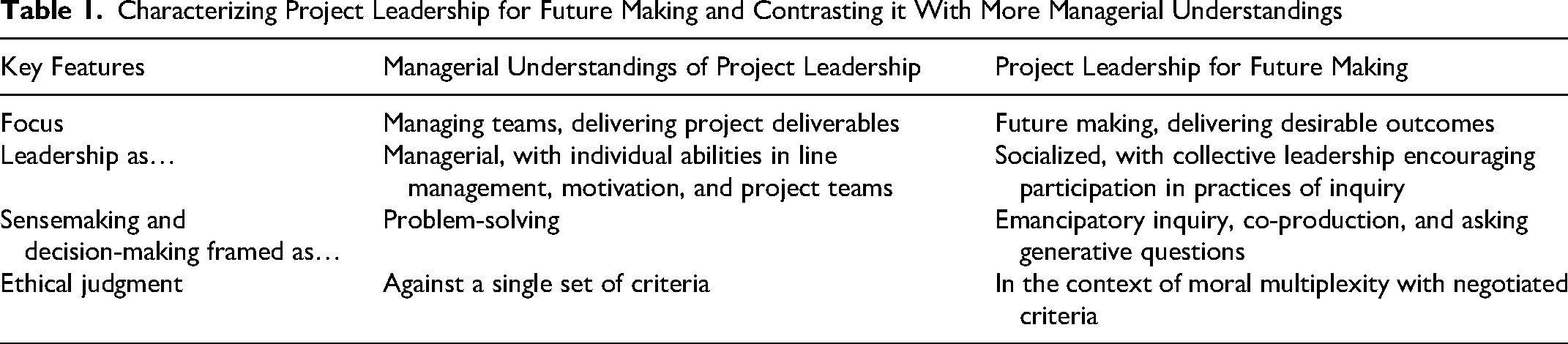
By drawing on the notion of future making as inquiry, we posit that this involves a broader process of sensemaking and decision-making than is understood through a framing of problem-solving. Work on inquiry sees the formulation of the problem as a significant part of the process. It starts with an indeterminate situation that gradually becomes defined as a problem. When working with multiple social groups, there may be significantly different understandings of what the situation is; thus, where there are significant decisions to be made, moving too quickly to problems and their solutions may lead to a failure to see other aspects of the situation. We see project leadership playing a significant role in framing the nature of the inquiry and setting its bounds and the legitimate space for debate and thus the potential nature of contributions and dissent.
Leadership becomes reframed as a phenomenon that is not invested solely in one individual but rather is socialized, with leadership taking different forms depending on the nature and stage of the project. With its focus on leadership as shared work, our perspective is different from work that identifies multiple leaders across distributed teams (McChrystal et al., 2015). Instead, we see project leadership as engaging proactively, and being future oriented, orienting knowledge and sensibilities toward what is not yet. It involves choices across project stages: There is a need to make ethical judgments and justify decisions made in relation to the values of diverse groups. In such a context, the Pragmatist tradition suggests the need for inquiry, as judgments are made in the context of moral multiplexity with negotiated criteria. We see the participation in collective practices of inquiry as involving diverse perspectives, teams, and communities that become engaged in negotiating organizational positions and narratives.
Thus, our contribution is to theorize leadership and its orientation to the future by setting out a perspective on project leadership for future making. While it might be argued that all theories of leadership are concerned with the future, or that project scholars have previously focused on the future, this perspective is grounded in the Pragmatist tradition, which emphasizes inquiry, reflection, and deliberation as the basis for improving the present situation (Simpson & den Hond, 2022). It provides a non-managerialist, socialized understanding of project leadership in which meaningful images of the future are not conceived of as an a priori vision of a leader, but rather as co-constructed meaningful images of the possible and probable futures, working through representations that can be adapted over time and open to the input of others.
Discussion: Why Project Leadership for Future Making?
Why do we need a new theory of project leadership for future making, which moves away from managerial understandings of project leadership, and from rationalistic approaches to managing the future through strategic planning? A much discussed, but still shocking, example of where managerial understandings of project leadership and futures failed is the destruction of Juukan Gorge, a sacred rock shelter in the Pilbara region of Western Australia, on the part of Rio Tinto.
In this extreme case, Rio Tinto’s evaluation of options was based solely on commercial criteria. Rio Tinto successfully planned and clearly set realistic targets to access iron ore—and achieved these targets. However, the blast by Rio Tinto not only expanded its Brockman mine but also destroyed a 46,000-year-old heritage. It led to work by the Parliament of the Commonwealth of Australia (Australian Federal Government, 2020, 2021), questions about the prospects for industry change (e.g., Kemp et al., 2023), and concerns that lessons continue not to be learned. The government investigation noted the lack of appropriate consultation with the traditional owners, the Puutu Kunti Kurrama and Pinikura (PKKP) peoples. The interim report makes this clear: Rio Tinto made a deliberate decision to choose the only one of four mine expansion options that required the destruction of the rock shelters on the basis that it would maximize the company’s access to the lucrative iron ore body located in the area. […] There is no evidence that the four options for the mine site were ever put to the PKKP for their consideration. Rather, Rio Tinto’s communications with the PKKP indicated that there was no possibility of avoiding the sites, which on Rio Tinto’s own admission was not correct. (Australian Federal Government, 2020, pp. 6–7)
Rio Tinto made decisions against a single set of criteria, without listening to groups with other values or knowledge of how to engage with their leadership. Changes of personnel in Rio Tinto led to the marketing team taking a greater role in engagement with PKKP. Yet, in the face of the government investigation, Rio Tinto could not justify the ethical decisions that it had made, putting short-term commercial gain above ancient cultural heritage and faced significant reputational damage.
This case motivated us to think about the question: How can project leadership achieve more desirable futures? It surfaces questions about how contemporary society addresses societal pasts and futures through projects and values these in relation to commercial interests. While the options were not put to the PKKP, we also believe that presenting four distinct and relatively complete options—framed in terms of corporate aims—also hindered the consideration of alternatives within Rio Tinto. This managerial understanding of project leadership was unhelpful in this case, as it led to the construction of a single set of criteria that did not reflect the values and knowledge of those outside the project team.
Conclusions
We frame project leadership for future making as the work of setting up and maintaining organizational contexts that support participation in collective practices of inquiry. These practices engage with incomplete representations of possible futures throughout the project life cycle. To achieve desirable futures, leadership needs to ask questions that identify and include diverse people, materials, and places to make ethical judgments for better futures. By synthesizing insights across recent work on future making, and a socialized perspective on project leadership, we thus contribute by developing new theory regarding the work of project leadership for future making. Here, to bring more desirable futures into being, the work of leadership is in facilitating the cocreation of possible and probable futures, and the iterative processes of evaluating, negotiating, and giving form to preferred ones.
Thus, ours is an argument based on ethical judgment, rather than legality or the optimization of commercial interests. We have heard the counterargument that project managers have schedules, budgets, and clients and are not empowered to engage in this form of leadership or to be concerned with future outcomes. Yet, where projects intervene and may affect communities across generations, we are unsympathetic to such arguments that project practitioners do not have time for moral reasoning or ethical judgments. This work opens new avenues for research in leadership and project leadership to enable future making as a process of inquiry, while ensuring democratic input into making futures that matter.
First, there is considerable potential for project leadership scholars to build on this theorizing to undertake empirical research on collective action. Scholars interested in project leadership and stakeholders may explore how processes of collective inquiry unfold when various groups—each with distinct value systems and different orientations to the past and future—are involved. Moreover, questions arise around ethics and morality (Holt & Yamauchi, 2023) in projects. What constitutes a desirable outcome in such a context? Who defines it and when? How can project leadership be sensitive to how the groups with rights and interests become heard or silenced? These questions invite further empirical work on how leadership can align diverse stakeholders with divergent interests and how ethical considerations influence the collective pursuit of shared goals within projects.
Second, there is the potential for further empirical work on the material nature of leadership for future making. In this thoughtlet we draw on Comi and Whyte (2018) and Whyte, Comi, et al. (2022) for the idea that inquiry draws on people, materials, and places. We have emphasized the socialized nature of leadership for future making, but inquiry involves situated and material practices. As projects intervene into the natural world (Whyte & Mottee, 2022), there are opportunities for scholars to examine project leadership for future making in relation to the physical contexts in which projects are delivered. In societies facing climate change there are opportunities for scholars to consider how the processes of making futures might be done better through projects.
Third, there is the opportunity to build on this work and its distinction between managerialist and pragmatist understandings of project leadership to extend our understanding of how time and timing changes ideas about the future. In particular it would be fruitful to examine how inquiry as a collective process enables specific aspects of the future to become understood over time. The work of inquiry might also bring in a new time order that could alter the relationship with the past and lead to different futures (e.g., Söderlund & Pemsel, 2022); and empirical work could further explore the relationship of view of the future with views of the past. Such new scholarship might build on our work to raise questions about the variety of short-term and long-term futures associated with the delivery of complex interorganizational projects. For example, scholars might explore the role of organizational memory and past experiences in shaping how project actors and stakeholders imagine and enact future paths (Feuls et al., 2024), exploring their understanding of the dynamic relationship among past, present, and future actions.
Fourth, questions arise about the different kinds of leadership needed for making futures in diverse project settings. What facilitation and technical integration skills are needed at different stages? Project leaders operate across diverse scales and complexities of projects and across the life cycle of project conception, stakeholder alignment, detailed design, delivery, and handover. Yet, while historically the design decisions have been made early, and the later phases of a project have been solely concerned with implementation, the dynamics of a changing world mean that ethical questions of outcomes (ends) as well as means of delivery arise through the delivery process. Desirable futures are not easy to accomplish, with the potential for actors to use futures to defer moral scrutiny (Van Elk et al., 2024). There is a need for scholars to use examples to unpack and examine the dynamic of leadership to extend understanding of how leaders can facilitate future making during different stages of the project life cycle, and how they can be held accountable in the present in relation to futures in the making.
To conclude, this work has broader implications as it synthesizes insights across recent work on future making and project leadership from a socialized perspective, with a view to addressing the question of how project leadership can achieve desirable futures. We suggest that the work of project leadership is to set up and maintain the organizational context that supports participation in collective processes of inquiry, through engagement with incomplete representations of the future in the present. Hence, the focus of project leadership is not setting out a predetermined vision, but rather listening, and asking questions to enable the inclusion and representation of diverse people, places, and materials in the cocreation of the future. Project leadership has an important role to play in providing organizational contexts in which diverse values might be juxtaposed and discussed to make ethical decisions and achieve better futures.
Footnotes
Acknowledgments
We acknowledge the helpful feedback on an early draft presented at the European Academy of Management (EURAM) 2024 in the Innovating Project Leadership track (10_08). Building on the feedback and suggestions from discussants and participants, this submission has been significantly developed since the conference. Alice Comi acknowledges support by the Fundamental Research Funds for the Central Universities, grant no. 22120240396 and NSFC National Natural Science Foundation of China, grant no. W2432048.
