




Abstract
Managing projects raises multiple tensions such as the need to balance cooperativeness and assertiveness. By adopting a process perspective, we analyze why a project group consisting of three heterogeneous subgroups is failing to uphold such balance over time. Instead, overemphasizing cooperativeness in the early phases of the project led to over-assertiveness and escalation of group conflict. We identify three mechanisms for reinforcing dynamics. First, we find that subgroups overestimate other subgroups’ behavioral autonomy, which promotes holding simplified, negative images of each other. Second, subgroups adopt vertical disidentification when they define their own particular role. Third, cooperativeness conceals pejorative perceptions.
Keywords
Introduction
Project management often involves setting up project-based working groups that consist of a heterogeneous set of employees working jointly on concrete tasks (Milliken & Martins, 1996). Heterogeneity can be very beneficial for promoting innovation, creativity, and change (Amabile & Pratt, 2016). However, heterogeneity may also lead to a lack of shared understanding and group conflict (Nishii, 2013; Smith et al., 2017). In turn, group conflict can be, but is not necessarily, detrimental to successful group work (Kozlowski & Ilgen, 2006). Hence, in order to collaborate effectively, Hardy et al. (2005, p. 69) suggest project groups upholding an ongoing tension between cooperativeness and assertiveness. In this study, we understand cooperativeness and assertiveness as “contradictory yet interrelated elements that exist simultaneously and persist over time” (Smith & Lewis, 2011, p. 382). Research on tensions clearly suggests attending to competing demands simultaneously in order to foster learning, flexibility, resilience, creativity, and sustainability (Smith & Lewis, 2011).
Despite its importance and relevance, many project groups fail to uphold an ongoing tension between cooperativeness and assertiveness. In order to address this problem, which is encountered on a regular basis in project groups, we ask for underlying reasons and contribute to research by shedding light on hindering dynamics. In order to identify dynamics that hinder upholding a tension between cooperativeness and assertiveness, we respond to the calls to explore projects from a process lens (Sergi, 2012) and contribute to refreshing the theoretical base of the project management research field (Morris, 2013; Söderlund, 2011). “Process and temporality … can be viewed from different ontologies of the social world: one a world made of things in which processes represent change in things (grounded in a substantive metaphysics) and the other a world of processes (grounded in process metaphysics)” (Langley et al., 2013, p. 4). This study adopts a substantive view by following how a project group (substantive entity) evolved and changed over time (process).
This article reports findings from a longitudinal study of a project group consisting of members of three heterogeneous subgroups that repeatedly descended into group conflict and thus failed to uphold an ongoing tension between cooperativeness and assertiveness. Specifically, we observe an imbalance toward over-cooperativeness in early phases of the project and over-assertiveness in the later phases. The focus on process and temporality enabled us to inductively build a process model, which shows that images and behavior reciprocally influence each other. Such reciprocal influence fuels a vicious cycle whose self-reinforcing dynamics are responsible for subgroups socially constructing predominant assertiveness and group conflict. Even though all three subgroups were interested in professionally conducting the project, they increasingly focused on protecting own interests and defending themselves against others’ seemingly conflicting goals. We derive three mechanisms that explain why the project group members in our case study got trapped in self-reinforcing dynamics. First, subgroups construe overly simplified negative images of each other, because they overestimate other subgroups’ behavioral autonomy and underestimate the impact of their own past actions affecting others’ seemingly negative behavior. Second, subgroups aim to define their own particular role within the project group by disidentifying from other subgroups’ perceived negative images. Third, when subgroups base their cooperative behavior on perceived incapability of other subgroups, cooperativeness conceals pejorative perceptions and fosters group conflict.
Our findings contribute to the theory on project management in general and project groups in particular in three ways. First, this study advances research on why project groups fail to uphold a tension between cooperativeness and assertiveness over time. Second, the dynamics illuminated in our process model help to understand why project group members make reciprocal accusations and repeatedly enter into group conflict despite the common objective of professionally conducting the project. Third, this study contributes to research by highlighting the essential role of disidentification within project groups. In particular, we provide a process perspective on disidentification and distinguish between horizontal and vertical disidentification. Horizontal disidentification builds on the assumption that the own subgroup is just different (without valuating the difference) from another subgroup; vertical disidentification builds on the assumption that the own subgroup is better (or worse) compared to another subgroup. While we infer that horizontal disidentification may be a promoting factor, our data analysis shows that vertical disidentification hinders upholding a tension between cooperativeness and assertiveness and reinforces group conflict.
Theoretical Framing
The Two Faces of Heterogeneity Within Project Groups
Setting up project-based working groups is one way for organizations to organize the development of new products or processes in increasingly dynamic environments (Gann & Salter, 2000; Sergeeva, 2017). Leading projects, which can be understood as temporary organizations with processes and structures designed to achieve specified goals (Lundin & Söderholm, 1995; Sergeeva, 2017; Turner & Müller, 2003), to a successful outcome is important for organizational success (Aubry & Hobbs, 2011), but it is also very challenging (Lampel, 2001). Project groups usually consist of a diverse set of employees working jointly on concrete tasks (Milliken & Martins, 1996). On the one hand, the heterogeneity of group members may increase the group’s ability to cope with complexity and promote creativity and innovation (Amabile & Pratt, 2016). On the other hand, due to group members’ different backgrounds, conflicts and a lack of shared understanding may emerge within heterogeneous groups (Nishii, 2013; Smith et al., 2017).
The Two Faces of Group Conflict
“Conflicts start with perceived incompatibilities or discrepant views among the parties involved and evolve into behavioral reactions” (Chiocchio et al., 2011, p. 82). In terms of whether group conflict is functional or dysfunctional for work group effectiveness, literature has been, well, conflicting (Kozlowski & Ilgen, 2006). One research stream views group conflict as a factor that hinders group effectiveness because it undermines group member satisfaction, interferes with information flow, diverts attention, increases cognitive load, and limits flexibility (Carnevale & Probst, 1998; Lau & Murnighan, 1998; Saavedra et al., 1993). Group conflict may imply the existence of fault lines and rigid boundaries between “us” versus “them” that fracture project groups into different subgroups (Petriglieri, 2011; Reid & Hogg, 2005). These subgroups often uphold polarizing stereotypes and simplified negative images of each other, which may lead to reciprocal disidentification (Fiol et al., 2009). In this study, we understand image as a subjective construct regarding another subgroup’s identity (Ravasi, 2016). When subgroups define themselves in opposition to another subgroup’s image, they tend to disidentify from this other subgroup (Kreiner & Ashforth, 2004). Hence disidentification implies that a subgroup’s self-description rests upon being not the same as another subgroup (Ashforth et al., 2008). When subgroups disidentify from other subgroups, literature often emphasizes the disruptive effect of disidentification. For instance, one of the consequences of disidentifying from specific groups may be reversing to and strengthening ties with other groups (Huettermann et al., 2017) and can involve strong emotions such as hatred, pride, and fear (Fiol et al., 2009).
Another research stream holds that group conflict can also be functional and may promote effectiveness to the extent that conflict is moderate and focuses on task-relevant issues (Jehn, 1997; Kozlowski & Ilgen, 2006). In this case, group conflict may counteract groupthink (Janis, 1972), reveal different perspectives, disclose important information (Amason, 1996), promote innovation, and enhance decision quality (Mannix & Neale, 2005). Hence, group conflict can also be seen as a factor of group effectiveness (Kozlowski & Ilgen, 2006). In sum, conflict that reveals different perspectives seems important in preventing imbalance toward over-cooperativeness. However, too much conflict signals over-assertiveness.
Upholding a Tension Between Cooperativeness and Assertiveness
According to Hardy et al. (2005), to effectively collaborate within a project group, members need to adopt both cooperative behavior as well as assertive behavior in order “to promote innovation and synergy and to ensure that stakeholder interests are represented” (Hardy et al., 2005, p. 71). Hence, effective collaboration involves balancing an ongoing tension between cooperativeness and assertiveness (Hardy et al., 2005). When group members practice cooperativeness, they are concerned about and engage with their peers’ interests (Tabassi et al., 2019), and they are willing “to listen to and engage with each other’s positions and interests … [and] work with and accommodate each other’s interests and preferences” (Hardy et al., 2005, p. 69). Cooperative behavior aims to foster trustful, reliable, and harmonious relationships (Unger et al., 2014). In contrast, when group members practice assertiveness, self-interested concerns are more significant (Tabassi et al., 2019). Also, assertiveness is associated with being confrontational (Unger et al., 2014) and directly expressing divergent opinions (Tabassi et al., 2019). It also “emphasizes participants’ insistence on articulating their own views and positions” (Hardy et al., 2005, p. 69).
Ensuring a balance of both cooperativeness and assertiveness requires actors to manage tensions, which refer to competing demands that perpetually interact with and inform one another over time (Smith & Lewis, 2011; Smith et al., 2017). As tensions are locked in an ongoing relationship to one another, they cannot be solved by splitting or choosing (Fairhurst et al., 2016). Recognizing that one “could never choose between competing tensions, because either option intensified needs for its opposite” (Smith & Lewis, 2011, p. 391), Smith and Lewis (2011) propose attending to contradictory yet interwoven demands simultaneously.
Dynamics That Hinder Upholding Tensions
Despite its importance and relevance, we find that many project groups fail to uphold a tension between cooperativeness and assertiveness. In order to address this problem, we ask for underlying reasons and contribute to research by shedding light on hindering dynamics. In order to identify hindering dynamics, we follow the calls by Smith and Lewis (2011) as well as Fairhurst et al. (2016), who suggest embracing a process lens and adopting process-oriented methodologies. A core feature of process studies is that they attend to “how and why things emerge, develop, grow, or terminate over time” (Langley et al., 2013, p. 1). Focus is shifted onto temporally evolving phenomena by featuring temporal progressions of activities and providing explanations for these progressions in the form of process theories (Langley et al., 2013).
Extant group research has tended to neglect crucial elements, such as time, nonlinearity, and complexity (Mathieu, Hollenbeck, van Knippenberg, & Ilgen, 2017). In our study, we aim to attend to these process elements for explaining why project subgroups that have common goals shift from cooperation to conflict and thus fail to uphold a cooperativeness-assertiveness tension over time. Instead of searching for static factors, we emphasize the dynamics of subgroup interaction over time and pose the following research questions: Which dynamics hinder upholding a tension between cooperativeness and assertiveness within project groups? And: Why is it challenging to escape these hindering dynamics? In order to answer these research questions, we inductively build a process model. In order to arrive at specific process theories, we conducted longitudinal case study research, which fits best to capture dynamics over time (Yin, 2014).
Methods
Research Setting
Austrian public authorities provide a sound research field for project management studies, as the public sector has been confronted with far-reaching reforms. Under the heading “new public management,” organizational structures have become leaner, flatter, and more autonomous, and employees are asked to behave in a more entrepreneurial, service-oriented, and creative way. Values have changed from equity, security, and universalism to efficiency, modernism, and individualism. In order to institutionalize these trends, many public authorities have set up project-based working groups to implement new organizational structures and working tools (Emery & Giauque, 2003). This setting is also appropriate for studying how subgroups with different mindsets interact, as for numerous decades, even centuries, public authorities separated their organization members structurally into two subgroups: politics and administration.
This study is an investigation of a project group within an Austrian public authority that was assigned the task of developing and implementing an update of a software tool that is supposed to enhance service quality for citizens of the public authority. The group we studied can be considered a heterogeneous project group with three specific subgroups: politics, administration, and third-party IT firm. The software tool was initially launched in August 2013. Between August 2013 and winter 2015/2016, the project group was a dyad consisting of the political subgroup and the IT firm. In September 2015, the software tool received an innovation award, an event that was prominently featured in local newspapers and which boosted motivation for extending its features. In December 2015, the contract about the software tool update was signed. As the software tool’s update affected the administration’s daily working practices, the administrative subgroup joined the project group in the beginning of 2016, thus, a dyad became a triad. We collected data from November 2015 until December 2016. By the end of 2016, after one year of working together, the project group eventually succeeded in launching the update. However, the project group members described the project as extremely difficult, and the working atmosphere as very tense and conflicted. Also, group members made reciprocal accusations by defining their own subgroup as willing and able, but accusing the other subgroups of being unwilling and/or unable to professionally conduct the project. We used this project group setting as our level of analysis to explore how project groups shift from cooperation to conflict and fail to uphold a tension between cooperativeness and assertiveness over time.
Data Sources
We collected data from three sources: interviews, telephone calls, and emails (see Table 1). Making telephone calls and reading emails served the purpose of triangulating data retrieved by interviews. While some information overlapped, each data source provided us with additional information.
Data Sources
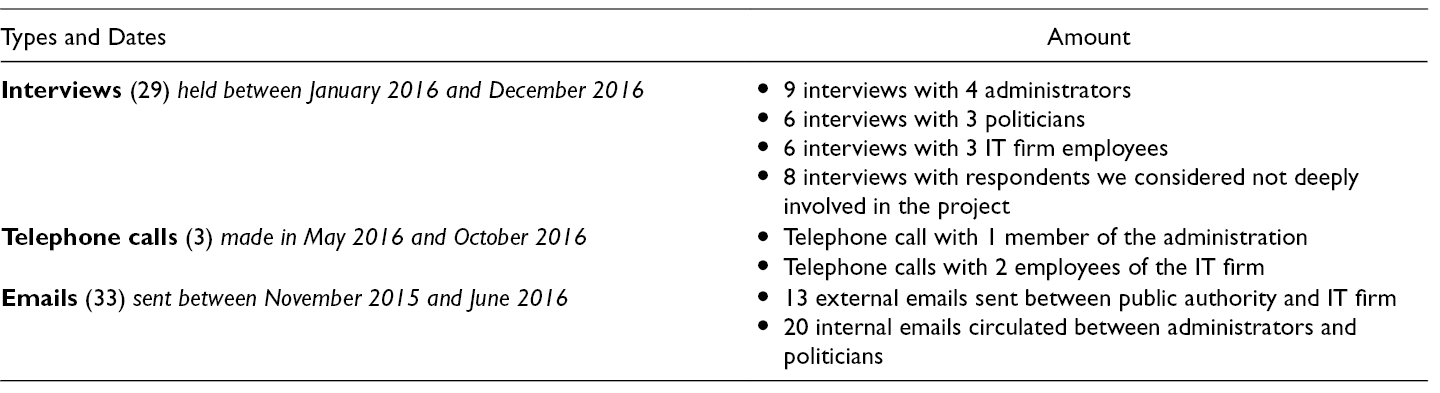
Interviews. We conducted 29 semi-structured interviews with members of the administrative subgroup, members of the political subgroup, as well as employees of the third-party IT firm. The majority of interviews lasted between 30 minutes and two hours. All interviews were recorded and transcribed verbatim. In January 2016, an interviewee mentioned the software tool extension as an example for a change project conducted within the public authority. The project group consisted of 10 members, and we were able to conduct interviews with each one of them (four administrators, three politicians, and three employees of the third-party IT firm). We considered these 10 respondents as project group members because they regularly attended project group meetings and conducted project work. In addition, we interviewed eight administrators who did not belong to the project group, but had heard about the project and provided us with precious insights into how the project’s success and working atmosphere was perceived from outside the project group. Subsequently, we conducted interviews with our 10 key interviewees at intervals of three to five months. Our interview guide included questions about important project events, perceived quality of the project work, and perceived working atmosphere. In particular, we asked all interviewees to draw developments over time starting when the respective interviewee first joined the project group. When interviewees charted important events on a timeline, we asked why these specific events seemed important. Also, when subjects’ own actions or decisions were mentioned, we asked for underlying motives. In case interviewees mentioned other members’ behavior, we asked for assumed underlying motives. Within consecutive interviews, we asked to draw timelines for the period between the last and the current interview.
Telephone calls. As we conducted interviews at intervals of three to five months, we called some interviewees in between the interviews in order to receive some impressions of current project-related developments, but also to be able to compare data retrieved via telephone calls to data retrieved via subsequent interviews and emails.
Emails. We also gained access to emails circulated within the public authority, as well as correspondence with the third-party IT firm. Similar to the telephone calls, these emails also served the purposes of triangulating data retrieved by interviews.
Data Analysis
Finding ourselves at an early stage in process research trying to demystify the puzzle of how groups move from cooperation to conflict, we believe it is imperative to let theory emerge from the data. Inductive research lends itself best to generating new concepts and ideas and serves as a valuable starting point (Gioia, Corley, & Hamilton, 2013; Siggelkow, 2007). In order to capture underlying dynamics that are responsible for observations over time, we decided to conduct inductive research based on the principles of systems thinking (Senge, 2006; Sterman, 2000; Vennix, 1996). In particular, we engaged in an iterative process of coding data, drawing a process model, adjusting codes, and redrawing the model. Initially, we started this iterative process by identifying several actions mentioned during interviews, telephone calls, or in emails. Next, for each action, we added antecedents as well as consequences (see Figure 1).
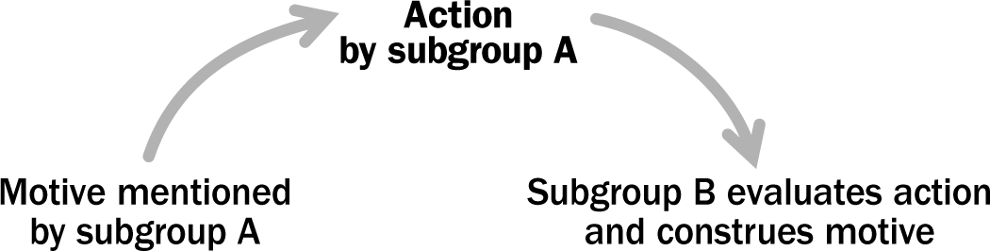
Drawing antecedents and consequences of specific actions.
Interestingly, as we continued to link antecedents to consequences, we found that all three subgroups applied the very same pattern when evaluating other subgroups’ behavior (see Figure 2). In particular, (1) subgroups evaluated behavior of other subgroups as either positive or negative in terms of being beneficial (positive) or detrimental (negative) to the project’s success and/or own subgroup’s success. (2) Consequently, subgroups construed images of other subgroups, which we categorized into the following four image attributes: capable, willing, incapable, and unwilling to professionally conduct the project. (3) Next, we found that all subgroups disidentified from other subgroups, irrespective of whether they held positive (willing/capable) or negative (unwilling/incapable) images. Where subgroups found other subgroups capable of something specific, they emphasized their own capability in something else. We called this process “horizontal disidentifying,” which refers to being different compared to others. Where subgroups found other subgroups unwilling or incapable, they highlighted their own willingness and/or capability. We called this process “vertical disidentifying,” which refers to being better (or worse) compared to others. (4) Next, subgroups construed other subgroups’ goals (perceived common or conflicting goals), from which (5) they derived either cooperative or assertive behavior toward other subgroups. In our data analysis, we understood cooperative behavior as emphasizing common goals and accommodating other subgroups by trying to be responsive to others’ interests. In contrast, we understood assertive behavior as aiming to pursue a subgroup’s own interests while suspecting that other subgroups have conflicting goals.
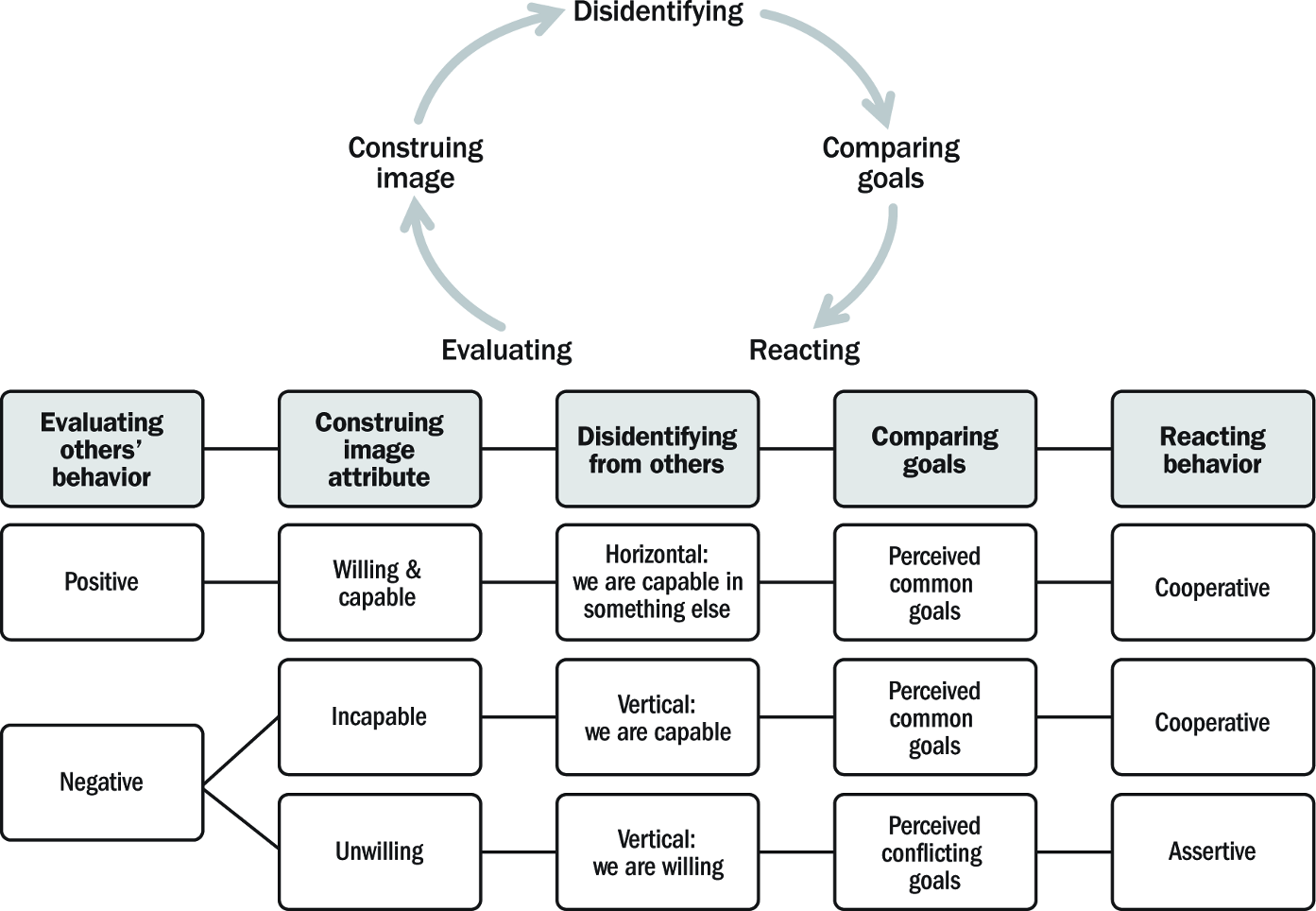
Process from evaluating others’ behavior to reacting toward others.
In sum, although subgroups often had diverging views on whether some specific behavior was either positive or negative, they had one thing in common: they evaluated and derived behavior according to the process depicted in Figure 2.
The process shown in Figure 2 can be applied to an arbitrary number of subgroups when used to understand the dynamics of a specific project group. As the project group in our case study consisted of three subgroups, our process model depicts a triad (see Figure 3 in the results section). Each of the three identical circles represents internal processes of one subgroup. The triangle depicts the interaction pattern between the three subgroups. The arrows within the triangle depict specific interactions between subgroups, indicating that one subgroup’s reacting behavior is evaluated by another subgroup.
When analyzing interactions within a triad, one can basically start anywhere. There is no actual start and there is no actual end. Everything is linked. Each cause is simultaneously an effect, while each effect is simultaneously a cause. Consequently, subgroup A’s images of subgroup B and subgroup C not only affect subgroup A’s behavior, but also influence subgroup B’s and subgroup C’s images and behavior, which in turn affect subgroup A’s images and behavior. The reciprocal influence of images and behavior generates dynamics within the triad and explains how three subgroups socially construct their project group reality.
Although one could start analyzing interactions anywhere in the model, for reporting our findings, we needed to define a specific starting and ending point. We used November 2015 (first email) as the starting point and December 2016 (last interview) as the ending point, as we collected our data within this specific time frame. However, we strongly emphasize that we do not view these points as static. Instead, we see these two points as embedded in time and space and therefore also dependent on previous interactions.
Results
With regard to the project group in our case study, we observed some development from an imbalance toward cooperativeness in early phases of the project to over-assertiveness, as well as group conflict in the later phases. Between August 2013 and January 2016, the project group was a dyad consisting of the political subgroup and the IT firm. Both subgroups described the working atmosphere in this phase as cooperative, harmonious, and trustful. However, according to our data analysis, the dyad was not upholding a tension between cooperativeness and assertiveness. Instead, the project group emphasized cooperativeness but neglected assertiveness. For instance, in September 2015, both subgroups emphasized the need to radically update and add many new features to the software tool. However, in December 2015, the dyad eventually signed a contract with only a limited number of new features. The IT firm was not very happy about the low number of new features, but still acted in a cooperative manner and accepted the decision.
In January 2016, the dyad turned into a triad, as the administrative subgroup joined the project group. By the end of 2016, group conflict prevailed. All three subgroups described the project work as difficult and the working atmosphere as tense and conflict laden. They very clearly demonstrated that they see the respective other subgroups’ behavior as being responsible for generating the unfortunate situation. All three subgroups accused the other subgroups of pursuing their own, partly illegitimate interests, instead of working together constructively. After one year of working together, all three subgroups held non-differentiated, negative images of each other.
In order to provide insights on how the project group moved from cooperation to conflict, we introduce a process model (see Figure 3), which depicts 15 specific subgroup perceptions (1–15) ordered by time. These perceptions offer snapshots of the process at different points in time. Taken together, these descriptions illustrate how the process of evaluating others’ behavior and reacting to these interpretations unfolded in the case of this project.
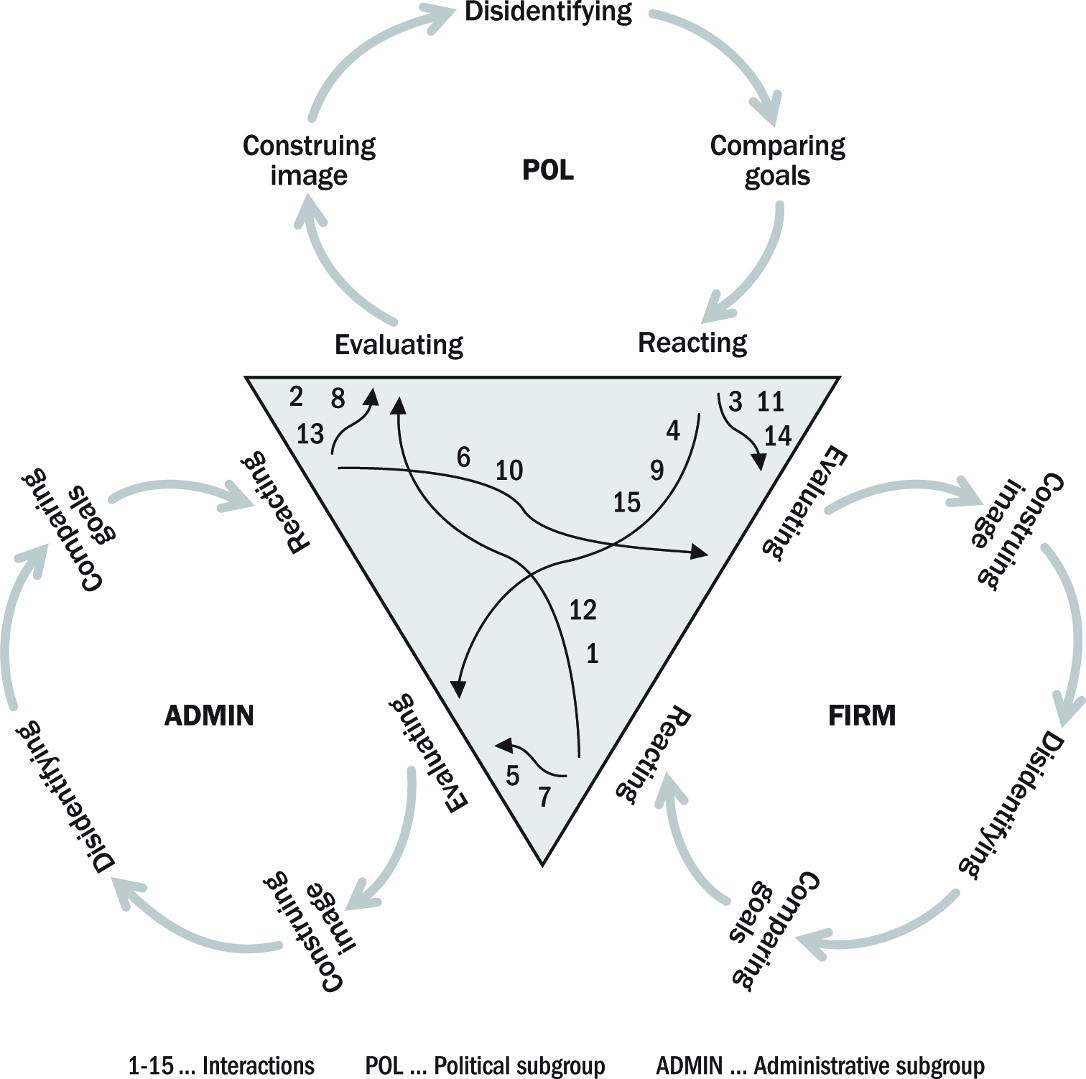
Process model of our case study’s triad.
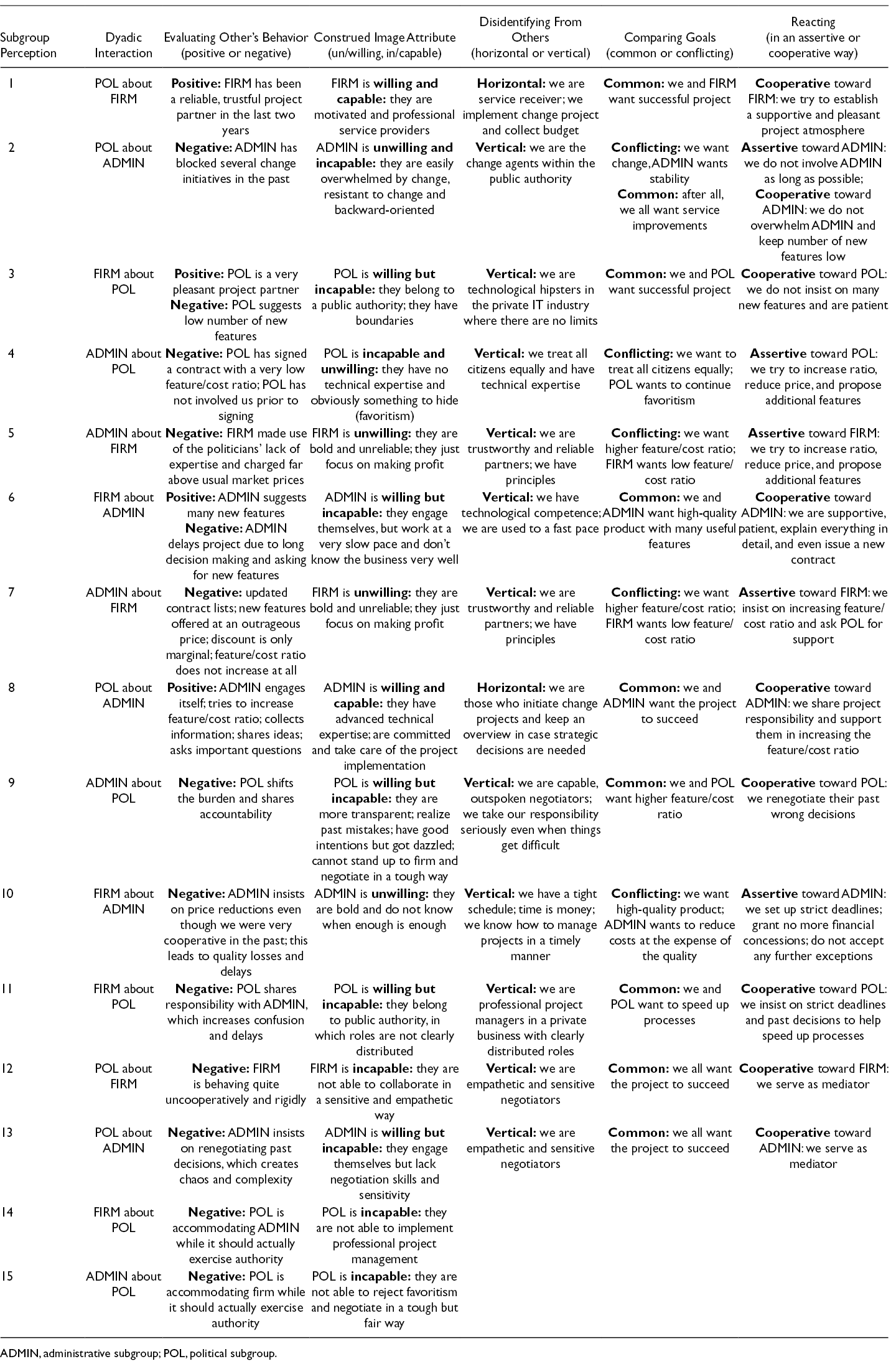
Table 2 provides details of the 15 subgroup perceptions and visualizes data by offering a process perspective both horizontally (from evaluating behavior via image, disidentifying, goals, to reacting behavior) as well as vertically (from subgroup perception 1 to subgroup perception 15).
Overview of 15 Subgroup Perceptions
ADMIN, administrative subgroup; POL, political subgroup.
Subgroup perception 1: Based on past positive experiences, the political subgroup described the IT firm as very motivated and professional project partner. While the political subgroup saw itself as service receiver, the IT firm was in their view the service provider (horizontal disidentifying). Both subgroups seemed to be interested in a successful project, hence the political subgroup tried to establish a supportive and pleasant project atmosphere.
Subgroup perception 2: Based on past incidents, when administrators had rejected change initiatives proposed by politicians, the political subgroup described the administrative subgroup as easily overwhelmed by change, backward oriented, and resistant to change. In contrast, the political subgroup defined itself as service-oriented, forward-looking change agents within the public authority (vertical disidentifying). Because it feared that the administrative subgroup could block the project, the political subgroup decided not to involve administrators too early in the project, but present them with a fait accompli.
Involving the administration prior to working out the project in a concrete way, is senseless, because you would run from pillar to post. (Politician 1, January 2016)
Still, the political subgroup believed that administrators must be interested in service improvements and decided to accommodate them by keeping the number of new features of the software tool update low in order not to overwhelm the administration.
Subgroup perception 3: The employees of the IT firm had experienced the political subgroup as very pleasant project partner in the past, but were not very happy about the low number of new features. However, they understood that the political subgroup was basically willing to implement many more features but was constrained by the public authority. Contrary to its self-image as being “technological hipsters,” the IT firm perceived the public authority as a change-resistant public organization (vertical disidentifying). Despite these differences, they saw that the political subgroup and the firm were pursuing common goals. Therefore, they acted in a cooperative manner and accepted the decision that additional features would be sequentially implemented at a later date.
Subgroup perception 4: When the administrative subgroup joined the project group and read the contract, it was astonished at the limited number of new features in relation to the high costs of the software tool. The only reason they could think of that might explain the nontransparent actions of the political subgroup was that the politicians obviously wanted to hide their favoritism toward the IT firm, as they saw the relationship as being based on close informal ties.
They didn’t give sufficient thought to what the citizens really need … We just would have wished for more features. There is lots of room for improvement. Overhasty decisions have been made by too many non-technicians on the political side. (Administrator 2, March 2016)
The administrative subgroup described itself as the group that aimed to treat all citizens equally and possessed the technical expertise within the public authority (vertical disidentifying). In order to protect the public authority from the low feature/cost ratio, the administrative subgroup decided to engage in this project.
Subgroup perception 5: According to the administrative subgroup’s opinion, the IT firm exploited the politicians’ lack of expertise and charged far above usual market prices. Hence the administrative subgroup perceived the IT firm as mainly focusing on their own benefits and as not being a trustworthy and reliable project partner.
This firm is not getting little money and I know exactly what they deliver in technical terms. They are just making money. And then I get really mad thinking that they are just taking and not really giving much. (Administrator 1, March 2016)
The administrative subgroup’s understanding of professional project management included open and transparent communication, fair negotiations, as well as being able to rely and trust project partners (vertical disidentifying). The administrative subgroup assumed that the IT firm was out to make as much profit as possible and to keep the feature/cost ratio at as low a level as possible. Hence, it decided to invest time and energy, scrutinize the project details, propose various additional features in order to legitimize the high costs, and to try to reduce costs whenever possible.
Subgroup perception 6: Although adding further features after the project start was difficult, the IT firm acknowledged that the administration was constrained by the decision-making system of the public authority.
Everything needs to be authorized by everybody, so this is sometimes a quite cumbersome and long process … Things go round in many circles … It’s challenging when those people who have to work with it are not those who are allowed to make decisions. (IT firm employee 1, April 2016)
The IT firm disidentified from the administrative subgroup in so far as they emphasized the firm’s technological competence and fast pace in contrast to the public organization’s focus on stability (vertical disidentifying). Despite these differences, when the public authority asked to add new features to the already signed contract, the IT firm agreed to issue a new contract and even granted a discount on the additional features.
Subgroup perception 7: Upon reading the updated contract, the administrative subgroup was upset about the costs of the additional features. The discount was only marginal and did not reduce the overall price to an acceptable level. Hence, the administrative subgroup confirmed its image of the IT firm being an unreliable project partner and mainly focusing on making money (vertical disidentifying). The administrative subgroup also asked the political subgroup for support in renegotiating financial concessions.
Subgroup perception 8: Meanwhile, the political subgroup noticed that administrators were trying to increase the feature/cost ratio of the software tool. The political subgroup welcomed these actions and it developed a new image of the administration as possessing advanced technical expertise and as actively engaging themselves. Politicians viewed the administrators as change implementers that deal with details, while seeing itself as change initiator that keeps an overview in case strategic decisions are needed (horizontal disidentifying). According to the political subgroup, both subgroups seemed to be interested in a successful project, hence it decided to share project responsibilities and to support the administrative subgroup in their attempts to increase the feature/cost ratio.
Subgroup perception 9: What was meant as cooperative by the political subgroup, however, was perceived by the administrative subgroup as negative behavior. Sharing responsibility for the administrative subgroup implied shifting the burden and sharing accountability for a very cumbersome project. Still, at least the politicians then seemed to be willing to manage this project in a more transparent way and to realize that they had made mistakes in the past. The administrative subgroup attributed to the political subgroup the incapability of standing up and negotiating in a tough way with the firm. In contrast, the administrators viewed themselves as capable, outspoken negotiators who are not afraid to take on responsibility, even when things get difficult (vertical disidentifying). Despite these differences, both subgroups still seemed to be interested in increasing the feature/cost ratio.
Subgroup perception 10: Meanwhile, the IT firm argued that it was quite difficult to work with public authorities, as administrators kept asking for cost reductions and renegotiating past decisions, which led to quality losses and delays. The firm saw itself as reliable partner who knows how to manage projects in a timely manner (vertical disidentifying). Whereas the administrative subgroup seemed to be interested only in reducing the costs at the expense of the quality of the product, the IT firm was interested in upholding the currently high quality of the software tool. Consequently, the IT firm decided to set up strict deadlines and charge usual market prices for any additional feature that was not already negotiated before the contract was signed.
Subgroup perception 11: The IT firm noticed that the political subgroup shared responsibility with the administrative subgroup, which led to confusion and delays.
The main problem in this project is that there are so many people involved but there is nobody taking concrete decisions. A lot of people talk, but no one really decides. (IT firm employee 2, April 2016)
Consequently, the IT firm perceived the political subgroup as incapable of determining clear roles and distributing concrete work packages to the administrative subgroup due to the hierarchical and bureaucratic decision-making system of the public authority. In contrast, the IT firm emphasized that it is a private business in which roles and responsibilities were clearly distributed (vertical disidentifying). Still, the IT firm assumed that the politicians were also interested in speeding up processes. In order to promote timely and professional project management, the IT firm kept insisting on strict deadlines and on decisions previously agreed with the political subgroup.
Subgroup perceptions 12 and 13: The political subgroup increasingly noticed uncooperative behavior on the part of the IT firm toward the administration and was also negatively surprised by the rigid way the firm dealt with financial issues. Consequently, the political subgroup perceived the IT firm as incapable of collaborating in a sensitive and empathetic way. The political subgroup also noticed that the administrative subgroup continued to insist on renegotiating past decisions, which created delays and chaos in the project group. While the political subgroup still perceived administrators as engaging themselves, it did not see them as capable of keeping the project simple and interacting with the firm in a sensitive way.
Administrators are very constructive; they know what’s going on and are also very critical concerning the money … [But] they have an internal perspective on things … they are not seeing everything … I feel that the administration is coming to a certain boundary when it concerns negotiating. (Politician 1, August 2016)
In contrast to the other two subgroups, politicians viewed themselves as professional negotiators who engaged with project partners in a sensitive and empathetic way (vertical disidentifying). After all, the political subgroup assumed that all three subgroups were striving for the success of the project and, consequently, was trying to improve the project group’s working atmosphere by mediating between the administrative subgroup and the IT firm.
Subgroup perceptions 14 and 15: Both the IT firm as well as the administrative subgroup believed that the political subgroup had its share in co-creating the currently conflictive situation and expected the politicians to stand up and speak up to the respective other subgroup. In contrast, the political subgroup seemed to accommodate the respective other subgroup. Consequently, the IT firm perceived the political subgroup as incapable of implementing professional project management by, for instance, delegating concrete work packages and distributing responsibility. In turn, the administrative subgroup believed that the political subgroup was still not able to reject favoritism and to negotiate with the firm in a tough but fair way.
To conclude, we answer our first research question as follows. As we documented through the description of the various subgroup perceptions, the project group was trapped in a vicious cycle whose self-reinforcing dynamics hindered upholding a cooperativeness-assertiveness tension and fostered group conflict. All three subgroups reinforced simplified negative images and polarizing stereotypes of one another. From each subgroup’s individual perspective, own behavior was perceived as legitimate and seemed to stand in contrast with other subgroups’ interests. Yet, when we merged the behavior of all three subgroups in our process model, we found that no one benefited from the subgroups’ socially constructed conflictive situations. In order to answer our second research question, next, we explain why it is challenging to escape these self-reinforcing dynamics.
Mechanism 1: Group Members Overestimate Others’ Behavioral Autonomy While Underestimating the Impact of Own Past Behavior
Interestingly, subgroups had diverging views on whether behavior was an action or reaction. While a subgroup’s own behavior was always seen as reaction, other subgroups’ behavior was perceived as autonomous action. In case of perceived negative actions, subgroups assumed that the other subgroups could easily change their irrational, uncooperative, and destructive behavior and expected them to start collaborating in a constructive way. In this case, subgroups not only overestimated others’ behavioral autonomy, but also neglected to take into account their own contribution in generating others’ seemingly irrational and uncooperative behavior. Such reluctance to consider the influence of the past on the present and future stimulated the self-reinforcing vicious cycle. Our data provide us with various examples.
For instance, within subgroup perception 2, the political subgroup decided not to involve the administration in the early phase of the project. The politicians viewed their decision as a reaction to the administrative subgroup’s past illegitimate behavior (administrators blocked many other change initiatives). In subgroup perception 4, the administrative subgroup evaluated the same behavior as a negative action and explained it by construing a negative image (politicians hide favoritism).
Another example refers to the administrative subgroup’s behavior to insist on increasing the feature/cost ratio (subgroup perception 7). Administrators viewed their own behavior as a reaction to the firm’s past illegitimate behavior (firm issued a contract with an outrageous price). In subgroup perception 10, the firm evaluated the same behavior as a negative action and explained it by construing a negative image (administrators do not know when enough is enough).
Finally, we provide an example of the IT firm deciding to set strict deadlines to speed up processes (subgroup perception 11). The firm viewed its decision as reaction toward the political subgroup’s past behavior (politicians did not clearly distribute responsibilities, which led to delays). In subgroup perception 12, politicians evaluated the same behavior as a negative action and arrived at a negative image (the firm is not able to collaborate in a sensitive way).
Mechanism 2: Subgroups Adopt Vertical Disidentification
Subgroups made their own particular role in the project group dependent upon disidentifying from construed images. Whenever subgroups perceived others as weak and held negative images, they tended to emphasize their own strengths. In other words, subgroups disidentified in a vertical way, stressing their own superiority. This may have been beneficial for in-subgroup cohesiveness, but hindered upholding a cooperativeness-assertiveness tension within the project group. Hence as others’ weaknesses elucidated a subgroup’s own strengths, escaping the vicious cycle that reinforces the construction of simplified negative images was challenging. Our data provide us with various examples.
For instance, when the political subgroup perceived the administrative subgroup as resistant to change, they viewed themselves as change promoters (subgroup perception 2). Another example refers to the administrative subgroup, who perceived the firm as an unreliable partner whose sole focus was on making profit. Consequently, they emphasized their own principles, trustworthiness, and reliability (subgroup perception 5). As a final example, the firm perceived the political subgroup as situated in a public organization, in which roles and responsibilities were not clearly distributed, which led to confusion and delays. Consequently, the firm stressed that it was a private business working with professional project management tools, tight time schedules, and clearly distributed roles and responsibilities (subgroup perception 11).
Mechanism 3: Cooperativeness Based on Images of Incapability Reinforces Conflict
Whenever subgroups attributed an image of incapability to other subgroups but still perceived common goals, they avoided talking about it, as they did not want to expose others. Also, instead of jointly trying to improve others’ capability, subgroups adopted cooperative behavior in order to avoid conflict. As such “good” intentions not only concealed pejorative perceptions but also ran counter to others’ interests, the other subgroup in turn evaluated such “cooperative” behavior in a negative way and arrived at negative images, which boosted the self-reinforcing vicious cycle. Our data provide us with various examples.
In subgroup perception 2, the political subgroup attributed an image of incapability to the administrative subgroup (they are easily overwhelmed by change) but still perceived common goals (we both want service improvements). Consequently, the political subgroup behaved in a cooperative way (we keep the number of new features low initially in order not to overwhelm them). What was meant to be cooperative was perceived as negative behavior in subgroup perception 4, when the administrative subgroup bitterly criticized the contract’s low feature/cost ratio and construed a negative image (they show favoritism).
In subgroup perception 6, the IT firm attributed an image of incapability to the administrative subgroup (they work at a very slow pace and don’t know the business very well) but still emphasized common goals (we both want many new features). Consequently, the firm behaved in a cooperative way (we exceptionally issue a new contract and even grant a discount). What was meant to be cooperative was perceived as negative behavior in subgroup perception 7, when the administrative subgroup criticized the overpriced offer and construed a negative image (they just focus on making money).
As a final example, in subgroup perception 9, the administrative subgroup attributed an image of incapability to the political subgroup (they cannot stand up to the firm and negotiate in a tough way) but still highlighted common goals (we both want a higher feature/cost ratio). Thus, the administration decided not to be assertive by openly blaming the political subgroup for their past mistakes, but behaved in a cooperative way (we renegotiate their past decisions). What was meant to be cooperative was perceived as negative behavior in subgroup perception 13, when the political subgroup was annoyed by the chaos and unpleasant atmosphere and construed a negative image (they lack negotiation skills).
Discussion
This research responds to the call for studies that utilize a process lens in order to renew the theoretical bases of the project management research field (Morris, 2013; Sergi, 2012; Söderlund, 2011). Adopting a process perspective on interactions within a project group enabled us to contribute to research on project management in three ways.
First, this study advances research on why project groups fail to uphold tensions over time. According to Fairhurst et al. (2016), attending to competing demands—such as cooperativeness and assertiveness—simultaneously, requires a better understanding of their dynamic relationships. “While the interdependencies of opposing elements have been recognized in … [research on tensions], much of the nuance and complexity that characterize these interdependencies remains unexamined or under-theorized” (Smith et al., 2017, p. 306). Hence, Fairhurst et al. (2016) as well as Smith and Lewis (2011) call for more studies that surface and theorize about how tensions interact in an ongoing, cyclical process. Our study responds to this call by shifting focus toward the dynamic interplay between cooperativeness and assertiveness. We find that while over-cooperativeness promotes harmony in the short term, it can also serve to create over-assertiveness and to reinforce group conflict in the long term. Thus, imbalance begets imbalance. By building a process model, we provide important insights of underlying mechanisms that explain these dynamics.
Second, the dynamics illuminated in our process model help to understand why project group members make reciprocal accusations and repeatedly enter into group conflict despite the common objective of professionally conducting the project. Literature on group conflict has developed multiple perspectives regarding its functionality (Kozlowski & Ilgen, 2006). We find that avoiding conflict—in the shape of cooperativeness derived from construed incapability despite common goals—first triggers a shift toward the cooperativeness end of the continuum. However, such “heroic” rescue attempts not only conceal pejorative perceptions but also run counter to others’ interests. In turn, other subgroups evaluate such “helping” behavior in a negative way. Hence cooperative behavior, which is based on perceiving others as incapable, contributes over time to over-assertiveness and conflict. This insight enhances our understanding of why so many project groups repeatedly descend into conflicts despite the fact that their project group members try for cooperativeness. Consequently, we agree with Vennix (1996) that cognitive conflict, which reveals different opinions and perspectives, is important, whereas too much conflict promotes an imbalance toward over-assertiveness. Hence, we elucidate the importance of appropriate timing. Whenever groups perceive a shift toward over-cooperativeness, cognitive conflict may lead to renewed tension between assertiveness and cooperativeness.
In addition, we provide an empirical account of discrepant punctuation and the fundamental attribution error within the organizational context. In our case study, subgroups reciprocally accuse each other of emphasizing their own, illegitimate interests and of being unwilling to professionally conduct the project. Subgroups assume that the other subgroup’s actions are fully autonomous. Others’ behavior is perceived as the cause and the subgroup’s own behavior as reaction to it, which indicates that both subgroups have discrepant punctuation (Watzlawick et al., 1967). Consequently, subgroups assume that the other subgroup can easily change its irrational, uncooperative, and destructive behavior and should start collaborating in a constructive way. Hence, we find that both subgroups suffer from the fundamental attribution error, referring to “the tendency for attributors to underestimate the impact of situational factors and to overestimate the role of dispositional factors in controlling behavior” (Ross, 1977, p. 183). Our process model especially focuses on situational factors, such as the impact of time and self-reinforcing dynamics, and therefore helps to reduce attribution errors.
Third, this study contributes to project management research by highlighting the essential role of disidentification within project groups. In particular, we accommodate various studies that call for more process research to better understand the underlying dynamics of disidentification processes. Such studies define disidentification as a process of becoming disidentified from an entity via reciprocal interaction with this entity (Ashforth et al., 2008; Gutierrez et al., 2010). Our study identifies three mechanisms that help to explain why subgroups get trapped in self-reinforcing dynamics through their reciprocal interactions. In addition, our study helps to clarify when the process of disidentification fosters or hinders upholding a cooperativeness-assertiveness tension. Most disidentification research stresses the disruptive element of disidentification. For instance, disidentification may develop through being invalidated by others, followed by a distortion of information, cognitive simplifications, overly polarizing stereotypes, and conflict (Fiol et al., 2009). One of the consequences of such disidentification from specific groups is a regression toward strengthening ties with other groups (Huettermann et al., 2017). In contrast to these negative views on disidentification, literature also highlights important positive effects. In particular, disidentification may help to construe a group’s identity by clarifying what the group is not like (Anand et al., 2013). According to social identity theory (Tajfel & Turner, 1986), groups disidentify from one another in order to achieve positive in-group distinctiveness. In other words, subgroups may compete with one another for specific identities or—using terminology of group research—particular roles within the overall project group. Hence such competition may promote role diversity, which, according to team development literature, can provide a greater pool of knowledge and perspectives (Shemla & Wegge, 2019).
This study enhances our understanding of the role of disidentification within project groups by distinguishing between horizontal and vertical disidentification. Horizontal disidentification refers to differentiating oneself from others without striving for superiority, while vertical disidentification stresses a subject’s own strengths in contrast to others’ weaknesses. In our case study, differentiating oneself from others in terms of construed superiority vis-à-vis construed inferiority (better/worse, stronger/weaker, more willing/less willing, more capable/less capable) may lead to reciprocal simplified negative images and promote group conflict. Vertical disidentification is basically a sign of insecurity and confusion. Also, it leads to a situation in which images and self-descriptions hardly match, which in turn leads to intensified insecurity and confusion. Project groups can counteract insecurity and confusion by refraining from drawing hasty conclusions, and by instead openly negotiating particular roles and jointly caring for role diversity and clear distributions of responsibilities (Hardy et al., 2005). This way, images and self-descriptions better match, which should help to reduce confusion, stress, and insecurity.
Implications and Outlook
Our study highlights some important questions for future project management scholars. For instance, while this research focused on hindering dynamics, we call for more studies attending to dynamics that promote upholding a cooperativeness-assertiveness tension over time. Next, we wondered how our interventions through conducting interviews as the project progressed would impact the way the project evolved over time. Future research may need to scrutinize more carefully the influence of researchers within process research. Also, we invite scholars to apply the process model developed in this study to other organizational settings. Public organizations are generally exposed to various stereotypes, third-party pressure, and permanent accountability toward citizens, media, and society in general. It might be interesting to see whether public settings in general are more prone to descend into conflict, or whether the probability of escalation can be explained by other underlying factors, such as power relations within organizations and/or with the external environment.
Our process research also identifies important implications for project group members as well as project management practitioners, who have the challenging task of managing successful project groups in organizations. Thus we respond to the call to “effectively attend to the challenge of reducing the gap that may exist between practice and theory in project research” (Sergi, 2012, p. 360). First, we elucidate the importance of balancing tension between cooperativeness and assertiveness over time (in all phases of the project) as well as over space (within subgroups, dyads, triads, etc.). For this purpose, we argue that it is essential for organizational stakeholders to take a process perspective. The latter necessitates acceptance of the influence of context and time. Then, one may find that giving groups positive images (willing and/or capable) or negative images (unwilling and/or incapable), that are based on simple, unchallenged assumptions, does not sufficiently explain their actions. After conducting our process research, we advise group members to occasionally step back and wonder why other group members behave the way they do and whether they themselves might have played a certain role in co-creating this behavior over time.
Second, instead of continuing to construe interpretations of others’ behavior, we strongly advise group members to engage in open, transparent conversations. Conflict is often born of insecurity. Hence we elucidate the importance of clarifying particular roles within the overall project group. In doing so, roles should not be carved in stone but should be renegotiated on a regular basis. Still, as our study clearly shows, especially negative images can hinder project group members from openly communicating, because they assume that transparent conversations will expose others, lead to a loss of face, and thus foster conflict. Hence where group members attribute incapability and common goals to others, we advise focusing conversations on concrete ways to improve others’ capability. In contrast, if case group members perceive others as unwilling and as pursuing conflicting goals, we advise them to pose “why” questions, such as “May I ask you for the underlying motive of your behavior?” in a polite but firm way. Finally, we suggest allowing oneself to be positively surprised by others and be open to adjusting images on a regular basis. This may lead to the ability to embrace the adoption of several, also diverse perspectives—an ability that could help to increasingly appreciate the diversity and complexity of the world we live in.
Footnotes
Declaration of Conflicting Interests
The author(s) declared no potential conflicts of interest with respect to the research, authorship, and/or publication of this article.
Funding
The author(s) received no financial support for the research, authorship, and/or publication of this article.
Author Biographies