




Abstract
This article introduces a process framework based on the realist social theory for studying governing in ongoing public–private partnerships (PPPs). Contractual and relational practices are defined as activities enacted and re-created by virtue of actors’ dual positions: at both the partnership and the parent organizational levels. In PPPs, complementarities and contradictions between public, rule-bureaucratic logic and private, market-oriented logic define structural demands on actors. Nonpredictive and innovative governing activities emerge from the actors’ reflexive capacity to balance different demands. The framework allows the examination of the complex interplay of relational and contractual practices, illustrated in a PPP Dutch case.
Keywords
Introduction
Because traditional project management approaches overlook the emergent nature of project activity, the turn to social theories is a promising but unexplored alternative for extending our understanding of the actuality of projects (Floricel, Bonneau, Aubry, & Sergi, 2014). This also applies to project governance, where the intense focus on economic and behavioral theories has provided little room to account for the complexity and dynamics of governing practices (Brunet, 2018). There is, in particular, a lack of alternative conceptualizations for the interplay between contractual and relational governance activities in projects. Governance scholars have mainly framed the interplay as either a substitutive or complementary one and, by doing so, have reduced it to two “mutually exclusive phenomena in terms of what they are, why they form, and how they are related” (Huber, Fischer, Dibbern, & Hirschheim, 2013, p. 83). Such an understanding does not give space to disentangle the array of interrelated governing actions, puts innovative interaction between brackets, and ignores the possibility that governing activities reshape governance structures (Sanderson, 2012).
This article aims at developing a process framework for studying the interplay between contractual and relational governance in ongoing public–private partnerships (PPPs), using as a canvas the meta-theorization of the interplay between agency and structure developed by realist social theory (Archer, 1995; Bhaskar, 1979; Reed, 2001). Rather than being a choice between two discrete forms of governance made by calculative actors, this theoretical perspective allows us to frame relational and contractual governance as emerging practices during the interaction of individuals in PPP projects filling organizational and social positions. The proposed framework of PPP governance as positioned-practices builds upon Archer’s (1995) morphogenetic approach in light of private and public organizational logics (Rufín & Rivera-Santos, 2012) and the prevalent multilevel view of project governance (Ahola, Ruuska, Artto, & Kujala, 2014; DeFillippi & Sydow, 2016; Turner & Müller, 2003). It suggests that individuals in PPP projects execute contractual and relational activities predisposed by a layered governance structure. While the structural complementarities and contradictions at the project level predispose public and private actors to interact through logics of compromise or solidarity, the contingent relationship outside the partnership predisposes the same actors to engage in modes of interaction ranging from competition upon contradictions and opportunism upon complementarities. In a continuous effort to find ways to avoid the consequences of not complying with the structure of trust/control relationships attached to their different roles, managers enact and re-create contractual and relational governing activities in a creative and nonpredictive way.
The framework shifts the attention from the static functional (dysfunctional) relationship between two discrete forms of governance to prevent opportunistic behavior in projects to the dynamic activity of inventive actors addressing the inconsistent and conflicting demands placed on them by their positions. This opens up the opportunity to explain the emergence of creative and sometimes paradoxical combinations of relational and contractual practices as the outcome of divergent demands from the horizontal relationship at the project level and the hierarchical relationships in their own organizations. In dealing with multiple and competitive demands, governing practices partially reshape the governance structure in place and actors’ expectations over time. States of complementarity and substitution between contractual and relational governing activities emerge from the underlying managerial struggles of actors to resolve multiple expectations attached to their roles, in the cycles of change or reproduction of the system of project rewards, penalties, and beliefs.
In order to develop the framework, the extant literature on relational and contractual governance is reviewed to illuminate the overemphasis on the ex-ante configurations of governance structures upon risk allocation and the poor conceptualization of the governing process during the actual execution of PPPs. The second section introduces the realist social theory and the morphogenetic cycle as an alternative point of departure for studying the complexity of relational and contractual governance in public–private partnerships. It makes a conceptual differentiation between compliance-oriented and trust-oriented governing activities as events emerging from actor interactions in the present, and the governance structure of interest, resources, powers, constraints, and predicaments inherited from previous cycles of interaction (and also susceptible to be transformed/reproduced in the future). On this theoretical basis, the third section elaborates on the process framework for the governance of PPP projects by clarifying the expected interactions and predispositions of managers, given their dual role at the partnership level (horizontal) and the parent organizational level (vertical). The fourth section presents the case of a PPP project for a military facility in the Netherlands to illustrate the potential of the proposed process framework for understanding the changing stages of contractual and relational governing practices during PPPs. The final discussion highlights the contribution of realist social theory as an alternative theoretical lens to our procedural understanding of governing activity and governance structure change in temporary organizations (Bakker, DeFillippi, Schwab, & Sydow, 2016).
Contractual and Relational Interplay in PPPs
The emergence of public–private partnerships as one of the pillars of contemporary public management is paradoxically linked to an ambiguous definition by scholars. The debate regards the extent to which PPPs involve political, economic, and managerial dimensions of a phenomenon not reducible to a simple project delivery agreement (Hodge & Greve, 2007, 2010, 2017). Among the alternatives to organizing the relationships between public and private organizations (Kivleniece & Quelin, 2012), most prominent is the transfer of typical responsibilities (and risk) to the market by means of long-term contracts (Hodge & Greve, 2017). Accordingly, PPP research has focused on the ex-ante contract design and risk allocation for reaching project performance, given diverse organizational objectives (de Castro e Silva Neto, Cruz, Rodrigues, & Silva, 2016). Value for money (VfM) proves to be the primary public objective represented by the procurement authority, while return on investment is the objective of the sponsors, and repayment is the objective of the lender (Grimsey & Lewis, 2002, 2005). To guarantee VfM, return on investment, and repayment, decision makers have a range of possibilities to address risks. Solutions include sharing risk, negotiating risk, transferring risk, or defining contingent risk rules (Cruz & Marques, 2013; Davies, Frederiksen, Dewulf, Taylor, & Chinowsky, 2010). Potential conflicts can be offset by allocating responsibilities and incentives to the actor in the best position to deal with risk (Bing, Akintoye, Edwards, & Hardcastle, 2005; Chang, 2013; Johnston & Gudergan, 2007).
The theoretical study of PPP has been inspired by the fundamental proposition of static alignment, according to which “the choice of organizational forms involves matching formal structures or strategies, exchange conditions, and environments in some discriminating way” (Zenger, Lazzarini, & Poppo, 2000, p. 290). Scholars conceptualize PPP contracts as a hybrid organization, in which suitability depends on adequate project risk allocation between private and public actors. For example, according to incomplete contract theory, the private organization should retain asset ownership by default, given its stronger incentives to introduce cost reduction. However, noncontractible qualities of the public service are susceptible to deterioration as a result of private incentives for cost reduction, and therefore, their control should be retained by the public organization (Francesconi & Muthoo, 2006; Hart, 2003; Hart, Shleifer, & Vishny, 1997). Inspired by transaction cost economics, Kivleniece and Quelin (2012) suggest that public and private partners have to make a front-end choice along a continuum between integrative and autonomous PPP organizational forms, which leads to collaborative versus supervisory modes of interaction (Wang & Bunn, 2004). The appropriate mode of governance will be determined by internal and external project idiosyncrasies. From a private actor’s perspective, the integrative model of governance with an emphasis on close collaboration will then be more suitable in the presence of high uncertainty from the market, technological change, or high exposure to social activism from stakeholders (Kivleniece & Quelin, 2012).
Elaborating on the assumption of self-oriented and bounded rationality that encourages parties to assume opportunistic behavior, relational governance is seen as an alternative for stabilizing mutual individual expectations in the process of value co-creation (Bachmann, 2001; Edelenbos & Eshuis, 2012; Scott, 2013). Contractual and relational governance use different mechanisms for dealing with the natural inclination toward devious behavior, leading to a more predictable exchange by absorbing conflicts and reducing uncertainty (Edelenbos & Eshuis, 2012). Contractual mechanisms are based on control enforced by ownership and authority, while relational mechanisms are based on trust and positive expectations of collaboration or social sanctions (Henisz, Levitt, & Scott, 2012).
Departing from their different nature but potential equivalence in safeguarding the integrity of transactions, organizational studies inspired by economic thinking have used the complementarity/substitution dichotomy as the primary conceptual frame to study the interplay of contractual and relational governance (Poppo & Zenger, 2002). Based on this conceptual frame, scholars have aimed at defining the conditions under which the use of one type of governance increases or decreases the functionality of the other respecting the outcomes of the transaction (Zenger et al., 2000). However, empirical evidence is rather contradictory in terms of whether contractual and relational governance mechanisms act as substitutes or complements. Only recently have scholars started to conceptually and empirically explore the dynamic interplay of governance mechanisms and the materialization of their idiosyncratic relationships over time (Cao & Lumineau, 2015; Howard, Roehrich, Lewis, & Squire, 2017; Huber et al., 2013).
Although the relationship between public and private actors is critical for the success of a PPP, it is also challenging to deal with (Kumaraswamy, Zou, & Zhang, 2015) and more often resembles a leader–follower relationship than a partnership (Shi, Chong, Liu, & Ye, 2016). There are key operative and administrative differences between public and private organizations that allow value-creating opportunities but also bring additional confusion to the inherent dilemmas when compromising specific and sunk investments (Scott & Triantis, 2005; Villani, Greco, & Phillips, 2015). While a permanent feature of private organizations is their profit-oriented and competitive-driven nature (Villani et al., 2015), policy outcomes shaped by sociopolitical interests drive the operation of public organizations (Mahoney, McGahan, & Pitelis, 2009). Procedural rigidity, responsiveness to stakeholders, and intense scrutiny not only put public officials at higher levels of risk aversion compared to private managers but also impose restrictions on the development of close and informal relationships between public and private officials, in order to avoid accountability and transparency concerns (Ke, Ling, & Ning, 2013; Ling, Ong, Ke, Wang, & Zou, 2014; Rufín & Rivera-Santos, 2012). Private organizations regard public accountability requirements as bureaucratically burdensome and as “red tape,” which can create financial difficulties for the firm when public procedures result in obstacles for payment delays (Rufín & Rivera-Santos, 2012). Different logics of public and private operations confront individuals in PPPs with competing demands (Villani, Greco, & Phillips, 2017), shaping a multilevel structure of project governance (Ahola et al., 2014; Turner & Müller, 2003). When people work together on projects, they bring different “identities,” including their individual identity, their collective project identity, and their organizational membership (Sydow & Braun, 2017). This can create tensions of loyalty through conflicting cultural norms and work expectations that project participants bring with these identities (DeFillippi & Sydow, 2016).
In order to address the complexity of multiple organizational logics, cultures, and interests in project work, the discussion of the interplay between contractual and relational governance mechanisms has been reframed in the broader perspective of structure and agency (Cicmil & Marshall, 2005; Floricel et al., 2014; Sanderson, 2012). It has been shown that relational aspects and trust are emerging in a process of joint and gradual sensemaking on the nature of a relationship (Bygballe, Dewulf, & Levitt, 2015) and that contractual forms do not necessarily have a direct relationship with PPP performance (Klijn & Koppenjan, 2016). However, trust mediates this relationship along with relational norms and the partners’ mutual contribution (Benítez-Ávila, Hartmann, Dewulf, & Henseler, 2018). In other words, contractual and relational governance mechanisms are mutually constituted over time to grapple with the multilevel identities of project participants (Bygballe et al., 2015). PPP governance becomes a process of interacting agents adjusting the actual operation of formal and informal structures by giving meaning to their work and relationships, supported by social scripts of social behavior (South, Eriksson, & Levitt, 2018).
The notion of mutual constitution of structure and agency was introduced by Giddens’s (1976) structuration theory. It states that activities only have the meaning agents ascribed to them, but these agents are limited and enabled by the structural context (Cruickshank, 2002). As agents can rework those circumstances, “structuration of social practices is to seek to explain how it comes about that structures are constituted through action, and reciprocally how action is constituted structurally” (Giddens, 1976, p. 161). Structuration theory is an appealing alternative to the economic frame of contractual and relational governance interplay (Sanderson, 2012), suggesting that informal aspects of governance and governing activity emerge and also reshape formal structures (Brunet, 2018; Bygballe et al., 2015). However, the suitability of structuration theory has been under some scrutiny in the sociological debate (Archer, 1995). It is particularly the “duality of structure” argument, according to which “structure is both medium and outcome of the reproduction of practices” (Giddens, 1979, p. 69) that has been criticized. The duality of structure implies that agency and structure are “two sides of the same thing” (Archer, 1995, p. 88), which makes it impossible to study the process that links external constraints and what people actually do, and leads to voluntarist explanations of social reality where structures are synonyms for the “practices which agents chose to repeat” (Cruickshank, 2002, p. 86). It provides insufficient guidance for specifying how structural relationships between diverse organizational roles and identities of project participants predispose specific types of interaction in the process of sensemaking and lead to contractual and relational governing activities.
Realist Social Theory for Studying Governing Activity
From the perspective of realist social theory, the explanation of human interaction must clearly define building blocks in relation to structure or agency as different levels of reality (Archer, 1995). The points of contact between human agency and social structures are the so-called positioned-practices (Bhaskar, 1979). These are activities that individuals can engage in by virtue of their position (e.g., places, functions, rules, tasks, etc.) (Archer, 1995; Bhaskar, 1979; Reed, 2001). “Positioned-practices provide the crucial link between structure and agency by establishing a mediating system of tasks, activities and relationships through which material conditions and individual actors are brought together in sustainable institutional forms” (Reed, 2001, p. 216). Enforcing a contractual clause, renegotiating contracts, or bringing together diverse stakeholders for discussing a project issue are positioned-practices. In this regard, there is a structural dimension of governance that is analytically different (and preexistent) to the particular governing actions that people enact and reproduce based on their positions. Governing agency and governance structure are “existentially interdependent but essentially distinct” (Reed, 1997, p. 30), implying that their interplay is only understandable over time.
Governance Structures and Situational Logics
Societies and organizations are organized by slots of positions, such as father–son, landlord–tenant, employer–employee, and public partner–private partner (Fleetwood, 2004). For example, enforcing a contract clause by a person is only possible by virtue of the position that he or she fills as an employer and in relation to the person who is filling the position of the employee (Bhaskar, 1979). Therefore, social and organizational structures are relational, as they exist as results of agents entering into relationships (Fleetwood, 2004). At the most basic level, structures “are expressed in certain structured interests, resources, powers, constraints and predicaments that are built into each position by the web of relationships” (Reed, 2001, p. 215). As these positions operate independently of the psychological drivers of people’s behaviors, there are objective relationships and emerging properties between positions and their related systems of penalties, rewards, and beliefs (Archer, 1995). Furthermore, the operation of some positions might facilitate or impose difficulties in the operation of other positions in the extent to which the attached systems of rewards, penalties, and beliefs are in contradiction or complementarity. As a consequence, these positions not only define a script of activities to people, but also the chance to “work together” upon their vested interest (Archer, 2011). A governance structure includes the specific configuration of positions with their attached systems of rewards, penalties, and beliefs, and even more important, the emerging relationships between these positions that predisposed people to guide their interaction with higher or lower levels of control and trust (Reed, 2001).
Archer (1995) coined the concept of situational logic for referring to the emerging properties of the relationships between different systems of rewards, penalties, and beliefs. Structural positions are related to one another either in complementary or contradictory fashion, if their system of penalties, rewards, and beliefs is mutually reinforcing or incompatible. While the definition of logical relationships of contradiction and complementarity used by Archer has a certain parallelism with work on institutional logics (Mutch, 2007), her innovative insight is the introduction of transcendental reasoning as a second axis to understand interactional predispositions among actors fulfilling social and organizational roles. Therefore, complementary or contradictory relationships between systems of penalties, rewards, and beliefs can be related in either a necessary or contingent fashion. Necessity “only states that X cannot be what it is without certain constituents A, B, C, N’ and the relations between them” (Archer, 1995, p. 174). For example, a partnership between public and private organizations implies a necessary relationship between the rule-bureaucratic logic of public organizations and the profit-oriented logic of private organizations. Then, a PPP cannot be without these constituents, which allow value co-creation and at the same time generate tensions among the people who are filling roles in the partnership. Contingency refers to the situation where X can be related to A, B, C, N’, but leaves aside those relationships that do not compromise the existence of X itself. For example, as a parent organization, a public authority can organize its operation relying on the profit-oriented logic of the private sector, without compromising its existence as a public organization. The configuration of structural relationships between social and organizational positions along the necessity–contingency axis and complementary–contradictory axis shapes four types of situational logic that predispose actors to different modes of interaction (Archer, 1995), described as follows: The situational logic of correction emerges from the contradictory relationship between the system of penalties, rewards, and beliefs of positions that are related in necessary fashion. This situational logic predisposes actors to engage in interactions aimed at containing others’ interests while making concessions to correct the structure of their relationships. The situational logic of protection emerges from complementarities between the system of penalties, rewards, and beliefs of positions that related in a necessary fashion. In this situational logic actors are predisposed to guide their interaction by solidarity and collaboration, reproducing the structure of their relationships. The logic of elimination emerges from the contradiction between the systems of rewards, penalties, and beliefs attached to positions related to one another in a contingent way. This logic predisposes actors to engage competitive modes of interaction pushing for structural change. Finally, the situational logics of opportunism emerges from the complementarity relationship between the system of penalties and rewards is attached to positions that are contingently related to each other. This situational logics predisposes actors to base their interactions on the exploitation of the potential gains, leading to structural differentiation and change.
Governing Activity: Positioned-Practices and Reflexivity
When an individual assumes a position as an actor in the web of relationships, it is expected that he or she will follow the script of behaviors attached to that position with respect to others (Archer, 1995). In consequence, the condition of possibility to enact/produce any activity in a specific situation is given by the vested interest attached to the role, and the emerging situational logic that brings together different organizational positions in the situation at hand. Likewise, relational and contractual activities are events that emerge in day-to-day working life, which materializes the repertory of possible actions aligned to vested interests and consequent situational logics between different positions. Relational governing activity refers to events of reciprocal social exchange based on trust, such as open communication, which are structurally predisposed by situational logics of commitment or solidarity. This predisposition is independent of the personal or psychological inclinations of the person filling that organizational or social position. Compliance-seeking activities such as enforcing contracts are predisposed by a mode of interaction where material/political interests are in tension, independent of individuals’ egoist or altruist disposition (Reed, 2001). Naturally, there is a scope of discretion to engage in practices in various ways, and people can even invent new practices. They must, however, be consistent with the position filled; not any practice goes (Fleetwood, 2004). In this regard, structural predisposition is neither a fate nor a mechanical behavioral force. Actors experience a premium to enact/produce activities that are consistent to their roles and situational logic where they are embedded, as well as opportunity cost to enact/produce activities that differ from these predispositions. However, “actors could then conform to the conditioned action, diverge and accept the cost, or even display an inventive capacity and circumvent the constraints posed by structures” (de Vaujany, 2008, p. 55).
The reflexive properties of human beings mediate structural predispositions and the actual enactment/production of social or organizational activity. Agency conceptualized from the critical social realist perspective focuses on the assessment of circumstances and ends, rather than the maximization of means for objectives (Caetano, 2015). In principle, actors are motivated to act in their interest, which is a function of their social and organizational positions. However, in a particular working situation, the enactment/production of relational and contractual governing activity is the result of people reflecting on the predispositions emerging from structural complexity, and prioritizing personal or professional concerns during interaction with their counterpart. Contractual and relational “events” are purposive actions with meaning in executing alliances, countermobilizing resistance, making compromises, concessions, and even imposing will on others. Individual reflexivity “not only mediates the impact that structures have on agents, but it also conditions individual responses to particular social situations” (Caetano, 2015, p. 62). The reintroduction of the sense of self in the network of positioned-practices is fundamental to explain the actual emergence of observable governing activity during interactions (Archer, 2003).
Realist conceptualization establishes different sources of people’s concerns, which guides their reflexivity assessment. At the most basic level, human concerns are “those of physical well-being in relation to the natural order, performative competence in relation to the practical order, and self-worth in relation to social order” (Archer, 2011, p. 88). These concerns are not necessarily articulated in a harmonious way, and they often confront us with dilemmas in our day-to-day human experience: “cessation of an activity in response to boredom in the practical domain can threaten physical well-being by leaving a task unfinished, and withdrawal as response to social shaming may entail a loss of livelihood” (Archer, 2011, p. 88). When people assume social and organizational roles, these basic concerns increase their complexity in such a way that “human agents are seen as necessarily located within, and both constrained and empowered by, a plurality of competing and contradictory social structures which often place inconsistent and incoherent demands on them” (Reed, 2001, p. 215). Therefore, relational or contractual activities in working interactions cannot be fully explained without the mediation of the specific people considering and prioritizing different sources of concerns linked to different organizational demands. The enactment of governing action entails “both judgments of worth and the assessment of whether we care enough to be able to live with the cost and trade-offs involved” (Archer, 2011, p. 89). In general, what emerges as an observable governing event is the contingent combination of different structural dispositions and agential reflexivity that happen to co-manifest themselves.
Cycles of Interplay and Levels of Change
The research agenda of realist social theory defines how organizational relationships and positioned-practices are ever susceptible to change at the macro-perspective level, in other words, at the level of social systems (Archer, 2011). Rather than appealing to external intrusions, the driver of change is the endogenous struggle of actors to maintain or improve their relative positions, reshaping or reproducing the structure of relations where they find themselves (Archer, 1995). Structural change emerges from their innovative capacity in reshaping initial constrictions and regrouping actors in new coalitions when they interact upon different situational logics. Archer uses the term morphogenesis for describing this systemic change, which implies new systems of penalties, rewards, and beliefs, and a change in the role array and the very life changes of different sections of the population assuming new positions in society (e.g., the actual possibility that women as a segment of the population enjoy full citizen rights such as voting) (Archer, 1995). On the other hand, morphostasis refers to the reproduction of the existing parts of the social order.
Archer (1995) proposes to elaborate the analytical histories of the emergence of new structures, consisting of three parts of a cycle: (T1) structural conditioning, (T2–T3) social interaction, and (T4) structural reproduction or elaboration leading to a new cycle. As an epistemological implication, the identification of cycle intervals is the business of specialized researchers. Systemic morphogenesis can only be explained as a diachronic narrative of the interplay between structure and agency, where (T4) is explained by virtue of (T2–T3) predisposed by (T1). Researching the present or synchronic relationships between agency and structure at the societal level focuses on the morphostatic account of how structures are sustained by actions, and also the identification of actions that are intended to change the status quo but have not yet succeeded in doing so (Archer, 2011). In fact, the explanation of why a social structure endures has to do with adaptations in its constitution, retaining “key relational properties and causal powers without it remaining the same entity” (Archer, 2011, p. 69).
If it is true that a radical change in structural control and trust relationships implies the study of macro-social dynamics, the occurrence of particular governing events in any organizational context is the outcome of causal properties of the macro and micro levels. Hence, “stratified interconnections between micro-level and macro-level social mechanisms are fundamental to an explanation of the trade-offs between trust and control in specific organizational situations” (Reed, 2001, p. 203). Observed patterns of contractual and relational activities result from the interaction between the structural conditioning domain and the creative social action domain, resisting complete codetermination. This analytical difference between structure and agency furnishes a dynamic conceptualization of governance phenomena, where the governing activity in the present is predisposed by the governance structure inherited from the past, but susceptible to be transformed for future cycles of governing activity. Realist perspective recognizes trust and control as structural properties with relative durability at the structural level given the configuration of different organizational and societal roles. They are, however, subject to contingency and innovation at the agency level where different organizational roles and demands operate upon the reflexive capacity of individuals to provide meaning to trust-based activities and compliance-based activities.
Toward a Process Framework of Governing Activity in Ongoing PPPs
The fundamental tenet of the theoretical perspective presented here is the need to introduce time as the element for organizing the cycles of the interplay between governing agency and governance structure. Considering that macroscopic social change unfolds along the cycle (T1) structural conditioning, (T2–T3) interaction, and (T4) structural morphogenesis or morphostasis, a process framework of PPP governance should outline the extent to which positioned-practices change through the endogenous dynamics of the partnership and the exogenous social dynamics. The starting point examines what is susceptible to change endogenously by virtue of the interaction of actors in a project. A complete morphogenetic cycle of public policy change cannot emerge from a single project. This does not mean that policy structures and parent organizations as structural entities have to be taken as static, but their change is mainly exogenous to the project level. The activities in one PPP project have a marginal effect on the structural configuration of public infrastructure policy or the infrastructure industry. Therefore, what is susceptible to change as the result of the interaction between actors in a project are the rules defined by formal agreements (partially), the material conditions of the source of value upon which parties engage in a partnership, the levels of interpersonal trust, and the practices for complying with the role assumed (within the structural boundaries). These elements must be deployed at the dualism defined by the temporal but necessary relationships between public and private positions at the project level, and the permanent but contingent relationships between public and private positions at the organizational level. Hence, the dynamics of project governing activity are defined through micro-cycles of practices enacted or re-created (T2–T3), while the change of project governance structure includes the macro cycle (T1 -> (T2–T3) ->T4) (see Figure 1).
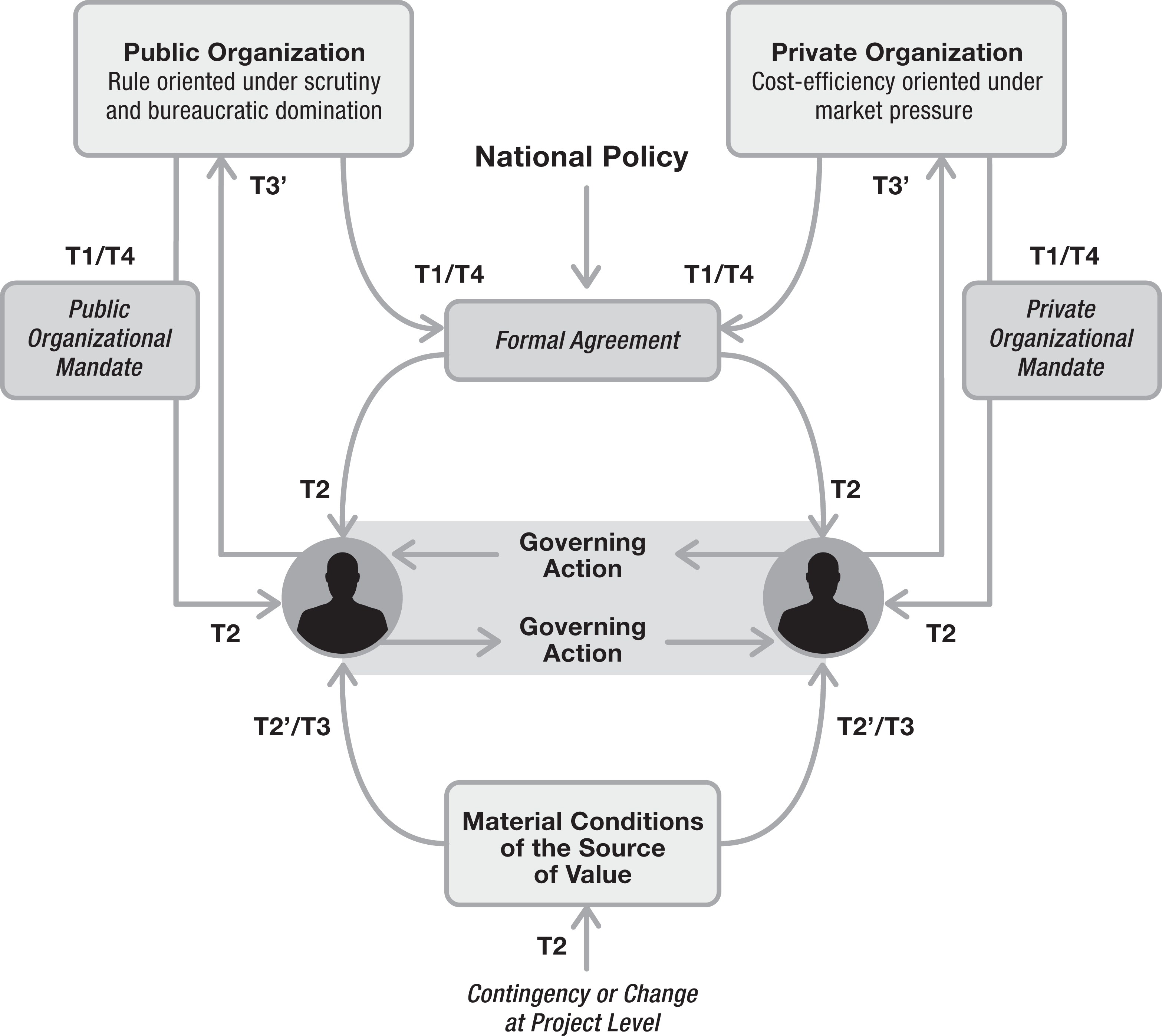
Process framework of governing activities in PPPs.
In (T1), there are two organizational entities with certain interests defined by their own logics of operation connecting resources, rewards, penalties, and beliefs in a hierarchical structure of positions. These two entities are related in a contingent way, meaning that the operation of their logics is independent from their counterpart. However, they engage a contractual relationship upon their potential performative complementary for the delivery of public services (Rangan, Samii, & Van Wassenhove, 2006), relying on institutional systems operating at the societal level (market, policy, and justice system). The negotiation of a PPP establishes a necessary relationship between the private and public organization, from an initial compromise between different logics of operation (profit-oriented versus rule-bureaucratic-oriented) (Rufín & Rivera-Santos, 2012; Villani et al., 2015). The new relationship defined by the contract brings together not only complementarities in a necessary fashion but also contradictions. These relationships are reshaped in the contractual form, as a result of the cycle of interaction between decision makers during the procurement and contract-crafting process acting under market, policy, and legal enablers and constrictions. The contractual system of penalties and rewards formally define the temporal system of rules, roles, and activities that mediate the process of value creation and capture and the interest of people filling organizational and project positions. The contract introduces a fundamental transformation in the nature of the relationship between organizations, establishing expectations for value co-creation and capture at the front end of the project.
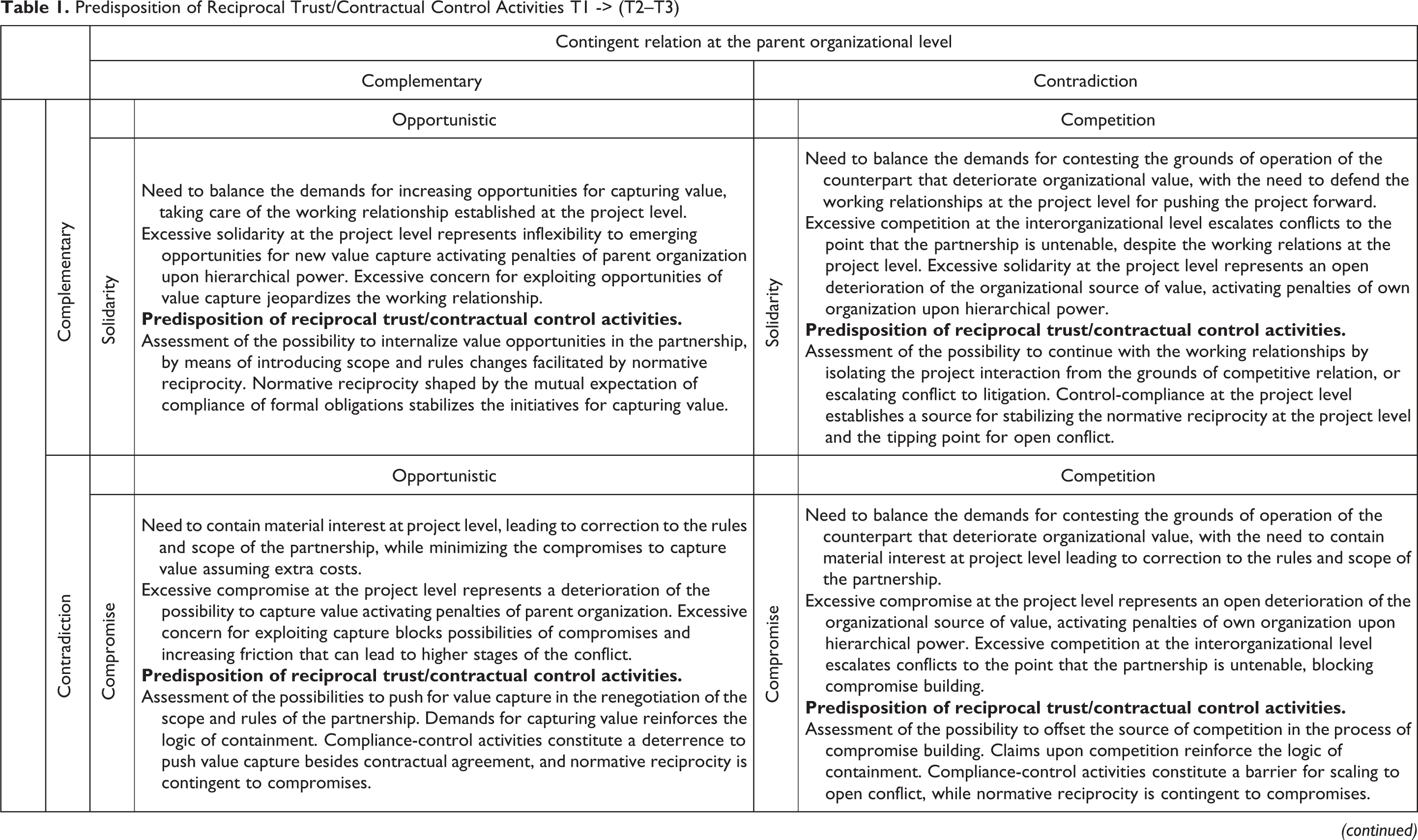
In (T2–T3), governing interaction is predisposed by structural degrees of complementarity and contradiction in T1 at two levels: between the logic of operation of parent organizations as independent entities and the logic of operation of the partnership as a singular but temporal entity. The need to integrate the work contribution at these two levels implies diverse demands (Braun, Ferreira, & Sydow, 2013; DeFillippi & Sydow, 2016; Sydow & Braun, 2017), emerging from the contingent relationships between permanent organizations (vertical) and the necessary relationship between public and private operations to reach the mission of the partnership (horizontal). Structural predispositions define the boundaries of the possible governing practices that can be enacted/created, and the opportunity cost of deviating from these scripts. Table 1 theorizes the modes of interaction between PPP actors and governing activity predisposition (engaging in reciprocal-trust or control-compliance governing activities).
Predisposition of Reciprocal Trust/Contractual Control Activities T1 -> (T2–T3)
Cycles of governing activity lead to (material) changes in the source of value, which accentuate or attenuate existing complementarities or contradictions at the project and interorganizational levels. The interaction at the project level can be triggered by a contingent event affecting the programmed functionality of the asset/material source of value of the partnership, or by the programmed life cycle process of the project (T2). Partners mutually monitor the expected functionality of the asset/source of value and the implications for the ongoing level of contradiction or complementarity in the operation of the partnership and the operation of the parent organization (T2’). From the initial monitoring effort, project actors define concerns based on the objective advantages and disadvantages of actions available by their positions (Caetano, 2015), using their deliberation to engage practices such as enforcing the contract as a power-induced compliance activity to control others’ actions, or carrying out relational activities based on trust and reciprocity.
The sequence of governing actions signalizes the actors’ intentions to the counterpart shaping the interaction loop in T2–T3 and provides meaning to the situation in terms of solidarity, competition, concessions, or opportunism. This meaning is also related to the effect of contractual and relational activities in the functional status of the asset, which ultimately defines value for the organizations in the partnership. During interaction, managers reflect on the material consequences of their governing activities and the extent to which the path of interaction might trigger penalizations (or miss rewards) from the hierarchical structure of their organizations, or in the day-to-day interaction with their project counterpart. Under the described logic, the interaction reinforces or dampens the initial structural predisposition, changing the cost of opportunity of the repertory of governing activities available to the actors’ positions.
The end of the cycle (T3) is defined by a closure of the problematic issue, emerging from the evaluation of the (material) stage of the asset/source of value. The closure can also be defined by the programmed transition of one phase to the other, following the regular life cycle process (e.g., transition from construction to operation). The dual role of managers implies that their interaction with their counterparts at the project level requires being aligned with the hierarchical structure of their organizations. This means that the manager himself or herself mediates the consequence of the interaction at the project level with the parent organization (T3’). Additionally, it is a matter of contingency if the managerial reflection indicates that a formal provision requires clarification or modification. Formal modifications are triggered by the interaction between managers but are mediated by the oversight mechanisms at the parent organizational level. Then, the final part of the cycle (T4) implies the change or reproduction of the original structural conditioning at the level of organizational mandates for the project and at the contract level (scope of rules).
Illustrative Case
In order to illustrate the shortcomings of the prevalent interplay conceptualization and how the developed framework can provide more insightful explanations into the dynamics of PPP governance, we make use of a case on a PPP for a military facility in the Netherlands organized as a design, build, finance, maintain, and operate (DBFMO) project. We are particularly interested in the interaction between the public contract manager and the private facility manager during the introduction of functional changes in the exploitation phase of the project. Their collaboration in the project involved a path of contractual and governing practices that appear to be paradoxical from the dichotomous perspective of the interplay between governance mechanisms (Poppo & Zenger, 2002), making the case an appropriate empirical setting to explore the conceptual framework developed upon the tenets of realist social theory.
Approach and methods
The case identification and selection took place during the involvement of the first researcher in an initiative for raising the awareness of the PPP practitioners about the complexity of introducing changes in the exploitation phase of DBFMO projects. In this regard, the research activity followed the principles of action research, which aims at creating scientific knowledge while solving a relevant social or organizational problem (McKay & Marshall, 2001). The initiative was led by a PPP professional network in the Netherlands, which supports knowledge transfer between DBFMO projects. The researchers were asked to elicit lessons from DBFMO projects during their exploitation phase, in order to provide inputs for a one-day conference of the network on cooperation in PPPs. In action research, a distinction should be made between the problem-solving interest and the research interest (McKay & Marshall, 2001). Accordingly, the scientific interest focused on the analysis of a military facility project, regarded as an emblematic case of collaboration in the PPP professional network. During the interaction with the managers of the project, the researchers found that current levels of collaboration implied a rather complex path of learning, with emphasis on contractual and relational governing activities over time. This idiosyncratic configuration provides grounds for the selection of this case as a paradigmatic one (Flyvbjerg, 2006a).
The data collection and analysis were conducted as an iterative process in two workshops and four interviews with practitioners involved in the case. For the two workshops, the first researcher used the group model building (GMB) technique with causal loop diagrams (CLDs) (Vennix, 1996) to elicit practices to deal with the introduction of functional changes. This technique was chosen because it allows the identification of complex relationships among variables, triggers participants to explain these relationships over time, and fosters learning, communication, shared vision, and commitment between teams (Vennix, 1996), stakeholders (Van den Belt, 2004), or the community of practitioners (Hovmand, 2014). Specifically, the GMB activity provided a space for reflecting on the process of introducing contractual changes and the dynamic of contractual and relational practices in this process. An initial CLD model was set up by the researcher based on organizational charts describing the contractual process for introducing functional changes for the operation of the two projects, the opinions of PPP network consultant about the frequent challenges faced by managers, and existing literature on the management of DBFMO projects in the Netherlands. In the first workshop, the CLD was discussed and rebuilt by four attendees, including the public and private managers of the selected case, the PPP network consultant, and a public manager of the second project. Between the workshops, face-to-face interviews with the workshop attendees were conducted to reveal whether the model reflects the dynamics of working practices for introducing changes from the practitioners’ perspective. In the second workshop, the extent to which the CLD reflected the working practices according to face-to-face interviews and captured the insights on how the relationship and working dynamics changed over time (validation of results) was discussed in a group setting. Because the CLD resulting from the workshops and interviews comprised more than 30 loops, the authors analytically abstracted the case governing activity in the final CLD included in this article. This final CLD, along with the explanatory narrative, was shared with managers and consultants as a final step of validation.
Functional change as a triggering event
DBFMO contracts establish a clear differentiation between the role of public contract manager and private facility manager in the introduction of functional changes during the exploitation phase. While the former must define required changes in terms of functional specifications (e.g., working environment for 100 new staff), the latter must define the best means for meeting these specifications considering life cycle cost, financial implications, and emerging risk (e.g., characteristics of the physical space, furniture, services, etc.). According to practice in the Netherlands, two particular difficulties lead to friction and frustration between public and private managers when introducing changes to the operation of assets procured by DBFMO contracting. First, establishing functional specifications turns out to be rather abstract compared to the traditional practice of contracting goods and services, eliciting discussions about roles and actual necessities. Second, the price submitted by the private facility manager usually triggers skepticism from the user. Reactions such as: “I can have this change cheaper when I refurbish my own house” are not only a symptom of incomprehension about the essence of DBFMO projects, but evidence of the interest to counteract the DBFMO regime by the user.
Governing activity
In order to face these two difficulties emerging from the DBFMO contractual arrangement, the public contract manager and the private facility manager of the selected case made a careful effort to make sense of their contractual roles and responsibilities, given the increasing pressure of user requirements and the regime of DBFMO penalties. This process of sensemaking was promoted by mutual acknowledgment that the project was one of the first DBFMO contracts in the Netherlands. It involved an extensive discussion on the scope and implications that functional specifications rule as well as the criteria for establishing reliable life cycle cost during the operation phase. At the beginning of this phase, the team introduced dialogues as informal activities to jointly translate the requirements of the user in output specification and discuss input specifications and life cycle cost in detail. In the dialogue, managers agreed to place between brackets the contractual principle according to which the public manager should deliver output specifications of the change, in a context where contractual roles were not totally clarified and appropriated, leading to delay and frustration. According to the public contract manager: In Year One we had a lot of dialogue about things, because we didn’t ask for functional specifications, we asked for the solutions.…At the beginning we had a lot of frustration, delay, redefining, discussion about the roles. The speed of the [functional] change process was quite low, and we had to reserve some time from the beginning until the end, we finally had an add-on in the contract. The main issue to evaluate was how to improve the speed of the process. But also, there was another part: The DBFMO contract does not provide everything in it, so there was an open end—for example, the costs we are making during the change are costs for our organization, but also profit of the work sum, the sum of the change, we do a general percentage over it. It was not agreed at the beginning in the contract. So, we also had to negotiate that during the years, and now it finished. That also made the procedure so long. Now it is overcome. And now, we can use that. Now, after five years…I give a blank check, do this for me. And call me when it is finished. At this moment when there is a change, I give you the function specifications, call me when it is ready and give me the bill. We don’t need extensive dialogue, we know each other, we know it is right.…At the beginning we argued a lot about the prices…now, when you say 100 €, of course it is 100 € because you said 100 €. I don’t say when he says it is 100 € it should be 90 €, no! But at the beginning you wonder why he said 100 €, and not 99 €…when it is cheaper the consortium gives me money back.
Complementarity/substitution from a dynamic perspective
The evolution of the governing activity brings to light ambiguous characteristics of governing practices, acquiring different properties over time in relation to their relational and contractual basis. Using system dynamics notation, Figure 2 describes how the degree of contractual roles enactment and level of trust changed over time, during the process of adjusting the governance structure for introducing functional modifications during the operational phase of the project.
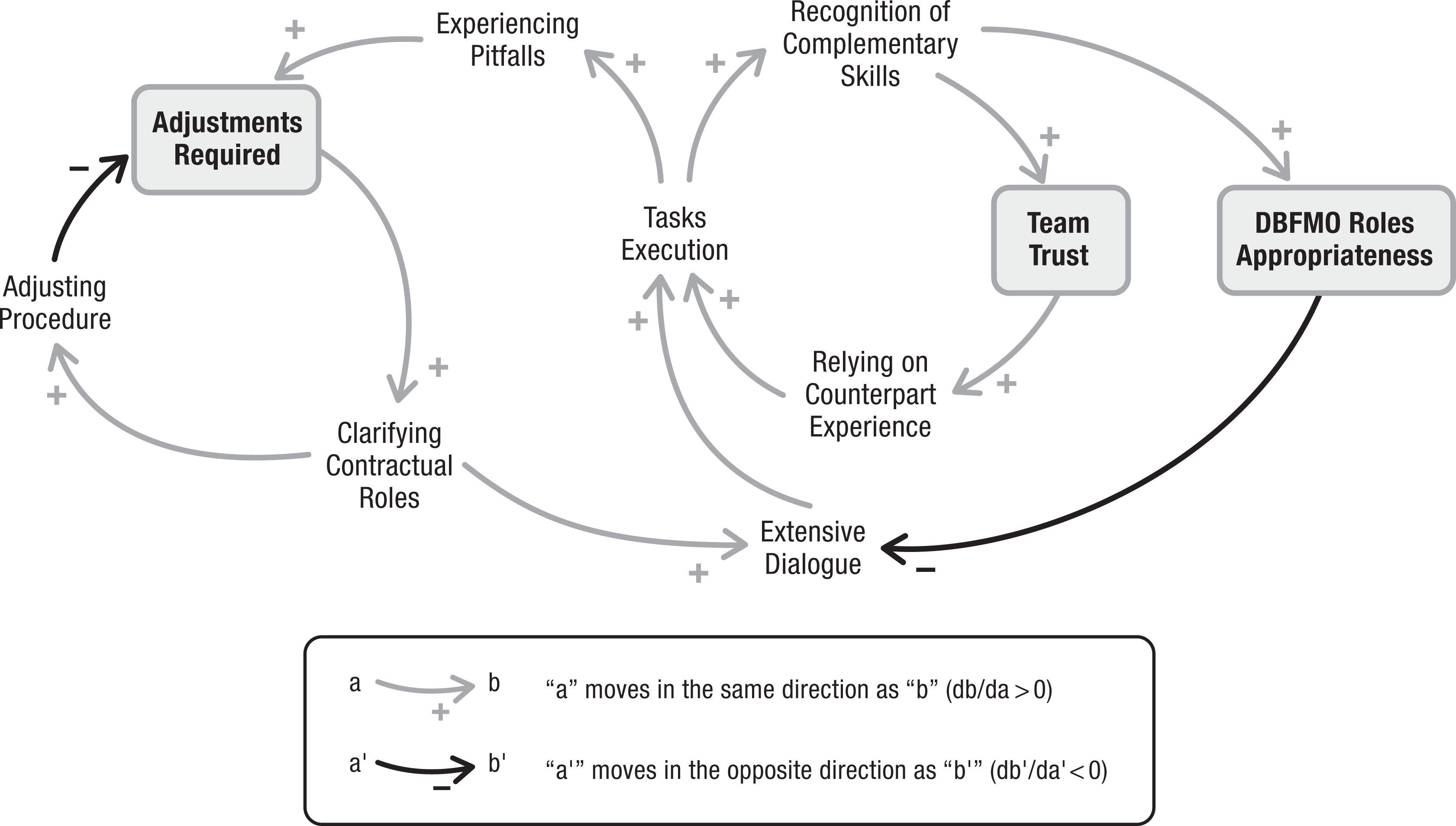
Introducing functional changes during the exploitation phase of a DBFMO contract.
In the beginning, there was a low appropriation of contractual roles, low trust, and unawareness of the contractual adjustment required. The system changed as requirements of functional changes compelled managers to execute tasks by means of extensive dialogue, substituting the DBFMO roles allocation. Additionally, the implementation of tasks for introducing functional changes in the operation of the asset resulted in pitfalls, such as delays as a result of blurry responsibilities, discussion of prices, and claims on administrative costs not overseen by the formal procedure. These aspects reinforced the need to clarify roles, which on the one hand, reproduced the extensive dialogue practice, and on the other hand, triggered activities to adjust the procedure itself. The initial stage of the interaction constituted the rise of extensive dialogue as the main governing activity, substituting the enactment of contractual roles that clearly required that the public manager discuss the type of solution. But what can be defined as a substitution effect of this relational practice on contractual governance actually permitted the development of appropriate contractual roles and adjustments to contractual procedure. The reduced emphasis on extensive dialogue over time was the result of day-to-day working dynamics, which allowed managers to emphasize the complementary aspect of their organizational functions and clarifying roles (extensive dialogue complementing contractual roles).
Performative complementarity turned out to be the basis for interpersonal trust between managers. Higher levels of interpersonal trust opened up the opportunity of relying on the counterpart’s expertise, while higher levels of role appropriation reduced the need to use the extensive dialogue practice. Then, there was a transition period where the extensive dialogue and the reliance on the counterpart derived from the execution of the task, given the need to address procedure adjustments by clarifying roles (mutual complementation). The final shift from the extensive dialogue practice to reliance on the counterpart’s expertise was the result of the reinforcing loop of trust driven by the complementarity of skills recognition, and the balancing loop of roles appropriateness. The dominance of trust at the end was possible as a result of the high levels of role appropriation between contractual managers, which made the extensive dialogue practice unnecessary (trust substituting for extensive dialogue).
Cycles of Governing Activity and Underlying Managerial Struggle
The rise and fall of the extensive dialogue describe a governing path where activity and interpersonal trust unfolded upon a change in the mode of interaction between managers, predisposed by the structural configuration of penalties, rewards, and beliefs. Interaction is triggered in T2 when the client experienced new building functionality, and managers had to negotiate the price and scope of the functional changes for its operation. The emergence of extensive dialogue as governing practice matches the situational logic of correction, which leads to concessionary modes of interaction. This means that there were material contradictions between the logic of operation of public and private organizations in T1, compromising organizational stakes when introducing functional changes in the military facility.
The DBFMO setting restricted the possibility of defining the specific characteristic of the asset, and introducing the life cycle cost implied a conflict on the public side of the partnership. The operation of the final user (ministry) required specific solutions reflecting the hierarchical values of the military (e.g., asking for specific furniture that symbolizes the hierarchical authority), while the contract manager was expected to follow the VfM principle (e.g., requiring working space for staff taking into account the life cycle cost). On the other hand, the lender evaluated the emerging risk from a given change, assessing the extent to which the private party would be able to make that service available in the future. Lenders are sensitive to the number of changes required, consistently increasing the risk premium over time and imposing pressure on the private contractor for acting cost-effectively. The special purpose vehicle was under pressure from the lenders, which increased their risk profile in the case that introducing a functional change might imply extra penalties because of lack of availability.
Besides these vertical pressures that imposed demands on the managers, what is interesting is the creative capacity of the managers in changing their logic of interaction from concessionary to solidarity at the project level. In this regard, the emergence of extensive dialogue in T2–T3 had the background of isolating day-to-day activities from external pressures. These external pressures revealed the contradictions between organizational actors with different expectations and dissimilar perceptions of DBMFO fairness. In the words of the public contract manager: In the back, there are more people. It is when you are playing football, there are people shouting, and they have their own opinion of the project. The consortium has the board, the people who spend money on it, invest the money, they want something in return. You have the users, high-rank military. On our side, we gave away a lot of things that we used to do for ourselves. Most of the people are very negative, skeptical about PPP. It is useless, it is spending money. There are lot of negative feelings upon my shoulders, but also on the private manager’s back. So, who are my partners? Directly, only this team, as I said to the private manager and the user representative. We have to make a strong team, we have to arrange what we have to do, upon our expertise. What is my expertise, your expertise? With a strong team we can do the job of the project, and we have to fight—I mean, we don’t have to fight, but we have to be strong with regard to the surroundings near us.
Discussion
This article provides a fresh look at the multilevel conceptualization of project governance compared with the economic understanding of managerial behavior that is traditional in project management studies (Turner & Müller, 2003). The traditional perspective imputes calculus, consistency, and selfishness as a static property of managers. As a result, the role of the manager as chief executive at a project level and as an agent of a hierarchical organization only leads to higher risk of moral hazard and adverse selection. (Turner & Müller, 2003). The social realist approach questions rationality as an intrinsic property of managers, through differentiating the role of the manager as a position with a specific vested interest from the existence of the person who contingently fills that position. Organizational roles imply objective premiums to specific behaviors, but people filling those roles can creatively circumvent objective constraints. This assumption allows explanations of how the weakening of contractual principles may be a representation of a transition period leading to the strengthening of contractual governance. Furthermore, it allows for explanation of the emergence of different governing practices between managers who have to collaborate at the project level, but are also exposed to the interests of their parent organizations.
By defining contractual and relational activities as positioned-practices, the conceptualization of the interplay from a realist social perspective focuses on the change and reproduction of available governing activities that people can enact by virtue of their place in the complex grid of positions and rules defining the structure of a PPP. It sheds light on how conflicting situations and solutions continuously emerge over time, by situating contracting and relational governing activity of people in “slotted” positions. Predispositions to engage in collaborative, concessionary, opportunistic, or competitive modes of interaction are a result of the structural relationships between the profit-oriented logic of private organizations and the rule-bureaucratic logic of public organizations. This was illustrated in the case where the adjustment of formal procedures from a concessionary mode of interaction at the beginning of the operation phase eventually led to a more solidary interaction over time.
Complexity of the Interplay Between Contractual and Relational Governance
The process framework addresses the complexity of governing activities in PPP projects, using time for disentangling what appears to be paradoxical for the dichotomy lenses to assess the interplay between contractual and relational governance. For example, in the illustrative case, the extensive dialogue placed contractual roles between brackets in order to address the urgency to execute the project task in the short term, but at the same time to trigger a process of adjustment and role appropriation that led to trust and the final enactment of contractual functions. Therefore, the structure of penalties and rewards formalized in the contract does not necessarily require its enactment by pure contractual activity. Instead, it furnishes the possibility of a range of relational-type governing activities, defining the performative conditions where trust can emerge as part of the positioned-practice of managers. Hence, trust is not an act, but it is the psychological property of reflexive people filling the role of an actor in a specific situation. The psychological manifestation of trust emerges from, but cannot be reduced to, the structural predispositions and situational logics (e.g., solidarity, competition, compromise, opportunism). Trust can be developed in a situation where managers recognize themselves as actors being confronted with the contradictory system of penalties and rewards from their parent organizations, but having the vested interest of moving the project forward. Trust offsets the opportunity cost of deviating from the contractual script, under the expectation that collaboration would lead to more harmonious conditions for the next cycle of interaction.
While previous research has pointed out that time is the key aspect for providing sense to the apparent paradoxical nature of governance mechanisms (Howard et al., 2017), this article advocates understanding the hidden mechanisms underlying the stages of complementarity of substitution (Huber et al., 2013). It does so by distancing itself from the mainstream conceptualization of imputing inherent functionality to contractual and relational activity. Contractual and relational governance are neither complements nor substitutes of each other per se, but they emerge from the reflexive mediation of contradictory or complementary relationships between systems of penalties, rewards, and beliefs attached to organizational positions arranged in a contingent or necessary fashion. Therefore, it is the situational logic that provides meaning to the type of interaction where governing activity takes place, including its degree of functionality or dysfunctionality. Examining the situational logic of actors’ governing practices can provide more clarity in those situations where “what is functional for one side of the dyad can be dysfunctional for the other party” (Howard et al., 2017, p. 14). From the realist perspective, this asymmetric valuation of functionality must have as an underlying driver some degree of contradiction between the system of penalties, rewards, and beliefs, or a contingent configuration of positions that increase the performative autonomy of project actors.
Governing Activity and Governance Structure
Another contribution of this article is the introduction of Archer’s ontology as an alternative to structuration theory (Giddens, 1984) for guiding the empirical research on PPP governance activity and structure change. Both Archer and Giddens assert that social structures influence the social interaction among humans, and social structures are reproduced or changed by human activity. Nevertheless, Archer (1995) takes a different view from Giddens, rejecting mutual constitution. Archer’s solution is based on emergence, using time as the key to link agency and structure, because agency and structure are distinct from each other. Framing relational and contractual governance in the morphogenetic cycle clarifies the process whereby structural relationships between diverse organizational rationalities in the past predispose specific contractual and relational activities in the present and shape the future of coming interactions. Rather than being a black box, the emergence of the complex repertory of relational and contractual governing actions is explained by structural dispositions, while actor interaction explicitly explains change and the reproduction of governance structure.
The distinction between emergence and mutual constitution is overlooked in project management studies but is crucial to understand how the perspective of governance as positioned-practices differs from governance-as-practice (Brunet, 2018). While the latter conceptualizes governing activity as the empirical enactment of institutional and organizational requirements (governance), the former emphasizes the mediating role of emerging situational logics and reflexivity between institutional and organizational requirements and the governing activity at the project level. Governance-as-practice not only neglects the differentiation between social governing and material governance, but also reduces the latter to artifacts (e.g., governance-written framework), the characteristics of which are “only relevant in relation to situated practices” (Brunet, 2018, p. 11). Therefore, the interplay between higher-level structure and activity enacted in the project is a black box that emphasizes the self-regulatory role of project actors but overlooks the preexisting systems of penalties, rewards, and beliefs that impute vested interests and predispose logics of interaction open to agential transformation over time. Governance is not only what people do (practices), but it also emerges from objective relationships between positions (positioned-practices).
Governance and Institutional Complexity in Ongoing Public–Private Partnerships
This article defines the relationship between public and private organizations in PPPs as necessary at the project level, but contingent at the organizational level, as a second axis to fully understand the implications of complementarities and contradictions between different systems of penalties, rewards, and beliefs. In particular, it provides a consistent framework for examining how inventive individuals filling public and private managerial roles reshape contractual and informal relations when addressing conflicts. This is a substantive problem not adequately addressed by the PPP governance literature, which has recognized but not fully theorized the formal and informal aspects emerging from the relationships between organizations with different logics of operation.
The mediation of informal aspects between formal contracts and project performance in PPPs empirically identified by Benítez-Ávila et al. (2018) is, from the perspective of realist social theory, a matter of necessity. Even the enforcement of a contract clause implies a reflexive process whereby “individuals make sense of governance and organizational design and act upon it” (Simard, Aubry, & Laberge, 2018, p. 468). This insight was already recognized by the neo-institutional approach (Zenger et al., 2000). From the realist social perspective, with its introduction of situational logic, contracts also operate as one of the multiple structural demands imposed on project managers’ agency. They create a necessary relationship defined as partnership, predisposing concessionary or solidary modes of interaction between project managers, who are also exposed to opportunism and competence as a result of the contingent relations with their parent organizations. Not only do these predispositions encourage managers to enact/produce governing activities, but they also push them to modify or reproduce the governance structure itself. The emphasis on situational logic emerging from structural relations sets a crucial distinction between the social realist and the neo-institutional study of PPP governance.
From the neo-institutional perspective, the governance problem is the result of institutional complexity that generates conflicts between competing public and private institutional logics, added to the immaturity of a PPP as an institutional arrangement itself (Saz-Carranza & Longo, 2012; South et al., 2018; Villani et al., 2017). Actors rely on “existing institutionalized modes of interaction, regardless if they fit the situation or are compatible with other stakeholders from other perspectives” (South et al., 2018, p. 65). In consequence, governing activities should aim to increase the legitimacy of the PPP arrangement and its possibility to regulate different organizational stakes, attached to diverse institutional logics. PPP governance consists in recognizing, addressing, or embracing institutional complexity by means of involvement of and communication with stakeholders, learning spaces, encouraging capacity building, and acknowledging complementarities susceptible to exploitation in business models. By emphasizing the values shared among different entities, the neo-institutional perspective adopts a determinist conceptualization of project reality where actors operating under totalizing institutional logics come before their capacity to re-create relationships (Donati, 2017). Realist social theory, on the other hand, suggests that situational logics emerge but are not reducible to the degrees of complementarity/contradiction between contingent or necessary organizational relations, embedded in wider networks of systemic and institutional relationships. As a result, situational logic operates with a certain autonomy with respect to the values shared (or not) among entities, expressed in the predisposition for changing or maintaining the current systems of penalties, rewards, and beliefs mediated by human reflexivity. In analytical terms, the relationship is the starting point and the “key way of getting to know the subjects and objects, and not the other way around” (Donati, 2017, p. 21).
Conclusion
This article introduced a process framework of PPP governance building on realist social theory and Archer’s (1995) morphogenetic cycle and conceptualizing contractual and relational governance as activity paths resulting from the interplay between governing agency and project governance structure over time. The framework possesses the potential to explain governing features that appear to be paradoxical from the dichotomous perspective of governance interplay as the outcome of agential mediation of diverse structural demands. While the economic perspective of governance interplay reduces the relationship between contractual and relational activity to the dichotomy of substitution/complementarity, the social realist perspective analyzes contradiction/complementarity in the contingent/necessary configuration of rewards, penalties, and beliefs that predispose diverse modes of interaction among partners. Final enactment and production of relational and contractual governing actions require reflexive actors, still free to find creative ways to comply with structural constraints and even accept the cost of diverging. Realist social theory calls for making a distinction between the activities, structural predispositions, and logics of actors’ interaction, identifying the hidden mechanism that links these elements. Private and public organizations are social entities. Their economic interaction is materialized in the activity of managers conditioned by a dual role in their day-to-day working practice. The motivation behind a sociological conceptualization of economic activity is the need to confront decision-making models with the actual projects, providing better frameworks for understanding change in interorganizational temporal settings.
There are limitations to be addressed in the future. First of all, the framework does not make explicit the implications for typical intertemporal governance problems in projects such as optimist biases (Flyvbjerg, 2006b) and displaced agency (Henisz et al., 2012). At a policy level, it is necessary to theoretically clarify how the morphogenesis cycle at the project level interacts with cycles of policy change in modern societies, where the increasing involvement of the private sector in public affairs seems to be a normative characteristic of modern societies that promotes “competition rather than concomitant complementarities” (Donati, 2015, p. 99). Finally, one central tenet of critical realist theory is the analytical differentiation between culture and material/political structure. In this framework, we have included them as the general definition of beliefs, while Archer (1995) warns that their relationships in terms of autonomy and complementarity are independent.
Researchers are invited to provide more fined-grained insights on how structural relationships predispose different types of trust or control activities, which empirically are observed as practices. They can explore the effect of implementing contractual mechanisms on the type of interaction between managers, expecting to discover particular paths of relational differentiation (Donati, 2017), emerging from bottom-up and top-down processes. The top-down perspective includes the investigation of emergence processes of specific PPP governance structures in interplay with the social and political struggles that take place at the policy level. On the other hand, the bottom-up approach calls for introducing a more detailed account of the micro-dynamics where contractual and relational activities take place, mediating diverse structural predispositions by day-to-day reflexive deliberations. In other words, the conceptualization of governance as positioned-practices opens up an opportunity to bridge the gap between project-as-practice literature focused on the deep empirical documentation of day-to-day managerial experiences (Blomquist, Hällgren, Nilsson, & Söderholm, 2010) and the neo-institutional tradition that appeals to the existence of normative, regulatory, and cognitive scripts shaping behavioral expectations (Henisz et al., 2012). For example, researchers can further explore how day-to-day practices such as the horizontal process of operational consensus-seeking and the vertical process of strategic escalation (Hällgren & Lindahl, 2017) are related to the institutional complexity of PPP in a specific policy context (Saz-Carranza & Longo, 2012), by means of studying modes of interaction and situational logic.
This contribution is aligned with the recent call for questioning the core assumptions of neo-institutional theory, whose current maturity level in organizational science seems to have reached a midlife crisis (Alvesson & Spicer, 2018). Rather than breeding expectations to find stable levels of legitimacy as a practical concern of neo-institutional scholarship, PPP can be studied assuming (and embracing) the everlasting struggle for changing or reproducing governance structures at the project, policy, and social levels. Given the illustrative nature of our case, scholars should also develop more solid research designs to investigate the dynamics of the managerial struggle embedded in multiple organizational levels. To address top-down and bottom-up research challenges, the framework presented here can be articulated with the guidelines for discovering institutional mechanisms in organizational case studies (Vincent & Wapshott, 2014), where researchers are called to determine the configurational (structure of positions and activities), normative (gap between expectations and behavioral tendencies), and broader contextual conditions to which governing practices are related. In any case, the process framework does not claim predictive power, given that the social ontology that has been developed is based on the scientific premise that explanation is not predictive. Explaining is proving histories or emergence, accounting for the activation of causal mechanisms and why organizational forms and governing activities are so and not otherwise at a given moment in a specific organizational setting (Edwards, O’Mahoney, & Vincent, 2014).
Footnotes
Declaration of Conflicting Interests
The author(s) declared no potential conflicts of interest with respect to the research, authorship, and/or publication of this article.
Funding
The author(s) disclosed receipt of the following financial support for the research, authorship, and/or publication of this article: The research was funded by the Netherlands Organization for Scientific Research (NWO) under Grant No. 409-14-014.