




Abstract
Delivering organizational change through interorganizational projects is a complex process, as several organizations must collaborate. The aim of this article is to understand how change and resistance are shaped in interorganizational projects. This article discusses a longitudinal case study (2012–2016) of an interorganizational project in the utility sector. The findings of the study describe four practices that both enabled and constrained change. The contribution of the article is an extension of our understanding of change and resistance in projects with the introduction of the notion of productive resistance and the notion that employees can be change agents and middle managers can be resisters.
The topic of organizational change has been receiving increasing attention in the project management literature (Crawford, 2014; Fiedler, 2010; Hornstein, 2015; Kenny, 2004; Partington, 1996). Current project management literature provides little guidance on how to support planned change (Crawford, 2014), which is strange because projects are becoming increasingly involved in change elements (Söderlund, 2010) or they serve as powerful means to evoking changes (Bresnen, Gousseveskaia, & Swan, 2005). Projects can be perceived to be agencies for change, with a coherent set of change objectives (Turner & Müller, 2003). The studies on project management, however, largely ignore the complex and emergent characteristics associated with the implementation of change (Crawford, Aitken, & Hassner-Nahmias, 2014; Jaafari, 2003). Therefore, we need to investigate what practitioners actually do in change projects (Crawford, 2014; Söderlund, 2010).
The meaning of organizational change objectives and change work by project actors is crucial in the process of organizational change and resistance (Weick, 1995). Organizational change studies have investigated the potentially positive intentions that may instigate negative responses to organizational change (Courpasson, Dany, & Clegg, 2012; Fiedler, 2010; Fleming & Spicer, 2003; Ford, Ford, & D’amelio, 2008; Piderit, 2000; Thomas, Sargent, & Hardy, 2011). For example, Ford et al. (2008) perceived thoughtful resistance to be more important than unquestioning acceptance in sustaining organizational change. In line with this thinking, Thomas et al. (2011) argued that resistance need not necessarily be passive or reactive, but rather can be understood as a way to situationally negotiate meaning that finally results in change. Resistance is thus an enactment of alternative power relations in an organization that has the potential to influence the direction of the change process (Courpasson & Valles, 2016).
Due to difficulties and drawbacks in carrying out work independently, organizations are increasingly involved in interorganizational projects (Kenis, Janowicz-Panjaitan, & Cambre, 2009; Scott, Levitt, & Orr, 2011). In this article, interorganizational projects are understood as a group of diversely skilled employees from several organizations who work together on a complex task over a limited period of time (Goodman & Goodman, 1976). More precisely, they can be defined as a group of firms that interact reciprocally to coordinate their efforts for a complex service or product during a finite period of time (Jones, Hesterly, & Borgatti, 1997). Often, they are characterized by the large number of partners (Scott et al., 2011), the absence of a clear hierarchical organizational structure among these partners (Jones & Lichtenstein, 2008), and internal power struggles (Van Marrewijk, Ybema, Smits, Clegg, & Pitsis, 2016). Therefore, interventions in interorganizational projects are challenging (Gray, 2008). Studies on change in these projects frequently leave out hierarchical relationships (Wooldridge, Schmid, & Floyd, 2008), whereas their change dynamics are not yet well understood (Cropper & Palmer, 2008).
The aim of this article is to understand how change and resistance are shaped in the interaction between project actors in interorganizational projects (Cropper & Palmer, 2008). This article discusses the “Innovation Atelier,” a planned bottom-up change approach (Burnes, 1996) signed by the top managers of four utility network operators and five contractor companies to improve their joint process of building networks. An essential challenge of change in an interorganizational project is that one has to intervene in each other’s processes, which, according to Nistelrooij and De Caluwe (2016), can best be done by creating a temporary space with new relationships and new rules. This temporary space was effectuated in the Innovation Atelier by installing two workgroups consisting of shop floor representatives and a steering committee consisting of middle manager representatives. In weekly meetings, these workgroups collectively reflected on collaborative work practices. Collective reflection of employees is an excellent intervention instrument used to change work practices (Yanow & Tsoukas, 2009).
Resulting from the preceding discussion, the following research question emerged: How is the process of change and resistance shaped by actors in interorganizational projects? To answer this question, a longitudinal qualitative study of the Innovation Atelier was executed. A research team consisting of five master’s students and one researcher/consultant executed the study between autumn 2012 and spring 2016, collecting data through 54 semistructured interviews, observations in 20 meetings, participant observations over three years, and through a document analysis. The first author served as a researcher/consultant, moving back and forth between the academic role of ethnographer and the practical role of change consultant supporting the change process.
This article makes three theoretical contributions to the project management literature. First, we show that planned change is a multiauthored process in which project employees can be change agents, while (middle) managers can act as resisters. This expands on the literature on change in projects (Crawford et al., 2014; Hornstein, 2015). Second, we show the complex and emergent character of change projects by going beyond the dichotomy of change versus resistance in project management literature. Resistance can sometimes also be productive and thus expand on the project management literature with the concept of productive resistance (Courpasson et al., 2012; Courpasson & Valles, 2016). Third, the article provides a multilevel perspective on change and resistance, including hierarchical relationships, to fully understand change dynamics in interorganizational projects as asked for (Wooldridge et al., 2008). Such a multilevel perspective is not frequently used in interorganizational project literature.
The remainder of the article is structured as follows. First, a theoretical framework has been developed to understand change as a multilevel process and to discuss the change literature on resistance. This is followed by a methodology paragraph that discusses the research methods used in this longitudinal field study. Next, the findings are presented, followed by a discussion section in which the findings are critically analyzed and compared with the current theoretical debate on resistance. This article ends with a conclusion paragraph, which summarizes the main findings, answers the research question, and discusses the implications for future research.
Understanding Change in Interorganizational Projects as a Process
Rather than perceiving change as episodic, linear, and stepwise (Lewin, 1958), which is a dominant view in project management studies (Crawford, 2014; Lines, Sullivan, & Smithwick, 2015), here organizational change is understood as continuous, uncertain, and transpiring at the shop floor level during day-to-day interactions and activities (Hornstein, 2015). In this view, change is an inevitable condition of project life in which every employee can be (and is) a change agent, as decisions on the daily organization of work are increasingly being made at the microlevel (Boud, Cressey, & Docherty, 2006). Planned change, therefore, is a multilevel and multiauthored process in which resistance is an integral part (Dawnson, 1993).
Such an approach understands project actors of all levels to be in a constant process of sensemaking and organizing (Weick, 1995) and thus producing everyday changes at a microlevel (Pettigrew, Woodman, & Cameron, 2001). Organizational change, thus, is not exclusively limited to top-down efforts but also focuses on change as driven from the bottom up (Burnes, 1996). And although interorganizational projects are often characterized by prior relationships between involved organizations, employees’ background differences influence the change process (Levering, Ligthart, & Noorderhaven, 2013). These employees, coming from different organizations, bring along different work practices, narratives, values, and norms (Veenswijk, van Marrewijk, & Boersma, 2010). Their backgrounds are not fixed and stable but can be understood as heterogeneous living worlds in which they constantly reflect upon the change process. Dille and Söderlund (2011) argued that partners in an interorganizational project have different contexts and backgrounds, which include divergent notions of temporality. When the notion of temporality varies among partners, each will feel the need to move at a different pace, resulting in a “temporal misfit” (Dille & Söderland, 2011). They state that the more the participating organizations are dependent upon each other, the stronger the negative effect of the temporal misfits will be on the tasks at hand. Change is thus an open-ended and discontinuous process of adaptation to changing conditions and circumstances.
Despite the misunderstanding of change derived by projects as being an open-ended, ongoing process, it does not mean that top-down change interventions cannot be successfully carried out. There is plenty of room for intentionality within a change project. For example, dialogues in change workshops can be either a breakthrough or a standoff, depending on the way in which meaning was constructed over time. Thomas et al. (2011) distinguish the generative dialogue, supporting change actions, and the degenerative dialogue that obstructs change. In other words, by acknowledging the always-changing context of an organization, we can better understand how acts of resisting and changing are directed toward organizational goals.
Understanding Resistance
The literature on resistance has traditionally focused on how project managers can control resisters effectively (Fiedler, 2010; Lines et al., 2015). Fiedler (2010), for example, developed a phased model to manage resistance in change projects, whereas Lines et al. (2015) found different factors that contributed to minimizing the resistance to change. This view has been challenged by critical management studies (Ford et al., 2008; Ogbonno & Wilkinson, 2003), which have focused on the role of middle managers. Although middle managers can act as change agents and change sponsors (e.g., Bresnen et al., 2005; Thomas et al., 2011), they can also be as ambiguous about change as shop floor employees, because change processes and organizational restructuring can bring along fears of monitoring, surveillance, and reduced autonomy (Ogbonno & Wilkinson, 2003). Drent and Goldberg (1999) state that middle managers are resistant to the loss of status, to the loss of job security, or to conforming, yet this is not the same as resisting change. Some scholars suggest abandoning the concept of resistance altogether (Dent & Goldberg, 1999; Piderit, 2000). This is too radical for Ford et al. (2008), who suggest reconstructing resistance by expanding it and including a critical discussion on the agent–recipient relationship.
Transcending the dichotomy between change agents and resisters, Mumby (2005) understands the perspective of resistance as a set of situated practices that simultaneously enable and constrain change. This invariably highlights the ways in which resistance transpires as a negotiation and interpretation of organizational phenomena and to which organizational actors may adhere different meanings and ambivalence (Piderit, 2000). None of the actions is in itself resistance but can be assigned and labeled “resistance” by others (Ford et al., 2008). These include the numerous ways in which employees create freedom (Mumby, 2005), such as cynical disidentification (Fleming & Spicer, 2003), which creates zones of discretion to maintain professional autonomy or invisible practices and transcripts. The resisting element of these practices can be questioned, as workers may know more and better than managers about what is good for a company; thus, employees can enact some degree of professional discretion without actually interrupting the status quo in power relationships (Courpasson et al., 2012).
Planned bottom-up changes, as is the case in the Innovation Atelier study, takes the reflection of professionals central. Through “reflective intervening” (Gray, 2008), professionals negotiate and collectively reflect upon work practices, enabling a continuous development of new practices (Van Marrewijk, Veenswijk, & Clegg, 2014). Such collective reflection stimulates establishing ideas on what works and what does not work and forms the bridge between the organization of work and change (Yanow & Tsoukas, 2009). This gives organizational actors the opportunity to reflect on their new experiences, which is necessary to make sense of changing practices and to produce productive resistance (Courpasson et al., 2012). Courpasson et al. (2012) distinguish three steps that turn resistance processes into productive ones. In the first step, resisters follow their initial rejection of a managerial decision; in the second step, resistance is made public by the resisters and support is organized; and in the third step, top management is forced to cooperate and coproduce new policies.
This theoretical exploration shows that members of diverse organizations are in a constant process of sensemaking, organizing, and resisting when involved in change in interorganizational projects. During this process, resistance can be discursively constituted, possibly resulting in an emerging dialectic relationship between change agents and change receptors. Therefore, resistance is not the outcome of a rational, linear response (Nistelrooij & De Caluwe, 2016), but rather has to be understood as a process of sensemaking and negotiation (Smits & van Marrewijk, 2012). Tensions and contradictions that are inherent in this dialectic relationship can create possibilities for everyday organizational change and transformation (Mumby, 2005). In sum, the acts and recurrent practices of resisters and the dynamic relationships between change agents and change receptors are crucially important in the understanding of resisting work (Courpasson et al., 2012).
Methodology
This article is based upon a longitudinal ethnographic field research (Pettigrew, 1990; Van Maanen, 1979) in the utilities sector. Ethnography is an excellent lens for studying change in interorganizational projects because it describes, interprets, and explains behavior, meaning, and cultural products through direct data collection by researchers who are physically present over a long period of time (Barley, 1990)—in our case from October 2012 through December 2016. The aim of ethnography here is to provide an emphatic understanding of the daily activities of employees in the utilities sector through the use of an interpretive sensemaking lens (Pink, Tutt, & Dainty, 2013; Yanow & Schwartz-Shea, 2006). Interpretive sensemaking is understood as an interesting method of theorizing, which enables, as an essential characteristic of the method, researchers to place special emphasis on the organizational actors’ speech and interpretation of the context in which they are inserted (Yanow & Schwartz-Shea, 2006). Furthermore, the typology of our change study is that of a process study in which the temporal predispositions of people, organizations, and cultures are socially constructed (Van de Ven & Poole, 2005). Process studies of organizational change need different terms.
The author, along with a team of five master’s students, executed the longitudinal ethnographic fieldwork, which had the characteristics of an action research (Swantz, 2008). The author was hired for approximately one day a week to empower the project participants and to facilitate the bottom-up change process from August of 2013 through December 2016. This role helped to bridge the gap between the theoretical (researcher) and practical (consultant) purpose and value of this article as suggested by Bartunek (2007). However, the role introduced methodological challenges of positionality (Yanow & Schwartz-Shea, 2006), sympathies, and subjective interpretations and reflexivity (Humphreys, 2005). The ethnographer’s roles are not separable from the interpretations of events in a study, and reflecting upon these must shed light on both the theory and practice of how applied fieldwork is done in contemporary contexts, about which we know relatively little (Yanow & Schwartz-Shea, 2006). Therefore, it is necessary to consider that, in this case, the researcher/consultant was a professionally trained engineer and anthropologist who held a part-time research position at the university. All the involved organizations knew and respected the author’s combined role. Humphreys (2005) calls these insights self-reflexive personal vignettes, which add authenticity and exposure to interpretations and, importantly, are useful for others.
Research Instruments
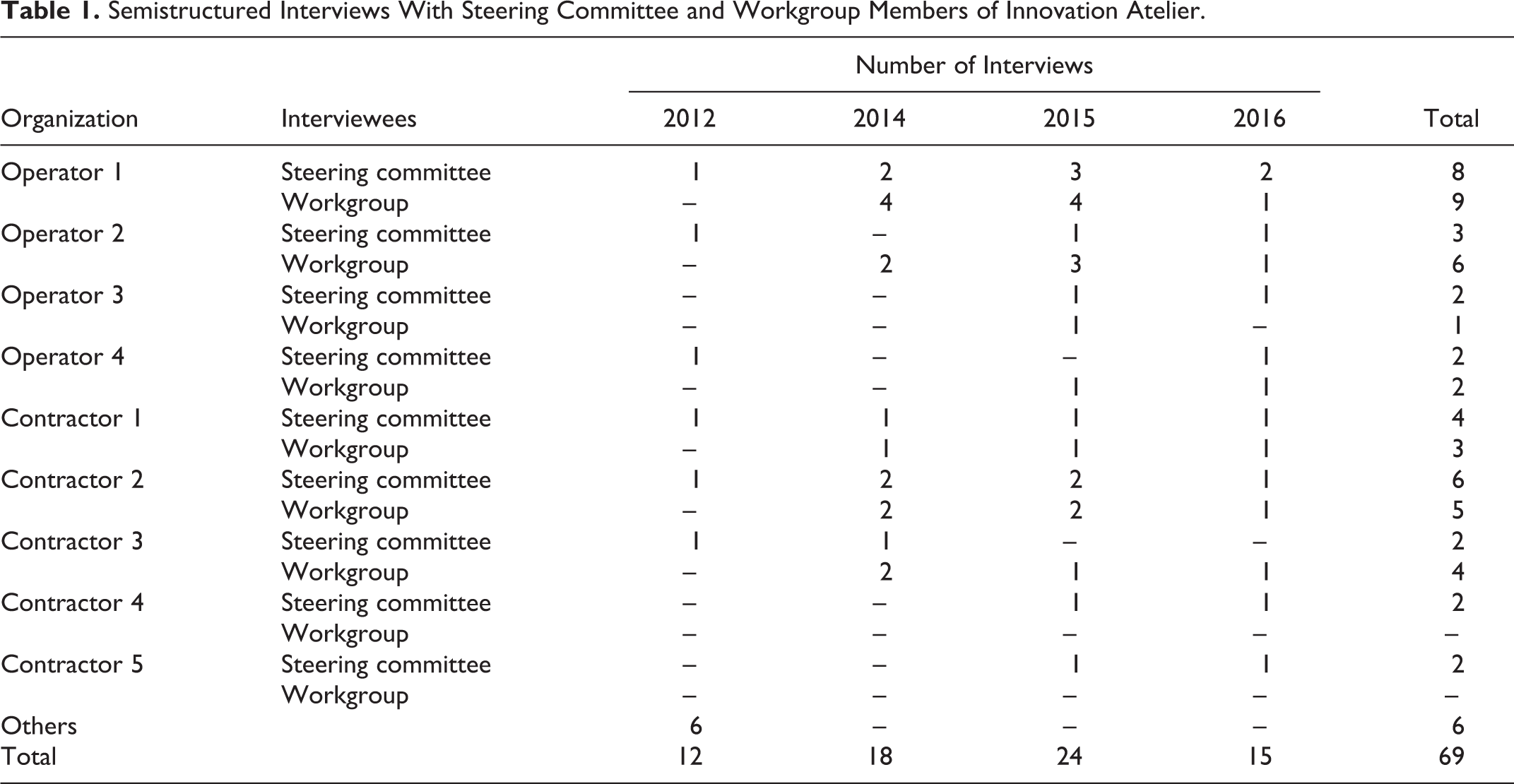
In the Innovation Atelier, the two workgroups, consisting of 30 representatives from all involved organizations, collectively reflected on collaborative work practices and introduced improved practices. The steering committee, consisting of 15 middle management representatives, made decisions as to whether or not to implement these improved practices in the joint building process. Combined fieldwork methods were used to study the workgroups and steering committee, involving (1) participant observation, (2) observation, (3) semistructured interviews, and (4) informal talks. These are discussed as follows: The researcher/consultant used participant observation in almost all (30) of the steering committee meetings between 2013 and 2016 and in a larger part of the workgroup meetings (40) between 2013 and 2015. These meetings typically lasted between two and three hours. Van der Ven and Johnson (Van de Ven & Johnson, 2006) argue that the quality and impact of research improve when academics organize the research project as a joint collaborative learning community. Therefore, meetings were held in the partner organizations to inform, validate, and share information with employees not directly related to the Innovation Atelier. Furthermore, workshops were organized with employees to create awareness about the cultural mechanism in the Innovation Atelier. Finally, four or more lectures were given in the utilities sector to present the findings. In total, 25 steering committee meetings and 20 collective reflection sessions have been recorded with participant permission. After each meeting, notes were written in a journal on the progress of the process. To prevent the risk of a researcher’s subjectivity (Yanow & Schwartz-Shea, 2006), each year, master’s students participated. During the period between February and May in both 2014 and 2015, two students executed fieldwork, whereas between February and May 2016, one student executed fieldwork. The students conducted field visits to obtain a better understanding of the subsurface building of infrastructures. This provided the researching team with firsthand experience regarding the implementation of the practices discussed during interviews and meetings. Together, the students observed and made notes about 23 steering committee and workgroup meetings. These observations were discussed with the researcher/consultant who was their supervisor during the study. The research team executed 54 semistructured interviews between 2012 and 2016 (see Table 1). Semistructured interviews allow the freedom to explore the ideas and perceptions of the participants in a conversational tone. The interviews also contain some fixed topics and predetermined questions that can be compiled in order to obtain a certain level of standardization (O’Reilly, 2005). In a first round conducted in 2012, the researcher/consultant held 12 interviews with representatives of the operators and contractors about collaboration. The analyses of these interviews helped to identify the research topics. For the second round conducted in 2014, two students held 18 interviews that questioned the interorganizational collaboration. In a third round, conducted in 2015, the two other students interviewed 24 Innovation Atelier participants, both old and new members. Finally, in 2016, 15 additional interviews with both old and new members were executed by a student. All participants agreed to allow the researchers to record the interviews, which were transcribed and coded. Informal conversations were held with all Innovation Atelier members and with the representatives of the Contractors Union. Van der Ven and Johnson (2008, p. 815) argue that engaged scholars systematically need to not only examine alternative models and theories but also come up with alternative practical formulations for the question of interest. In the informal conversations and steering committee meetings, the first author provided feedback on the collaborative practices and (cultural) change mechanism in the partner organizations. This helped the participants to reformulate the change question in the context of power structures and multilevel interests.
Semistructured Interviews With Steering Committee and Workgroup Members of Innovation Atelier.
Data Analysis
To support the triangulation or researcher’s findings (Yanow & Schwartz-Shea, 2006), meetings with the master’s students were held on a regular basis, and these were geared toward supervising, sharing analyses and results, and providing feedback. The perspectives from the involved researchers were then drawn together in order to obtain a more in-depth, holistic, and enriched view on a social reality through different prisms (Yanow & Schwartz-Shea, 2006).
The data were analyzed using an interpretative approach in which data are understood within the context of the case (LeCompte & Schensul, 2013). We adopted interpretive sensemaking—a practice of “dwelling” in the data. Such analysis, in which data are understood within the context of the case, strengthens the claims made about actors’ interpretations. A four-step interpretive method was engaged for the analysis (LeCompte & Schensul, 2013). In the first step, the researchers familiarized themselves with the specific terms used in the utilities sector when entering the field, which included the reading of students’ findings from previous years. In the second step, after the data had been gathered and organized, each of the students analyzed his or her field data separately using the topics, cultural change initiatives, resistance, timing, negotiating meaning, and managerial perceptions to write the thesis. In the third step, the researcher/consultant went through multiple readings of observational accounts, interview transcriptions, and the five theses. From these iterations between tentative assertions and field data, various practices of productive resistance emerged (Yanow & Schwartz-Shea, 2006). Resulting from this step, a time line of events and milestones in the Innovation Atelier was made. In the final step, the preliminary findings were discussed with participants and practitioners in the utilities sector to verify the outcomes.
The Goals and Design of the Innovation Atelier
The Innovation Atelier has to be understood as a bottom-up intervention of contractors to the traditional domination of operators in the Dutch utilities sector. Generally, the top management in these operators initiated change projects, facilitated by consultancy firms, to improve their internal process of planning and engineering network construction. The contractors, who experienced the large impacts of these change projects on their working processes and declining market prices for the building of networks, had little to say: “The operators…they decide. We have an open discussion, but then they say at the end ‘We will not do it’” (interview with manager, Contractor 5, April 2015). The contractors experienced little room for operators to improve the joint building process: “We want to innovate, to collaborate smarter and we only saw a pressure on the prices with no room for innovation and better collaboration” (interview with manager, Contractor 1, February 2014).
To challenge this power asymmetry, two contractors presented a plan to improve the joint building process of utilities infrastructure to the network operator in 2010. These contractors were supported by the Dutch Contractors Union. At first, the operators’ top management resisted this initiative: “Some in our company think that you have to be harsh on the contractor, to act the bogeyman” (interview with top manager, Operator 1, September 2012). After several years of discussing and modifying, along with pressure from the Dutch Contractors Union, the top management of Operators 1 and 2 and Contractors 1, 2, and 3 signed the Innovation Atelier contract in the autumn of 2012. Later, Operators 3 and 4 and Contractors 4 and 5 also joined the contract.
The Innovation Atelier had the general goal of “striving to find new and more efficient ways of collaborating” (interview with middle manager, Operator 1, February 2015). Operator 1 was the largest partner, participating in more than 50% of all joint building activities, whereas Operator 3 (40%), Operator 2 (30%), and Operator 4 (15%) participated less frequently. According to participants, Operator 1 was the most dominant partner: “Yeah, it is the largest. It is our client, I am just a contractor. If they go to a competitor, they can do so” (interview with manager, Contractor 2, February 2015). Other prominent goals concerned the reduction of construction costs by 20%, the improvement of customer satisfaction to a minimum of 8 (out of 10), and the reduction of delivery time by 20%. The Innovation Atelier had to reduce the complexity of work tasks, organization, and coordination: We have made the work very complex, with all kinds of decisions, processes, permits, and responsibilities divided among different companies. We have to look in the mirror and ask ourselves how we can streamline this again. (Interview with manager, Operator 3, April 2015)
In order to achieve the goals of the contract, and in line with the bottom-up character of the intervention, a bottom-up change approach was chosen. Respondents stated that changes should not be suggested by managers but should be in the hands of shop floor employees because they had well-founded and detailed technical knowledge of the joint building process and the capability of providing the most innovative ideas: We on the shop floor can analyze and judge the processes we are working on much better than management because we work directly with these processes on a day-to-day basis. We are the experts; we can immediately spot the bottlenecks. (Interview with employee, Contractor 2, February 2015)
Enthusiasm Over Bottom-Up Innovations With Shop Floor Employees
Almost all workgroup respondents were positive about the potential of the bottom-up approach to change work practices: “We believe in the ideas as we are the ones who created them” (interview with employee, Operator 2, March 2015). The workgroup meetings were used to reflect collectively (Gray, 2008) upon the joint building process. The process was illustrated on a large piece of paper on the wall, giving participants the opportunity to write down deficiencies, improvements, and changes. This generated enthusiasm among participants: “I am totally enthusiastic about the Innovation Atelier. Yes, I very much enjoy being a part of this” (interview with employee, Contractor 4, February 2015). Consequently, only a few meetings were needed to come up with numerous possible innovations; joint engineering of a new utility connection; one check on contaminated soil instead of all partners checking; one contact with the customer instead of multiple email and telephone messages from different organizations; and the shared use of digital information. One employee explained: “It is not so hard to come up with brilliant ideas, but it is hard to implement these. People need the space, the time, the mandate, and the tools” (interview with employee, Operator 1, February 2015). The positive collaboration and growth of mutual understanding were related to the fact that most Innovation Atelier participants have known each other for some time: I have known many of them for an extensive period of time. You know they are just as experienced as you and know what they are talking about. The fact that you have known each other for such a long time eases the collaboration, which is very pleasant. (Interview with employee, Contractor 2, February 2015) The tension is noticeable this morning. Marcel [engineer of Contractor 2] stated that the contractors could easily take over the work preparations now done by employees of Operator 1. John [group leader of Operator 1] responded angrily that this is exactly what he has been afraid of; that the contractors want to do the work of the operators. To Marcel the solution to improve the joint process is clear: to bring the work preparations of all operators to one contractor. John is now angry, telling Marcel that this hasn’t been decided yet. (Observation during workgroup meeting, May 2014)
Managerial Resistance to the Bottom-Up Innovations
An intriguing phenomenon that emerged from this study was that the bottom-up innovations proposed by the workgroups often led to a dismissive or even resistant attitude of middle managers. Four different practices were found, which both enabled and constrained the Innovation Atelier change process: timing, pacing, projectifying, and aligning.
Timing
Throughout the change process, timing was a very dominant issue in both the workgroups and the steering group. For three reasons, operators’ middle managers resisted the start of pilot projects and implementation. First, there were other change processes that had been enacted (at Operator 3) or were ongoing (at Operator 1). Operator 3 just finished a change program and “has invested much money in the joint process in the past. We have said, we put [the Innovation Atelier] on hold, we do not run, we wait for a while” (interview with manager, Operator 3, April 2015). In Operator 1, the change program “is much bigger than the Innovation Atelier. The [other] change program was inopportune to us, as we were busy with this [Innovation Atelier], if we had not had this change program we would have progressed much quicker” (interview with manager Operator 1, March 2014). The other partners also observed this timing issue: I think that the big problem has been that they [Operator 1] were involved in a massive internal reorganization and that the plans emerging from the Innovation Atelier would make it really complicated for that reorganization. It has been unfortunate timing. The internal reorganization is much more important to them than our project and they do not want us to get in the way of that. (Interview with employee, Contractor 1, March, 2015) Look, at the shop floor—everyone is enthusiastic and top-management looks at the numbers and sees severe cost reductions and they would love that. Those in between those layers see a disappearance of jobs and they are afraid, therefore they are more skeptical. (Interview with employee, Operator 2, April 2015) You move one step back every time, instead of going forward. Yesterday again, when we finished the meeting, they said yes we will decide on 3 April and then we will see further. The last time we decided was on 28 February and so we continue again, we move a month and in that month really nothing happens. (Interview with employee, Contractor 3, March 2014)
Pacing
One of the major issues in the interorganizational collaboration was the speed of transforming the joint building process. Contractors wanted to implement the innovations directly: “In my opinion, especially those who work for a contractor want to go much faster, all this work is redundant in their eyes, they want to get to work” (interview with employee, Operator 2, February 2015). Respondents of contractors claimed that agreed-on deadlines and deliverables were not fulfilled, such as giving access to computer systems and the lack of pilot cases provided by the Operators. “I think it is because our colleagues are not informed about the Innovation Atelier” (Interview with employee, Operator 3, April 2015). The operators were perceived to have more complex decision-making processes and changes in top and middle management positions. This constrained the change process with more delays and set the (slow) pace of the developments, which was confirmed by one of the operators: That is our culture here. They do want [to transform], but if it really gets close, then it is difficult to really make it happen. This is not only at the employee level, but also at the management level. Who makes the decision? (Interview with manager, Operator 1, March 2015) We must all come together to make the project successful. We need to see how fast everyone can go, because we must have a plan to go one way together. Whether we are to go faster or slower, it is important that we all go the same way. (Interview with employee, Operator 1, April 2015) All operators want to do it in their own way and at their own pace. There is no collaboration there. People within the work group do want to work together, but the different operators stick to their own stories. They will forever do it only in a way that suits them. (Interview with employee, Contractor 1, March 2015) The tension in the Steering group was there. Everyone felt that this could be the end of the process, as the managers of Operators 2 and 4 clearly stated in their emails that they wanted to start implementing improvements and not wait any longer. Operators 1 and 3, in contrast, repeated that they needed 2016 to prepare the organization for the changes. Then, the Operator 2 manager suggested splitting up the transformation process into two speeds: one direct implementation for Operators 2 and 4 and one slow implementation for Operators 1 and 3. Participants wondered why they hadn’t thought about this earlier; there was relief that the Innovation Atelier could go on. (Observation, steering committee meeting, December 2015)
Projectifying
Because the bottom-up change was unfamiliar to many of the actors involved, the activities and proposed innovations were perceived by some of the operators to be too vague and too loosely organized: “Operator 3 would have managed the [Innovation Atelier] process on results. My manager always asks: What will be the benefit of it? And show it to me! The structure would have been tighter” (interview with employee, Operator 3, April 2015). Operators 1 and 3, specifically, asked the workgroup to translate the proposed innovations and new work practices in a business case, as that was needed for senior management to decide upon: “She [Operator 1 manager] has the dilemma of not knowing when to say yes or no” (interview with employee, Operator 1, March 2015). Striking differences were found here between the focus of (semi) public and private organizations. While managers of private organizations were mainly focused on competition, cost reduction, and profits, the managers of the (semi) public Operators 1 and 3 were mainly occupied with internal decision-making processes. “The private companies want to move on, because they have competition. But the public companies don’t, they have less competition” (interview with manager, Contractor 5, April 2015). Consequently, middle managers of Operators 1 and 3 asked for more information on the consequences and benefits of the proposed innovations. “I have this idea that they [Operator 1] are waiting for the results of the pilots, which they will then use to come up with a prognosis of the consequences for their own organization” (interview with employee, Operator 4, February 2015). “What is the benefit? Based upon the return you conclude whether to stop or to continue. Look—that is exactly what I miss. Now it [the results of the Innovation Atelier] is just a guess. That has to be shown” (interview with employee, Operator 3, April 2015).
Clearly, the requirement to organize a full support team and translate the change in a business case constrained the change process. The process was delayed by more than a year before actually starting the pilot; however, it also helped to measure and display the effects of the innovations on the joint building process. In addition, the support team stimulated collective reflection of practitioners on the joint work practices, which was needed to actually implement the changes. Furthermore, the (positive) business case was used by the operators’ middle managers to collect funding and support for the innovations in each of their organizations.
Aligning
Participants generally agreed that the activities of shop floor employees, middle management, and top management were misaligned in the Innovation Atelier. Many respondents perceived the lack of mandate of middle managers to originate from the absence of proper support, commitment, and involvement from the top management of the larger operators: “So we need to have the commitment of the higher management; without this commitment there’s a big risk for failure” (interview with manager, Contractor 5, March 2015). Respondents stated that despite the strong bottom-up change character, strong sponsorship and support were needed from the top management at each organization. The middle managers of Operator 1 and Operator 3, especially, were in a difficult position because “those companies are big and so their higher management doesn’t have the time to sit around the table. So, we have a middle manager to do this work, and that’s a big risk” (interview with manager, Contractor 5, March 2015). This difficult position was constantly felt by the middle managers of the operators who find it difficult to take risks.
Members stated that due to the operators’ complex and political decision-making process, their middle management was more actively involved than their top management in the everyday routine and efforts of the Innovation Atelier, as the latter delegated the responsibility of implementing the change program in the organization to the former. The workgroup participants understand very well the need for support throughout the entire organization: You need to have support and trust from your manager. Not just your team manager, but actually you need support from the whole company. They have to know what we are doing. You need backup from your company and also the authority to engage in discussions and make decisions. (Interview with employee, Operator 1, March 2014)
Discussion
This study focused upon how the process of change and resistance is shaped in the context of interorganizational collaboration between operators and contractors in the joint building of utilities networks. In the case study, four change practices of project actors were found: timing, pacing, projectifying, and aligning. These practices both enabled and constrained the change process. The context of the interorganizational project in terms of unequal power balance between the operators and contractors, mutual (negative) stereotyping, fear of job losses, and the differences between (semi) public and private organizations made this change project complex. These findings contrast with statements made by previous researchers (e.g., Jones & Lichtenstein, 2008) who argue that interorganizational projects are characterized by their absence of a clear hierarchy among the participating actors. Clearly, power differences slowed the Innovation Atelier progress. Furthermore, the case showed the complex and emergent characteristics associated with the implementation of change, largely ignored by project management studies (Crawford et al., 2014; Jaafari, 2003).
The discussed change process can be understood as a multilevel change (Boud et al., 2006), empowering contractors and shop floor employees to initiate innovations in the joint building process and enable top management to sign the contract. The suggested innovations made in the project had to be transferred to the permanent operators by the middle managers who found themselves with their hands tied. Middle managers, especially from Operators 1 and 3, used the change practices of timing, pacing, projectifying, and aligning to constrain the change process. This made them “resisters,” engaged in what Thomas et al. (2011) called “degenerative dialogue,” and thus freezing the sensemaking of employees (Sonenshein, 2010). These findings are in line with other studies (Dent & Goldberg, 1999; Ogbonno & Wilkinson, 2003), which show that resistance not only arises from the work floor but occurs in middle management too.
The negative responses to organizational change by the middle managers had potentially positive intentions as the found change practices also enabled the ongoing of the change process. They negotiated meaning in the steering committee over the timing, pace, implementation, and consequences of the change process. In this way, there was room to maneuver in the same way as Mumby (2005) had observed with employees in change processes. Middle managers of both operators and contractors used organizational and personal networks to intervene and deal with the temporal misfit between the private and public partners. We already knew that change required patience (Lines et al., 2015), and the topic of timing in interorganizational change has been observed in other studies (Dille & Söderlund, 2011).
Translation of change in temporary organizations toward the permanent organizations appeared to be a major issue in the studied case, as already indicated by Crawford (2014). The temporary setting with its new rules to accommodate new collaborative relations appeared to have worked well, but each of the interorganizational project organizations strongly maintained zones in which they had autonomy over their own interests, practices, benefits, and decision-making processes.
Conclusions
This article concerned the study of a change process in the Innovation Atelier to answer the research question of how the process of change and resistance is shaped by actors in interorganizational projects. In the studied case, nine public and private organizations, both operators and contractors, intended to improve their mutual collaboration and joint building process of underground utilities infrastructures. In this study, four change practices were found, which both enabled and constrained change: timing, pacing, projectifying, and aligning.
This study adds to our understanding of change and resistance in project management studies, as requested by scholars (Crawford et al., 2014; Hornstein, 2015), in the following ways. First, whereas other studies focused on overcoming the resistance of project employees (Lines et al., 2015), this study showed change practices used to overcome the resistance of middle managers. Planned change is thus a multiauthored process in which middle managers were simultaneously both change supporters and resisters to the implementation of changes suggested by project employees. Second, the case showed that resistance can be productive (Courpasson et al., 2012), because a new joint building process was successfully piloted. Third, the study adds to the debate on interorganizational temporary collaboration. Unlike other studies (Jones & Lichtenstein, 2008; Kenis et al., 2009), the case acknowledged informal hierarchy and brought the divergent notions of temporality and the power clashes to attention. These findings invite project management researchers to critically reflect on hierarchical relationships and power issues in interorganizational projects.
The study has implications for practitioners and change consultants involved in the design and implementation of interorganizational change. A bottom-up change approach helped to smoothen the sensitive issue of intervening in each other’s work processes, whereas the temporary guided meetings (with temporary rules) organized to reflect on change and negotiate resistance contributed to innovations. The case also shows the limits of the bottom-up approach of change and the need for a multilevel approach. Special attention is needed for middle management as they are the translators between the temporary and the permanent organizations. The active involvement of top management during the change process has proven to be of outmost importance. The practical contribution is found in the temporary guided meetings (with temporary rules) organized to reflect on the change process turning resistance into productive resistance.
Footnotes
Acknowledgments
First, I want to thank all Innovation Atelier participants for their involvement. Second, master’s students, Indira Stammes, Julia Magalhaes, Ivy Bicentini, Jolijn Jansen, and Sarah de Kock were very helpful collecting data. The article was presented at the EGOS Conference in Naples, Italy, 5–8 July, 2016. I also want to thank Dr. Leonore van den Ende for suggestions and for presenting the article at the IRNOP 2017 conference in Boston, Massachusetts, USA.
Declaration of Conflicting Interests
The author(s) declared no other potential conflicts of interest with respect to the research, authorship, and/or publication of this article than has been discussed in the methodological paragraph.
Funding
The author(s) received financial support for the research, authorship, and/or publication of this article: The research was financially supported by the nine organizations participating in the Innovation Atelier and by PMI’s Sponsored Research Program 2017 (SRP).