




Abstract
Focusing on relational dynamics among collaborating organizations, we ask how inter-organizational projects respond to digitalization and ensure that the dynamics remain manageable. Digital tools, such as Building Information Modeling (BIM) in the construction industry, can help to manage relational dynamics but may also cause additional ones. Considering the theorizing of stability and change as a duality, the practice-based perspective adopted, and the empirical evidence from two comparable construction projects investigated, these dynamics are not only mitigated, but also maintained, or even mobilized. With its focus on relationally embedded interorganizational projects, and additional relational dynamics triggered and managed by BIM in face of the recursive interplay between stability and change, the study provides a nuanced manageability framework. With this it contributes not only to project management scholarship, but also to management research more broadly, which is increasingly interested in forms of temporary organizing.
Keywords
Introduction
Projects, large or small, feature so frequently today that some speak of a “projectification of the firm” (Midler, 1995) or even a “project society” (Lundin et al., 2015). It therefore comes as no surprise that projects, insightfully defined decades ago as “temporary systems” (Goodman & Goodman, 1976) or conceived somewhat later as “temporary organizations” (Lundin & Söderholm, 1995), have become of increasing interest not only to specialized “project studies” (Geraldi & Söderlund, 2018) but also to most subdisciplines of management. This is also true for interorganizational projects that involve actors from at least two organizations collaborating to create a product or service within a time-limited period (Jones & Liechtenstein, 2008).
In our study, we employ a practice-based perspective (Nicolini, 2012) on such interorganizational projects, specifically informed by structuration theory (Giddens, 1984). This perspective, sometimes considered, like other practice-based approaches, to be a helpful meta-theory to work toward the convergence of diverging (sub-) disciplines of management (Davies et al., 2018), is used to capture how processes evolve (“becoming”) rather than merely describing states (“being”) (Pitsis et al., 2014). This perspective also sensitizes us to (inter-) organizational processes and to how they are enacted with the help of management practices in light of emerging tensions.
Our research interest is centered around the tension between stability and change because of the ongoing transitional character of projects that nevertheless require some stability (Lundin & Söderholm, 1995). Thereby, stability and change are conceptualized as a duality rather than a dualism (Farjoun, 2010) as has become commonly recognized in practice-based research in management studies and organization theory (Feldman & Orlikowski, 2011), but has thus far been less acknowledged in project management research (Bygballe et al., 2021, for a rare exception). Such a practice-based duality view assumes not only the simultaneous coexistence of stability and change within and across organizations, but also that the one is likely to enable as well as restrain the other.
With the help of this duality lens, we will study the relational dynamics within and across interorganizational projects and the role played by digital tools. By “digital tools” we mean artifacts or boundary objects, which help in the structuring of project work (i.e., the planning, execution, and review) by either substituting (“automation”) or complementing (“augmentation”) human (inter-) action. While there is a body of research on digitalization in the context of projects that points to the impact of this technology on institutional change (e.g., Söderlund & Pemsel, 2022), our study focuses on one particular tool that has become prominent in the construction industry: Building Information Modeling (BIM). During the digital transformation of the industry this tool plays a central role, since the “ubiquitous digital information sharing among multi-disciplinary actors in BIM-based projects, activates dense inter-organisational processes” (Papadonikolaki et al., 2019, p. 378). Moreover, “digital technologies, such as BIM,” are used “for construction projects as they shift project, inter-organisational, intra-organisational and professional boundaries” (p. 389). More precisely, we will explore the implications of BIM as one such digital, quite integrative tool that triggers and manages relational dynamics, in other words, ongoing changes in and of relations across organizational boundaries. Like most technologies, at least when conceived from a structuration perspective, 1 BIM may, on the one hand, be used for keeping such often-large interorganizational projects manageable via automation and/or augmentation, for instance by enhancing communication across organizational boundaries (Papadonikolaki et al., 2019). On the other hand, BIM is likely to cause—again, like most other technologies and organizing activities—additional dynamics within and across such projects. While some of these dynamics may be welcomed by management, it may not be the case with others being, for example, of the strategic scope (Jiang, 2023). Against this background, Muruganandan et al. (2022) build on the concept of “disciplined flexibility,” which pronounces that systems integration is a dynamic process of maintaining stability, while at the same time responding flexibly to changes of boundary conditions. In the wake of such dynamics, interorganizational projects have to be kept manageable, whereby manageability refers back to the ability of actors, in particular of project managers, to intervene intentionally with the help of practices into organizational and interorganizational processes in a way that allows project goals to continue to appear achievable.
The practice-based perspective applied here (see Feldman & Orlikowski, 2011; Jarzabkowski & Spee, 2009; and Jarzabkowski et al., 2022, for reviews) has quickly gained attention and relevance in project studies (Blomquist et al., 2010; Brunet, 2019; Clegg et al., 2018; Floricel et al., 2014; Lalonde et al., 2010; Manning, 2010; Manning & Sydow, 2011; cf. Lundin et al., 2015, pp. 225–230), but not yet mobilized to fully understand the intricate interplay between stability and change in and across projects, not to mention against the background of digital tools intended to support practices. A practice-based perspective, in particular if informed by structuration theory (Giddens, 1984), provides a process view for analyzing the planning and execution of projects (Brunet et al., 2022)—a view that is sensitive to tensions in organizational as well as interorganizational settings in general and to those between stability and change in particular (Farjoun, 2010). In accordance with such an approach, we ask the following research question: How do organizational actors employ practices to manage stability and change in interorganizational projects? And thereby: How do digital tools interact with such practices affecting manageability?
Although such manageability is crucial for a project to reach its goals successfully, and even for an organization to survive, extant research has not explored what practices actors employ to keep interorganizational projects manageable, especially in the wake of the increasing use of digital tools in the construction industry. To answer this research question, we use a comparative case study approach (Eisenhardt & Graebner, 2007; Yin, 2014). More precisely, we employ a qualitative methodology based on interviews and nonparticipant observations and compare two interorganizational projects in the construction industry that use BIM in similar settings and starting conditions to manage their projects. Originally, the two cases were selected following a theoretical convergence but, despite significant commonalities, the second emerged as a contrasting case (Eisenhardt & Graebner, 2007). This is intriguing, as the explored tensions differed substantially and allowed us to understand which boundary conditions and practices were more promising in terms of keeping the dynamics of stability and change manageable. While in both cases the focal level of analysis is the particular interorganizational project involved, we look at them from a multilevel perspective by also considering the relational embeddedness of interorganizational projects. Such a multilevel perspective is supported by structuration theory, which is based on a tall rather than a flat ontology of practice (Seidl & Whittington, 2014; Papadonikolaki et al., 2019) and requires both an analysis of strategic conduct and an institutional analysis to fully capture the duality of agency and structure (Giddens, 1984; Sewell, 1992).
Our comparison of the two large interorganizational projects from the construction industry shows that their management with the help of BIM—a technology typically considered to enable decentralized coordination (Sacks et al., 2010)—is made possible de facto against all odds by centralized interorganizational project leadership (cf. Müller-Seitz, 2012). Under these circumstances, BIM promises to help not only to keep relational dynamics manageable for the lead organization, but also to sustain this leadership. This is quite in line not only with advanced duality conceptualizations of stability and change, which emphasize the enabling potential of one for the other (e.g., Farjoun, 2010), but also with detailed empirical studies of the use of information technologies, such as BIM, that demonstrate an ongoing if not increased need for expert work and project leadership (e.g., Dossick et al., 2019). Furthermore, our study demonstrates how digital tools may trigger additional uncertainty, so that relying on established relationships and relational practices becomes necessary to keep interorganizational projects manageable. Against this background, we develop a conceptual framework from which we also derive three propositions that contrast these ways of keeping relational dynamics that arise in the wake of digitalization manageable, via mitigating, maintaining, and mobilizing the tension between stability and change.
Keeping Relational Dynamics in Interorganizational Projects Manageable: A Practice-Based Perspective
While temporariness is the only constitutive property of temporary organizations, systems of this kind, not least projects, may differ significantly with respect to time, task, team, and transition (Bakker, 2010; Lundin & Söderholm, 1995). Capturing this variety does not constitute a problem for a practice-based perspective that goes beyond classic distinctions such as those between contractual and relational modes of governance (cf. Cao & Lumineau, 2015). A practice-based perspective also allows us to focus on how interorganizational projects are managed not in the least with regard to relational dynamics, including the frequently subtle interplay between formal contracts and informal connections (Berends et al., 2011).
Relational Dynamics Within and Across Interorganizational Projects
Following Van de Ven and Poole (1995) as well as Majchrzak and colleagues (2015), we define relational dynamics, in a first step, as any change in the form or the state of an interorganizational relationship over time, no matter whether it should be of incremental or transformational nature. Dynamics are of a relational nature when they have “meaning in relation to a counterparty” (Lumineau & Oliveira, 2016, p. 445). Some of these dynamics are considered to be inherent in processes and practices, not in the least from a structuration perspective (Giddens, 1984), which has often been referred to in management studies and organization theory (Den Hond et al., 2012, for a review) and even developed further by management scholars (e.g., Barley & Tolbert, 1997; Child, 1997; Ortmann et al., 2023). This is also true for repeatedly reproduced practices that—as routines—are usually expected to contribute to the maintenance of stability but can also trigger change (Feldman & Pentland, 2003). Beyond reproducing ties to members of an interorganizational project (Shao & Cao, 2024), interorganizational relationships may either be added, exchanged, or terminated. Conversely, building upon this—the quality of one or more relationship within or across an interorganizational project may change more or less episodically or continuously (e.g., from collaborative to more competitive, or from latent to salient, or vice versa). Majchrzak et al. (2015) differentiate expediently among various forms of transitions that interorganizational collaborations may undergo, thereby describing the patterns of dynamics that are triggered by the doings and sayings of the actors. We will refer to their differentiation of changes in goals, interaction style, and actor composition as one important dimension of relational dynamics in the interorganizational projects we study in light of digital tool use.
A Structuration Perspective on Managing Stability and Change
Lundin and Söderholm (1995), in their theory of temporary organization, focused on action, in other words, managerial action. This is understandable, given the dominant focus of organization and management theory on decision or choice at that time. But today, action or interaction should not be emphasized at the expense of structure. Instead, we would argue, with reference to Giddens’ (1984) practice theory of structuration, that the primary focus should be on social practices, that is, on recurrent actions situated in, but extending well beyond particular time–space contexts. Such practices are enacted by individual or collective actors and enabled as well as restrained by structures, in other words, rules and resources (Giddens, 1984). In turn, these structures depend upon their enactment, reproduction, and eventual transformation, in other words, on action and interaction or—more precisely—on practices. The duality of agency and structure, highlighted by structuration theory and central to this recursive understanding of organized practice, has been taken seriously by studies informed by structuration theory. These studies, however, rarely zoom into the intricate interplay of stability and change in processes of patterning that allow for the continuity of (inter-) action even in the wake of significant disruptions (Feldman et al., 2022; Raynard et al., 2021). This is particularly the case on the level of temporary or semi- temporary systems, such as project-based organizations and project networks (Bygballe et al., 2021), not to mention regarding digital technologies, which are, from a practice-based perspective, conceived as both a medium and a result of structuration (Orlikowski, 1992).
In these often fragile and tension-laden structuration processes, stability and change are not considered simply to be sequences that replace one another over time or only to be contradictory in time. Rather than being seen as opposites, stability and change are conceived as constituting a duality (Farjoun, 2010) and, as such, an input as well as an output of effortful accomplishment (Feldman & Pentland, 2003); in other words, they are “dynamically created and recreated” (Danner-Schröder & Geiger, 2016, p. 654). This means that, while stability and change may well contradict each other at times, change may also require stability (e.g., stable change processes). Conversely, stability may call for change (e.g., adaptation to secure survival under changed circumstances), not the least in the form of “dynamic stability” (Lalaounis & Nayak, 2021) or “disciplined flexibility” (Muruganandan et al., 2022). In short, “stability and change are fundamentally interdependent—both contradictory but complementary” (Farjoun, 2010, p. 203). Thereby, “stability and change both can be outcomes, objectives, and performances, as well as underlying mechanisms—processes, practices and forms” (Farjoun, 2010, p. 203). While stable (e.g., self-reinforcing) mechanisms may well produce stability (such as in path-dependent processes), they may also produce change (by breaking an established and/or creating a new path, for example). What is more, stability and change may be outcomes not of different but of the same dynamics (Feldman & Orlikowski, 2011). In turn, a mechanism that triggers and drives adaptation and change may ultimately produce the more or less dynamic stability required from a temporary or more than temporary system (such as a project network) to survive as a flexible and adaptable, but nevertheless stable form or practice (cf., with regard to path dependence and creation, Stache & Sydow, 2023). Viewing relational dynamics through such a duality lens prevents one from searching for a kind of intermediate optimum or “sweet spot” between the stability and change of an interorganizational project that, in the end, protects “the dominant logic of order at the cost of examining how the interplay of order and disorder drive paradoxical practices” (Cunha & Putnam, 2019, p. 99).
Looking more closely at the dialectics of relational dynamics, Farjoun (2010) identified mechanisms to provide either stability through change (e.g., through redundancy and loose coupling or moderate experimentation) or to foster change through stability (e.g., by enacting institutions or disciplined intervention). This duality lens allows us to reconcile the seemingly contradictory empirical findings that stability-providing mechanisms (such as bureaucratic structures) as well as presumably change-fostering processes and practices (such as experimentation or agile approaches) may, at least under specific circumstances and depending on the framing and interpreting capabilities of the actors involved, for example, enable or restrain adequate (inter-)actions.
Management, in this case that of an interorganizational project, whether embedded in a project network or not (cf. DeFillippi & Sydow, 2016; Windeler & Sydow, 2001), then must reproduce a stable, though adaptable process of patterning (Feldman et al., 2022) through what may be called “maintenance work” (Raynard et al., 2021). This applies even from the perspective of a strong process view, allowing for “a stable state of recurring patterns of activity” (Hernes, 2014, p. 30) to keep the process going and manageable in the face of relational dynamics. While changing construction tasks as well as varying organizational actors (not in the least with respect to actor composition, actor goals, and interaction styles) are both common to large interorganizational projects and potential drivers of such dynamics, it is still unknown what practices are used to keep such dynamics manageable when digital tools are adopted and stability and change are conceived as a duality rather than a dualism.
Research Setting and Methodology: Interorganizational Projects in the Construction Industry
Following a multiple-case study design (Eisenhardt & Graebner, 2007; Yin, 2014), extremely common in project studies, we collected qualitative data for two in-depth cases in the construction industry in Germany and Sweden for a comparative analysis. 2 Two particular interorganizational projects were chosen because they had similarities in many respects, including their starting conditions in terms of project size, project duration, project impact as a landmark in the city, multiorganizational project planning and execution, future use of the artifacts, claimed use of digital tools and, finally, the starting times of the projects and their completion. Despite these similarities, the projects turned out to be managed quite differently with regard to the roles of digital tools and relational dynamics, thereby promising to enable us to theorize on how interorganizational projects are kept manageable in the wake of such dynamics, which may possibly be (co-) provoked by using digital tools. Overall, this means that both projects started from a very similar point yet unfolded in completely different ways.
The construction industry has been a popular setting for project studies for quite some time (e.g., Eccles, 1981). One reason for this is that the construction industry is undoubtedly project based, in other words, populated by project-based organizations (Hobday, 2000; Pemsel & Müller, 2012) and even interorganizational project networks (Crespin-Mazet et al., 2015; Müller et al., 2024; Oliveira & Lumineau, 2017; Tódt et al., 2018; Sariola & Martinsuo, 2015). That is to say value in this industry is created almost exclusively by projects, more precisely because of their complexity in interorganizational projects, and managed often in parallel as well as in sequence (Martinsuo & Ahola, 2022). Another reason is that most construction projects are quite dynamic, not in the least with regard to the artifact (e.g., modifications of buildings throughout the planning and even the execution phases), the technology (e.g., switches between BIM and CAD planning tools), and the actors involved (e.g., changes in ownership structure and within the project network of contributing organizations), allowing us to study relational dynamics.
Research Context
The two cases were selected based on their similarity, initially following a logic of emergent theory where both cases underpin a theoretical explanation (Eisenhardt & Graebner, 2007), not in the least regarding the role of a particular technology: BIM. However, as the data collection and analysis moved forward, distinct and contrasting theoretical patterns emerged.
Over the past two decades, this technology has been developed in a process of being tinkered into a usable tool for the construction industry. Meanwhile, BIM is perceived to not only support the management of interorganizational projects in this field, but also affect or afford relational processes and practices (e.g., Çidik et al., 2017; Linderoth, 2009; Linderoth et al., 2017; Miettinen & Paavola, 2014; Papadonikolaki et al., 2019).
Using three-dimensional representation and a common database with a very detailed data model, BIM can provide a more or less complete digital version not only of the salient physical assets in a project, but also of the “system of information exchanges, workflows and procedures” (Dossick et al., 2019). This visual representation and shared database can be used for a variety of purposes, individually or collectively, to connect the artifact (i.e., the digital model) with the activity of modeling and model use over the course of a project cycle, beginning with the first design of a building to its construction as well as its later usage, which also includes the maintenance of the building (Chen et al., 2015). Furthermore, BIM, especially if used collectively, increases the transparency of the whole process by providing an “integrated digital record of all steps taken during the planning, engineering and delivery of buildings” (Whyte & Hartmann, 2017, p. 591; see Chen et al., 2015, and Oraee et al., 2017, for comprehensive reviews of the literature on BIM, and Miettinen & Paavola, 2014, for a more critical account). In sharp contrast to the more emergent, informal or improvisational use of information technology (IT) in some temporary organizations (Fernandes et al., 2021), the usage of BIM is more the outcome of carefully planned use, albeit still difficult to manage and control.
One of these cases is in Germany and we label it “Southern Link” to ensure anonymity. The project entails the construction of a building that serves as an office for a large international corporation and is located close to the center of a large city. The office building has a total size of 30,000 square meters across the floors. One of the highlights of the building is a roof that spans the 1,600 square-meter atrium. Originally, the interorganizational project was initiated by a European project developer; however, the company sold the building, which happened even before the construction phase had begun. The former owner of the project nevertheless remained as the project developer until close out. Thereby, the owner continued to act in the role as a client of the architect, the external project management consultancy, the general contractor, as well as other external project partners. In cooperation with the new owner, the project developer already identified a tenant, who later signed a long-lasting rental contract and intended to use it as the international headquarters. Regardless of the long-lasting contract, both the current and former owners ensured a multitenant usability from the very beginning of the project. Multitenant usability allows for new tenants to occupy the space even years later with no further remodeling of the building required. However, the aim to provide for multitenant usability became less accentuated during the course of project execution, giving higher priority to the artifact’s immediate use than to a potential future transition. Figure 1 represents the main actors at the start of this interorganizational project and their usage of BIM at that time. Over the course of the project, and while more organizations became involved, the adoption of BIM first gained momentum but then collapsed in the execution phase. The adoption of this unsteady and dynamic digital tool caught our interest for deeper exploration.
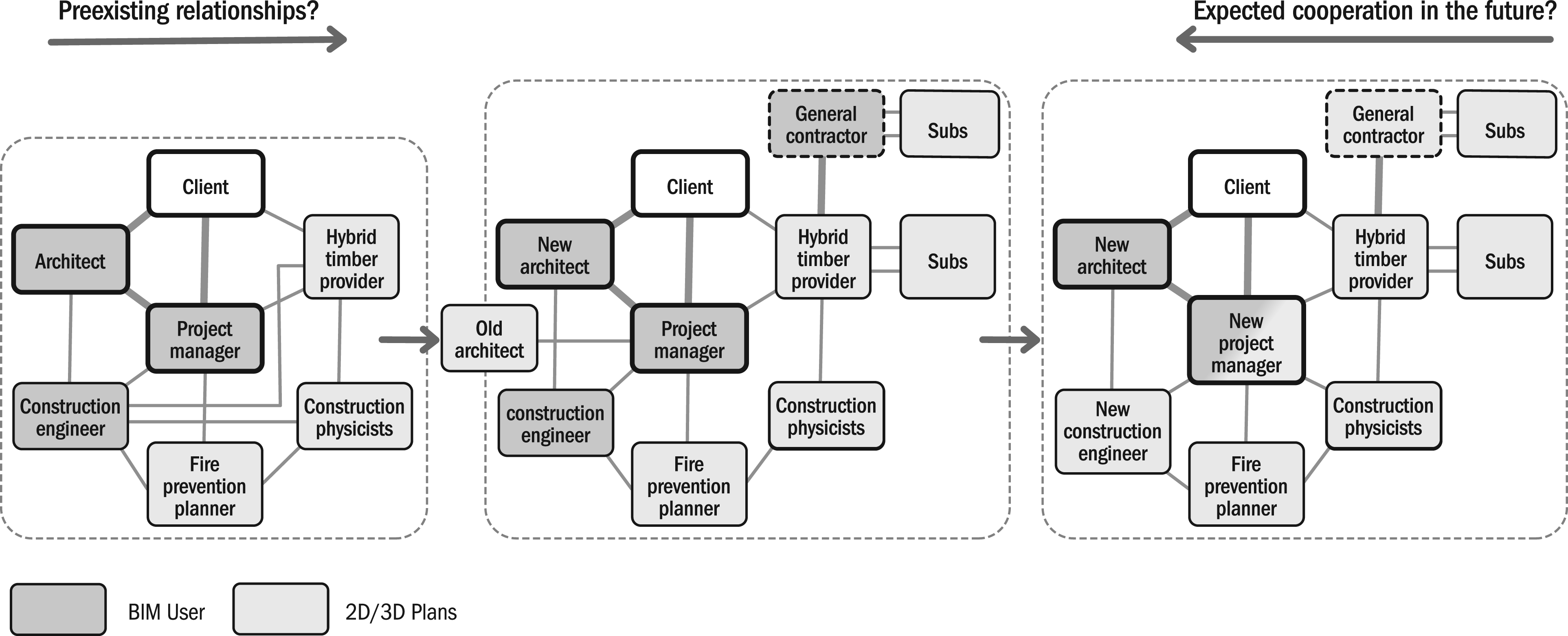
Main actors in the Southern Link project.
In the Swedish case, which we call “Northern Link,” the challenge was to develop structures right in the heart of a bustling city. The project’s owner, a property development firm, oversaw the endeavor from inception to completion. The owner approached an architectural company, with whom they had cultivated strong connections over time, to propose ideas for utilizing the site through a mix of renovated and new buildings. The architects put forward their concepts, which were warmly accepted by the owner. Following this, the owner reached out to a prominent construction company to draft plans for the building work. However, a disagreement arose between the owner and the construction firm regarding project execution. The construction company preferred demolishing all existing structures and commencing anew, whereas the owner sought to retain most of the current walls and facades. This discord resulted in the exclusion of the major construction company from the endeavor and the eventual division of the project into three sections, with three different construction projects each being assigned roughly one-third of the original task (Figure 2).
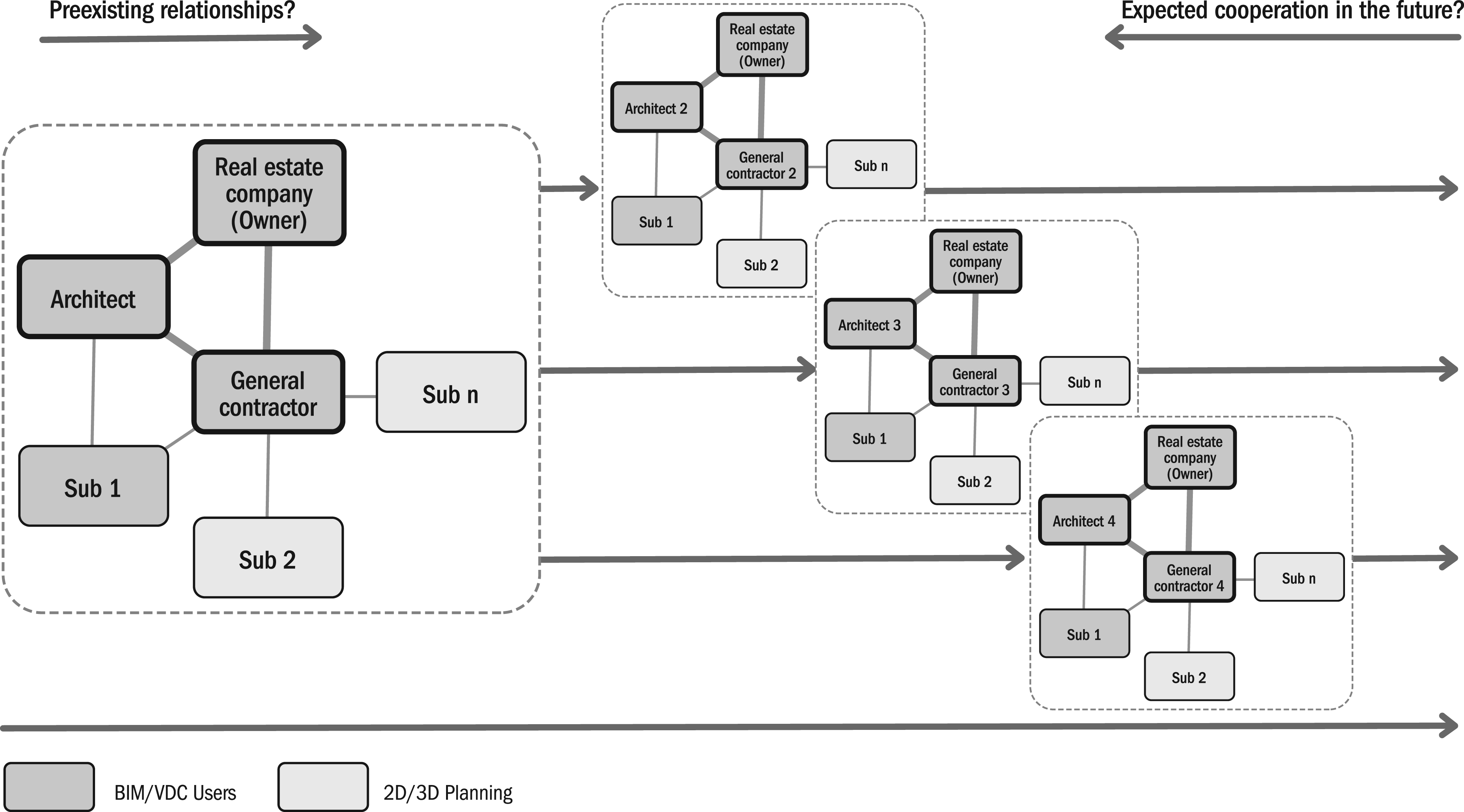
Main actors in the Northern Link project.
Data Collection and Analysis
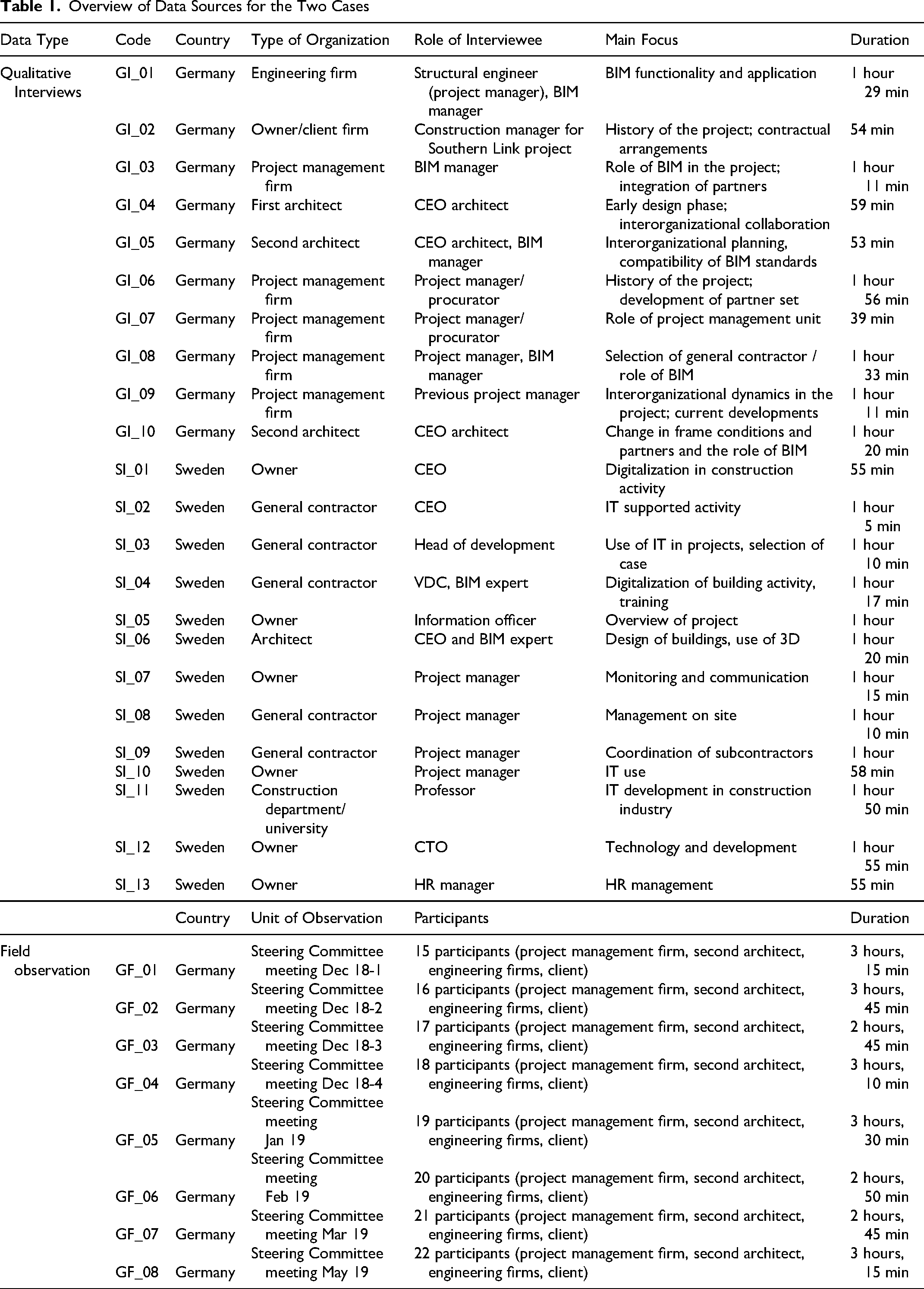
Information for both cases was primarily gathered through interviews with senior and mid-level managers within the organizations, all of whom were engaged in the ongoing interorganizational projects at the time of data collection. Because of privileged access, we were able to enhance these interviews in the German context with ethnographic field observations at the interorganizational level such as during regular project meetings. Insights from site visits were used to complement the interview data in Sweden. Given the overall short duration of the research project, we also started incorporating retrospective information about past projects, as well as the histories of the organizations and their networks. Furthermore, we collected internal company documents, such as project records, presentations, and reports from portfolio meetings, and stored these along with the interview and observational data in two separate case study databases. What is more, we updated our insights on the relational dynamics in mid-2021 to enable coverage of the time span for an additional year. In these final interviews, we enquired as to the development of the two interorganizational projects; the two project networks in which they are embedded; and the roles of digital tools and methods in creating, cultivating, or changing interorganizational relations. We also used the four additional interviews to reflect on the relational dynamics in retrospect. In sum, a total of 23 interviews were conducted, supplemented by data collection from 40 hours of field observation and 20 documents. Table 1 provides more detailed information on the data collection in both the German and Swedish cases.
Overview of Data Sources for the Two Cases
The data was stored in a shared database and then independently examined by each of the coauthors. To begin the analytic process, the researchers acquainted themselves with the data, encompassing a thorough review of transcripts, observation notes, and various documents they had utilized repeatedly. A concise case description was constructed to enhance the comprehension of the projects’ particulars. The case descriptions were developed iteratively in a process in which each of the researchers added or refined case-related details. Following this, three in-person workshops were held. After this preliminary phase, two of the coauthors conducted an open coding round using a practice-based lens to identify emerging aspects from the data. This coding round led to the recognition of six pertinent dimensions that included both levels on which relational dynamics occurred (artifact, actors, and technology) and practices that were being applied to address these dynamics (mitigating, maintaining, and mobilizing). In this phase, the detailed case descriptions were essential to interpret and contextualize the data correctly. During the iterative analysis, an emerging dimension was introduced, paraphrased, and underpinned by the original quote. The interview data, observation notes, and documents underwent multiple iterative coding rounds using MaxQDA in combination with Excel spreadsheets. Because of its iterative nature, which involves alternating between inductively analyzing data and applying a practice lens alongside existing knowledge of interorganizational projects and project networks, this type of data analysis is most accurately described as “abductive” (Dubois & Gadde, 2002). Selected quotes from the data were chosen to illuminate the specific content of the dimensions and themes. Beyond merely describing the case, this phase of analysis aimed to deepen engagement with the data, which aligns with the idea that the analyses achieve closure as saturation is reached, as suggested by Eisenhardt (1989). This approach allowed the researchers to emphasize novel aspects in the case and gain fresh insights into exactly which practices were being enacted in a context of extensive relational dynamics in conjunction with digital tool adoption, and how these practices navigated the projects through the tension of stability and change. In a final step, another workshop was conducted where the insights from the case descriptions and the coding were brought together and aggregated to a more generalized framework. Multiple versions of the emerged framework were discussed and iteratively challenged by the coauthor team (e.g., by referring to quotes and original data that supported or contradicted the emerging framework). A cross-case analysis using such an abductive approach aims to reveal consistent patterns and at the same time helps to identify contingencies.
Findings From Two Interorganizational Projects
In what follows, we will first present our findings from the two construction sites, beginning with the German case and subsequently addressing the Swedish one. The dynamics in the two cases proved to be quite distinct, despite many similarities in their initial setup. Most notably, the German case encountered significant turbulence, whereas the Swedish case progressed more smoothly, particularly in terms of BIM and its use to coordinate the interorganizational projects and the project networks in which they were integrated.
Relational Turbulence as a Response to Digitalization in the German Case
From the outset, the construction of the Southern Link building site by the German interorganizational project stood out in terms of relational dynamics in at least two aspects, both stemming from the strategy set by the original owner and project developer. First, the goal was to construct environmentally friendly buildings with a convincingly sustainable design. In practice, this involved implementing the cradle-to-cradle principle, ensuring that construction materials could be recycled at the end of the building’s life cycle. The two primary materials were timber for the building structure and a relatively smaller amount of concrete. An efficient and eco-friendly block-type thermal power station provided electricity, and e-mobility parking spaces were to be installed in the building's basement. This approach posed challenges for the project management unit responsible for consulting the project developer, as well as for the selection of project participants, since providers of this kind of hybrid construction were still scarce and the selecting organization had limited expertise. Second, the construction project was designated as a pilot project for BIM. The project team was using BIM for the very first time, making it crucial to establish and secure a certain level of BIM capability and initiate the corresponding learning process (Braun & Sydow, 2019): The owner insisted on a progressive approach in terms of digitalization and cooperation. At the beginning, the owner wanted to have a consistent BIM model as the basis for cooperation, and as many project partners as possible should have the capability to use BIM.
When the project commenced, the foundational interorganizational project had been established and the core team gathered (see the left side of Figure 1). The project developer chose an external project management firm and, right from the start, emphasized that all planning activities should be grounded in an integrated BIM model. Together, the project developer and the project management firm enlisted an architect (for the initial design); four design offices (covering building physics, fire safety, HVACR [heating, ventilation, air conditioning, and refrigeration], and MEP [mechanical, electrical, and plumbing engineering]). These actors were complemented by two civil engineering firms (one with the required BIM expertise and the other also serving as the HVACR planner); both civil engineering firms were part of the same holding company. At this phase, the final function of the building remained undecided; originally, the concept was to construct a hotel instead of an office building. Additionally, the construction material of the building—a hybrid wood, steel, and concrete setup—had yet to be selected. Nonetheless, there was a plan to include a centrally located open square within the building to enhance interior lighting and for design and relaxation purposes.
For the subsequent stage of the Southern Link project, the project management firm and the project developer jointly chose more partners to complement the “team” while it was still in the planning phase (see the middle of Figure 1). Specifically, a new architect was hired to deal with the construction project, because the previous one neither had the capacity to supervise the project through the execution phase nor, as it turned out, the required expertise to employ BIM. What might have caused significant disruption of the interorganizational project turned out in fact—due to preexisting relations among the two architects, the owner, and the project management unit—to be a fairly smooth transition. As stated by a project manager of the project management firm: The new and the old architect knew each other from previous projects. This helped us to reach a consensus among all parties that the transition would be beneficial for the project. One could say ‘Here, the network has really paid off.’ The old architect felt more comfortable with the initial planning—centered around creativity and art—while the new architect was a professional for realizing planned projects. Moreover, the new architect turned out to be an important source of stability for the entire project—despite all the changes, transitions, the fluctuation among partners, and insufficient capacities. Here, the new architect has proven to be as solid as a rock in turbulent waters.
In addition to the second architect, an additional HVACR planner with explicit BIM capabilities was commissioned as a subsupplier of the first architect and additional suppliers were involved—an intervention that yielded additional relational stability. Consequently, the interorganizational project became larger already—in the planning phase—comprising 10 organizations even before the general contractor was chosen. Furthermore, a fresh burst of momentum was created when a lease agreement was finalized with a major corporation planning to use the building as its new German headquarters. The new tenant promptly requested some alterations that did not fully align with the original multitenant concept. For instance, the tenant required additional e-mobility parking spaces in the building's basement, which had considerable implications for the electrical infrastructure. In addition, the building needed to be more “smart,” incorporating standby facilities for emergencies (e.g., cooling system and backup power supply). At that point, it also became evident that the supplier of the prefabricated hybrid components lacked an internal partner capable of handling the construction planning. Instead, the supplier independently chose a reputable local partner, but the initial bid from this potential partner exceeded all budget expectations. As a result, the client opted to halt negotiations and impose a temporary moratorium. In this phase, the owner moved away from the original ambition to run the entire project on BIM. Instead, the price became the dominant factor and BIM was regarded only as “nice to have,” and did not play a role in the selection of the general contractor later on.
In the meantime, with the support of the project management firm and another external partner, the client emphasized the tendering processes to find a general contractor. During this time, the project management firm prequalified alternative suppliers for the prefabricated hybrid components, opening the space for relational changes within the interorganizational project; however, only few offers had come in. In the meantime, the client was adamant about commencing construction. Moreover, the general contractors and the HVACR subcontractor had demanded hefty premium fees in their bids if they were to use BIM. At that juncture, the client’s relatively weak leadership in the network allowed a decision to move forward without mandating BIM for all project partners. Instead, they permitted the use of older technologies, including CAD and paper-based planning: At this point, there was a cut, where BIM involving the three-dimensional space was downgraded to the old two-dimensional planning—irrespective of whether all the previous work had been accurately done using BIM. One reason may have been that the general contractor was concerned that he could be made liable for the realization of all details within the BIM model, and he did not want to take these legal risks.
One significant crisis in the project was caused by selecting a nonqualified planner for building services, which led to further substantial delays. This firm not only lacked any form of established ties with the other major project partners but also had no experience with BIM technology. After a few months, the planning task had to be reallocated and was taken over by the general contractor, stabilizing the interaction dynamics. The fact that this project partner was quite hesitant to do so caused further delays in the planning procedure, in turn causing work to lag even more behind the actual construction of the building.
Once the general contractor along with the many subcontractors had been integrated into the project, the number of project partners soared to almost 60 (see the right side of Figure 1). The procurator of the project management firm explained: With the general contractor entering the project, the number of subs exploded—even for us it is hard to keep track of all the organizations. We recently tried to count them—around 60.
Shortly after the general contractor had been selected, the owner decided to replace the project management firm with another one because, given the fact that the general contractor initially wanted to avoid all planning duties and reduce their own risk, there was dissent between the organizations regarding the legal liability. Since the top management of the general contractor had decided not to use BIM, further usage of this technology continued to be confined to just two project members: the project management unit, and the (new) architect.
Relational Calmness as a Response to Digitalization in the Swedish Case
The Northern Link interorganizational project involves the comprehensive reconstruction of several buildings in the heart of a major Swedish city. In addition to having multiple floors above street level, the structures include seven underground levels. The construction process was becoming increasingly complex due to the decision to preserve the old frames and walls, as well as most parts of the facades, largely unchanged. The heavy traffic around the buildings posed significant logistical challenges. The entire interorganizational project encompassed the renovation of three large buildings, while simultaneously adding a new, much smaller structure. Since the project covered 80,000 square meters of space across various levels, design options were difficult to identify, and available space at work sites was very limited due to the existing frames and walls. Just-in-time delivery was essential to prevent bottlenecks in the construction process. These constraints made coordination vital for the construction companies collaborating on-site. In the early phases, much like the Southern Link project but for a different reason, the entire endeavor had to be reassessed. This reconsideration stemmed from the fact that the plans also featured a hotel; however, it was later discovered that a major hotel was to be constructed nearby. Consequently, the hotel project was scrapped, necessitating a reevaluation of the plans and impacting both the construction firms and the owner regarding the site’s intended use, leading to a renegotiation of the entire venture. After evaluating the market conditions, the decision was made to construct office spaces instead. A major real estate firm still retained ownership of the entire Northern Link project and oversaw it from the outset. This company remained the primary stakeholder in most aspects throughout. As both owner and developer, the company possessed substantial project management expertise, necessitating the involvement of only a handful of external consultants in the interorganizational project. Furthermore, the owner could serve as the leading organization for the interorganizational project, thus effectively orchestrating interorganizational coordination to implement the chosen form of network governance (see also Roehrich et al., 2023), including the application of BIM technology and the management of the project network out of which the interorganizational project emerged. In other words, the owner can justifiably be considered a true system integrator running an interorganizational project PMO (project management office) (Davies & Mackenzie, 2016; Braun, 2018; Braun & Sydow, 2024).
However, despite these stabilizing factors, significant changes were involved at the start of the interorganizational project, well before the concept of utilizing the site for a hotel was ever revisited. As mentioned, the real estate company divided the total venture into three distinct parts, distributed among three construction companies, each of which was allocated roughly one-third of the project (see again Figure 2). The three companies that subsequently took over as general contractors were, in a way, rivals, which led to friction during their interactions. At the same time, the fact that there were three general contractors gave the entire project some leeway in terms of redundant, latent, or loosely coupled relationships, for example (Mariotti & Delbridge, 2012). The general contractors still had to collaborate closely due to the very limited space available for construction and logistics at the site. The parties met frequently on-site to address issues such as logistical challenges.
Sometime later, there were signs that the demand for permanent big offices was waning, while at the same time it was becoming more common to ask for a combination of smaller offices and temporary access to more space for flexible use. The project met this requirement by building and furnishing well-equipped areas of open space together with traditional offices. At the same time and because of this, it became increasingly common to negotiate so-called hybrid contracts. These contracts comprise different combinations of long, short, and flexible agreements. These tendencies have been further underlined in the wake of the COVID-19 pandemic over the past few years. Both the feature of the open space intended for use by all the customers of the real estate company and the introduction of hybrid contracts are important in at least one respect: they symbolize how the design of working space is able to adapt to and support the tendencies toward new ways of working now that project organization, temporary employment regimes, and remote working are becoming more common (see Ekstedt, 2019).
Yet another change of direction occurred in the middle of the project. Sustainability became a major business idea of the owner/developer company. This idea was further promoted by the new CEO, who joined the company in 2020. It was a challenge to equip and design the common space in an attractive and flexible way and, at the same time, remain aware of the call for sustainability. In more concrete terms, the materials used inside the buildings, including the inner walls and furniture, now had to be reusable. All the real estate company buildings were meant to be climate neutral by 2030. In consequence, it became a big challenge and an additional source of tension to convince all the building companies and suppliers involved to use correspondingly reusable materials and methods. One problem with this was that the suppliers worked on several levels—from the contractors down to small companies and self-employed workers from different countries. Whenever the owner adjusted the plans, despite the extensive use of IT, it was difficult to check in detail how the supplier companies were actually working and what kinds of materials and energy they were using.
The owner also took the lead in digitalization, mandating BIM as a prerequisite for involvement in the interorganizational project. The three general contractors were obligated to comply with the requirements established by the lead organization, which subsequently impacted their subcontractors. Moreover, the owner/developer provided its project partners with access to an on-site BIM lab. The CEO emphasized that: The lab makes it possible to instantly coordinate design and work from different specialty areas such as those involving electricity, ventilation, and pipes.
The owner organized regular sessions in the lab, occasionally even once per week. This lab provided a space for team interaction that was needed “in order to make data and expertise meaningful to others” (Dossick et al., 2019). When coordination in space (and time) was less than perfect, which often happens in large construction projects like this, specialists assigned each other tasks to complete before the next meeting to better meet these demands. Indeed, the owner, general contractors, and many subcontractors and architects were coordinated through BIM, supplemented by Virtual Design in Construction (VDC). The assistance from these systems, in various forms, was a crucial aspect of the daily operations at the construction site; even subcontractors utilized the systems to a considerable degree.
In addition to the use of BIM and VDC there was another digital system in place, specifically for logistics. This was an urgent requirement in this case, because the location and scarcity of space required that all components be available just-in-time on the construction site.
In addition, an IT system employed by all the involved parties focused on security. Some interviewees mentioned efforts to achieve an optimal solution where different systems would be compatible, enabling total and immediate coordination; however, this had not yet been realized. Nonetheless, IT holds the potential, at least from a long-term viewpoint, to transform and streamline the conventional setup of actors in a building interorganizational project. In fact, such changes have already taken place within the owner company of the Northern Link project. An in-house project manager shared that: I am in charge of a medium-sized building project in which we don’t have any support from a general contractor. IT makes it possible to handle all the relations with the suppliers and customers by ourselves.
The technology in use facilitated work for a wide range of project partners, which allowed the in-house project manager to choose and hire suitable subcontractors directly. The inbuilt power of the IT technology seemed to have the potential to reconfigure/simplify the historically ingrained setup of actors and thereby the management of the traditional construction process.
During the building process, hundreds and thousands of sensors were installed without anyone having a clear idea of what they were to be used for. Today, the IT sensors are pivotal for handling all kinds of activities in the buildings. The purpose became clear when realization dawned on how useful they could be when managing flexible spaces and hybrid contracts on the one hand and climate-smart houses on the other. The chief technology officer (CTO) of the owner company stated: Today, when using the facilities, the “Internet of Things” (IoT) is more important than BIM, even if the two digitalization modes are intertwined. The digital twin shown in the 3D model of BIM, together with all kinds of information from the sensors shown in the model, make it possible to illustrate, measure and control the presence in rooms and the use of light, electricity, fans, heating/cooling, humidity, water, door locks, and the charging of electric cars, etc. The use of rooms is also displayed on a common screen.
The extensive use of digital tools such as BIM and IoT throughout the Northern Link project—from design and construction to managing the houses—had a substantial impact on the management of the project. The use of the BIM lab in the building phase made the coordination among different actors smoother and more effective compared with older coordination methods. Thanks to digital tools, it was also possible to handle and coordinate just-in-time deliveries to the limited space of the construction site. The CTO of the owner company envisaged the future: AI systems will also take over and support human activity when the houses are erected, both by coordinating the complex hybrid rental contracts, as well as by running many of the devices of the smart houses in an efficient way.
Cross-Case Comparison: Navigating Practices to Mitigate, Maintain, and Mobilize Tensions Between Stability and Change
In both cases, changes in the project task and the artifact were major drivers of relational dynamics. Digital tools, as one of the means used to help accomplish the task, contributed to a different extent to the relational dynamics in the two interorganizational projects. While in the Southern Link project the employment of BIM for coordinating the interorganizational project was confined to only two or three actors and varied significantly during the project, the owner and developer of the Northern Link project ensured that it was used to a great extent for the entire duration of the interorganizational project. There, instead of triggering change, the use of digital tools contributed significantly to stability in the relations within and across the project.
Table 2 compares both interorganizational projects with regard to how relational dynamics, and more specifically the tensions between stability and change, were addressed by practices that contributed either to their mitigation, their maintenance, or even to their mobilization. In the interorganizational project, our focal level of analysis, we investigate these practices and their enactment by the participating actors. The practices are analyzed regarding the artifacts (i.e., the constructed buildings), the organizational actors involved (i.e., their goals, goal dynamics, interaction style, and composition), and the adoption of digital tools (primarily focusing on the adoption and use of BIM). Thereby, the practices exhibit features that ensure that the dynamics within both projects are kept manageable, though to a different extent (see the bottom of Table 2).
Case Comparison Regarding Practices Addressing the Tension Between Stability and Change and How Relational Dynamics are Kept Manageable
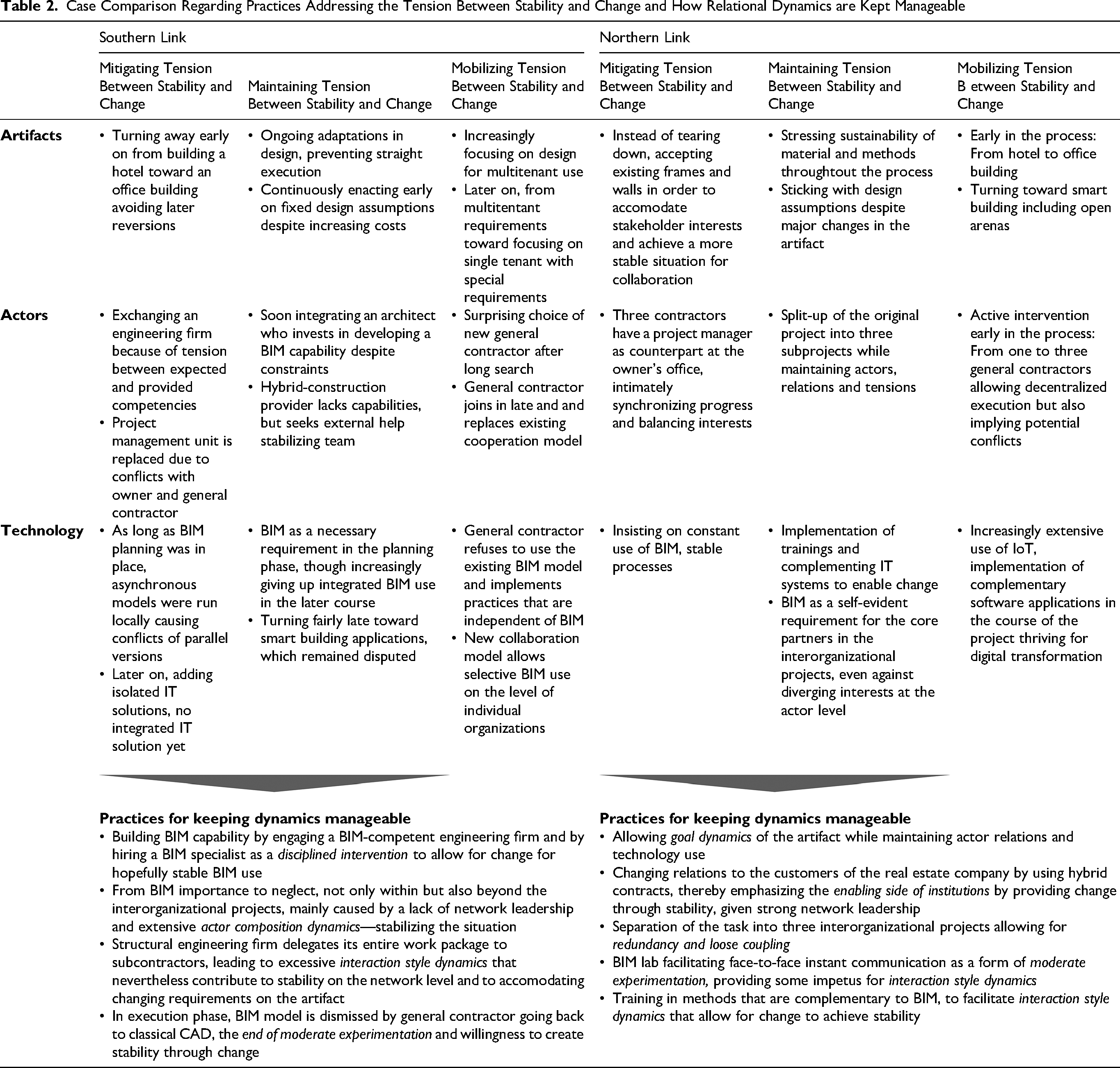
In the following section, we will focus more specifically on the interplay of BIM technology and the relational dynamics in the two focal interorganizational projects. As learned from the cases, the role of BIM seems to be rather complex and capable of both stabilizing or dynamizing the very relational context to which it is applied (see Linderoth, 2009; Papadonikolaki et al., 2019). Against this background, a closer look at the interplay of this digital tool with the context to which it is applied advances our understanding of the duality of stability and change, while focusing on practices to keep the dynamics manageable, particularly the tensions related to the artifact, actors, and IT.
Tensions Related to the Artifact
Starting with the Southern Link case, an early decision in the project under the leadership of the client—that is, to construct an office building instead of a hotel—helped to overcome potentially emerging uncertainties related to the goal and task of the project and prevent later reversions of the building. Other tensions regarding the stability and change of the artifact continued to prevail throughout the course of the project, including ongoing, iterative adaptations in the design, such as the atrium at the core of the new building, which prevented a straightforward execution of the construction process. This tension, surprisingly, was maintained for months to ultimately identify the most appropriate architecture for the building. To ensure compliance with sustainability principles, fixed design assumptions were created at the beginning and enacted, yet always challenged vis-à-vis the increasing costs associated with the sustainability requirements. Some of the tensions between stability and change were even further mobilized. While early in the project there was an increasing focus on designing the building for multitenant operations, despite the complications and costs associated with this decision, later on multitenant requirements were excluded. The focus shifted to single tenant use, allowing more cost efficiency and adaptation for the preferred tenant. This tenant, however, had rented the building in the meantime and demanded special adjustments such as the removal of redundant electricity systems initially installed to accommodate for future changes, which also immediately raised costs.
In the Northern Link case, the artifact also encountered changes threatening the stability needed to execute the project. Instead of tearing down an existing building, the client decided to take over the existing frames and walls to accommodate stakeholder interests and achieve a more stable situation. Specifically, the achieved clarity relating to the artifact enabled and constrained subsequent collaboration among the contributing organizations within the interorganizational project. Some tensions prevailed, however, and persisted. For example, even though there was a permanent struggle to ensure the sustainability of material and methods mainly due to the effect on costs, this tension was not abandoned but kept as a challenge that guided the behavior of actors in the planning and execution of the project. In addition, the practice of sticking with design assumptions, such as sustainability principles, despite major changes in the artifact turned out to be a source of creativity when developing workable solutions during project execution. In some respects, the tension between stability and change was even mobilized. Early in the process, this entailed the shift from a hotel toward an office building—a tremendous change for the project, which ensured stability for the subsequent planning and execution process. Despite the ambition to hold on to this revised plan, another change was implemented. This time, the client challenged the project team to consider smart building solutions including IoT applications and open working areas.
Tensions Related to the Actors
In the Southern Link case, due to tension between potential and existing capabilities, one of the engineering firms was replaced at an early stage in the project to keep operations going. Later, the project management firm was also dismissed because of ongoing conflicts with the owner. Later still, the general contractor was regarded as an obstacle to a smooth execution of the project and replaced. Other tensions were maintained, not mitigated. For example, a second architect, prepared to invest in developing a BIM capability despite time pressure on the project execution, was integrated. A lack of competencies of specific actors also played a role later during execution of the project. The provider of the wood–steel elements for the hybrid construction lacked planning capabilities and therefore hired an engineering office for temporary assistance to keep at least the core of the actor constellation stable. Finally, the late and surprising choice of the general contractor after a long search also recreated uncertainties among the core partners. As it turned out, this was for good reason: the general contractor was able to replace the existing collaboration model (e.g., by bringing in its own subcontractor) with preexisting relations. This challenged the existing collaboration, but also created a new stable “core team” (Manning & Sydow, 2011) at the center of the interorganizational project.
In the Northern Link case, tensions had been smoothed over by implementing a project manager at the owner’s office acting as a counterpart to the project managers of the three contractors, closely synchronizing project progress and balancing interests. Despite that, not all tensions could be resolved, given the original project had been split into three subprojects, while keeping the actors involved. Thus, this step ensured that the set of actors, their relationships, and the inherent tensions remained unchanged. Overall, the early intervention in this interorganizational project (i.e., moving from one to three general contractors) allowed for a decentralized and modular execution of the project but also implied potential conflict among the contractors. Nevertheless, this move turned out to boost commitment among the organizational partners and make them more accountable for their tasks, thus contributing to stability.
Tensions Related to IT
As long as BIM planning was on the agenda of the Southern Link case, asynchronous BIM models were run on demand without synchronizing them real-time. Though not quite efficient, this was a workable solution for the time being. Over the course of the project, isolated IT solutions were added, but an integrated IT solution was still not implemented to avoid conflicting IT infrastructures hosted by the various project partners. Importantly, the overall BIM policy of the owner changed over the course of the project, which maintained core tensions related to IT. While BIM was originally a necessary requirement in the planning phase, integrated BIM use was given up later. Only a few of the project partners held on to some selected BIM components for the duration of the project. Tensions were also maintained by turning fairly late in the process toward smart building applications (e.g., app control), which remained disputed through completion. At times, the tension between stability and change was mobilized even further by the practices applied. The general contractor actively refused to use the existing BIM model and implemented practices that were independent of BIM, for example, causing major disruptions in the short term, yet at the same time stabilizing the project toward completion.
The approach to IT in the Northern Link case differed substantially from that of the Southern Link. Right from the start, the client insisted on the constant use of BIM by most of the participants in the interorganizational project and thus ensured fairly stable processes. Tensions between stability and change were also addressed by implementing training sessions and complementing IT systems to enable adaptation throughout the construction process. Thereby, the patience and assertiveness of the client helped to position BIM as a self-evident requirement for the core partners in the interorganizational project, even against diverging interests at the actor level. The negative impact of this tension was limited by the fact that many of the interorganizational projects’ major project partners already had existing BIM capabilities, including, importantly, the lead organization. Since the client and project owner aimed to be a technology leader, some tensions were even mobilized to generate novel solutions. All in all, an increasingly extensive use of IoT and the implementation of complementary software applications during the project were a valuable contribution to the digital transformation of several parts of the project.
Keeping the Dynamics Manageable
Obviously, and not unexpectedly, a change in the task to be accomplished was the major, but by no means the only, driver of relational dynamics within and across both interorganizational projects. In both cases, the idea of building a hotel had to be cancelled. In the German case, major changes also occurred regarding the actors involved—by hiring an additional architect and several planners at various stages of the project, for instance—as well as regarding technology, whereby BIM was strongly advocated at first, but then later on divergence allowed. Thus, BIM caused unprecedented and undesirable dynamics, which none of the interorganizational project participants had anticipated or could control effectively. In the Swedish case, dynamics resulted predominantly from splitting up the initial project into three subprojects. BIM, along with other IT applications, contributed there to the effective management of the intricate interplay between stability and change, diligently orchestrated by the project owner and developer, who acted over the whole process as the uncontested lead organization of the interorganizational projects.
A comparison of the two cases reveals that the anticipated savings and increases in efficiency that had originally been expected for the Southern Link by using BIM collapsed in light of the challenge to keep the relational dynamics manageable, whereas in the case of the Northern Link, the project was kept on track and BIM played a stabilizing role. In the Southern Link case, BIM did not work properly as it was not rolled out with strict strategic top-down pressure on the part of the owner and the project management unit. In combination with a lack of bottom-up stabilization (Kim et al., 2014), the process finally resulted in extensive actor composition dynamics (Majchrzak et al., 2015). This was not the case for Northern Link due to a stronger interorganizational project leadership from the top and a relatively stable configuration of actors. Considering a lack of BIM-related competences among the organizational partners in the Southern Link, the coordination fell back on classical modes of interorganizational coordination and collaboration, whereby already existing trust and the application of routines as relational governance mechanisms were mobilized (Cao & Lumineau, 2015), though not without frictions and fragilities (Kostis et al., 2022; Vedel & Geraldi, 2023). Important spaces in which to develop trust and routines also included regular steering committee and working group meetings, which, incidentally, changed significantly when the new project management unit was tasked with coordinating the interorganizational project.
In the wake of limited BIM use, this coordination continued to rely heavily on such classic relational forms, which ultimately allowed for completion of the building measures, though with a significant delay and cost overrun. Despite accessing the BIM expertise of the international partner and investing substantially in building a BIM capability within the project management firm, the BIM model was abandoned by and large in the execution phase, and the general contractor reverted to classical CAD planning. In addition, there were no explicit interventions by the leadership of the interorganizational project to proactively (re-)create stability. Instead of using BIM to stabilize relational dynamics, this technology contributed to further maintaining these very dynamics in this particular case. This was quite different in the case of the Northern Link, where BIM maintained dynamics at a manageable level under strong interorganizational project leadership. In consequence, the management of the Southern Link project relied even more than the other interorganizational project on the network of established—though not always activated—relationships (DeFillippi & Sydow, 2016). In other words, in the end, very traditional “relational practices” (Ness, 2009) ensured coordination within and across organizational boundaries in this interorganizational project, although in light of the dynamics described, important milestones could neither be reached nor could the deadline for finishing the project be met.
Instead of enhancing the coordinative capacity of the interorganizational project—and potentially also the project network in which it was embedded—with the help of digital tools, the Southern Link moved unintentionally toward mobilizing tensions, contributing to rather than mitigating relational dynamics. Relational embeddedness and relational practices had to compensate for the missed opportunity to improve coordination with this new kind of technological support. These practices ensured a certain, yet not quite adequate level of manageability—in complete contrast to the Northern Link. For example, the leadership of the Southern Link interorganizational project reacted to the additional complexity of the artifact by outsourcing work packages to subcontractors, which, however, led to excessive dynamics in the interaction style (Majchrzak et al., 2015). Even worse, in the execution phase the moderate experimentation with BIM was even stopped, not only forgoing a more integrative approach to digitalization, but also causing new relational dynamics that were difficult to recapture to secure a stability that would allow for change or at least a level of change that would secure the stability necessary for in-time delivery.
Discussion and Conclusion
Our empirical insights into the relational dynamics of the two interorganizational projects using digital tools allow us—along with our practice-based perspective that conceives stability and change as a duality and illuminates the tension between these two—to develop a manageability framework and derive at least three propositions. These could and should be tested in studies with larger samples. We will conclude by outlining the theoretical as well as the practical implications.
Toward a Manageability Framework
Based on insights gained from the comparison of our empirical cases, we thus conceive the—expected—mitigation of the tension between stability and change with the help of relational practices as making the tension less salient. This may in fact relate to the timing and duration of the tension (e.g., resolving tensions earlier rather than later; keeping the tension within temporal limits), the frequency of the tension (e.g., limiting the amount of contradictions; reducing repetitions and cyclical issues), the quality of the tension (e.g., avoiding critical moments such as triggering events, tipping points, or deadline overruns), and the effect of the tension (e.g., breaking a negative trajectory; avoiding negative snowball or self-reinforcing effects). The—rather unexpected—maintenance keeps the level of salience of the tension mainly constant. This also relates to its timing and duration (e.g., postponing the mitigation of a tension to the future; stretching the tension over time), its frequency (e.g., continuously bringing contradictions to the surface; repeating and revisiting issues without solving them completely), its quality (e.g., enabling and constraining triggering events and tipping points; maintaining the possibility of hitting deadlines and quality measures), and its effect (e.g., moving along one trajectory; keeping the possibility of self-reinforcing effects salient). The— equally unexpected—mobilization even increases the level of salience. Mobilizing the tension between stability and change may also concern the timing and duration of the tension (e.g., escalating the tension in the present; intentionally holding up contradictions over time), the frequency of the tension (e.g., initiating new tension arenas; provoking new and additional encounters), the quality of the tension (e.g., actively using tensions to enable and constrain major changes and transitions in the project), and the effect of the tension (e.g. further leveraging self-reinforcing effects; breaking existing paths). Mitigating, maintaining, and mobilizing practices have to play subtly together—mutually adjusted by collaborating organizations (Muruganandan et al., 2022)—to manage tensions between stability and change effectively and account for the fact that, more often than not, stability needs change and change needs stability. As captured in Figure 3, we thus propose:
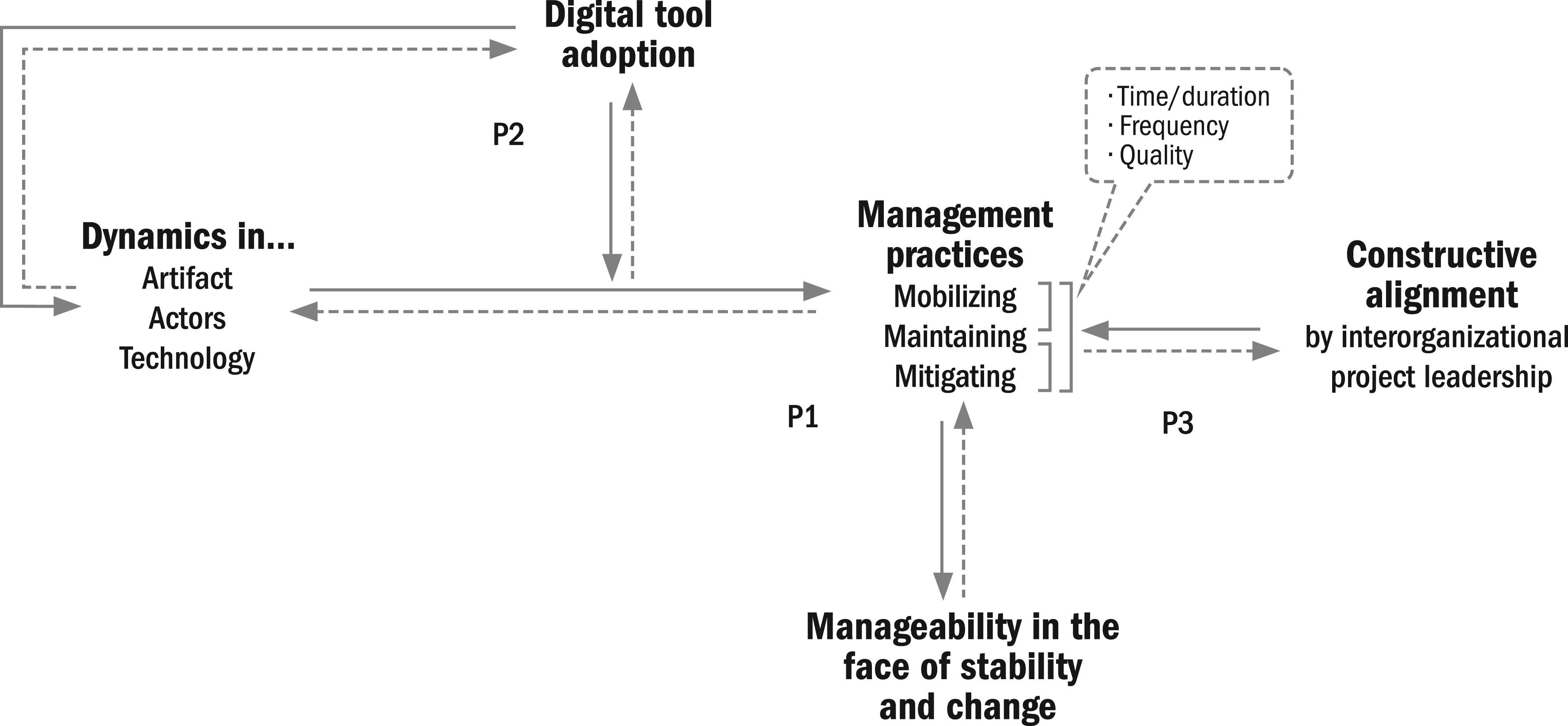
Toward a manageability framework: mitigating, maintaining, and mobilizing the tension between stability and change.
Respective project- and network-related management practices help to keep the interorganizational project manageable in light of such tensions. In case other mechanisms (including BIM) fail, the management of an interorganizational project can at least rely on more conventional relational practices to mitigate, maintain, and/or mobilize the respective tension to allow for the necessary “dynamic stability” (Lalaounis & Nayak, 2021) or “disciplined flexibility” (Muruganandan et al., 2022). In consequence, it seems worthwhile, if not necessary, as propagated just recently by Martinsuo and Ahola (2022), to be aware—conceptually and empirically—of the increased embeddedness of (multi-) project management into interorganizational contexts.
The two cases have shown that, while digital tools such as BIM may trigger relational dynamics (as has already been shown by Linderoth, 2009, or Papadonikolaki et al., 2019, for instance), the tension between stability and change is also managed with the help of technology-enabling practices that either mobilize, maintain, or mitigate relational dynamics. Thus, digital tools are referred to by practices that can diverge even into opposing directions. This leads us to a second proposition clarifying the role of IT in general and BIM in particular:
However, these practices are bound by context, which in effect enables, but also constrains the manageability of an interorganizational project. One important contextual factor is, as the comparison of the two specific cases shows, the strength of interorganizational project leadership. The cases have shown that weak interorganizational project leadership can result in a lack of tool implementation (e.g., insufficient persistence in the rollout of BIM by all the project actors), which increases the stability–change tension. This implies, vice versa, that a more centralized leadership retains the manageability of the interorganizational project, given the indicated tensions (Müller-Seitz, 2012). Against this background, we propose:
Figure 3 illustrates these effects in an overarching manageability framework that conceives of mitigating, but also maintaining and mobilizing the tension between stability and change as practices of structuration (Giddens, 1984).
Theoretical and Practical Implications
Stability and change, as already indicated at the outset of this article, should not be conceived as a dualism but rather as a duality (Farjoun, 2010), an insight already adopted by some project studies (Bygballe et al., 2021; Sydow & Windeler, 2020), but rarely brought fully to bear in empirical research (see Danner-Schröder & Geiger, 2016, for an exception). Structuration theory sensitizes us to the recursive interplay not only between structure and agency, but also between technology and organization (Orlikowski, 1992) and, importantly, provides the necessary duality view on stability and change (Farjoun, 2010). What is more, despite its focus on recurrent, intentional actions, this theory allows for unintended consequences, which are quite likely to arise in light of at least partly unknown conditions of actions and eventually to trigger a cumulative process that may, at some point, turn relational dynamics into an either virtuous or vicious cycle (Masuch, 1985; Tsoukas & Cunha, 2017). This cycle reflects a certain decoupling of process dynamics from actions, hence decentering agency (even from a practice perspective; Kremser & Sydow, 2022) to an extent that allows for processes that unfold to some extent behind the backs of the actors. In any case, the respective tensions involved are a sensible target to address to keep projects manageable as temporary organizations. In this setting, digital tools, such as BIM, serve as a fitting artifact to make collaboration smoother and help solve or balance tensions. However, considering digital tools in a relational context may also entail substantial risks, leading to even more tensions and unintended consequences. Against this background, our article emphasizes the roles of a sensitive orchestration, adjustment, and readjustment of practices following up on the dynamics of collaboration.
In line with Majchrzak et al. (2015), our results have shown that goal dynamics, interaction style dynamics, and actor composition dynamics account for the relational dynamics in projects and are at the same time essential for their manageability. Management, in particular project managers, should be aware of this. The results have also shown that stability rarely comes with passiveness, but is the outcome of active management, in other words, it is more often than not achieved through change. In this regard, the results confirm two of the conditions identified by Farjoun (2010), namely redundancy and loose coupling, as well as moderate experimentation. On the other hand, the cases also show that change can be achieved through stability by enacting established institutions and by limited or disciplined intervention (Farjoun, 2010). This becomes particularly clear when new members are integrated into an interorganizational project or a project network and, consequently, required to adopt not only the technology-in-use, but also the changed relational practices that come along with it.
Footnotes
Acknowledgments
We are grateful for the generous grant from Project Management Institute (PMI), which allowed the international team to meet regularly and conduct our case study research simultaneously in Sweden and Germany. We also thank Joana Geraldi, senior editor, and three reviewers of this journal for their critical but constructive guidance during the development of this article.
Declaration of Conflicting Interests
The author(s) declared no potential conflicts of interest with respect to the research, authorship, and/or publication of this article.
Funding
The author(s) received no financial support for the research, authorship, and/or publication of this article.
