




Abstract
Objective:
Female infertility may be a commonly encountered problem that presently accounts for a great percentage of women seeking gynecologic services. A systematic review was preformed to evaluate the most common cause of infertility, using sonography.
Materials and Methods:
A search was executed with Google Scholar, PubMed, NCBI, and Medscape databases, from 2001 to 2020. Two investigators independently reviewed and assessed those studies for eligibility. The data were tabulated in a Microsoft Excel sheet. The Statistical Package for the Social Sciences (SPSS), version 24 software was used to evaluate the data.
Results:
Out of 70 studies, the contributing factors, detected with sonography, for infertility were as follows: polycystic ovarian syndrome (PCOS), 44.9%; fibroids, 43.6%; endometriosis, 33.3%; polyps, 29.5%; adhesions, 29.5%; pelvic inflammatory disease, 23.1%; ovarian cysts, 23.1%; congenital anomalies, 20.5%; and adenomyosis, 11.5%.
Conclusion:
The most common cause of infertility, detected with sonography, was PCOS, and the least contributor to infertility was adenomyosis.
Infertility is considered a psychological and social condition, which affects an enormous range of individuals, all around the world. 1 Female infertility may be a commonly encountered problem that accounts for a large percentage of women searching for gynecologic services. 2 An evaluation of publications describes that there were higher rates of psychiatric disorders and endometrial cancer in women with infertility, compared with the overall population. 3 Infertility varies across different regions of the world. The World Health Organization (WHO) determined that 60–80 million couples around the world are currently dealing with infertility issues. 4 Infertility impacts around 10%–15% of reproductive age couples. 5 Among women, the prevalence of infertility is believed to increase with age. In one research study, the rate of infertility was reported to be 12% and 21%, respectively, for women aged 32 and 38 years. 6 After the age of 35 years, the potential to maintain fertility for women decreases. 6
Infertility can often be attributed to the female, the male, and both and has been categorized as either primary or secondary. 7 As stated, there are two types of infertility, primary and secondary infertility. According to the WHO, primary infertility is defined as women 15 to 49 years old, with an inability to conceive within 2 years of exposure to pregnancy (e.g., sexually active, noncontraception, and nonlactating). 4 Secondary infertility is the inability to conceive following a previous pregnancy. 4 Globally, the most common form of female infertility is secondary infertility. Secondary infertility is noted in areas where there are high rates of unsafe abortion, poor maternity care, and postabortive and/or postpartum infection. 8
There are many reasons for both primary and secondary female infertility. This incorporates various disorders involving the fallopian tubes, uterus, ovaries, cervix, and peritoneum. 2 In one study, the causes of infertility in women were most commonly attributed to menstrual disorders (62.6%), obesity, thyroid diseases, diabetes (58.7%), impaired ovulation (50.3%), uterine causes (16.7%), and fallopian tube pathology (15.4%), and the least common were cervical issues (7.9%). 9
Sonography is considered the primary imaging modality for the examination of the female pelvis and to identify many of the referenced issues for infertility. Sonography is considered an accurate, noninvasive, and cost-effective imaging modality that provides beneficial diagnostic information for the detection and characterization of possible factors for female infertility.10,11 A thorough pelvic sonogram, using transvaginal sonography (TVS), can identify the suspected causes of female infertility, such as uterine abnormalities, ovarian disorders, and other pathologic conditions.2,10,11 There are a myriad of causes for female infertility that have been mentioned in the literature. However, it is difficult to decide the most common and other rare causes of infertility. In this current review of the literature, the gap in research and most common causes of female infertility were addressed. Based on the data collected, from various articles, infertility can be caused by various diseases and physiological conditions. It is important for gynecologists and other physicians to be well acquainted with the most common causes of female infertility, as this leads to proper patient management.
Materials and Methods
A search was conducted using different search engines, such as Google Scholar, PubMed, NCBI, and Medscape databases, from 2001 to 2020. After removal of duplicate articles, all references were manually screened. The titles and abstracts of relevant and full-text articles were screened. After the database search was concluded, 439 studies were retained. The review process did require that 185 studies be excluded due to duplication, 87 studies were removed due to insufficient data, and 97 articles were excluded based on the title and abstract. A flow chart summarizes how the inclusion and exclusion of articles are recommended, as part of the review process. 12 Ultimately, a total of 70 studies were retained for this literature review (see Figure 1). The tabulated data from these studies are included in Online Supplemental Material.
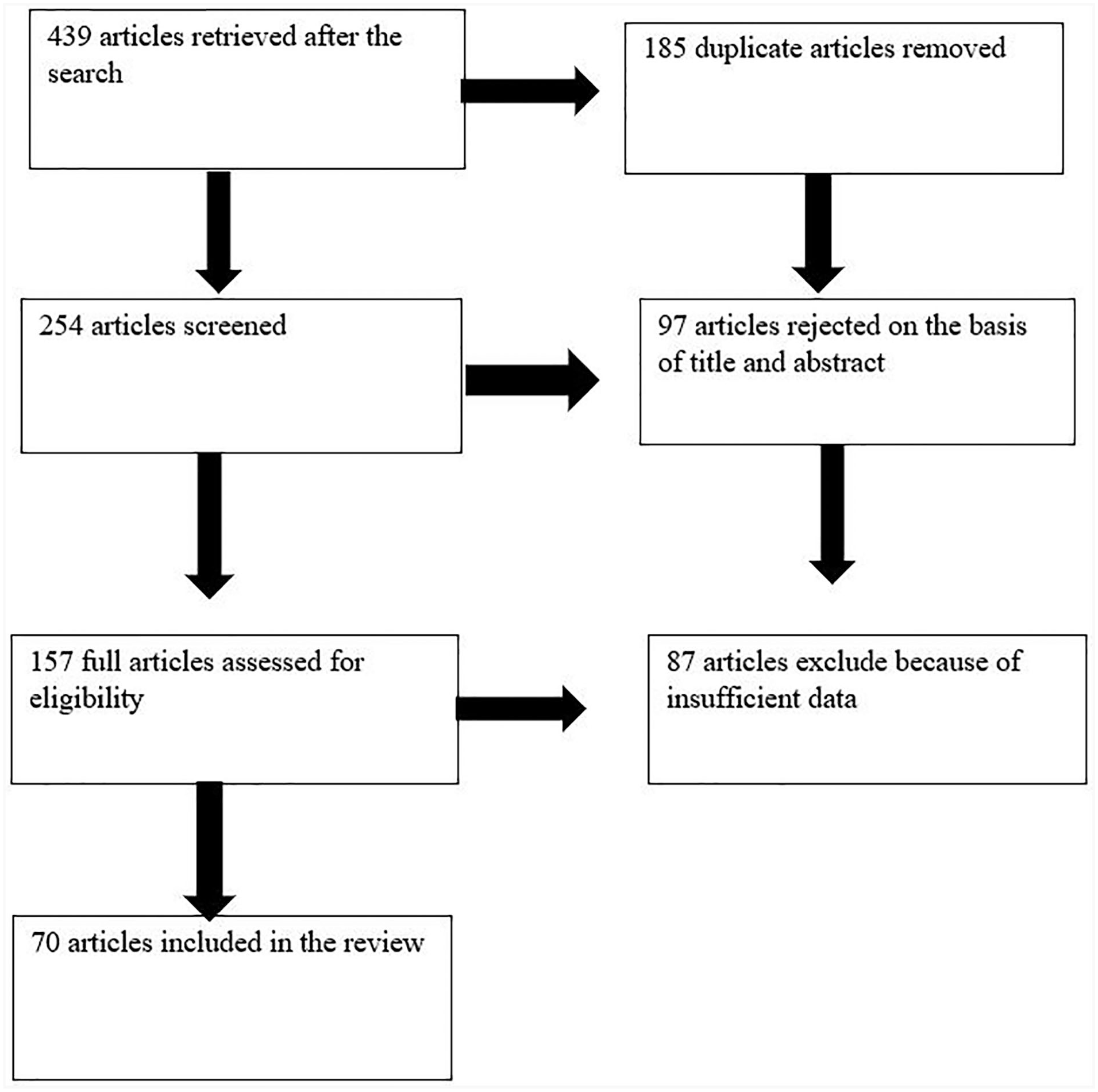
A flow chart of the literature search and article selection process.
Inclusion criteria were descriptive studies and analytic studies prospective, observational retrospective cohort, and cross-sectional and randomized controlled trials. For this literature review, it was important to include studies related to various causes of female infertility. Review articles, case reports, and case series were excluded. Based on the above criteria, two investigators independently reviewed and assessed the studies for eligibility. A table was made that includes author name and year of publication, sample size, study design, and contributing factor or causes of infertility. After retrieving all the required information from the published article, the data were tabulated in a Microsoft Excel spreadsheet (see Online Supplemental Material). The Statistical Package for the Social Sciences (SPSS), version 24 (SPSS 24; IBM, Armonk, NY, USA) software was used for evaluation of the data. 13
Results
Of the 439 total published studies identified and pulled for this review, only 70 met the inclusion criteria and were retained (see Figure 1). Of the 70 retained studies, the causes of female infertility were calculated based on the percentage of detection. As a result, 35 of the 70 articles indicated that the most frequent cause of infertility, detected with sonography, was polycystic ovarian syndrome (PCOS) at 44.9%. This review also noted that fibroid development and endometriosis caused infertility at 43.6%, and 33.3%, respectively. However, endometrial polyps and adhesions were found with sonography and could cause infertility with an equal effect of 29.5%. However, pelvic inflammatory disease (PID) and ovarian cysts were determined to cause infertility at a rate of 23.1% and 23.1%, respectively. The second least common cause of infertility, found with sonography, was uterine congenital anomalies, at 20.5%. The least common cause of infertility was determined to be adenomyosis, at 11.5% (see Table 1).
Frequency and Percentage of Pathologic Conditions, Responsible for Infertility.
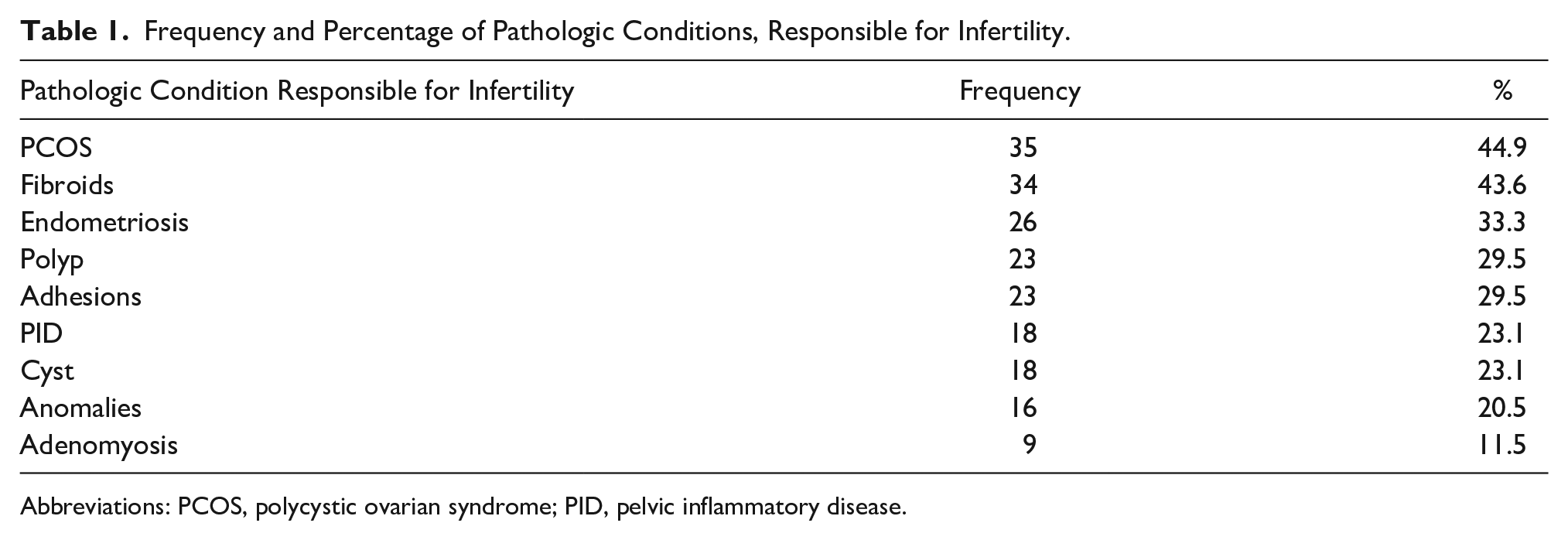
Abbreviations: PCOS, polycystic ovarian syndrome; PID, pelvic inflammatory disease.
Discussion
Infertility, as described by most experts, is the inability to conceive after a minimum of 1 year of intentional sexual activity. Infertility can be an extremely traumatic experience for women. 14 In this current literature review, the most common cause of infertility was noted to be PCOS. Schmid et al stated that PCOS is the most well-known endocrine issue, influencing female infertility. 15 Deshpande and Gupta also noted that female infertility was usually discovered due to PCOS and tubal pathology; therefore, these conditions contributed to infertility by a rate of 46% and 33.8%, respectively. 16 In contrast to this study, Roupa et al stated that problems within the fallopian tubes were the most common cause of female infertility. 17 In another study, Masoumi et al observed that the most common cause of infertility in women was menstrual disorders (62.6%). 9 In this study, the effect of fibroids, detected with sonography, on women’s infertility was 43.6%. Guo and Segars also described the prevalence of fibroid development, in infertile patients, as 5%–10%, and in up to 2.4% of patients, this may be the sole cause of infertility. 18 The issue of whether fibroids can be a contributor to infertility may not be inadequately understood by some clinicians. 18 It has also been stated that not all types of fibroids affect women’s fertility.19,20 Women with submucosal and intramural fibroids were considered to have a significantly lower clinical pregnancy rate, but subserosal fibroids had little or no effect.19,20 Bulletti et al stated that about 30%–50% of women with endometriosis are infertile and 25%–50% of those with infertility had endometriosis. 21 Navarro stated that women with endometriosis had a lower likelihood of pregnancy, in contrast to those who had unexplained infertility. 22 This may explain the presence of a lower combined pregnancy rate in women, at the beginning phases of endometriosis, compared with those women with an unknown cause of infertility. 22 In this study, it was observed that an endometrial polyp, detected with sonography, had a great effect on infertility. Nijkang et al also observed that endometrial polyps can be associated with infertility. The incidence of this disease in primary infertility is higher (8%–38.5%) than secondary infertility (1.8%–17%). 23 In contrast, Pérez-Medina et al stated that polyps have never been seriously considered as a cause of infertility, in the reproductive process. 24 In this study, it was determined that adhesions, detected with sonography, could cause infertility. Diamond et al 25 observed that adhesion development can have a major impact on a patient’s subsequent health. Adhesions are a significant source of impaired organ functioning, bowel obstruction, decreased fertility, difficult reoperation, and possibly pain. In contrast to this study, Kodaman and Arici stated that not all adhesions cause infertility; their extent, location, and thickness must be assessed to determine their possible interference with normal reproductive physiology. 26 In the current literature review, it was determined that sonographically detected PID could cause infertility at 23.1%. Similarly, Wiesenfeld et al observed that tubal infertility is the leading cause of infertility among women. Most commonly, damage results from previous episodes of PID. 27 Tsevat et al determined that PID is the most common but preventable cause of infertility. 28 The relationship between ovarian cysts and infertility is a subject of debate. Keyhan et al stated that not all ovarian cysts cause infertility. 29 Legendre et al observed that some ovarian cysts may be associated with a decreased rate of fertility, especially those that are caused by an underlying condition, such as endometriosis. 30 In the current literature review, it was observed that sonographically documented uterine anomalies could cause infertility. Saravelos et al felt that the role congenital uterine anomalies may play in infertility remains unclear. However, uterine anomalies have been described as contributing to infertility, by interfering with normal gestational implantation and placentation. There seems to be an increase in the prevalence of a septate uterus with the women suffering with infertility, compared with those who are fertile. The prevalence of unicornuate and hypoplastic uterus has been noted to have a moderately higher prevalence in those who are infertile. Conversely, an arcuate uterus has lower prevalence compared with women who are fertile. 31 In this study, it was observed that adenomyosis is the least common, sonographically detected, cause of infertility. Similarly, Barbosa-Silva and Barros stated that uterine adenomyosis remains a fairly frequent and debilitating disease that could be encountered with increasing incidence among infertile women. 32
Limitations
The literature search was conducted using authors’ web access for open access journals and those titles for which the host university subscribed. Nevertheless, a limitation to this search was the inability to access journals that required a fee for downloading. This has limitations of generalizability due to it not being a meta-analysis of the topic.
Conclusion
The result of this recent review of the literature found that PCOS was the most common cause of infertility, and the least contributor to infertility was adenomyosis.
Supplemental Material
sj-docx-1-jdm-10.1177_87564793211052023 – Supplemental material for Sonographic Evaluation of Various Causes of Female Infertility: A Literature Review
Supplemental material, sj-docx-1-jdm-10.1177_87564793211052023 for Sonographic Evaluation of Various Causes of Female Infertility: A Literature Review by Hafiza Iqra Kanwal, Munaza Shahid and Raham Bacha in Journal of Diagnostic Medical Sonography
Footnotes
Declaration of Conflicting Interests
The authors declared no potential conflicts of interest with respect to the research, authorship, and/or publication of this article.
Funding
The authors received no financial support for the research, authorship, and/or publication of this article.

References
Supplementary Material
Please find the following supplemental material available below.
For Open Access articles published under a Creative Commons License, all supplemental material carries the same license as the article it is associated with.
For non-Open Access articles published, all supplemental material carries a non-exclusive license, and permission requests for re-use of supplemental material or any part of supplemental material shall be sent directly to the copyright owner as specified in the copyright notice associated with the article.
