



Abstract
There are few regulations regarding facility accreditation and individual credentialing in diagnostic medical sonography (DMS), although it is known that the quality of examinations in the field can vary based by the operator. This literature review summarizes the findings from 19 research studies on accreditation, credentialing, and quality improvement and includes illustrative quotes from 23 position papers and 42 editorials. The review uncovered large differences in facility accreditation status based on sonography specialty and geographical area. The findings included many examples of positive correlations between accreditation and improved quality and also a positive correlation between credentialing and improved image quality. The survey studies revealed overwhelming support for accreditation and credentialing. Many articles raised concerns about the unknown quality of sonograms performed in nonaccredited facilities or by uncredentialed sonographers. If facility accreditation and/or individual credentialing could be implemented nationwide in DMS, it may lead to increased quality within the field.
It is well known that the field of diagnostic medical sonography (DMS) is operator dependent,1–8 and there can be variability in the quality of sonography examinations.1,2,4,5,7,9–12 The Medicare Improvements for Patients and Providers Act of 2008 mandated accreditation for reimbursement for nonhospital facilities that provide computed tomography (CT), magnetic resonance imaging (MRI), and nuclear medicine (NM) imaging13–15; however, there are few regulations regarding facility accreditation and individual credentialing in the field of DMS.1,5,7,9,10,13
There are multiple agencies that accredit diagnostic imaging facilities. The American College of Radiology (ACR), Intersocietal Accreditation Commission (IAC), Joint Commission, and RadSite accredit general diagnostic imaging facilities that perform CT, MRI, and NM studies.10,13,15 Within the field of DMS, there are two accrediting agencies for general sonography (ACR and American Institute of Ultrasound in Medicine [AIUM]), two for vascular sonography (ACR and IAC), and one for adult/pediatric echocardiography (IAC).5,7–10,13,15 There are three agencies that offer credentials to sonographers: the American Registry for Diagnostic Medical Sonography (ARDMS), Cardiovascular Credentialing International, and American Registry of Radiologic Technologists.7,8 Many health care insurance companies do not yet mandate accreditation or credentialing for general sonography reimbursement; however, some private and federal insurers have started requiring accreditation or credentialing for cardiovascular reimbursement.3,7–10,12–20 Although accreditation and credentialing are still mostly voluntary for the DMS field, this movement toward linking accreditation or credentialing with reimbursement will likely have ramifications for both facilities and sonographers soon. This literature review summarizes the findings from articles on DMS accreditation, credentialing, and quality improvement.
Methods and Materials
A comprehensive search of the PubMed, Ovid MEDLINE, and Cumulative Index of Nursing and Allied Health Literature (CINAHL) databases was performed using the following search terms: sonography accreditation quality, sonography credentialing quality, ultrasound accreditation quality, and ultrasound credentialing quality. A search of the Journal of the American Society of Echocardiography (JASE), the Journal of Diagnostic Medical Sonography (JDMS), the Journal of Ultrasound in Medicine (JUM), and the Journal for Vascular Ultrasound (JVU) was then performed using the same search terms. Finally, the reference list of each article was reviewed to determine if any pertinent articles had inadvertently been overlooked. There were no limits on the date range of the literature searched, but the search concluded in November 2018.
A total of 23 084 results were initially found (PubMed, 650; Ovid MEDLINE, 112; CINAHL, 1409; JASE, 13 597; JDMS, 1556; JUM, 5678; and JVU, 82). Duplicate entries were removed, and results whose titles were not concentrated on accreditation, credentialing, or the DMS field were excluded. The search produced a total of 222 articles, which included editorials, position papers, meta-analyses, and original research studies. Fifty-six articles that focused exclusively on general health care and 82 articles that solely emphasized the role of the physician, improved scanning efficiency, internal quality improvement processes, automated scanning protocols/measurements, appropriate use criteria, patient outcomes/satisfaction, and education were excluded from the study. A diagram of the literature search process is shown in Figure 1.
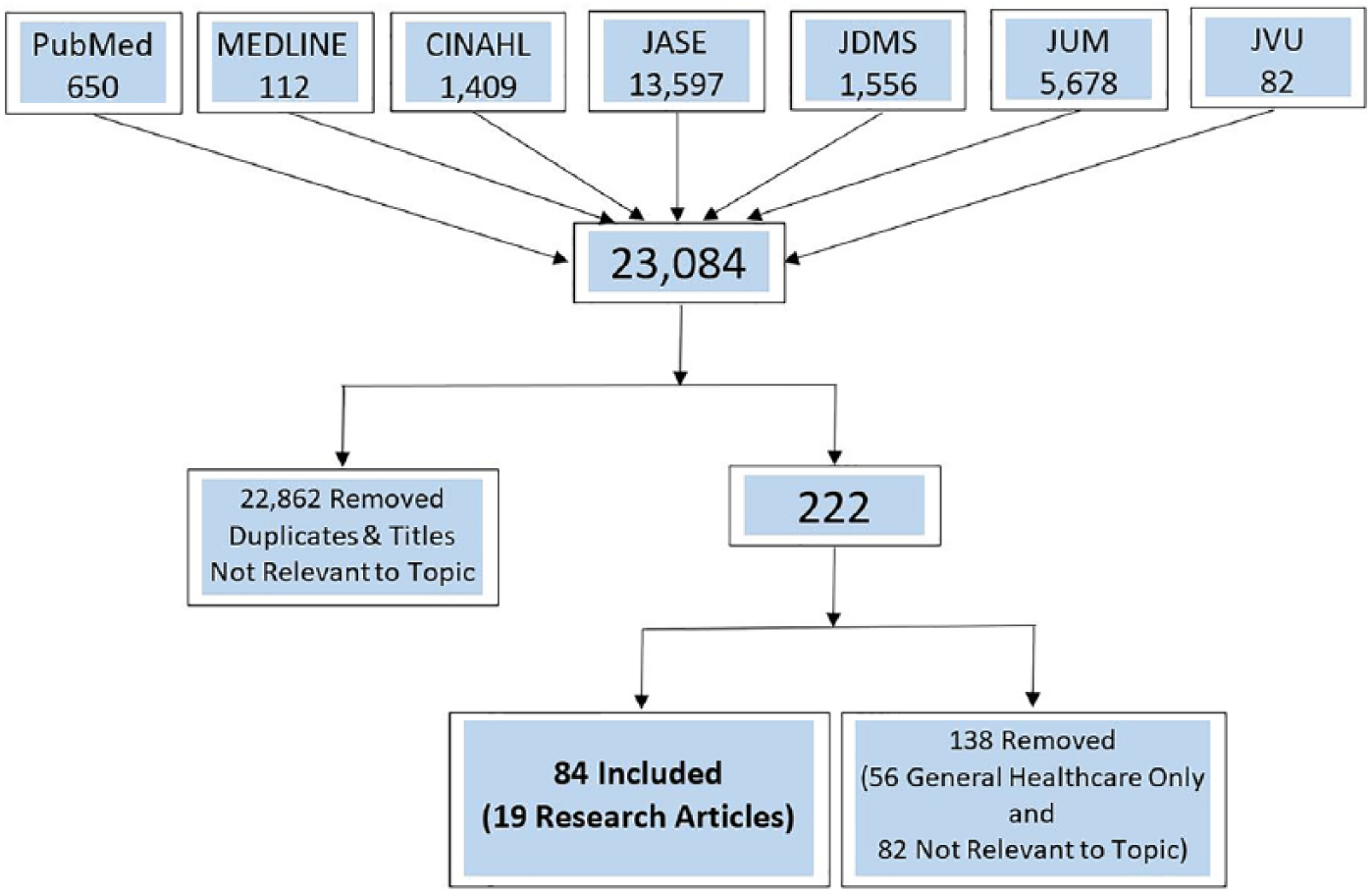
Diagram of the literature search process. CINAHL, Cumulative Index of Nursing and Allied Health Literature; JASE, Journal of the American Society of Echocardiography; JDMS, Journal of Diagnostic Medical Sonography; JUM, Journal of Ultrasound in Medicine; JVU, Journal for Vascular Ultrasound.
Eighty-four articles that highlighted the impact of accreditation and credentialing on quality improvement in DMS were included in the study. The publication date of the included articles ranged from 1988 to 2018, and the breakdown of the article type was as follows: 19 research articles, 23 position papers/statements, and 42 editorials. The research articles constitute the bulk of this literature review, but the position papers and editorials are included to highlight the prevalence of this topic in health care publications. This literature review did not involve research on human subjects; therefore, review and approval from an institutional review board were not needed.
Results
General Information on the Articles
This literature review included analysis of 19 research articles related to accreditation, credentialing, and quality improvement in DMS that were published between 2003 and 2018.1–16,21–23 Research questions, methodology, sample size, and findings are listed in Table 1. Eight of the articles are retrospective reviews of data,5,6,8–10,16,21,22 six of them are correlational studies,1,3,4,11,12,23 and five of them are analyses of surveys.2,7,13–15 Seventeen of the articles focus on cardiovascular imaging (nine on vascular,2,4–6,10,11,13,21,22 seven on echocardiography,3,8,9,12,14,16,23 and one on both 15 ), one on obstetrics and gynecology (OB/GYN), 1 and one on all DMS specialties. 7 Sixteen articles focus on the IAC accreditation process (formerly known as the Intersocietal Commission for the Accreditation of Vascular Laboratories [ICAVL] and Intersocietal Commission for the Accreditation of Echocardiography Laboratories [ICAEL]),3–6,8–16,21–23 one on the AIUM accreditation process, 1 one on multiple accreditation processes (ACR, AIUM, ICAVL, and ICAEL), 7 and one does not refer to a specific accreditation process. 2
Summary of Research Articles Included in the Literature Review. a
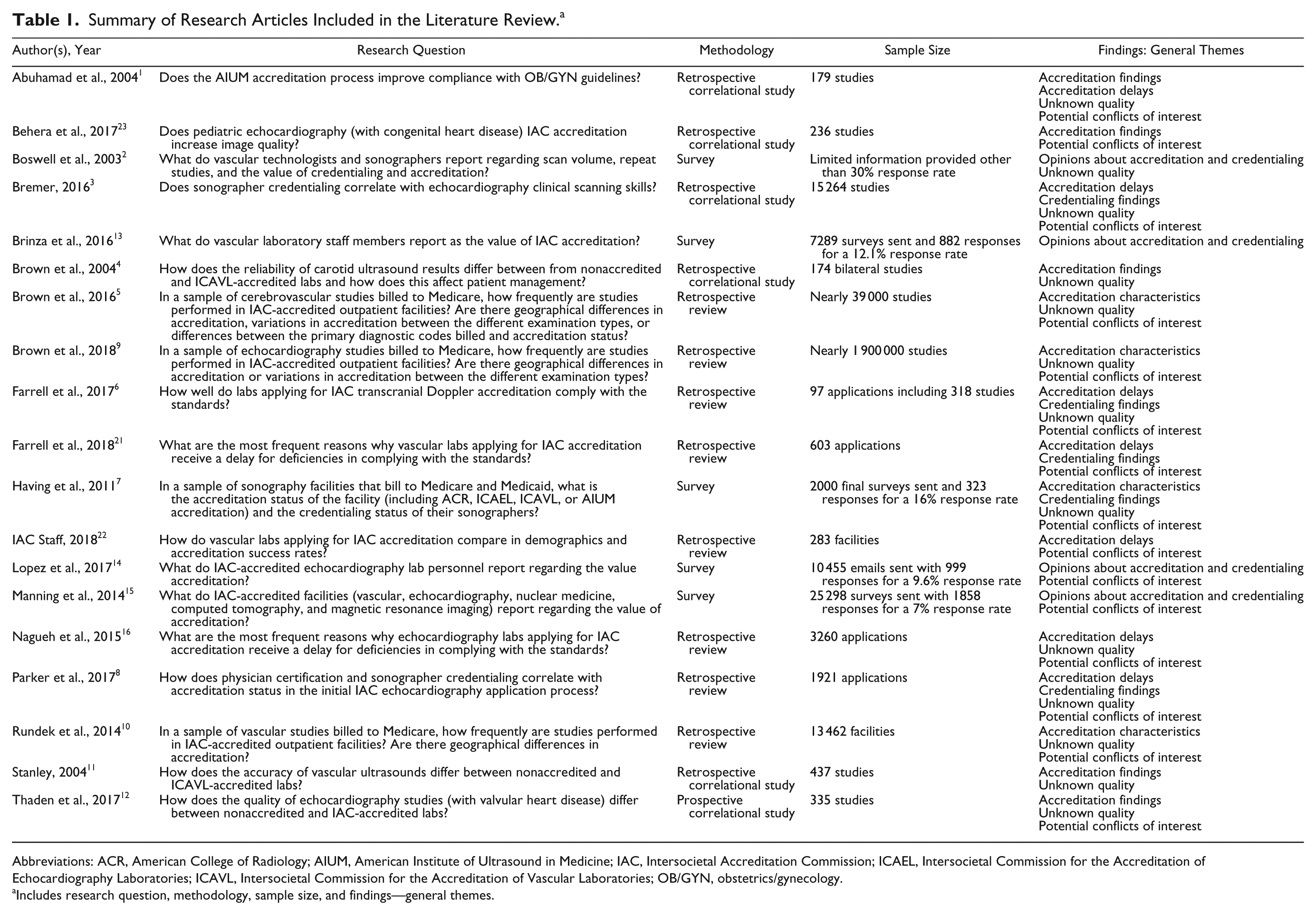
Abbreviations: ACR, American College of Radiology; AIUM, American Institute of Ultrasound in Medicine; IAC, Intersocietal Accreditation Commission; ICAEL, Intersocietal Commission for the Accreditation of Echocardiography Laboratories; ICAVL, Intersocietal Commission for the Accreditation of Vascular Laboratories; OB/GYN, obstetrics/gynecology.
Includes research question, methodology, sample size, and findings—general themes.
During the course of the research, 23 position papers/statements that focus on accreditation, credentialing, and quality improvement in DMS/diagnostic imaging were found.23–46 These papers were published between 1995 and 2018, and they follow the pattern noted above in that most of them focus on vascular imaging and echocardiography. Descriptions and illustrative quotes from each paper are listed in Table 2. It is noteworthy that some statements advocating sonographer credentialing were published nearly 20 years ago, and credentialing is still not mandatory for sonographers nationwide.41,44
Summary of Position Papers/Statements Related to Accreditation, Credentialing, and Quality Improvement in Sonography. a
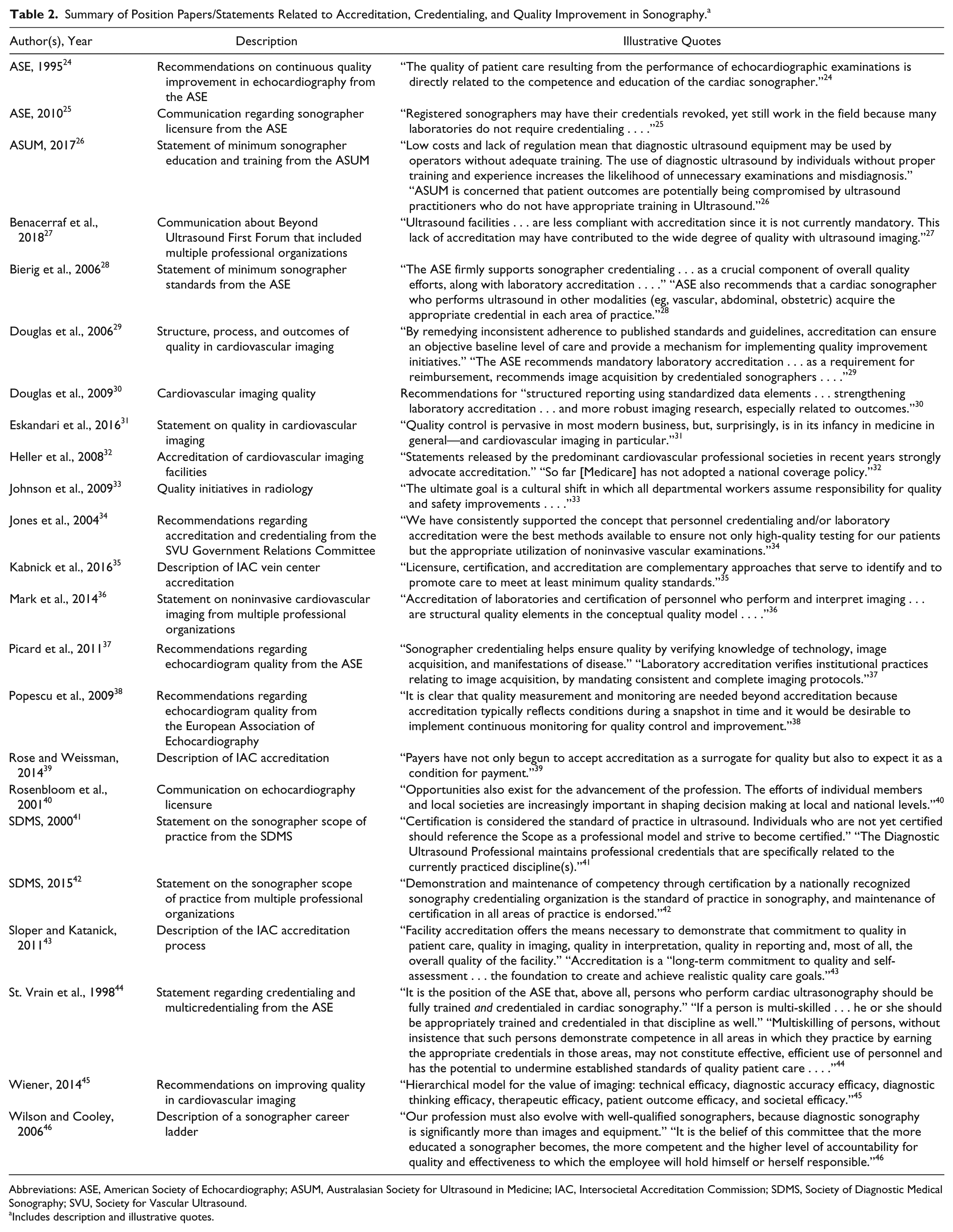
Abbreviations: ASE, American Society of Echocardiography; ASUM, Australasian Society for Ultrasound in Medicine; IAC, Intersocietal Accreditation Commission; SDMS, Society of Diagnostic Medical Sonography; SVU, Society for Vascular Ultrasound.
Includes description and illustrative quotes.
In addition, 42 editorial articles that focused on accreditation, credentialing/licensing, and quality improvement in DMS/diagnostic imaging were found.47–88 These editorials were published between 1988 and 2019, and they follow the pattern noted above in that most of them focus on vascular imaging and echocardiography. Three of the editorials were published more than 30 years ago, supporting the concept that the sonographic quality has been a topic for many years.47,53,58
Several overarching themes were found during the review of the research articles. These general themes include accreditation characteristics, findings, and delays; credentialing findings; opinions about accreditation and credentialing; unknown quality; and potential conflicts of interest. Details about the articles that fall under these themes are outlined below.
Accreditation Characteristics
In the four articles that reported the percentages of accredited facilities, there was large variation (range from 13% to 99.6%), with the lowest percentages reported for vascular and the highest reported for echocardiography.5,7,9,10 When evaluated by the percentage of studies performed in accredited centers, a large variation was again noted (range, 37% to 99.8%), with the same exact pattern of the lowest percentages reported in vascular sites and the highest in echocardiography sites.5,7,9 Interestingly, the highest percentage of vascular accredited centers were noted in the Northeast and the lowest in the West,5,10 while the highest percentage of echocardiography accredited centers were noted in the South and Midwest and the lowest in Puerto Rico. 9
Accreditation Findings
Five articles compared findings between accredited and nonaccredited facilities. One article found that accredited facilities applying for reaccreditation in OB/GYN were significantly more likely to have higher case study scores when compared with facilities that were applying for initial accreditation. 1 Two articles found the concordance between accredited and nonaccredited vascular studies to be closer to 50%,4,11 while two other articles found it to be close to 80% for echocardiography studies.12,23 There was large variation in the percentage of incorrect studies that led to changes in clinical decision making (range, 18%–55%).4,11,23 In two studies, most errors were overestimation of disease,4,12 while one study found it to be underestimation. 23 The reasons most cited for discordant results were inaccurate image interpretation, technique, and criteria.4,12,23 Four articles in this section concluded that there was a positive correlation between higher-quality studies and accreditation,1,4,11,12 and one article mentioned that study comprehensiveness and report completeness improved significantly after accreditation but that there was no difference in image quality or diagnostic accuracy. 23
Accreditation Delays
Accreditation delays were very common for IAC accreditation, as six of the studies reported delays for more than 61% of the applications.3,6,8,16,21,22 Fewer accreditation delays were noted for the AIUM OB/GYN accreditation process, but still there were significant delays (approximately 50%). 1 Four of the most common reasons for delays were issues with the report, staff qualifications, quality improvement, and image quality. Four articles specifically commented that facilities that have undergone multiple accreditation cycles have fewer deficiencies.1,8,16,21
Credentialing Findings
The five studies that cited credentialing statistics found that the vast majority of the sonographers in their samples were credentialed in at least one sonography specialty (range, 79.5%–93.9%).3,6–8,21 If specific credentialing was mandatory for performed examinations, one study found that 36.5% of sonographers would need to obtain an additional specialty credential. 7 One study focused specifically on evaluating the correlation between sonographer credentialing and echocardiography scanning skills and determined that credentialed sonographers received higher image quality scores for almost all of the comparisons. 3
Opinions About Accreditation and Credentialing
The three survey studies that elicited opinions about accreditation found overwhelming support for the process (range, 92%–94.3%),13–15 and the one survey study that elicited opinions about accreditation and credentialing combined also found that respondents strongly favored the practice of accreditation (98%). 2
Unknown Quality
Seven articles highlighted the important point that quality efforts are unknown in facilities that are not accredited,4,5,6,7,9,10,16 and two articles mentioned that quality efforts for uncredentialed sonographers are unknown.2,7 Furthermore, five studies found a positive correlation between accreditation and high-quality studies,1,4,8,11,12 and two studies found a positive correlation between credentialing and high-quality studies.3,8
Potential Conflicts of Interest
It is important to note that potential conflicts of interest were noted in 15 of the 19 articles.1,3,5–10,12,14–16,21–23 Nine articles disclosed that at least one author was an IAC employee,5,6,9,10,14–16,21,22 nine articles disclosed that at least one author was an IAC board member,3,5,6,9,10,14–16,21 eight articles disclosed that they were supported by grants (seven IAC grants5,6,8–10,12,23 and one SDMS grant 7 ), one article disclosed that an author was the immediate past president of the IAC Board of Directors, 12 one article disclosed that an author was an IAC consultant, 8 and two articles disclosed that an author was an ARDMS board member.5,10 Furthermore, one article was conducted by a sonography organization and subsequently published in the journal that is associated with that organization. 1
Discussion
The results of this literature review demonstrate that there are many DMS facilities that are not accredited5,7,10 and there are commonly delays with obtaining accreditation and reaccreditation.1,3,6,8,16,21,22 This result was somewhat unexpected considering that the standards of practice for accrediting agencies are widely published, and facilities typically submit their best cases for the accrediting agencies to review. Not surprisingly, though, those facilities applying for reaccreditation were found to have fewer deficiencies.1,8,16,21 The vast majority of sonographers were credentialed in at least one specialty3,6–8,21; however, almost all of these studies were reviews of accreditation databases, and the actual number of credentialed sonographers nationwide may have been overestimated.
Multiple articles found correlations between quality and accreditation/credentialing,1,3,4,7,8,11,12 and many raised concerns about the unknown quality of sonograms performed in nonaccredited facilities or by uncredentialed sonographers.2,4–7,9,10,16 Figure 2 illustrates this concept of known and unknown quality in the field of DMS.
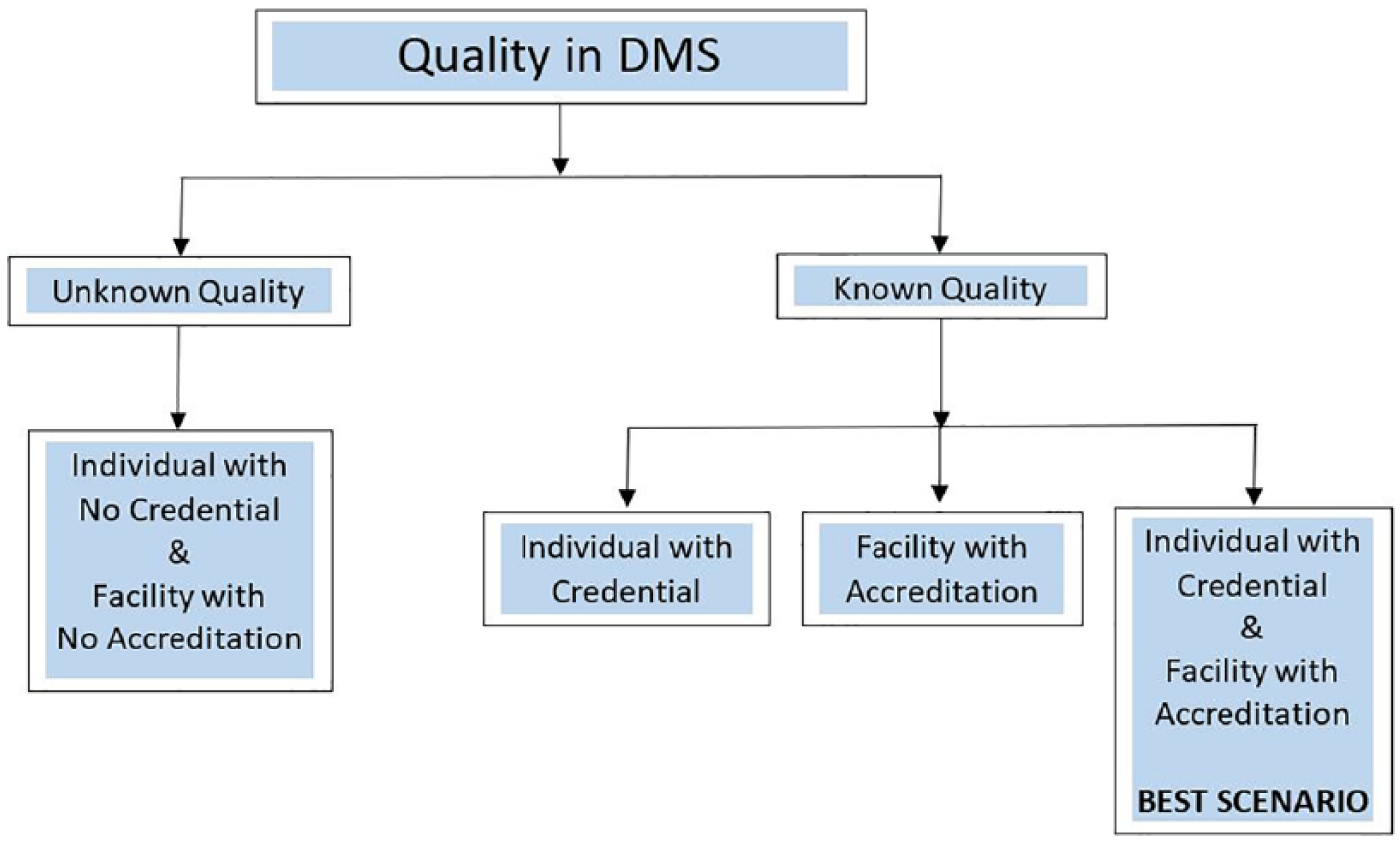
Diagram of quality in diagnostic medical sonography (DMS). Individuals with sonography credentials and/or facilities with sonography accreditation have met a known quality standard. Individuals without credentials and facilities without accreditation have unknown levels of quality.
Individuals with sonography credentials and/or facilities with sonography accreditation have met a known quality standard. Individuals without credentials and facilities without accreditation have unknown levels of quality. Only one article found no correlation between accreditation and image quality/diagnostic accuracy, and this article focused on pediatric echocardiography. 23 Perhaps since pediatric echocardiography is a very specialized area of DMS, facilities that perform the studies are already completing them with a high level of accuracy and quality. The surveys in this literature review found overwhelming support for accreditation and credentialing,2,13–15 but the response rates ranged from 9.6% to 30%, and this may have introduced bias.
The literature review revealed that echocardiography was found to have a much higher percentage of accredited facilities and a much higher concordance rate of studies performed in accredited versus nonaccredited facilities.4,11,12,23 During the literature search process, the echocardiography-specific journal (JASE) produced the most results for the search terms, and the number of results found was more than double that of the next closest journal. Furthermore, 17 of the 19 research articles included in this review focused on cardiovascular sonography.2–6,8–16,21–23 Increasingly, private and federal insurers require accreditation or credentialing for cardiovascular reimbursement.3,7–10,12–20 This may have resulted in increased scrutiny of quality in cardiovascular sonography.
Many of the retrospective review studies in this literature review were done by evaluating accreditation databases.1,3,6,8,16,21,22 The information provided is extremely helpful, but the sample size is limited to facilities that are accredited or applying for accreditation. This may have introduced a bias because many of these facilities are already focused on quality improvement. The quality of examinations in nonaccredited imaging centers is largely unknown. Considering the high percentage of facilities that are not accredited in some of these studies,5,7,10 there are many imaging centers in which the focus on quality improvement is unknown.
Future Directions
The findings of the present study uncovered many areas that require additional information through future research. There are an extremely limited number of published research studies on accreditation, credentialing, and quality improvement in general sonography (abdomen, OB/GYN, small part imaging, etc.), and this is an area that should be further evaluated. Potential options for future research would be to evaluate the number of billed general sonography studies that have been performed in accredited facilities or evaluate how credentialing correlates with general sonography scanning skills.
Although this review contained a number of articles on vascular imaging, the resulting data were not as extensive when compared with echocardiography. In addition, in-depth data on vascular imaging could be collected with continued research. Furthermore, although none of the conflicts of interest definitively pose actual conflicts, additional studies on accreditation and credentialing conducted by a wider range of authors and institutions would provide even more robust evidence of the impact on quality improvement in the field of DMS.
This search found no research studies that have compared the outcomes of the sonographer-training pathways. Sonography students can obtain their knowledge and experience through multiple options, ranging from on-the-job clinical training to a dedicated DMS educational program. Furthermore, there are optional, accreditation pathways that some DMS educational programs choose to pursue to demonstrate their commitment to high-quality education and continuous improvement. Future research correlating the outcomes of these different training pathways (on-the-job clinical training, nonaccredited DMS programs, and accredited DMS programs) would be beneficial. A potential option for a study would be to evaluate the differences in credentialing pass rates or job placement rates between applicants who had undertaken the different training pathways.
Conclusion
This literature review summarizes the findings from 19 research studies on accreditation, credentialing, and quality improvement and includes illustrative quotes from position papers and editorials. The review uncovered large differences in facility accreditation status based on sonography specialty and geographical area; however, it found that most sonographers are credentialed in at least one specialty. The findings included many examples of positive correlations between accreditation and improved quality and also a positive correlation between credentialing and improved image quality. The survey studies revealed overwhelming support for accreditation and credentialing. Many articles raised concerns about the unknown quality of sonograms performed in nonaccredited facilities or by uncredentialed sonographers.
In 1989, Craig asked, “how badly do we all want quality diagnostic ultrasound?” 58 Then in 1998, a Primetime Live segment broadcast instances of poor-quality sonograms and the low certification rate of sonographers (50%). 66 Nearly 20 years after that broadcast, the field of sonography is still grappling with the same issue of how to ensure quality. There is still a lot of variability in the quality of sonograms, but it is promising to see that research on accreditation, credentialing, and quality improvement is being undertaken to address and improve the situation. If facility accreditation and/or individual credentialing can be implemented nationwide in DMS, it may lead to increased quality within the field.
Footnotes
Acknowledgements
The author would like to acknowledge and thank Merri L. Bremer, EdD, RN, ACS, RDCS, for her assistance in planning this project and reviewing drafts of the manuscript. The author would also like to acknowledge and thank Angelo Sorrentino, MS, for his assistance with creating the figures in this document.
Declaration of Conflicting Interests
The author declared no potential conflicts of interest with respect to the research, authorship, and/or publication of this article.
Funding
The author disclosed receipt of the following financial support for the research, authorship, and/or publication of this article: This project was supported in part by a Society of Diagnostic Medical Sonography Foundation Research Grant.