




Abstract
The U.S. Geological Survey (USGS) National Seismic Hazard Model (NSHM) is the scientific foundation of seismic design regulations in the United States and is regularly updated to consider the best available science and data. The 2018 update of the conterminous U.S. NSHM includes significant changes to the underlying ground motion models (GMMs), most of which are necessary to enable the new multi-period response spectra (MPRS) requirements of seismic design regulations that use hazard results for 22 spectral periods and eight site classes. This article focuses on the GMMs used in the western United States (WUS) and is a companion to a recent article on the GMMs used in the central and eastern United States (CEUS). In the WUS, for crustal and subduction earthquakes, two models used in previous versions of the NSHM are excluded to provide consistency over all considered periods and site classes. To more accurately estimate ground motions at long periods in the vicinity of Los Angeles, San Francisco, Salt Lake City, and Seattle, the 2018 NSHM incorporates deep sedimentary basin depth from local seismic velocity models. The subduction GMMs considered lack basin depth terms and are modified to include an additional scale factor to account for this. This article documents the WUS GMMs used in the 2018 NSHM update and provides detail on the changes to GMM medians, aleatory variability, epistemic uncertainty, and site-effect models. It compares each of these components with those considered in prior NSHMs and discusses their total effect on hazard.
Keywords
Introduction
The National Seismic Hazard Model (NSHM), developed by the U.S. Geological Survey (USGS) for the United States and its territories, has long been the scientific foundation of seismic design regulations in the United States. Among other applications, these models have been used to compute design ground motions for the National Earthquake Hazard Reduction Program (NEHRP) Recommended Seismic Provisions for New Buildings and Other Structures (NEHRP Provisions, for example, Building Seismic Safety Council (BSSC), 2020) over the past several decades. For the conterminous United States (lower 48 states; CONUS), the 1996 USGS NSHM (Frankel et al., 1996) was the first model adopted by the NEHRP Provisions in 1997. The most recent development of the USGS NSHM for CONUS started in 2017 and was completed in 2019, resulting in the 2018 USGS NSHM (Petersen et al., 2020), which was influenced by and accepted for adoption in the 2020 NEHRP Provisions (BSSC, 2020).
In a companion paper, Rezaeian et al. (2021) present a brief history of adopting USGS NSHMs in the NEHRP Provisions and provide details on how the needs of the 2020 NEHRP Provisions (BSSC, 2020) influenced the 2018 USGS NSHM. For development of the 2018 USGS NSHM, the most significant requirement of the 2020 NEHRP Provisions was to incorporate multi-period and multi-
The USGS uses NSHMs to compute probabilistic seismic hazard over 0.05° spaced grids spanning the CONUS. The two fundamental components of an NSHM are (1) seismic source models, which include finite fault and background or smoothed seismicity models that forecast the occurrence rates and magnitudes of potential seismic events, and (2) ground motion models (GMMs), which provide estimates of the ground shaking (i.e. median ground motions and their uncertainties) for a given seismic event. Both components are updated in the 2018 NSHM; this article focuses on the second component, the GMMs, including comparisons and implementation details not covered in Petersen et al. (2020). For details of the 2018 source model, see Boyd et al. (2015), Frankel et al. (2015), Moschetti et al. (2015), Powers and Field (2015), and Petersen et al. (2020). The USGS uses a set of GMM selection criteria to vet published GMMs and select those most appropriate for use in each NSHM update. In response to the Project 17 recommendation that the NSHM support development of MPRS, the USGS modified the selection criteria for the 2018 update.
The geology, tectonics, and earthquake potential represented in the NSHM CONUS source model are diverse, ranging from the stable continental setting of the central and eastern United States (CEUS) to the active tectonic setting, including subduction zones, in the western United States (WUS). Similar to previous NSHMs for the CONUS, the GMMs used in the 2018 NSHM consist of four groups: those applicable to earthquakes in (1) the stable craton and margin of the CEUS, (2) the active shallow crust of the WUS (including that of the Pacific Northwest), (3) the Cascadia subduction zone interface in the Pacific Northwest, and (4) the Cascadia subduction zone intraslab setting. Rezaeian et al. (2021) elaborate on the CEUS GMM updates in the 2018 NSHM. Here, we focus on the changes made to the other three GMM groups in the WUS and the influence these changes have on seismic hazard.
The new MPRS requirements and advances in our understanding and ability to quantify long-period ground motions in deep sedimentary basins required the USGS to consider including such effects in the 2018 update (Petersen et al., 2020). Whereas basin effects are often negligible at soft rock reference site conditions and short periods, they can more than double ground motions at soft soil sites and long periods (e.g. Frankel et al., 2002; Hartzell et al., 1997). The 2018 NSHM therefore incorporates, for the first time, spatially varying basin depth data to better estimate basin effects for long-period (T ≥ 1 s) ground motion due to the reflecting, refracting, and focusing of seismic waves in basin structures. The 2018 update considers basin depth when computing hazard at periods greater than 0.5 s in the vicinity of Los Angeles, San Francisco, Salt Lake City, and Seattle, for which sufficiently developed shear wave velocity models exist.
The 2018 NSHM update did not consider new GMMs for use in the WUS. Although new subduction zone models were available in time for inclusion in the NSHM (e.g. Abrahamson et al., 2018; Zhao et al., 2016a, 2016b), the BSSC has recently adopted a more compressed update schedule (4–5 years instead of the usual 6 years between prior updates), and the NSHM project decided to forego updating the subduction GMMs until the 2023 update when the NGA-Subduction GMMs will be available (Bozorgnia, 2020).
In this article, we briefly review updates to the GMM selection criteria (Rezaeian et al., 2021) that stem from the recommendation of Project 17 to use MPRS and discuss limitations of previous WUS GMMs in terms of period and
GMM selection criteria
GMMs (or ground motion prediction equations, GMPEs) are models that describe the probability distribution of ground motion intensities in relation to parameters that represent the earthquake source, the seismic wave propagation path, and local site characteristics. A comprehensive model specifies the center, body, and range of this distribution (Budnitz et al., 1997). GMMs typically provide equations for (1) the median value of horizontal pseudo-spectral acceleration (SA) assuming a lognormal distribution and (2) an estimate of the standard deviation (or aleatory variability). These equations are functions of spectral period, source parameters such as earthquake magnitude, path parameters such as source-to-site distance, and local site parameters such as
The USGS GMM selection criteria were formally published as a part of the 2014 NSHM update (see Petersen et al., 2014: 109–110; Rezaeian et al., 2015: S61–S62) and are designed to be general and flexible to accommodate the continued evolution of GMMs. There are 16 criteria, grouped into four categories: (1) general requirements, (2) database scope, (3) parameters and applicability range, and (4) functional form and modeling procedure. Given the new MPRS requirement of the 2020 NEHRP Provisions, it was necessary to update these criteria for development of the 2018 NSHM (Rezaeian et al., 2021). Specifically, 2 of the 16 criteria were updated: (1) the Basic Requirement was updated to specify support for PGA and 21 response spectral periods, up from PGA and two periods in 2014; and (2) the Site Condition Requirement was updated to specify support for a minimum of eight
Minimum requirements for spectral periods and site classes
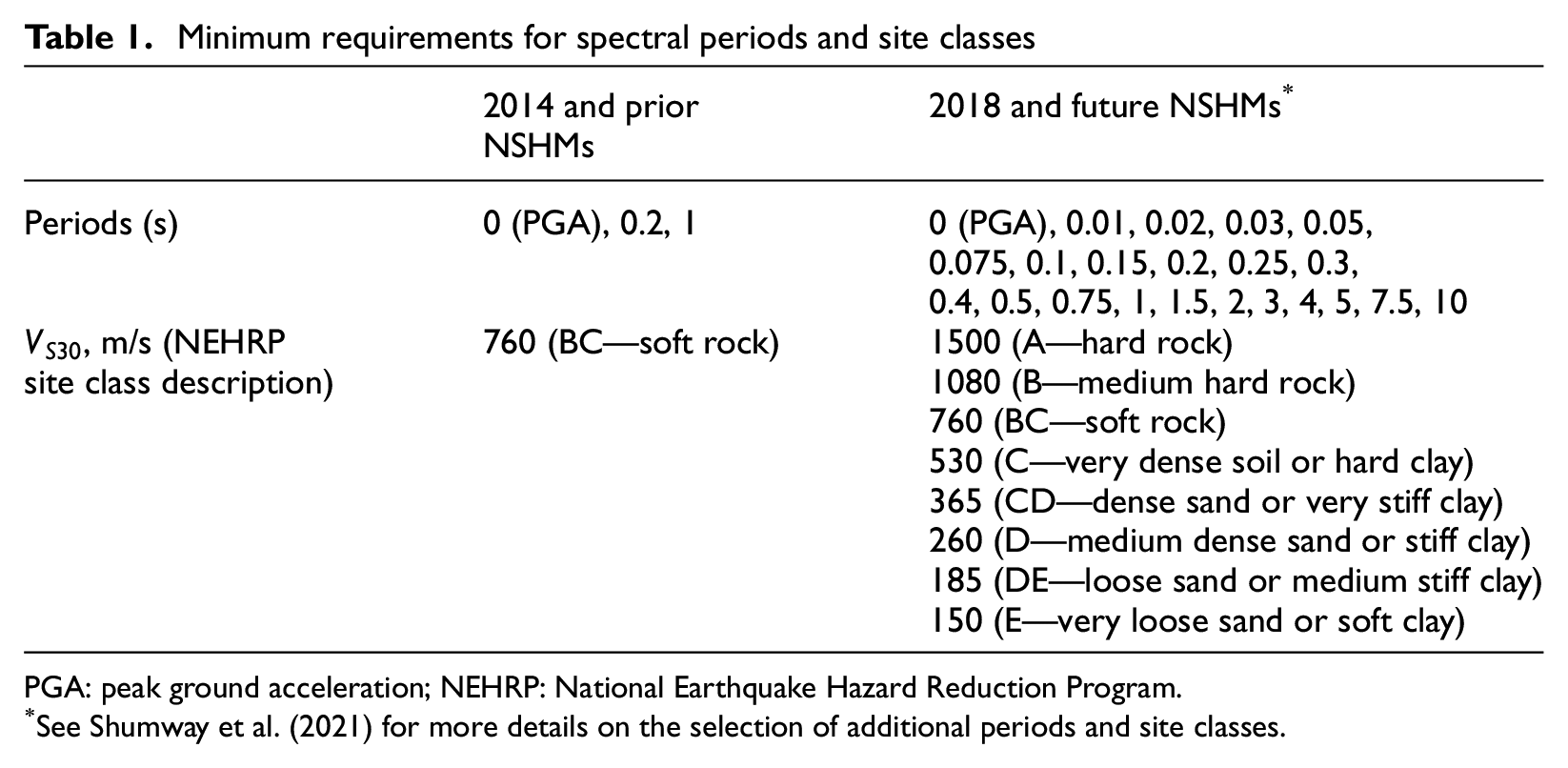
PGA: peak ground acceleration; NEHRP: National Earthquake Hazard Reduction Program.
See Shumway et al. (2021) for more details on the selection of additional periods and site classes.
Limitations of 2014 WUS GMMs in terms of period and
For the 2018 NSHM update, it was important to select GMMs that are applicable or that can be reasonably extrapolated to all periods and site conditions of interest shown in Table 1. The list of WUS GMMs selected for the 2014 and 2018 NSHM updates, along with their references, acronyms, applicability ranges with respect to period and
Ground motion models in the 2014 and 2018 NSHMs
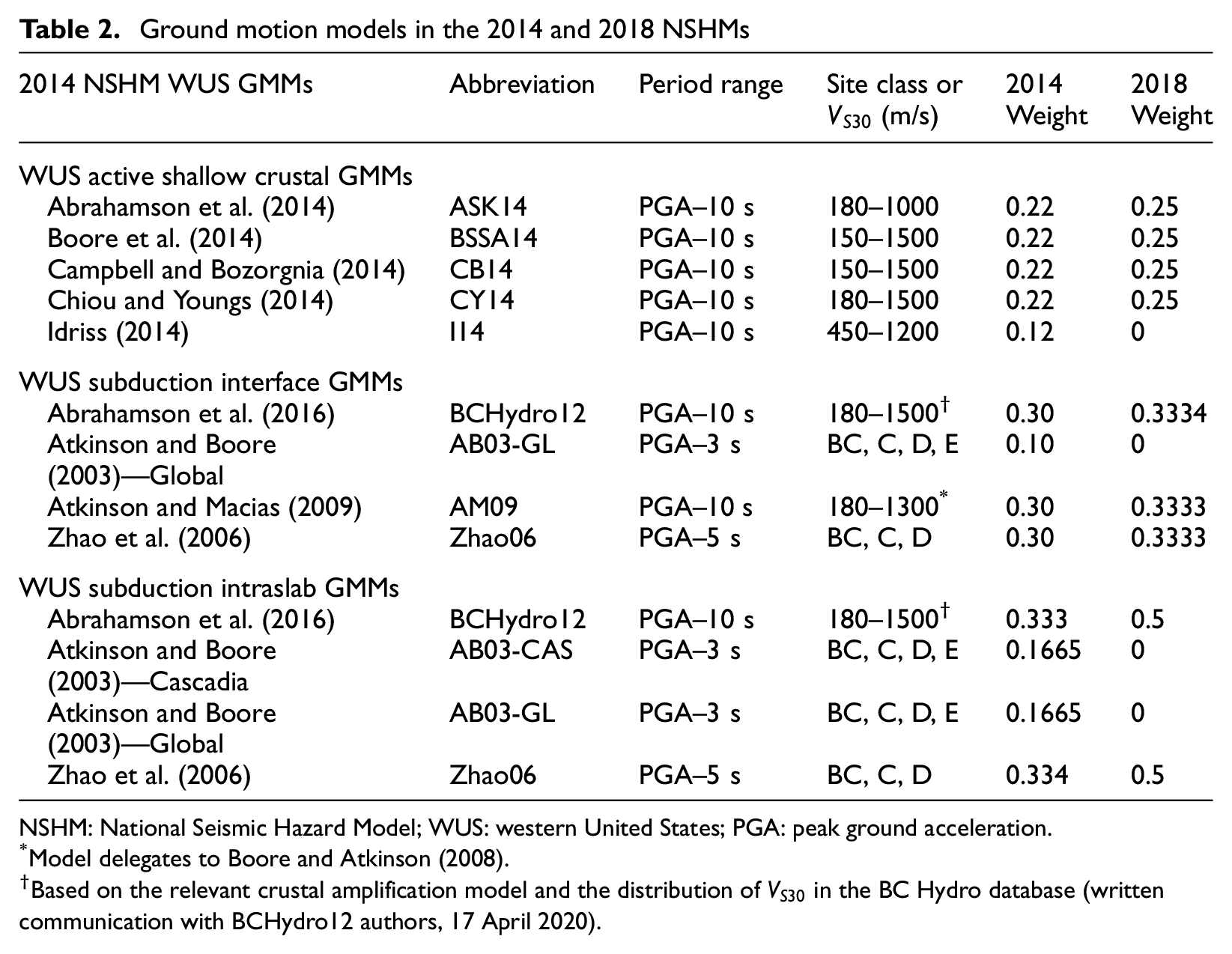
NSHM: National Seismic Hazard Model; WUS: western United States; PGA: peak ground acceleration.
Model delegates to Boore and Atkinson (2008).
Based on the relevant crustal amplification model and the distribution of
Rezaeian et al. (2014) reviewed the five 2014 NSHM GMMs for active crustal earthquakes in the WUS. As shown in Table 2, the I14 GMM used in the 2014 NSHM is not applicable to site classes CD or softer (
Rezaeian et al. (2015) reviewed the 2014 NSHM GMMs for subduction earthquakes in the WUS. As shown in Table 2, all of the AB03 GMMs used in the 2014 NSHM are not applicable to periods beyond 3 s. The models were also found to decay too slowly with distance for interface events at periods above 1 s and distances greater than 100 km (Shumway et al., 2018). Moreover, the AB03-CAS model underestimates ground motions at short periods and distances less than 100 km, which has practical consequences for Seattle and other urban centers of the Pacific Northwest. For these reasons, the AB03 models are removed from the 2018 NSHM and the weights of the remaining GMMs are adjusted. This leaves three GMMs for interface and two GMMs for intraslab earthquakes. Furthermore, because none of the subduction GMMs has a basin-depth term, modifications are made using crustal amplification factors and guided by simulations such as the Cascadia M9 project (Frankel et al., 2018).
Although Zhao06 supports a more limited range of site classes and spectral periods up to 5 s, the 2018 NSHM preserves this GMM to avoid reducing the intraslab GMM logic tree (epistemic uncertainty) to a single model. We found Zhao06 to reasonably extrapolate to longer periods and maintain that the Zhao06 site-effects implementation is adequate as long as other GMMs are also considered (see section “2018 Update of WUS Subduction GMMs” below). The consequences of eliminating I14 and AB03 are discussed, crustal GMMs are scrutinized for various basin depths, and modifications to subduction GMMs for deep basin effects are documented in the following section.
2018 update of WUS crustal GMMs
For shallow crustal earthquakes in the active tectonic setting of the WUS, the five NGA-West2 GMMs (Bozorgnia et al., 2014) were used in the 2014 NSHM (Rezaeian et al., 2014) for sources up to 300 km from a site and spanning magnitudes from 5 to 8.3 (Moschetti et al., 2015; Powers and Field, 2015). Four GMMs—ASK14, BSSA14, CB14, and CY14—were assigned an equal weight of 0.22; the fifth, I14, received a lower weight of 0.12 for reasons described in Rezaeian et al. (2014). The 2018 NSHM drops I14, as previously discussed, to maintain consistency across all site classes and assigns an equal weight of 0.25 to the remaining models.
The range of applicable
Consequences of removing I14
For a soft rock site (
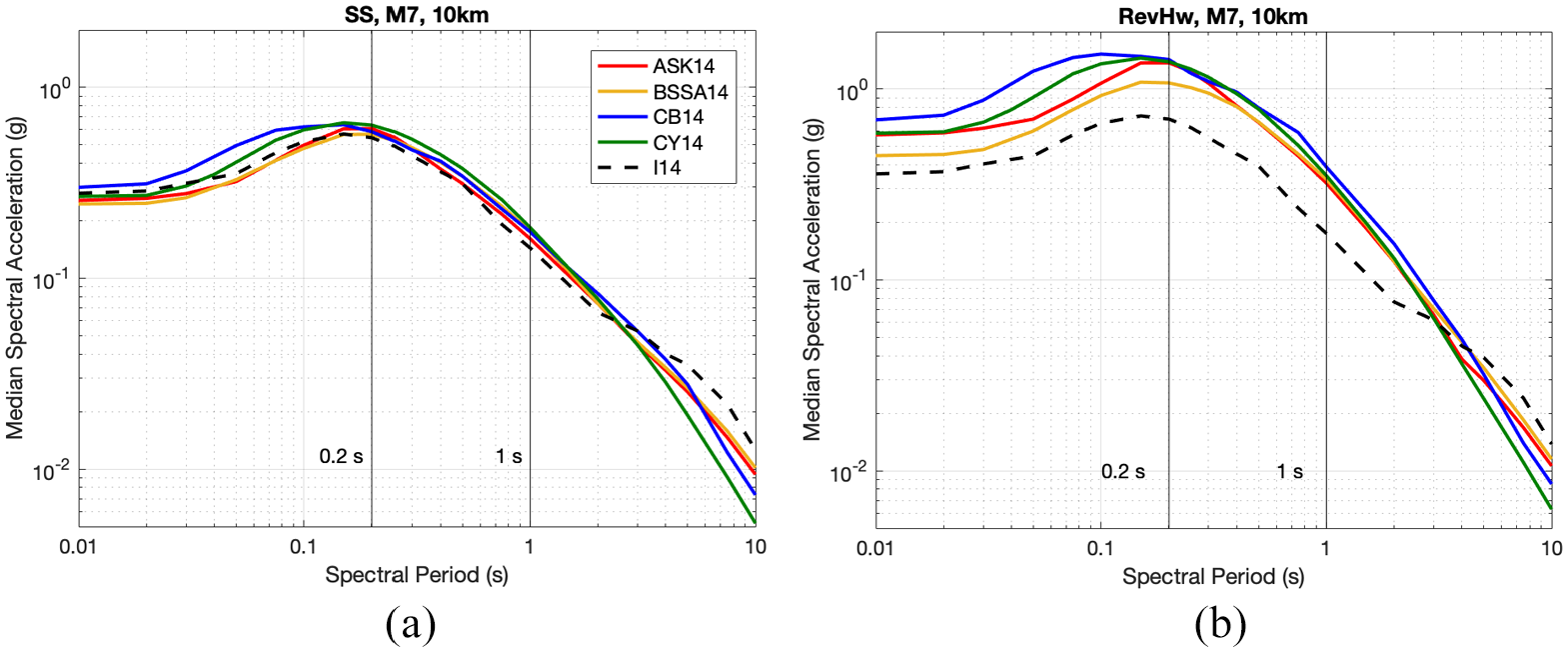
Median GMMs used in the 2014 and 2018 NSHMs for a magnitude 7 event on a soft rock site (
The 2018 and 2014 weighted combinations of median GMMs at 0.2 and 1 s versus distance for a magnitude 7 event are plotted in Figure 2. Figure 2 also includes the combined 2008 GMMs (three NGA-West1 GMMs; Petersen et al., 2008) and shows that the changes from 2008 to 2014 were much more significant compared to the changes from 2014 to 2018 for soft rock site conditions. Removal of I14 in the 2018 NSHM causes little change in weighted average median ground motion at sites near strike-slip faults and leads to small increases in near-field ground motion over reverse faults for soft rock site conditions (Figure 2). These changes are specific to a soft rock site condition, and if softer site classes were considered in the 2014 NSHM, removal of I14 from the 2018 NSHM would have had a more significant impact on design ground motions.
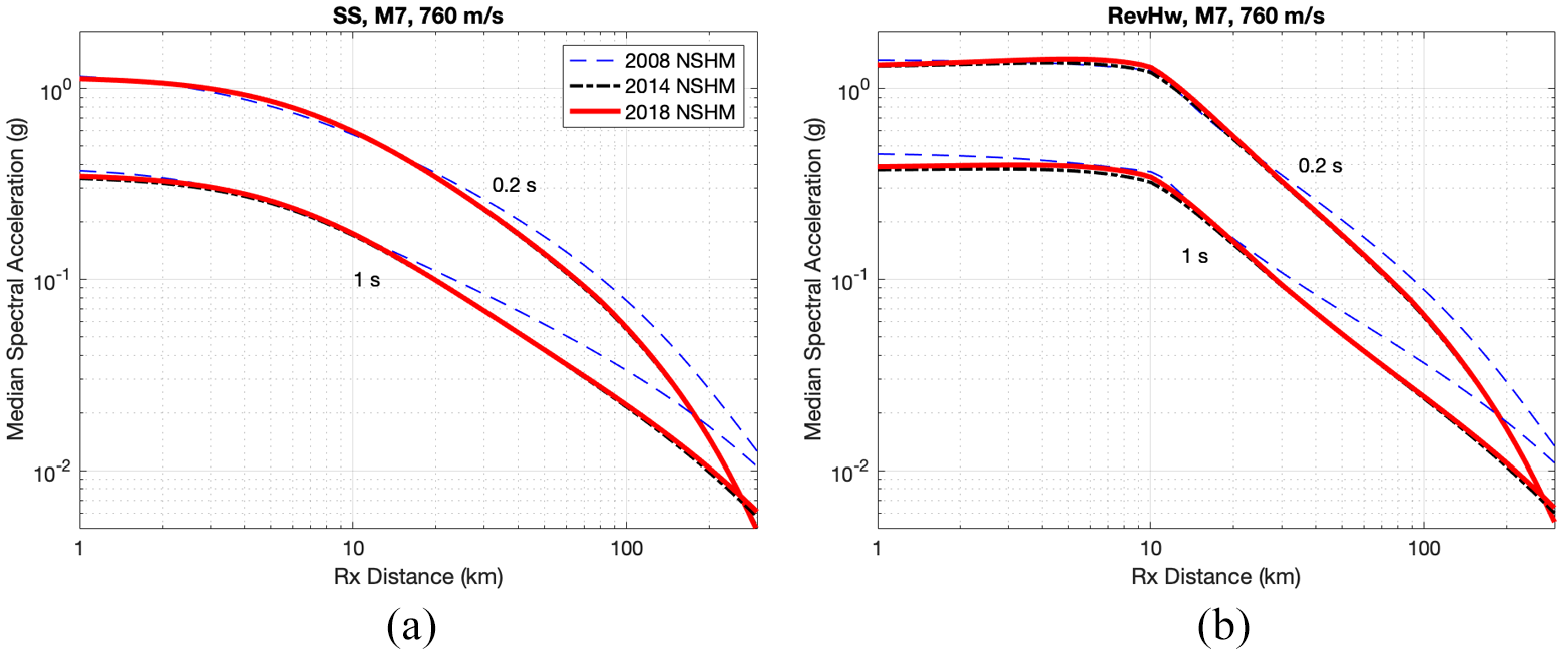
Weighted combinations of 0.2- and 1-s median WUS crustal GMMs in the 2018, 2014, and 2008 NSHMs for a magnitude 7 event on a soft rock site (
The I14 standard deviation is generally higher than that of the other four models at most periods and site classes, as shown in Figure 3, and is much higher at smaller magnitudes and longer periods. In probabilistic hazard calculations, increases in average median ground motions near reverse and normal faults is balanced by the decrease in average standard deviations of the four crustal GMMs arising from the removal of I14.
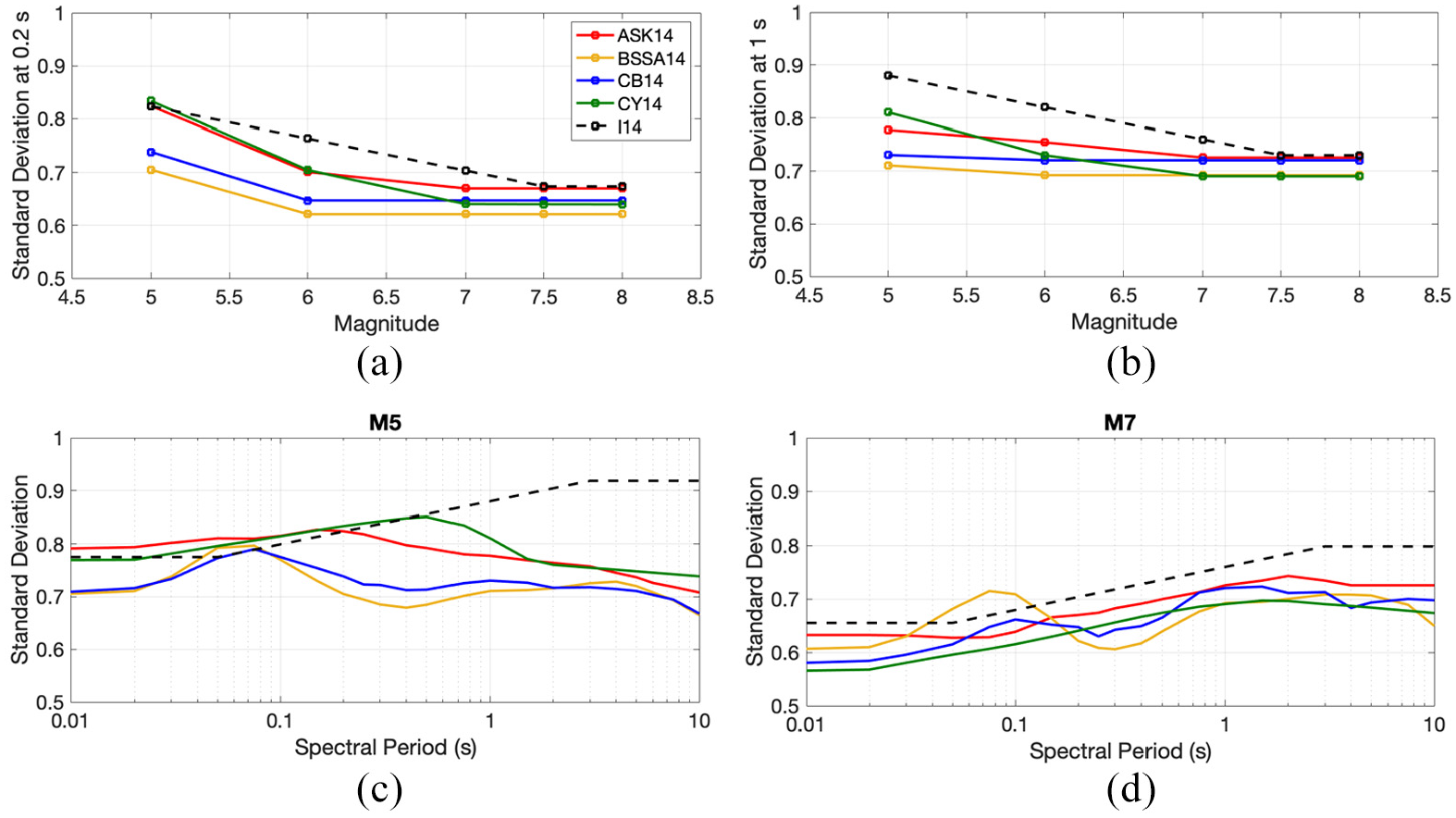
Standard deviations in natural log units of WUS crustal GMMs used in the 2014 and 2018 NSHMs plotted versus magnitude for (a) 0.2-s and (b) 1-s periods, and versus period for (c) a magnitude 5 and (d) a magnitude 7 event. The plots are for a strike-slip fault at 10 km on a soft rock site (Table 1).
Epistemic uncertainty for crustal GMMs
Epistemic uncertainty characterizes the range of plausible alternative input model assumptions and parameterizations given limitations in knowledge; these alternatives are represented by logic trees of GMMs and their associated weights. In hazard space, the epistemic uncertainty in GMMs yields a suite of hazard curves with a weighted average value that is typically adopted in forward applications such as the USGS hazard maps. Consistent with the 2008 NSHM (NGA-West1 GMMs) and 2014 NSHM (NGA-West2 GMMs), an additional magnitude- and distance-dependent epistemic uncertainty term is added to the WUS crustal GMMs in the 2018 NSHM (see Table 3 in Rezaeian et al., 2014). The 2008 NSHM assumed a 50% increase in ground motion (i.e. 1.5 scale factor, equivalent to ln(1.5) = 0.4 additive factor in log-space) due to the application of largely California-based GMMs to the Pacific Northwest and interior WUS. The NGA-West crustal GMMs include little or no strong motion data for very large earthquakes outside California, and one could claim that additional epistemic uncertainty is also needed within California for sources that have not yet been recorded, for example, a large magnitude 7.8 San Andreas earthquake. The 2014 NSHM followed the same assumption for the least populated magnitude-distance bin (magnitudes greater than 7 and distances less than 10 km) and reduced the factor for other bins proportional to the number of available earthquakes. In the 2018 NSHM, similar to the 2014 NSHM, this additional epistemic uncertainty scales with the sparseness of the NGA-West2 database (larger values at short distances and large magnitudes) and also accounts for the close interactions between the four NGA-West2 modeling groups. Note the similarity of the models in the response spectra of Figure 4, except at long periods where they diverge. At softer soil sites, there is greater variability between the NGA-West2 GMMs due to differences in site-effect models, as discussed later in the section “Deep Sedimentary Basin Effects in WUS Crustal GMMs.”
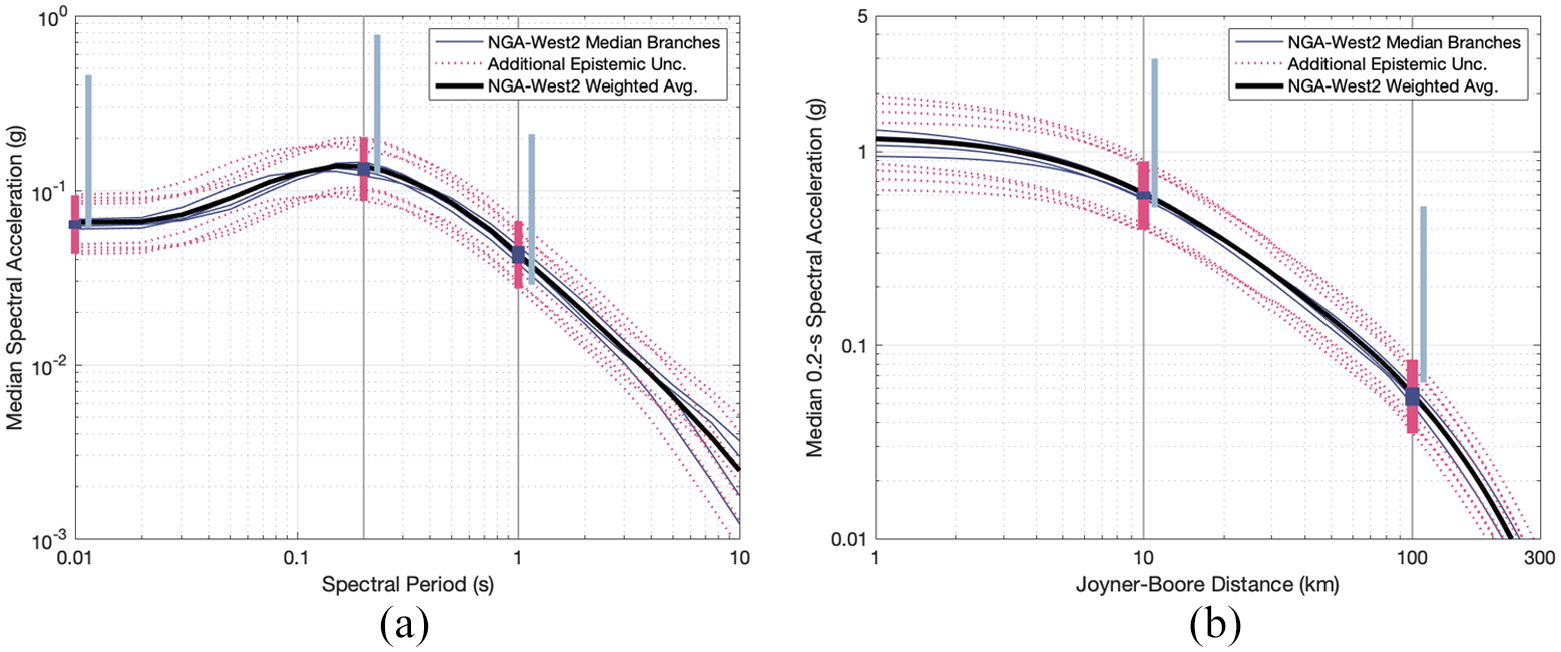
Medians of the four WUS crustal GMMs in the 2018 NSHM for a magnitude 7 event on a soft rock site (
The additional epistemic uncertainty is modeled as a three-point distribution about the mean with symmetric weights [0.2, 0.6, 0.2]. It is shown in Figures 4 and 5 to yield an average factor of 4 increase in the range of ground motion (pink bars relative to dark blue bars). Note that the vertical scale is logarithmic in Figure 5 and that the range in each subplot, while different, spans a similar order of magnitude for easy comparison; the dashed lines show weighted averages of median ground motions. Application of this symmetric distribution (in log space) of median ground motions in the NSHM yields an increase of 2%–3% in uniform hazard. For reference, Figures 4 and 5 also show the range of ground motion spanned by the GMMs used in the CEUS for the 2018 NSHM (see similar figures for CEUS in Rezaeian et al., 2021), which is a factor of 3–4 greater than that spanned by the epistemic uncertainty branches of the WUS GMMs (light blue bars relative to pink bars). The WUS crustal GMMs span a much smaller range of ground motion, as expected, owing to a richer WUS earthquake catalog and thereby less epistemic uncertainty as compared to CEUS. Note the steps in ground motion at 10 and 30 km in Figure 4b due to the distance dependence in the epistemic uncertainty logic tree branches.
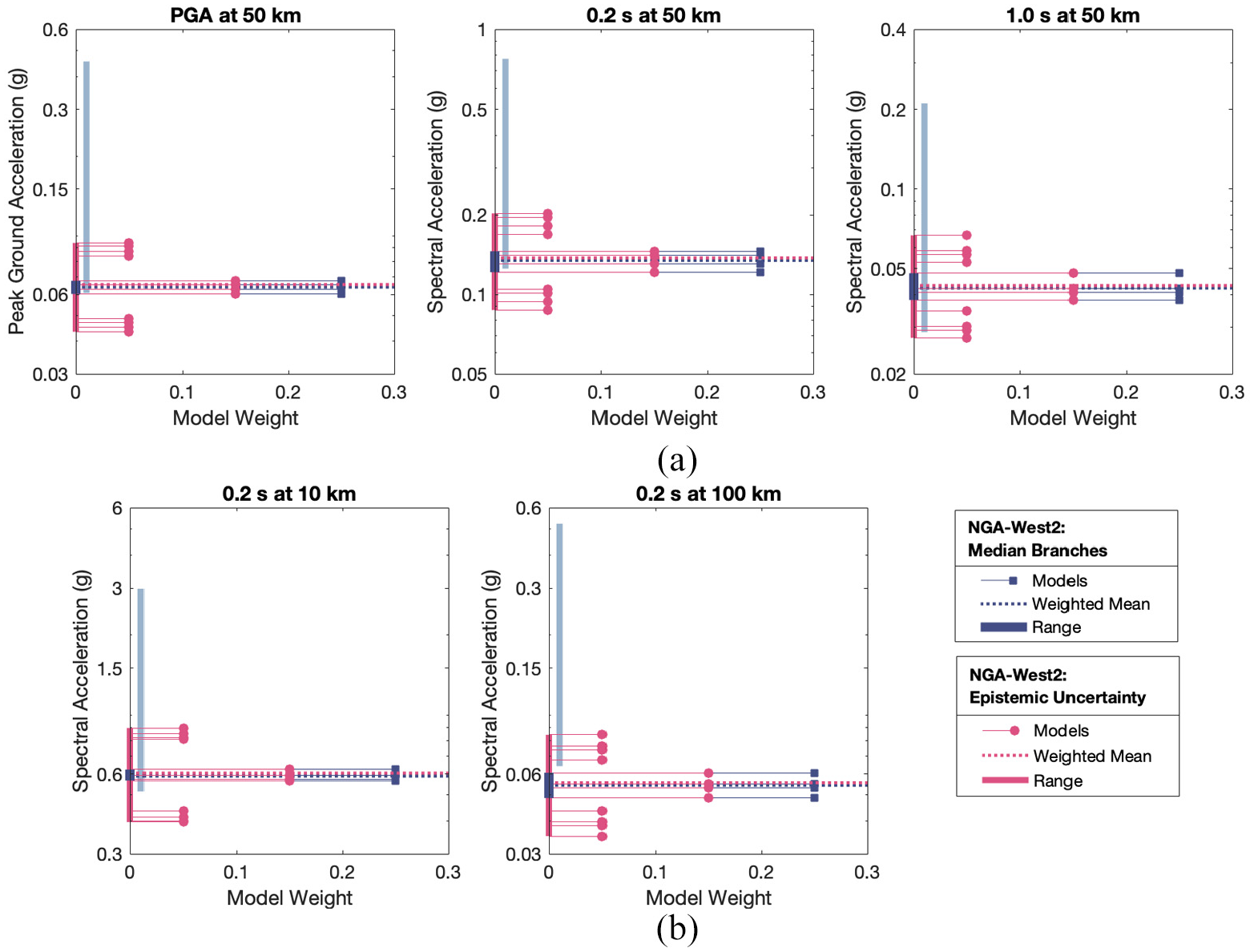
Epistemic uncertainty for the four WUS crustal GMMs represented by the range and distribution of ground motions at vertical cross sections of Figure 4 for (a) three example periods, PGA, 0.2 and 1 s, at 50 km and (b) two example distances, 10 and 100 km, at 0.2-s period, both for a magnitude 7 event on a soft rock site (
Deep sedimentary basin effects in WUS crustal GMMs
Long-period ground motion is highly sensitive to basin depth at soft sites. Ground motion observations and three-dimensional (3D) simulations demonstrate that deep sedimentary basins amplify long-period ground motions due to the reflecting, refracting, and focusing of waves trapped within the basin structure (e.g. Aagaard et al., 2008; Frankel et al., 2002, 2018; Graves et al., 2011; Hartzell et al., 1997; Moschetti et al., 2017; Stephenson et al., 2006). The WUS crustal GMMs account for such basin effects with terms that are parameterized by either
The WUS crustal GMM basin-effect terms were developed using empirical data from northern and southern California with very high scatter. Each term is conditioned on
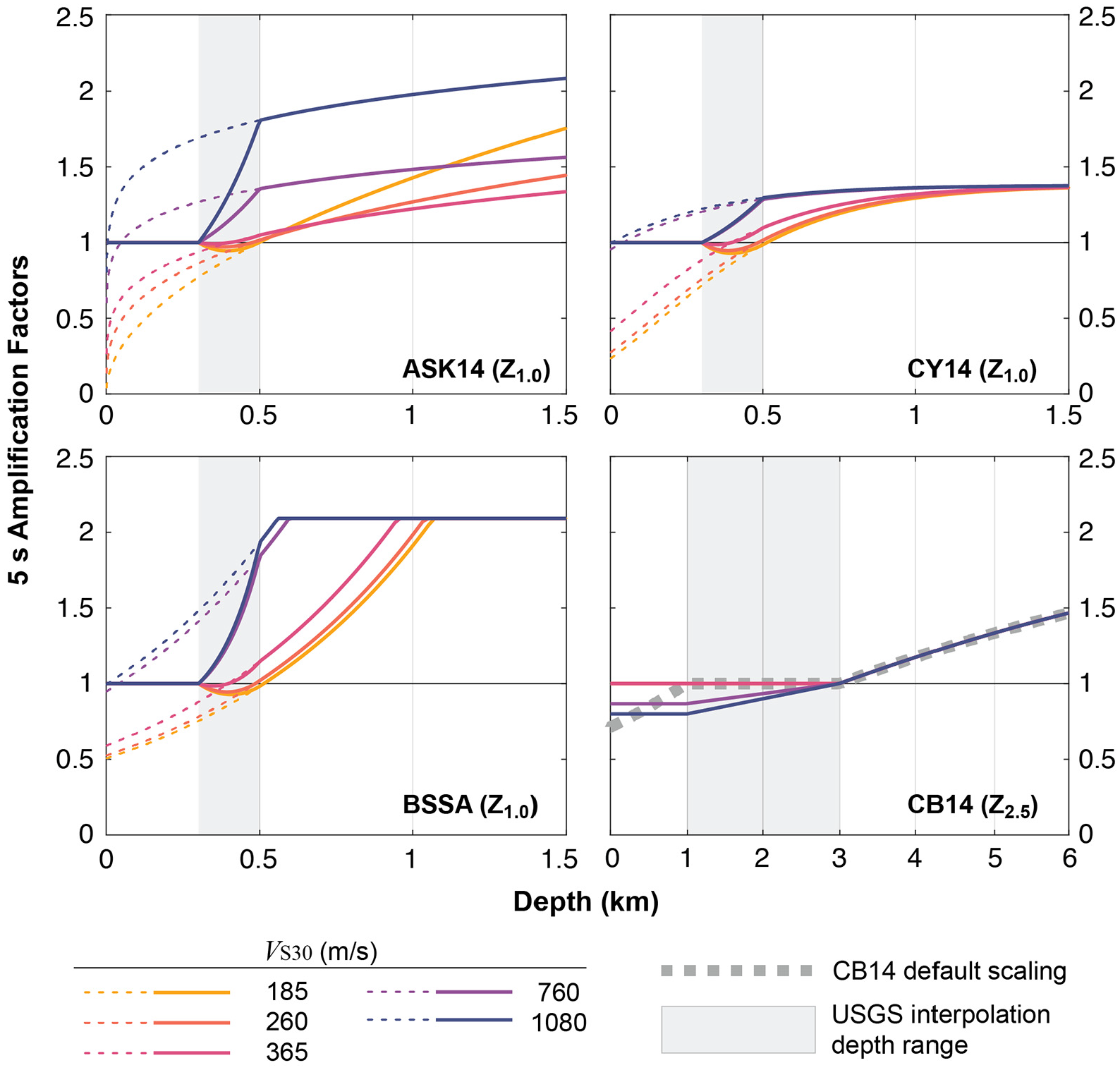
Five-second basin-effect scaling for NGA-West2 ground motion models. ASK14, CY14, and BSSA14 use
In the 2018 NSHM, spatially varying


where
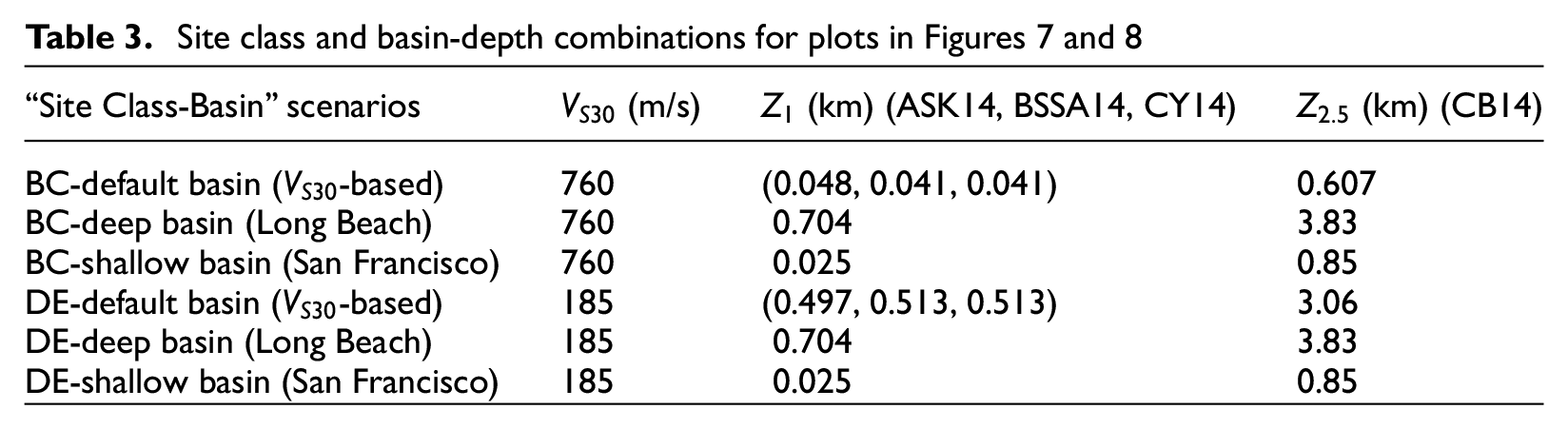
During development of the 2018 NSHM, the question arose whether to apply basin effects over the full range of depths represented in regional velocity models. While amplification relative to the default for sites overlying the deepest basins is consistently observed, behavior of seismic waves at shallow depths is poorly constrained. The basin-effect terms of the four crustal GMMs generally de-amplify ground motions relative to the
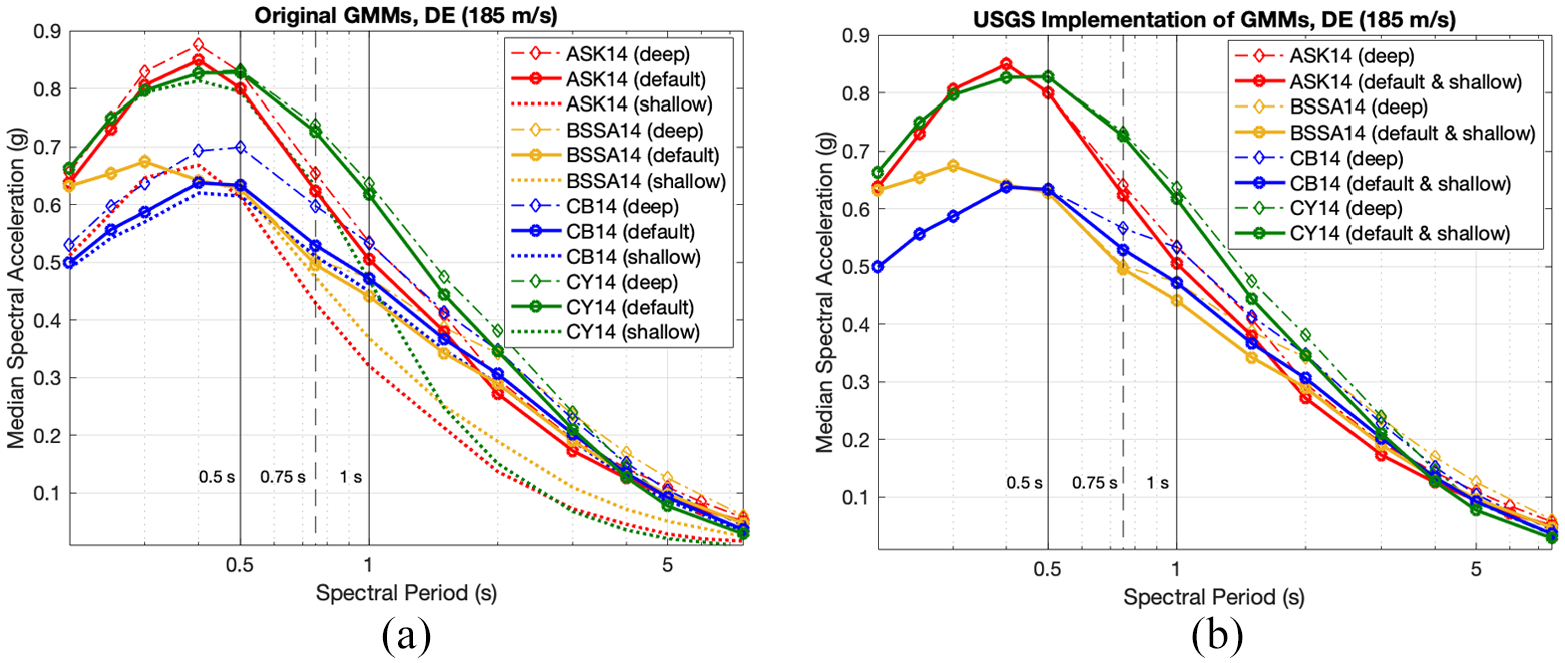
Median ground motion from the four WUS crustal GMMs at a DE site class for (a) the models as published and (b) the 2018 USGS implementation, considering the different basin depths listed in Table 3. The ground motion shown is for a magnitude 7 event on a strike-slip fault at a distance of 10 km.
The USGS basin-effect model is also only applied to spectral periods ≥1 s, with a scaled value at 0.75 s to maintain a smooth spectrum between 0.5 and 1 s. This limited and conservative depth- and period-dependent modeling approach was guided by available observations and results from simulations in Seattle and southern California (e.g. Frankel et al., 2002, 2018). In developing the model, we considered applying a basin amplification-only effect when basin depths were deeper than the
In the 2014 NSHM and in regions outside of the deep basins considered in the 2018 NSHM, the
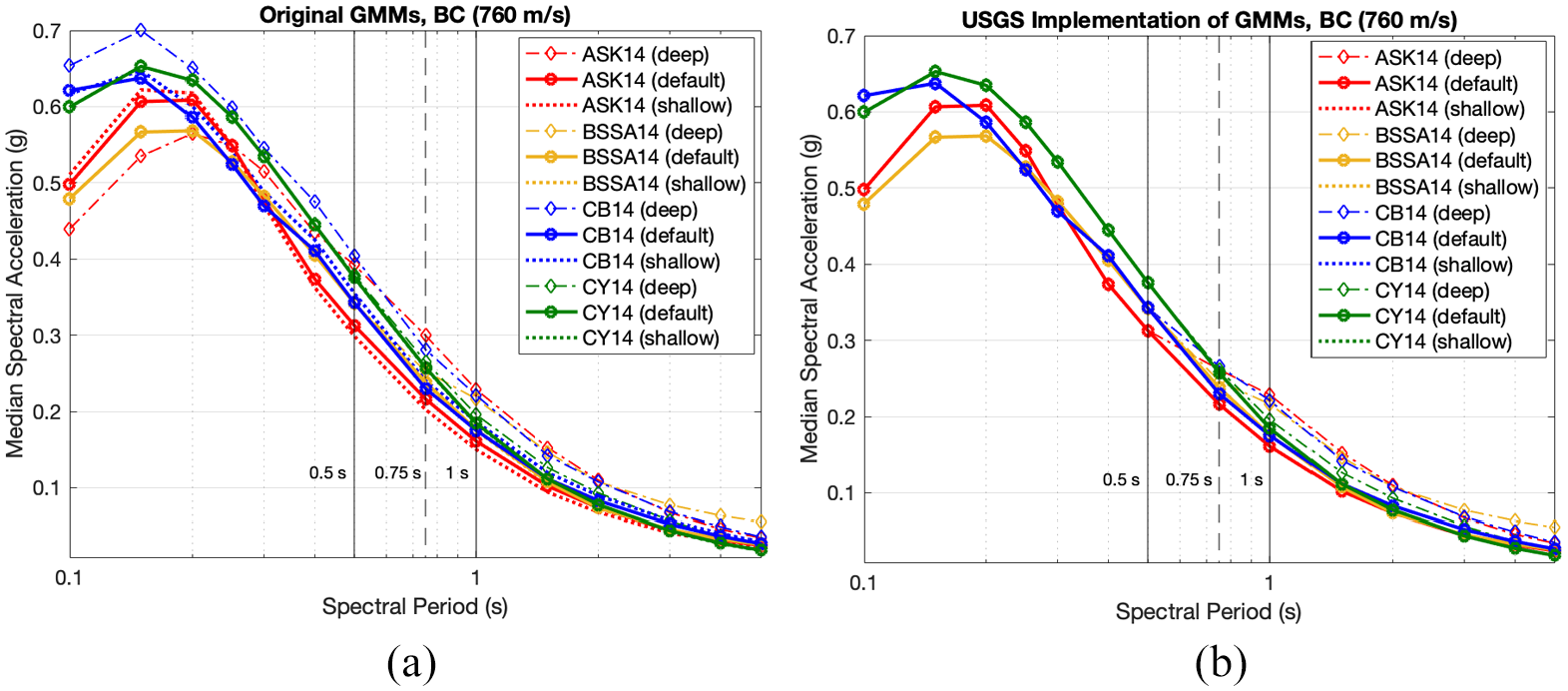
Median ground motion of the four WUS crustal GMMs at a BC site class for (a) the models as published and (b) the 2018 USGS implementation, considering the different basin depths listed in Table 3. The ground motion shown is for a magnitude 7 event on a strike-slip fault at a distance of 10 km.
Figure 7 shows site class DE, for which significant default basin effects are expected; Figure 8 shows site class BC, for which basin effects are expected to be much lower. The broader distribution of ground motions in Figure 7a relative to Figure 8a again shows that the site amplification models of the NGA-West2 GMMs exhibit greater epistemic uncertainty than do the median models for soft rock sites.
Figures 7b and 8b show the USGS modified crustal GMMs for site classes DE and BC, respectively, where ground motions are the same for “default” and “shallow” depths but amplified for “deep” basins at long periods. Although the USGS model restricts basin effects to long periods to maintain a smooth spectral shape, basin effects are suppressed at 0.5 s and below, given a log-period interpolated weight (≈0.5) at 0.75 s, and are fully considered at 1 s and above (note the vertical lines in Figures 7 and 8 that mark these three periods). Note also that in Figures 7a and 8a, BSSA14 and CY14 both exhibit no variation from the default
2018 update of WUS subduction GMMs
Four GMMs were used in the 2014 NSHM to estimate ground shaking for both subduction interface events up to 1000 km from a site and magnitudes as high as 9.34, and deep subduction intraslab events up to 300 km from a site and magnitudes up to 7.95 (Table 2; Frankel et al., 2015; Rezaeian et al., 2015). As published, the AB03 GMM, which was used for both event types, is only applicable to periods up to 3 s and cannot be reasonably extrapolated to longer periods, among other issues discussed in the section “Limitations of 2014 WUS GMMs in Terms of Period and
Consequences of removing AB03
The interface variant of the AB03-GL GMM is fairly similar in response spectral shape to the other GMMs considered in the 2014 NSHM (Figure 9). For a magnitude 9 interface event at a distance of 100 km, Figure 9a shows AB03-GL to be centered among the other GMMs except at long periods. At shorter distances, however, AB03-GL is lower than the other GMMs, and at distances greater than 100 km, it is higher. This behavior is consistent for both short and long spectral periods as illustrated in Figure 10a by the crossover in ground motion at about 100 km between the weighted combinations of the 2014 and 2018 subduction interface GMMs. Note also that AM09 median ground motion is significantly higher at long periods, possibly due to the use of stochastic simulations to model low-frequency shaking.
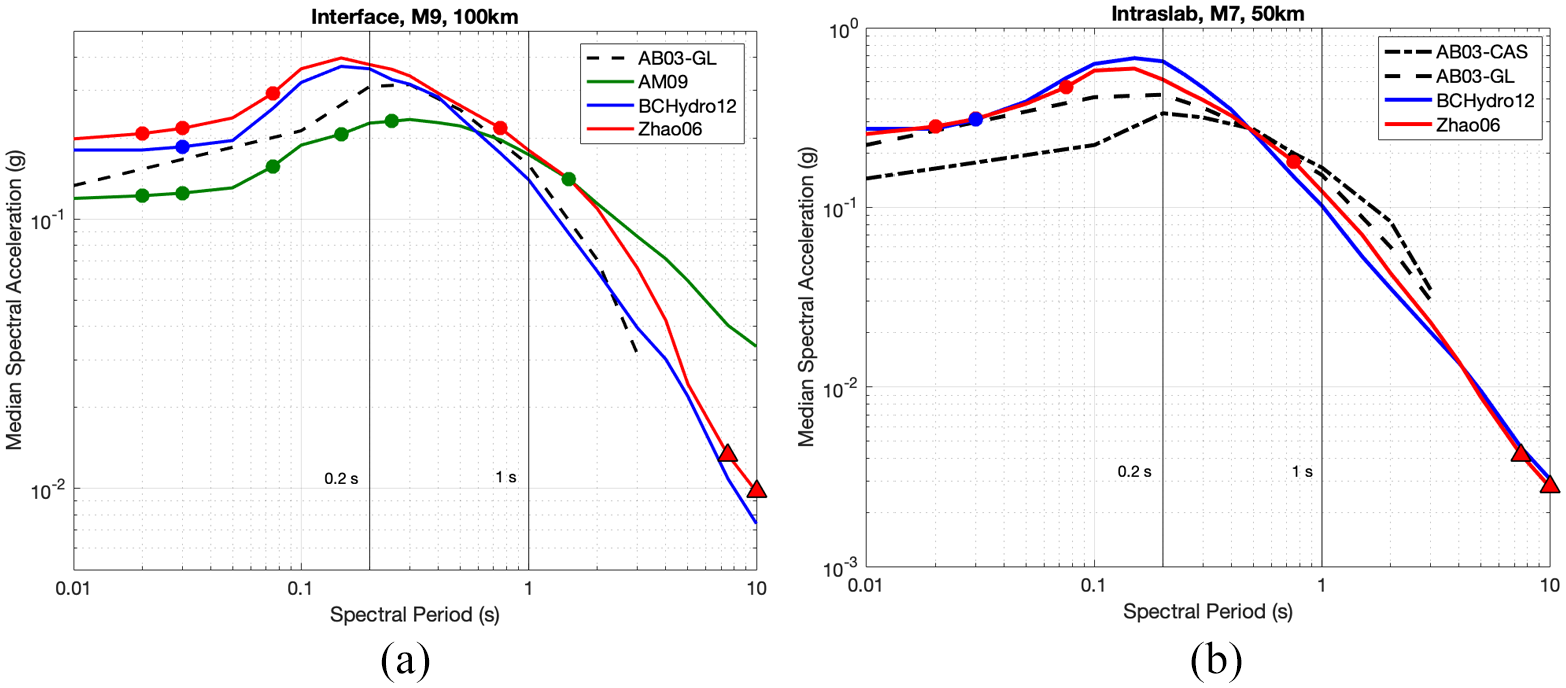
Median ground motion for WUS subduction GMMs versus period at a soft rock site (
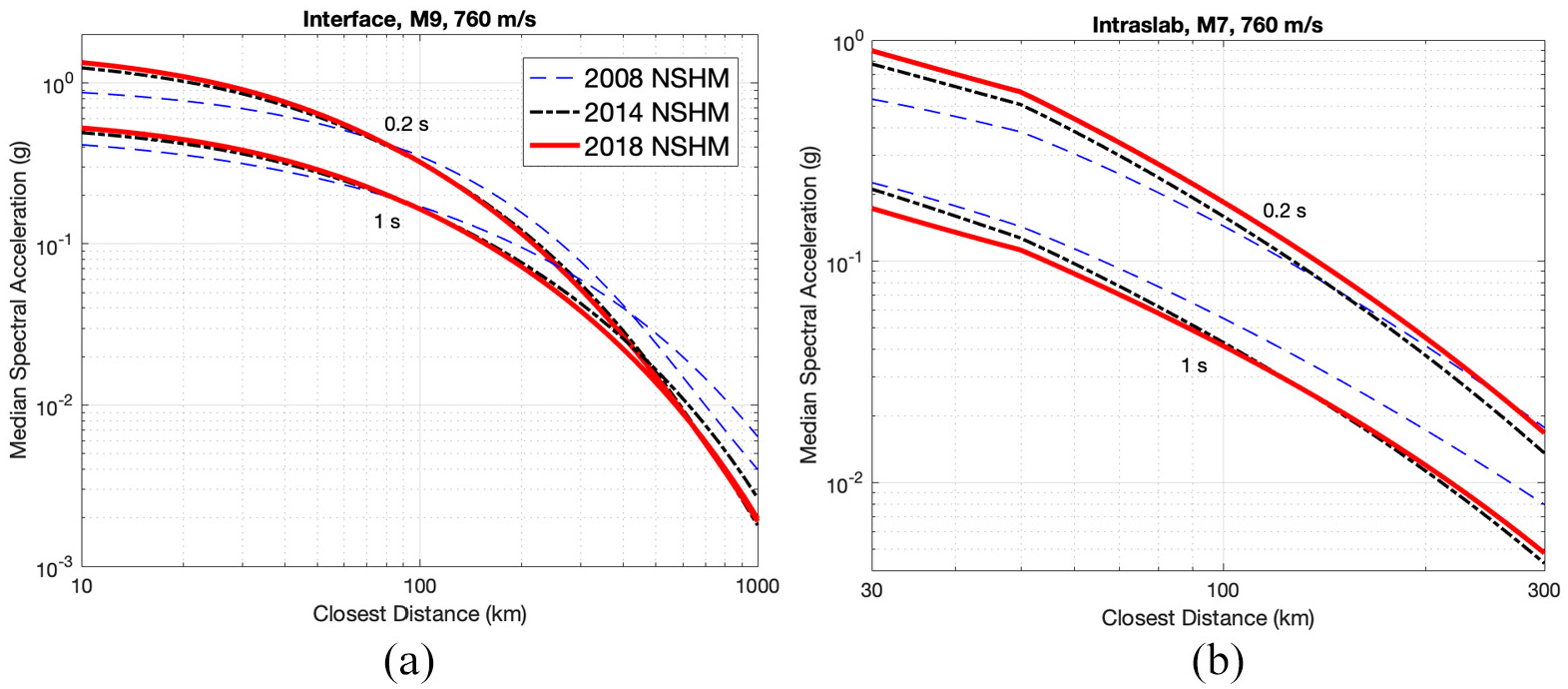
Weighted combination of median WUS subduction GMMs versus rupture distance,
For intraslab events, predicted ground motions of the AB03-CAS and AB03-GL models are significantly lower at short periods and somewhat higher at long periods relative to other GMMs (Figure 9b). This behavior is consistent across all distance ranges as illustrated in Figure 10b by the increase in the 2018 weighted combination of deep intraslab GMMs, relative to the 2014 values, at 0.2 s. An overall decrease at 1-s spectral period is observed at short distances. For both interface and intraslab events, the change in ground motion from 2014 to 2018 is significantly less than that arising from comparison with the 2008 NSHM GMMs, which included the Youngs et al. (1997) GMM and higher magnitude saturation thresholds for the intraslab AB03 GMM (Rezaeian et al., 2015).
Aleatory variability for AB03 is generally lower than for the other subduction GMMs; although at long periods, standard deviation of the AB03-GL interface is about the same as the other interface GMMs (Figure 11). Removal of AB03, therefore, results in increases to standard deviation for subduction interface and intraslab events in the 2018 NSHM. When combined with increases in median ground motion observed for interface events at short distances and intraslab events at short periods, we expect commensurate increases in ground motion and hazard.
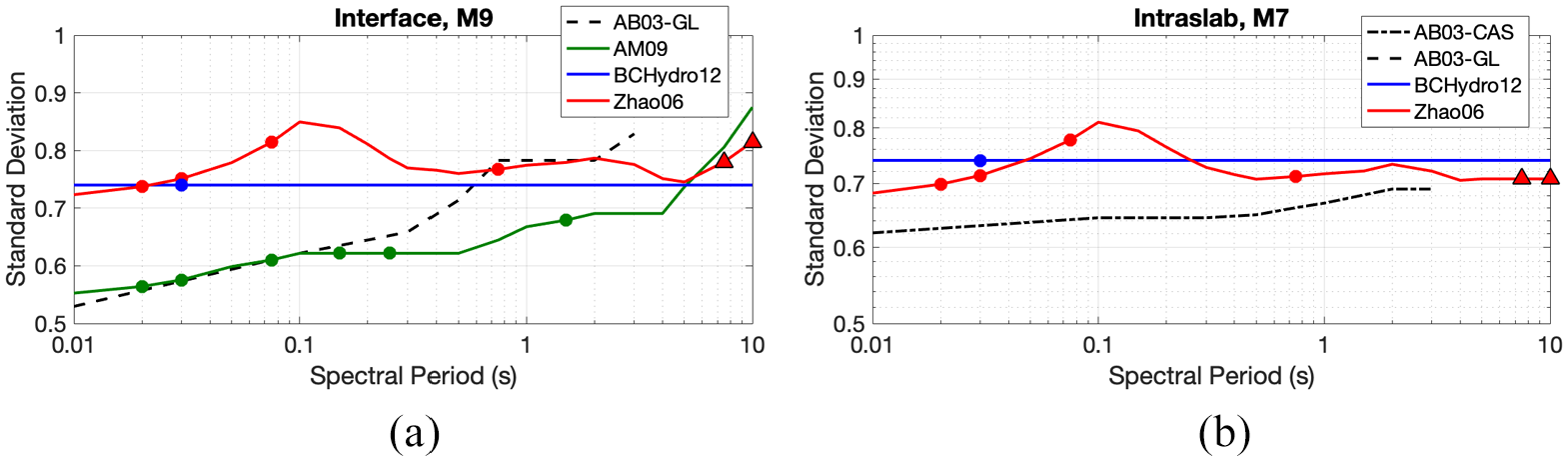
Standard deviations of subduction GMMs for (a) a magnitude 9 interface event and (b) a magnitude 7 deep intraslab event. Dots indicate spectral periods computed via interpolation of adjacent periods; triangles indicate extrapolated periods.
Epistemic uncertainty for WUS subduction GMMs
The distribution of epistemic uncertainty for WUS subduction GMMs has historically been very narrow relative to both WUS crustal GMMs in active tectonic settings and CEUS GMMs in stable continental regions, as reflected in the logic trees for the 2014 and 2018 NSHMs (Table 2) and Figure 12. Although removal of AB03 in the absence of alternative GMMs further reduces the number of models considered, median ground motions do not change significantly. There is, however, considerable room for improvement. The tectonic and geologic characteristics of Cascadia are quite different from other, young, high convergence rate and seismically productive subduction zones, recordings from which are the basis for the majority of subduction GMMs (Bozorgnia, 2020). Little data for Cascadia and none for subduction interface events indicate a much broader representation of epistemic uncertainty or an increase in the aleatory variability of the GMMs should be considered in the NSHM. Future updates of the CONUS NSHM are expected to consider epistemic and aleatory uncertainty more thoroughly.
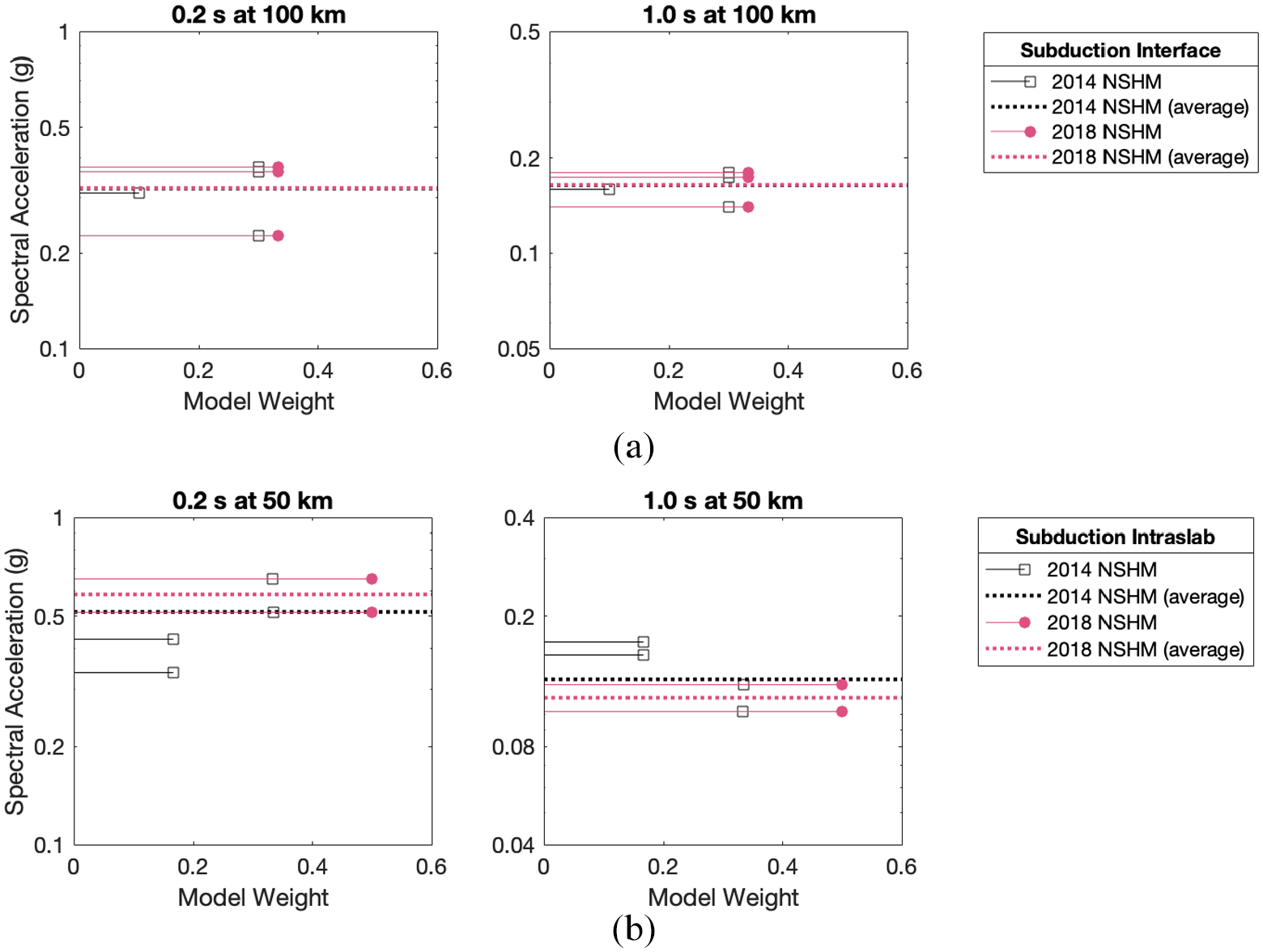
Epistemic uncertainty of WUS subduction GMMs represented by the range and distribution of ground motions at two example periods, 0.2 and 1 s, on a soft rock site (
Deep sedimentary basin effects added to subduction GMMs
None of the subduction GMMs considered in the 2018 NSHM include basin-effect terms. Because basin amplifications are critical for estimating long-period ground motions on soft site classes, the 2018 NSHM includes adjustments to subduction GMMs to include additional basin-effect scale factors. Chang et al. (2014) conclude that
In deciding how to modify the subduction GMMs, we also considered replacing the entire site-effects model (i.e. including the
Figures 13 and 14 show the effect of applying the CB14 basin-effect scale factor to the WUS subduction interface and intraslab GMMs, respectively. In these examples, we use a very deep basin-depth value representing a location in the vicinity of Seattle,
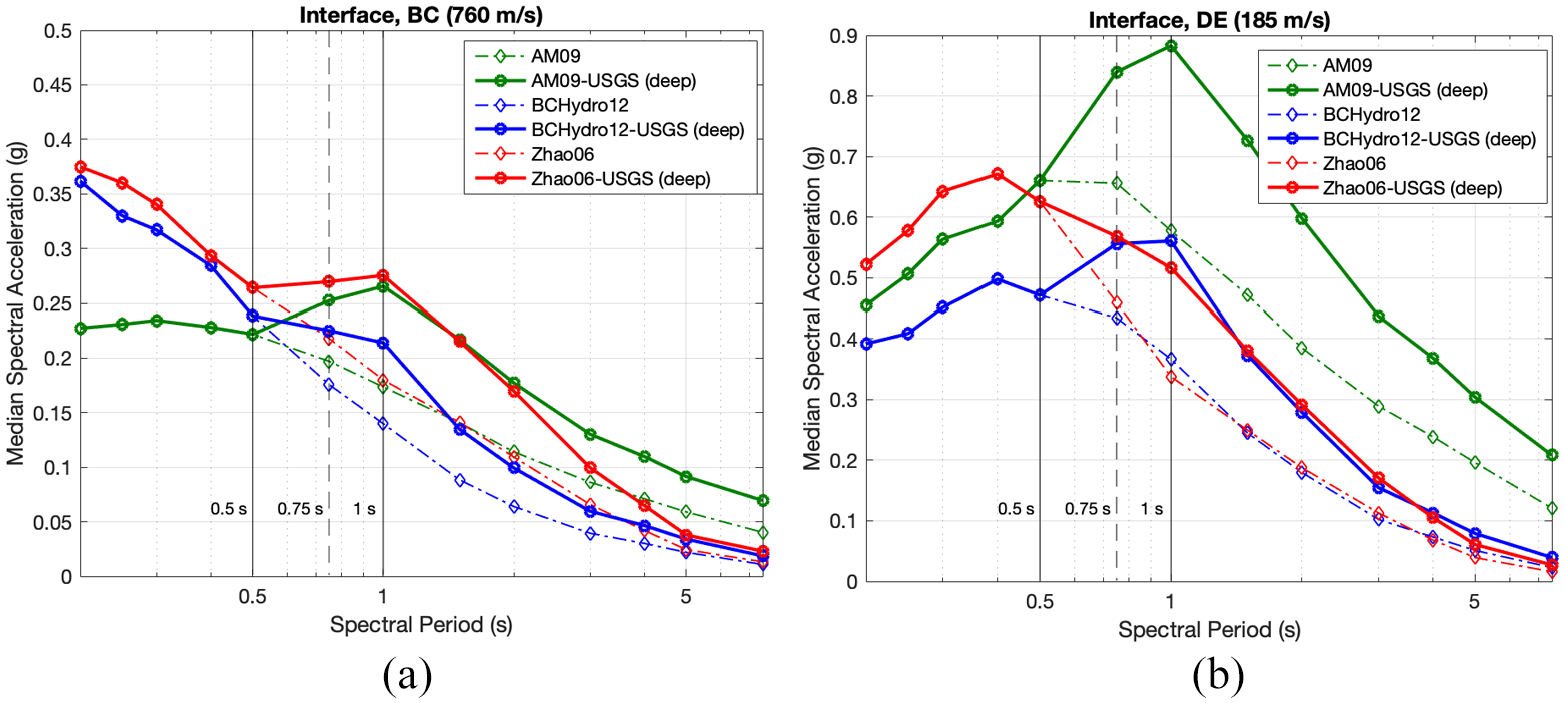
USGS implementation of WUS subduction GMMs for deep basins like Seattle,
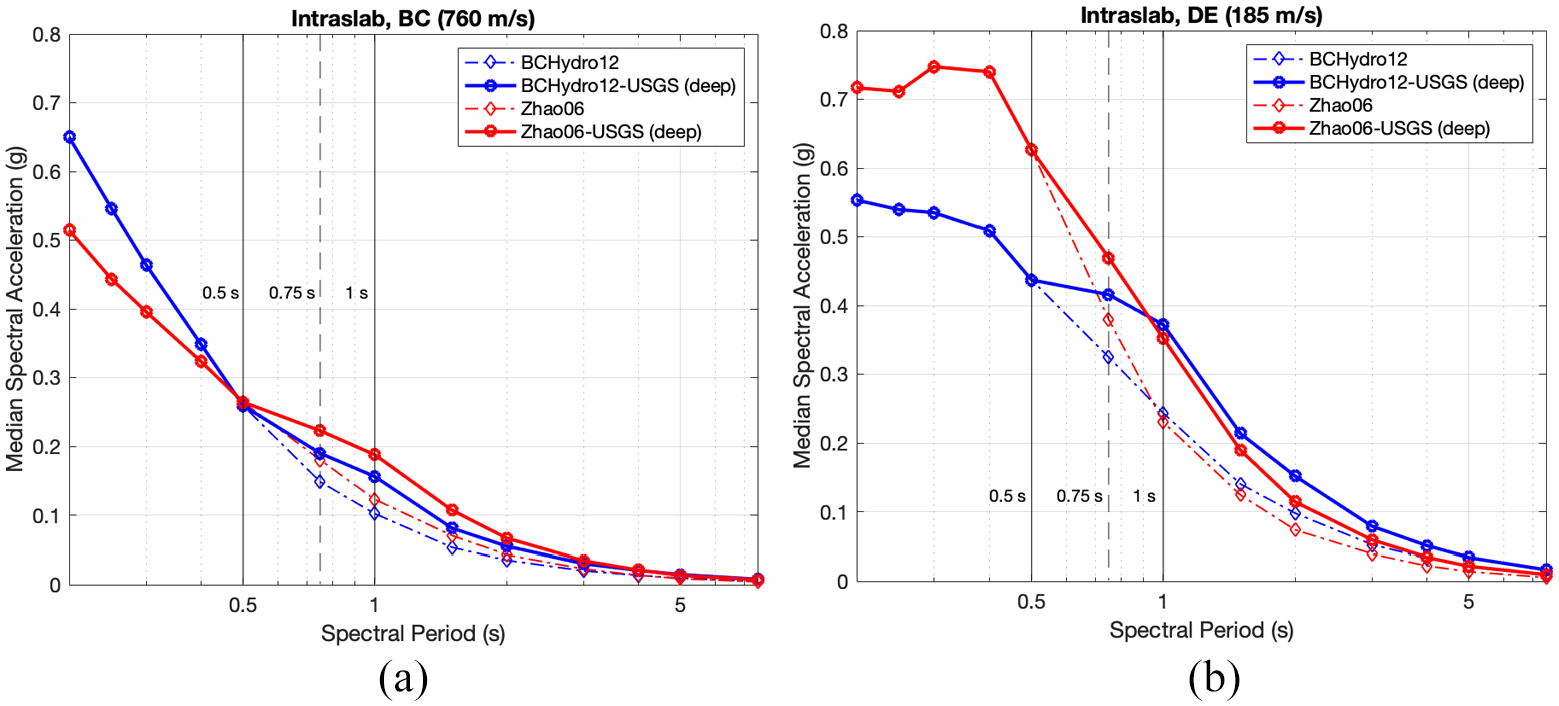
USGS implementation of WUS subduction GMMs for deep basins like Seattle,
Implications of WUS GMM changes on hazard
This section shows the combined effects of changes in GMM medians, standard deviations, site-effect models, and epistemic uncertainty on hazard over multiple NSHM cycles. Difference and ratio maps of mean hazard with a 2% probability of exceedance in 50 years for the WUS using the 2014 NSHM source model, but with the 2008 and 2014 NSHM GMMs at 2 spectral periods, 0.2 and 1 s, are shown in Figure 15. Figure 16 shows the same comparison, using the 2014 NSHM source model, but paired with the 2014 and 2018 NSHM GMMs. Note that these maps are not representative of the total change in hazard given that they use the same source model; they only show the effects of GMM updates. Petersen et al. (2021) provide information on the total changes in hazard, including those due to source model updates.
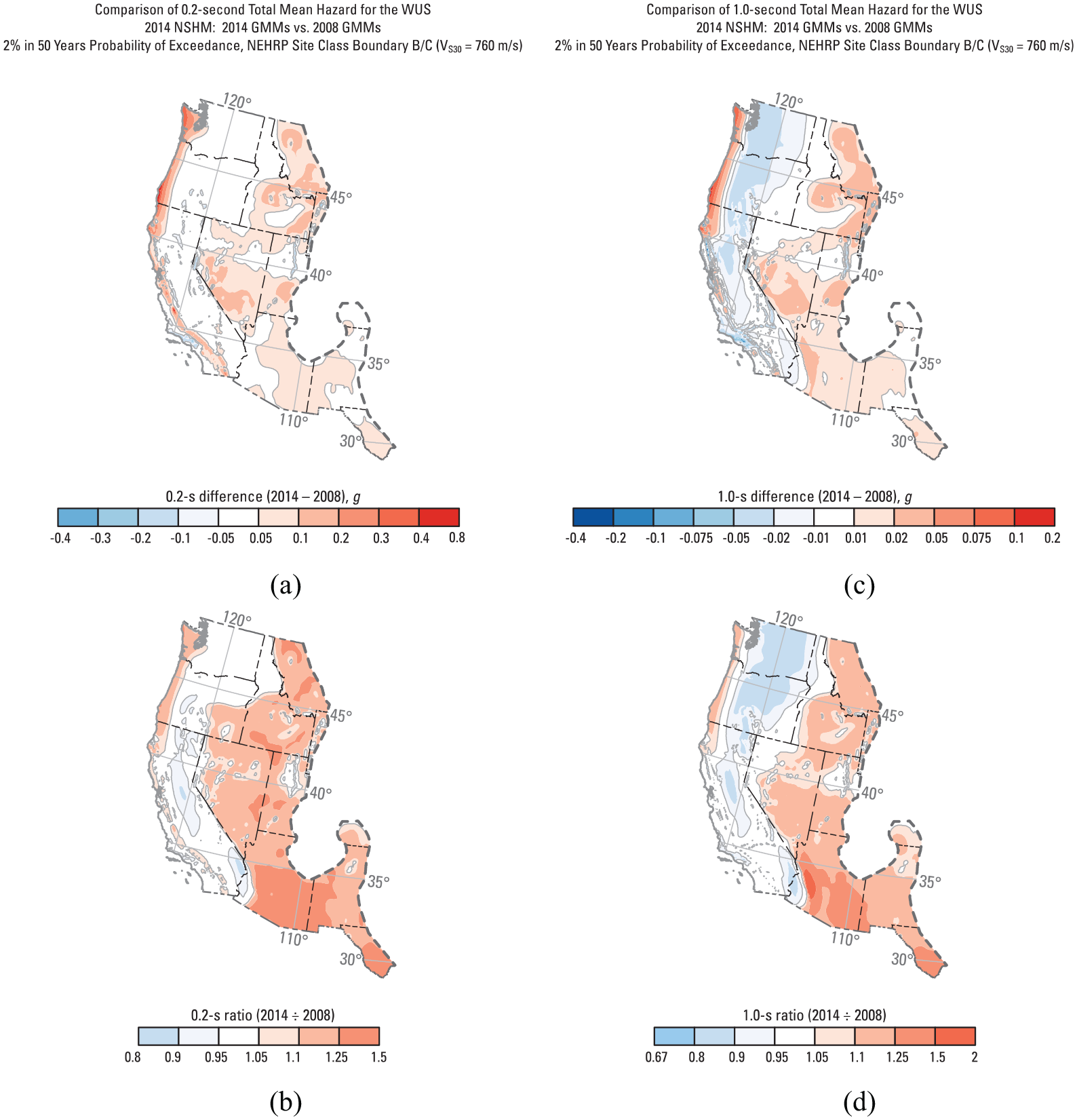
(a, c) Differences and (b, d) ratios in mean hazard, calculated using the 2008 and 2014 WUS GMMs (both using the 2014 source model) at 0.2- and 1-s spectral periods.
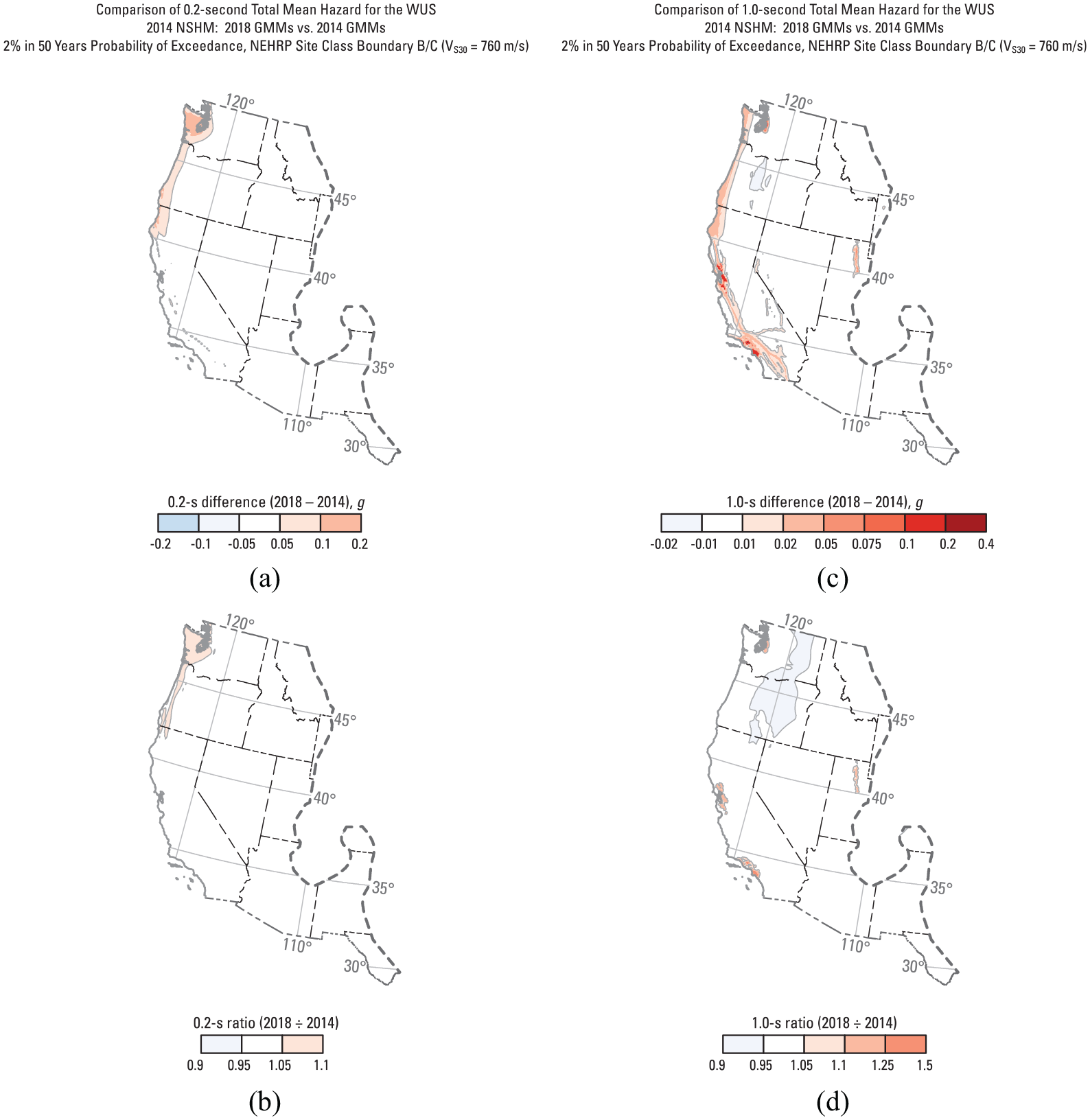
(a, c) Differences and (b, d) ratios in mean hazard, calculated using the 2014 and 2018 WUS GMMs (both using the 2014 source model) at 0.2- and 1-s spectral periods.
In the 2014 NSHM update, the primary change to the 2008 crustal GMMs in the WUS was the adoption of the full suite of five NGA-West2 GMMs, replacing three NGA-West1 models. Features of the new models at 0.2 s included larger predicted ground motions near high slip rate strike-slip faults (e.g. along the San Andreas Fault in CA; Figure 15a) and decreased near-field hanging-wall effects (e.g. in southern CA and along the Wasatch front in UT; Figure 15a). Broad increases in predicted ground motion across the WUS from 2008 to 2014 are attributed to increased far-field ground motion response to normal fault events in the NGA-West2 GMMs (Powers and Field, 2015; Rezaeian et al., 2014). Changes in the predicted Pacific Northwest ground motions arise from the updated composition and weighting of both interface and intraslab GMMs (Frankel et al., 2015). In the 2014 NSHM, the Youngs et al. (1997) intraslab GMM was replaced in favor of Zhao06 and BCHydro12. In addition, the 2014 NSHM imposed a lower magnitude saturation in the AB03-CAS and AB03-GL intraslab GMM implementations. On the interface side, Youngs et al. (1997) was replaced with AM09 and BCHydro12. Collectively, and consistent with Figure 10a, these GMM changes led to significant increases in calculated hazard along the California, Oregon, and Washington coastlines, where hazard is dominated by the earthquake potential of the Cascadia subduction zone; slight decreases in hazard occurred inland. Similar features are present in the 1 s difference and ratio maps (Figure 15c and d) with a more pronounced decrease in far-field subduction ground motions present across central and eastern Oregon and Washington. For more detail on the interplay of changes between the GMMs and extensive changes to the NSHM source model from 2008 to 2014, see Rezaeian et al. (2014, 2015); and Powers and Field (2015).
In the 2018 NSHM update, changes to GMMs and resultant calculated hazard were relatively minor as shown in Figure 16. Consistent with Figure 10a, both near- and far-field subduction ground motions changed, resulting in increased hazard along the Pacific Northwest coastline (Figure 16a) and decreased hazard slightly inland (Figure 16d) due to removal of the AB03 GMMs. Removal of the I14 model from the crustal GMM logic tree causes minor changes in hazard due to its relatively low weight (0.12) in the 2014 model. I14 predicts lower ground motions for M > 7 events at 1-s SA, resulting in increases in calculated hazard of 2%–5% along the fastest slipping faults in California (e.g. the San Andreas, Hayward, San Jacinto, and Garlock faults) that are capable of hosting the largest earthquakes (Figure 16c). Changes arising from removal of I14 are consistent with changes to the average median and standard deviation discussed earlier. The 1-s maps show the expected long period increases in hazard in the vicinity of Los Angeles, San Francisco, Salt Lake City, and Seattle due to the inclusion of spatially varying basin depth data (see Petersen et al., 2020, for higher resolution hazard ratio maps of the basins). Other changes present in the ratio maps for Montana, Wyoming, Utah, and Colorado are due to changes in CEUS GMMs, the influence of which extends as far west as −115°.
Future work
Improvements to the representation, quantification, and reduction of epistemic and aleatory uncertainty are currently a major focus of NSHM research and development. As demonstrated in this article, representation of epistemic uncertainty in the GMMs in the WUS is somewhat limited relative to 2018 updates to the CEUS GMMs (Rezaeian et al., 2021); this is especially true in the case of the subduction GMMs. Fortunately, the NGA-Subduction project is underway (Bozorgnia, 2020), and possible adoption of these models in the 2023 update to the CONUS NSHM would be a marked improvement in this area. In addition to multiple models available for consideration (Abrahamson and Gülerce, 2020; Kuehn et al., 2020; Parker et al., 2020), each NGA-Subduction GMM includes a model of epistemic uncertainty.
Site effects also continue to be an area of focus for future NSHM development. Specifically, site classes A and E, which are at the extremes supported by some NGA-West2 crustal GMMs, require additional study to validate median ground motion predictions. WUS subduction GMM site-effect models (e.g. Zhao06, AM09) could also be improved. As above, we expect the NGA-Subduction GMMs to include improved site-effect models with built-in basin-effect terms. There are also improvements to be made on the products and user-guidance side of the NSHM. While the new MPRS requirements and inclusion of basin effects have significantly improved and expanded the range of hazard maps and design ground motions available, users could obtain hazard values that are physically unlikely. For example, hazard computed for the hard rock maps (site class A) for the WUS will include deep basin effects, an unlikely combination, in some locations.
The 2018 update marks the first time spatially varying site data were included in a USGS NSHM. While including basin effects in localized areas for long periods is a significant advance, there is more to be done with respect to understanding and developing models for shallow basins and basin-edge effects, as well as developing more regionalized, partially non-ergodic, and non-ergodic GMMs. In addition to considering additional sedimentary basins in other regions of the WUS and improving site-effect models, work on which is ongoing, site data (i.e. basin depths,
Summary
The USGS NSHMs are used in building design applications, which traditionally have been based on three spectral periods and one reference site class. The 2018 NSHM update supports the new MPRS recommendations of Project 17 for the future generation of building designs that call for hazard results at 22 spectral periods and 8 site classes. Resulting updates to the USGS GMM selection criteria necessitated the exclusion of some GMMs in the WUS and rebalancing the logic tree weights of those retained from previous editions of the CONUS NSHM. For WUS crustal GMMs, the Idriss (2014) model was excluded because it does not apply to ground motion estimation at soft soil sites. This change led to little impact on hazard at the three periods and one site class supported in the 2014 NSHM but, if included in the 2018 NSHM, would have produced very high ground motions under the expanded MPRS requirements. For WUS subduction interface GMMs, the Atkinson and Boore (2003) GMMs, both Cascadia and global models, were excluded due to lack of support for long periods and having weak attenuation at long distances. This change led to minor increases in computed hazard along the coast in the Pacific Northwest at short periods (e.g. 0.2 s) and minor decreases inland at long periods (e.g. 1 s; less than 10% in both cases). The most significant change in the 2018 NSHM in the WUS is the inclusion of deep basin effects to improve estimates of long period (T ≥ 1 s) ground motions on soft site conditions. This change necessitated updates to WUS crustal GMMs and addition of basin-effect scale factors to WUS subduction GMMs to support the depth- and period-dependent USGS basin-effects model. The 2018 NSHM considers spatially varying basin depth data in the vicinity of Los Angeles, San Francisco, Salt Lake City, and Seattle. As a result, long period ground motions increased relative to 2014 in these regions. Epistemic uncertainty is fairly well represented in crustal GMMs, but that of subduction GMMs should be increased in the future.
Footnotes
Acknowledgements
The authors thank the U.S. Geological Survey (USGS) Earthquake Hazards Program for funding the development of the 2018 NSHM and the USGS Steering Committee for providing helpful input in developing the 2018 NSHM. They also acknowledge the continued contributions and input from all GMM developers mentioned in this manuscript, including Norm Abrahamson, Gail Atkinson, David Boore, Yousef Bozorgnia, Brian Chiou, Ken Campbell, Nick Gregor, Izzat Idriss, Ronnie Kamai, Emel Seyhan, Walt Silva, Jonathan Stewart, Robert Youngs, and John Zhao, among others. Finally, they thank the reviewers and editors of Earthquake Spectra, Brian Shiro, and Grace A. Parker for their reviews, and Janet Slate for reviewing the document for editorial and policy issues.
Additional resources

Declaration of conflicting interests
The author(s) declared no potential conflicts of interest with respect to the research, authorship, and/or publication of this article.
Funding
The author(s) received no financial support for the research, authorship, and/or publication of this article.