




Abstract
Students’ motivation to engage in elective music courses can be complicated or nuanced and is often informed by myriad personal and environmental factors. In this review of literature, I examine general education and music education research related to organismic perspectives on the development and maintenance of academic motivation among middle school students. The motivational constructs considered were Eccles’ task values (i.e., interest, attainment, utility, and cost) and Deci and Ryan’s psychological needs (i.e., autonomy, competence, and relatedness). When adolescents evaluate the importance, usefulness, enjoyment, and cost of the electives in which they take part, they are formulating task value beliefs. The more that students value a task, the greater the likelihood they will continue to engage in the task despite the costs. Continued task engagement, however, may require that students’ psychological needs for autonomy, competence, and relatedness be met. Implications and suggestions for music teachers are also presented.
Middle school presents a critical time for adolescent musical development, with many students beginning instrumental instruction during those years and participating in band and orchestra ensembles for the first time. The middle grades are also a time for physical development as students who begin instrumental programs in the fifth or sixth grade will enter ninth grade having grown by over half a foot on average, will need more rest, and become less coordinated due to their rapid growth (Antonisamy et al., 2017). To make matters more difficult, and in a stark contrast to self-contained elementary school classrooms, middle school students often visit multiple classrooms each day while being provided with more responsibility and choice than at any other time in their lives (Mackniak, 2009). With the expansion of elective choice for middle school students comes a precipitous decline in ensemble participation. Kinney (2019) reported that the percentage of students who elect to participate in a school ensemble dropped from 25% to 17% to 9% as students progress from sixth to seventh to eighth grade, respectively. Concurrently, enrollment rates for orchestra students dropped from 7% in sixth grade to 4% in eighth and 10th grades.
Music education researchers have faced difficulty interpreting the “intersecting factors” that influence music participation, thus limiting the development of practical suggestions for music teachers (Pendergast, 2020, p. 39). Ensemble participation has often been related to high competency levels in music and achievement in other subjects as strong indicators of future enrollment (Corenblum & Marshall, 1998; Hartley & Porter, 2009; Kinney, 2009; Klinedinst, 1991), while structural elements of the music program, peers and parents, and student interests have also been associated with retention (Stewart, 2005; Warnock, 2009). Concurrently, practitioners have suggested that (a) performance opportunities, (b) field trips, (c) group accolades, (d) fundraising events, and (e) social gatherings might explain student persistence in instrumental ensembles throughout middle school and beyond (Darling, 2014; Dolan, 2018; Sandene, 1994). The consideration of academic motivation, or a student’s desire to learn and engage in academic domains, might allow for a more nuanced investigation of student participation in elective instrumental school ensembles.
Problem and Purpose
Perspectives on music student retention typically ignore the fundamental role of motivation in determining whether student interest in music ensemble participation will strengthen or wane as they mature and are presented with other options (McPherson & Hendricks, 2010). One consequence of this blind spot is an incomplete understanding of the factors contributing to school music ensemble participation. An organismic approach, whereby students tend to regulate their own growth and integrate experiences from academic challenges into a developing sense of self, should be inclusive of environmental, social, and psychological antecedents. To understand students’ rationales for instrumental music ensemble participation in middle school and beyond, it remains important to consider the circumstances through which students elicit the motivation to engage in and persist at instrumental music learning.
There are many valuable perspectives that tend to explain variance in student motivation for instrumental music participation, including (a) achievement goal theory (Nicholls, 1984), (b) possible selves theory (Markus & Nurius, 1986), (c) self-efficacy theory (Bandura, 1977), (d) theory of planned behavior (Ajzen, 1985; Yoo, 2020), and (e) Shavelson et al.’s (1976) hierarchical model of self-concept. However, Deci and Ryan’s (2000) self-determination theory (SDT) and Eccles’ (1983) expectancy value theory (EVT) can be applied in tandem to the problem of instrumental ensemble retention as predictive relationships have been identified between the two theories for adolescent instrumentalists, warranting further focused inquiry inclusive of these specific perspectives (Freer & Evans, 2018; M. Frey, 2018; Kingsford-Smith & Evans, 2019; Lowe, 2011; Yoo, 2021).
The purpose of this review of literature was to synthesize music education research that explores the impact of psychological needs satisfaction and task values of adolescents on academic motivation in instrumental music classes. As such, all studies presented were germane to the phenomenon of middle school student’s experiences of needs satisfaction and task values. More specifically, I selected studies related to adolescent motivation for instrumental music learning through targeted database searches in SAGE, ProQuest Dissertations & Theses Global, and JSTOR. In addition, I sought articles that included citations of seminal studies from attendant metatheories that present organismic explanations for student retention in elective music classes. The keywords and phrases used to access SDT literature were “basic psychological needs satisfaction,” “needs frustration,” “autonomy,” “competence,” “relatedness,” and “intrinsic motivation” as each related to adolescent instrumental music. Considering EVT, I searched for the keywords related to “task values,” “interest,” “utility” or “usefulness,” “importance” or “attainment,” and “cost” for adolescent instrumental music students. Literature on choir participation was not accessed as choral music learning tends to be ecologically distinct from instrumental learning, most notably the use of voice versus the use of instruments in the ensemble and the emphasis on social dimensions of motivation (Parker, 2018).
Adolescent Academic Motivation
Academic motivation is typically revealed by (a) student activity choices, (b) the investment or effort they devote to those activities, and (c) the extent to which students persist or continue engaging in those activities. Academic choices and behaviors are subject to the influence of normative values from parents and peers. For example, an adolescent may exhibit behaviors that are readily accepted and mirrored by the aggregate population of students in that school and that of parents (M. P. McCormick & Cappella, 2014). Moreover, middle school students selectively apply ability appraisals from peers, parents, and teachers in their efforts to manage expectancies for academic success (McPartlan et al., 2020; Pendergast, 2020). Although academic motivation ebbs and flows over time, changes in academic motivation may also be moderated by parents, peers, teachers, and more stable characteristics such as aptitude, gender, and personality (Eccles, 2011; Freer & Evans, 2018; Oga-Baldwin et al., 2017).
Activity Choice
Students begin choosing academic activities around the start of middle school as certain subject areas shift from a compulsory to an elective nature. Researchers addressing activity choice in academic motivation typically want to answer the question “What do students choose to do or not do, and why?” Parents are commonly attributed with influence over the beliefs and choices of adolescents, a process that begins at birth and continues into adult life (Ormrod, 2003). For instance, Simpkins et al. (2012) found that a mother’s importance and efficacy beliefs, as well as the mother’s perceptions of a child’s ability in the areas of sports, music, and math, positively predicted student participation in those areas up to one year later, and as many as four years later in some cases. A parent might provide support to instrumental music students through encouragement, provision of instruments and private lessons, as well as transportation to learning environments. Conversely, parents can become too involved in a child’s academic life and inhibit the development of a child’s academic motivation (Ormrod, 2003).
The motivating power of belonging, or relatedness, can change the course of a student’s life and value systems. Accordingly, middle school peers can exert influence on the enrollment decisions of others through encouragement or discouragement (Nichols, 2008). Researchers (Elpus & Abril, 2011, 2019) also present evidence for a logical notion—that a family with lower socioeconomic status (SES) might find the financial burdens of instrumental music education to be overwhelming, thus limiting the ability for an instrumental student to purchase a usable instrument, buy music or other materials, and fulfill other expectations of a contemporary instrumental music program (e.g., private lesson instruction). As such, adolescents from lower SES backgrounds might be at risk for attrition at critical decision points for elective ensemble enrollment.
Activity Investment
Research on activity investment refers to how much effort students expend on activities. Practitioners play a crucial role in the development of activity investment. Specifically, the way an instructor provides feedback can shape students’ desire to engage in, or put effort into, learning activities. Patall et al. (2018) suggested that when teachers explain the importance of an activity, acknowledge students’ negative attitudes toward tasks, and design learning activities to fit the interests of students, students were more likely to retain a sense of competence from lesson to lesson. The quality of teacher interaction with students has far-reaching consequences for student engagement and learning outcomes (Bundick et al., 2014). Furthermore, the relationship a student has with a teacher (e.g., whether a student feels supported, respected, and inspired) tended to influence students’ perceptions of the subject area’s relevance, usefulness, and value.
Among the instructional areas over which teachers can exert control, feedback may be the one element that most directly impacts students’ perceptions of competence, interest, and engagement within an academic domain. Krijgsman et al. (2019) found that process feedback allowed students to take ownership of their own learning, such that in lessons where students were aware of the learning goals, they demonstrated lower levels of rejection after receiving instructor feedback. Beyond commenting on the quality of effort or accuracy of performance, a music teacher providing process feedback might emphasize strategies for improving the learning process or performance outcome, thereby enhancing investment in the activity (Hattie & Timperly, 2007).
Activity Persistence
Persistence refers to both how and why students stay in an activity over time (e.g., playing an instrument from fifth grade through college). Although academic persistence is often predicted by a student’s task values (Mouratidis et al., 2018), perceptions of competence and belonging are useful metrics for predicting persistence through an activity. For instance, Chatzisarantis et al. (2019) reported that student achievement tended to increase “when friends [were] provided and received relatively high and equal levels of autonomy support,” indicating that students tended to value a subject only when peers were treated fairly and provided with choices in their academic tasks (p. 34). Persistence intentions have also been linked to the extent to which students can motivate themselves without reliance on external rewards (Renaud-Dube et al., 2015; Savard et al., 2013).
Perceived competence, or the extent to which a student feels capable of completing a task, is uniquely related to persistence in challenging academic circumstances. Radel et al. (2012) reported that students who engaged in choice-deprived academic tasks would not only experience lower levels of perceived competence but would also disengage in future scenarios where choices were provided unless perceived competence was restored. This finding implies that perceptions of competence may serve as a gatekeeper for a student’s ability to make their own choices in academic domains, even when provided with multiple academic task options.
However, it is important to note that competence beliefs or expectancies of success are not always correlated with actual competence (Ballion et al., 2004; Eccles, 2011). Alternatively, a student’s need for competence is most readily satisfied when both perceived and actual competence are aligned. Furthermore, students’ self-perceptions of competence and the cost of participating in a certain activity tend to act as unique and separate predictors of academic persistence between the seventh and eighth grades (Chiang et al., 2011). This empirical distinction supports models of academic motivation that consider students’ competence beliefs and value systems as independent functions of students’ self-directed achievement motivation. For example, an instrumental student might be appropriately challenged, experience a sense of achievement in an ensemble, and find ensemble class to be uninteresting, unimportant, too time-consuming, or financially cost-prohibitive to continue another year. Moreover, supporting students’ sense of competence is an important part of a larger consideration of psychological constructs that influence student retention.
Psychological Perspectives on Academic Motivation
A Brief History of Needs Satisfaction
Humans are social creatures, often driven by basic needs for acceptance and belonging, or feelings of competence and efficacy. Motivation, in the form of attitudes and actions, may be enhanced when such needs are fufilled. Between the 1930s and 1950s, multiple viewpoints on motivation emerged. Early conceptualizations included drive-reduction theory, which suggested that people respond to drives such as the need to sleep or drink water with actions that minimize the strength of the drive (Gagné, 2015). More specifically, humans often act out of a need to quell obstacles to homeostasis (Hull, 1943). Drive theory faced criticism for the negative framing of motivation, specifically in that it lacked explanations for pleasure-seeking motivations or activity preferences and too often reduced learning to managerial behaviors.
As time passed, notions of unconscious needs gave way to behaviorism, pioneered by B. F. Skinner, whereby behaviors were proposed to be modified through a system of reinforcements and punishments (Skinner, 1938). According to Skinner and others, desired student behaviors (e.g., paying attention in class) can be reinforced through praise or tangible rewards. Conversely, undesirable student behaviors (e.g., disrespecting peers or teachers) can be punished, for instance, with a phone call home or the loss of certain privileges at school. Despite the influence of behaviorism, social scientists within many disciplines believe that external rewards tend to inhibit motivation over time (Deci et al., 1999; B. Frey, 1997).
As an alternative to Hull’s drive theory of motivation, Maslow introduced the concept of needs satisfaction. In Maslow’s theory, lower levels of needs satisfaction (e.g., the need for physical safety) act as a filter for higher levels of needs satisfaction (e.g., the need for belonging and love), in that lower needs must be met to achieve higher needs satisfaction. To identify the “modern” needs of humanity, Maslow landed on a representative set that included physiological needs, safety needs, love and belonging needs, self-esteem needs, and finally the need for self-actualization (Maslow, 1943). Maslow’s theory suggests that desire to learn only emerges after lower order safety needs are met. This perspective is not always applicable to contemporary educational scenarios as some students struggle to meet basic safety needs such that their desire to learn is compromised or difficult to fully realize. As such, all students may not necessarily progress through each level of Maslow’s hierarchy in a linear fashion.
The Organismic Perspective
As envisioned by Deci and Ryan (2000), SDT was developed as a counter to the principles of behaviorism and as an extension to the concept of needs satisfaction. This theory is fundamentally embedded in an organismic dialectical approach, which assumes that “people are active organisms with evolved tendencies toward growing, mastering ambient challenges, and integrating new experiences into a coherent sense of self” (Deci & Ryan, 2017, para. 4). Deci and Ryan continued, These natural developmental tendencies do not, however, operate automatically, but instead require ongoing social nutriments and supports. That is, the social context can either support or thwart the natural tendencies toward active engagement and psychological growth, or it can catalyze lack of integration, defense, and fulfillment of need-substitutes. Thus, it is the dialectic between the active organism and the social context that is the basis for [SDT’s] predictions about behavior, experience, and development. (para. 4)
Needs satisfaction functions similar to deposits in a bank account or a healthy diet—subsequently providing individuals with the resources or motivational energy needed to sustain engagement in a task. Furthermore, the way a student engages with their academic context influences the extent to which their psychological needs are satisfied. The early focus of SDT research was intrinsic motivation, or the engagement in an activity for its “inherent satisfaction” (Ryan & Deci, 2000, p. 56). With this focus, Deci and Ryan attempted to reorient human motivation research toward the self as an active yet integrative process rather than a fixed or conditioned process (Ryan & Deci, 2000).
Basic Psychological Needs
A set of basic psychological needs (autonomy, competence, and relatedness) emerged that tended to predict intrinsic motivation, as well as positive experiences and perceptions of overall wellness across a multitude of learning domains—including music education (Evans, 2015). Needs satisfaction has been described as a “socially embedded process” that explains individual differences between students who do and do not retain motivation for a task over time (Kupers et al., 2014, p. 24). More specifically, psychological needs have been utilized as a framework for investigating middle school students’ motivation for music participation and their persistence through learning ebbs and plateaus. Research on psychological needs satisfaction in music education contexts has been limited to secondary school and undergraduate populations, while a handful of studies delineate the impacts of needs satisfaction on middle school instrumental students. In a study on middle school music student practice engagement, Schatt (2018) identified significant positive relationships between motivation to practice and instrumental experience, private lesson study, intrinsic motivation, and needs satisfaction. Needs satisfaction has also been identified as a significant predictor of intrinsic motivation and enrollment in high school music programs (Anguiano, 2006; Freer & Evans, 2018, 2019; Yoo, 2021). Furthermore, music students who cease musical activities as adults experienced significantly lower levels of needs satisfaction than music students who were highly engaged in musical activities (Evans et al., 2012). Needs-supportive parents have also been associated with students who were more motivated to practice than students of unsupportive parents (Schatt, 2018). In addition, needs satisfaction plays a key role in the development of task values, holding both direct and indirect effects on subsequent elective intentions, as “a sense of value for music as a subject and the activities in the classroom will be advanced to the extent that the students’ psychological needs are developed” (Freer & Evans, 2018, p. 892).
Autonomy
Autonomy is a student’s perceived agency over their own lived experience. In educational contexts, autonomy typically refers to the extent to which students are provided choices in completing an academic task. High levels of autonomy have been found to elicit positive impacts on retention in music education, and often predict internalized motivation to continue band or orchestra studies (Evans, 2015). This basic need is thwarted when students lack choice in educational settings. From a teacher’s perspective, providing students with autonomy may be equated with a loss of control; when student desire for autonomy is thwarted, however, problem-solving skills, creativity, and intrinsic motivation suffer (Amoura et al., 2015). Conversely, providing students with reasonable and developmentally appropriate choices enhances the perception of student control and might satisfy the need for autonomy.
Practically, autonomy supportive instruction includes “non-controlling language, providing explanatory rationales, acknowledging students’ feelings, and allowing an aspect of choice” over the course of instrumental music instruction (Freer & Evans, 2019, p. 795). Bonneville-Roussy et al. (2020) investigated the construct of autonomy for music students in higher education settings. The facets of autonomy, according to those results, were (a) choice, (b) structure, (c) rationale, and (d) perspective taking (i.e., whether a teacher validates a student’s anxieties), which mirror the findings of Evans’ (2015) research, where similar examples of needs satisfying and thwarting teacher behaviors were presented.
Instrumental music teachers can support the notion of choice by involving students in the planning of assignments and assessments while encouraging and providing choices for students throughout the curriculum and within each lesson. Teachers can also provide a structure for the emergence of autonomy by reiterating course procedures, by allowing students to ask questions about the structure of the course, and by building flexibility for student circumstances (e.g., low SES background or neurodiversity) into the grading structure of the course. In addition, music teachers might present their rationales for music learning tasks and allow students to explain their reasoning behind their views on such tasks (e.g., “I want you to practice scales because it will help you play your part more confidently”). A rationale-focused dialogue may allow students to internalize their teacher’s motivations, while teachers are given an opportunity to understand how their instructional choices are received by students. Finally, and perhaps most importantly, music teachers should be responsive to student feedback by adjusting their policies and practices to be inclusive of structured student choices, thus creating room for autonomy support throughout their instrumental music curricula.
Competence
Competence reflects whether a student perceives their knowledge and skill set as meeting the requirements and expectations of a task they must complete. Deci and Ryan (2000) stated that competence is undermined in music education contexts when students are given assignments, musical or otherwise, which they cannot see themselves successfully completing. Conversely, the need for competence can be frustrated when a task is not challenging enough for a student (Deci & Ryan, 2000). It is common for middle school students to form competence beliefs regarding their expectations and abilities as an instrumentalist. However, students who experience frustration in the face of an academic challenge may resort to extrinsic motivation for task completion. Students may also experience amotivation, colloquially referred to as apathy, due to incongruence between academic expectations and perceived competence (Evans, 2015). When the learning process is impeded through tasks that are too easy or too difficult for the student, the student’s persistence and investment in academic activities tend to be negatively impacted. In some instances, students may self-handicap through procrastination, disruptive behaviors, and overexertion in multiple activities to mask low levels of perceived competence—which may be perceived by the teacher as noncompliance (Urdan et al., 1998).
Yoo (2021) recommended to support the satisfaction of competence: that teachers might clarify rules and expectations for rehearsal participation, provide clear learning goals, and consider developmentally appropriate learning tasks. Yoo also suggested that competence can be supported by utilizing improvement criteria, placing an emphasis on the development of individuals, and valuing the role of each individual student in the ensemble, and, as Freer and Evans (2019) stated, “when teachers focus on progress rather than evaluation of ability” (p. 795). Specifically, music teachers should get to know the musical abilities and social capabilities of their students. In addition, teachers should be mindful of how difficult assigned tasks are for students, while emphasizing the process of effort invested into those tasks over how successful students are. Finally, as Patall et al. (2018) suggested, “the more students perceived their teachers to provide rationales regarding the usefulness and importance of the classwork, acknowledged negative affect, structured activities around students’ interests, and provided encouraging, informational feedback” the more capable students were at retaining competence over time (p. 227).
Relatedness
Relatedness is a sense of connectedness with peers and teachers and can potentially explain students’ perceptions of the social context of music learning. Relatedness functions as a fundamental prerequisite for competence and autonomy development—partially accounting for the active role that external surroundings play in motivation (Deci & Ryan, 2000). In educational contexts, students have a need to feel connected with their instructors and their peers to fully enjoy the benefits of competence and autonomy needs satisfaction. Instructors can support relatedness as they build relationships with their students, pay attention to the “social-emotional climate” in their classrooms, and utilize instruction that improves shared feelings among students (Deci & Ryan, 2000; Kagan, 1994; Korthagen & Evelein, 2016).
Relatedness is a key lever in the development of positive intentions for future band or orchestra participation. For example, when teachers give effort toward building interpersonal relationships with students, they tend to have higher intentions for continued participation (Yoo, 2021). When an adolescent’s need for relatedness is satisfied, they might feel a “sense of belonging. . . that they are respected, liked, and supported by both their teacher and their peers” (Evans, 2015; Evans et al., 2012; Freer & Evans, 2019, p. 795). Often, relatedness can be built through conversations that occur outside of class and as students enter the classroom, which demonstrate a teacher’s awareness and appreciation of a student as an individual—the rapport-building efforts that lead to trust and mutual respect. In addition, music teachers can plan for group work and develop strategies to boost the prevalence of students’ use of voice (e.g., responding to questions or working with a partner) in class activities.
Task Values
In the early 20th century, members of the American Philosophical Association defined value as “something which is ultimate and which attaches itself to things independently of consciousness of an organic being with desires and aversions” (McGilvary et al., 1913, p. 168). Psychologists subsequently conceived of value as part of a deliberately constructed belief system that influences motivation. According to EVT, student motivation is driven by expectancies (i.e., task-related predictions of future success) and task valuation (i.e., the level to which an individual perceives a task as valuable; Atkinson, 1957).
On valuation, Eccles suggested that what one values is equal to, or in response to, a perception of what is appreciated (Eccles, 1983). More specifically to instrumental contexts, students tend to adjust their effort in ensembles to align with their expected success and value for the task (M. Frey, 2018). EVT suggests that expectations for success are associated with future achievement, whereas task values predict future activity engagement, elective course decisions, and ultimately student career paths. In situations that involve student choice, task values typically impact choices to a greater extent than expectations (Eccles & Wigfield, 1995) or needs satisfaction (Freer & Evans, 2018).
To provide a comprehensive overview of the influences on adolescents’ academic choice and motivation, Eccles (2011) developed a model depicting achievement-related choices and performance as critical outcomes influenced by either expectations for success or the value which students attach to available “behavioral options” within academic tasks (p. 195). The model, displayed in Figure 1, further links achievement-related beliefs, affective reactions, and goals to (a) self-directed attributions of intelligence; (b) influence from parents, peers, teachers, and media; (c) gender-role beliefs; (d) SES; and (e) as overall expectancies and values for academic tasks and choices. Through this model, Eccles demonstrated the complex relationships between the psychological constructs and achievement-related choices and performance, which in turn are determinants of future achievement.
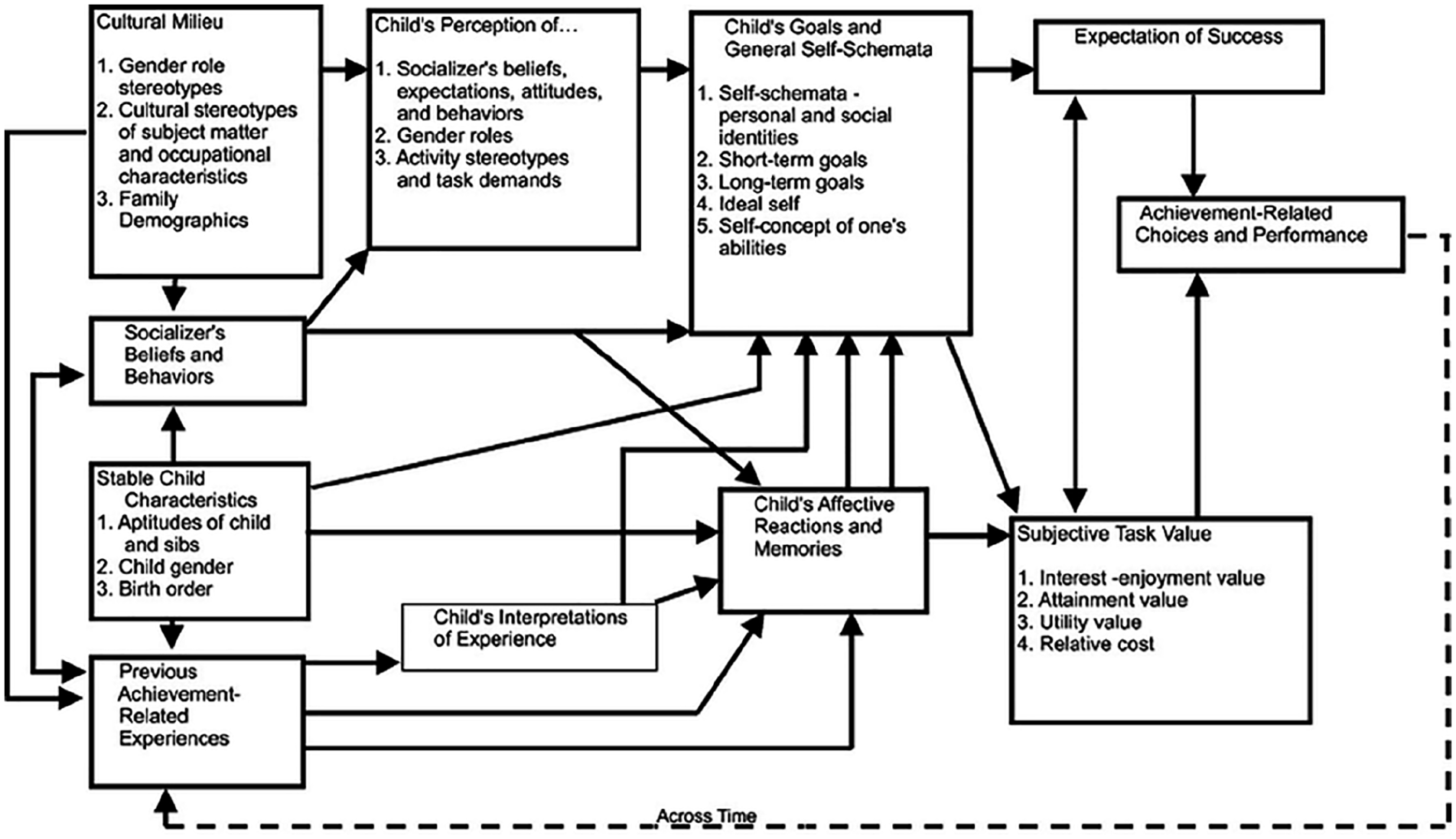
Eccles’ Model of Achievement-Related Choices.
McPherson and O’Neill (2010) compared 24,143 middle school music students’ valuation of music with five other school subjects in Brazil, China, Finland, Hong Kong, Israel, South Korea, Mexico, and the United States. Across the entire sample, music was valued less and perceived as less difficult than language, physical education, mathematics, and sciences classes. In addition, music students held higher competence and value beliefs, as well as perceptions of lower task difficulty in all school subjects compared with nonmusic students. This finding might indicate that the competence acquired through the process of learning to play an instrument can spur motivation for other academic subjects as well. Conversely, this finding could imply that students who were inherently motivated to attend school and learn also are attracted to and remain engaged in music. In either case, the psychological benefits accrued from music learning seem to diminish over time (McPherson et al., 2015).
In addition, there are several studies that pinpoint task value as a predictor of continued participation in music as well as the decision to cease music participation (Freer & Evans, 2018, 2019; M. Frey, 2018; Holster, 2021; Kingsford-Smith & Evans, 2019; Lowe, 2011; Yoo, 2021). In consideration of retention, music teachers often emphasize student interest and enjoyment in their lessons through an attempt to make music learning “fun.” Accordingly, Cogdill (2015) suggested that, to boost student persistence, music teachers should expand their course offerings to satisfy student interests and provide process feedback within those courses. Interest and enjoyment are paramount for students’ activity choices; however, persistence in music participation beyond the middle grades also requires the development of usefulness perceptions both for the present and the future as students begin to think about their career choices and life after pre-K–12 schooling (Wigfield, 1994).
Recommendations
The purpose of this review of literature was to synthesize music education research that explores the impact of psychological needs satisfaction and task values of adolescents on academic motivation in instrumental music classes. Several common factors emerged that tend to influence adolescents’ elective intentions, including (a) SES; (b) parents’ values; (c) peers’ values; (d) the satisfaction of relatedness, competence, and autonomy needs; and (e) the fulfillment of task values in instrumental music learning contexts. By considering the collective impact of these phenomena, teachers may adopt policies and procedures that tend to support students’ intentions to pursue future music ensemble coursework. For instance, to negate the negative influence of SES, instrumental teachers might limit the amount of after-school rehearsals that obligate families to arrange transportation around difficult work schedules and tight budgets. In addition, music teachers might consider the difficulties students have finding instruments and demonstrate flexibility regarding formal wear for performances.
Instrumental teachers might also acknowledge the role of parents in the development of motivation for enrollment. More specifically, instrumental teachers can send home a flyer, or other communication, highlighting the importance of providing a place for the student to practice in their home or share ideas with parents on how to discuss values in band or orchestra with their students (e.g., validating a child’s practice efforts). Teachers might also facilitate peer-to-peer conversations as peers can support each other’s motivation for music enrollment by starting conversations regarding band or orchestra and encouraging each other to enroll in instrumental music in the next school year or semester. Furthermore, students might buttress their peers’ academic motivation by attending each other’s extracurricular events and supporting their related accomplishments. It may also be important that if peers are in the same instrumental music class each of their needs are satisfied as congruence among peers’ needs satisfaction predicts academic achievement (Chatzisarantis et al., 2019).
Music teachers should seek to understand how task values relate to the tasks that students are asked to complete, while also acknowledging the role of grade level in task values. Instrumental music teachers should be prepared to observe an inverse relationship between task valuation and age for their students. In response to decreased valuation over time, it may be helpful to create curricular and extracurricular programs to respond to dips in task values, specifically for students who are approaching the transition to high school. In addition, interest valuation may serve as an initial emotional response to the presentation of a task to a student. Teachers might need to plan to support student interests over time, so that such interest can become internalized before discussing the importance and usefulness of instrumental music study, while also acknowledging the financial, emotional, and psychological costs associated with music ensemble participation.
Task values are best encouraged by teachers through needs-satisfaction-supportive instruction alongside the validation and curiosity provided by parents and peers. Therefore, a pragmatic path toward increasing task values is to utilize the influence of parents, peers, and needs satisfaction to boost task values and, in turn, increase the likelihood of continued enrollment. Furthermore, teachers might connect their students with older mentors who could address issues of interest, importance, utility, and cost from their more experienced, but relatable, vantage point. Finally, and possibly most importantly, music teachers should allow students with task values that do not align with future band or orchestra enrollment to depart their programs with their full support. Although some researchers have had success in developing adolescent interest by intervention, task values are not particularly malleable, and are often preconceived—implicitly constructed over the course of a child’s early educational and extracurricular experiences (Hulleman et al., 2010). As such, any investigation of task values for middle school students should be initiated to affirm individual differences, rather than pressure individuals to conform or become more similar in their values. Instrumental teachers should be prepared to adapt their programs in response to those individual differences—potentially at the expense of the instrumental ensemble model in favor of other modalities of music learning.
Conclusion
To contend with waning academic motivation for music participation over time, teachers might adopt an organismic perspective—to acknowledge that instrumental music students “are active organisms, with evolved tendencies toward growing, mastering . . . challenges, and integrating new experiences” (Deci & Ryan, 2017, para. 4). Moreover, music teachers should consider places in the curriculum where needs satisfaction (i.e., opportunities for autonomy, competence, and relatedness) can be frequently and meaningfully highlighted for their students. Furthermore, researchers, music teacher educators, music teachers, and parents of music students might conceptualize student behaviors surrounding certain tasks (e.g., avoidance of engagement on scales during warm-up, or being disruptive while other sections are being worked with) through the lens of both the needs satisfaction and task values constructs. These stakeholders should acknowledge that students arrive at all academic tasks with a preexisting sense of their interest, the usefulness, the importance, and the psychological, financial, effort, or opportunity cost of that task. Based on the presented findings, a proposed course of action for successful retention efforts is to boost task values, and subsequent academic motivation, by considering students’ task values in the development of curricula and instructional methods while ensuring that students’ needs for autonomy, competence, and relatedness are satisfied, and that any boundaries related to SES are addressed for students and their families.
Footnotes
Declaration of Conflicting Interests
The author(s) declared no potential conflicts of interest with respect to the research, authorship, and/or publication of this article.
Funding
The author(s) received no financial support for the research, authorship, and/or publication of this article.
