




Abstract
As artificial intelligence (AI) and its applications continue to reshape our world, understanding its historical roots is important, and increasingly so, for several explicit reasons. First, the pace and scale of AI’s impact are accelerating. The rapid integration of AI into critical sectors—such as healthcare, transportation, finance, and education—means that decisions about research, policy, and regulation must be informed by a deep understanding of how current technologies evolved and the lessons learned from past successes and failures. Second, the importance of understanding AI’s history is growing because ethical, societal, and regulatory questions are becoming more urgent. This is particularly true for Europe, where a rich tapestry of AI-based research and innovation has unfolded over the past seven decades. We hypothesize that by documenting the histories of AI in Europe through this timeline, we will uncover underrepresented milestones, providing insights into future AI research directions and policy developments. This timeline will offer a comprehensive historical record and serve as a practical tool for analyzing trends in AI development specific to the European context.
Introduction
Artificial intelligence (AI) is increasingly central to contemporary societies and economies, shaping how we learn, communicate, and make decisions. In Europe, as elsewhere, AI has become a strategic policy and innovation priority. Yet crafting a distinctly European vision for the field’s future demands a solid grasp of its longer-term scientific and socioeconomic evolution. This paper meets that need by presenting a timeline of AI in Europe—an instrument for historical reflection on key developments that can underpin more robust anticipatory governance. Understanding these historical roots yields three concrete benefits: (i) clearer insight into AI’s current state; (ii) a lens on how the technology is reshaping social and political structures; and (iii) guidance to help the scientific community avoid repeating past mistakes.
The idea of documenting the histories of AI in Europe arose naturally during a series of informal discussions among AI researchers involved in the HUMANE-AI project (HUMANE-AI Project Team, 2024). 1
While global narratives of AI’s history often focus on contributions from the United States and Japan, it is crucial to recognize that Europe has played a pivotal but underreported role in AI research and development, making significant contributions that have shaped the field. Recent publications such as Bibel (2014), Sandewall (2014), and AI Watch (2020) have begun to address this gap by providing an overview of AI’s early history in Europe. However, more focused accounts on regional development remain sparse. By integrating sources from European scientific journals, AI communications, and interviews with AI pioneers, we aim to provide a more robust citation base that will serve as a comprehensive reference for European AI history.
Examining the historical evolution of AI in Europe also yields insights into the continent’s pursuit of technological sovereignty and its positioning in global competition, particularly with the US and China. It also underscores the importance of overcoming fragmented political and industrial ecosystems to establish a unified European AI strategy. In this paper, we strongly advocate for creating a comprehensive timeline that documents the rich history of AI in Europe (see Section 4). This invaluable resource will benefit researchers, policymakers, and industry leaders.
One significant challenge in developing a comprehensive history of AI in Europe is that AI, as a technology, is intricately linked to economic growth and societal changes. Both aspects must be considered to achieve a successful result in this task.
The proposed timeline will fill a critical gap by documenting Europe’s contributions, including breakthroughs in logic programming, cognitive architectures, and robotics, many of which have influenced global AI policy, innovation, and research. In doing so, we will address the gap in existing literature and provide a European-centric perspective, emphasizing how Europe’s regulatory, ethical, and academic frameworks have shaped AI’s trajectory differently from other regions. By critically evaluating the historical decisions and long-term impacts on Europe’s AI landscape, influenced by key figures, we can extract valuable insights for future strategic planning.
Building a comprehensive timeline of AI history in Europe is both important and necessary for understanding the continent’s unique contributions, such as the birth of the first European AI research institutions and the development of key AI theories and challenges, such as the impact of geopolitical changes on AI research and applications, in this rapidly evolving field. Involving the European Association for Artificial Intelligence (EurAI) community in this effort is indispensable to ensuring a diverse and accurate representation of AI’s development across European countries and research institutions.
The Workshop on the History of AI in Europe (WHAI@EU; see Section 2) played a seminal role in this endeavor by bringing together experts to collaborate on the timeline project. By highlighting significant historical landmarks, we can trace the development of AI across Europe and identify key turning points that have shaped the current landscape (see Section 4).
To ensure accuracy and breadth, it is essential to consult a diverse range of AI experts across Europe—including national associations and research institutions—to gather insights on key milestones and influential figures (see Figure 1). This collaborative approach will help highlight individuals who have played instrumental roles in advancing European AI and inspire future generations. By engaging the EurAI community, the timeline aims to offer a more robust, inclusive, and authoritative account of European AI history—from its theoretical roots to current applications and regulation.
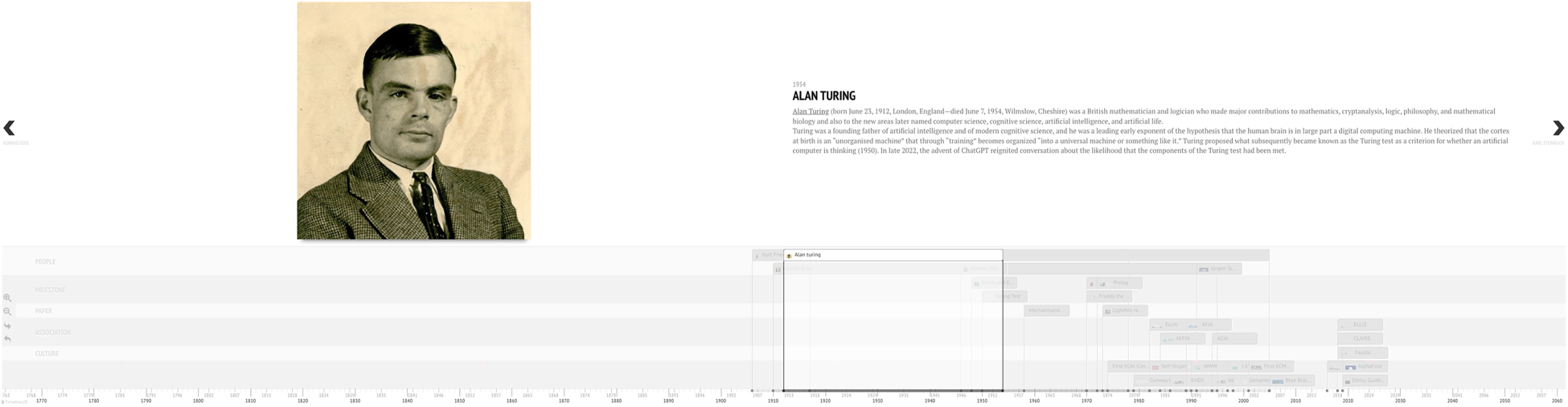
Timeline Showcasing Alan Turing Item.
To maintain consistency and relevance, we must develop a clear set of criteria and recommendations for including historical facts in the timeline, considering factors such as impact, innovation, and geographical representation (see Section 5).
The EurAI, uniting Europe’s AI scholars, is best positioned to curate and assess this timeline, ensuring academic coherence and authoritative stewardship. The EurAI Board has adopted these criteria and recommendations and commits to their application, harnessing its influential position as a premier organization in the field to oversee and validate this vital historical record. By doing so, the Board can ensure its continued accuracy and relevance, enhance its value to the European AI community, and foster a deeper understanding of AI’s evolution and impact across the continent (see Section 6.1).
The WHAI@EU was held as part of the 27
WHAI@EU aimed to explore the chronological development of AI in Europe, tracing its evolution from theoretical concepts to practical applications. WHAI@EU’s primary objectives were to highlight essential milestones, themes, and advances in European AI history and identify key individuals who played significant roles in shaping AI’s development on the continent.
During the workshop, participants contributed to developing a timeline of European AI, which Professor Luc Steels later presented during the 50
The discussion helped identify new inputs and validate some seeded key milestones, influential figures, and transformative moments that have shaped European AI research and development. Several participants highlighted the value of including living figures in the timeline to ensure the narrative remains dynamic, noting that ignoring contemporary contributions risks distorting the evolution of the field. A participant pointed out the importance of incorporating Soviet-era research, emphasizing that early AI work in Eastern Europe is often overlooked but fundamentally shaped the discipline. Incorporating these insights has been instrumental in shaping a timeline that is both comprehensive and nuanced, reflecting the multifaceted nature of European AI history. The collaborative discussions at WHAI@EU enriched our understanding of the diverse historical influences on AI and underscored the necessity of a flexible, community-driven approach to timeline construction. After the workshop on the History of AI in Europe, we proposed the next steps:
to agree on a list of inclusion criteria (see Section 5); submit this list to the EurAI board for its approval; and to publish the timeline on the EurAI Web page (see Barrué & Cortés, 2025).
Historiographical Approaches and the Evolution of AI in Europe
The reconstruction of scientific disciplines through historical inquiry demands rigorous methodological approaches prioritizing critical analysis, contextualization, and interdisciplinary synthesis. In examining the development of any scientific discipline, historians have increasingly relied on a robust framework that triangulates diverse sources, situates technological advances within broader sociopolitical landscapes, and engages in comparative studies across national boundaries.
Historians traditionally distinguish between primary sources—such as archival documents, original publications, correspondence, and technical reports—and secondary sources, including monographs and peer-reviewed articles. This dual reliance is essential for validating events and ideas through multiple corroborative lines of evidence. As Carr (1961) famously posited in What is history?, history is not merely a compilation of facts but a contextual narrative that interprets these facts within a larger, dynamic framework. This principle is especially relevant when exploring AI’s formative years in the 1950s and 1960s, a period marked by pioneering experiments and evolving theoretical paradigms.
Critical to this historiographical endeavor is the transparent acknowledgment of potential biases inherent in each source. As highlighted by Bloch (1992) in The historian’s craft, constructing a historical narrative requires a conscientious effort to assess the limitations and selective omissions within the archival record. This methodological rigor ensures that the narrative of AI’s evolution is coherent and reflective of the complex interplay between technological innovation and the prevailing cultural, economic, and political influences of the time.
Moreover, studying AI in Europe illustrates the importance of comparative and transnational perspectives. European research in AI did not develop in isolation but was shaped by diverse national policies, funding mechanisms, and academic traditions. For instance, the trajectories observed in France, the United Kingdom, Germany, and the Nordic countries reveal convergent and divergent paths influenced by regional political climates and economic strategies. Tosh (2015) provides an invaluable framework for understanding how comparative methodologies enrich our comprehension of these variances.
The interdisciplinary nature of AI further complicates its historical narrative. As a field that intersects computer science, mathematics, neuroscience, and philosophy, the evolution of AI in Europe is a testament to the fruitful collaboration between distinct academic traditions. Seminal texts such as Russell and Norvig’s Artificial intelligence: A modern approach (Russell & Norvig, 2016), while primarily technical, reflect the evolution of thought within the discipline and serve as markers for shifts in methodology and application over time.
In her seminal work, Kragh (1987), An introduction to the historiography of science, argues that the history of science possesses unique characteristics that distinguish it from general historical narratives. Kragh emphasizes that scientific progress is driven by internal epistemic shifts—paradigm changes, theoretical debates, and methodological innovations—that interact with yet remain distinct from external sociopolitical and cultural forces. His perspective underscores that a comprehensive historiographical approach to scientific disciplines must reconcile these internal dynamics with their broader contexts. This dual lens is particularly pertinent to examining the evolution of AI in Europe. The field’s development is a succession of technological breakthroughs and an unfolding intellectual narrative shaped by shifting scientific paradigms and external societal challenges.
On the other hand, AI is a relatively recent field. Unlike other phenomena that have been historically studied and are characterized by a lack of sources of information, AI presents the opposite challenge: an overwhelming abundance of information. In Europe, we have digital repositories maintained by academic institutions, scientific societies, or private companies that contain thousands of documents in different formats (text, video, audio, etc.). This makes it a real challenge to select and identify the relevant documentation, events, and processes that have genuinely influenced the development of AI.
The impact of AI on European society is best understood through a synthesis of these historiographical approaches. Historians have not only chronicled the technological milestones but have also investigated how public policy, ethical debates, and media representations have shaped—and been shaped by—the evolution of AI. This dual focus on innovation and societal integration underscores historical inquiry’s need to remain analytically rigorous and contextually sensitive.
The historiography of AI in Europe is still an evolving field, and there is not yet a single canonical historian dedicated exclusively to this topic. However, interdisciplinary research efforts that bring together historians, sociologists, and computer scientists are increasingly characterizing the narrative of AI in Europe. These collaborative approaches can highlight how public policy, funding mechanisms, and international cooperation have influenced the direction of AI research on the continent.
The European AI Timeline
In this timeline, we define “European AI contributions” as milestones that either (a) originated from European research institutions or companies or (b) were led by European scientists on European soil, excluding those born in Europe, but they developed their AI contributions in the US, Japan, or elsewhere.
This comprehensive definition ensures we capture contributions from European researchers working on the European context. It encompasses major European-led AI conferences, showcasing the continent’s academic leadership and projects funded by European bodies such as the European Union, highlighting institutional support for AI advancement. Additionally, including European regulatory efforts that influence AI research and development globally underscores Europe’s role in shaping ethical and legal frameworks for AI. This approach documents Europe’s direct contributions to AI and its broader impact on the global AI landscape. It reflects the continent’s multifaceted influence in driving innovation, setting standards, and guiding the responsible development of AI technologies.
This timeline (see Barrué & Cortés, 2024) aims to offer a more comprehensive overview of the development of AI in Europe than previous attempts. Furthermore, this timeline would help us trace how progress was manifested in specific historical events and analyze the goals pursued by the scientific AI environment over time. We aim to help establish clear criteria for including events, individuals, scientific papers, and milestones in a timeline of European AI history. For us, those criteria are necessary for several reasons:
Therefore, by carefully defining these criteria, we create a more robust, useful, and insightful timeline that accurately reflects the unique journey of AI development in Europe (Bianchini & Ancona, 2023).
A Glance to the Timeline
One of the key innovations of this timeline is its digital format, which allows for continuous updates and interactive features. Unlike static historical records, the timeline will be a living document accessible online, allowing users to explore AI milestones by decade, region, or specific subfields of AI. This dynamic approach ensures that the timeline remains relevant as new developments in AI unfold while providing an intuitive interface for researchers, students, and policymakers.
Figure 2 showcases a sample mockup of the timeline interface, designed to help readers better understand its structure. Each milestone is represented by a clickable node, allowing users to interact with individual events. Users can zoom in on specific periods for a more detailed view. At the top of the interface, a prominent visual of the selected milestone is displayed, accompanied by a detailed description and relevant media, such as images or documents. The timeline at the bottom is fully navigable and spans various decades, with clearly marked years for easy reference. Items are organized into distinct categories, displayed in horizontal rows:
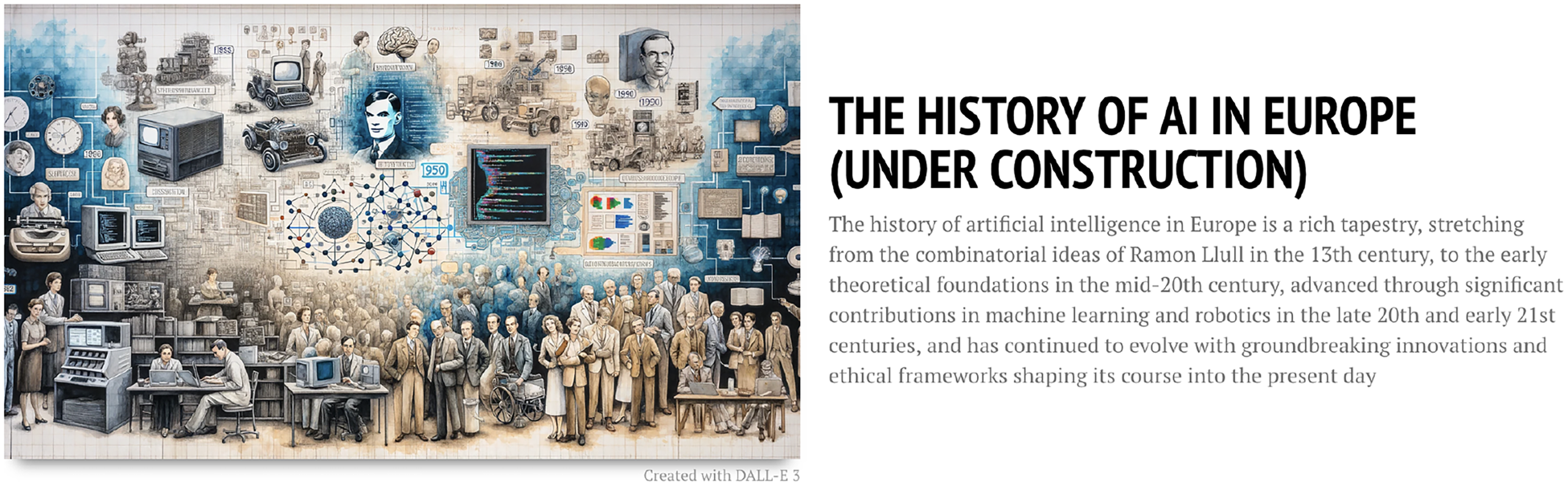
The Timeline of the History of Artificial Intelligence in Europe.
The timeline spans from ancient Greeks to the present day, showing past developments and potentially projecting future milestones, making it a living, evolving document that can be updated over time. The categorization is still open to discussion. More details on the validation process can be found in the next section.
Following the discussions held during the first Workshop on the History of AI in Europe (Cortés et al., 2024), we propose a structured yet flexible framework for deciding which historical facts, individuals, and events are included in the European AI Timeline. This framework seeks to ensure accuracy, relevance, and comprehensiveness, while acknowledging that historical relevance does not always conform to rigid quantitative thresholds. This guidance is particularly important in the context of AI as a rapidly evolving sociotechnical domain with growing societal impact. By adopting these criteria, we aim to represent not only major scientific breakthroughs, but also structural, institutional, ethical, and regulatory milestones that shape the development of AI in Europe. These criteria draw from best practices in historiography, archival research, and AI ethics, and are informed by previous historical accounts of AI in Europe (AI Watch, 2020; Bibel, 2014; Essen & Ossewaarde, 2024; Sandewall, 2014).
We organize the inclusion criteria as follows:
Example: the development of logic programming (e.g., Prolog; Colmerauer & Roussel, 1996) in Marseille in the 1970s, which fundamentally influenced AI knowledge representation and reasoning.
Example: The creation of AI Factories under amendments to the EuroHPC Regulation, integrating supercomputing infrastructure with domain-specific talent.
Example: the High-Level Expert Group on Artificial Intelligence (2019) and its influence on the EU’s AI policy framework.
Example: The CitCom.ai project, which established a pan-European Testing and Experimentation Facility for Smart Cities, engaging stakeholders across infrastructure, mobility, and energy.
Example: the EU AI Act, first proposed in April 2021 and updated in June 2023, as the first comprehensive legal framework for regulating AI.
While all seven criteria contribute to the historical value of a given entry, we recognize that not all may apply equally to every case. Therefore, we define a structured evidence framework and a tiered decision rule to ensure consistency, while maintaining scholarly flexibility.
Evidence Requirements
For each submitted event, curators must assemble an evidence bundle that includes: At least two independent primary sources to establish One archived primary source and one peer-reviewed secondary source, each bearing a persistent identifier (e.g., DOI and ISBN), to meet the Documentation of either Evidence of In the case of
Decision Rule and Workflow
To be included, an event must satisfy two mandatory criteria—Significance and Verifiability—and at least one of the two supporting criteria: Innovation or Impact. Transdisciplinary reach and ethical/legal importance are registered as descriptive tags and used to support interpretation, while geographical balance is achieved over time through corpus-level analysis. Every submission undergoes automated checks for metadata integrity, followed by dual review by volunteer curators. In cases of disagreement or borderline eligibility, the proposal is escalated to the Scientific Editorial Board. All accepted entries are published immediately on the public timeline. Each inclusion decision is recorded in a public changelog and its supporting evidence to ensure transparency and traceability.
Geographical Representation
To avoid an overconcentration of milestones from a handful of countries, we introduce Criterion 5 and task the Scientific Editorial Board with monitoring it on a rolling basis. Each quarter, the Board reviews the country distribution of newly accepted events using three complementary indicators and selects the one that best matches the current growth dynamics:
a prevalence threshold (no single member state may account for more than 25% of entries in any 12-month window); a Shannon diversity index over ISO-3166 country codes (target a qualitative heat-map audit highlighting missing or sparsely represented regions.
If any indicator signals imbalance, the Board issues a public call for nominations from the underrepresented areas, and curators proactively mine bibliographic data sets (OpenAlex and DBLP) to propose additional events for fast-track review. A dashboard reporting the chosen indicator, its current value, and the full country histogram is published on the project website every quarter, ensuring transparency and accountability.
To ensure the AI timeline’s accuracy, relevance, and comprehensiveness, we recommended establishing a robust set of criteria for including historical facts and individuals (see Section 5).
Building a timeline is not easy, and some risks must be avoided. For example, (a) there is a risk of criteria favoring well-known institutions or regions, potentially overlooking significant contributions from less prominent sources; (b) objectively determining which milestones or contributions are sufficiently significant to merit inclusion in the timeline can be a complex and challenging task; (c) dealing with incomplete information, historical records may be incomplete or biased, making it challenging to apply consistent criteria across different periods, and (d) ensuring transparency and explainability.
It will be no less important to address potential disagreements among experts and adapt the criteria to the ever-evolving definition of AI. AI definition and scope have changed over the last 70 years, which can complicate the application of consistent criteria in the future.
By carefully considering these potential risks, our community can develop a more comprehensive and accurate timeline for the history of AI in Europe. This will enable us to navigate better the complex landscape of AI research and application developments, regulation, and implementation.
To address the potential risks inherent in constructing this timeline, we propose a multiphase validation process that will take as a starting point the current timeline implementation X.
This approach aims to mitigate potential bias and increase the transparency of the selection process.
This will be complemented by interviews with pioneering AI researchers in Europe, whose first-hand accounts will provide qualitative insights into the lesser-documented aspects of European AI history.
Implementation Road-Map and Governance
The timeline prototype hosting 67 curated events is publicly accessible Barrué Cortés (2024). All source code, structured data, and documentation reside in a version-controlled GitHub repository, which provides automatic off-site backup and full provenance for every revision. A repository and web front-end transfer to EurAI’s infrastructure is underway; once complete, the EurAI Secretariat will act as legal data controller and day-to-day operator of the service.
Content governance will follow a three-tier model. First, a Scientific Editorial Board, composed of senior scholars appointed by EurAI, will define curation policy, adjudicate borderline cases, and provide final approval. Second, a pool of volunteer Content Curators, drawn from national AI societies, will screen incoming proposals and prepare metadata. Third, Technical Maintainers, funded by EurAI part-time, will ensure the platform’s reliability, security, and incremental feature evolution. Candidate events may be proposed anytime via an open submission form; once approved, they are integrated immediately into the timeline. All decisions and explanatory notes are recorded in a transparent change log to support reproducibility.
Long-term preservation is achieved by retaining the master repository on GitHub while mirroring the production instance to EurAI servers. Should EurAI ever be unable to continue hosting, the author team has undertaken to resume maintenance so that public access remains uninterrupted under the existing open-source license.
Financially, EurAI has earmarked a dedicated budget line covering hosting fees and essential technical upgrades—such as security patches, API extensions, and multilingual support. All editorial activities, including curation and board deliberations, will be provided in-kind by members of the EurAI community, thereby securing broad geographical representation without adding recurrent personnel costs.
Conclusions and Future Steps
The European AI strategy aims to make the EU a world-class hub for AI and ensure that AI is human-centric and trustworthy.
Creating a timeline for the History of AI in Europe delivers practical value beyond academic interest. It enriches all educational curricula with European case studies, fostering a finer understanding of AI’s evolution. It offers evidence-based insights for policymakers to inform effective, context-aware regulation, such as the EU AI Act (AIA, 2024), and supports strategic planning for technological sovereignty. Industry benefits from lessons learned, helping innovators avoid past pitfalls and leverage Europe’s unique strengths in trustworthy, human-centric, responsible AI. Critically, this timeline preserves a fair memory of European research and industrial achievements, ensuring that regional breakthroughs and contributions are recognized and not overshadowed by other narratives. By documenting these milestones, the timeline strengthens Europe’s position in global AI competition and supports unified, forward-looking AI strategies.
We believe the timeline and our proposed criteria contribute to the European AI strategy. The EurAI Board’s pivotal role in adopting and overseeing these criteria will be instrumental in adding a layer of authority and credibility to the project. Their expertise and connections with AI experts across Europe and their validation of the timeline’s content will be invaluable in creating a trusted historical record.
To further strengthen the timeline’s historical significance, we propose an empirical analysis of the impact of selected AI milestones on subsequent research and industry development in Europe. This will be achieved by tracing citation networks from key European AI papers and patents and identifying how ideas and innovations have diffused in academic and industrial domains. By quantifying the influence of European AI contributions in this way, we can demonstrate their long-term significance within the global AI ecosystem.
Recommendation for EurAI Board Adoption
The EurAI Board has formally adopted these criteria and recommendations for creating and maintaining the European AI timeline. As a leading organization in the field, EurAI is uniquely positioned to oversee this project, ensuring its accuracy, impartiality, and ongoing relevance. With its long-standing presence and deep expertise in the European AI landscape, EurAI provides the essential long-term continuity to maintain a comprehensive and evolving record of AI developments across Europe. This continuity is vital for capturing the rapid progress of the field and its wide-ranging impact on society, research, and industry.
By embracing this initiative, EurAI can:
Provide an authoritative resource on Europe’s AI history. Foster a stronger sense of European AI identity and community. Support educational initiatives and policy discussions. Highlight Europe’s ongoing role in shaping the global AI landscape.
By carefully curating this historical timeline, we can better appreciate Europe’s AI legacy, inform its present, and inspire its future in this transformative and decisive research field.
Future Steps
The EurAI community and other key stakeholders must collaborate to populate the AI timeline in Europe. The EurAI community should be invited to contribute their expertise and historical knowledge through a dedicated online platform or series of workshops. This platform could allow members to submit key events, milestones, and breakthroughs in European AI development. To attract interest from European industry and other important stakeholders, organizing a series of roundtable discussions on the impact of AI-based technologies on various sectors would be beneficial. These events could highlight how the timeline project aligns with the EU’s AI strategy and the implementation of the AI Act.
Additionally, partnering with national AI research centers and universities to conduct targeted research on the history of AI in their respective countries would enrich the timeline’s content. The national associations have a principal role in accomplishing this aim. To ensure broad participation, a public call for contributions could be launched, inviting AI practitioners, policymakers, and historians to share relevant information. We expect to have new editions of WHAIS@EU in future ECAI editions.
Finally, establishing a dedicated task force within EurAI to oversee the timeline’s development, verify submissions, and maintain its accuracy and relevance would be essential for the project’s long-term success and credibility. This would also create a framework through which future iterations could address the methodological and coverage limitations identified in the present version.
Footnotes
Acknowledgments
We thank the ECAI Chairs and the EurAI board for their invaluable support in making this workshop possible. We would like to thank Maarten Frölich from IOS Press for facilitating this special issue.

Funding
The authors received no financial support for the research, authorship, and/or publication of this article.
Declaration of Conflicting Interests
The authors declared no potential conflicts of interest with respect to the research, authorship, and/or publication of this article.