




Abstract
In the context of abstract argumentation, we present the benefits of considering temporality, i.e. the order in which arguments are enunciated, as well as causality. We propose a formal method to rewrite the concepts of acyclic abstract argumentation frameworks into an action language that allows us to model the evolution of the world and to establish causal relationships between the enunciation of arguments and their consequences on the acceptability of other arguments, whether direct or indirect. An Answer Set Programming implementation is also described. Furthermore, we lay the ground for the generation of explanations using the causal relations as well as two graphical representations to support such explanations.
Introduction
The abstract argumentation framework (AAF), first introduced by Dung (1995), provides a framework for representing and reasoning about contradicting information, using arguments and a binary relation between them called attack relationship. It makes it possible to find sets of arguments, called extensions, that can be accepted together, and then to give explanations on the reasons why such sets are accepted or not (Čyras et al., 2021). Now, if one wishes to model dialogs, i.e. temporally ordered arguments, and provide both on-the-spot explanations and human-centered explanations, it is essential to be able to keep track of the order in which arguments are enunciated and thus to include a notion of temporality. Indeed, this is very important to establish the causal relations in the dialog which constitute a mandatory element for building explanations (Miller, 2019). However, this is not possible with the classic version of AAF as it is a static framework. In this paper, we address the issue of modeling an entire dialog, including the order of enunciation, and then deriving the causal relationships that lead to the specific acceptability status of each argument. Note that we observe the dialog and do not take part in it. Thus, in contrast to argumentation based dialog systems (Black et al., 2021), we adopt a descriptive approach to model and reason on an AAF.
This work constitutes a first proposition to bring together different existing tools from the Knowledge Representation and Reasoning field to tackle issues that arise in abstract argumentation when considering causality and temporality together. This paper considers the case of acyclic argumentation graphs. We propose to investigate the use of action description languages (ADL) (Fox & Long, 2006; Giunchiglia & Lifschitz, 1998) to solve these issues. This choice is motivated by the fact that the ADL formalism offers tools to reason about action and change, and has been conceived to include the notion of time. Indeed, it is a classical transition system: The set of events that occur at time point
Starting from a dialog, we propose the modular framework represented in Figure 1 to reach the explanation. The process is divided into three building blocks: The action language, the causal model and the explanation model. First, the dialog is modeled using an ADL adapted for argumentation purposes. From this ADL block, the state trace and the action trace are generated. Then, from these two traces, a causal trace is generated through the causal model block using a certain definition of actual causality. Finally, thanks to the three traces and given an explanandum, i.e. here the arguments whose acceptability status is to be explained, an explanation as well as two graphical representations are produced.
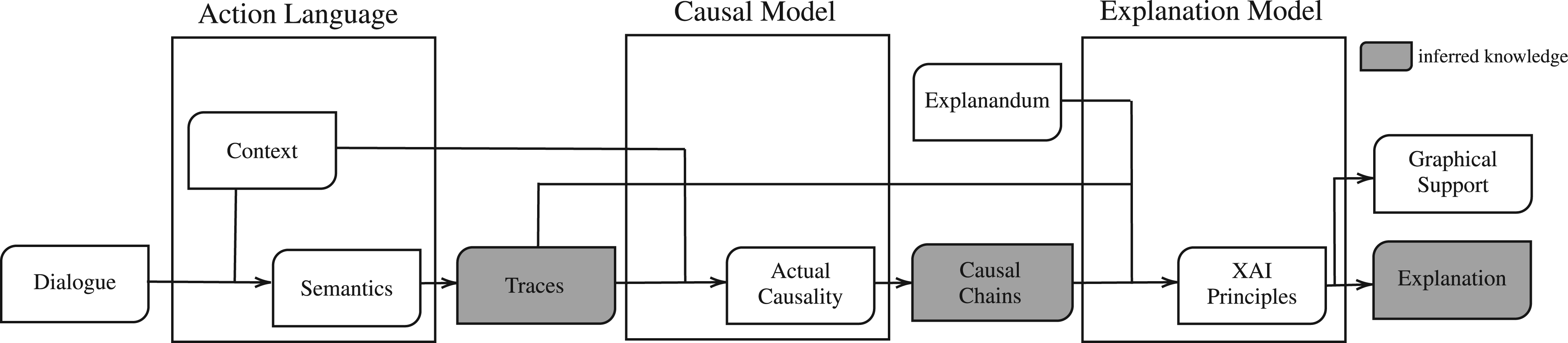
Modular framework for explaining temporal Abstract Argumentation Framework. The shaded boxes represent what is inferred from the dialog.
The contributions of this paper are located in the Action Language and the Explanation Model blocks. First of all, we propose a modification of the context and the semantics to translate an AAF and the admissible semantics into the chosen ADL. Its corresponding implementation in ASP is also given. Secondly, we establish the formal properties of this transformation, including its soundness and completeness, as well as the relevance of the temporality inclusion. Thirdly, we propose two different graphical representations of the dialog to improve the understanding of the argumentative process as well as a discussion on how to generate explanations. Note that this paper is an extended version of an earlier paper presented at a national conference (Munro et al., 2023).
The paper is structured as follows. Section 2 presents related works regarding the inclusion of temporality and causality in abstract argumentation. Section 3 briefly recalls the principles of abstract argumentation and describes the chosen action language and the actual causality definition suitable for it (Causal Model in Figure 1). Section 4 describes the Action Language part of Figure 1, i.e. the formalization we propose of acyclic abstract argumentation graphs into an action language, with its corresponding implementation in ASP. Section 5 establishes the formal properties of this transformation. Section 6 illustrates the exploitation of the proposed formalization to get enriched information, as graphical representations and causal relations, and discusses how to generate explanations using these relations (Explanation Model in Figure 1). Section 7 concludes the paper.
The main objective of this work is the generation of explanations about the acceptability status of arguments in a dialog. Even if there is no single definition of an explanation, it is generally accepted from a social science point of view that an explanation is an answer to a why question, as reported by Miller (2019). Therefore, the notion of explanation is deeply related to the notion of causality. For that reason, this work focuses on two aspects that have been studied separately within the field of abstract argumentation: First, modeling the order of enunciation of the arguments in a dialog, and secondly, inferring the causal relationships between the arguments.
Modeling Temporality in AAF
Several extended argumentation frameworks have been proposed to include a notion of time in an AAF.
Barringer et al. (2005) propose different scales to include temporality in abstract argumentation. Among them, they suggest, without formalizing it, to include the action of adding arguments. In our paper, a possible formalization of this idea is proposed, based on an ADL. It gives both an “object level” (with the traces) and “meta level” (with the argumentative states) description of the temporality in the argumentation framework.
The YALLA logical formalism Dupin de Saint-Cyr et al. (2016) proposes to use revision or belief change operators to update the model of an argumentation system. It offers a highly expressive language that allows identifying which attack relations or arguments should be removed or added to achieve a given acceptability status in the subsequent time step. Such a reasoning can be used to build an explanation. However, the number of terms manipulated by YALLA increases exponentially with the number of arguments, which is not suited to model the whole dialog.
The approach by Doutre et al. (2017) proposes to use a dynamical propositional language to model the argumentation graph and its evolution across the dialog. By doing so, it partially answers the question we consider as it successfully integrates the notion of temporality. However, it does not include the notion of causality, a necessary notion to generate explanations.
Finally, Kampik et al. (2024) propose to create an argumentation graph at each time step in the context of quantitative bipolar framework (QBAF). With this sequence of QBAF, different types of explanations are generated to explain the changes between two graphs. In contrast to an AAF, in a QBAF the acceptability of an argument is a numerical value computed using an acceptability function. For that reason, a first difference with our approach lies in the nature of what is explained. Secondly, the main objective of Kampik et al. (2024) is to explain the changes between two graphs and not necessarily to model the temporality of a dialog. Finally, in contrast to this work, our approach is based on an ADL. Therefore, it provides the causal foundations necessary for the explanation process.
Causality in AAF
Bochman (2005) establishes an equivalence between abstract argumentation and a causal reasoning system. This system has later been extended to more complex causal reasoning (Bochman, 2021). However, these works apply to classical AAFs without temporality which is a central notion in our work.
Recently, Bengel et al. (2022) used a knowledge-based formalism to define counterfactual reasoning for structured argumentation. Their definition is the direct application of Pearl’s definition for causal model (Pearl, 2000), similar to what is called a but-for test. However, first we are dealing with abstract argumentation. Secondly, the definition of causality based on but-for test is not always adapted (see Section 3.2.2 for more details).
Argumentative eXplainable Artificial Intelligence
There exist numerous work on explaining the acceptability status of arguments, which is called argumentative eXplainable Artificial Intelligence, see e.g. Čyras et al. (2021) and Vassiliades et al. (2021). However, to the best of our knowledge, they are not grounded in a framework that includes a notion of time. For example, Borg and Bex (2022, 2024) study different forms of explanation related to causality, such as a definition of contrastive explanation. The latter is based on the definition of acceptance and non-acceptance explanation (Borg & Bex, 2021), which groups all arguments that play a role in the acceptability status of an argument. Such a set is similar to the causal chain, a key element of an explanation (see section 6.2 for more details). Nevertheless, their work is based on AAFs or structured argumentation frameworks that do not include a notion of the order of enunciation.
Preliminaries
This section recalls the basics of Dung’s AAF (Dung, 1995) and illustrates them with an example. It then recalls the formal aspects of the Action Language proposed in Sarmiento et al. (2022) that is used in this paper.
Abstract Argumentation Framework
An abstract argumentation framework
As
Throughout this paper, we use the following fictitious illustrative example modeling the interaction between a requesting physician, P, and a radiologist, R, concerning an examination of a young baby for pathology Z.
P: Can you do an X-ray scanner (CT) for this baby? (
R: It is better for a baby to avoid ionising radiations. (
R: I can suggest an MRI (magnetic resonance imaging) in two days’ time. (
P: Can Z be seen on an MRI? (
R: Yes, of course. If you want confirmation, look at the guide to good radiology practice. (
P: But a baby might move and so you might not be able to get the information you are looking for because the image may be artefacted. (
R: Do not worry, I am used to doing MRI for babies. (
P: Does not it cost the hospital a lot more to do an MRI rather than a CT? (
R: No problem here. The high cost includes the experience gained by my team so that in the future this type of delicate examination can be performed without me. (
P: I have just spoken to the family, no problem with the MRI, the exam is refunded. (
P: However, the family is not comfortable with the idea of having to wait two days, could not you do the exam earlier? (
R: No my schedule for today is already full. My next slot is in two days, as I told you. (
After this discussion, the decision is made to schedule an MRI in two days’ time. But later that day, the physician receives a call from the family saying that the baby is really not well and insisting on the emergency of the examination. Therefore, the physician contacts the radiologist to add a final argument.
P: It is very urgent for the baby, we need a place today. (
From this dialog, arguments and their relations are extracted to create the AAF represented in Figure 2 with the following arguments: Argumentation graph associated with Example 1.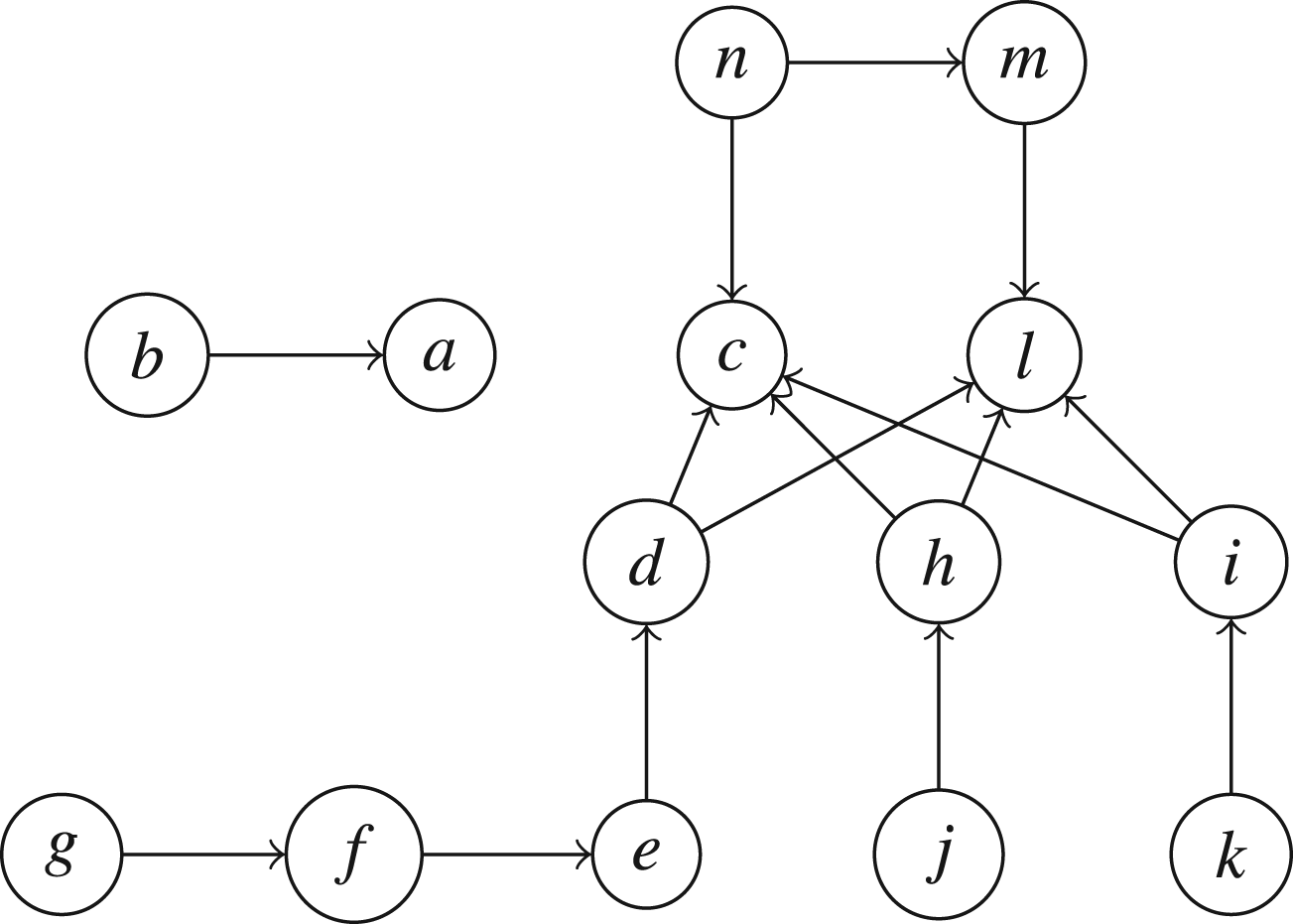
The obtained argumentation system shown in Figure 2 is a possible graph that can be extracted from this dialog. Here the extraction process has been done manually to create this AAF. However, this process can be done automatically using so-called argument mining methods (Lippi & Torroni, 2016).
Note that the graph is a static representation of the dialog from which any notion of temporality has been erased. Thus, if the arguments had been stated in a different order, the graph would be the same. This is important to address causality in Section 6.2.
Once an argumentation graph has been constructed, it is possible to reason on it to determine sets of arguments that can be considered as accepted.
The set of direct attackers of
Then an admissible set
(continued) – The argument graph is acyclic. To determine the set of acceptable arguments, it is sufficient to start from the non-attacked arguments, here
In this paper, we propose to investigate the use of a transition system to include the order in which arguments are enunciated in a dialog formalization. We do not consider a transition system as a language for reasoning about action and change, but rather as a general way of adapting to a dynamic environment. Thus, in practice, we choose an action language as a formalism to include a notion of temporality in an argumentation graph. In particular, we select the action language developed in Sarmiento et al. (2022) due to its adapted tools for reasoning about causality, which is the first step towards explanations. This section introduces the formal aspects of the action language proposed in Sarmiento et al. (2022) and then briefly describes what is considered to be an actual cause in this formalism. For more details refer to Sarmiento et al. (2023).
Syntax and Semantics
Transition systems generally define dynamical systems, describing the state of the world at any time step as a collection of variables that describe the properties of the world. Furthermore, they assert that the evolution of the world can be described as a series of states transitioning from one to another as a result of a set of events. An action language is a formalism for describing such a transition system (Gelfond & Lifschitz, 1998). The purpose of the action language introduced in Sarmiento et al. (2022) is to describe the evolution of the world given a set of actions corresponding to the deliberate choices of the agent. These actions might trigger some chain reaction through external events. Therefore, in order to have a complete knowledge of the evolution of the world, the method in Sarmiento et al. (2022) keeps track of both: The evolution of the states of the world and the occurrence of events.
We denote by
(state)
A set Coherent: Complete:
A state thus gives the value of each of the fluents describing the world. Time is modeled linearly and in a discrete way to associate a state
An event
The preconditions and triggering conditions on the one hand and the effects on the other hand are represented as formulas of the languages
The set of all events that occur at time point
With a bounded past formalization, events that occurred before
As the considered action language allows for the concurrency of events, it requires tools to solve potential conflicts or to prioritise among events: This is achieved by introducing a strict partial order
(context
)
The context, denoted as
As mentioned previously, when considering causality, it is important to understand what are the consequences of the occurrence of an event
(actual effects)
Given a context

Given a partial state
For the sake of conciseness, we adopt an update operator giving the resulting state when an event occurs at a given state. Given a state
(update operator
)
Given a context
These definitions lead to a classical transition system:
(valid execution)
An execution is a sequence alternating sets of events and states at each time stamp
An execution is valid given
There is potentially more than one valid execution for a given context
Given a scenario
The state trace
Actual Causality
In the taxonomy proposed in the case of argumentation in Čyras et al. (2021), explaining the acceptability status of an argument can be related to the identification of arguments that must be removed from an argumentation graph to make a non-acceptable argument acceptable (Fan & Toni, 2015). In causal terminology, this corresponds to the search for a but-for cause of the non-acceptability of an argument. However, this test does not solve cases where the occurrence of one of two events would have been sufficient to cause an effect in the absence of the other, called over-determination (Menzies & Beebee, 2020). To address this issue, the Necessary Element for the Sufficiency of a Set test, NESS-test, has been proposed by Wright in Wright (1985) leading to a different definition of actual causality. This test states that: “A particular condition was a cause of a specific consequence if and only if it was a necessary element of a set of antecedent actual conditions that was sufficient for the occurrence of the consequence.” In this section, we recall the actual causation definition proposed in Sarmiento et al. (2022) which is a suitable formalization in an action language of Wright’s NESS test.
A causal relation links a cause to an effect. Since action languages represent the evolution of the world as a succession of states produced by the occurrence of events, states are introduced between events. Therefore, in addition to the actual causality relation that links two occurrences of events, as commonly accepted by philosophers (Andreas & Guenther, 2021; Menzies & Beebee, 2020), it is necessary to define causal relations where causes are occurrences of events and effects are formulas of the language
(i) Direct NESS-causes are the first building block to find long distance causal relations. Indeed, they look at the effects that the occurrence of an event actually had, which are not necessarily the same as the expected ones. Direct NESS-causes relate occurrences of events and formulas of
(ii) NESS-causes allow for such a causal chain to be found. If we denote by
(iii) The occurrence of a first event
The formal definition of the three different causal relations can be found in Sarmiento et al. (2023). In practice, depending on the form of the formula we are interested in, it is possible to determine its direct NESS-causes with simple conditions. The propositions giving these conditions are enough to understand the cases of causality in an argumentative context. The proofs for these two propositions can be found in Sarmiento et al. (2023).
In the case where
(direct NESS-cause of a literal Sarmiento et al., 2023)
Given a couple
(
(
(
In the case where
(direct NESS-cause of a literal conjunction Sarmiento et al., 2023)
Given a causal setting
(
(
(
Structural equations Halpern and Pearl (2005) constitute another formal model of causality that addresses the over-determination issue and can be exploited in the argumentation framework, e.g. using the transformation of acyclic abstract argumentation graphs to that formalism, as proposed in Munro et al. (2022). The main differences are as follows: From a philosophical point of view, the definition of causality underlying the NESS test belongs to the family of regularity approaches (Andreas & Guenther, 2021), whereas Halpern’s definitions (Halpern & Pearl, 2005) belong to the family of counterfactual approaches (Menzies & Beebee, 2020). Secondly, the use of action languages makes it possible to model and to take into account temporality and the dynamics of the dialog, which is a crucial component. From a mathematical point of view, according to Beckers (2021), Halpern’s definition of causality can be described as “contrastive actual weak sufficiency,” whereas the one used in this paper would be “minimal actual strong sufficiency”: In a nutshell, whereas the former emphasizes that a cause must be necessary for an effect, hence the contrastive aspect, the latter emphasizes sufficiency and subordinates necessity to it. From a practical point of view, the advantage of the causal approach used here is that it does not require counterfactual reasoning nor interventionism, mechanisms that are computationally expensive and criticised for introducing subjectivity into causal enquiry (Sarmiento et al., 2022; Wright, 1985).
From AAF to Action Languages
This section presents our first contribution: A formalization of acyclic AAF into the action language introduced in Section 3.2. Section 4.1 presents the translation of an AAF in the form of the octuplet
Differing from classical AAF, we propose to take into account the order of enunciation of arguments. Instead of having only a couple
(dialog
)
A dialog is a set
Instantiating the Context
In order to formalize an AAF in the action language described in Section 3.2, let us first define the variables necessary to describe the world, i.e. the AAF. These variables correspond to the fluents
(continued) – Applying these definitions, the set of fluents is given by
In an AAF, the only deliberate action is to enunciate an argument, which leads to
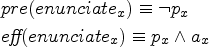
When a new argument is enunciated, before enunciating the next argument, we choose to update the acceptability of all other arguments present after the enunciation of this new argument until a suitable state is reached. Such a state refers to one in which the AAF principles for acceptability of arguments are applied. In particular, if an argument attacks an acceptable argument, then the attacker is necessarily unacceptable. Similarly, if an argument is not attacked, or is attacked only by unacceptable arguments, then it is acceptable. This defines a state which we call argumentative state.
A state
i)
ii)
After an argument is enunciated, we want updates to be triggered automatically. We represent them with two exogenous events:
Acceptability update: Suppose that an argument

Non-acceptability update: Suppose that argument
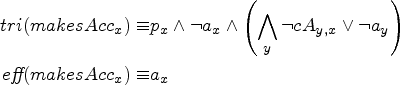


In this section, we defined the context the set of fluents the set of events
Semantics Adapted to AAF
Having an adapted
The definition of a scenario
(argumentative setting
)
The argumentative setting of the action language, denoted by
These modifications require changes to Definitions 6 and 7. Definition 11 below is the result obtained after modifying Definition 6. Conditions 2.d and 2.e are added and
(valid execution in an argumentative context)
Given an argumentative context If
In Definition 7 traces are defined as extracts of a valid execution given
Given an argumentative setting
For a valid execution given
To generate the traces used to illustrate the paper, we have adapted a version of the sound and complete implementation in ASP of the action language we consider (Sarmiento et al., 2023). This implementation is described in details in Sarmiento et al. (2023). The ASP programs
The most important change concerns when an action can be performed. First, we move from a scenario to a sequence. Unlike the original program, where actions are performed in the state determined by the scenario, in our program an action ordered
(actual causality program
)
Given a scenario
The entire program
Formal Properties of the Proposed Transformation
This section establishes formal properties of the proposed transformation described in the previous section. First, we prove that a notion of temporality is captured by the transformation. Then we prove its soundness and completeness. Finally, we introduce the propositions that pave the way to the discussion on explanation of Section 6.
Preliminary Property on a Valid Execution
We start by showing that, although valid executions given
Given an argumentative setting
Let us prove by contradiction the uniqueness of valid executions given
According to Definition 6,
Since the assumption of the existence of
From now on, when references are made to events and states, they will be those from the unique
In this section, we establish the soundness and completeness of the transformation proposed in Section 4. For that, we first introduce the notion of associated graph as follows:
Given a state
From the acyclicity property of the fluent
Now, we focus on the notion of acceptability. We first characterize argumentative states using the triggering condition functions
Let
In our context,
An argumentative state can therefore be seen as a state where nothing happens until a voluntary action is made. Now we prove that it is always possible to reach such a state from an argumentative state in which an argument
Given an argumentative setting
Given an argumentative state
As
Finally, this proposition allows us to prove that an acceptable argument in the argumentative state is acceptable in the associated graph and vice-versa, as the triggering rules have been designed so as to model how acceptability is computed. We first prove a useful lemma.
Given an argumentative state
The next proposition establishes the correspondence between acceptability in argumentation and argumentative states.
Given an argumentative state
Let us suppose that
Otherwise, as there is a finite number of arguments, it is possible to apply to
So,
If
Otherwise, let us prove that
So, as
Proposition 5 establishes that there is an equivalence between the acceptability status in an argumentative state and in its associated graph. Now, from a dialog and the attack relation, the traces are generated as well as an AAF. From that point, we establish the existence of a state whose associated graph is equal to the initial AAF. Such a state is called the final argumentative state and is defined as an argumentative state
Given a dialog
As
Moreover, by construction of
Finally, from Proposition 5, as
Proposition 3 highlights the fact that temporality is captured by the proposed transformation. Indeed, given an order of enunciation, as expressed by sequence
Let
Let us denote by
Now, according to Proposition 5,
This property implies that the final argumentative state does not depend on
Given an
Proposition 6 and its corollary are in accordance with the classical AAF. Indeed, in an acyclic argumentation graph there is a single maximal admissible set and therefore a single possible acceptability status for each argument. The relevance of temporality integration comes from the intermediate states, as illustrated in the next section, and from the causal relations that can be derived from it:
Causal relations, i.e. NESS and actual causes, depend on the sequence
This proposition is proved by example, commented in detail in the next section that illustrates the effect of considering Example 1, and a modification thereof in Example 2. Let
This proposition shows that causal relations depend on the order in which arguments are enunciated. Thus, even if, as in the classical framework of argumentation, the acceptability of an argument in the final argumentative state does not depend on it (see Theorem 1), it is essential to take temporality into account when dealing with notions related to causality, especially in explainability.
The formalization of acyclic abstract argumentation graphs into an action language as proposed in Section 4 allows us to dispose of complete knowledge of the evolution of the dialog. Indeed, it allows generating two traces: One tracing the evolution of world states, the other tracing the occurrence of events. This section proposes to explore at three levels how the use of action languages can benefit AAFs to generate explanations. In particular, it considers successively two classes of argumentation explanations in the taxonomy proposed by Čyras et al. (2021): it first shows how it can lead to graphical representations of the processes of accepting/rejecting arguments, it then discusses causal explanations that provide information on the reason for the acceptability status of arguments. Example 1 is used throughout this section to illustrate the discussion. The state trace corresponding to the example contains thirty one states and the event trace fourteen actions and twenty exogenous events.
Graphical Representation and Explanation
According to Čyras et al. (2021), argumentation explanations can consist in extracting argumentative subgraphs to justify the acceptance or rejection of an argument for a given AAF semantics, producing a graphical representation of the underlying process. The transformation proposed in Section 4 makes it possible to derive graphical representations of the argumentative process.
Indeed, transition systems such as action languages offer a way to model the world that is suitable for visual representation: the representation of two successive states and the events that led to this evolution gives an accurate representation of how the evolution of the world is modeled. For that, in the case of the considered action language, we use the traces that record the evolution of the world. Therefore, displaying them in chronological order provides a narration of the dialog.
Following this idea of using the narration of the dialog provided by traces, Figure 3 proposes a possible display of the event and state traces obtained from Example 1 by showing fluents as hexagons and triggered events as rectangles. Since the acceptability of arguments is what mainly matters in a dialog, we represent only the fluents
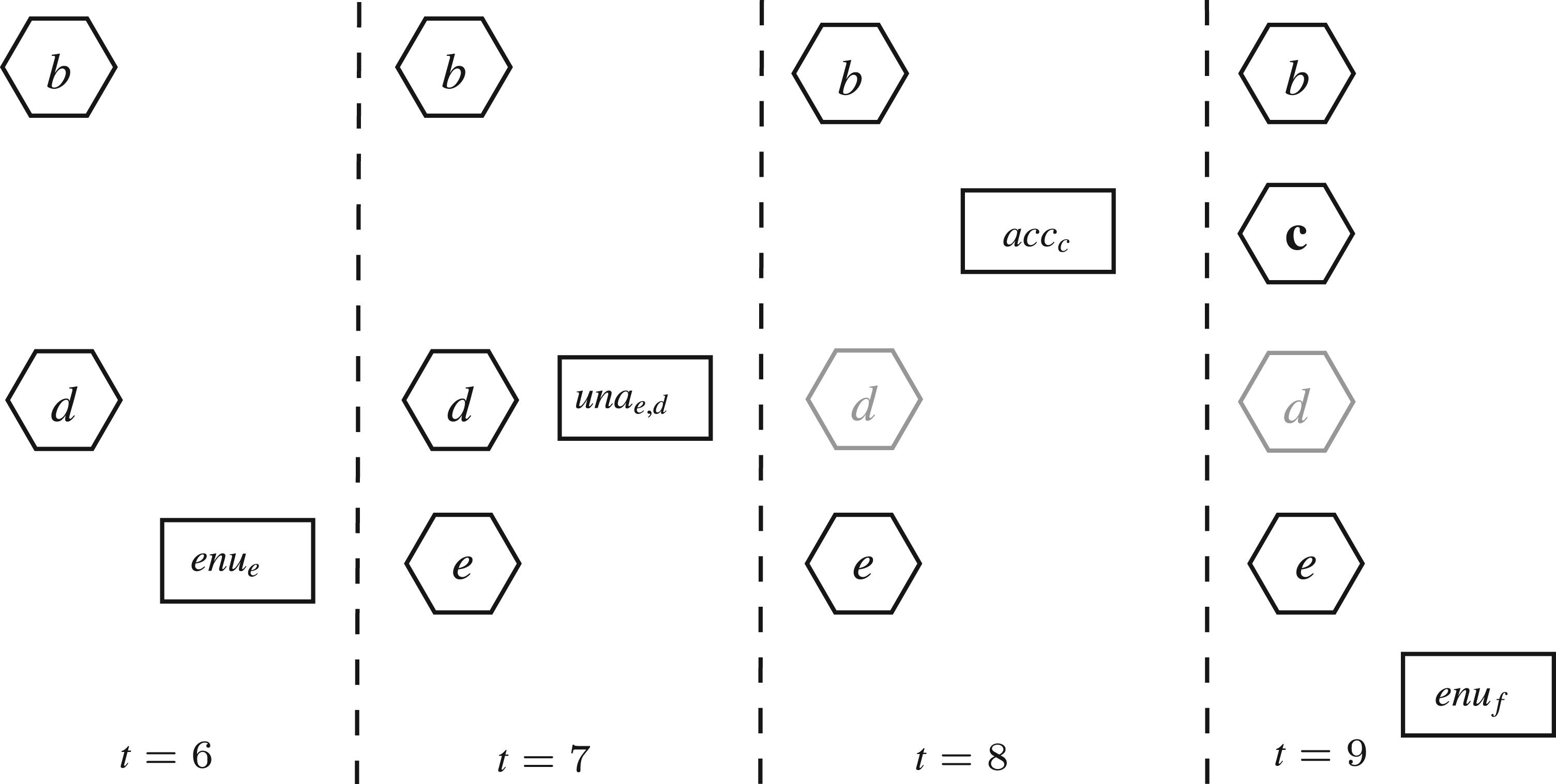
Partial graphical representation associated with Example 1. Hexagons represent fluents and rectangles events.
(continued) – Figure 3 shows a partial representation of the state trace obtained for Example 1 using the ASP implementation described in Section 4.3.
The first represented state corresponds to
This partial graphical representation shows the causal relations that can be deduced immediately, these are the direct causal relations. They can be used to derive directly basic explanations such as the fact that enunciating argument
However, using only the temporality to derive simple causal relations between states is not enough, and more complex relations are needed. Indeed, saying that
A second, more compact, tabular visualization is proposed, illustrated in Figure 4: the arguments are represented in the first column and the order of the performed actions in the first row. For the sake of readability,
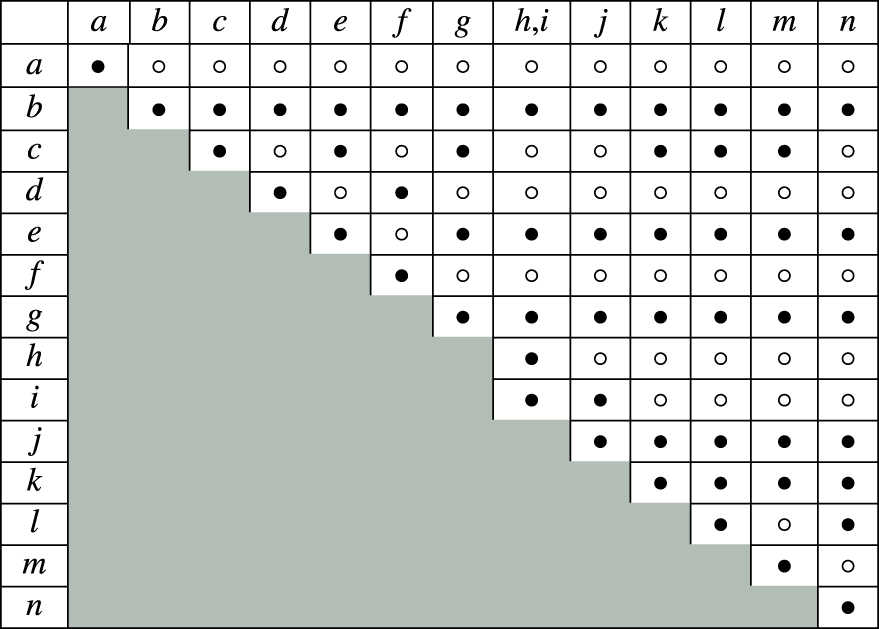
Tabular representation of the entire interaction of Example 1. The first line represents the sequence and the others the acceptability status of the arguments.
Let us consider the same dialog as in Example 1, starting with the enunciation of arguments
Figure 5 displays the proposed compact visualization for the evolution of the acceptability of the decision variable Impact of the order in which arguments are enunciated (lines 1, 3) on the acceptability of the argument c (lines 2, 4).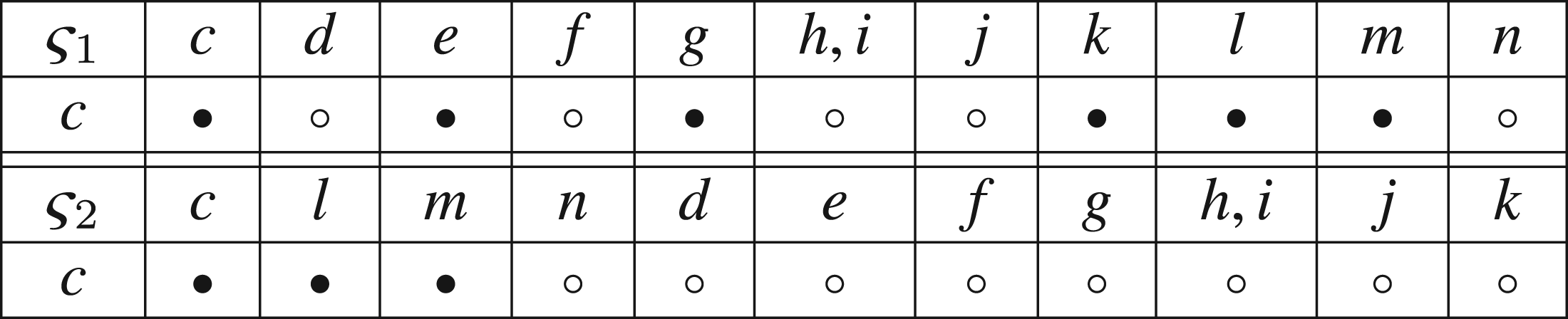
This visualization thus also illustrates the relevance of the temporality integration in the argumentation framework: the differences between the two scenarios cannot be captured by classical AAFs.
Beyond the graphical representations of the acceptance/rejection process, the proposed formalization of AAF into action models allows us to transfer the notion of actual causality recalled in Section 3.2.2 to the argumentation framework, providing tools for richer explanations. Indeed, the extraction of causal chains has been shown to be an important property for explanations (Miller, 2019).
Using the three causal relations described in Section 3.2.2, we propose a richer graphical representation that gives a deeper understanding of the argumentation process illustrated in Figure 6. Indeed, in the context of argumentation, the NESS causes provide information about what are the changes in the acceptability status of arguments that have led to the acceptability of a particular argument. This includes the enunciation of a new argument as it makes that argument acceptable. To find an actual cause, we look at the NESS causes of the preconditions and triggering conditions of an event. Thus, in this context, actual causes correspond to the changes in the acceptability status of arguments that have caused the changes in the acceptability status of other arguments. Those relations are inferred from the state and event traces using the program
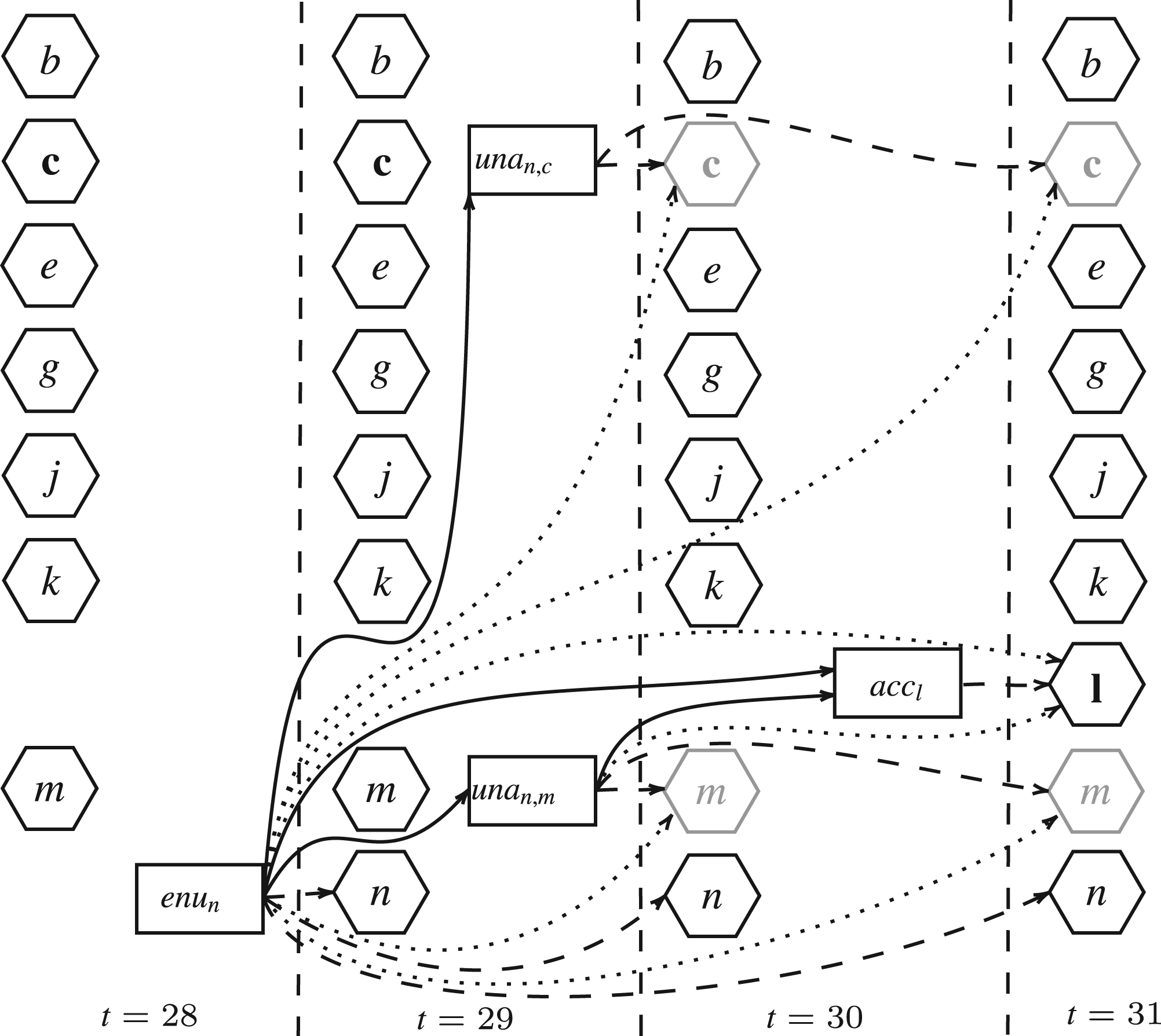
Enriched graphical representation of Example 1, with causal relations extracts: Direct NESS-causes (––), NESS-causes (-----), and actual causes (—).
For example, the richer causal relations tell us that the enunciation of
(continued) – Figure 6 graphically displays the last four states in the traces of Example 1, corresponding to the enunciation of argument
As represented in Figure 6 its enunciation in state
To find out why the latter happens, we need to look at the NESS causes and the actual causes to construct the causal chain that leads to it. By transitivity, we get that
(continued) – To illustrate the impact of temporality when dealing with causality, let us consider the modified version of the dialog, in which the order of enunciation has been modified. In the original scenario, when building the complete causal chain of why
The graphical representations proposed in the previous sections, like the causal chains, may not represent an explanation per se. Indeed, these relations, as helpful as they can be, tend to form long causal chains that may contain redundancy or useless variables. This raises the question of the appropriate way to use causal chains to derive explanations. The aim of the ongoing work is therefore to propose a method that makes it possible to extract, from this enrichment of argument graphs, explanations on the acceptability or non-acceptability of one or more arguments. A first direction can be found in the works that study the links between the notions of causality and explanation. These are summarized in Miller’s paper (2019), which establishes several interesting properties that an explanation should satisfy. We discuss in this section five of them: Proximity of the explanation to the explanandum, consideration of an agent’s volition, contrastivity, robustness, and short length. The question is how to apply these properties to the framework we propose in order to provide explanations to a final user.
To apply the first two principles, an action language is particularly well suited. In fact, the temporal proximity of an event to the consequence can be evaluated and formalized, using the inclusion of time in the framework, by comparing positions in the traces. Another interesting property is that a deliberate action is often preferred to one that is not. In the proposed formalism, this means that an action is preferred to an exogenous event. Then, given two explanations that are identical except for one element, the one with the temporally closest deliberate actions is preferred.
The next two properties, contrastivity and robustness, require to introduce new notions. First, following the principles Miller applies to Halpern’s structural causal model (Miller, 2021), to define a contrastive explanation, we need to introduce the formalism for a contrastive causal chain. Intuitively, contrastive causes of
Applying these principles to Example 1, an explanation for the acceptability of
Conclusion
This paper proposes a formalization of acyclic abstract argumentation systems in an action language that offers tools for identifying causal relations (Sarmiento et al., 2022), and it establishes its formal properties: the proposed formalization first allows increasing the expressiveness of AAF models, through the integration of temporality, making it possible to examine the effect of the order of the argument enunciation. Moreover, it allows us to exploit the notion of causality associated with the action language, offering the possibility to give rich information about the argument acceptance or rejection and justifications about the latter. The paper proposes two types of graphical representations of the argumentation process that can be used as visual support, it also discusses how to extract explanations from causal chains. Thus, this work makes it possible to model the evolution of a dialog and opens the way to the generation of user-adapted causal explanations.
Future works lies in the Action Language and the Explanation Model parts of the framework presented in Figure 1. On the one hand, we are working on generalizing the transformation into the action language framework to richer argumentation cases, especially cyclic argumentation graphs. The latter raise technical issues regarding the termination and completeness of the transformation. Moreover, in contrast to acyclic graphs, there is more than one possible outcome for the dialog, and several extensions can be obtained for a given a semantic. Using temporality, we think that it will be possible to distinguish between these extensions given an argumentation semantics, which is another advantage of modeling the order of enunciation. On the other hand, ongoing works also aim at formalizing Miller’s desired explanation properties (Miller, 2019) in the action language framework. Then, the next step will aim at evaluating the method experimentally, conducting user studies to assess the intelligibility of the generated explanations, both in terms of objective understanding and subjective satisfaction.
Footnotes
Acknowledgments
The authors would like to thank Professor Catherine Adamsbaum, a pediatric radiologist, for discussing the examples.
ORCID iDs

Funding
The authors received financial support for the research, authorship, and/or publication of this article:This work was partly funded by Isabelle Bloch’s Chair in Artificial Intelligence (Sorbonne Université and SCAI).
Declaration of Conflicting Interests
The authors declared no potential conflicts of interest with respect to the research, authorship, and/or publication of this article.