




Abstract
Breast implant rupture due to iatrogenic injury is one of the most dreaded complications for Aesthetic surgeons. This problem can happen with experienced as well as novice surgeons. Using a simple spoon while taking deep closure bites in tissue while Spoon covering the implant not only decreases the chance of suture needle injury to the implant but also acts as a retractor for better vision. We recommend that it be part of the breast implant surgery instrument set.
The Idea
The Spoon has been used for various purposes in different surgical specialties.
Ian T. Jackson and his team have showcased the remarkable application of this unassuming utensil in non-emergency situations, particularly in ophthalmic-related surgeries. 1 Orthopedicians have used Spoon in meniscal closure 2 and anterior acromioplasty preventing rotator cuff. 3 Some surgeon used it during surgery for the removal of retrosternal goitre. 4
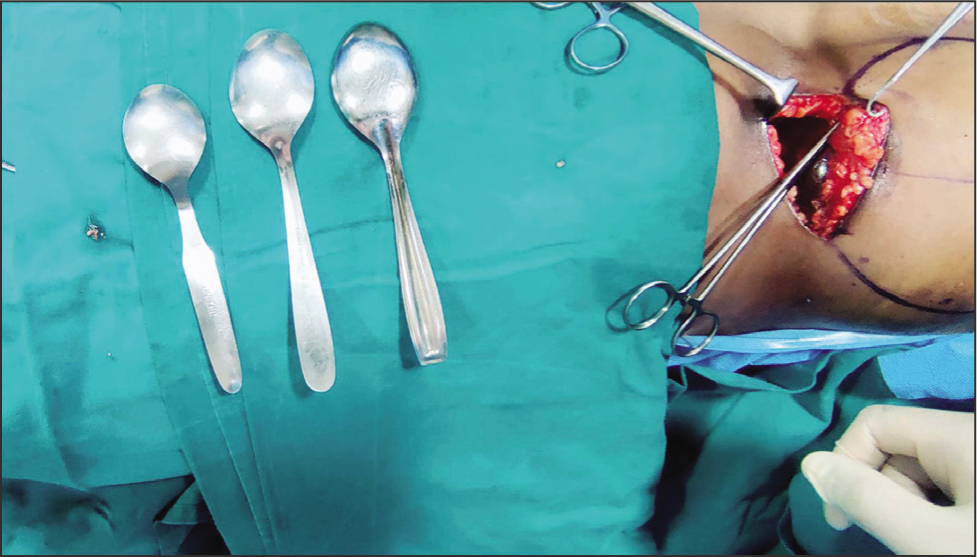
In Aesthetic surgery, Breast augmentation with silicone implant surgery is one of the most commonly performed surgery. We encountered a genuine problem of inadvertently injuring the silicon implant with a suture needle while closing the wound. So we came up with a simple yet ingenious solution – Using a common tablespoon to prevent this. We used a stainless steel regular tablespoon of variable sizes that can be sterilized with autoclaving (Figure 1).
Three different sizes of Common Tablespoon.
The curvature of this humble Spoon plays a pivotal role in these surgeries. With its concave side strategically positioned towards the visible part of the implant, it acts as a shield, while the convex surface offers an optimal background for precise suture placement (Figure 2). Also, this Spoon acts as a retractor and helps surgeons better visualize the incision’s caudal edge.
Placement of Spoon in the Incision Wound to Cover Silicone Implant.
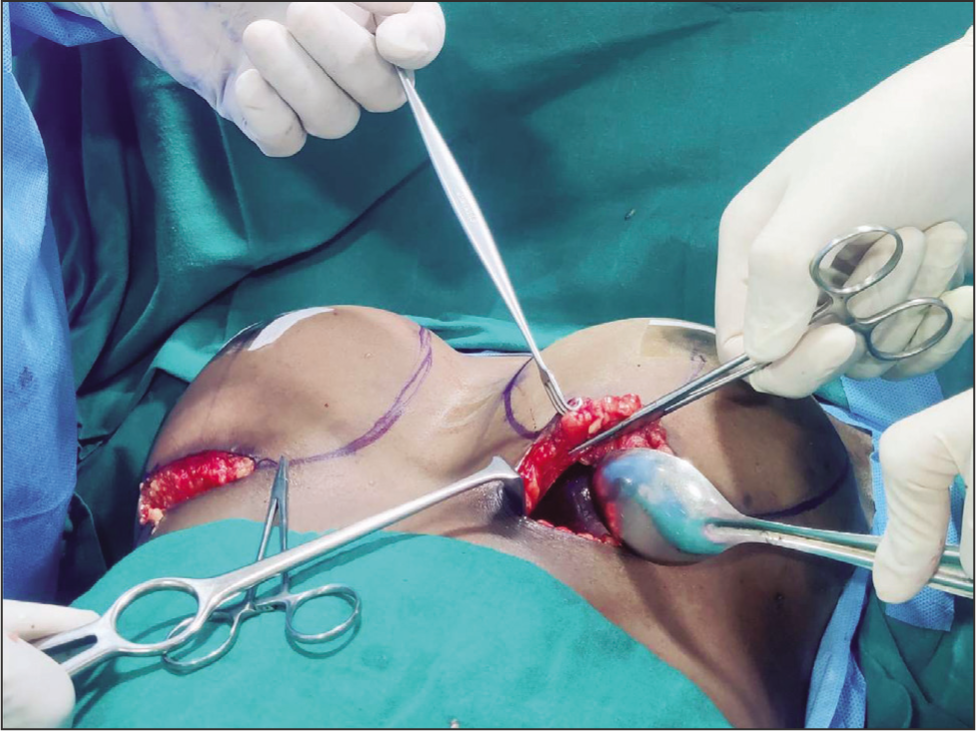
After closing more than half of the wound, this spoon end can be removed and reversed, thus the other end of the Spoon can be used to guide the suture needle.
Discussion
Accidental injury to an implant during the saline implant era was a nightmare for any implant surgeon, though the cohesive implants do not have that anxiety of immediate leak, but shell failure can happen later.5,6 The data of various studies has suggested that iatrogenic damage is the most frequent cause of rupture and surgical instrument damage is the most frequent one. 5 Brandon et al. stratified the occurrence of shell rupture into three distinct periods: (a) during or before implantation; (b) in vivo; and (c) during explantation. Implants can be damaged anytime, but the most likely periods are during implantation and explantation. Their study using a scanning microscope showed a small flaw induced in the shell by a surgical instrument, like a needle prick, which may not cause immediate shell failure but could weaken the shell and lead to a rupture at a later date. 6 Another study even identified the microscopic pattern of various needle prick injuries on silicone implants. 7
The Spoon’s savior action by guiding the suture needle on one side and preventing the underlying content, on the other hand, has also been utilized by surgeons in thoracotomy wound closure post coronary bypass8,9 and laparotomy closure. 10 This innovative approach exemplifies how sometimes complex problems can find elegant solutions through simple means. The utilization of ‘The Spoon’ underscores the creativity and resourcefulness within medical practices, showcasing how even everyday objects can play a crucial role in enhancing surgical outcomes.
Footnotes
Declaration of Conflicting Interests
The authors declared no potential conflicts of interest with respect to the research, authorship and/or publication of this article.
Funding
The authors received no financial support for the research, authorship and/or publication of this article.